Consumer Behavior in Services
Context
“ I can’t get no satisfaction”
Mick Jagger
Understanding customer behavior lies at the
heart of marketing. We need to understand how
people make decisions about buying and using
service and what determines their satisfaction
with it after consumption. Without
understanding, no organization can hope to
create and deliver services that will result in
satisfied customers.
01/02/18
Three-Stage Model of Service
Consumption
SERVICE CONSUMPTION
1. pre purchase
2. service encounter
3. post encounter
01/02/18
Service consumption Key Concepts
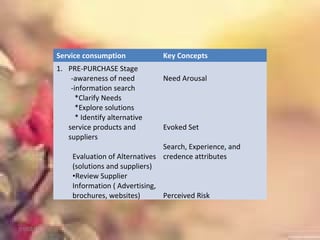
1. PRE-PURCHASE Stage
-awareness of need
-information search
*Clarify Needs
*Explore solutions
* Identify alternative
service products and
suppliers
Evaluation of Alternatives
(solutions and suppliers)
•Review Supplier
Information ( Advertising,
brochures, websites)
Need Arousal
Evoked Set
Search, Experience, and
credence attributes
Perceived Risk
Pre Purchase
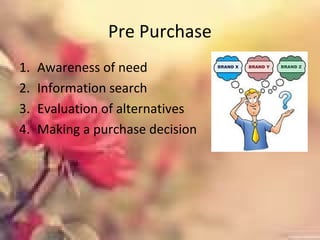
1. Awareness of need
2. Information search
3. Evaluation of alternatives
4. Making a purchase decision
Need Awareness
• The decision to buy or use a service is
triggered by a person’s or organization’s
underlying need or need arousal.
• It will drive an information search and
evaluation of alternatives before a decision is
reach.
Needs may triggered by:
• Unconscious minds (personal identity and
aspirations)
• Physical Conditions (hunger needs that lead
you to ate Pam’s)
• External sources (a service firm’s marketing
activites)
01/02/18
• When need is recognized, people are likely to
take action to resolve it.
• The need for a hairstylist was triggered by
remembering that you have a date later this
week.
• Needs have become very exciting and in
greater value
VACATIONS, ENTERTAINMENT, OTHER
SERVICE EXPERIENCES.
The shift in Consumer Behavior and
attitudes provide opportunities
for service providers.
• Increased interests in extreme sports.
• Adventures in nature
• New experiences beyond imagination.
01/02/18
Information Search
• Once a need or a problem is recognized,
customers are motivated to search for
solutions to satisfy the need.
• Hiring someone to cut down dying tree in
their lawn instead of doing it yourself using a
chainsaw.
• Choosing between going out in theater with
your bf or just downloading the film via
internet and watch it at home..(ayeeee)
Several Alternatives
• EVOKED SET (considerations)
– The set of products or brands a customer may
consider in the decision-making process.
– When you see a long line in the counter of mcdo,
you will settle for a second choice as evoked set,
you just went to siomai house.
– Evoked set can be derived from past experience or
external sources (advertising, retail displays, news
stories, online searches, and recommendations)
01/02/18
Evaluating Alternatives
• SERVICE ATTRIBUTES- Customers need to
compare and evaluate the different service
offerings.
• Service Attributes are tangible characteristics
customers can evaluate before purchase.
• Style, color, texture, taste, and sound are
examples of such features that allow
prospective consumers to try out, taste, or
“test drive” the product prior to purchase
• Clothing, furnitures, cars, electronic
equipment, and foods are among the
manufactured products high in search
attributes.
• Service attributes are found in many services
too. (for restaurants- Fine Dining, Casual,
Family-friendly)
• Experience Attributes- are those that cannot
be evaluated before purchase. Customers
must “experience” the service before they can
assess attributes such as reliability, ease of
use, and customer support.
• In restaurant- you won’t know how much you
actually like the food, the service provided by
your waiter, and the atmosphere in the
restaurant until you are actually consuming
the service.
• Credence Attributes
– Product characteristics that customers find hard
to evaluate after consumption are known as
credence attributes.
– The customer is forced to believe or trust that
certain tasks have been performed at the
promised level of quality.
– Hygiene conditions of the kitchen and the
healthiness of the cooking ingredients.
Credence Attributes
• Examples
• It is not easy for the customers to determine
the quality of repair and maintenance work
performed on a car, or cellphone or any
gadgets.
• Patients cant usually evaluate how well their
dentists have performed complex dental
procedures.
01/02/18
Credence Attributes
• People seek such services precisely because
they lack the necessary training and expertise
in themselves
– Counseling, surgery, legal advice, and consulting
services
• It is only a matter of having confidence in
provider’s skills and professionalism.
01/02/18
quiz
1-3.What are the three stages service
consumption
2.______ are tangible characteristics customers
can evaluate before purchase.
3-6. the four process of pre-purchase.
7.Give example of a need triggered by physical
conditions.
8-10.Give three Service Attributes are tangible
characteristics customers can evaluate before
purchase.01/02/18
Perceived Risk
• Is especially relevant for services that are
difficult to evaluate before purchase and
consumption, and first-time users are likely to
face greater uncertainty.
• Think about how you felt the first time you
had to make decision about an unfamiliar
service, buying a health insurance or choosing
a college. It is likely that you are worried
about the probability of a negative outcome.
• The worse the possible outcome and the more
likely it is to occur, the higher the perception
of risk.
01/02/18
Types of Risk
• FUNCTIONAL (unsatisfactory performance
outcomes)
– Will this training course give the skills I need to get
a better job?
– Will this credit card be accepted wherever and
whenever I want to make purchase?
– Will the dry cleaner be able to remove the stains
from this jacket?
01/02/18
• FINANCIAL (monetary loss, unexpected costs)
– Will I lost money if I make the investment
recommended by the stockholder?
– Could my identity be stolen if I make this purchase
on internet?
– Will I incur a lot of unanticipated expenses if I go
on this vacation?
– Will repairing my car costs me more than the
original estimate?
01/02/18
• Temporal(waste of time, consequences of
delays)
– Will I have to wait in line before entering the
exhibition?
– Will service at this restaurant be slow that I will be
late for my afternoon meeting?
– Will the renovations to our bathroom be
completed before our friends come to stay with
us?
01/02/18
• Physical(personal injury or damage to
possessions)
– Will I get hurt if I go skiing at this resort?
– will the contents of this package get damaged in
the mail?
– Will I fall sick if travel abroad on vacation?
01/02/18
• Psychological (personal fears and emotions)
– How can I be sure that this airplane will not crash?
– Will the consultant make me feel stupid?
– Will the doctor’s diagnosis upset me?
01/02/18
• Social (how others think and react)
– What will my friends think of me if they learned
that I stayed at the cheap motel?
– Will my relatives approve of the restaurant I have
chosen for the family reunion dinner?
– Will my business colleagues disapprove my of
selection of unknown law firm?
01/02/18
• Sensory (unwanted effects on any of the
senses)
– Will I get a view of the parking lot rather than the
beach from my restaurant table?
– Will the hotel bed be uncomfortable?
– Will I be kept awake by noise from the guests in
the room next door?
– Will my room smell a stale of cigarette smoke?
– Will the coffee at breakfast taste disgusting?
01/02/18
Reducing risk through:
• Seeking information from trusted and
respected personal sources such as family,
friends, and peers
• Using web to compare offerings
• Rely on company with good reputation
• Looking for guarantees and warranties
• Visiting facilities
• Asking employees about competing services
01/02/18
Service Expectations
• Are formed during the search and decision-
making process, and they are heavily shaped
by information search and evaluation of
attributes.
• it changes over through advertising, pricing
and new strategies and service innovations
01/02/18
• Expectation can be SITUATION-SPECIFIC.
– Service delivery timing during peak hours
• Expectation change over time
– Advertising, pricing, new technologies and service
innovation
01/02/18
Factors that influence the different
levels of customer expectation
• Desired services
– This type of service customers hope to receive is
termed desired service. “wished for” a
combination of what customers believe can and
should be delivered in the context of their
personal needs.
01/02/18
Factors that influence the different
levels of customer expectation
• Adequate Service
– The minimum level of service customers will
accept without being dissatisfied
• Predicted Service
– Customers anticipate receiving. Service providers
promises, word of mouth, and past experiences.
01/02/18
Factors that influence the different
levels of customer expectation
• Zone of Tolerance
– Service delivery at all touchpoints across many
service delivery channels, branches, and often
thousands of employees.
– The extent to which the customers are willing to
accept this variation
01/02/18
Purchase Decision
• Selecting the option they like best
• Purchase decisions can be made simple and
quick, without too much thought.
• Favorite supplier of services
• Price as factor for decision making
• The outcome of the prepurchase stage.
01/02/18
Service Encounter Stage
• It includes a series of contacts with the chosen
service firm.
• The stage begins with placing an order,
requesting a reservation, or even submitting
an application
• Contacts may take the form of personal
exchanges between customers and service
employees or impersonal interactions with
machines and websites.
01/02/18
Service Encounter
• Is a period of time during which a customer
interacts directly with a service provider.
• Some service encounter are brief and consist
of just few steps others may extend over a
longer frame and involve multiple actions of
varying degrees of complexity.
01/02/18
High Contact to Low Contact
• Service encounter can range to High Contact
and Low Contac.
• High Contact- when the customer’s exposure
to the service provider takes on a physical and
tangible nature
• Low Contact- when the customer’s exposure
is very little in physical contact with the
service providers.
01/02/18
Service Encounters are “Moments
of Truth”
• It shows the importance of effectively
managing touchpoints
• To help us better understand the extent and
nature of points of contacts.
• It focuses on various types of interactions that
together create the customer’s service
experience.
01/02/18
Post encounter Stage
• In this stage, customers evaluate the service
performance they have experience and
compare it with their prior expectations.
• CUSTOMER SATISFACTION with SERVICE
EXPERIENCES
01/02/18
Post encounter Stage
• Satisfaction
• Determinants of Satisfaction
– Confirmation or disconfirmation of pre-
consumption expectation
• This means that a certain predicted service
level in prior to consumption
• Predicted level- the outcome of the search
and choice process
01/02/18
• Are EXPECTATION always the
RIGHT comparison standard?
01/02/18
Customer Delight
• Richard Oliver, Roland Rust, and Sajeev Varki
• Customer Delight is a function of three
components:
– Unexpectedly high levels of performance
– Arousal
– Positive affect
• Delight requires focusing on what is currently
unexpected by the customer. Its more on
avoiding problems or “zero defects”.
01/02/18

Consumer behavior in services context

  • 1.
    Consumer Behavior inServices Context “ I can’t get no satisfaction” Mick Jagger
  • 2.
    Understanding customer behaviorlies at the heart of marketing. We need to understand how people make decisions about buying and using service and what determines their satisfaction with it after consumption. Without understanding, no organization can hope to create and deliver services that will result in satisfied customers. 01/02/18
  • 3.
    Three-Stage Model ofService Consumption SERVICE CONSUMPTION 1. pre purchase 2. service encounter 3. post encounter
  • 4.
    01/02/18 Service consumption KeyConcepts 1. PRE-PURCHASE Stage -awareness of need -information search *Clarify Needs *Explore solutions * Identify alternative service products and suppliers Evaluation of Alternatives (solutions and suppliers) •Review Supplier Information ( Advertising, brochures, websites) Need Arousal Evoked Set Search, Experience, and credence attributes Perceived Risk
  • 5.
    Pre Purchase 1. Awarenessof need 2. Information search 3. Evaluation of alternatives 4. Making a purchase decision
  • 6.
    Need Awareness • Thedecision to buy or use a service is triggered by a person’s or organization’s underlying need or need arousal. • It will drive an information search and evaluation of alternatives before a decision is reach.
  • 7.
    Needs may triggeredby: • Unconscious minds (personal identity and aspirations) • Physical Conditions (hunger needs that lead you to ate Pam’s) • External sources (a service firm’s marketing activites) 01/02/18
  • 8.
    • When needis recognized, people are likely to take action to resolve it. • The need for a hairstylist was triggered by remembering that you have a date later this week. • Needs have become very exciting and in greater value VACATIONS, ENTERTAINMENT, OTHER SERVICE EXPERIENCES.
  • 9.
    The shift inConsumer Behavior and attitudes provide opportunities for service providers. • Increased interests in extreme sports. • Adventures in nature • New experiences beyond imagination. 01/02/18
  • 10.
    Information Search • Oncea need or a problem is recognized, customers are motivated to search for solutions to satisfy the need. • Hiring someone to cut down dying tree in their lawn instead of doing it yourself using a chainsaw. • Choosing between going out in theater with your bf or just downloading the film via internet and watch it at home..(ayeeee)
  • 11.
    Several Alternatives • EVOKEDSET (considerations) – The set of products or brands a customer may consider in the decision-making process. – When you see a long line in the counter of mcdo, you will settle for a second choice as evoked set, you just went to siomai house. – Evoked set can be derived from past experience or external sources (advertising, retail displays, news stories, online searches, and recommendations) 01/02/18
  • 12.
    Evaluating Alternatives • SERVICEATTRIBUTES- Customers need to compare and evaluate the different service offerings. • Service Attributes are tangible characteristics customers can evaluate before purchase. • Style, color, texture, taste, and sound are examples of such features that allow prospective consumers to try out, taste, or “test drive” the product prior to purchase
  • 13.
    • Clothing, furnitures,cars, electronic equipment, and foods are among the manufactured products high in search attributes. • Service attributes are found in many services too. (for restaurants- Fine Dining, Casual, Family-friendly)
  • 14.
    • Experience Attributes-are those that cannot be evaluated before purchase. Customers must “experience” the service before they can assess attributes such as reliability, ease of use, and customer support. • In restaurant- you won’t know how much you actually like the food, the service provided by your waiter, and the atmosphere in the restaurant until you are actually consuming the service.
  • 15.
    • Credence Attributes –Product characteristics that customers find hard to evaluate after consumption are known as credence attributes. – The customer is forced to believe or trust that certain tasks have been performed at the promised level of quality. – Hygiene conditions of the kitchen and the healthiness of the cooking ingredients.
  • 16.
    Credence Attributes • Examples •It is not easy for the customers to determine the quality of repair and maintenance work performed on a car, or cellphone or any gadgets. • Patients cant usually evaluate how well their dentists have performed complex dental procedures. 01/02/18
  • 17.
    Credence Attributes • Peopleseek such services precisely because they lack the necessary training and expertise in themselves – Counseling, surgery, legal advice, and consulting services • It is only a matter of having confidence in provider’s skills and professionalism. 01/02/18
  • 18.
    quiz 1-3.What are thethree stages service consumption 2.______ are tangible characteristics customers can evaluate before purchase. 3-6. the four process of pre-purchase. 7.Give example of a need triggered by physical conditions. 8-10.Give three Service Attributes are tangible characteristics customers can evaluate before purchase.01/02/18
  • 19.
    Perceived Risk • Isespecially relevant for services that are difficult to evaluate before purchase and consumption, and first-time users are likely to face greater uncertainty.
  • 20.
    • Think abouthow you felt the first time you had to make decision about an unfamiliar service, buying a health insurance or choosing a college. It is likely that you are worried about the probability of a negative outcome. • The worse the possible outcome and the more likely it is to occur, the higher the perception of risk. 01/02/18
  • 21.
    Types of Risk •FUNCTIONAL (unsatisfactory performance outcomes) – Will this training course give the skills I need to get a better job? – Will this credit card be accepted wherever and whenever I want to make purchase? – Will the dry cleaner be able to remove the stains from this jacket? 01/02/18
  • 22.
    • FINANCIAL (monetaryloss, unexpected costs) – Will I lost money if I make the investment recommended by the stockholder? – Could my identity be stolen if I make this purchase on internet? – Will I incur a lot of unanticipated expenses if I go on this vacation? – Will repairing my car costs me more than the original estimate? 01/02/18
  • 23.
    • Temporal(waste oftime, consequences of delays) – Will I have to wait in line before entering the exhibition? – Will service at this restaurant be slow that I will be late for my afternoon meeting? – Will the renovations to our bathroom be completed before our friends come to stay with us? 01/02/18
  • 24.
    • Physical(personal injuryor damage to possessions) – Will I get hurt if I go skiing at this resort? – will the contents of this package get damaged in the mail? – Will I fall sick if travel abroad on vacation? 01/02/18
  • 25.
    • Psychological (personalfears and emotions) – How can I be sure that this airplane will not crash? – Will the consultant make me feel stupid? – Will the doctor’s diagnosis upset me? 01/02/18
  • 26.
    • Social (howothers think and react) – What will my friends think of me if they learned that I stayed at the cheap motel? – Will my relatives approve of the restaurant I have chosen for the family reunion dinner? – Will my business colleagues disapprove my of selection of unknown law firm? 01/02/18
  • 27.
    • Sensory (unwantedeffects on any of the senses) – Will I get a view of the parking lot rather than the beach from my restaurant table? – Will the hotel bed be uncomfortable? – Will I be kept awake by noise from the guests in the room next door? – Will my room smell a stale of cigarette smoke? – Will the coffee at breakfast taste disgusting? 01/02/18
  • 28.
    Reducing risk through: •Seeking information from trusted and respected personal sources such as family, friends, and peers • Using web to compare offerings • Rely on company with good reputation • Looking for guarantees and warranties • Visiting facilities • Asking employees about competing services 01/02/18
  • 29.
    Service Expectations • Areformed during the search and decision- making process, and they are heavily shaped by information search and evaluation of attributes. • it changes over through advertising, pricing and new strategies and service innovations 01/02/18
  • 30.
    • Expectation canbe SITUATION-SPECIFIC. – Service delivery timing during peak hours • Expectation change over time – Advertising, pricing, new technologies and service innovation 01/02/18
  • 31.
    Factors that influencethe different levels of customer expectation • Desired services – This type of service customers hope to receive is termed desired service. “wished for” a combination of what customers believe can and should be delivered in the context of their personal needs. 01/02/18
  • 32.
    Factors that influencethe different levels of customer expectation • Adequate Service – The minimum level of service customers will accept without being dissatisfied • Predicted Service – Customers anticipate receiving. Service providers promises, word of mouth, and past experiences. 01/02/18
  • 33.
    Factors that influencethe different levels of customer expectation • Zone of Tolerance – Service delivery at all touchpoints across many service delivery channels, branches, and often thousands of employees. – The extent to which the customers are willing to accept this variation 01/02/18
  • 34.
    Purchase Decision • Selectingthe option they like best • Purchase decisions can be made simple and quick, without too much thought. • Favorite supplier of services • Price as factor for decision making • The outcome of the prepurchase stage. 01/02/18
  • 35.
    Service Encounter Stage •It includes a series of contacts with the chosen service firm. • The stage begins with placing an order, requesting a reservation, or even submitting an application • Contacts may take the form of personal exchanges between customers and service employees or impersonal interactions with machines and websites. 01/02/18
  • 36.
    Service Encounter • Isa period of time during which a customer interacts directly with a service provider. • Some service encounter are brief and consist of just few steps others may extend over a longer frame and involve multiple actions of varying degrees of complexity. 01/02/18
  • 37.
    High Contact toLow Contact • Service encounter can range to High Contact and Low Contac. • High Contact- when the customer’s exposure to the service provider takes on a physical and tangible nature • Low Contact- when the customer’s exposure is very little in physical contact with the service providers. 01/02/18
  • 38.
    Service Encounters are“Moments of Truth” • It shows the importance of effectively managing touchpoints • To help us better understand the extent and nature of points of contacts. • It focuses on various types of interactions that together create the customer’s service experience. 01/02/18
  • 39.
    Post encounter Stage •In this stage, customers evaluate the service performance they have experience and compare it with their prior expectations. • CUSTOMER SATISFACTION with SERVICE EXPERIENCES 01/02/18
  • 40.
    Post encounter Stage •Satisfaction • Determinants of Satisfaction – Confirmation or disconfirmation of pre- consumption expectation • This means that a certain predicted service level in prior to consumption • Predicted level- the outcome of the search and choice process 01/02/18
  • 41.
    • Are EXPECTATIONalways the RIGHT comparison standard? 01/02/18
  • 42.
    Customer Delight • RichardOliver, Roland Rust, and Sajeev Varki • Customer Delight is a function of three components: – Unexpectedly high levels of performance – Arousal – Positive affect • Delight requires focusing on what is currently unexpected by the customer. Its more on avoiding problems or “zero defects”. 01/02/18