
4210011 0010 1010 1101 0001 0100 1011
Lecture 15
Managing Sales
Promotion and Public
Relations
421
0011 0010 1010 1101 0001 0100 1011
Sales promotions
• Sales promotions traditionally are complementary
to advertising.
• They are used to reinforce and encourage
customers to trial the product and then to
purchase.
• Sales promotion provides a range of short-term
tactical measures to induce sales of particular
products or services.
• Its aim is to provide extra value to the product or
service, creating the extra impetus to purchase
products that we might not normally buy.
421
0011 0010 1010 1101 0001 0100 1011
Sales promotions: a definition
A range of tactical marketing
techniques designed within a strategic
marketing framework to add value to a
product or service in order to achieve
specific sales and marketing
objectives.
421
0011 0010 1010 1101 0001 0100 1011
Sales promotion and other elements of
marketing mix
• Sales promotion should be part of a planned
approach and very much an integral part of
the marketing communications planning
framework.
• It should be planned and executed in
parallel with associated advertising and
possible public relations campaigns.
421
0011 0010 1010 1101 0001 0100 1011
Aims and objectives of Sales Promotion
• To increase brand and product awareness - attracting
new customers
• To increase trial and adoption of new and existing
products
• To attract customers to switch brands and products
from competing organizations
• To level out fluctuations in supply and demand
• To increase brand usage
• To increase customer loyalty
• To disseminate information
• To encourage trading up to the next size or the next
range
421
0011 0010 1010 1101 0001 0100 1011
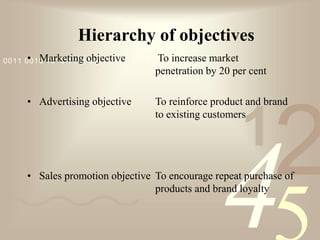
Hierarchy of objectives
• Marketing objective To increase market
penetration by 20 per cent
• Advertising objective To reinforce product and brand
to existing customers
• Sales promotion objective To encourage repeat purchase of
products and brand loyalty
421
0011 0010 1010 1101 0001 0100 1011
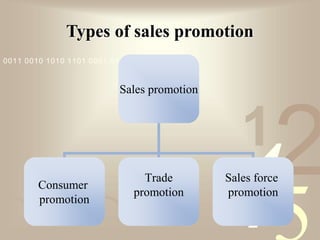
Types of sales promotion
Sales promotion
Consumer
promotion
Trade
promotion
Sales force
promotion
421
0011 0010 1010 1101 0001 0100 1011
Sales promotion objectives
• Product trial and sampling
• Increasing rate/frequency of purchase
• Trading up
• Introducing a new product
421
0011 0010 1010 1101 0001 0100 1011
Retailer to consumer sales promotions
• The key aims and objectives of this process will be to increase
sales through a range of promotional techniques:
• Increase in-store trade and customer traffic - the use of coupons
and money-off vouchers.
• Increase frequency of purchase - discounted promotions for next
purchase.
• Increase in-store loyalty- through the use of scorecards and
rewards systems.
• Increase own brand sales - encourage customers to purchase
own brand products through a range of sale promotion incentives
such as trial packs, in-store demonstrations and so on.
• Achieve consistent demand - reduce fluctuations and provide
sales promotions in particular time bands to encourage a more
consistent approach to shopping
421
0011 0010 1010 1101 0001 0100 1011
Sales promotion techniques
• Money-off vouchers/coupons
• Buy one get one free
• Free gifts
• Customer loyalty bonus schemes
• Twin packs
• Bulk buying
• Discounts
• Try before you buy
• Cash rebates
• Trial-sized products
• Prize draws
• Competition codes
• Point-of-sale displays.
• In-store sampling
421
0011 0010 1010 1101 0001 0100 1011
Money-off vouchers
• Money-off promotions, in their variety of implementations,
remain the most commonly employed promotional device.
• Often referred to as price packs or RPOs, these promotions
offer the consumer the most powerful incentive to
purchase - money!
• Most often, the offering consists of a flash on the pack
detailing the size of the price reduction, either as an
absolute price or as a reduction on the normal price.
• By providing an immediate price reduction, a manufacturer
makes the most impactful offer.
• The impact of the technique is considerable. It has a
universal appeal and both the trade and the consumer like
the promotion.
421
0011 0010 1010 1101 0001 0100 1011
Coupons
• Coupons is another way of transmitting a money-off offer to
the consumer.
• On some occasions, a manufacturer will use another product
within the range to carry the coupon. This is sometimes
referred to as cross-couponing.
• Although far more costly, money-off coupons can be
distributed within the media, or even on a door-to-door basis
to attract new users or to employ a more cost-effective
carrier to reach the target audience.
• Where the coupon is designed to be redeemed at the time of
a subsequent purchase, such offerings have a similar
appearance of immediacy and impact although, in practice,
many consumers forget to redeem the coupon.
• Hence, money-off coupons may have a similar visual
impact to that of an immediate money-off offer, but will
represent a lower real cost, since the level of redemption
will be lower.
421
0011 0010 1010 1101 0001 0100 1011
Buy one get one free
There are several variations on this theme:
• Three for the price of two, which as the title suggests is a
greater value incentive to the purchaser. The retailer may use
this option as a means of reducing a stock inventory.
• Lower price item reduced: when two items are bought from a
particular range the lower-priced item is discounted. The
objective here is to create an incentive for the buyer to try
another product within the product range.
• Free product with every purchase: this can be used as a co-
branding exercise where the company links up with a related
product: for example, a toothpaste manufacturer co-brands
with one that produces toothbrushes. Although the toothbrush
is free it provides the manufacturer with a promotional outlet
which may lead to increasing purchases
421
0011 0010 1010 1101 0001 0100 1011
Free gifts
• Many manufacturers seek to incentives the purchase by the
offering of a free gift item at the time of purchase.
• There are four distinct forms of free gift offer.
– The on-pack free gift is any item of. merchandise which is
presented to the consumer by affixing it to the external
surface of the product.
– The in-pack free gift is used by a number of packaged goods
manufacturers, with a description of the gift on the pack
surface, and the item only available once the packaging has
been opened.
– The with-pack free gift, is an execution which relies on the
co-operation of the retailer, since the free item of
merchandise is not attached to the purchased item.
– The fourth important area of free gift is the pack itself. Once
it is recognized that the packaging, or some alternative
presentation, may represent added value to the consumer, it
can be appreciated that this is an area of considerable
potential.
421
0011 0010 1010 1101 0001 0100 1011
In-store sampling
• In-store sampling may provide the
opportunity to provide a direct Interface
between the product and the consumer.
• The trade like such promotions, since they
generate in-store activity which tends to
encourage a higher level of all product
purchases - not just the product which is
being sampled.
421
0011 0010 1010 1101 0001 0100 1011
Customer loyalty schemes: 11-Ps of loyalty marketing
1. Pricing Be customer-specific
2. Purchases Make product-specific offers
3. Point flexibility Occasionally offer double points
4. Partners Develop alliances with retailers
5. Prizes Weekly draw for cardholders
6. Pro-bono Allow customers to convert points to charity
donations
7. Personalization Direct mail, specifically targeted at the
customer
8. Privileges Invite cardholders to special events
9. Participation Invite best customers to take part in new
schemes
10.Pronto Generate offers at point of sale
11.Proactive Use information to predict/preempt
customer behaviour
421
0011 0010 1010 1101 0001 0100 1011
Planning process of sales promotional
campaign
• Identification of the target market.
• Sales promotion objectives versus budget
appropriation.
• Identification of both cost of communication
for the sales promotion campaign and also the
actual cost of the campaign.
• Implementation - clearly the promotion will
probably run in parallel with the advertising
programme.
421
0011 0010 1010 1101 0001 0100 1011
Trade objectives
• Traffic building
• Inventory building
• Stock reduction
• Offsetting impact of competitive activity
• Promotional support to trade
421
0011 0010 1010 1101 0001 0100 1011
Trade promotions
• Manufacturers are looking to encourage their
wholesalers and retailers to take their products and
effectively 'take them to market'.
• It is likely that manufacturers will encourage
organizations to increase their stock levels in order to
gain some level of commitment to increase sales
potential in the marketplace.
• Alternatively, there is intensive competition for
increased shelf space within retail outlets. The greater
the incentive provided by the manufacturer, the more
potential there is for greater shelf-space in the retail
outlet.
421
0011 0010 1010 1101 0001 0100 1011
Methods of trade promotion
• Allowances and discounts.
• Volume allowances.
• Discount overriders - based upon retrospective
performance, for example on a quarterly or annual
basis.
• Free merchandize.
• Selling and marketing assistance - co-operative
advertising, merchandizing allowances market
information, product training,
• Sales contests.
• Bonus payments
421
0011 0010 1010 1101 0001 0100 1011
Sales force objectives
• Provide the opportunity to build on special
events, for example, a new store opening.
• The motivation of the sales force, dealers,
etc.
421
0011 0010 1010 1101 0001 0100 1011
PR
Public relations is the dimension of
communications which is specifically
concerned with establishing and enhancing
goodwill between an organization and the
various publics with which it seeks to
communicate.
421
0011 0010 1010 1101 0001 0100 1011
PR: definitions
The Institute of Public Relations (IPR)
defines public relations as:
‘The deliberate, planned and sustained
effort to establish and maintain mutual
understanding between an
organisation and its publics’.
421
0011 0010 1010 1101 0001 0100 1011
PR: definitions
The Public Relations Society of America adopts a
broader-based definition and, more importantly,
identifies a series of specific functions relating to
public relations:
1. Anticipating, analyzing and interpreting public opinion,
attitudes and issues which might impact, for good or ill,
on the operations and plans of the organization.
2. Counseling management at all levels with regard to
policy decisions, courses of action and communication.
3. Researching, conducting and evaluating, on a continuing
basis, programmes of action and communication to
achieve informed public understanding necessary for the
success of the organization's aims.
4. Planning and implementing the organization's efforts to
influence or change public policy.
5. Managing the resources needed to perform the functions
of public relations.
421
0011 0010 1010 1101 0001 0100 1011
PR and other elements of promotional mix
• Public relations, as with all other elements of the
marketing mix, requires a planned approach and plays
an important role at a strategic level. It is also subject
to strategic level objectives.
• For example, the launch of a new model by Mercedes
Benz will be subject to a significant PR campaign
running in parallel with significant advertising and
direct marketing, perhaps on a local level by the local
dealerships.
• Therefore PR becomes a high-level communications
objective and it is critical that it is subject to the same
intensity in respect of targeting specific groups of the
public
421
0011 0010 1010 1101 0001 0100 1011
A comparison between public relations and
advertising
The goals of advertising and PR are somewhat different.
• The primary goal of advertising is to inform and persuade
consumers in relation to a specific product offering.
• The primary goal of PR is to establish goodwill, and to develop
favourable attitudes and an understanding of the organization
and its products or services.
• A major distinction between advertising and PR is the credibility
of the alternative routes to message delivery. PR messages are
included in media vehicles as news stories and are, as a result,
somewhat more credible than advertising.
• Advertising is inherently based upon the self-interest of the
organization placing it and paying for the exposure.
• PR messages, on the other hand, are not immediately apparent as
such. They appear as editorial content within a newspaper,
magazine or television segment and are often seen as
'independent' of the company which originated them.
421
0011 0010 1010 1101 0001 0100 1011
Public relations
• Publicity and public relations are often
interrelated and seen as companions
within the promotional mix.
• Indeed publicity is often deemed to be
part of public relations activities and
certainly seems to happen as a result of
PR.
421
0011 0010 1010 1101 0001 0100 1011
Publicity vs. PR
• Publicity- is information, news,
communications in relation to the
organization, transmitted through a range of
different media.
• Public relations - is a planned and sustained
effort to establish and maintain goodwill
and mutual understanding between an
organization and its target public.
421
0011 0010 1010 1101 0001 0100 1011
The role of PR
• The role of public relations is to look after
the nature and basis of the external
relationships between the organization and
all stakeholder groups.
• It is aimed at creating a sustainable
corporate brand and an overall company
image within the marketplace.
421
0011 0010 1010 1101 0001 0100 1011
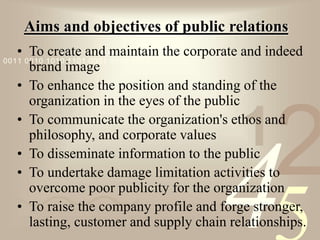
Aims and objectives of public relations
• To create and maintain the corporate and indeed
brand image
• To enhance the position and standing of the
organization in the eyes of the public
• To communicate the organization's ethos and
philosophy, and corporate values
• To disseminate information to the public
• To undertake damage limitation activities to
overcome poor publicity for the organization
• To raise the company profile and forge stronger,
lasting, customer and supply chain relationships.
421
0011 0010 1010 1101 0001 0100 1011
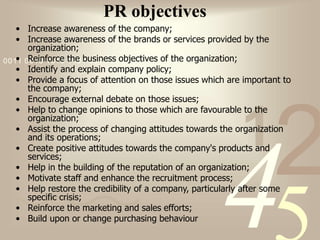
PR objectives
• Increase awareness of the company;
• Increase awareness of the brands or services provided by the
organization;
• Reinforce the business objectives of the organization;
• Identify and explain company policy;
• Provide a focus of attention on those issues which are important to
the company;
• Encourage external debate on those issues;
• Help to change opinions to those which are favourable to the
organization;
• Assist the process of changing attitudes towards the organization
and its operations;
• Create positive attitudes towards the company's products and
services;
• Help in the building of the reputation of an organization;
• Motivate staff and enhance the recruitment process;
• Help restore the credibility of a company, particularly after some
specific crisis;
• Reinforce the marketing and sales efforts;
• Build upon or change purchasing behaviour
4210011 0010 1010 1101 0001 0100 1011
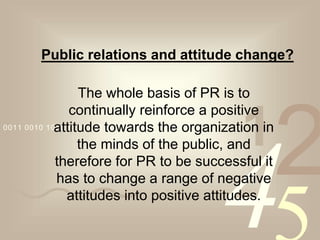
Public relations and attitude change?
The whole basis of PR is to
continually reinforce a positive
attitude towards the organization in
the minds of the public, and
therefore for PR to be successful it
has to change a range of negative
attitudes into positive attitudes.
421
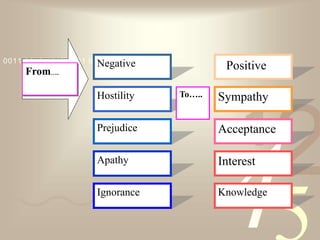
0011 0010 1010 1101 0001 0100 1011Negative
Hostility
Prejudice
Apathy
Ignorance
From…..
To….. Sympathy
Acceptance
Interest
Knowledge
Positive
421
0011 0010 1010 1101 0001 0100 1011
The functions of public relations
• Opinion forming
• Liaison with public officials- Maintaining close and realistic
relationships with local and central government officials and other regulatory bodies is
a key dimension of positive public relations.
• Communications policies
• Community relations -No organization exists in isolation of the
various communities within which it exists. Like other aspects of its
operations, these are multi-dimensional.
• In-house activities -Most companies recognize the need to maintain
positive relationships with all members of staff.
• Media relations -The appearance of positive publicity for a company
is the result of carefully nurtured relationships between the various media and
the company over a long period of time.
• Event management - events are used to create positive relationships
between the company and one or more of its target audiences, often of an
informal nature.
421
0011 0010 1010 1101 0001 0100 1011
The functions of public relations
• Product or service publicity -The external perception of
public relations is its involvement with the creation of publicity for the
products and services which the company provides.
• Business sponsorship -A similarly important area of activity
is that of creating business sponsorships which serve to associate the
company with some specific activity, designed to enhance the image
associations of the organization.
• Financial activity
• In-house activities -Most companies recognize the need to
maintain positive relationships with all members of staff. The role of
public relations will be to explain and secure support for the variety of
management decisions which will be taken. Often, the organ for such
communications will be some form of in-house journal, designed to
create a bond between the people who work within the organization.
421
0011 0010 1010 1101 0001 0100 1011
Publics: a definition
Any group with some common characteristics,
with which an organization needs to
communicate. Each public poses a different
communication problem, as each has different
information needs and requires a different kind
of relationship with the organization, and may
start with perceptions of what the organization
stands for.
(Marston, 1979 as quoted in Brassington and Pettitt,
2000)
421
0011 0010 1010 1101 0001 0100 1011
Publics
• Customer groups.
• Local and central government.
• The general public.
• Financial institutions -
investors/shareholders/borrowers.
• The media - TV, press, radio (locally and
nationally).
• Opinion leaders/formers.
• Internal marketplace - employees, trade unions,
employee relations bodies.
• Potential employees.
• Suppliers, distributors.
• Local community
421
0011 0010 1010 1101 0001 0100 1011
Types of publics
• Direct publics: as the title suggests these are
publics that have a direct relationship with the
organisation or individual. Depending upon the
nature of the relationship they normally include
employees/ customers, suppliers, competitors and
the local community.
• Indirect publics: these are publics that have no
immediate direct relationship with the organisation
or individual. Examples are the proposed
introduction of new rules and regulations by a
government department, and how a company or
individual handles a crisis management situation.
421
0011 0010 1010 1101 0001 0100 1011
PR techniques/tools
• Press releases
• Press conferences
• Publications
• Advertising
• Media relations
• Events
• Annual reports
• Lobbying
• Internal PR.
• Sponsorship
• Two additional tools of public relations, however,
deserve special mention.
421
0011 0010 1010 1101 0001 0100 1011
Advertorials
• An advertorial is a combination of advertisement and
editorial, paid for by the advertiser and appearing to look
like editorial from the newspaper. Such activities must be
flagged with the word 'advertisement'.
• Readers enjoy advertorials as a form of communication;
appreciate that they usually provide more information than
conventional advertising; and that they represent added
value advertising.
• Their success depends on:
– the relevance of the product to the reader;
– the fit with the motivations for magazine purchase;
– the product category relevance;
– the fit with the editorial style, content and image of the
magazine;
– the balance between information and selling;
– the visual appeal.
421
0011 0010 1010 1101 0001 0100 1011
Infomercials
• These extend the premise of the advertorial
into the television medium.
• They first started in the USA on cable and
local TV .
• The growth of commercial television, and
the advent of the vast numbers of digital
channels, are likely to extend the potential
application of the technique.
421
0011 0010 1010 1101 0001 0100 1011
Adding to brand values
• Consumers buy company reputation as much as they
purchase the individual products which those companies
produce.
• Most of the conversations companies have with their
customers are related to their products and services.
• The study (USA by DDB Needham and Porter Novelli)
identified five factors which had a major influence on
consumers:
• 96 per cent rated product quality;
• 85 per cent the company's method of handling complaints;
• 73 per cent the way in which a company handles a crisis in which
it is at fault;
• 60 per cent the handling of a challenge by a government agency
about the safety of its products;
• 59 per cent an accusation of illegal or unethical trading practices.
421
0011 0010 1010 1101 0001 0100 1011
Responding to crisis situations
• A key role of public relations is the
management of the relationship between an
organization and its publics at times of
crisis.
421
0011 0010 1010 1101 0001 0100 1011
Charity PR
• Charitable organizations and other non-profit
organizations are prime users of public relations
activities
• A primary requirement for charitable bodies is the need
to raise funds to finance their main activities.
• Since the majority of charities depend both on
voluntary contributions and voluntary participation,
activity is needed which will maintain interest in the
areas of concern.
• In all cases, the use of public relations must relate to the
strategic aims of the organization. It is important that
any such events are designed to fulfill specific
objectives which relate to the overall goals.
421
0011 0010 1010 1101 0001 0100 1011
Sponsorship
Sponsorship is the provision of
financial or material support by a
company for some independent
activity... not usually directly linked to
the company's normal business, but
support from which the sponsoring
company would hope to benefit.
(Wilmhurst, 1999)
421
0011 0010 1010 1101 0001 0100 1011
Sponsorship objectives
• Increasing brand awareness
• Building and enhancing corporate image
• Raising awareness of brands related to
products restricted in advertising through
various legislation, such as alcohol and
cigarettes
421
0011 0010 1010 1101 0001 0100 1011
Types of sponsorship
• Programme sponsorship
• Вroadcast sponsorship
• Arts/sports sponsorship
421
0011 0010 1010 1101 0001 0100 1011
Types of sponsorship
• Sponsorship of other events - for example
exhibitions, festivals and opening ceremo-
nies. These are again high profile, and are
sometimes very useful forms of sponsorship
for smaller businesses that wish to raise their
profile locally.
• Sponsorship of individuals or teams-
Mercedes Benz sponsor the British tennis
player Tim Henman and Siemens sponsor
Formula One motor racing.
421
0011 0010 1010 1101 0001 0100 1011
Role of sponsorship
• Sponsorship can provide a more cost-effective means
of reaching the target audience, but the design, content
and message are much more controlled.
• From a corporate perspective and PR perspective,
sponsorship raises the profile of the organization and
its corporate values, and in some instances can really
bring the brand name and corporate image to centre
stage.
• Sponsorship offers vast opportunities for the
organization in terms of the value-added perspective of
merchandizing, public relations activities, improved
stakeholder relationships and highlighted ethical and
social values.
421
0011 0010 1010 1101 0001 0100 1011
Sponsorship: considerations
However, a number of key factors should be
considered prior to taking the decision to proceed
with sponsorship arrangements:
• What relevance does the particular sponsorship
arrangement have in terms of the match between the
two organizations and the potential target audience?
For example, it is clear that when Carling Black
Label sponsor sports events it will bring in
additional sales of both drinks and cigarettes, both
during and after the event, as support for sport is
effectively linked to both of these habits.
• The period of impact- How long before and after the
event will the sponsorship profile last for? Is the
event a one-off or a sequence of events?
421
0011 0010 1010 1101 0001 0100 1011
Sponsorship: considerations
– The uniqueness of the sponsorship agreement- From a
competitive perspective it will be essential that the
agreement with the sponsored individual or organization
allows the brand, market and competitive position to be
differentiated in a unique way.
– The level of spin-off promotions is also essential - For
example, the importance of a co-ordinated approach
between other elements of the promotional mix will be
essential to maximize and optimize cost-effectiveness of
particular high profile events. Here advertising,
merchandizing and promotional incentives may be a
particular match for the promotional mix.
421
0011 0010 1010 1101 0001 0100 1011
Programme planning
• The development of a cohesive and effective PR
plan is dependent, as we have seen, on a thorough
understanding of the audiences for the campaign
message.
– Situational analysis
– Determination of objectives
– Identification of target publics
– Choice of PR strategy
– Budget definition
– Development of programme components
– Programme implementation
– Evaluation and feedback
4210011 0010 1010 1101 0001 0100 1011
Thank you for attention

Managing sales promotion and pr

  • 1.
    4210011 0010 10101101 0001 0100 1011 Lecture 15 Managing Sales Promotion and Public Relations
  • 2.
    421 0011 0010 10101101 0001 0100 1011 Sales promotions • Sales promotions traditionally are complementary to advertising. • They are used to reinforce and encourage customers to trial the product and then to purchase. • Sales promotion provides a range of short-term tactical measures to induce sales of particular products or services. • Its aim is to provide extra value to the product or service, creating the extra impetus to purchase products that we might not normally buy.
  • 3.
    421 0011 0010 10101101 0001 0100 1011 Sales promotions: a definition A range of tactical marketing techniques designed within a strategic marketing framework to add value to a product or service in order to achieve specific sales and marketing objectives.
  • 4.
    421 0011 0010 10101101 0001 0100 1011 Sales promotion and other elements of marketing mix • Sales promotion should be part of a planned approach and very much an integral part of the marketing communications planning framework. • It should be planned and executed in parallel with associated advertising and possible public relations campaigns.
  • 5.
    421 0011 0010 10101101 0001 0100 1011 Aims and objectives of Sales Promotion • To increase brand and product awareness - attracting new customers • To increase trial and adoption of new and existing products • To attract customers to switch brands and products from competing organizations • To level out fluctuations in supply and demand • To increase brand usage • To increase customer loyalty • To disseminate information • To encourage trading up to the next size or the next range
  • 6.
    421 0011 0010 10101101 0001 0100 1011 Hierarchy of objectives • Marketing objective To increase market penetration by 20 per cent • Advertising objective To reinforce product and brand to existing customers • Sales promotion objective To encourage repeat purchase of products and brand loyalty
  • 7.
    421 0011 0010 10101101 0001 0100 1011 Types of sales promotion Sales promotion Consumer promotion Trade promotion Sales force promotion
  • 8.
    421 0011 0010 10101101 0001 0100 1011 Sales promotion objectives • Product trial and sampling • Increasing rate/frequency of purchase • Trading up • Introducing a new product
  • 9.
    421 0011 0010 10101101 0001 0100 1011 Retailer to consumer sales promotions • The key aims and objectives of this process will be to increase sales through a range of promotional techniques: • Increase in-store trade and customer traffic - the use of coupons and money-off vouchers. • Increase frequency of purchase - discounted promotions for next purchase. • Increase in-store loyalty- through the use of scorecards and rewards systems. • Increase own brand sales - encourage customers to purchase own brand products through a range of sale promotion incentives such as trial packs, in-store demonstrations and so on. • Achieve consistent demand - reduce fluctuations and provide sales promotions in particular time bands to encourage a more consistent approach to shopping
  • 10.
    421 0011 0010 10101101 0001 0100 1011 Sales promotion techniques • Money-off vouchers/coupons • Buy one get one free • Free gifts • Customer loyalty bonus schemes • Twin packs • Bulk buying • Discounts • Try before you buy • Cash rebates • Trial-sized products • Prize draws • Competition codes • Point-of-sale displays. • In-store sampling
  • 11.
    421 0011 0010 10101101 0001 0100 1011 Money-off vouchers • Money-off promotions, in their variety of implementations, remain the most commonly employed promotional device. • Often referred to as price packs or RPOs, these promotions offer the consumer the most powerful incentive to purchase - money! • Most often, the offering consists of a flash on the pack detailing the size of the price reduction, either as an absolute price or as a reduction on the normal price. • By providing an immediate price reduction, a manufacturer makes the most impactful offer. • The impact of the technique is considerable. It has a universal appeal and both the trade and the consumer like the promotion.
  • 12.
    421 0011 0010 10101101 0001 0100 1011 Coupons • Coupons is another way of transmitting a money-off offer to the consumer. • On some occasions, a manufacturer will use another product within the range to carry the coupon. This is sometimes referred to as cross-couponing. • Although far more costly, money-off coupons can be distributed within the media, or even on a door-to-door basis to attract new users or to employ a more cost-effective carrier to reach the target audience. • Where the coupon is designed to be redeemed at the time of a subsequent purchase, such offerings have a similar appearance of immediacy and impact although, in practice, many consumers forget to redeem the coupon. • Hence, money-off coupons may have a similar visual impact to that of an immediate money-off offer, but will represent a lower real cost, since the level of redemption will be lower.
  • 13.
    421 0011 0010 10101101 0001 0100 1011 Buy one get one free There are several variations on this theme: • Three for the price of two, which as the title suggests is a greater value incentive to the purchaser. The retailer may use this option as a means of reducing a stock inventory. • Lower price item reduced: when two items are bought from a particular range the lower-priced item is discounted. The objective here is to create an incentive for the buyer to try another product within the product range. • Free product with every purchase: this can be used as a co- branding exercise where the company links up with a related product: for example, a toothpaste manufacturer co-brands with one that produces toothbrushes. Although the toothbrush is free it provides the manufacturer with a promotional outlet which may lead to increasing purchases
  • 14.
    421 0011 0010 10101101 0001 0100 1011 Free gifts • Many manufacturers seek to incentives the purchase by the offering of a free gift item at the time of purchase. • There are four distinct forms of free gift offer. – The on-pack free gift is any item of. merchandise which is presented to the consumer by affixing it to the external surface of the product. – The in-pack free gift is used by a number of packaged goods manufacturers, with a description of the gift on the pack surface, and the item only available once the packaging has been opened. – The with-pack free gift, is an execution which relies on the co-operation of the retailer, since the free item of merchandise is not attached to the purchased item. – The fourth important area of free gift is the pack itself. Once it is recognized that the packaging, or some alternative presentation, may represent added value to the consumer, it can be appreciated that this is an area of considerable potential.
  • 15.
    421 0011 0010 10101101 0001 0100 1011 In-store sampling • In-store sampling may provide the opportunity to provide a direct Interface between the product and the consumer. • The trade like such promotions, since they generate in-store activity which tends to encourage a higher level of all product purchases - not just the product which is being sampled.
  • 16.
    421 0011 0010 10101101 0001 0100 1011 Customer loyalty schemes: 11-Ps of loyalty marketing 1. Pricing Be customer-specific 2. Purchases Make product-specific offers 3. Point flexibility Occasionally offer double points 4. Partners Develop alliances with retailers 5. Prizes Weekly draw for cardholders 6. Pro-bono Allow customers to convert points to charity donations 7. Personalization Direct mail, specifically targeted at the customer 8. Privileges Invite cardholders to special events 9. Participation Invite best customers to take part in new schemes 10.Pronto Generate offers at point of sale 11.Proactive Use information to predict/preempt customer behaviour
  • 17.
    421 0011 0010 10101101 0001 0100 1011 Planning process of sales promotional campaign • Identification of the target market. • Sales promotion objectives versus budget appropriation. • Identification of both cost of communication for the sales promotion campaign and also the actual cost of the campaign. • Implementation - clearly the promotion will probably run in parallel with the advertising programme.
  • 18.
    421 0011 0010 10101101 0001 0100 1011 Trade objectives • Traffic building • Inventory building • Stock reduction • Offsetting impact of competitive activity • Promotional support to trade
  • 19.
    421 0011 0010 10101101 0001 0100 1011 Trade promotions • Manufacturers are looking to encourage their wholesalers and retailers to take their products and effectively 'take them to market'. • It is likely that manufacturers will encourage organizations to increase their stock levels in order to gain some level of commitment to increase sales potential in the marketplace. • Alternatively, there is intensive competition for increased shelf space within retail outlets. The greater the incentive provided by the manufacturer, the more potential there is for greater shelf-space in the retail outlet.
  • 20.
    421 0011 0010 10101101 0001 0100 1011 Methods of trade promotion • Allowances and discounts. • Volume allowances. • Discount overriders - based upon retrospective performance, for example on a quarterly or annual basis. • Free merchandize. • Selling and marketing assistance - co-operative advertising, merchandizing allowances market information, product training, • Sales contests. • Bonus payments
  • 21.
    421 0011 0010 10101101 0001 0100 1011 Sales force objectives • Provide the opportunity to build on special events, for example, a new store opening. • The motivation of the sales force, dealers, etc.
  • 22.
    421 0011 0010 10101101 0001 0100 1011 PR Public relations is the dimension of communications which is specifically concerned with establishing and enhancing goodwill between an organization and the various publics with which it seeks to communicate.
  • 23.
    421 0011 0010 10101101 0001 0100 1011 PR: definitions The Institute of Public Relations (IPR) defines public relations as: ‘The deliberate, planned and sustained effort to establish and maintain mutual understanding between an organisation and its publics’.
  • 24.
    421 0011 0010 10101101 0001 0100 1011 PR: definitions The Public Relations Society of America adopts a broader-based definition and, more importantly, identifies a series of specific functions relating to public relations: 1. Anticipating, analyzing and interpreting public opinion, attitudes and issues which might impact, for good or ill, on the operations and plans of the organization. 2. Counseling management at all levels with regard to policy decisions, courses of action and communication. 3. Researching, conducting and evaluating, on a continuing basis, programmes of action and communication to achieve informed public understanding necessary for the success of the organization's aims. 4. Planning and implementing the organization's efforts to influence or change public policy. 5. Managing the resources needed to perform the functions of public relations.
  • 25.
    421 0011 0010 10101101 0001 0100 1011 PR and other elements of promotional mix • Public relations, as with all other elements of the marketing mix, requires a planned approach and plays an important role at a strategic level. It is also subject to strategic level objectives. • For example, the launch of a new model by Mercedes Benz will be subject to a significant PR campaign running in parallel with significant advertising and direct marketing, perhaps on a local level by the local dealerships. • Therefore PR becomes a high-level communications objective and it is critical that it is subject to the same intensity in respect of targeting specific groups of the public
  • 26.
    421 0011 0010 10101101 0001 0100 1011 A comparison between public relations and advertising The goals of advertising and PR are somewhat different. • The primary goal of advertising is to inform and persuade consumers in relation to a specific product offering. • The primary goal of PR is to establish goodwill, and to develop favourable attitudes and an understanding of the organization and its products or services. • A major distinction between advertising and PR is the credibility of the alternative routes to message delivery. PR messages are included in media vehicles as news stories and are, as a result, somewhat more credible than advertising. • Advertising is inherently based upon the self-interest of the organization placing it and paying for the exposure. • PR messages, on the other hand, are not immediately apparent as such. They appear as editorial content within a newspaper, magazine or television segment and are often seen as 'independent' of the company which originated them.
  • 27.
    421 0011 0010 10101101 0001 0100 1011 Public relations • Publicity and public relations are often interrelated and seen as companions within the promotional mix. • Indeed publicity is often deemed to be part of public relations activities and certainly seems to happen as a result of PR.
  • 28.
    421 0011 0010 10101101 0001 0100 1011 Publicity vs. PR • Publicity- is information, news, communications in relation to the organization, transmitted through a range of different media. • Public relations - is a planned and sustained effort to establish and maintain goodwill and mutual understanding between an organization and its target public.
  • 29.
    421 0011 0010 10101101 0001 0100 1011 The role of PR • The role of public relations is to look after the nature and basis of the external relationships between the organization and all stakeholder groups. • It is aimed at creating a sustainable corporate brand and an overall company image within the marketplace.
  • 30.
    421 0011 0010 10101101 0001 0100 1011 Aims and objectives of public relations • To create and maintain the corporate and indeed brand image • To enhance the position and standing of the organization in the eyes of the public • To communicate the organization's ethos and philosophy, and corporate values • To disseminate information to the public • To undertake damage limitation activities to overcome poor publicity for the organization • To raise the company profile and forge stronger, lasting, customer and supply chain relationships.
  • 31.
    421 0011 0010 10101101 0001 0100 1011 PR objectives • Increase awareness of the company; • Increase awareness of the brands or services provided by the organization; • Reinforce the business objectives of the organization; • Identify and explain company policy; • Provide a focus of attention on those issues which are important to the company; • Encourage external debate on those issues; • Help to change opinions to those which are favourable to the organization; • Assist the process of changing attitudes towards the organization and its operations; • Create positive attitudes towards the company's products and services; • Help in the building of the reputation of an organization; • Motivate staff and enhance the recruitment process; • Help restore the credibility of a company, particularly after some specific crisis; • Reinforce the marketing and sales efforts; • Build upon or change purchasing behaviour
  • 32.
    4210011 0010 10101101 0001 0100 1011 Public relations and attitude change? The whole basis of PR is to continually reinforce a positive attitude towards the organization in the minds of the public, and therefore for PR to be successful it has to change a range of negative attitudes into positive attitudes.
  • 33.
    421 0011 0010 10101101 0001 0100 1011Negative Hostility Prejudice Apathy Ignorance From….. To….. Sympathy Acceptance Interest Knowledge Positive
  • 34.
    421 0011 0010 10101101 0001 0100 1011 The functions of public relations • Opinion forming • Liaison with public officials- Maintaining close and realistic relationships with local and central government officials and other regulatory bodies is a key dimension of positive public relations. • Communications policies • Community relations -No organization exists in isolation of the various communities within which it exists. Like other aspects of its operations, these are multi-dimensional. • In-house activities -Most companies recognize the need to maintain positive relationships with all members of staff. • Media relations -The appearance of positive publicity for a company is the result of carefully nurtured relationships between the various media and the company over a long period of time. • Event management - events are used to create positive relationships between the company and one or more of its target audiences, often of an informal nature.
  • 35.
    421 0011 0010 10101101 0001 0100 1011 The functions of public relations • Product or service publicity -The external perception of public relations is its involvement with the creation of publicity for the products and services which the company provides. • Business sponsorship -A similarly important area of activity is that of creating business sponsorships which serve to associate the company with some specific activity, designed to enhance the image associations of the organization. • Financial activity • In-house activities -Most companies recognize the need to maintain positive relationships with all members of staff. The role of public relations will be to explain and secure support for the variety of management decisions which will be taken. Often, the organ for such communications will be some form of in-house journal, designed to create a bond between the people who work within the organization.
  • 36.
    421 0011 0010 10101101 0001 0100 1011 Publics: a definition Any group with some common characteristics, with which an organization needs to communicate. Each public poses a different communication problem, as each has different information needs and requires a different kind of relationship with the organization, and may start with perceptions of what the organization stands for. (Marston, 1979 as quoted in Brassington and Pettitt, 2000)
  • 37.
    421 0011 0010 10101101 0001 0100 1011 Publics • Customer groups. • Local and central government. • The general public. • Financial institutions - investors/shareholders/borrowers. • The media - TV, press, radio (locally and nationally). • Opinion leaders/formers. • Internal marketplace - employees, trade unions, employee relations bodies. • Potential employees. • Suppliers, distributors. • Local community
  • 38.
    421 0011 0010 10101101 0001 0100 1011 Types of publics • Direct publics: as the title suggests these are publics that have a direct relationship with the organisation or individual. Depending upon the nature of the relationship they normally include employees/ customers, suppliers, competitors and the local community. • Indirect publics: these are publics that have no immediate direct relationship with the organisation or individual. Examples are the proposed introduction of new rules and regulations by a government department, and how a company or individual handles a crisis management situation.
  • 39.
    421 0011 0010 10101101 0001 0100 1011 PR techniques/tools • Press releases • Press conferences • Publications • Advertising • Media relations • Events • Annual reports • Lobbying • Internal PR. • Sponsorship • Two additional tools of public relations, however, deserve special mention.
  • 40.
    421 0011 0010 10101101 0001 0100 1011 Advertorials • An advertorial is a combination of advertisement and editorial, paid for by the advertiser and appearing to look like editorial from the newspaper. Such activities must be flagged with the word 'advertisement'. • Readers enjoy advertorials as a form of communication; appreciate that they usually provide more information than conventional advertising; and that they represent added value advertising. • Their success depends on: – the relevance of the product to the reader; – the fit with the motivations for magazine purchase; – the product category relevance; – the fit with the editorial style, content and image of the magazine; – the balance between information and selling; – the visual appeal.
  • 41.
    421 0011 0010 10101101 0001 0100 1011 Infomercials • These extend the premise of the advertorial into the television medium. • They first started in the USA on cable and local TV . • The growth of commercial television, and the advent of the vast numbers of digital channels, are likely to extend the potential application of the technique.
  • 42.
    421 0011 0010 10101101 0001 0100 1011 Adding to brand values • Consumers buy company reputation as much as they purchase the individual products which those companies produce. • Most of the conversations companies have with their customers are related to their products and services. • The study (USA by DDB Needham and Porter Novelli) identified five factors which had a major influence on consumers: • 96 per cent rated product quality; • 85 per cent the company's method of handling complaints; • 73 per cent the way in which a company handles a crisis in which it is at fault; • 60 per cent the handling of a challenge by a government agency about the safety of its products; • 59 per cent an accusation of illegal or unethical trading practices.
  • 43.
    421 0011 0010 10101101 0001 0100 1011 Responding to crisis situations • A key role of public relations is the management of the relationship between an organization and its publics at times of crisis.
  • 44.
    421 0011 0010 10101101 0001 0100 1011 Charity PR • Charitable organizations and other non-profit organizations are prime users of public relations activities • A primary requirement for charitable bodies is the need to raise funds to finance their main activities. • Since the majority of charities depend both on voluntary contributions and voluntary participation, activity is needed which will maintain interest in the areas of concern. • In all cases, the use of public relations must relate to the strategic aims of the organization. It is important that any such events are designed to fulfill specific objectives which relate to the overall goals.
  • 45.
    421 0011 0010 10101101 0001 0100 1011 Sponsorship Sponsorship is the provision of financial or material support by a company for some independent activity... not usually directly linked to the company's normal business, but support from which the sponsoring company would hope to benefit. (Wilmhurst, 1999)
  • 46.
    421 0011 0010 10101101 0001 0100 1011 Sponsorship objectives • Increasing brand awareness • Building and enhancing corporate image • Raising awareness of brands related to products restricted in advertising through various legislation, such as alcohol and cigarettes
  • 47.
    421 0011 0010 10101101 0001 0100 1011 Types of sponsorship • Programme sponsorship • Вroadcast sponsorship • Arts/sports sponsorship
  • 48.
    421 0011 0010 10101101 0001 0100 1011 Types of sponsorship • Sponsorship of other events - for example exhibitions, festivals and opening ceremo- nies. These are again high profile, and are sometimes very useful forms of sponsorship for smaller businesses that wish to raise their profile locally. • Sponsorship of individuals or teams- Mercedes Benz sponsor the British tennis player Tim Henman and Siemens sponsor Formula One motor racing.
  • 49.
    421 0011 0010 10101101 0001 0100 1011 Role of sponsorship • Sponsorship can provide a more cost-effective means of reaching the target audience, but the design, content and message are much more controlled. • From a corporate perspective and PR perspective, sponsorship raises the profile of the organization and its corporate values, and in some instances can really bring the brand name and corporate image to centre stage. • Sponsorship offers vast opportunities for the organization in terms of the value-added perspective of merchandizing, public relations activities, improved stakeholder relationships and highlighted ethical and social values.
  • 50.
    421 0011 0010 10101101 0001 0100 1011 Sponsorship: considerations However, a number of key factors should be considered prior to taking the decision to proceed with sponsorship arrangements: • What relevance does the particular sponsorship arrangement have in terms of the match between the two organizations and the potential target audience? For example, it is clear that when Carling Black Label sponsor sports events it will bring in additional sales of both drinks and cigarettes, both during and after the event, as support for sport is effectively linked to both of these habits. • The period of impact- How long before and after the event will the sponsorship profile last for? Is the event a one-off or a sequence of events?
  • 51.
    421 0011 0010 10101101 0001 0100 1011 Sponsorship: considerations – The uniqueness of the sponsorship agreement- From a competitive perspective it will be essential that the agreement with the sponsored individual or organization allows the brand, market and competitive position to be differentiated in a unique way. – The level of spin-off promotions is also essential - For example, the importance of a co-ordinated approach between other elements of the promotional mix will be essential to maximize and optimize cost-effectiveness of particular high profile events. Here advertising, merchandizing and promotional incentives may be a particular match for the promotional mix.
  • 52.
    421 0011 0010 10101101 0001 0100 1011 Programme planning • The development of a cohesive and effective PR plan is dependent, as we have seen, on a thorough understanding of the audiences for the campaign message. – Situational analysis – Determination of objectives – Identification of target publics – Choice of PR strategy – Budget definition – Development of programme components – Programme implementation – Evaluation and feedback
  • 53.
    4210011 0010 10101101 0001 0100 1011 Thank you for attention