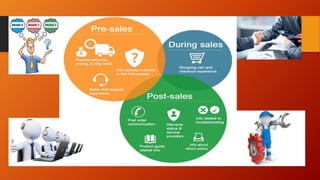
Service Marketing
By
Abhishek Kanojia
Adnan Sara
Ajay Gupta
Altamash Ansari
Amit Walawalker
Ammar Rumane
What are services
• Services are deeds, processes, and performances
provided by one entity or person for another entity or
person
• “…All economic activities whose output is not a physical
product, and is generally consumed at the time it is
produced, provides added value in forms that are
essentially intangible concerns of its first purchaser
(convenience, health, comfort, amusement)…”
• Examples : The core offerings of hospitals, hotels, banks
and utilities are primarily deeds and actions performed for
customers
Characteristics of services (IHIP)
• Intangibility
Because services are performances or actions rather than objects they cannot
be seen, felt, tasted, or touched in the same manner that you can sense
tangible goods
Example : Heath care services are actions performed by the providers and
directed towards patients and their families
This services cannot be seen or touched by the patient
• Heterogeneity
Because services are performances, frequently produced by humans no two
services will be alike
The features of service by a provider cannot be uniform or standardised
Example : A Doctor can charge much higher fee to a rich client and take much
low from a poor patient.
• Inseparability
Personal service cannot be separated from the individual and some
personalized services are created and consumed simultaneously
Example : Hair cut is not possible without the presence of an individual
A doctor can only treat when his patient is present
• Perishability
Perishability refers to the fact that services cannot be saved, stored, or returned.
Example : A seat on an airplane or in a restaurant, or space in a shipping
container not used or purchased cannot be reclaimed and used or resold at a
later time
Importance of services sector
• Contribution to Gross Domestic Product
• Employment opportunities
• Contribution to Exports
• Helpful in Development of Infrastructure and Communication
Services
• FDI Inflows
• Nurturing IT/ITes sector as young sector
• Support to other sectors
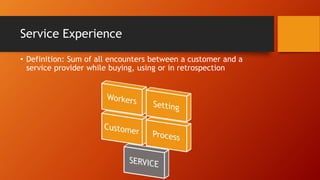
Service Experience
• Definition: Sum of all encounters between a customer and a
service provider while buying, using or in retrospection
Service Experience
• Service Workers : A service worker is a person who provides a
service to other people, like a waiter or waitress
• Service Settings : Totality of the ambience and physical
environment in which a service occurs
• Service Customer : The actual individual who wants the service
• Service Process : Process in services refers to the actual
procedures, mechanisms, and flow of activities by which the
service is delivered
Service Experience Example Banking
• Workers : Are the Actual Staff members who work in the Bank
• Settings : Layout of the bank, Infrastructure, Ambience, etc
• Process : The actual process through the customer has to go
through to avail a service
• Customer : Person who is availing the service in the bank
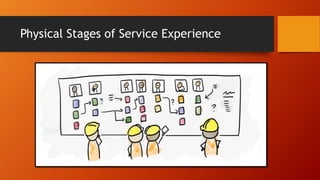
Physical Stages of Service Experience
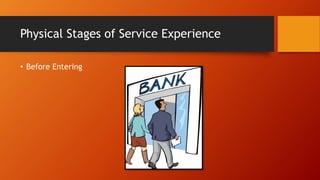
• Before Entering
Physical Stages of Service Experience
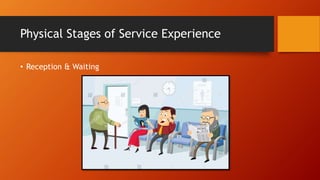
• Reception & Waiting
Physical Stages of Service Experience
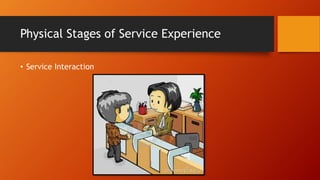
• Service Interaction
Physical Stages of Service Experience
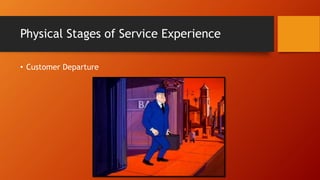
• Customer Departure
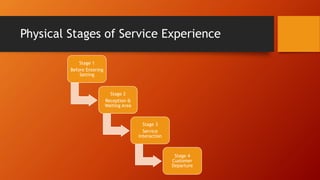
Physical Stages of Service Experience
Stage 1
Before Entering
Setting
Stage 2
Reception &
Waiting Area
Stage 3
Service
Interaction
Stage 4
Customer
Departure
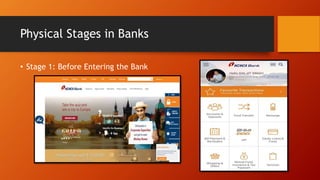
Physical Stages in Banks
• Stage 1: Before Entering the Bank
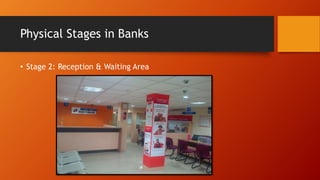
Physical Stages in Banks
• Stage 2: Reception & Waiting Area
Physical Stages in Banks
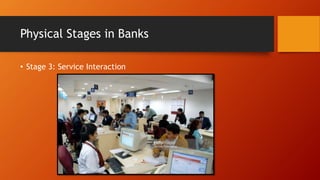
• Stage 3: Service Interaction
Physical Stages in Banks
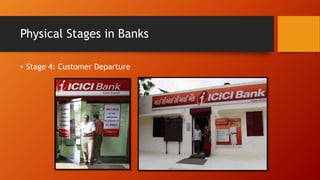
• Stage 4: Customer Departure
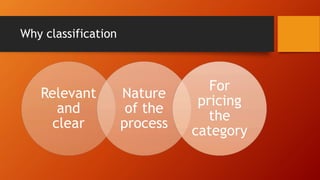
Why classification
Relevant
and
clear
Nature
of the
process
For
pricing
the
category
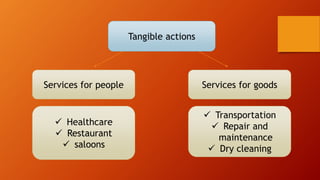
Tangible actions
Services for people Services for goods
 Healthcare
 Restaurant
 saloons
 Transportation
 Repair and
maintenance
 Dry cleaning
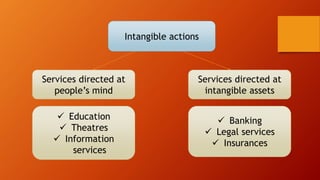
Intangible actions
Services directed at
people’s mind
Services directed at
intangible assets
 Education
 Theatres
 Information
services
 Banking
 Legal services
 Insurances
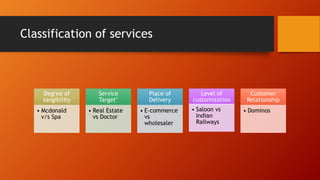
Classification of services
Degree of
tangibility
• Mcdonald
v/s Spa
Service
Target’
• Real Estate
vs Doctor
Place of
Delivery
• E-commerce
vs
wholesaler
Level of
customization
• Saloon vs
Indian
Railways
Customer
Relationship
• Dominos
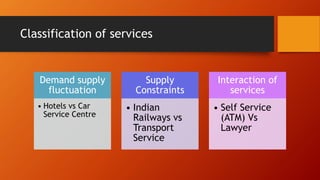
Classification of services
Demand supply
fluctuation
• Hotels vs Car
Service Centre
Supply
Constraints
• Indian
Railways vs
Transport
Service
Interaction of
services
• Self Service
(ATM) Vs
Lawyer
CONSUMER BUYING DECISION STAGES
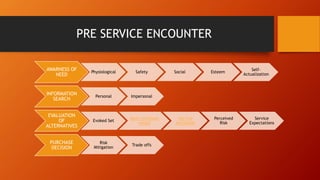
PRE SERVICE ENCOUNTER
AWARNESS OF
NEED
Physiological Safety Social Esteem
Self-
Actualization
INFORMATION
SEARCH
Personal Impersonal
EVALUATION
OF
ALTERNATIVES
Evoked Set
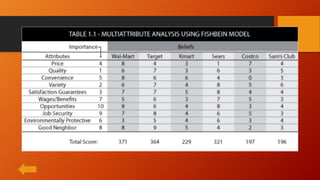
Multi-attribute
model
Service
Attributes
Perceived
Risk
Service
Expectations
PURCHASE
DECISION
Risk
Mitigation
Trade offs
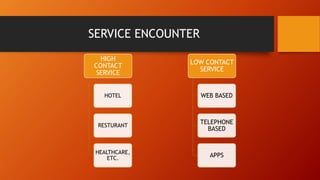
SERVICE ENCOUNTER
HIGH
CONTACT
SERVICE
HOTEL
RESTURANT
HEALTHCARE,
ETC.
LOW CONTACT
SERVICE
WEB BASED
TELEPHONE
BASED
APPS
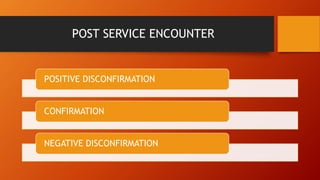
POST SERVICE ENCOUNTER
POSITIVE DISCONFIRMATION
CONFIRMATION
NEGATIVE DISCONFIRMATION
Classification of Services

Classification of Services

  • 1.
    Service Marketing By Abhishek Kanojia AdnanSara Ajay Gupta Altamash Ansari Amit Walawalker Ammar Rumane
  • 2.
    What are services •Services are deeds, processes, and performances provided by one entity or person for another entity or person • “…All economic activities whose output is not a physical product, and is generally consumed at the time it is produced, provides added value in forms that are essentially intangible concerns of its first purchaser (convenience, health, comfort, amusement)…” • Examples : The core offerings of hospitals, hotels, banks and utilities are primarily deeds and actions performed for customers
  • 3.
    Characteristics of services(IHIP) • Intangibility Because services are performances or actions rather than objects they cannot be seen, felt, tasted, or touched in the same manner that you can sense tangible goods Example : Heath care services are actions performed by the providers and directed towards patients and their families This services cannot be seen or touched by the patient • Heterogeneity Because services are performances, frequently produced by humans no two services will be alike The features of service by a provider cannot be uniform or standardised Example : A Doctor can charge much higher fee to a rich client and take much low from a poor patient.
  • 4.
    • Inseparability Personal servicecannot be separated from the individual and some personalized services are created and consumed simultaneously Example : Hair cut is not possible without the presence of an individual A doctor can only treat when his patient is present • Perishability Perishability refers to the fact that services cannot be saved, stored, or returned. Example : A seat on an airplane or in a restaurant, or space in a shipping container not used or purchased cannot be reclaimed and used or resold at a later time
  • 5.
    Importance of servicessector • Contribution to Gross Domestic Product • Employment opportunities • Contribution to Exports • Helpful in Development of Infrastructure and Communication Services • FDI Inflows • Nurturing IT/ITes sector as young sector • Support to other sectors
  • 6.
    Service Experience • Definition:Sum of all encounters between a customer and a service provider while buying, using or in retrospection
  • 7.
    Service Experience • ServiceWorkers : A service worker is a person who provides a service to other people, like a waiter or waitress • Service Settings : Totality of the ambience and physical environment in which a service occurs • Service Customer : The actual individual who wants the service • Service Process : Process in services refers to the actual procedures, mechanisms, and flow of activities by which the service is delivered
  • 8.
    Service Experience ExampleBanking • Workers : Are the Actual Staff members who work in the Bank • Settings : Layout of the bank, Infrastructure, Ambience, etc • Process : The actual process through the customer has to go through to avail a service • Customer : Person who is availing the service in the bank
  • 9.
    Physical Stages ofService Experience
  • 10.
    Physical Stages ofService Experience • Before Entering
  • 11.
    Physical Stages ofService Experience • Reception & Waiting
  • 12.
    Physical Stages ofService Experience • Service Interaction
  • 13.
    Physical Stages ofService Experience • Customer Departure
  • 14.
    Physical Stages ofService Experience Stage 1 Before Entering Setting Stage 2 Reception & Waiting Area Stage 3 Service Interaction Stage 4 Customer Departure
  • 15.
    Physical Stages inBanks • Stage 1: Before Entering the Bank
  • 16.
    Physical Stages inBanks • Stage 2: Reception & Waiting Area
  • 17.
    Physical Stages inBanks • Stage 3: Service Interaction
  • 18.
    Physical Stages inBanks • Stage 4: Customer Departure
  • 19.
  • 20.
    Tangible actions Services forpeople Services for goods  Healthcare  Restaurant  saloons  Transportation  Repair and maintenance  Dry cleaning
  • 21.
    Intangible actions Services directedat people’s mind Services directed at intangible assets  Education  Theatres  Information services  Banking  Legal services  Insurances
  • 22.
    Classification of services Degreeof tangibility • Mcdonald v/s Spa Service Target’ • Real Estate vs Doctor Place of Delivery • E-commerce vs wholesaler Level of customization • Saloon vs Indian Railways Customer Relationship • Dominos
  • 23.
    Classification of services Demandsupply fluctuation • Hotels vs Car Service Centre Supply Constraints • Indian Railways vs Transport Service Interaction of services • Self Service (ATM) Vs Lawyer
  • 24.
  • 26.
    PRE SERVICE ENCOUNTER AWARNESSOF NEED Physiological Safety Social Esteem Self- Actualization INFORMATION SEARCH Personal Impersonal EVALUATION OF ALTERNATIVES Evoked Set Multi-attribute model Service Attributes Perceived Risk Service Expectations PURCHASE DECISION Risk Mitigation Trade offs
  • 27.
  • 28.
    POST SERVICE ENCOUNTER POSITIVEDISCONFIRMATION CONFIRMATION NEGATIVE DISCONFIRMATION