Sequencing problem
• Thistopic concentrates on the problem of
determining the sequence (order) in which a
number of jobs should be performed on
different machines in order to make effective
use of available facilities and achieve greater
output.
3.
Sequencing problem
• Forexample, consider a sequencing problem
where n jobs are to be performed on m
different machines. In such a case, our problem
is to determine the sequence, which minimizes
the total elapsed time.
• Here, the term elapsed time means the time
from the start of first job upto the completion
of the last job.
4.
Sequencing problem
In thischapter, we discuss the following cases:
1) Processing n jobs through two machines
2) Processing n jobs through three machines
3) Processing two jobs through m machines
5.
Sequencing problem
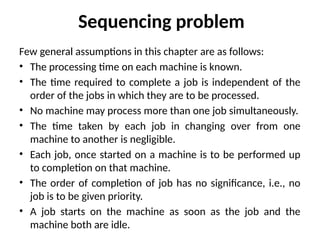
Few generalassumptions in this chapter are as follows:
• The processing time on each machine is known.
• The time required to complete a job is independent of the
order of the jobs in which they are to be processed.
• No machine may process more than one job simultaneously.
• The time taken by each job in changing over from one
machine to another is negligible.
• Each job, once started on a machine is to be performed up
to completion on that machine.
• The order of completion of job has no significance, i.e., no
job is to be given priority.
• A job starts on the machine as soon as the job and the
machine both are idle.
6.
Sequencing problem
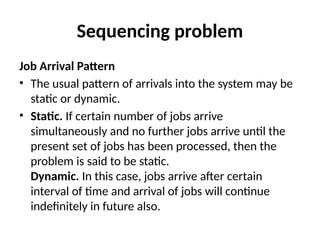
Job ArrivalPattern
• The usual pattern of arrivals into the system may be
static or dynamic.
• Static. If certain number of jobs arrive
simultaneously and no further jobs arrive until the
present set of jobs has been processed, then the
problem is said to be static.
Dynamic. In this case, jobs arrive after certain
interval of time and arrival of jobs will continue
indefinitely in future also.
7.
Sequencing problem
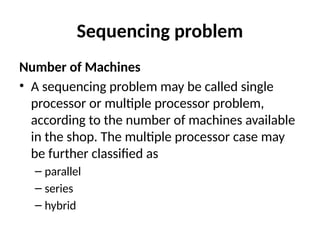
Number ofMachines
• A sequencing problem may be called single
processor or multiple processor problem,
according to the number of machines available
in the shop. The multiple processor case may
be further classified as
– parallel
– series
– hybrid
8.
Sequencing problem
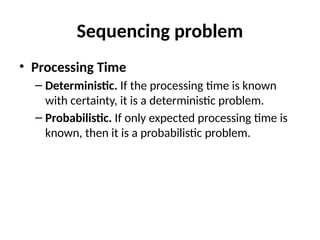
• ProcessingTime
– Deterministic. If the processing time is known
with certainty, it is a deterministic problem.
– Probabilistic. If only expected processing time is
known, then it is a probabilistic problem.
9.
Processing n JobsThrough Two Machines
• Suppose n jobs are to be processed on two
machines, say A & B.
• Each job has to pass through the same
sequence of operations in the same order, i.e.,
passing is not allowed.
10.
Processing n JobsThrough Two Machines
• After a job is completely processed on machine A, it is
assigned to machine B. If machine B is not free at that
moment, then the job enters the waiting queue. Each job
from the waiting queue is assigned to machine B according
to FIFO discipline. Let
Ai = Processing time for ith
job on machine A
Bi = Processing time for ith
job on machine B
T = Total elapsed time
• The problem here is to determine the sequence in which
these n jobs should be processed through A & B, so that
the total elapsed time (T) is minimum.
11.
Processing n JobsThrough Two Machines
Optimal Sequence Algorithm
• The best technique for determining an optimal
sequence was developed by Johnson &
Bellman, which is discussed below.
12.
Processing n JobsThrough Two Machines
Steps
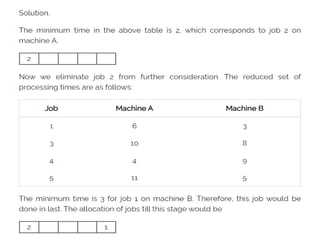
• Select the minimum processing time out of all the Ai's and Bi's. If it is Ar
then do the rth job first. If it is Bs then do the sth job in last.
• If there is a tie in selecting minimum of all the processing times, then there
are following three ways to deal with such a situation:
– If the minimum of all the processing times is Ar, which is also equal to
Bs.
That is, Min (Ai, Bi) = Ar = Bs
Then do the rth job first and sth job in last.
– If Min (Ai, Bi) = Ar, but Ar = Ak, i.e., there is a tie for minimum among Ai's,
then select any one.
– If Min (Ai, Bi) = Bs, but Bs = Bt, i.e., there is a tie for minimum among Bi's,
then select any one.
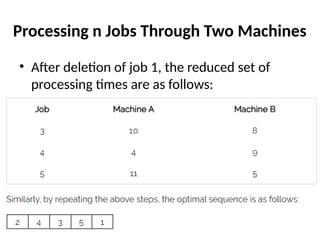
• Now eliminate the job which has already been assigned from further
consideration, and repeat steps 1 and 2 until an optimal sequence is found.
13.
Processing n JobsThrough Two Machines
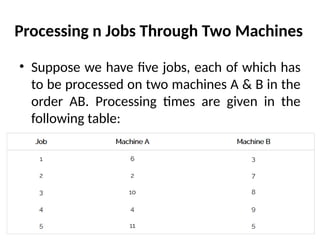
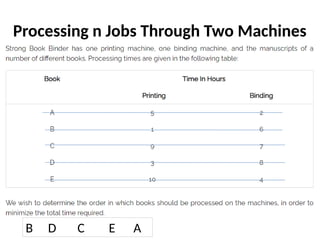
• Suppose we have five jobs, each of which has
to be processed on two machines A & B in the
order AB. Processing times are given in the
following table:
14.
Processing n JobsThrough Two Machines
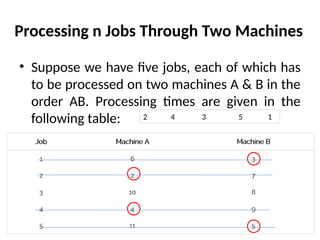
• Suppose we have five jobs, each of which has
to be processed on two machines A & B in the
order AB. Processing times are given in the
following table: 2 4 3 5 1
15.
Processing n JobsThrough Two Machines
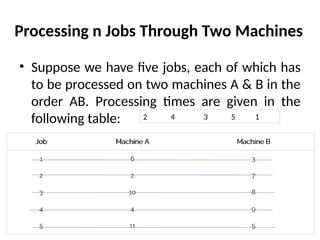
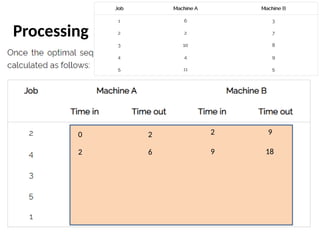
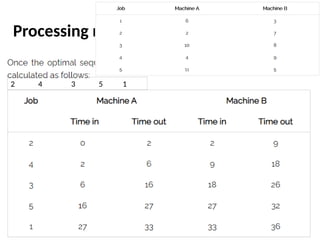
• Suppose we have five jobs, each of which has
to be processed on two machines A & B in the
order AB. Processing times are given in the
following table: 2 4 3 5 1
16.
Processing n JobsThrough Two Machines
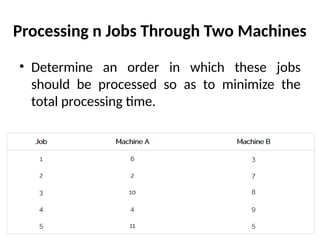
• Determine an order in which these jobs
should be processed so as to minimize the
total processing time.
Processing n JobsThrough Two Machines
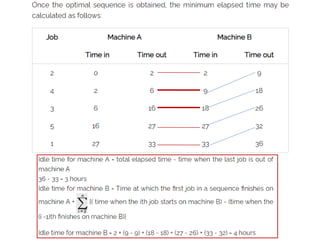
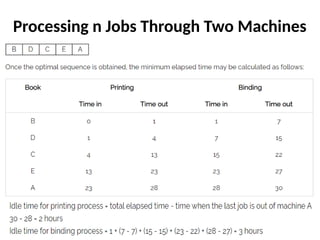
• Idle time for printing process = total elapsed
time - time when the last job is out of machine
A
30 - 28 = 2 hours
Idle time for binding process = 1 + (7 - 7) + (15
- 15) + (23 - 22) + (28 - 27) = 3 hours
24.
Processing n JobsThrough Three Machines
• This case is similar to the previous case except
that instead of two machines, there are three
machines.
• Problems falling under this category can be
solved by the method developed by Johnson.
25.
Processing n JobsThrough Three Machines
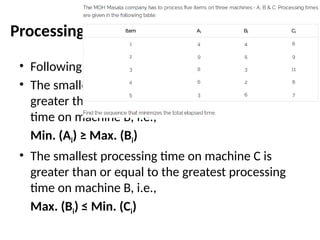
• Following are the two conditions of this approach:
• The smallest processing time on machine A is
greater than or equal to the greatest processing
time on machine B, i.e.,
Min. (Ai) ≥ Max. (Bi)
• The smallest processing time on machine C is
greater than or equal to the greatest processing
time on machine B, i.e.,
Max. (Bi) ≤ Min. (Ci)