


Seq2seq
...and beyond
Hello!I am Roberto Silveira
EE engineer, ML enthusiast
rsilveira79@gmail.com
@rsilveira79
Sequence
Is a matter of time
RNN
Is what you need!
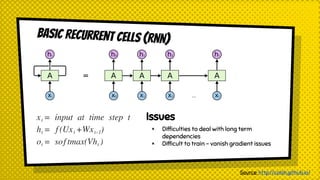
Basic Recurrent cells (RNN)
Source: http://colah.github.io/
Issues
× Difficulties to deal with long term
dependencies
× Difficult to train - vanish gradient issues
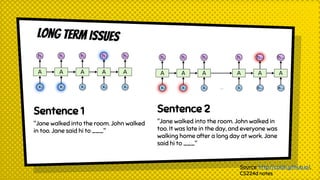
Long term issues
Source: http://colah.github.io/,
CS224d notes
Sentence 1
"Jane walked into the room. John walked
in too. Jane said hi to ___"
Sentence 2
"Jane walked into the room. John walked in
too. It was late in the day, and everyone was
walking home after a long day at work. Jane
said hi to ___"
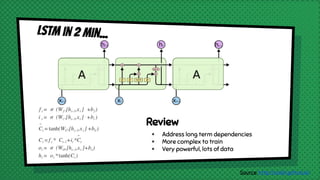
LSTM in 2 min...
Review
× Address long term dependencies
× More complex to train
× Very powerful, lots of data
Source: http://colah.github.io/
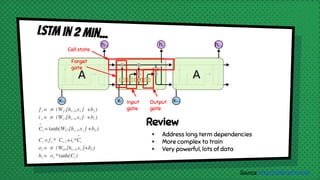
LSTM in 2 min...
Review
× Address long term dependencies
× More complex to train
× Very powerful, lots of data
Cell state
Source: http://colah.github.io/
Forget
gate
Input
gate
Output
gate
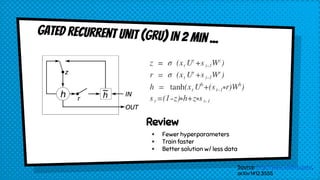
Gated recurrent unit (GRU) in 2 min ...
Review
× Fewer hyperparameters
× Train faster
× Better solution w/ less data
Source: http://www.wildml.com/,
arXiv:1412.3555
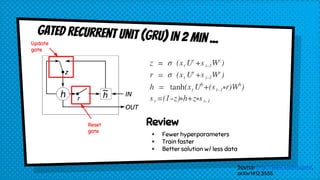
Gated recurrent unit (GRU) in 2 min ...
Review
× Fewer hyperparameters
× Train faster
× Better solution w/ less data
Source: http://www.wildml.com/,
arXiv:1412.3555
Reset
gate
Update
gate
Seq2seq
learning
Or encoder-decoder
architectures
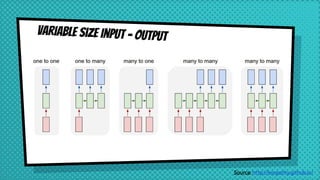
Variable size input - output
Source: http://karpathy.github.io/
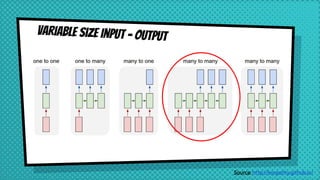
Variable size input - output
Source: http://karpathy.github.io/
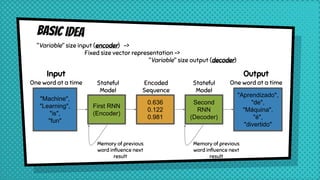
Basic idea
"Variable" size input (encoder) ->
Fixed size vector representation ->
"Variable" size output (decoder)
"Machine",
"Learning",
"is",
"fun"
"Aprendizado",
"de",
"Máquina",
"é",
"divertido"
0.636
0.122
0.981
Input
One word at a time Stateful
Model
Stateful
Model
Encoded
Sequence
Output
One word at a time
First RNN
(Encoder)
Second
RNN
(Decoder)
Memory of previous
word influence next
result
Memory of previous
word influence next
result
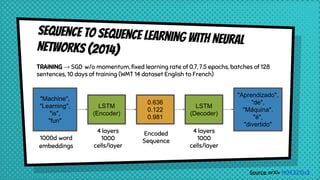
Sequence to Sequence Learning with NeuralNetworks (2014)
"Machine",
"Learning",
"is",
"fun"
"Aprendizado",
"de",
"Máquina",
"é",
"divertido"
0.636
0.122
0.981
1000d word
embeddings
4 layers
1000
cells/layer
Encoded
Sequence
LSTM
(Encoder)
LSTM
(Decoder)
Source: arXiv 1409.3215v3
TRAINING → SGD w/o momentum, fixed learning rate of 0.7, 7.5 epochs, batches of 128
sentences, 10 days of training (WMT 14 dataset English to French)
4 layers
1000
cells/layer
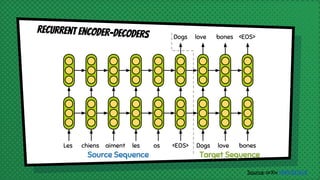
Recurrent encoder-decoders
Les chiens aiment les os <EOS> Dogs love bones
Dogs love bones <EOS>
Source Sequence Target Sequence
Source: arXiv 1409.3215v3
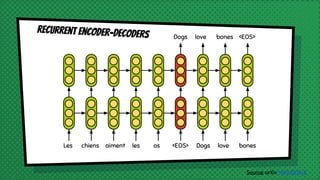
Recurrent encoder-decoders
Les chiens aiment les os <EOS> Dogs love bones
Dogs love bones <EOS>
Source: arXiv 1409.3215v3
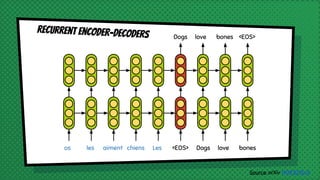
Recurrent encoder-decoders
Leschiensaimentlesos <EOS> Dogs love bones
Dogs love bones <EOS>
Source: arXiv 1409.3215v3
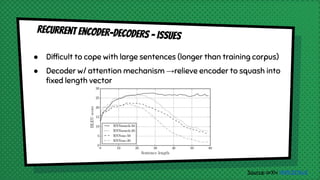
Recurrent encoder-decoders - issues
● Difficult to cope with large sentences (longer than training corpus)
● Decoder w/ attention mechanism →relieve encoder to squash into
fixed length vector
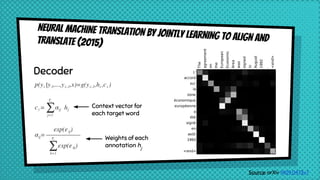
NEURAL MACHINE TRANSLATION BY JOINTLY LEARNING TO ALIGN ANDTRANSLATE (2015)
Source: arXiv 1409.0473v7
Decoder
Context vector for
each target word
Weights of each
annotation hj
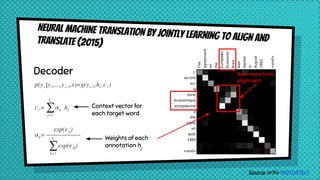
NEURAL MACHINE TRANSLATION BY JOINTLY LEARNING TO ALIGN ANDTRANSLATE (2015)
Source: arXiv 1409.0473v7
Decoder
Context vector for
each target word
Weights of each
annotation hj
Non-monotonic
alignment
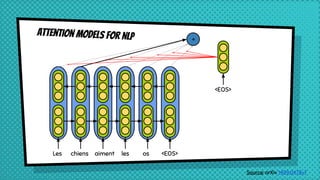
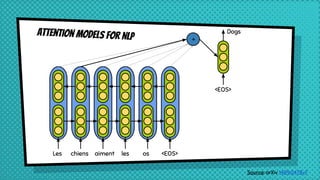
Attention models for NLP
Source: arXiv 1409.0473v7
Les chiens aiment les os <EOS>
+
<EOS>
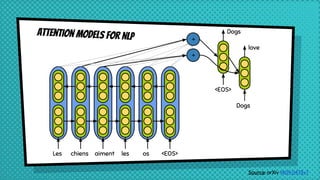
Attention models for NLP
Source: arXiv 1409.0473v7
Les chiens aiment les os <EOS>
+
<EOS>
Dogs
Attention models for NLP
Source: arXiv 1409.0473v7
Les chiens aiment les os <EOS>
+
<EOS>
Dogs
Dogs
love
+
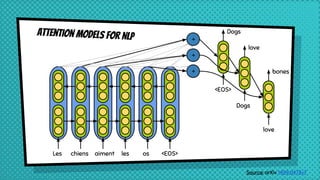
Attention models for NLP
Source: arXiv 1409.0473v7
Les chiens aiment les os <EOS>
+
<EOS>
Dogs
Dogs
love
+
love
bones+
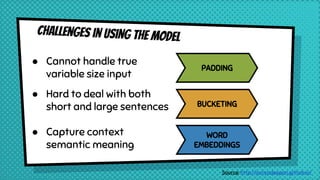
Challenges in using the model
● Cannot handle true
variable size input
Source: http://suriyadeepan.github.io/
PADDING
BUCKETING
WORD
EMBEDDINGS
● Capture context
semantic meaning
● Hard to deal with both
short and large sentences
padding
Source: http://suriyadeepan.github.io/
EOS : End of sentence
PAD : Filler
GO : Start decoding
UNK : Unknown; word not in vocabulary
Q : "What time is it? "
A : "It is seven thirty."
Q : [ PAD, PAD, PAD, PAD, PAD, “?”, “it”,“is”, “time”, “What” ]
A : [ GO, “It”, “is”, “seven”, “thirty”, “.”, EOS, PAD, PAD, PAD ]
Source: https://www.tensorflow.org/
bucketing
Efficiently handle sentences of different lengths
Ex: 100 tokens is the largest sentence in corpus
How about short sentences like: "How are you?" → lots of PAD
Bucket list: [(5, 10), (10, 15), (20, 25), (40, 50)]
(defaut on Tensorflow translate.py)
Q : [ PAD, PAD, “.”, “go”,“I”]
A : [GO "Je" "vais" "." EOS PAD PAD PAD PAD PAD]
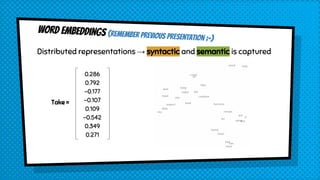
Word embeddings (remember previous presentation ;-)
Distributed representations → syntactic and semantic is captured
Take =
0.286
0.792
-0.177
-0.107
0.109
-0.542
0.349
0.271
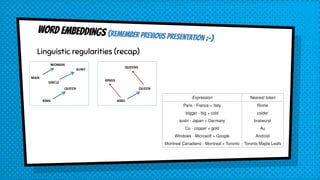
Word embeddings (remember previous presentation ;-)
Linguistic regularities (recap)
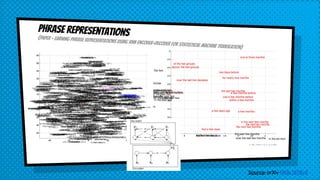
Phrase representations(Paper - earning Phrase Representations using RNN Encoder–Decoder for Statistical Machine Translation)
Source: arXiv 1406.1078v3
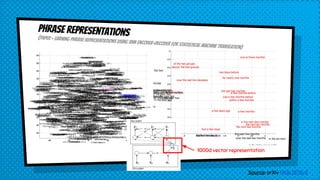
Phrase representations(Paper - earning Phrase Representations using RNN Encoder–Decoder for Statistical Machine Translation)
Source: arXiv 1406.1078v3
1000d vector representation
applications
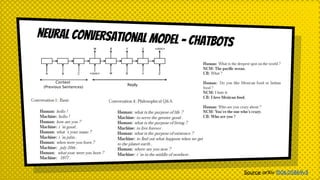
Neural conversational model - chatbots
Source: arXiv 1506.05869v3
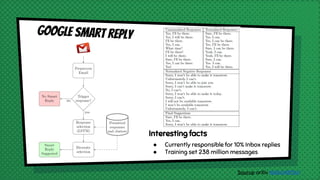
Google Smart reply
Google Smart reply
Source: arXiv 1606.04870v1
Interesting facts
● Currently responsible for 10% Inbox replies
● Training set 238 million messages
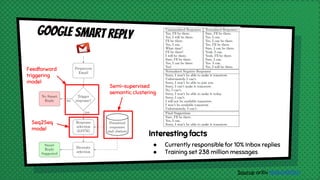
Google Smart reply
Source: arXiv 1606.04870v1
Seq2Seq
model
Interesting facts
● Currently responsible for 10% Inbox replies
● Training set 238 million messages
Feedforward
triggering
model
Semi-supervised
semantic clustering
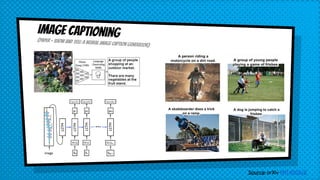
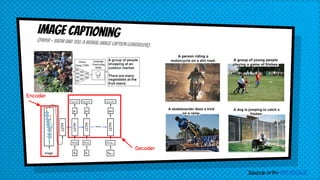
Image captioning(Paper - Show and Tell: A Neural Image Caption Generator)
Source: arXiv 1411.4555v2
Image captioning(Paper - Show and Tell: A Neural Image Caption Generator)
Encoder
Decoder
Source: arXiv 1411.4555v2
What's next?
And so?
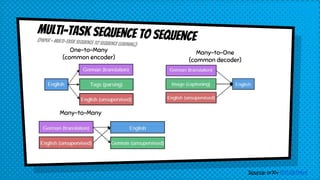
Multi-task sequence to sequence(Paper - MULTI-TASK SEQUENCE TO SEQUENCE LEARNING)
Source: arXiv 1511.06114v4
One-to-Many
(common encoder)
Many-to-One
(common decoder)
Many-to-Many
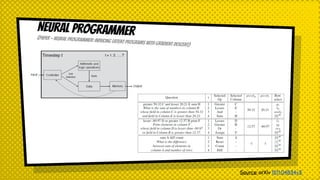
Neural programmer(Paper - NEURAL PROGRAMMER: INDUCING LATENT PROGRAMS WITH GRADIENT DESCENT)
Source: arXiv 1511.04834v3
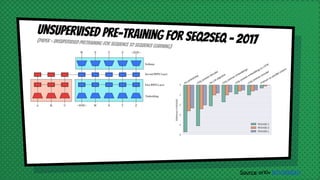
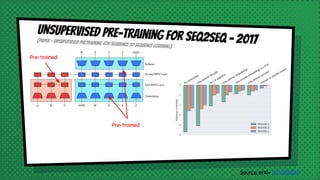
Unsupervised pre-training for seq2seq - 2017(Paper - UNSUPERVISED PRETRAINING FOR SEQUENCE TO SEQUENCE LEARNING)
Source: arXiv 1611.02683v1
Unsupervised pre-training for seq2seq - 2017(Paper - UNSUPERVISED PRETRAINING FOR SEQUENCE TO SEQUENCE LEARNING)
Source: arXiv 1611.02683v1
Pre-trained
Pre-trained
THANKS!
rsilveira79@gmail.com
@rsilveira79
Place your screenshot here
A Quick
example on
tensorflow

Sequence to sequence (encoder-decoder) learning

  • 1.
  • 2.
    Hello!I am RobertoSilveira EE engineer, ML enthusiast rsilveira79@gmail.com @rsilveira79
  • 3.
  • 4.
  • 5.
    Basic Recurrent cells(RNN) Source: http://colah.github.io/ Issues × Difficulties to deal with long term dependencies × Difficult to train - vanish gradient issues
  • 6.
    Long term issues Source:http://colah.github.io/, CS224d notes Sentence 1 "Jane walked into the room. John walked in too. Jane said hi to ___" Sentence 2 "Jane walked into the room. John walked in too. It was late in the day, and everyone was walking home after a long day at work. Jane said hi to ___"
  • 7.
    LSTM in 2min... Review × Address long term dependencies × More complex to train × Very powerful, lots of data Source: http://colah.github.io/
  • 8.
    LSTM in 2min... Review × Address long term dependencies × More complex to train × Very powerful, lots of data Cell state Source: http://colah.github.io/ Forget gate Input gate Output gate
  • 9.
    Gated recurrent unit(GRU) in 2 min ... Review × Fewer hyperparameters × Train faster × Better solution w/ less data Source: http://www.wildml.com/, arXiv:1412.3555
  • 10.
    Gated recurrent unit(GRU) in 2 min ... Review × Fewer hyperparameters × Train faster × Better solution w/ less data Source: http://www.wildml.com/, arXiv:1412.3555 Reset gate Update gate
  • 11.
  • 12.
    Variable size input- output Source: http://karpathy.github.io/
  • 13.
    Variable size input- output Source: http://karpathy.github.io/
  • 14.
    Basic idea "Variable" sizeinput (encoder) -> Fixed size vector representation -> "Variable" size output (decoder) "Machine", "Learning", "is", "fun" "Aprendizado", "de", "Máquina", "é", "divertido" 0.636 0.122 0.981 Input One word at a time Stateful Model Stateful Model Encoded Sequence Output One word at a time First RNN (Encoder) Second RNN (Decoder) Memory of previous word influence next result Memory of previous word influence next result
  • 15.
    Sequence to SequenceLearning with NeuralNetworks (2014) "Machine", "Learning", "is", "fun" "Aprendizado", "de", "Máquina", "é", "divertido" 0.636 0.122 0.981 1000d word embeddings 4 layers 1000 cells/layer Encoded Sequence LSTM (Encoder) LSTM (Decoder) Source: arXiv 1409.3215v3 TRAINING → SGD w/o momentum, fixed learning rate of 0.7, 7.5 epochs, batches of 128 sentences, 10 days of training (WMT 14 dataset English to French) 4 layers 1000 cells/layer
  • 16.
    Recurrent encoder-decoders Les chiensaiment les os <EOS> Dogs love bones Dogs love bones <EOS> Source Sequence Target Sequence Source: arXiv 1409.3215v3
  • 17.
    Recurrent encoder-decoders Les chiensaiment les os <EOS> Dogs love bones Dogs love bones <EOS> Source: arXiv 1409.3215v3
  • 18.
    Recurrent encoder-decoders Leschiensaimentlesos <EOS>Dogs love bones Dogs love bones <EOS> Source: arXiv 1409.3215v3
  • 19.
    Source: arXiv 1409.3215v3 Recurrentencoder-decoders - issues ● Difficult to cope with large sentences (longer than training corpus) ● Decoder w/ attention mechanism →relieve encoder to squash into fixed length vector
  • 20.
    NEURAL MACHINE TRANSLATIONBY JOINTLY LEARNING TO ALIGN ANDTRANSLATE (2015) Source: arXiv 1409.0473v7 Decoder Context vector for each target word Weights of each annotation hj
  • 21.
    NEURAL MACHINE TRANSLATIONBY JOINTLY LEARNING TO ALIGN ANDTRANSLATE (2015) Source: arXiv 1409.0473v7 Decoder Context vector for each target word Weights of each annotation hj Non-monotonic alignment
  • 22.
    Attention models forNLP Source: arXiv 1409.0473v7 Les chiens aiment les os <EOS> + <EOS>
  • 23.
    Attention models forNLP Source: arXiv 1409.0473v7 Les chiens aiment les os <EOS> + <EOS> Dogs
  • 24.
    Attention models forNLP Source: arXiv 1409.0473v7 Les chiens aiment les os <EOS> + <EOS> Dogs Dogs love +
  • 25.
    Attention models forNLP Source: arXiv 1409.0473v7 Les chiens aiment les os <EOS> + <EOS> Dogs Dogs love + love bones+
  • 26.
    Challenges in usingthe model ● Cannot handle true variable size input Source: http://suriyadeepan.github.io/ PADDING BUCKETING WORD EMBEDDINGS ● Capture context semantic meaning ● Hard to deal with both short and large sentences
  • 27.
    padding Source: http://suriyadeepan.github.io/ EOS :End of sentence PAD : Filler GO : Start decoding UNK : Unknown; word not in vocabulary Q : "What time is it? " A : "It is seven thirty." Q : [ PAD, PAD, PAD, PAD, PAD, “?”, “it”,“is”, “time”, “What” ] A : [ GO, “It”, “is”, “seven”, “thirty”, “.”, EOS, PAD, PAD, PAD ]
  • 28.
    Source: https://www.tensorflow.org/ bucketing Efficiently handlesentences of different lengths Ex: 100 tokens is the largest sentence in corpus How about short sentences like: "How are you?" → lots of PAD Bucket list: [(5, 10), (10, 15), (20, 25), (40, 50)] (defaut on Tensorflow translate.py) Q : [ PAD, PAD, “.”, “go”,“I”] A : [GO "Je" "vais" "." EOS PAD PAD PAD PAD PAD]
  • 29.
    Word embeddings (rememberprevious presentation ;-) Distributed representations → syntactic and semantic is captured Take = 0.286 0.792 -0.177 -0.107 0.109 -0.542 0.349 0.271
  • 30.
    Word embeddings (rememberprevious presentation ;-) Linguistic regularities (recap)
  • 31.
    Phrase representations(Paper -earning Phrase Representations using RNN Encoder–Decoder for Statistical Machine Translation) Source: arXiv 1406.1078v3
  • 32.
    Phrase representations(Paper -earning Phrase Representations using RNN Encoder–Decoder for Statistical Machine Translation) Source: arXiv 1406.1078v3 1000d vector representation
  • 33.
  • 34.
    Neural conversational model- chatbots Source: arXiv 1506.05869v3
  • 35.
  • 36.
    Google Smart reply Source:arXiv 1606.04870v1 Interesting facts ● Currently responsible for 10% Inbox replies ● Training set 238 million messages
  • 37.
    Google Smart reply Source:arXiv 1606.04870v1 Seq2Seq model Interesting facts ● Currently responsible for 10% Inbox replies ● Training set 238 million messages Feedforward triggering model Semi-supervised semantic clustering
  • 38.
    Image captioning(Paper -Show and Tell: A Neural Image Caption Generator) Source: arXiv 1411.4555v2
  • 39.
    Image captioning(Paper -Show and Tell: A Neural Image Caption Generator) Encoder Decoder Source: arXiv 1411.4555v2
  • 40.
  • 41.
    Multi-task sequence tosequence(Paper - MULTI-TASK SEQUENCE TO SEQUENCE LEARNING) Source: arXiv 1511.06114v4 One-to-Many (common encoder) Many-to-One (common decoder) Many-to-Many
  • 42.
    Neural programmer(Paper -NEURAL PROGRAMMER: INDUCING LATENT PROGRAMS WITH GRADIENT DESCENT) Source: arXiv 1511.04834v3
  • 43.
    Unsupervised pre-training forseq2seq - 2017(Paper - UNSUPERVISED PRETRAINING FOR SEQUENCE TO SEQUENCE LEARNING) Source: arXiv 1611.02683v1
  • 44.
    Unsupervised pre-training forseq2seq - 2017(Paper - UNSUPERVISED PRETRAINING FOR SEQUENCE TO SEQUENCE LEARNING) Source: arXiv 1611.02683v1 Pre-trained Pre-trained
  • 45.
  • 46.
    Place your screenshothere A Quick example on tensorflow