Basics of Autoencoders
-- Ashok Govindarajan
About Myself
● Technologist at Zilogic Systems
● Past experience include algorithm development
and debugging in wireless systems like 2G, 4G,
Satellite
● Using Python as a simulation tool to build
models in WLAN and 5G
● Reachable at ashok@zilogic.com
Contents
● Intro to Autoencoders
● Applications
● Python code walk through
● Conclusion/Take-aways
● References
Intro to Autoencoders
● Autoencoders (AE) are a family of neural networks for which the input is the
same as the output. Primarly, a neural network architecture.
● Part of the unsupervised learning paradigm
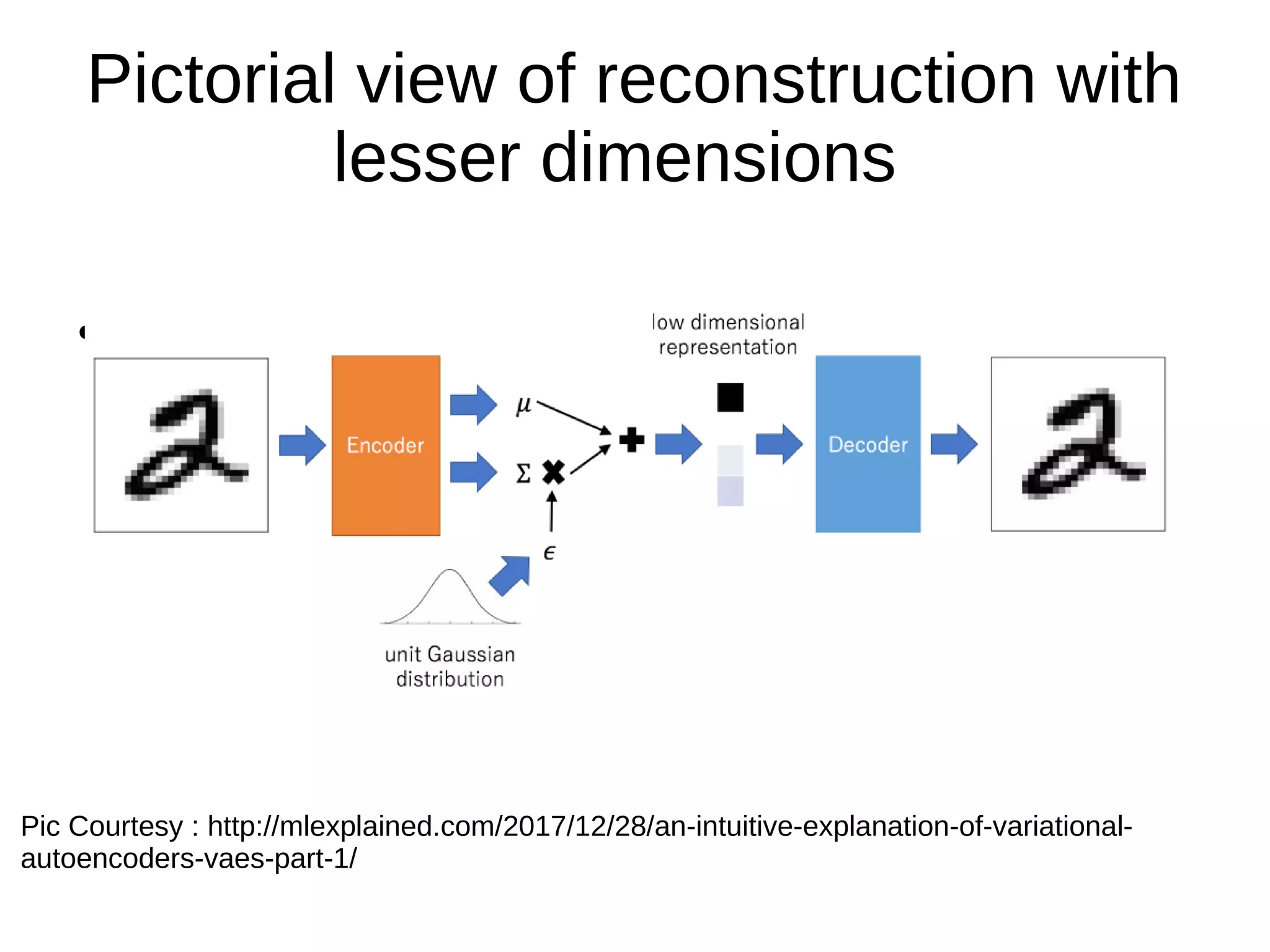
● They work by compressing the input into a lesser dimensional space
representation and then reconstructing the output from this representation.
● Why Autoencoders?
Despite the fact, the practical applications of autoencoders were pretty rare
some time back, today data denoising and dimensionality reduction for
data visualization are considered as two main interesting practical
applications of autoencoders.
● With appropriate dimensionality and sparsity constraints, autoencoders can
learn data projections that are more interesting than PCA or other basic
techniques
How do autoencoders work?
●
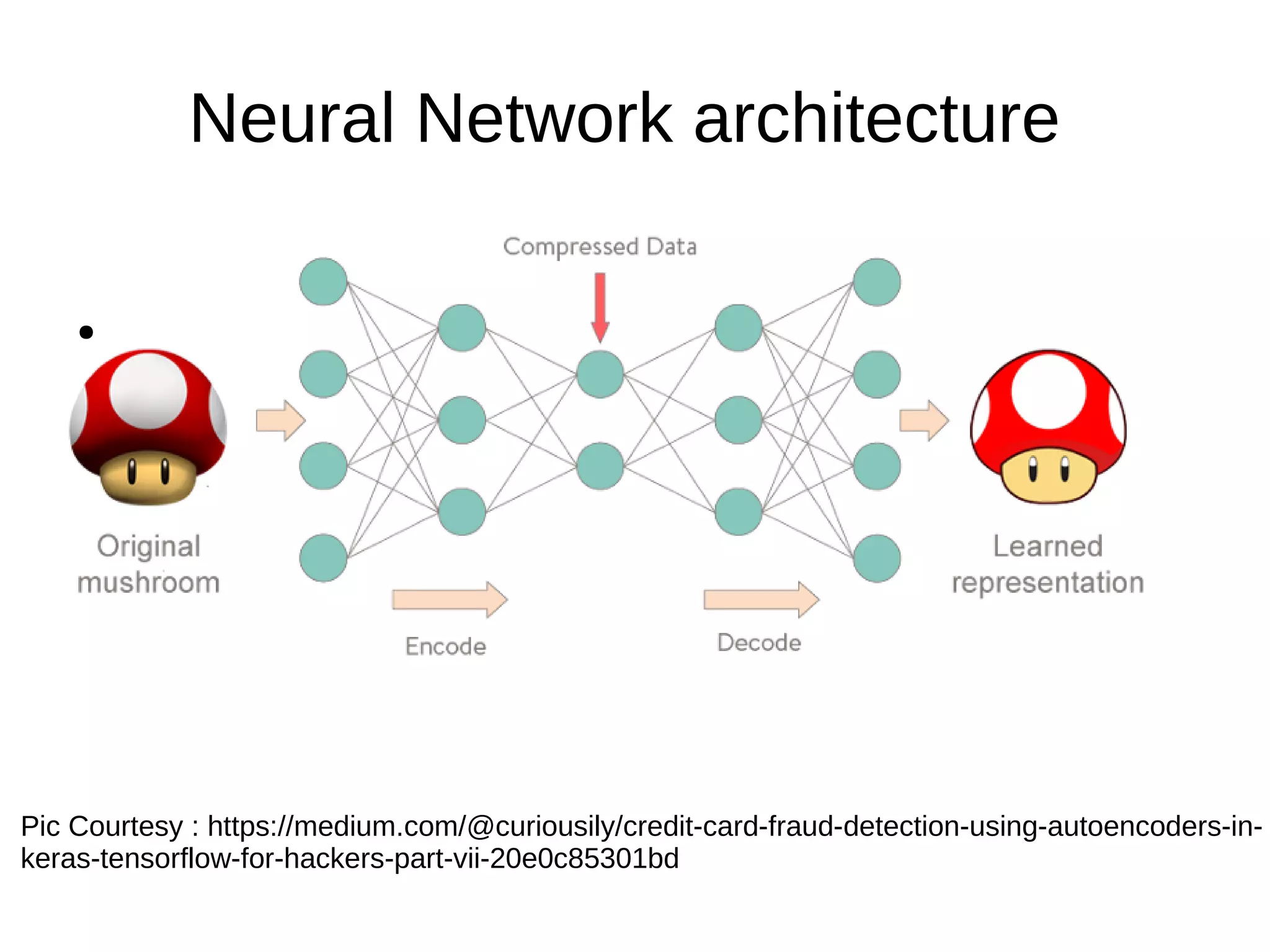
Autoencoders are structured to take an input, transform this input into a
different representation, an embedding of the input.
● From this embedding, it aims to reconstruct the original input as precisely as
possible. It basically tries to copy the input.
●
The layers of the Autoencoder that create this embedding are called the
encoder, and the layers that try to reconstruct the embedding into the original
input are called decoder.
●
Usually Autoencoders are restricted in ways that allow them to copy only
approximately. Because the model is forced to prioritize which aspects of the
input should be copied, it often learns useful properties of the data.
Neural Network architecture
●
Pic Courtesy : https://medium.com/@curiousily/credit-card-fraud-detection-using-autoencoders-in-
keras-tensorflow-for-hackers-part-vii-20e0c85301bd
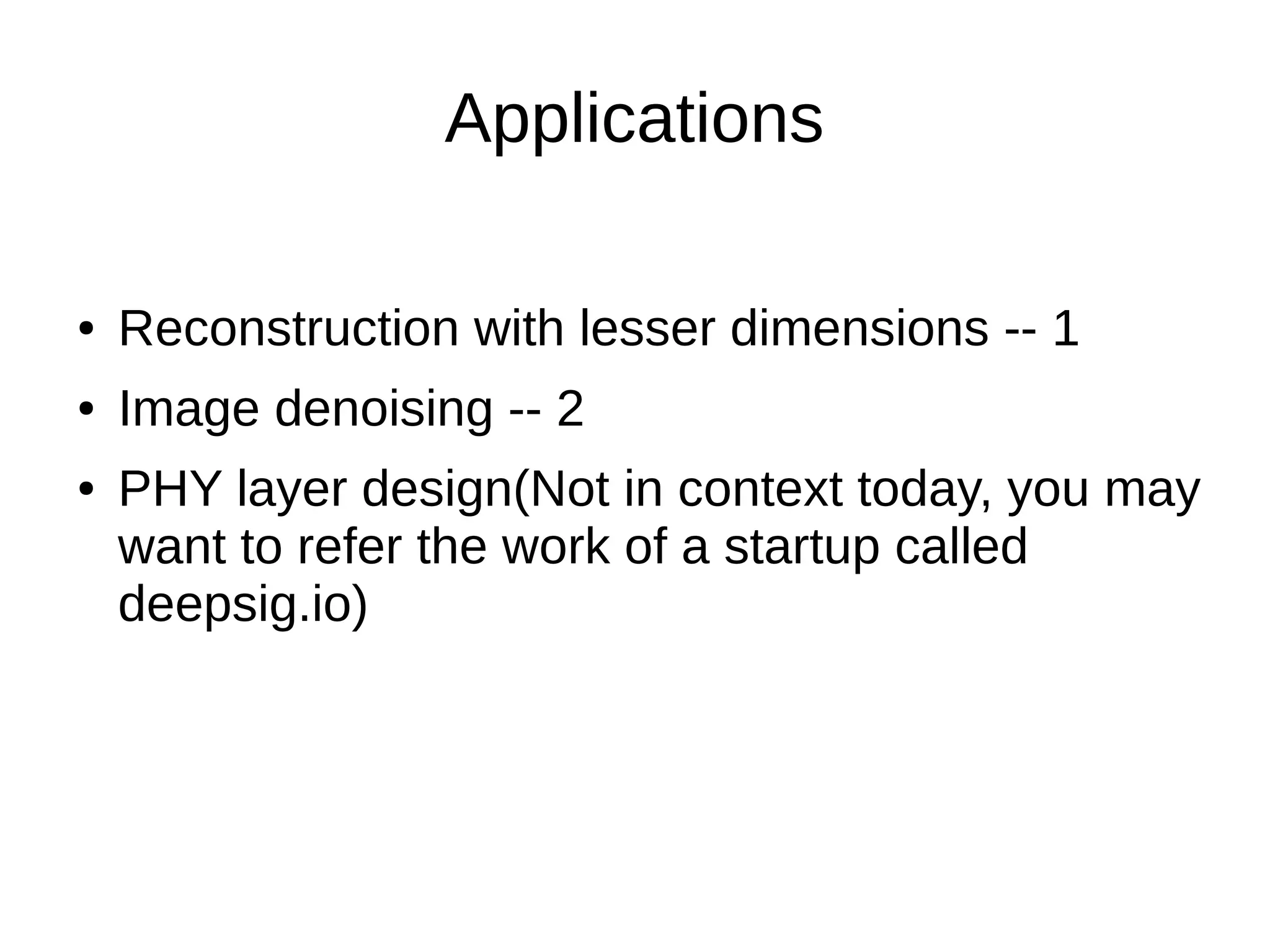
Applications
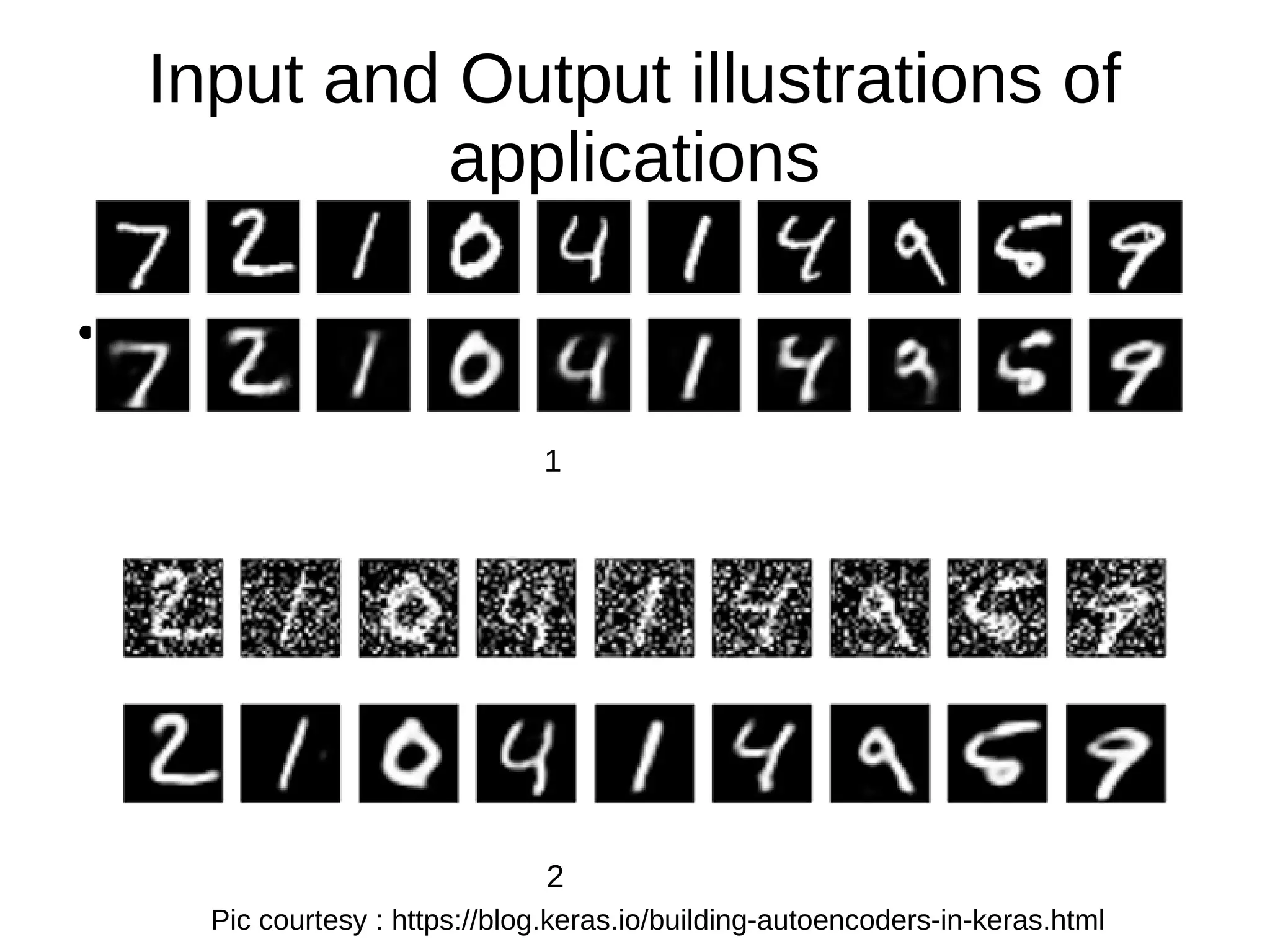
● Reconstruction with lesser dimensions -- 1
● Image denoising -- 2
● PHY layer design(Not in context today, you may
want to refer the work of a startup called
deepsig.io)
Input and Output illustrations of
applications
●
1
2
Pic courtesy : https://blog.keras.io/building-autoencoders-in-keras.html
Pictorial view of reconstruction with
lesser dimensions
●
Pic Courtesy : http://mlexplained.com/2017/12/28/an-intuitive-explanation-of-variational-
autoencoders-vaes-part-1/
Python code for reconstruction with
lesser dimension
● Data prep
● Layer specification
● Compiling and training the autoencoder
● Predicting
● Plotting
Conclusion/Take-aways
● A peek into the world neural networks and in
particular autoencoders
● Framework for moving from away from hand-
engineered algorithms to inference based
● Joint optimisation vs unit-level optimisation
● KPI in GPU context is Inferences per second to
what was formerly instructions per second
References
1)https://blog.keras.io/building-autoencoders-in-
keras.html
2)https://www.deepsig.io/
Thank You

Autoencoders

  • 1.
    Basics of Autoencoders --Ashok Govindarajan
  • 2.
    About Myself ● Technologistat Zilogic Systems ● Past experience include algorithm development and debugging in wireless systems like 2G, 4G, Satellite ● Using Python as a simulation tool to build models in WLAN and 5G ● Reachable at ashok@zilogic.com
  • 3.
    Contents ● Intro toAutoencoders ● Applications ● Python code walk through ● Conclusion/Take-aways ● References
  • 4.
    Intro to Autoencoders ●Autoencoders (AE) are a family of neural networks for which the input is the same as the output. Primarly, a neural network architecture. ● Part of the unsupervised learning paradigm ● They work by compressing the input into a lesser dimensional space representation and then reconstructing the output from this representation. ● Why Autoencoders? Despite the fact, the practical applications of autoencoders were pretty rare some time back, today data denoising and dimensionality reduction for data visualization are considered as two main interesting practical applications of autoencoders. ● With appropriate dimensionality and sparsity constraints, autoencoders can learn data projections that are more interesting than PCA or other basic techniques
  • 5.
    How do autoencoderswork? ● Autoencoders are structured to take an input, transform this input into a different representation, an embedding of the input. ● From this embedding, it aims to reconstruct the original input as precisely as possible. It basically tries to copy the input. ● The layers of the Autoencoder that create this embedding are called the encoder, and the layers that try to reconstruct the embedding into the original input are called decoder. ● Usually Autoencoders are restricted in ways that allow them to copy only approximately. Because the model is forced to prioritize which aspects of the input should be copied, it often learns useful properties of the data.
  • 6.
    Neural Network architecture ● PicCourtesy : https://medium.com/@curiousily/credit-card-fraud-detection-using-autoencoders-in- keras-tensorflow-for-hackers-part-vii-20e0c85301bd
  • 7.
    Applications ● Reconstruction withlesser dimensions -- 1 ● Image denoising -- 2 ● PHY layer design(Not in context today, you may want to refer the work of a startup called deepsig.io)
  • 8.
    Input and Outputillustrations of applications ● 1 2 Pic courtesy : https://blog.keras.io/building-autoencoders-in-keras.html
  • 9.
    Pictorial view ofreconstruction with lesser dimensions ● Pic Courtesy : http://mlexplained.com/2017/12/28/an-intuitive-explanation-of-variational- autoencoders-vaes-part-1/
  • 10.
    Python code forreconstruction with lesser dimension ● Data prep ● Layer specification ● Compiling and training the autoencoder ● Predicting ● Plotting
  • 11.
    Conclusion/Take-aways ● A peekinto the world neural networks and in particular autoencoders ● Framework for moving from away from hand- engineered algorithms to inference based ● Joint optimisation vs unit-level optimisation ● KPI in GPU context is Inferences per second to what was formerly instructions per second
  • 12.
  • 13.