














Sepsis :
Is a clinical syndrome of life-
threatening organ dysfunction
caused by a dysregulated
response to infection
:Septic shocks
Is a subset of sepsis with significantly
increased mortality due to severe
abnormalities of circulation andor
cellular metabolism
Involves persistent hypotension (defined
as the need for vasopressors to
maintain mean arterial pressure≤ 65 mm Hg ,
and a serum lactate level 2 mmol/L despite
adequate volume resuscitation
<
Etiology :
Predisposing factors include:
. Diabetes mellitus
. Cirrhosis
. Leukopenia
. Leukopenia
. Invasive
Pathophysiology :
Initially , arteries and arterioles dilate , decreasing
peripheral arterial resistance ; cardiac output typically
increases . This stage has been referred to as warm
shock
Even in the stage of increased cardiac output
,vasoactive mediators cause blood flow to bypass
capillary exchange vessels ( a distributive defect )
Coagulopathy may develop because of intravascular
coagulation with consumption of major clotting factors ,
excessive fibrinolysis in reaction thereto , and more
often a combination of both .
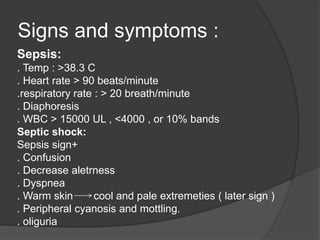
Signs and symptoms :
Sepsis:
. Temp : >38.3 C
. Heart rate > 90 beats/minute
.respiratory rate : > 20 breath/minute
. Diaphoresis
. WBC > 15000 UL , <4000 , or 10% bands
Septic shock:
Sepsis sign+
. Confusion
. Decrease aletrness
. Dyspnea
. Warm skin cool and pale extremeties ( later sign )
. Peripheral cyanosis and mottling.
. oliguria
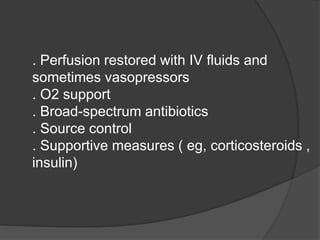
. Perfusion restored with IV fluids and
sometimes vasopressors
. O2 support
. Broad-spectrum antibiotics
. Source control
. Supportive measures ( eg, corticosteroids ,
insulin)
Patients with septic shock should be
treated in an ICU . The following should be
monitored hourly :
. CVP , PAOP , or ScvO2
. pulse oximetry
. ABGs
. Blood glucose , lactate , and electrolyte levels
. Urine output , a good indicator of renal
perfusion
Perfusion restoration :
. Target ScvO2 is 70%
. Target CVP reaches 8 mmHg -12
mmHg ( 10 cm H2O ) for non ventilated
patient .
. Norepinephrine or vasopressin – to
maintain MAP 60 mmHg
. Correction of albumine level
≤
≤
Other supportive measures
:
. Normalization of glucose – IV infusion (1-4
units/hr) to maintain glucose between 110 – 180
mg/dl . See glucose control protocol in ICU
. Corticoisteroid therapy – hydrocortisone 50 mg IV
q 6 h (or 100 mg q 8 h)
. DVT prophylaxis
. PUD prophylaxis
. Sedation in ICU
. Delirium management
Key points :
. Sepsis and septic shocks are increasingly severe clinical
syndromes of life-threatening organ dysfunction caused by a
dysregulated response to infection
. An important component is critical reduction in tissue perfusion ,
which can lead to acute failure of multiple organs , including the
lungs , kidneys , and liver
. Early recognition and treatment is
the key to improved survival
. Resuscitate with IV fluids and
sometimes vasopressors titrated to
optimize central venous oxygen
saturation ( ScvO2) and preload , and
lower serum lactate levels
. Control the source of infection by
removing catheters , tubes , and infected
and/or necrotic tissue and by draining
abscesses
. Give empiric broad-spectrum antibiotics
directed at most likely organisms and
switch quickly to more specific drugs
based on culture and sensitivity results
Correction of serum albumine
Sepsis  and septic shock guidelines

Sepsis and septic shock guidelines

  • 8.
    Sepsis : Is aclinical syndrome of life- threatening organ dysfunction caused by a dysregulated response to infection
  • 10.
    :Septic shocks Is asubset of sepsis with significantly increased mortality due to severe abnormalities of circulation andor cellular metabolism Involves persistent hypotension (defined as the need for vasopressors to maintain mean arterial pressure≤ 65 mm Hg , and a serum lactate level 2 mmol/L despite adequate volume resuscitation <
  • 13.
    Etiology : Predisposing factorsinclude: . Diabetes mellitus . Cirrhosis . Leukopenia . Leukopenia . Invasive
  • 15.
    Pathophysiology : Initially ,arteries and arterioles dilate , decreasing peripheral arterial resistance ; cardiac output typically increases . This stage has been referred to as warm shock Even in the stage of increased cardiac output ,vasoactive mediators cause blood flow to bypass capillary exchange vessels ( a distributive defect ) Coagulopathy may develop because of intravascular coagulation with consumption of major clotting factors , excessive fibrinolysis in reaction thereto , and more often a combination of both .
  • 18.
    Signs and symptoms: Sepsis: . Temp : >38.3 C . Heart rate > 90 beats/minute .respiratory rate : > 20 breath/minute . Diaphoresis . WBC > 15000 UL , <4000 , or 10% bands Septic shock: Sepsis sign+ . Confusion . Decrease aletrness . Dyspnea . Warm skin cool and pale extremeties ( later sign ) . Peripheral cyanosis and mottling. . oliguria
  • 22.
    . Perfusion restoredwith IV fluids and sometimes vasopressors . O2 support . Broad-spectrum antibiotics . Source control . Supportive measures ( eg, corticosteroids , insulin)
  • 23.
    Patients with septicshock should be treated in an ICU . The following should be monitored hourly : . CVP , PAOP , or ScvO2 . pulse oximetry . ABGs . Blood glucose , lactate , and electrolyte levels . Urine output , a good indicator of renal perfusion
  • 25.
    Perfusion restoration : .Target ScvO2 is 70% . Target CVP reaches 8 mmHg -12 mmHg ( 10 cm H2O ) for non ventilated patient . . Norepinephrine or vasopressin – to maintain MAP 60 mmHg . Correction of albumine level ≤ ≤
  • 28.
    Other supportive measures : .Normalization of glucose – IV infusion (1-4 units/hr) to maintain glucose between 110 – 180 mg/dl . See glucose control protocol in ICU . Corticoisteroid therapy – hydrocortisone 50 mg IV q 6 h (or 100 mg q 8 h) . DVT prophylaxis . PUD prophylaxis . Sedation in ICU . Delirium management
  • 30.
    Key points : .Sepsis and septic shocks are increasingly severe clinical syndromes of life-threatening organ dysfunction caused by a dysregulated response to infection . An important component is critical reduction in tissue perfusion , which can lead to acute failure of multiple organs , including the lungs , kidneys , and liver
  • 31.
    . Early recognitionand treatment is the key to improved survival . Resuscitate with IV fluids and sometimes vasopressors titrated to optimize central venous oxygen saturation ( ScvO2) and preload , and lower serum lactate levels
  • 32.
    . Control thesource of infection by removing catheters , tubes , and infected and/or necrotic tissue and by draining abscesses . Give empiric broad-spectrum antibiotics directed at most likely organisms and switch quickly to more specific drugs based on culture and sensitivity results Correction of serum albumine