Coleman’s Classroom www.clmn.net
Understanding Sentence
Types
Coleman’s Classroom www.clmn.net
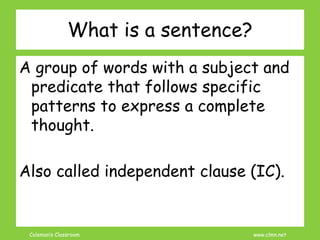
What is a sentence?
A group of words with a subject and
predicate that follows specific
patterns to express a complete
thought.
Also called independent clause (IC).
Coleman’s Classroom www.clmn.net
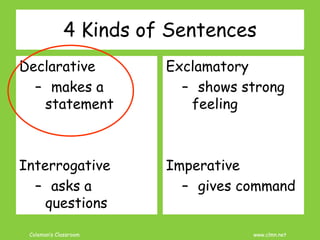
4 Kinds of Sentences
Declarative
– makes a
statement
Interrogative
– asks a
questions
Exclamatory
– shows strong
feeling
Imperative
– gives command
Coleman’s Classroom www.clmn.net
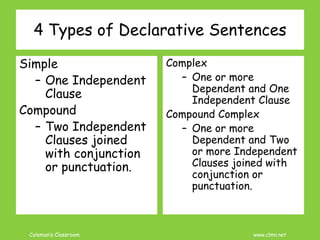
4 Types of Declarative Sentences
Simple
– One Independent
Clause
Compound
– Two Independent
Clauses joined
with conjunction
or punctuation.
Complex
– One or more
Dependent and One
Independent Clause
Compound Complex
– One or more
Dependent and Two
or more Independent
Clauses joined with
conjunction or
punctuation.
Coleman’s Classroom www.clmn.net
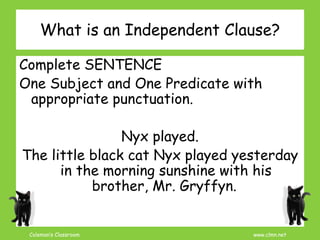
What is an Independent Clause?
Complete SENTENCE
One Subject and One Predicate with
appropriate punctuation.
Nyx played.
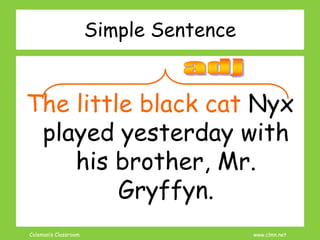
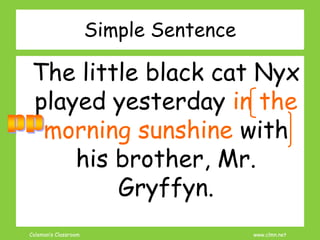
The little black cat Nyx played yesterday
in the morning sunshine with his
brother, Mr. Gryffyn.
Coleman’s Classroom www.clmn.net
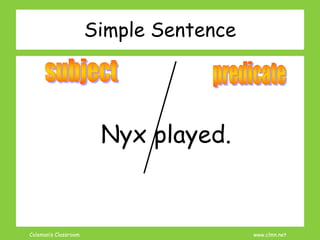
Nyx played.
Simple Sentence
Coleman’s Classroom www.clmn.net
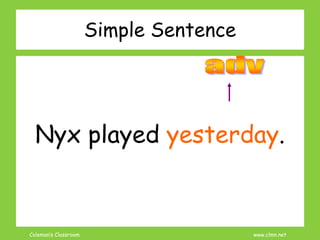
Nyx played yesterday.
Simple Sentence
Coleman’s Classroom www.clmn.net
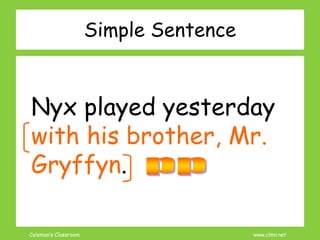
Simple Sentence
Nyx played yesterday
with his brother, Mr.
Gryffyn.
Coleman’s Classroom www.clmn.net
The little black cat Nyx
played yesterday with
his brother, Mr.
Gryffyn.
Simple Sentence
Coleman’s Classroom www.clmn.net
The little black cat Nyx
played yesterday in the
morning sunshine with
his brother, Mr.
Gryffyn.
Simple Sentence
Coleman’s Classroom www.clmn.net
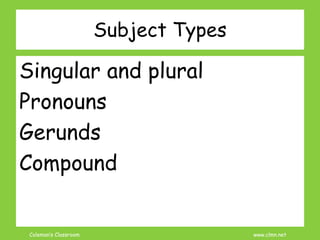
Subject Types
Singular and plural
Pronouns
Gerunds
Compound
Coleman’s Classroom www.clmn.net
Remember
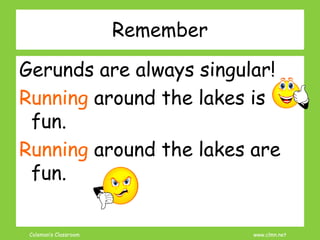
Gerunds are always singular!
Running around the lakes is
fun.
Running around the lakes are
fun.
Coleman’s Classroom www.clmn.net
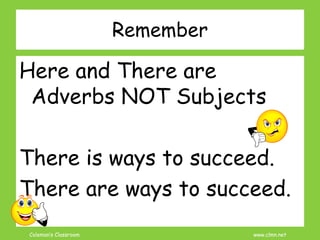
Remember
Here and There are
Adverbs NOT Subjects
There is ways to succeed.
There are ways to succeed.
Coleman’s Classroom www.clmn.net
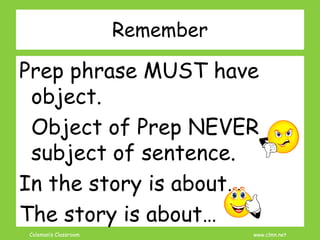
Remember
Prep phrase MUST have
object.
Object of Prep NEVER
subject of sentence.
In the story is about…
The story is about…
Coleman’s Classroom www.clmn.net
You Try Simple Sentences
Write a short simple sentence
with one simple subject and one
simple verb.
Write another sentence, adding
information to the subject and
predicate, but keep the
sentence simple.
Coleman’s Classroom www.clmn.net
Compound Sentence
Two Independent Clauses joined with
conjunction or punctuation.
3 Ways to Compound Independent Clauses
– Coordinate Conjunction
– Punctuation (semi-colon)
– Conjunctive Adverb with
Punctuation (;)
Coleman’s Classroom www.clmn.net
What is a Coordinate Conjunction?
Specific 7 words that join words,
phrases, and clauses
Closed set that will never change
Follows very specific syntax and
punctuation rules
FANBOYS
Coleman’s Classroom www.clmn.net
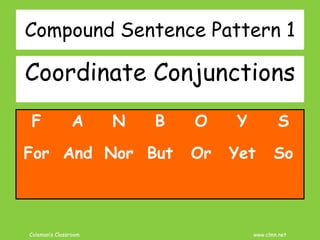
Compound Sentence Pattern 1
Coordinate Conjunctions
F A N B O Y S
For And Nor But Or Yet So
Coleman’s Classroom www.clmn.net
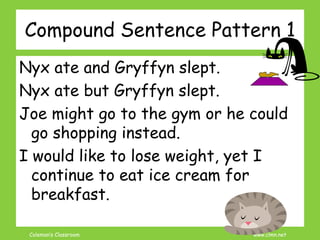
Nyx ate and Gryffyn slept.
Nyx ate but Gryffyn slept.
Joe might go to the gym or he could
go shopping instead.
I would like to lose weight, yet I
continue to eat ice cream for
breakfast.
Compound Sentence Pattern 1
Coleman’s Classroom www.clmn.net
A semi-colon joins two
Independent Clauses.
Each Independent Clause
MUST be complete with S
and Predicate!!
Compound Sentence Pattern 2
Coleman’s Classroom www.clmn.net
Nyx ate; Gryffyn slept.
Joe might go to the gym; he could go
shopping instead.
Compound Sentence Pattern 2
Coleman’s Classroom www.clmn.net
ERROR ALERT!!
When linking two clauses
with ; both MUST be
complete sentences!!!
Coleman’s Classroom www.clmn.net
Correct??
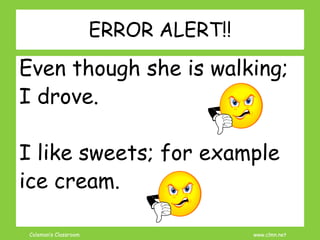
Even though she is walking;
I drove.
I like sweets; for example
ice cream.
Coleman’s Classroom www.clmn.net
ERROR ALERT!!
Even though she is walking;
I drove.
I like sweets; for example
ice cream.
Coleman’s Classroom www.clmn.net
ERROR ALERT!!
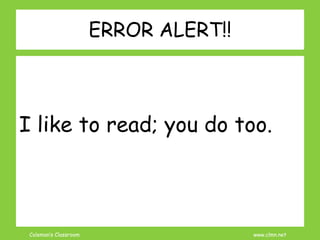
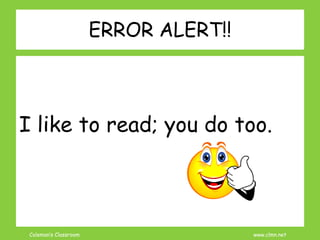
I like to read; you do too.
Coleman’s Classroom www.clmn.net
ERROR ALERT!!
I like to read; you do too.
Coleman’s Classroom www.clmn.net
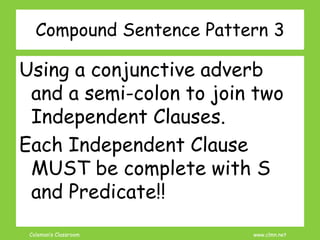
Compound Sentence Pattern 3
Using a conjunctive adverb
and a semi-colon to join two
Independent Clauses.
Each Independent Clause
MUST be complete with S
and Predicate!!
Coleman’s Classroom www.clmn.net
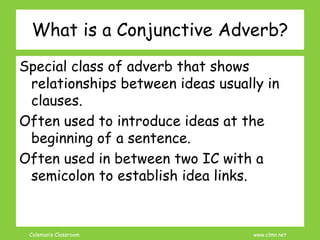
What is a Conjunctive Adverb?
Special class of adverb that shows
relationships between ideas usually in
clauses.
Often used to introduce ideas at the
beginning of a sentence.
Often used in between two IC with a
semicolon to establish idea links.
Coleman’s Classroom www.clmn.net
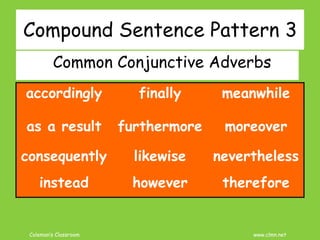
Compound Sentence Pattern 3
Common Conjunctive Adverbs
accordingly finally meanwhile
as a result furthermore moreover
consequently likewise nevertheless
instead however therefore
Coleman’s Classroom www.clmn.net
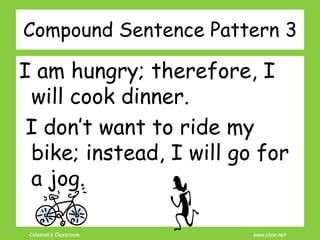
Compound Sentence Pattern 3
I am hungry; therefore, I
will cook dinner.
I don’t want to ride my
bike; instead, I will go for
a jog.
Coleman’s Classroom www.clmn.net
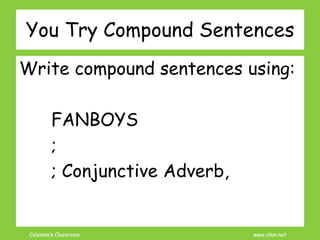
You Try Compound Sentences
Write compound sentences using:
FANBOYS
;
; Conjunctive Adverb,
Coleman’s Classroom www.clmn.net
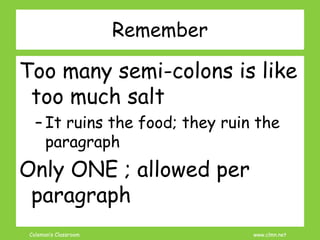
Remember
Too many semi-colons is like
too much salt
– It ruins the food; they ruin the
paragraph
Only ONE ; allowed per
paragraph
Coleman’s Classroom www.clmn.net
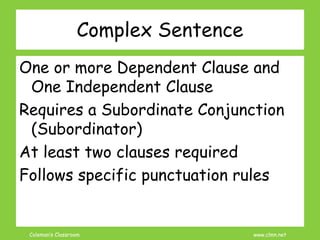
Complex Sentence
One or more Dependent Clause and
One Independent Clause
Requires a Subordinate Conjunction
(Subordinator)
At least two clauses required
Follows specific punctuation rules
Coleman’s Classroom www.clmn.net
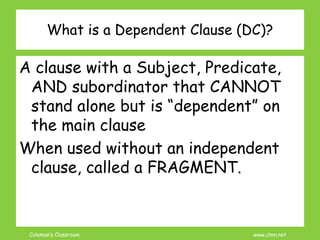
What is a Dependent Clause (DC)?
A clause with a Subject, Predicate,
AND subordinator that CANNOT
stand alone but is “dependent” on
the main clause
When used without an independent
clause, called a FRAGMENT.
Coleman’s Classroom www.clmn.net
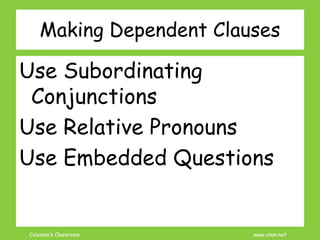
Making Dependent Clauses
Use Subordinating
Conjunctions
Use Relative Pronouns
Use Embedded Questions
Coleman’s Classroom www.clmn.net
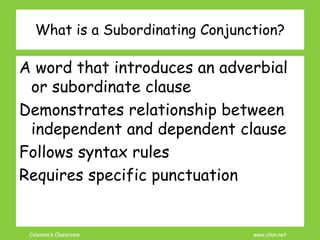
What is a Subordinating Conjunction?
A word that introduces an adverbial
or subordinate clause
Demonstrates relationship between
independent and dependent clause
Follows syntax rules
Requires specific punctuation
Coleman’s Classroom www.clmn.net
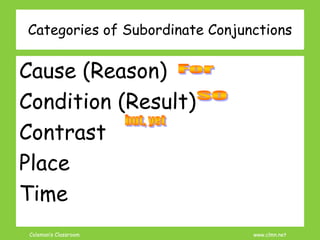
Categories of Subordinate Conjunctions
Cause (Reason)
Condition (Result)
Contrast
Place
Time
Coleman’s Classroom www.clmn.net
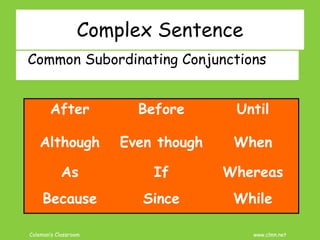
Complex Sentence
Common Subordinating Conjunctions
After Before Until
Although Even though When
As If Whereas
Because Since While
Coleman’s Classroom www.clmn.net
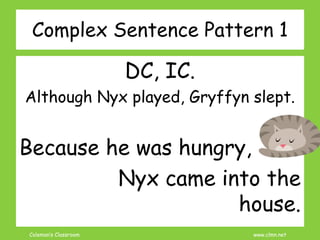
Complex Sentence Pattern 1
DC, IC.
Although Nyx played, Gryffyn slept.
Because he was hungry,
Nyx came into the
house.
Coleman’s Classroom www.clmn.net
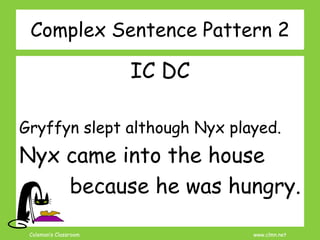
Complex Sentence Pattern 2
IC DC
Gryffyn slept although Nyx played.
Nyx came into the house
because he was hungry.
Coleman’s Classroom www.clmn.net
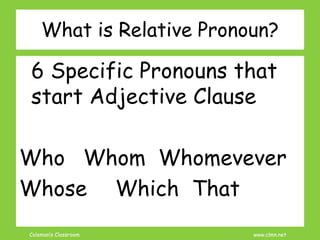
What is Relative Pronoun?
6 Specific Pronouns that
start Adjective Clause
Who Whom Whomevever
Whose Which That
Coleman’s Classroom www.clmn.net
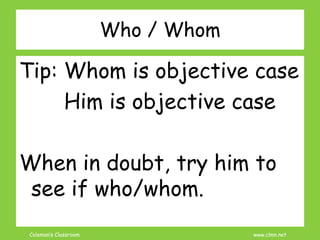
Who / Whom
Tip: Whom is objective case
Him is objective case
When in doubt, try him to
see if who/whom.
Coleman’s Classroom www.clmn.net
Remember
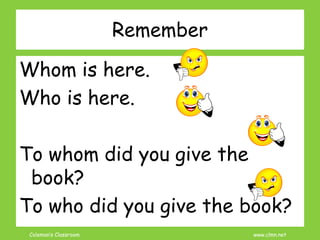
Whom is here.
Who is here.
To whom did you give the
book?
To who did you give the book?
Coleman’s Classroom www.clmn.net
Who/That/Which
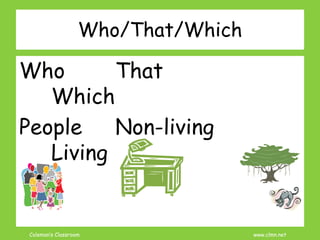
Who That
Which
People Non-living
Living
Coleman’s Classroom www.clmn.net
Who/That/Which
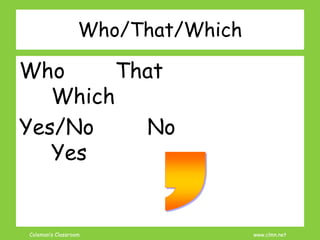
Who That
Which
Yes/No No
Yes
Coleman’s Classroom www.clmn.net
Remember
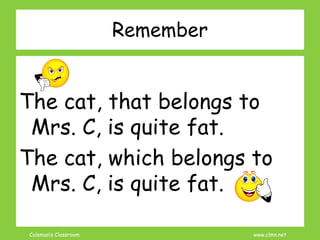
The cat, that belongs to
Mrs. C, is quite fat.
The cat, which belongs to
Mrs. C, is quite fat.
Coleman’s Classroom www.clmn.net
Complex Sentence Pattern 3
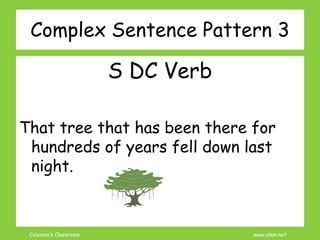
S DC Verb
That tree that has been there for
hundreds of years fell down last
night.
Coleman’s Classroom www.clmn.net
ERROR ALERT!!
When DC BEFORE IC, there
IS comma!!
When DC AFTER IC, NO
COMMA!!
Coleman’s Classroom www.clmn.net
ERROR ALERT!!
Even though she is walking
I drove.
I like sweets, while they
make me fat.
Coleman’s Classroom www.clmn.net
ERROR ALERT!!
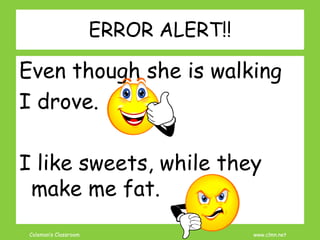
Even though she is walking
I drove.
I like sweets, while they
make me fat.
Coleman’s Classroom www.clmn.net
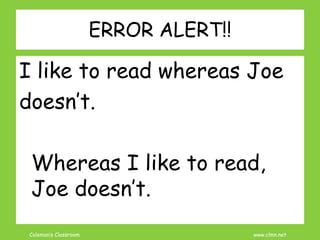
ERROR ALERT!!
I like to read whereas Joe
doesn’t.
Whereas I like to read,
Joe doesn’t.
Coleman’s Classroom www.clmn.net
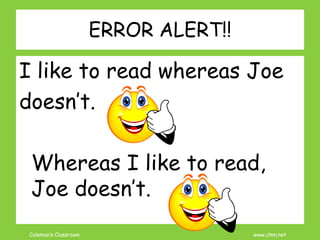
ERROR ALERT!!
I like to read whereas Joe
doesn’t.
Whereas I like to read,
Joe doesn’t.
Coleman’s Classroom www.clmn.net
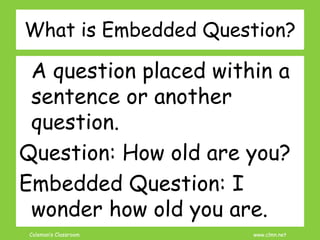
What is Embedded Question?
A question placed within a
sentence or another
question.
Question: How old are you?
Embedded Question: I
wonder how old you are.
Coleman’s Classroom www.clmn.net
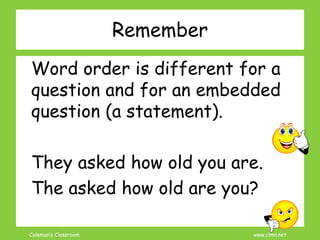
Remember
Word order is different for a
question and for an embedded
question (a statement).
They asked how old you are.
The asked how old are you?
Coleman’s Classroom www.clmn.net
You Try Complex Sentences
Write a sentence with DC, IC
Write a sentence with IC DC
Write a sentence with Relative
Pronoun DC
Write an Embedded Clause
sentence
Coleman’s Classroom www.clmn.net
More Practice
Identify the type (simple,
compound, complex,
compound/complex) and
pattern for each sentence:
Coleman’s Classroom www.clmn.net
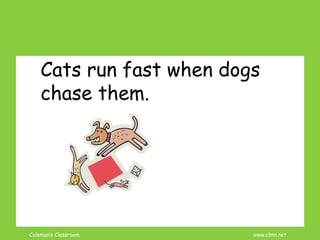
Cats run fast when dogs
chase them.
Coleman’s Classroom www.clmn.net
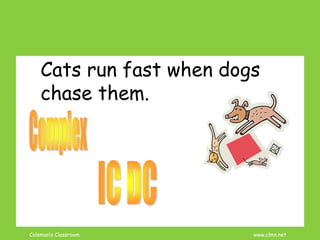
Cats run fast when dogs
chase them.
Coleman’s Classroom www.clmn.net
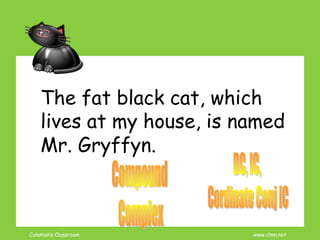
The fat black cat, which
lives at my house, is named
Mr. Gryffyn.
Coleman’s Classroom www.clmn.net
The fat black cat, which
lives at my house, is named
Mr. Gryffyn.
Coleman’s Classroom www.clmn.net
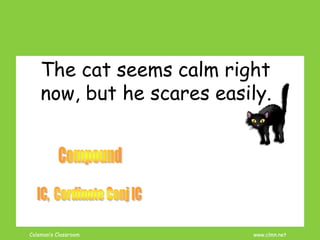
The cat seems calm right
now, but he scares easily.
Coleman’s Classroom www.clmn.net
The cat seems calm right
now, but he scares easily.
Coleman’s Classroom www.clmn.net
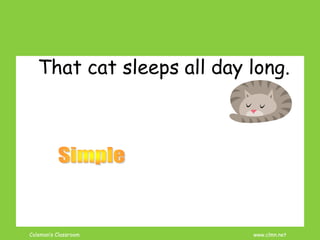
That cat sleeps all day long.
Coleman’s Classroom www.clmn.net
That cat sleeps all day long.
Coleman’s Classroom www.clmn.net
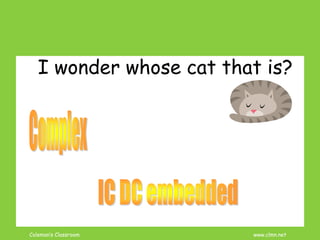
I wonder whose cat that is?
Coleman’s Classroom www.clmn.net
I wonder whose cat that is?
Coleman’s Classroom www.clmn.net
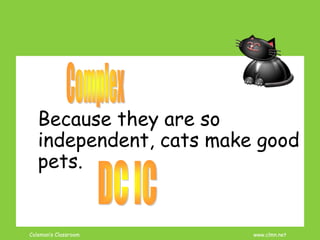
Because they are so
independent, cats make good
pets.
Coleman’s Classroom www.clmn.net
Because they are so
independent, cats make good
pets.
Coleman’s Classroom www.clmn.net
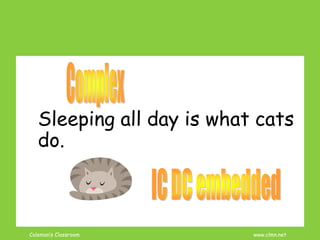
Sleeping all day is what cats
do.
Coleman’s Classroom www.clmn.net
Sleeping all day is what cats
do.
Coleman’s Classroom www.clmn.net
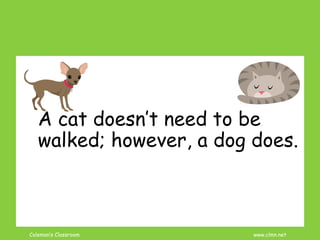
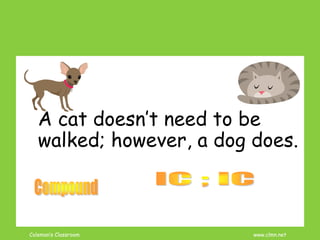
A cat doesn’t need to be
walked; however, a dog does.
Coleman’s Classroom www.clmn.net
A cat doesn’t need to be
walked; however, a dog does.
Coleman’s Classroom www.clmn.net
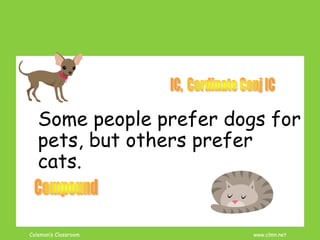
Some people prefer dogs for
pets, but others prefer
cats.
Coleman’s Classroom www.clmn.net
For More Information
Email Mrs. C
ccoleman@clmn.net
Visit Coleman’s Classroom
www.clmn.net

Sentence Types

Editor's Notes

  • #78 http://www.slideshare.net/CatherineColeman1/review-verbs-simple-and-progressive-tense