Department of English Language and Literature
Major: English Language and Literature
Extra Semantics Session: Types of sentences
Dr. Badriya Al Mamari
Academic year 2021/2022
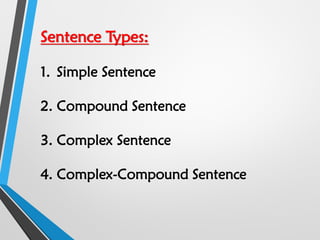
Sentence Types:
1. Simple Sentence
2. Compound Sentence
3. Complex Sentence
4. Complex-Compound Sentence
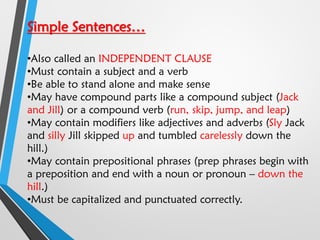
Simple Sentences…
•Also called an INDEPENDENT CLAUSE
•Must contain a subject and a verb
•Be able to stand alone and make sense
•May have compound parts like a compound subject (Jack
and Jill) or a compound verb (run, skip, jump, and leap)
•May contain modifiers like adjectives and adverbs (Sly Jack
and silly Jill skipped up and tumbled carelessly down the
hill.)
•May contain prepositional phrases (prep phrases begin with
a preposition and end with a noun or pronoun – down the
hill.)
•Must be capitalized and punctuated correctly.
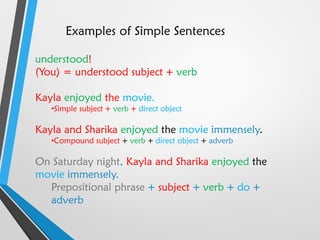
Examples of Simple Sentences
understood!
(You) = understood subject + verb
Kayla enjoyed the movie.
•Simple subject + verb + direct object
Kayla and Sharika enjoyed the movie immensely.
•Compound subject + verb + direct object + adverb
On Saturday night, Kayla and Sharika enjoyed the
movie immensely.
Prepositional phrase + subject + verb + do +
adverb
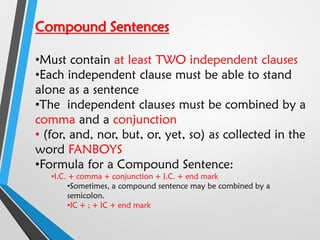
Compound Sentences
•Must contain at least TWO independent clauses
•Each independent clause must be able to stand
alone as a sentence
•The independent clauses must be combined by a
comma and a conjunction
• (for, and, nor, but, or, yet, so) as collected in the
word FANBOYS
•Formula for a Compound Sentence:
•I.C. + comma + conjunction + I.C. + end mark
•Sometimes, a compound sentence may be combined by a
semicolon.
•IC + ; + IC + end mark
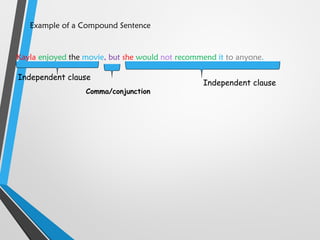
Example of a Compound Sentence
Kayla enjoyed the movie, but she would not recommend it to anyone.
Independent clause
Comma/conjunction
Independent clause
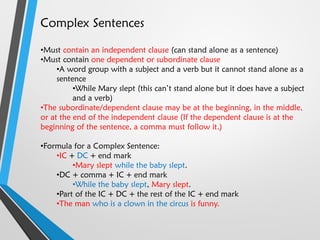
Complex Sentences
•Must contain an independent clause (can stand alone as a sentence)
•Must contain one dependent or subordinate clause
•A word group with a subject and a verb but it cannot stand alone as a
sentence
•While Mary slept (this can’t stand alone but it does have a subject
and a verb)
•The subordinate/dependent clause may be at the beginning, in the middle,
or at the end of the independent clause (If the dependent clause is at the
beginning of the sentence, a comma must follow it.)
•Formula for a Complex Sentence:
•IC + DC + end mark
•Mary slept while the baby slept.
•DC + comma + IC + end mark
•While the baby slept, Mary slept.
•Part of the IC + DC + the rest of the IC + end mark
•The man who is a clown in the circus is funny.
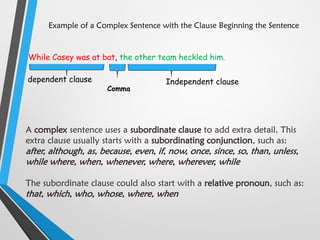
Example of a Complex Sentence with the Clause Beginning the Sentence
While Casey was at bat, the other team heckled him.
dependent clause
Comma
Independent clause
A complex sentence uses a subordinate clause to add extra detail. This
extra clause usually starts with a subordinating conjunction, such as:
after, although, as, because, even, if, now, once, since, so, than, unless,
while where, when, whenever, where, wherever, while
The subordinate clause could also start with a relative pronoun, such as:
that, which, who, whose, where, when
Example of a Complex Sentence with the Clause at
the End
Kayla enjoyed the movie while her mother shopped at the mall..
independent clause No comma needed dependent clause
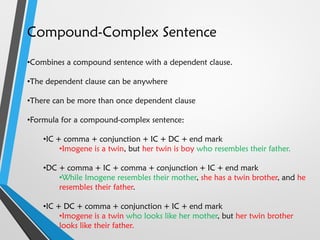
Compound-Complex Sentence
•Combines a compound sentence with a dependent clause.
•The dependent clause can be anywhere
•There can be more than once dependent clause
•Formula for a compound-complex sentence:
•IC + comma + conjunction + IC + DC + end mark
•Imogene is a twin, but her twin is boy who resembles their father.
•DC + comma + IC + comma + conjunction + IC + end mark
•While Imogene resembles their mother, she has a twin brother, and he
resembles their father.
•IC + DC + comma + conjunction + IC + end mark
•Imogene is a twin who looks like her mother, but her twin brother
looks like their father.
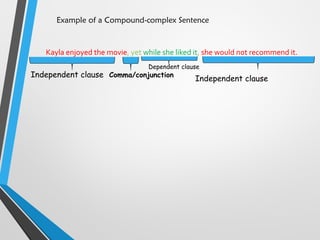
Example of a Compound-complex Sentence
Kayla enjoyed the movie, yet while she liked it, she would not recommend it.
Independent clause Comma/conjunction
Independent clause
Dependent clause

Semantics_types of sentences_ Explanation.pdf

  • 1.
    Department of EnglishLanguage and Literature Major: English Language and Literature Extra Semantics Session: Types of sentences Dr. Badriya Al Mamari Academic year 2021/2022
  • 2.
    Sentence Types: 1. SimpleSentence 2. Compound Sentence 3. Complex Sentence 4. Complex-Compound Sentence
  • 3.
    Simple Sentences… •Also calledan INDEPENDENT CLAUSE •Must contain a subject and a verb •Be able to stand alone and make sense •May have compound parts like a compound subject (Jack and Jill) or a compound verb (run, skip, jump, and leap) •May contain modifiers like adjectives and adverbs (Sly Jack and silly Jill skipped up and tumbled carelessly down the hill.) •May contain prepositional phrases (prep phrases begin with a preposition and end with a noun or pronoun – down the hill.) •Must be capitalized and punctuated correctly.
  • 4.
    Examples of SimpleSentences understood! (You) = understood subject + verb Kayla enjoyed the movie. •Simple subject + verb + direct object Kayla and Sharika enjoyed the movie immensely. •Compound subject + verb + direct object + adverb On Saturday night, Kayla and Sharika enjoyed the movie immensely. Prepositional phrase + subject + verb + do + adverb
  • 5.
    Compound Sentences •Must containat least TWO independent clauses •Each independent clause must be able to stand alone as a sentence •The independent clauses must be combined by a comma and a conjunction • (for, and, nor, but, or, yet, so) as collected in the word FANBOYS •Formula for a Compound Sentence: •I.C. + comma + conjunction + I.C. + end mark •Sometimes, a compound sentence may be combined by a semicolon. •IC + ; + IC + end mark
  • 6.
    Example of aCompound Sentence Kayla enjoyed the movie, but she would not recommend it to anyone. Independent clause Comma/conjunction Independent clause
  • 7.
    Complex Sentences •Must containan independent clause (can stand alone as a sentence) •Must contain one dependent or subordinate clause •A word group with a subject and a verb but it cannot stand alone as a sentence •While Mary slept (this can’t stand alone but it does have a subject and a verb) •The subordinate/dependent clause may be at the beginning, in the middle, or at the end of the independent clause (If the dependent clause is at the beginning of the sentence, a comma must follow it.) •Formula for a Complex Sentence: •IC + DC + end mark •Mary slept while the baby slept. •DC + comma + IC + end mark •While the baby slept, Mary slept. •Part of the IC + DC + the rest of the IC + end mark •The man who is a clown in the circus is funny.
  • 8.
    Example of aComplex Sentence with the Clause Beginning the Sentence While Casey was at bat, the other team heckled him. dependent clause Comma Independent clause A complex sentence uses a subordinate clause to add extra detail. This extra clause usually starts with a subordinating conjunction, such as: after, although, as, because, even, if, now, once, since, so, than, unless, while where, when, whenever, where, wherever, while The subordinate clause could also start with a relative pronoun, such as: that, which, who, whose, where, when
  • 9.
    Example of aComplex Sentence with the Clause at the End Kayla enjoyed the movie while her mother shopped at the mall.. independent clause No comma needed dependent clause
  • 10.
    Compound-Complex Sentence •Combines acompound sentence with a dependent clause. •The dependent clause can be anywhere •There can be more than once dependent clause •Formula for a compound-complex sentence: •IC + comma + conjunction + IC + DC + end mark •Imogene is a twin, but her twin is boy who resembles their father. •DC + comma + IC + comma + conjunction + IC + end mark •While Imogene resembles their mother, she has a twin brother, and he resembles their father. •IC + DC + comma + conjunction + IC + end mark •Imogene is a twin who looks like her mother, but her twin brother looks like their father.
  • 11.
    Example of aCompound-complex Sentence Kayla enjoyed the movie, yet while she liked it, she would not recommend it. Independent clause Comma/conjunction Independent clause Dependent clause