Sentence Structure
What is a sentence?
• A sentence is a syntactic unit which has a complete
thought in the form of
• statement, question, instruction, or exclamation. Thus, a
sentence can stand alone without a context or text. A
sentence normally consists of a subject and a verb. It can
be simple, complex, or c ompund .
Examples:
• He swims regularly.
• She reads a book at night.
• The cat was chasing a mouse through the brick walls.
• Because wind is invisible, it is hard to see a tornado
unless it forms a condensation funnel made up of water
droplets, dust and debris.
Types of Sentence
1. Simple sentence
• A simple sentence consists of one independent clause.
EXAMPLES:
• Betty works as an engineer at the company. )
• I'm happy.
• She exercises every morning.
• His dog barks loudly.
• We always eat dinner together.
2. Complex sentence
• A complex sentence consists of one independent clause
that is followed or preceded by a dependent clause
EXAMPLE;
• When it rains, the road is very slippery./Although she is
smart, she isn’t arrogant.
• While I am a passionate basketball fan, I prefer football.
• Although she was considered smart, she failed all her
exams.
• Whenever it rains, I like to wear my blue coat.
3. Compound sentence
• A compound sentence consists of two independent
clauses that are joined by conjunctions such as and, but,
or
EXAMPLE;
• I like Bakso but I don’t like the meatballs.
• He plays soccer, but she prefers swimming.
• They study hard, so they get good grades.
• We work during the day, and we relax in the evening.
• She loves her job, yet she complains about it a lot.
Sentence construction
• To form a sentence in English, an essential element is the
subject and the verb (and object), depending on the verb
(S- V - O). The number of subject (including object) and
contexts (tense & aspect) of sentence determine the form
or shape of the verb.
Examples:
• 1. Sally l ikes watching Korean Dramas.
• 2. The dog is chasing the cat/The d ogs are chasing the
cat.
Parts of Speech & Syntactic elements
• Noun (car )
• Verb ( have )
• Adjective ( fast )
• Adverb ( )
• Preposition ( in, at, on, )
• Subject (nouns)
• Predicate (verbs)
• Object (nouns)
• Complement (object,
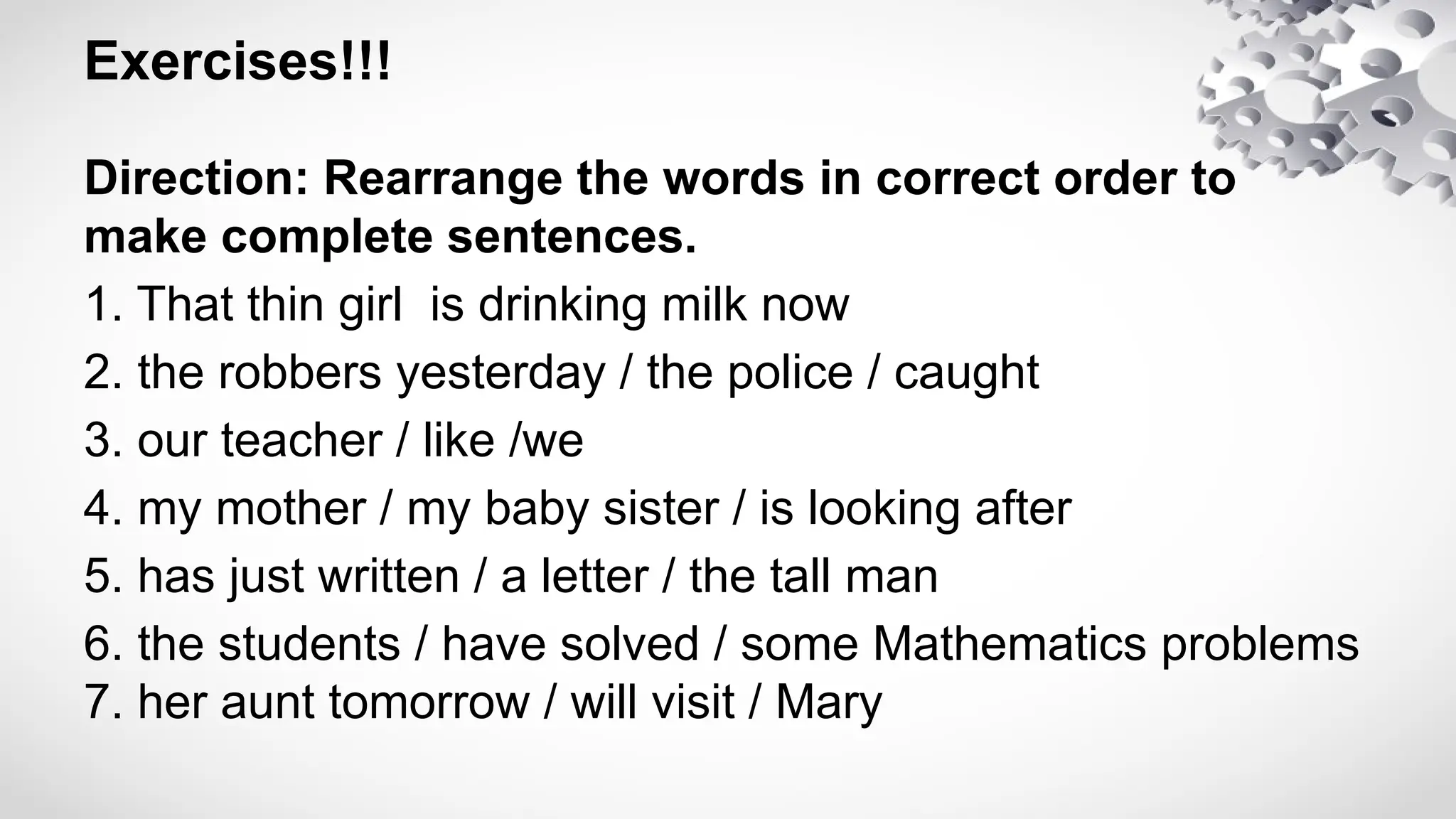
Exercises!!!
Direction: Rearrange the words in correct order to
make complete sentences.
1. That thin girl is drinking milk now
2. the robbers yesterday / the police / caught
3. our teacher / like /we
4. my mother / my baby sister / is looking after
5. has just written / a letter / the tall man
6. the students / have solved / some Mathematics problems
7. her aunt tomorrow / will visit / Mary

Sentence Structure. GRDAE 7 FINAL.POWERPOINT PRESENTATION

  • 1.
  • 2.
    What is asentence? • A sentence is a syntactic unit which has a complete thought in the form of • statement, question, instruction, or exclamation. Thus, a sentence can stand alone without a context or text. A sentence normally consists of a subject and a verb. It can be simple, complex, or c ompund .
  • 3.
    Examples: • He swimsregularly. • She reads a book at night. • The cat was chasing a mouse through the brick walls. • Because wind is invisible, it is hard to see a tornado unless it forms a condensation funnel made up of water droplets, dust and debris.
  • 4.
    Types of Sentence 1.Simple sentence • A simple sentence consists of one independent clause. EXAMPLES: • Betty works as an engineer at the company. ) • I'm happy. • She exercises every morning. • His dog barks loudly. • We always eat dinner together.
  • 5.
    2. Complex sentence •A complex sentence consists of one independent clause that is followed or preceded by a dependent clause EXAMPLE; • When it rains, the road is very slippery./Although she is smart, she isn’t arrogant. • While I am a passionate basketball fan, I prefer football. • Although she was considered smart, she failed all her exams. • Whenever it rains, I like to wear my blue coat.
  • 6.
    3. Compound sentence •A compound sentence consists of two independent clauses that are joined by conjunctions such as and, but, or EXAMPLE; • I like Bakso but I don’t like the meatballs. • He plays soccer, but she prefers swimming. • They study hard, so they get good grades. • We work during the day, and we relax in the evening. • She loves her job, yet she complains about it a lot.
  • 7.
    Sentence construction • Toform a sentence in English, an essential element is the subject and the verb (and object), depending on the verb (S- V - O). The number of subject (including object) and contexts (tense & aspect) of sentence determine the form or shape of the verb. Examples: • 1. Sally l ikes watching Korean Dramas. • 2. The dog is chasing the cat/The d ogs are chasing the cat.
  • 8.
    Parts of Speech& Syntactic elements • Noun (car ) • Verb ( have ) • Adjective ( fast ) • Adverb ( ) • Preposition ( in, at, on, ) • Subject (nouns) • Predicate (verbs) • Object (nouns) • Complement (object,
  • 9.
    Exercises!!! Direction: Rearrange thewords in correct order to make complete sentences. 1. That thin girl is drinking milk now 2. the robbers yesterday / the police / caught 3. our teacher / like /we 4. my mother / my baby sister / is looking after 5. has just written / a letter / the tall man 6. the students / have solved / some Mathematics problems 7. her aunt tomorrow / will visit / Mary