Elements of aSentence
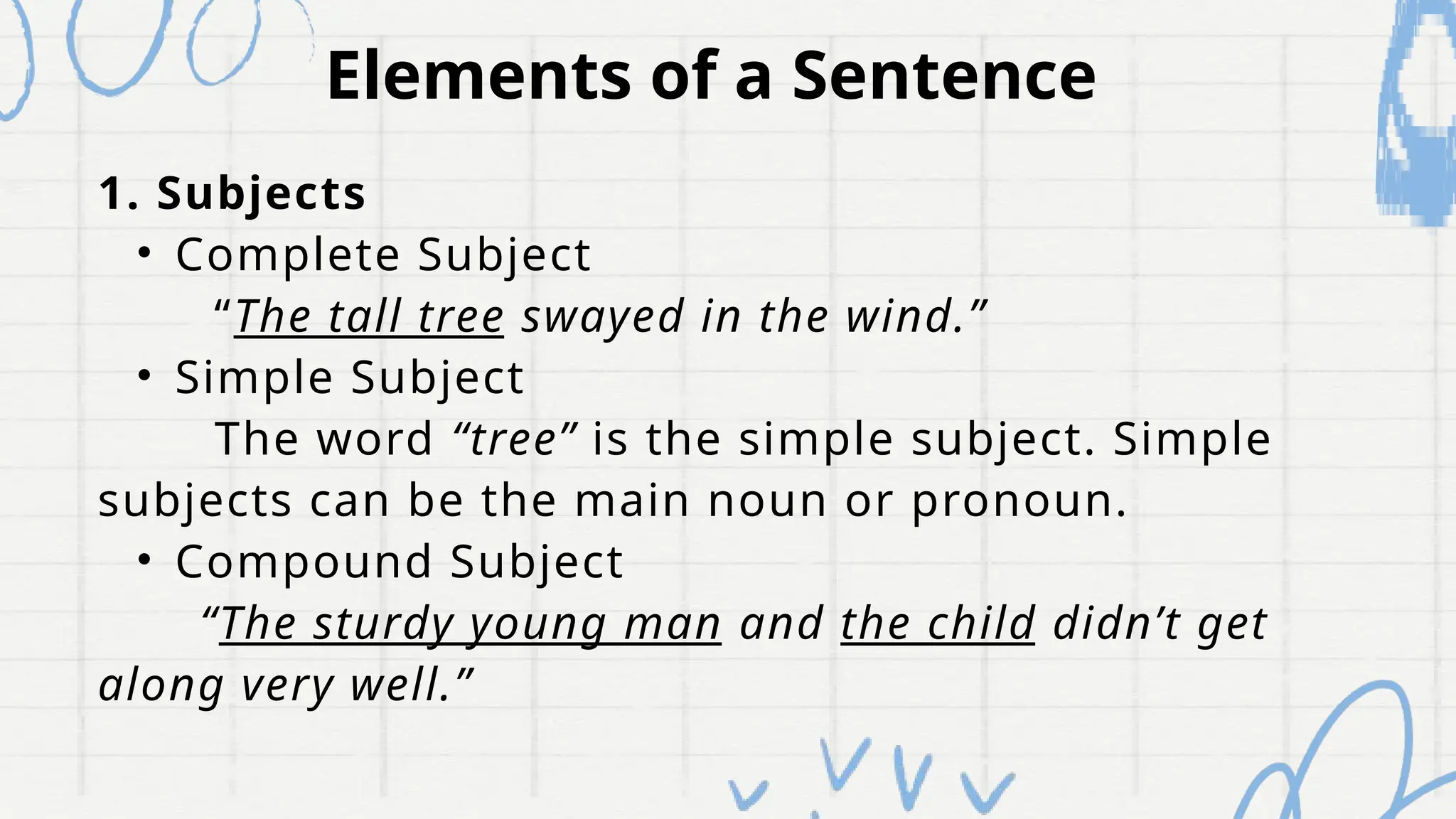
1. Subjects
• Complete Subject
“The tall tree swayed in the wind.”
• Simple Subject
The word “tree” is the simple subject. Simple
subjects can be the main noun or pronoun.
• Compound Subject
“The sturdy young man and the child didn’t get
along very well.”
3.
Elements of aSentence
2. Predicates
• Complete Predicate
She studied for hours every night
The teacher explained the lesson clearly to the students.
• Simple Predicate
He sings beautifully.
They played basketball.
• Compound Predicate
She wrote the letter and sent it.
The children ran and jumped in the park.
4.
Elements of aSentence
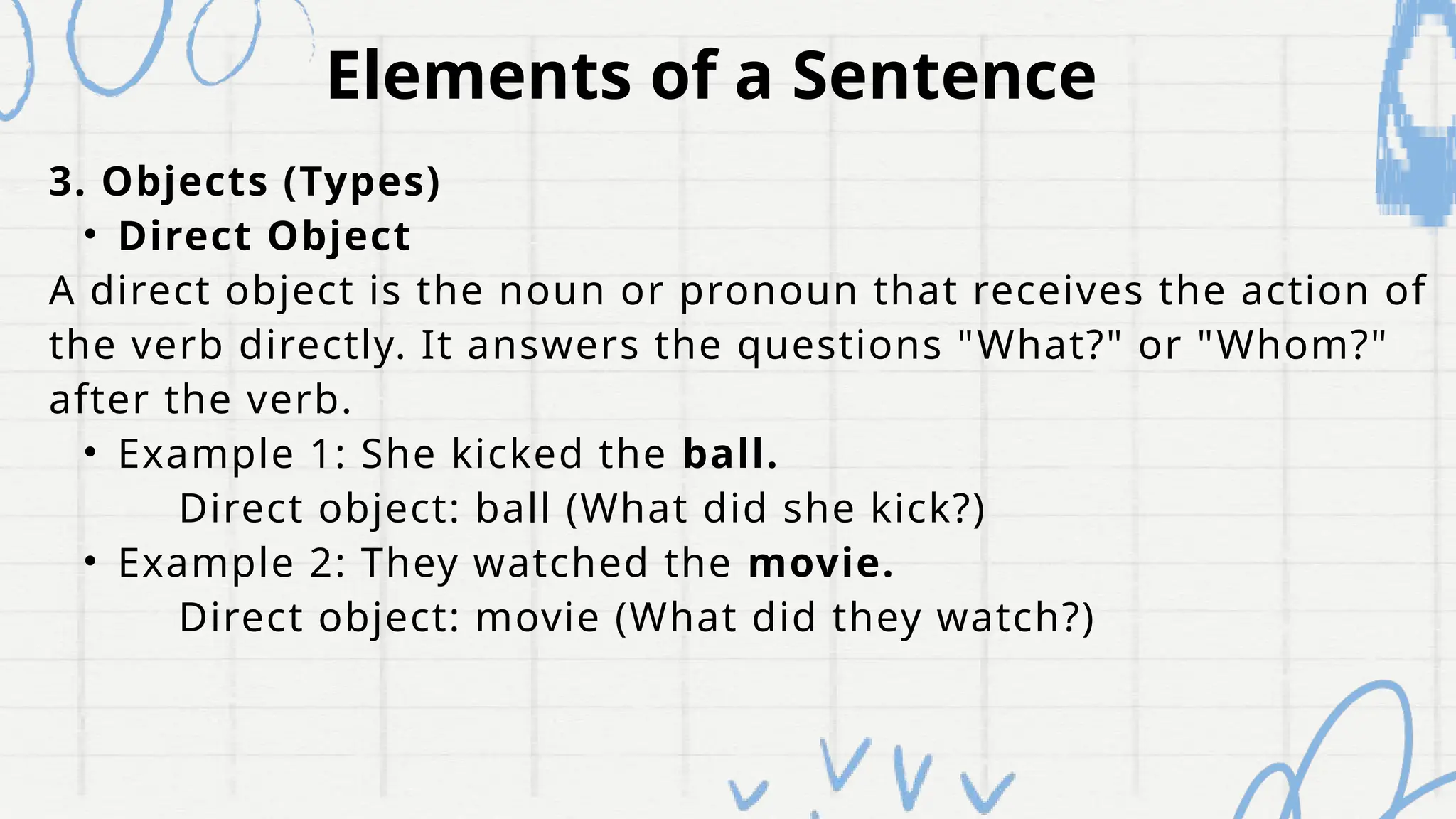
3. Objects (Types)
• Direct Object
A direct object is the noun or pronoun that receives the action of
the verb directly. It answers the questions "What?" or "Whom?"
after the verb.
• Example 1: She kicked the ball.
Direct object: ball (What did she kick?)
• Example 2: They watched the movie.
Direct object: movie (What did they watch?)
5.
Elements of aSentence
3. Objects (Types)
• Direct Object
A direct object is the noun or pronoun that receives the action of
the verb directly. It answers the questions "What?" or "Whom?"
after the verb.
• Example 1: She kicked the ball.
Direct object: ball (What did she kick?)
• Example 2: They watched the movie.
Direct object: movie (What did they watch?)
6.
Elements of aSentence
3. Objects (Types)
• Indirect Object
An indirect object is the noun or pronoun that receives the direct
object or benefits from the action. It answers the questions "To
whom?" or "For whom?" the action is performed.
• Example 1: He gave his friend a gift.
• Indirect object: friend (To whom did he give a gift?)
• Example 2: The teacher handed the students their
assignments.
• Indirect object: students (To whom did the teacher hand the
assignments?)
7.
Elements of aSentence
3. Objects (Types)
• Prepositional Object
A prepositional object (or object of the preposition) is the noun
or pronoun that follows a preposition. It tells us more about the
relationship between the object and the rest of the sentence.
• Example 1: She sat on the chair.
• Prepositional object: chair (On what did she sit?)
• Example 2: The book is under the table.
• Prepositional object: table (Under what is the book?)
1. SIMPLE SENTENCE
Asimple sentence consists of one independent clause
(The independent clause contains a subject and a verb
and expresses a complete thought).
Example:
I love going to the mall.
Xuli loves visiting the park.
10.
2. COMPOUND
SENTENCE
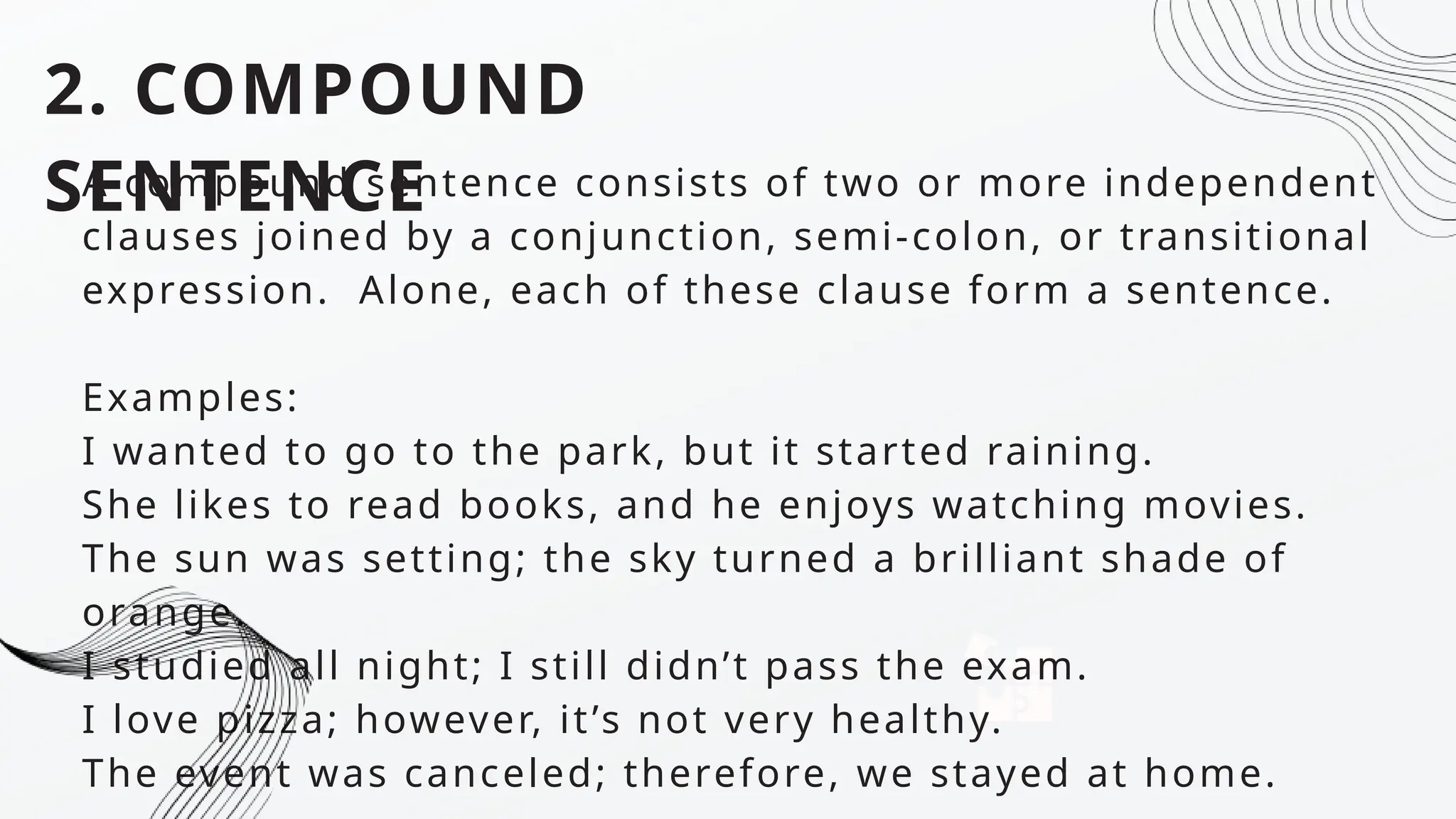
A compoundsentence consists of two or more independent
clauses joined by a conjunction, semi-colon, or transitional
expression. Alone, each of these clause form a sentence.
Examples:
I wanted to go to the park, but it started raining.
She likes to read books, and he enjoys watching movies.
The sun was setting; the sky turned a brilliant shade of
orange.
I studied all night; I still didn’t pass the exam.
I love pizza; however, it’s not very healthy.
The event was canceled; therefore, we stayed at home.
11.
3. COMPLEX SENTENCE
Acomplex sentence has one independent clause (a complete
thought) and at least one dependent clause (incomplete
thought), joined by a subordinating conjunction like
because, although, since, while, if, etc., or a relative
pronoun.
Examples:
1. I stayed home because it was raining.
2. Although she was tired, she finished her homework.
3. When the phone rang, I was reading a book.
4. We will go to the park if the weather is nice.
12.
4. COMPOUND-COMPLEX
SENTENCE
A compound-complexsentence combines at least two
independent clauses (complete thoughts) and one or more
dependent clauses (incomplete thoughts).
Examples:
1. Although it was raining, we decided to go for a walk, and
we took our umbrellas.
2. He stayed up late because she had a lot of work to do,
but she still woke up early.
3. When the show ended, the audience clapped, and the
actors bowed.
4. I will visit you if I have time, but I might call instead.
1. Subject +Verb (S+V)
• Example: She runs.
2. Subject + Verb + Object (S+V+O)
• Example: He eats pizza.
3. Subject + Verb + Complement (S+V+C)
• Example: The sky is blue.
4. Subject + Verb + Indirect Object + Direct Object (S+V+IO+DO)
• Example: She gave him a book.
5. Subject + Verb + Object + Complement (S+V+O+C)
• Example: They painted the house red.
6. Subject + Verb + Adverbial (S+V+A)
• Example: She danced beautifully.
Editor's Notes
#2 Compound Subject
- Compound subjects consist of two or more subjects joined together by conjunctions. Remember that the simple subjects of that sentence are "man and child."
#3 Compound Subject
- Compound subjects consist of two or more subjects joined together by conjunctions. Remember that the simple subjects of that sentence are "man and child."
#4 Compound Subject
- Compound subjects consist of two or more subjects joined together by conjunctions. Remember that the simple subjects of that sentence are "man and child."
#5 Compound Subject
- Compound subjects consist of two or more subjects joined together by conjunctions. Remember that the simple subjects of that sentence are "man and child."
#6 Compound Subject
- Compound subjects consist of two or more subjects joined together by conjunctions. Remember that the simple subjects of that sentence are "man and child."
#7 Compound Subject
- Compound subjects consist of two or more subjects joined together by conjunctions. Remember that the simple subjects of that sentence are "man and child."