English and Arabic Basic
Sentence structure
Course :
Translation 3
Supervised by :
Dr. Aisha Maashi
Prepared by:
*Manal Aied Al-Nomasi
*Maali Salim Al-Atawi
*Hamda Mohammad Al-Inazi
*Basma Ali Al-Inazi
*Shareefa Aied Al-Nomasi
*Anoud Abdullah Al-Inazi
* Manal Owied Al-Blowi
*Hanan Mubarak Al-Inazi
*Samira Salim Al-Howaiti
The aim is to present the
English and Arabic basic
sentence structure
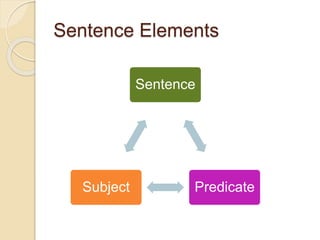
Sentence Elements
Sentence
PredicateSubject
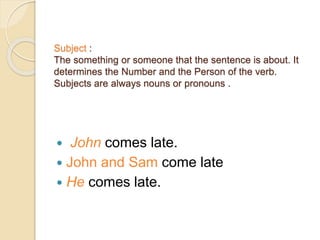
Subject :
The something or someone that the sentence is about. It
determines the Number and the Person of the verb.
Subjects are always nouns or pronouns .
 John comes late.
 John and Sam come late
 He comes late.
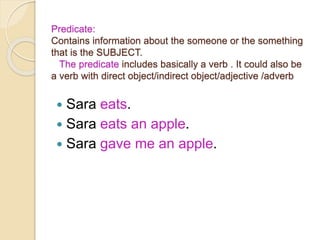
Predicate:
Contains information about the someone or the something
that is the SUBJECT.
The predicate includes basically a verb . It could also be
a verb with direct object/indirect object/adjective /adverb
 Sara eats.
 Sara eats an apple.
 Sara gave me an apple.
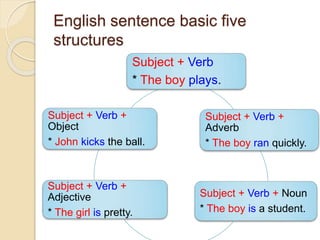
English sentence basic five
structures
Subject + Verb
* The boy plays.
Subject + Verb +
Adverb
* The boy ran quickly.
Subject + Verb + Noun
* The boy is a student.
Subject + Verb +
Adjective
* The girl is pretty.
Subject + Verb +
Object
* John kicks the ball.
Arabic Sentence Structure
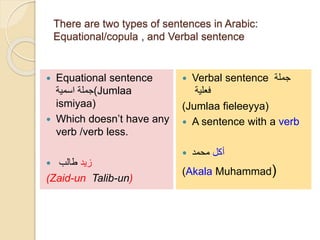
There are two types of sentences in Arabic:
Equational/copula , and Verbal sentence
 Equational sentence
‫اسمية‬ ‫(جملة‬Jumlaa
ismiyaa)
 Which doesn’t have any
verb /verb less.
 ‫زيد‬‫طالب‬
(Zaid-un Talib-un)
 Verbal sentence ‫جملة‬
‫فعلية‬
(Jumlaa fieleeyya)
 A sentence with a verb
 ‫أكل‬‫محمد‬
(Akala Muhammad)
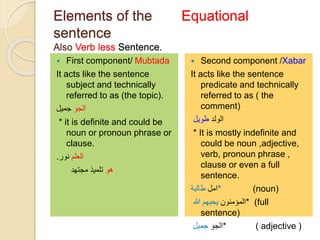
Elements of the Equational
sentence
Also Verb less Sentence.
 First component/ Mubtada
It acts like the sentence
subject and technically
referred to as (the topic).
‫الجو‬‫جميل‬
* it is definite and could be
noun or pronoun phrase or
clause.
‫العلم‬‫نور‬.
‫هو‬‫مجتهد‬ ‫تلميذ‬
 Second component /Xabar
It acts like the sentence
predicate and technically
referred to as ( the
comment)
‫الولد‬‫طويل‬
* It is mostly indefinite and
could be noun ,adjective,
verb, pronoun phrase ,
clause or even a full
sentence.
‫امل‬‫طالبة‬ * (noun)
‫المؤمنون‬‫هللا‬ ‫يحبهم‬ * (full
sentence)
‫الجو‬‫جميل‬ * ( adjective )
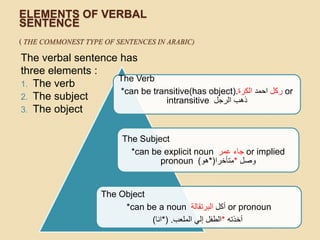
ELEMENTS OF VERBAL
SENTENCE
( THE COMMONEST TYPE OF SENTENCES IN ARABIC)
The verbal sentence has
three elements :
1. The verb
2. The subject
3. The object
The Verb
*can be transitive(has object). ‫ركل‬‫احمد‬‫الكرة‬ or
intransitive ‫الرجل‬ ‫ذهب‬
The Subject
*can be explicit noun ‫عمر‬ ‫جاء‬ or implied
pronoun ‫وصل‬*‫متأخرا‬*(‫هو‬)
The Object
*can be a noun ‫أكل‬‫البرتقالة‬ or pronoun
‫أخذته‬*‫الملعب‬ ‫إلي‬ ‫الطفل‬*( .‫انا‬)
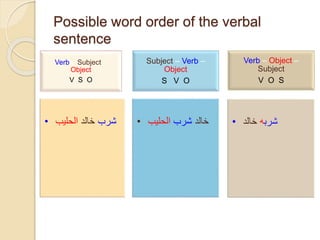
Possible word order of the verbal
sentence
Verb – Subject –
Object
V S O
• ‫شرب‬‫خالد‬‫الحليب‬
Subject – Verb –
Object
S V O
• ‫خالد‬‫شرب‬‫الحليب‬
Verb – Object –
Subject
V O S
• ‫شرب‬‫ه‬‫خالد‬
Conclusion
There are of course some difference between English and Arabic
Language sentence structure . In English a complete sentence must
have a verb while in Arabic a sentence can stand in its own with out
a verb like that of the Equational sentence which could cause some
problems in translation.
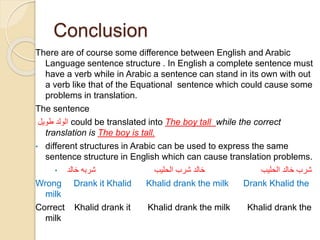
The sentence
‫طويل‬ ‫الولد‬ could be translated into The boy tall while the correct
translation is The boy is tall.
• different structures in Arabic can be used to express the same
sentence structure in English which can cause translation problems.
• ‫خالد‬ ‫شربه‬ ‫الحليب‬ ‫شرب‬ ‫خالد‬ ‫الحليب‬ ‫خالد‬ ‫شرب‬
Wrong Drank it Khalid Khalid drank the milk Drank Khalid the
milk
Correct Khalid drank it Khalid drank the milk Khalid drank the
milk
References
- Brinton, Laurel J.(2000). The Structure of Modern English :A Linguistic
Introduction
- Fabb, Nigel. (2005). Sentence Structure. Routledge
- Radford, Andrew .(2010). An Introduction to English Sentence
Structure
- Alhawary, Mohammad T. (2011). Modern Standard Arabic Grammar: A
Learner’s Guide. Willey- Blackwell
- Rydin, Karin.(2005). A Reference Grammar Modern Standard Arabic.
John Benjamin's Publishing

Sentence structure arabic and english

  • 1.
    English and ArabicBasic Sentence structure
  • 2.
    Course : Translation 3 Supervisedby : Dr. Aisha Maashi
  • 3.
    Prepared by: *Manal AiedAl-Nomasi *Maali Salim Al-Atawi *Hamda Mohammad Al-Inazi *Basma Ali Al-Inazi *Shareefa Aied Al-Nomasi *Anoud Abdullah Al-Inazi * Manal Owied Al-Blowi *Hanan Mubarak Al-Inazi *Samira Salim Al-Howaiti
  • 4.
    The aim isto present the English and Arabic basic sentence structure
  • 5.
  • 6.
    Subject : The somethingor someone that the sentence is about. It determines the Number and the Person of the verb. Subjects are always nouns or pronouns .  John comes late.  John and Sam come late  He comes late.
  • 7.
    Predicate: Contains information aboutthe someone or the something that is the SUBJECT. The predicate includes basically a verb . It could also be a verb with direct object/indirect object/adjective /adverb  Sara eats.  Sara eats an apple.  Sara gave me an apple.
  • 8.
    English sentence basicfive structures Subject + Verb * The boy plays. Subject + Verb + Adverb * The boy ran quickly. Subject + Verb + Noun * The boy is a student. Subject + Verb + Adjective * The girl is pretty. Subject + Verb + Object * John kicks the ball.
  • 9.
  • 10.
    There are twotypes of sentences in Arabic: Equational/copula , and Verbal sentence  Equational sentence ‫اسمية‬ ‫(جملة‬Jumlaa ismiyaa)  Which doesn’t have any verb /verb less.  ‫زيد‬‫طالب‬ (Zaid-un Talib-un)  Verbal sentence ‫جملة‬ ‫فعلية‬ (Jumlaa fieleeyya)  A sentence with a verb  ‫أكل‬‫محمد‬ (Akala Muhammad)
  • 11.
    Elements of theEquational sentence Also Verb less Sentence.  First component/ Mubtada It acts like the sentence subject and technically referred to as (the topic). ‫الجو‬‫جميل‬ * it is definite and could be noun or pronoun phrase or clause. ‫العلم‬‫نور‬. ‫هو‬‫مجتهد‬ ‫تلميذ‬  Second component /Xabar It acts like the sentence predicate and technically referred to as ( the comment) ‫الولد‬‫طويل‬ * It is mostly indefinite and could be noun ,adjective, verb, pronoun phrase , clause or even a full sentence. ‫امل‬‫طالبة‬ * (noun) ‫المؤمنون‬‫هللا‬ ‫يحبهم‬ * (full sentence) ‫الجو‬‫جميل‬ * ( adjective )
  • 12.
    ELEMENTS OF VERBAL SENTENCE (THE COMMONEST TYPE OF SENTENCES IN ARABIC) The verbal sentence has three elements : 1. The verb 2. The subject 3. The object The Verb *can be transitive(has object). ‫ركل‬‫احمد‬‫الكرة‬ or intransitive ‫الرجل‬ ‫ذهب‬ The Subject *can be explicit noun ‫عمر‬ ‫جاء‬ or implied pronoun ‫وصل‬*‫متأخرا‬*(‫هو‬) The Object *can be a noun ‫أكل‬‫البرتقالة‬ or pronoun ‫أخذته‬*‫الملعب‬ ‫إلي‬ ‫الطفل‬*( .‫انا‬)
  • 13.
    Possible word orderof the verbal sentence Verb – Subject – Object V S O • ‫شرب‬‫خالد‬‫الحليب‬ Subject – Verb – Object S V O • ‫خالد‬‫شرب‬‫الحليب‬ Verb – Object – Subject V O S • ‫شرب‬‫ه‬‫خالد‬
  • 14.
    Conclusion There are ofcourse some difference between English and Arabic Language sentence structure . In English a complete sentence must have a verb while in Arabic a sentence can stand in its own with out a verb like that of the Equational sentence which could cause some problems in translation. The sentence ‫طويل‬ ‫الولد‬ could be translated into The boy tall while the correct translation is The boy is tall. • different structures in Arabic can be used to express the same sentence structure in English which can cause translation problems. • ‫خالد‬ ‫شربه‬ ‫الحليب‬ ‫شرب‬ ‫خالد‬ ‫الحليب‬ ‫خالد‬ ‫شرب‬ Wrong Drank it Khalid Khalid drank the milk Drank Khalid the milk Correct Khalid drank it Khalid drank the milk Khalid drank the milk
  • 15.
    References - Brinton, LaurelJ.(2000). The Structure of Modern English :A Linguistic Introduction - Fabb, Nigel. (2005). Sentence Structure. Routledge - Radford, Andrew .(2010). An Introduction to English Sentence Structure - Alhawary, Mohammad T. (2011). Modern Standard Arabic Grammar: A Learner’s Guide. Willey- Blackwell - Rydin, Karin.(2005). A Reference Grammar Modern Standard Arabic. John Benjamin's Publishing