Adjectives in English and Arabic
Translation 3
Presented by:
Amani
Asma
Hind
Introduction
In this project we will be presenting the meaning of adjectives and adjectives
structure in English and Arabic, also we will discuss the difference between
them, finally we show how we translate the adjectives from English to
Arabic.
Adjectives in English
 The adjective can be defined as "a word that modifies, or qualifies, a noun or pronoun,
in one of three forms of comparative degree: positive (strong, beautiful), comparative
(stronger, more beautiful), or superlative (strongest, most beautiful).
An adjective modifies a noun or a pronoun by describing, identifying, or quantifying words.
An adjective usually precedes the noun or the pronoun which it modifies.
Adjectives nearly always appear immediately before the noun or noun phrase that they
modify. Sometimes they appear in a string of adjectives, and when they do, they appear in a
set order according to category.
When indefinite pronouns — such as something, someone, and anybody— are modified by
an adjective, the adjective comes after the pronoun.
Anyone capable of doing something horrible to someone nice should be punished.
Something wicked this way comes.
Adjective structure
 There are 2 basic positions for adjectives:
1. Before the noun: (Attributive adjectives)
 I like big black dogs.

1. after some verbs: (Predicative adjectives)
 She is afraid of ghosts
 That dress is new, isn't it?
Most English adjectives have the same form for the singular as for the plural. The only
exceptions are the demonstrative adjectives this and that.
Notice that we have two words – the first is an adjective and the second is the noun that it
describes or qualifies. And needless to say, the adjective will always stay the same while the
noun that it describes can be of any gender, plurality, or definiteness. For example, we can
say
• Gender: “the ferocious lion” and “the ferocious lioness”
• Plurality: “the ferocious lion” and “the ferocious lions”
• Definiteness: “the ferocious lion” and “a ferocious lion”
However, there are some exceptions that let adjectives do not follow the main grammatical
rules.
Arabic Adjectives
 In English, adjectives come before the nouns they
modify. However, the opposite is true for adjectives in
Arabic; they follow the nouns. Unlike in English, where
the adjective stays the same and the noun inflects for
gender, plurality, and definiteness, both parts in Arabic
must match. And the aspects in which they match are
four:
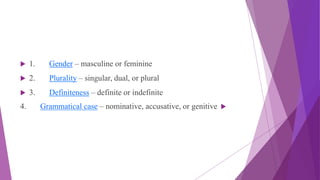
 1. Gender – masculine or feminine
 2. Plurality – singular, dual, or plural
 3. Definiteness – definite or indefinite
4. Grammatical case – nominative, accusative, or genitive
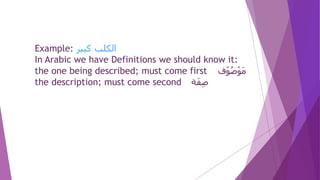
‫كبير‬ ‫الكلب‬Example:
In Arabic we have Definitions we should know it:
‫ف‬ْ‫و‬ُ‫ص‬ْ‫و‬َ‫م‬the one being described; must come first
‫ة‬َ‫ف‬ِ‫ص‬the description; must come second
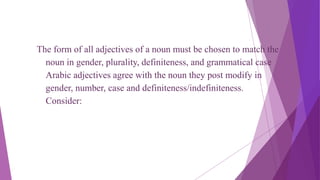
The form of all adjectives of a noun must be chosen to match the
noun in gender, plurality, definiteness, and grammatical case
Arabic adjectives agree with the noun they post modify in
gender, number, case and definiteness/indefiniteness.
Consider:
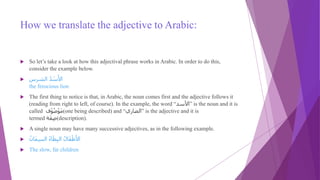
How we translate the adjective to Arabic:
 So let’s take a look at how this adjectival phrase works in Arabic. In order to do this,
consider the example below.
 ‫الشرس‬ ُ‫د‬ َ‫س‬َ‫األ‬
the ferocious lion
 The first thing to notice is that, in Arabic, the noun comes first and the adjective follows it
(reading from right to left, of course). In the example, the word “‫”األسد‬ is the noun and it is
called ‫ف‬ْ‫و‬ُ‫ص‬ْ‫و‬َ‫م‬(one being described) and “‫”الضاري‬ is the adjective and it is
termed ‫ة‬َ‫ف‬ِ‫ص‬(description).
 A single noun may have many successive adjectives, as in the following example.
 ُ‫َان‬‫م‬ِ‫س‬‫ال‬ ُ‫ء‬‫ا‬َ‫ط‬ِ‫ب‬‫ال‬ ُ‫ل‬‫ا‬َ‫ف‬ْ‫ط‬َ‫األ‬
 The slow, fat children
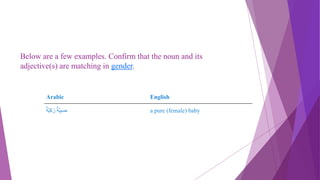
Below are a few examples. Confirm that the noun and its
adjective(s) are matching in gender.
Arabic English
ٌ‫َّة‬‫ي‬ِ‫ك‬ َ‫ز‬ ٌ‫َّة‬‫ي‬ِ‫ب‬َ‫ص‬ a pure (female) baby
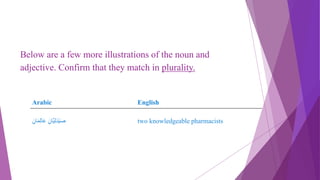
Below are a few more illustrations of the noun and
adjective. Confirm that they match in plurality.
Arabic English
ِ‫ان‬َ‫م‬ِ‫ل‬‫ا‬َ‫ع‬ ِ‫َّان‬‫ي‬ِ‫ل‬َ‫د‬ْ‫ي‬َ‫ص‬ two knowledgeable pharmacists
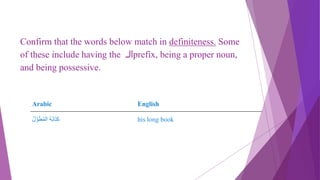
Confirm that the words below match in definiteness. Some
of these include having the ‫الـ‬prefix, being a proper noun,
and being possessive.
Arabic English
ُ‫ل‬ َّ‫و‬َ‫ط‬ُ‫م‬‫ال‬ ُ‫ه‬ُ‫ب‬‫ا‬َ‫ت‬ِ‫ك‬ his long book
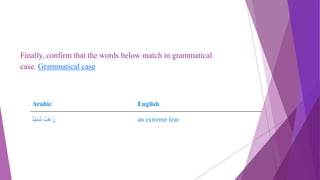
Finally, confirm that the words below match in grammatical
case. Grammatical case
Arabic English
ٌ‫د‬ْ‫ي‬ِ‫د‬َ‫ش‬ ٌ‫ْب‬‫ع‬ُ‫ر‬ an extreme fear
Conclusion
This research is dedicated to study the adjective substitutes both in English
and Arabic to find out the points of similarity and difference between the
English adjectival substitutes with their Arabic counterparts. By adjectival
substitute we mean any word or a part of speech can work as adjective in any
sentence. So, we can find so many words and parts of speech in both
languages that can do what an adjective does in a sentence. As for English
language, there is the noun like Wood floor, the adverb like quite surprise,
the pronouns like my folder, the prepositional phrase as in during the wedding
and verbal phrase as in frightening place. The same in Arabic language
different parts of speech can be adjective substitutes. For example: the
noun in and the verbal phrase in and the pronoun like in But there are
few single words in Arabic work as adjective substitutes for example: the
word ― ” in and the word ― This study is a trial to shed light on the points of
similarities and ‖ like . differences between the adjective substitutes in
both languages.

References:
 ‫د‬.‫اليازجي‬ (2011). A Contrastive Study Of Attributive Adjectives In English And Arabic.
‫الجامعة‬ ‫المأمون‬ ‫كلية‬ ‫مجلة‬.
 Adjectives in English and Arabic. (2010). Retrieved November 28, 2015, from
http://site.iugaza.edu.ps/wamer/files/2010/02/Adjectives-in-English-and-Arabic1.doc

Adjectives in-english-and-arabic

  • 1.
    Adjectives in Englishand Arabic Translation 3 Presented by: Amani Asma Hind
  • 2.
    Introduction In this projectwe will be presenting the meaning of adjectives and adjectives structure in English and Arabic, also we will discuss the difference between them, finally we show how we translate the adjectives from English to Arabic.
  • 3.
    Adjectives in English The adjective can be defined as "a word that modifies, or qualifies, a noun or pronoun, in one of three forms of comparative degree: positive (strong, beautiful), comparative (stronger, more beautiful), or superlative (strongest, most beautiful). An adjective modifies a noun or a pronoun by describing, identifying, or quantifying words. An adjective usually precedes the noun or the pronoun which it modifies. Adjectives nearly always appear immediately before the noun or noun phrase that they modify. Sometimes they appear in a string of adjectives, and when they do, they appear in a set order according to category. When indefinite pronouns — such as something, someone, and anybody— are modified by an adjective, the adjective comes after the pronoun. Anyone capable of doing something horrible to someone nice should be punished. Something wicked this way comes.
  • 4.
    Adjective structure  Thereare 2 basic positions for adjectives: 1. Before the noun: (Attributive adjectives)  I like big black dogs.  1. after some verbs: (Predicative adjectives)  She is afraid of ghosts  That dress is new, isn't it?
  • 5.
    Most English adjectiveshave the same form for the singular as for the plural. The only exceptions are the demonstrative adjectives this and that. Notice that we have two words – the first is an adjective and the second is the noun that it describes or qualifies. And needless to say, the adjective will always stay the same while the noun that it describes can be of any gender, plurality, or definiteness. For example, we can say • Gender: “the ferocious lion” and “the ferocious lioness” • Plurality: “the ferocious lion” and “the ferocious lions” • Definiteness: “the ferocious lion” and “a ferocious lion” However, there are some exceptions that let adjectives do not follow the main grammatical rules.
  • 6.
    Arabic Adjectives  InEnglish, adjectives come before the nouns they modify. However, the opposite is true for adjectives in Arabic; they follow the nouns. Unlike in English, where the adjective stays the same and the noun inflects for gender, plurality, and definiteness, both parts in Arabic must match. And the aspects in which they match are four:
  • 7.
     1. Gender– masculine or feminine  2. Plurality – singular, dual, or plural  3. Definiteness – definite or indefinite 4. Grammatical case – nominative, accusative, or genitive
  • 8.
    ‫كبير‬ ‫الكلب‬Example: In Arabicwe have Definitions we should know it: ‫ف‬ْ‫و‬ُ‫ص‬ْ‫و‬َ‫م‬the one being described; must come first ‫ة‬َ‫ف‬ِ‫ص‬the description; must come second
  • 9.
    The form ofall adjectives of a noun must be chosen to match the noun in gender, plurality, definiteness, and grammatical case Arabic adjectives agree with the noun they post modify in gender, number, case and definiteness/indefiniteness. Consider:
  • 10.
    How we translatethe adjective to Arabic:  So let’s take a look at how this adjectival phrase works in Arabic. In order to do this, consider the example below.  ‫الشرس‬ ُ‫د‬ َ‫س‬َ‫األ‬ the ferocious lion  The first thing to notice is that, in Arabic, the noun comes first and the adjective follows it (reading from right to left, of course). In the example, the word “‫”األسد‬ is the noun and it is called ‫ف‬ْ‫و‬ُ‫ص‬ْ‫و‬َ‫م‬(one being described) and “‫”الضاري‬ is the adjective and it is termed ‫ة‬َ‫ف‬ِ‫ص‬(description).  A single noun may have many successive adjectives, as in the following example.  ُ‫َان‬‫م‬ِ‫س‬‫ال‬ ُ‫ء‬‫ا‬َ‫ط‬ِ‫ب‬‫ال‬ ُ‫ل‬‫ا‬َ‫ف‬ْ‫ط‬َ‫األ‬  The slow, fat children
  • 11.
    Below are afew examples. Confirm that the noun and its adjective(s) are matching in gender. Arabic English ٌ‫َّة‬‫ي‬ِ‫ك‬ َ‫ز‬ ٌ‫َّة‬‫ي‬ِ‫ب‬َ‫ص‬ a pure (female) baby
  • 12.
    Below are afew more illustrations of the noun and adjective. Confirm that they match in plurality. Arabic English ِ‫ان‬َ‫م‬ِ‫ل‬‫ا‬َ‫ع‬ ِ‫َّان‬‫ي‬ِ‫ل‬َ‫د‬ْ‫ي‬َ‫ص‬ two knowledgeable pharmacists
  • 13.
    Confirm that thewords below match in definiteness. Some of these include having the ‫الـ‬prefix, being a proper noun, and being possessive. Arabic English ُ‫ل‬ َّ‫و‬َ‫ط‬ُ‫م‬‫ال‬ ُ‫ه‬ُ‫ب‬‫ا‬َ‫ت‬ِ‫ك‬ his long book
  • 14.
    Finally, confirm thatthe words below match in grammatical case. Grammatical case Arabic English ٌ‫د‬ْ‫ي‬ِ‫د‬َ‫ش‬ ٌ‫ْب‬‫ع‬ُ‫ر‬ an extreme fear
  • 15.
    Conclusion This research isdedicated to study the adjective substitutes both in English and Arabic to find out the points of similarity and difference between the English adjectival substitutes with their Arabic counterparts. By adjectival substitute we mean any word or a part of speech can work as adjective in any sentence. So, we can find so many words and parts of speech in both languages that can do what an adjective does in a sentence. As for English language, there is the noun like Wood floor, the adverb like quite surprise, the pronouns like my folder, the prepositional phrase as in during the wedding and verbal phrase as in frightening place. The same in Arabic language different parts of speech can be adjective substitutes. For example: the noun in and the verbal phrase in and the pronoun like in But there are few single words in Arabic work as adjective substitutes for example: the word ― ” in and the word ― This study is a trial to shed light on the points of similarities and ‖ like . differences between the adjective substitutes in both languages.
  • 16.
    References:  ‫د‬.‫اليازجي‬ (2011).A Contrastive Study Of Attributive Adjectives In English And Arabic. ‫الجامعة‬ ‫المأمون‬ ‫كلية‬ ‫مجلة‬.  Adjectives in English and Arabic. (2010). Retrieved November 28, 2015, from http://site.iugaza.edu.ps/wamer/files/2010/02/Adjectives-in-English-and-Arabic1.doc