The study of
language
By George Yule
College: ISFD N°41
Subject: Language and Written Expression IV
Student: Gianella Jacqueline, Melgarejo Erica, Delgado
Gisela, Ríos Florencia, Lagrotta Daniela, Jiménez Ariel.
Teacher: Saubidet, Stella
Date: September, 2020
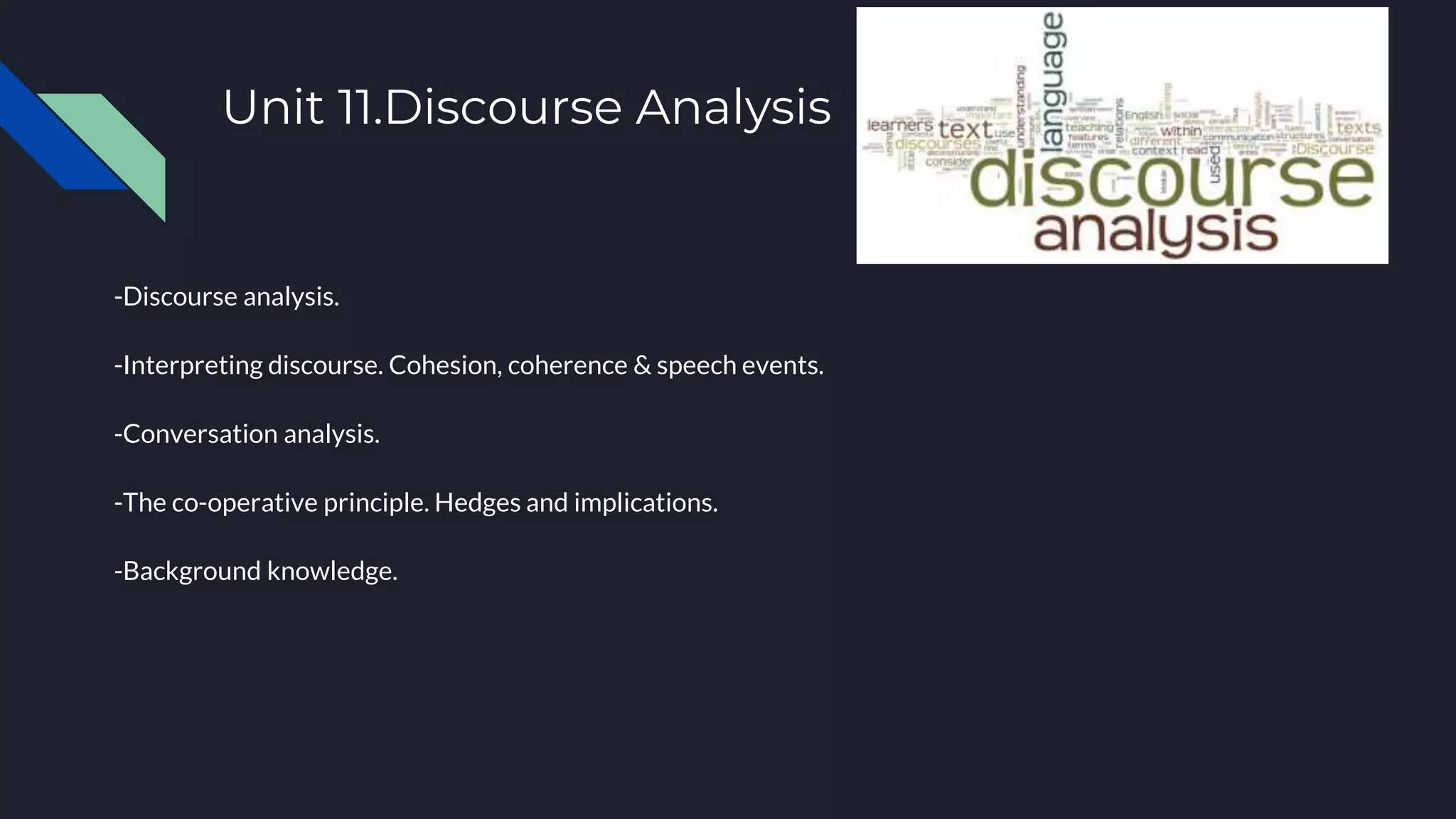
Unit 11.Discourse Analysis
-Discourse analysis.
-Interpreting discourse. Cohesion, coherence & speech events.
-Conversation analysis.
-The co-operative principle. Hedges and implications.
-Background knowledge.
Discourse Analysis
Discourse analysis.Its analysis concerns the study of language in texts and conversation.
Interpreting discourse.It is a key element because as language-users we try to arrive at a reasonable
perception of what the speakers want to provide despite ungrammatical forms.
● Cohesion:The ties and connections that exist within texts.
● Coherence: Our ability to make sense of what we perceive or experience in the world.
For example: - That’s the telephone
- I’m in the bath.
- OK
● Speech events:Any situation in which we take part in conversation (debate, interview, disccussion)
Conversation Analysis
A conversation occurs when two or more people take turn at speaking.
● Turn taking :Different expectations of conversational style and different strategies of
participation.
You can mark your turn as complete:
-By asking a question. -By pausing at the end of a completed syntactic structure.
To indicate you want to take the turn:
-You can start to make short sounds, or use body shifts or facial expressions.
To keep the turn:
-Do not pause at the end of sentences -Make your sentences run on by using connectors -Place
your pauses where the message is clearly incomplete -”Fill” the pause with a hesitation marker.
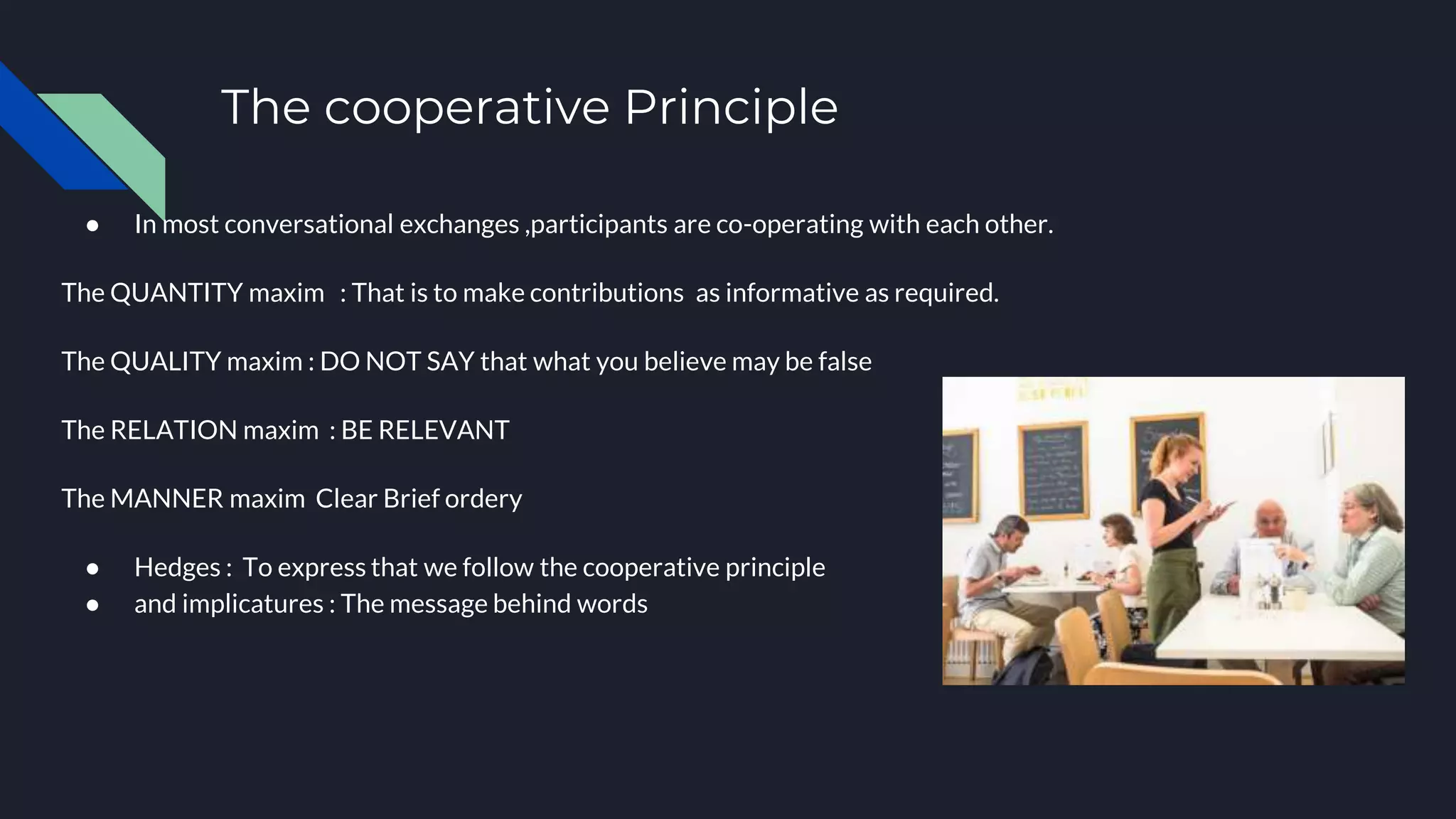
The cooperative Principle
● In most conversational exchanges ,participants are co-operating with each other.
The QUANTITY maxim : That is to make contributions as informative as required.
The QUALITY maxim : DO NOT SAY that what you believe may be false
The RELATION maxim : BE RELEVANT
The MANNER maxim Clear Brief ordery
● Hedges : To express that we follow the cooperative principle
● and implicatures : The message behind words
Background knowledge
We interpret based on our expectations of what normally happens.
● Schemas is conventional knowledge which exist in memory.
● Scripts is essentially a dynamic schema which conventional actions takes place.

Chapter 11: Discourse analysis

  • 1.
    The study of language ByGeorge Yule College: ISFD N°41 Subject: Language and Written Expression IV Student: Gianella Jacqueline, Melgarejo Erica, Delgado Gisela, Ríos Florencia, Lagrotta Daniela, Jiménez Ariel. Teacher: Saubidet, Stella Date: September, 2020
  • 2.
    Unit 11.Discourse Analysis -Discourseanalysis. -Interpreting discourse. Cohesion, coherence & speech events. -Conversation analysis. -The co-operative principle. Hedges and implications. -Background knowledge.
  • 3.
    Discourse Analysis Discourse analysis.Itsanalysis concerns the study of language in texts and conversation. Interpreting discourse.It is a key element because as language-users we try to arrive at a reasonable perception of what the speakers want to provide despite ungrammatical forms. ● Cohesion:The ties and connections that exist within texts. ● Coherence: Our ability to make sense of what we perceive or experience in the world. For example: - That’s the telephone - I’m in the bath. - OK ● Speech events:Any situation in which we take part in conversation (debate, interview, disccussion)
  • 4.
    Conversation Analysis A conversationoccurs when two or more people take turn at speaking. ● Turn taking :Different expectations of conversational style and different strategies of participation. You can mark your turn as complete: -By asking a question. -By pausing at the end of a completed syntactic structure. To indicate you want to take the turn: -You can start to make short sounds, or use body shifts or facial expressions. To keep the turn: -Do not pause at the end of sentences -Make your sentences run on by using connectors -Place your pauses where the message is clearly incomplete -”Fill” the pause with a hesitation marker.
  • 5.
    The cooperative Principle ●In most conversational exchanges ,participants are co-operating with each other. The QUANTITY maxim : That is to make contributions as informative as required. The QUALITY maxim : DO NOT SAY that what you believe may be false The RELATION maxim : BE RELEVANT The MANNER maxim Clear Brief ordery ● Hedges : To express that we follow the cooperative principle ● and implicatures : The message behind words
  • 6.
    Background knowledge We interpretbased on our expectations of what normally happens. ● Schemas is conventional knowledge which exist in memory. ● Scripts is essentially a dynamic schema which conventional actions takes place.