Unit II: Sensory Evaluation (Part III)
By:
Dr. R. K. Jaiswal
Asstt. Prof.-cum-Jr. Scientist
Dept. of LPT
Bihar Veterinary College
Bihar Animal Sciences University
Patna-800014 (Bihar)
LPT 602: MEAT PROCESSING , PACKAGING,
QUALITY CONTROL AND MARKETING
Date of lecture: 10/11/2020
Selection & Training of Panelists
Criteria for selection
Willingness, availability, capability, sensitivity, selectivity, dependability
and general health.
Also fill up questionnaire indicating their food likes or dislikes and food
allergies if any.
For screening the sensitivity of the panelists
Recognition test (qualitative determination)
Threshold test (quantitative determination)
• Training of panelists accomplished by personal interviews, group
discussion and improving their sensitivity further by serial dilution tests
• Training sessions continued till the sensory scores did not vary more
than +1 from the mean scores (on 8-point hedonic scale).
On the basis of the training panelist are categorized
1. Trained panelists :
To establish the intensity of sensory character or overall
quality of meat and meat products
 Involved in all developmental and processing studies.
2.Semi-trained panelists :
Normally familiar with the quality of different classes of
meat
In a semi-trained panel, individual variations are generally
balanced by involving greater number of panelists
Preparation & Presentation Of Samples
Testing environment
1. Sensory evaluation laboratory separate from the sample preparation
room (only 45 cm x 30 cm connection allowed )
2. Provision of air conditioning with exhaust to eliminate external
odours.
3. Separate booth for each panelist having wash basin, water for oral
rinsing, thermostatically controlled heating device, writing table,
chair, water beakers and arrangements for colored as well as neutral
white lights.
4. Also provision for white plastic serving trays, paper napkins,
forks, knives and group discussion area equipped with a large table
and stools to sit 12-15 persons.
5. Relative humidity – 70 to 75% & temperature - 20±2°C for ideal
laboratory conditions.
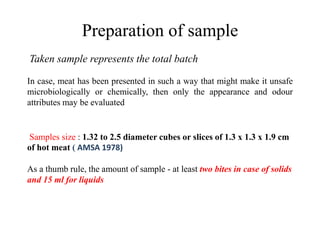
Preparation of sample
Taken sample represents the total batch
In case, meat has been presented in such a way that might make it unsafe
microbiologically or chemically, then only the appearance and odour
attributes may be evaluated
Samples size : 1.32 to 2.5 diameter cubes or slices of 1.3 x 1.3 x 1.9 cm
of hot meat ( AMSA 1978)
As a thumb rule, the amount of sample - at least two bites in case of solids
and 15 ml for liquids
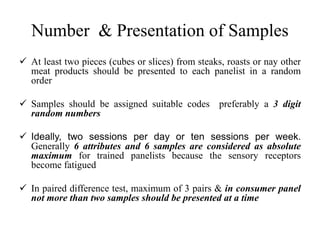
Number & Presentation of Samples
 At least two pieces (cubes or slices) from steaks, roasts or nay other
meat products should be presented to each panelist in a random
order
 Samples should be assigned suitable codes preferably a 3 digit
random numbers
 Ideally, two sessions per day or ten sessions per week.
Generally 6 attributes and 6 samples are considered as absolute
maximum for trained panelists because the sensory receptors
become fatigued
 In paired difference test, maximum of 3 pairs & in consumer panel
not more than two samples should be presented at a time
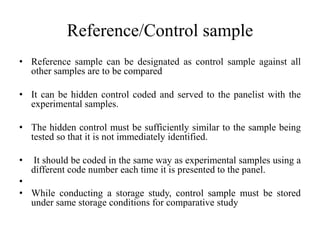
Reference/Control sample
• Reference sample can be designated as control sample against all
other samples are to be compared
• It can be hidden control coded and served to the panelist with the
experimental samples.
• The hidden control must be sufficiently similar to the sample being
tested so that it is not immediately identified.
• It should be coded in the same way as experimental samples using a
different code number each time it is presented to the panel.
•
• While conducting a storage study, control sample must be stored
under same storage conditions for comparative study
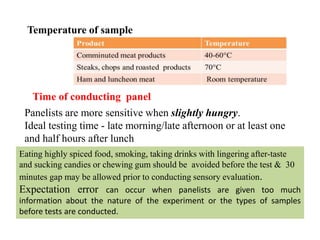
Temperature of sample
Time of conducting panel
Panelists are more sensitive when slightly hungry.
Ideal testing time - late morning/late afternoon or at least one
and half hours after lunch
Eating highly spiced food, smoking, taking drinks with lingering after-taste
and sucking candies or chewing gum should be avoided before the test & 30
minutes gap may be allowed prior to conducting sensory evaluation.
Expectation error can occur when panelists are given too much
information about the nature of the experiment or the types of samples
before tests are conducted.

Sensory_Evalauation__Part_III_.pptx

  • 1.
    Unit II: SensoryEvaluation (Part III) By: Dr. R. K. Jaiswal Asstt. Prof.-cum-Jr. Scientist Dept. of LPT Bihar Veterinary College Bihar Animal Sciences University Patna-800014 (Bihar) LPT 602: MEAT PROCESSING , PACKAGING, QUALITY CONTROL AND MARKETING Date of lecture: 10/11/2020
  • 2.
    Selection & Trainingof Panelists Criteria for selection Willingness, availability, capability, sensitivity, selectivity, dependability and general health. Also fill up questionnaire indicating their food likes or dislikes and food allergies if any. For screening the sensitivity of the panelists Recognition test (qualitative determination) Threshold test (quantitative determination) • Training of panelists accomplished by personal interviews, group discussion and improving their sensitivity further by serial dilution tests • Training sessions continued till the sensory scores did not vary more than +1 from the mean scores (on 8-point hedonic scale).
  • 3.
    On the basisof the training panelist are categorized 1. Trained panelists : To establish the intensity of sensory character or overall quality of meat and meat products  Involved in all developmental and processing studies. 2.Semi-trained panelists : Normally familiar with the quality of different classes of meat In a semi-trained panel, individual variations are generally balanced by involving greater number of panelists
  • 4.
    Preparation & PresentationOf Samples Testing environment 1. Sensory evaluation laboratory separate from the sample preparation room (only 45 cm x 30 cm connection allowed ) 2. Provision of air conditioning with exhaust to eliminate external odours. 3. Separate booth for each panelist having wash basin, water for oral rinsing, thermostatically controlled heating device, writing table, chair, water beakers and arrangements for colored as well as neutral white lights. 4. Also provision for white plastic serving trays, paper napkins, forks, knives and group discussion area equipped with a large table and stools to sit 12-15 persons. 5. Relative humidity – 70 to 75% & temperature - 20±2°C for ideal laboratory conditions.
  • 5.
    Preparation of sample Takensample represents the total batch In case, meat has been presented in such a way that might make it unsafe microbiologically or chemically, then only the appearance and odour attributes may be evaluated Samples size : 1.32 to 2.5 diameter cubes or slices of 1.3 x 1.3 x 1.9 cm of hot meat ( AMSA 1978) As a thumb rule, the amount of sample - at least two bites in case of solids and 15 ml for liquids
  • 6.
    Number & Presentationof Samples  At least two pieces (cubes or slices) from steaks, roasts or nay other meat products should be presented to each panelist in a random order  Samples should be assigned suitable codes preferably a 3 digit random numbers  Ideally, two sessions per day or ten sessions per week. Generally 6 attributes and 6 samples are considered as absolute maximum for trained panelists because the sensory receptors become fatigued  In paired difference test, maximum of 3 pairs & in consumer panel not more than two samples should be presented at a time
  • 7.
    Reference/Control sample • Referencesample can be designated as control sample against all other samples are to be compared • It can be hidden control coded and served to the panelist with the experimental samples. • The hidden control must be sufficiently similar to the sample being tested so that it is not immediately identified. • It should be coded in the same way as experimental samples using a different code number each time it is presented to the panel. • • While conducting a storage study, control sample must be stored under same storage conditions for comparative study
  • 8.
    Temperature of sample Timeof conducting panel Panelists are more sensitive when slightly hungry. Ideal testing time - late morning/late afternoon or at least one and half hours after lunch Eating highly spiced food, smoking, taking drinks with lingering after-taste and sucking candies or chewing gum should be avoided before the test & 30 minutes gap may be allowed prior to conducting sensory evaluation. Expectation error can occur when panelists are given too much information about the nature of the experiment or the types of samples before tests are conducted.