CPCSEA Guidelines
By- Twinkle Parashar
M.Pharm-Pharmacology
Semester-1st
Baddi university of Emerging Science and Technology
CPCSEA guidelines to conduct Experiments on
animals.
CPCSEA
• It is “Committee for purpose of control and supervision of experiments on animals. “
• Statutory body formed by the Act of the Indian Parliament under the Prevention of
Cruelty to Animals Act, 1960.
• Formed in 1964.
• Amendement was made in 1982 is to prevent the unnecessary pain or suffering in the
animals.
• The necessary requirements are only carried out during experimental procedure.
• Further revived in 1998, under the committed chairmanship of Meneka Gandhi.
• Two more amendments were made in 2001 and 2006:
1. To regulate experimentation on animals.
2. Increase breading and experiment on animals ( control and supervision).
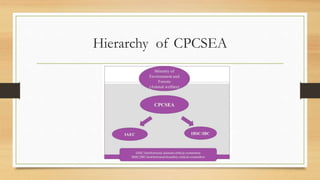
Hierarchy of CPCSEA
Need for CPCSEA
• To ensure that lab animals are well maintained and experiment are conducted
according to ethical norms.
• To promote human care towards animals used in biomedical and behaviour
research.
• Enhance animal well-being and quality.
• Improve laboratory animal facilities.
• Enhance biological Knowledge that is relevant to human and animals .
Basic Principles of CPCSEA
• Investigators are responsible for well being of the animals and Euthanasia is permitted during the
study in some special circumstances :
1. Animals are paralyzed or are incapable of locomotion.
2. Extreme or Recurring pain and distress.
3. Situation at which lack of Euthanasia may becomes life threatening to human or animals.
4. Animal house should produce GLP guidelines for their housing, feeding, care and disposal.
5 R’s
• Reduction : Use of methods that enable researchers to obtain comparable levels of information from fewer
animals, or to obtain information from the same number of animals.
• Refinement : Use of methods that alleviate or minimise potential pain suffering and inhance animal welfare
for the animals used.
• Replacement : Methods which avoid or replace use of animals in research.
• Rehabilitation : It is defined as “ The aftercare rendered to animals that have been”
1. Breed for the purpose of experimentation.
2. Subject to any form of experimentation, both
3. Retain in laboratory animal houses or breeding houses for the purpose of experimentation, both for
education and research.
Continue…
• With the sole intention of alleviating the pain /distress or suffering due to physical trauma that the
animals have been exposed to and to provide animals a life distinctly different from laboratory housing
and care, until the point of natural death.
• Reuse : Of laboratory animals is a term used after completion of an experiment on animal used again
in same or a different protocol .
Functions of CPCSEA
• Registration of any institution / establishment conducting animal experimentation and breeding of any
animals for this purpose.
Business animal house also require approval from CPCSEA not only for institution, when it procure
animals.
2nd Generation animals are used for animal experiments.
• Selection and appointment of nominees in the Institution animal ethical Committee of registered
establishment.
Continue
• Approval of the animal house facilities on the basis of the report of inspection conducted by
CPCSEA.
Animal house has 2 area
1. Bad corridor ( All wastes and kept here)
2. Good Corridor ( All animals are full hygienic and bruding are done here).
Continue
• After the approval, permission is granted for the conduction of experiments using animals. IEAC can
give permission to work on smaller animals, But if the experiments are to be carried out on higher
animals like Monkey, horse etc. permission is needed from. Central Committee.
• Recommendation for import of animals for use in experiments.
• Action against establishment in case of violation of any illegal norms.
Facilities of Animal house ( Laboratory)
• Require surveillance, diagnostic and treatment of the disease occur in animal, so it should be carried
out under supervision of Veterinary Doctor. (Visit 3times a month)
• Facilities for the animals experiments should include :
1. Hazardous Agents
2. Physical restraint
Physical Facilities
• Functional Area: Animals room : 50 – 60%
Stores : 8-10%
Washing : 8 – 10%
Machine room : 4-5%
Quarantine and corridor : 12 – 15%
Physical Facilities
• Physical Facilities :
• Building materials : Durable, moisture proof and fire resistant.
• Walls and barriers : Free of cracks.
• Doors : Rust, vermin and dust proof, rodent barrier.
• Floors: Smooth, non absorbant and skid proof.
• Corridor : Wide enough.
• Exterior window : not recommended for small animals Facilities.
• Floor drains: To prevent high humidity.
• Storage area: Designed for fled, Cages and materials not used.
• Experimental Area: For small animals experiments carried out in separate area and for larger animals separate area for surgical procedures and
supportive treatments.
Environment
• Temperature : 18 – 29°C
• Humidity : 30 – 70%
• Ventilation : Air Conditioning System
• Power and lightning : Fluroscent lights, emergency power.
• Social Environment :
Population density can affect reproduction, metabolism, immune responses and behaviour.
• Bedding : Absobent, free of toxic chemicals
Change bedding twice a week
Optimize normal animal behaviour.
Animal Husbandary
• Adequate space, maintenance of body temperature, urination, defecation and reproduction.
• Keep animals dry and clean.
• Polyprolene, polycarbonate and stainless steel Cages should be made.
• Easy for inspection.
Food
• Palatable, non contaminated and nutritionally adequate.
• Should contain crude fibers, crude protein, essential vitamins, minerals, fats and carbohydrates for providing
appropriate nutrition.
• Shelf life: 6 months.
• No hormone, drug or antibiotics are added.
• Water : fresh, potable, uncontaminated.
• Pest Control Programs
• Emergency weekend and holiday care
• Everyday care is essential.
Veterinary Care
• Daily observation of animals.
• Reviewing protocols and proposals.
• Establishment of appropriate policies and procedures for animal Husbandary.
• To maintain zoonosis control programmes.
Quarantine :
• Quarantine is the separation of newly received animals from those already in the animal facility.
• Detemines microbial status of newly received animals.
• Minimizes introduction of pathogenesis into an established colony.
• Duration : Small animals – 1 week
Large animals – 6 weeks
Surveillance, Diagnosis, Treatment and control of Disease
• All animals should be observed for signs of any illness, injury or abnormal behaviour by animal house staff, if any sign of contagious disease should be seen they should
be isolated from healthy animals in the colony.
Personal hygiene
• Showers, changing rooms, footwear
• Clothing
• Use disposable wear such as gloves, masks, Head caps, costs, shoes cover.
• Avoid eat, drink and smoke in animal facility.
Animal experimentation involving Hazardous agents:
• Procedure and facilities involving Hazardous agents should be reviewed by
• Institutional Bio – safety Committee.
• Institutional animals ethics Committee.
Duration of Experiments:
• No animals should be used for experiments for more than 3yrs unless adequate justification is provided.
Sanitization and Cleanliness
• Cages should be sanitized before the animals are placed.
• Cages and water bottles can be disinfected by rinsing at a temperature of 82.2°C or by chemical agents such
as Hypochlorite to destroy pathogenic microbes.
• Autoclave or gas sterilizers can be used.
Water Disposal
• Water disposal : incercination .
• Storage of waste: Separated area.
• Cold Storage : Prevent decomposition of biological waste.
• Waste should be removed frequently.
Thank you 

Cpcsea presentation

  • 1.
    CPCSEA Guidelines By- TwinkleParashar M.Pharm-Pharmacology Semester-1st Baddi university of Emerging Science and Technology
  • 2.
    CPCSEA guidelines toconduct Experiments on animals.
  • 3.
    CPCSEA • It is“Committee for purpose of control and supervision of experiments on animals. “ • Statutory body formed by the Act of the Indian Parliament under the Prevention of Cruelty to Animals Act, 1960. • Formed in 1964. • Amendement was made in 1982 is to prevent the unnecessary pain or suffering in the animals. • The necessary requirements are only carried out during experimental procedure. • Further revived in 1998, under the committed chairmanship of Meneka Gandhi. • Two more amendments were made in 2001 and 2006: 1. To regulate experimentation on animals. 2. Increase breading and experiment on animals ( control and supervision).
  • 4.
  • 5.
    Need for CPCSEA •To ensure that lab animals are well maintained and experiment are conducted according to ethical norms. • To promote human care towards animals used in biomedical and behaviour research. • Enhance animal well-being and quality. • Improve laboratory animal facilities. • Enhance biological Knowledge that is relevant to human and animals .
  • 6.
    Basic Principles ofCPCSEA • Investigators are responsible for well being of the animals and Euthanasia is permitted during the study in some special circumstances : 1. Animals are paralyzed or are incapable of locomotion. 2. Extreme or Recurring pain and distress. 3. Situation at which lack of Euthanasia may becomes life threatening to human or animals. 4. Animal house should produce GLP guidelines for their housing, feeding, care and disposal.
  • 7.
    5 R’s • Reduction: Use of methods that enable researchers to obtain comparable levels of information from fewer animals, or to obtain information from the same number of animals. • Refinement : Use of methods that alleviate or minimise potential pain suffering and inhance animal welfare for the animals used. • Replacement : Methods which avoid or replace use of animals in research. • Rehabilitation : It is defined as “ The aftercare rendered to animals that have been” 1. Breed for the purpose of experimentation. 2. Subject to any form of experimentation, both 3. Retain in laboratory animal houses or breeding houses for the purpose of experimentation, both for education and research.
  • 8.
    Continue… • With thesole intention of alleviating the pain /distress or suffering due to physical trauma that the animals have been exposed to and to provide animals a life distinctly different from laboratory housing and care, until the point of natural death. • Reuse : Of laboratory animals is a term used after completion of an experiment on animal used again in same or a different protocol .
  • 9.
    Functions of CPCSEA •Registration of any institution / establishment conducting animal experimentation and breeding of any animals for this purpose. Business animal house also require approval from CPCSEA not only for institution, when it procure animals. 2nd Generation animals are used for animal experiments. • Selection and appointment of nominees in the Institution animal ethical Committee of registered establishment.
  • 10.
    Continue • Approval ofthe animal house facilities on the basis of the report of inspection conducted by CPCSEA. Animal house has 2 area 1. Bad corridor ( All wastes and kept here) 2. Good Corridor ( All animals are full hygienic and bruding are done here).
  • 11.
    Continue • After theapproval, permission is granted for the conduction of experiments using animals. IEAC can give permission to work on smaller animals, But if the experiments are to be carried out on higher animals like Monkey, horse etc. permission is needed from. Central Committee. • Recommendation for import of animals for use in experiments. • Action against establishment in case of violation of any illegal norms.
  • 12.
    Facilities of Animalhouse ( Laboratory) • Require surveillance, diagnostic and treatment of the disease occur in animal, so it should be carried out under supervision of Veterinary Doctor. (Visit 3times a month) • Facilities for the animals experiments should include : 1. Hazardous Agents 2. Physical restraint
  • 13.
    Physical Facilities • FunctionalArea: Animals room : 50 – 60% Stores : 8-10% Washing : 8 – 10% Machine room : 4-5% Quarantine and corridor : 12 – 15%
  • 14.
    Physical Facilities • PhysicalFacilities : • Building materials : Durable, moisture proof and fire resistant. • Walls and barriers : Free of cracks. • Doors : Rust, vermin and dust proof, rodent barrier. • Floors: Smooth, non absorbant and skid proof. • Corridor : Wide enough. • Exterior window : not recommended for small animals Facilities. • Floor drains: To prevent high humidity. • Storage area: Designed for fled, Cages and materials not used. • Experimental Area: For small animals experiments carried out in separate area and for larger animals separate area for surgical procedures and supportive treatments.
  • 15.
    Environment • Temperature :18 – 29°C • Humidity : 30 – 70% • Ventilation : Air Conditioning System • Power and lightning : Fluroscent lights, emergency power. • Social Environment : Population density can affect reproduction, metabolism, immune responses and behaviour. • Bedding : Absobent, free of toxic chemicals Change bedding twice a week Optimize normal animal behaviour.
  • 16.
    Animal Husbandary • Adequatespace, maintenance of body temperature, urination, defecation and reproduction. • Keep animals dry and clean. • Polyprolene, polycarbonate and stainless steel Cages should be made. • Easy for inspection.
  • 17.
    Food • Palatable, noncontaminated and nutritionally adequate. • Should contain crude fibers, crude protein, essential vitamins, minerals, fats and carbohydrates for providing appropriate nutrition. • Shelf life: 6 months. • No hormone, drug or antibiotics are added. • Water : fresh, potable, uncontaminated. • Pest Control Programs • Emergency weekend and holiday care • Everyday care is essential.
  • 18.
    Veterinary Care • Dailyobservation of animals. • Reviewing protocols and proposals. • Establishment of appropriate policies and procedures for animal Husbandary. • To maintain zoonosis control programmes. Quarantine : • Quarantine is the separation of newly received animals from those already in the animal facility. • Detemines microbial status of newly received animals. • Minimizes introduction of pathogenesis into an established colony. • Duration : Small animals – 1 week Large animals – 6 weeks Surveillance, Diagnosis, Treatment and control of Disease • All animals should be observed for signs of any illness, injury or abnormal behaviour by animal house staff, if any sign of contagious disease should be seen they should be isolated from healthy animals in the colony.
  • 19.
    Personal hygiene • Showers,changing rooms, footwear • Clothing • Use disposable wear such as gloves, masks, Head caps, costs, shoes cover. • Avoid eat, drink and smoke in animal facility. Animal experimentation involving Hazardous agents: • Procedure and facilities involving Hazardous agents should be reviewed by • Institutional Bio – safety Committee. • Institutional animals ethics Committee. Duration of Experiments: • No animals should be used for experiments for more than 3yrs unless adequate justification is provided.
  • 20.
    Sanitization and Cleanliness •Cages should be sanitized before the animals are placed. • Cages and water bottles can be disinfected by rinsing at a temperature of 82.2°C or by chemical agents such as Hypochlorite to destroy pathogenic microbes. • Autoclave or gas sterilizers can be used. Water Disposal • Water disposal : incercination . • Storage of waste: Separated area. • Cold Storage : Prevent decomposition of biological waste. • Waste should be removed frequently.
  • 21.