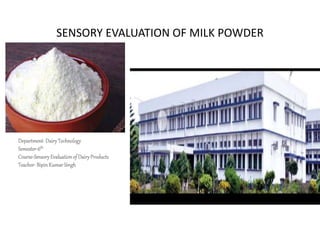
SENSORY EVALUATION OF MILK POWDER
Department- DairyTechnology
Semester-6th
Course-SensoryEvaluationof DairyProducts
Teacher-BipinKumarSingh
Introduction
• Sensory evaluation of milk powder is
important for determining the shelf life of the
product. Descriptive sensory analysis method
has been used to identify and quantify flavors
in several dairy products.
WMP
• Sensorial Characteristics of milk powder
Flavour: Stale, storage, old, Rancid,
Oxidized/tallowy, Scorched
• Physical Characteristics of WMP
o Body and texture: Lumpy, Caked
o Colour of WMP: Browned or darkened,
Scorched, Lack of uniformity
Skim milk powder
• Skim milk powder (SMP)
Flavour: Stale, storage, old, Scorched, Oxidized/
tallowy
• Physical Characteristics of SMP
Colour of SMP
Malted milk
• Flavour: Malted milk, being composed in large
part of maltose and dextrose, has a definitely
sweet taste. It should have a distinct flavour of
malt. The product should be judged for its lack of
malt flavour and for oxidized flavour defect.
• Body and texture: Malted milk has a coarse and
grainy texture unlike the fine texture of spray
dried milk. While judging, product must be
examined for possible stickiness and formation of
cakes because of its affinity for water.
Sensory Evaluation procedure
• Begin with the examination of the powder container for its appearance
and seal. A perfect package should be properly sealed and unsoiled.
• Open the container and immediately assess the product for its odour.
• Take out the sample in sufficient quantity in a petri plate or any other
convenient and coverable container.
• Judge the product for its appearance and then for flavour by taking a
small quantity in the mouth and manipulating it inside mouth by using the
tongue. Expel the product from mouth.
• To consolidate the information obtained as above, evaluate the product
further by reconstituting it by adding 13 g whole milk powderor 1 Og skim
milk powder to 100 ml. distilled water (temperature of
Contd..
water should be 30 -35°C for skim milk powder and 40-45°C
for whole milk powder) and mixing it vigorously for 90 sec
with the help of an electric mixer.
• Before evaluating the reconstituted milk, allow it to stand for
30 min. for blending of flavours which would help the judge in
determining more accurately the true flavour; otherwise,
freshly prepared fluid milk often gives a slightly chalky, watery
or cooked taste.
• Instant dry milk can be reconstituted by adding the proper
amount to cold distilled water with vigorous shaking, allowing
the mixture to stand in the container for a minimum of 15
min. and then gently mixing again before judging.
Contd..
• Take the reconstituted milk (about 50 ml.) in a
100 ml beaker or a testing glass. For flavour
evaluation, take a generous sip and roll it in
the mouth and note the flavour sensation.
• Sometimes the after-taste is enhanced by
breathing in fresh air very slowly through the
mouth and then exhaling it slowly through the
nose.
Contd..
• Shake the milk and place the nose directly over the container
immediately after the milk has been shaken and note the presence
of any off-odour by taking a full 'whiff of the air.
• The flavour impression obtained on the dry product as such should
be correlated with that on the reconstituted product before giving
the score.
• Following the above procedure it would be convenient to keep the
product ready in both dry as well as reconstituted forms before
starting its examination.
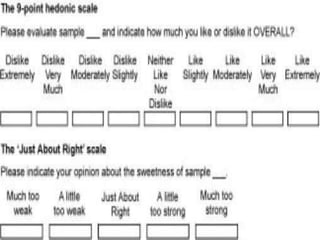
• Indicate the scores on different attributes in the Evaluation Card.
The hints given in Scoring Guide will aid the judge to score the
product properly.
SENSORY-EVALUATION-OF-MILK-POWDER.pptx

SENSORY-EVALUATION-OF-MILK-POWDER.pptx

  • 1.
    SENSORY EVALUATION OFMILK POWDER Department- DairyTechnology Semester-6th Course-SensoryEvaluationof DairyProducts Teacher-BipinKumarSingh
  • 2.
    Introduction • Sensory evaluationof milk powder is important for determining the shelf life of the product. Descriptive sensory analysis method has been used to identify and quantify flavors in several dairy products.
  • 3.
    WMP • Sensorial Characteristicsof milk powder Flavour: Stale, storage, old, Rancid, Oxidized/tallowy, Scorched • Physical Characteristics of WMP o Body and texture: Lumpy, Caked o Colour of WMP: Browned or darkened, Scorched, Lack of uniformity
  • 4.
    Skim milk powder •Skim milk powder (SMP) Flavour: Stale, storage, old, Scorched, Oxidized/ tallowy • Physical Characteristics of SMP Colour of SMP
  • 5.
    Malted milk • Flavour:Malted milk, being composed in large part of maltose and dextrose, has a definitely sweet taste. It should have a distinct flavour of malt. The product should be judged for its lack of malt flavour and for oxidized flavour defect. • Body and texture: Malted milk has a coarse and grainy texture unlike the fine texture of spray dried milk. While judging, product must be examined for possible stickiness and formation of cakes because of its affinity for water.
  • 6.
    Sensory Evaluation procedure •Begin with the examination of the powder container for its appearance and seal. A perfect package should be properly sealed and unsoiled. • Open the container and immediately assess the product for its odour. • Take out the sample in sufficient quantity in a petri plate or any other convenient and coverable container. • Judge the product for its appearance and then for flavour by taking a small quantity in the mouth and manipulating it inside mouth by using the tongue. Expel the product from mouth. • To consolidate the information obtained as above, evaluate the product further by reconstituting it by adding 13 g whole milk powderor 1 Og skim milk powder to 100 ml. distilled water (temperature of
  • 8.
    Contd.. water should be30 -35°C for skim milk powder and 40-45°C for whole milk powder) and mixing it vigorously for 90 sec with the help of an electric mixer. • Before evaluating the reconstituted milk, allow it to stand for 30 min. for blending of flavours which would help the judge in determining more accurately the true flavour; otherwise, freshly prepared fluid milk often gives a slightly chalky, watery or cooked taste. • Instant dry milk can be reconstituted by adding the proper amount to cold distilled water with vigorous shaking, allowing the mixture to stand in the container for a minimum of 15 min. and then gently mixing again before judging.
  • 9.
    Contd.. • Take thereconstituted milk (about 50 ml.) in a 100 ml beaker or a testing glass. For flavour evaluation, take a generous sip and roll it in the mouth and note the flavour sensation. • Sometimes the after-taste is enhanced by breathing in fresh air very slowly through the mouth and then exhaling it slowly through the nose.
  • 10.
    Contd.. • Shake themilk and place the nose directly over the container immediately after the milk has been shaken and note the presence of any off-odour by taking a full 'whiff of the air. • The flavour impression obtained on the dry product as such should be correlated with that on the reconstituted product before giving the score. • Following the above procedure it would be convenient to keep the product ready in both dry as well as reconstituted forms before starting its examination. • Indicate the scores on different attributes in the Evaluation Card. The hints given in Scoring Guide will aid the judge to score the product properly.