Center for Food Technology
Jiwaji University, Gwalior
Presentation Topic:
CHEESE
Presented By: Ankur Gupta
M.Sc. 3rd Semester
( 2015-17 )
Introduction
Cheese has been defined as a product made from
the curd obtained from milk by coagulating the
casein with the help of rennet or similar
enzymes in the presence of lactic acid produced
by added or adventitious micro-organisms ,from
which part of the moisture has been removed by
the cutting ,cooking and pressing ,which has
been shaped in a mould, then ripened by holding
it for some time at suitable temprerature and
humidities.
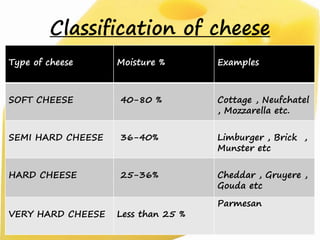
Classification of cheese
Type of cheese Moisture % Examples
SOFT CHEESE 40-80 % Cottage , Neufchatel
, Mozzarella etc.
SEMI HARD CHEESE 36-40% Limburger , Brick ,
Munster etc
HARD CHEESE 25-36% Cheddar , Gruyere ,
Gouda etc
VERY HARD CHEESE Less than 25 %
Parmesan
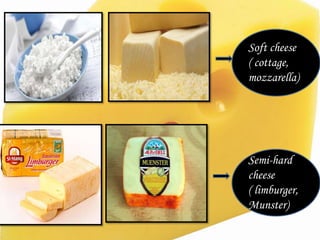
Soft cheese
( cottage,
mozzarella)
Semi-hard
cheese
( limburger,
Munster)
Hard cheese
( gouda,
cheddar)
Very hard
cheese
(parmesan)
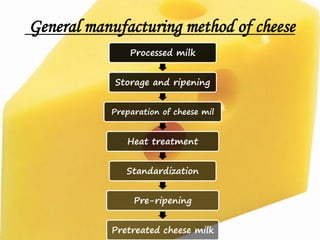
General manufacturing method of cheese
Processed milk
Storage and ripening
Preparation of cheese mil
Heat treatment
Standardization
Pre-ripening
Pretreated cheese milk
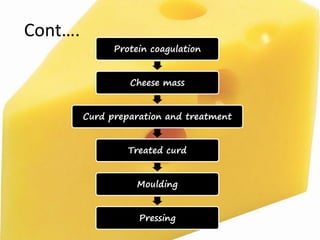
Cont….
Protein coagulation
Cheese mass
Curd preparation and treatment
Treated curd
Moulding
Pressing
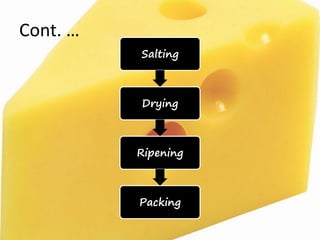
Salting
Drying
Ripening
Packing
Cont. …
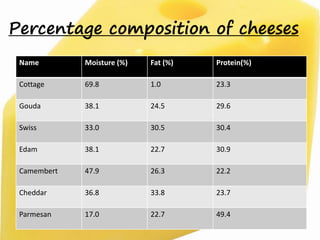
Percentage composition of cheeses
Name Moisture (%) Fat (%) Protein(%)
Cottage 69.8 1.0 23.3
Gouda 38.1 24.5 29.6
Swiss 33.0 30.5 30.4
Edam 38.1 22.7 30.9
Camembert 47.9 26.3 22.2
Cheddar 36.8 33.8 23.7
Parmesan 17.0 22.7 49.4
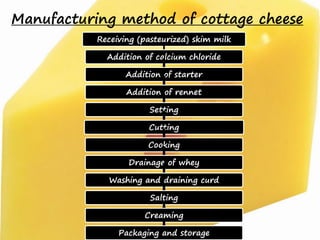
Manufacturing method of cottage cheese
Receiving (pasteurized) skim milk
Addition of calcium chloride
Addition of starter
Addition of rennet
Setting
Cutting
Cooking
Drainage of whey
Washing and draining curd
Salting
Creaming
Packaging and storage
Manufacturing method of cheddar cheese
Receiving milk
Pre-heating(35-40°C)
Filtration/clarification
Standardization
Pasteurization (63°C/30 min.)
Addition of starter(ripening at 31°C)
Addition of color
Adding rennet (renneting at 31°C)
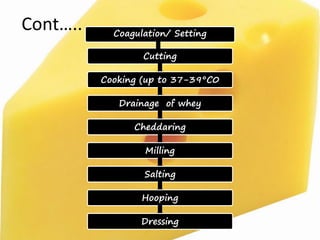
Cont…..
Cutting
Cooking (up to 37-39°C0
Drainage of whey
Cheddaring
Milling
Salting
Hooping
Dressing
Coagulation/ Setting
Cont……..
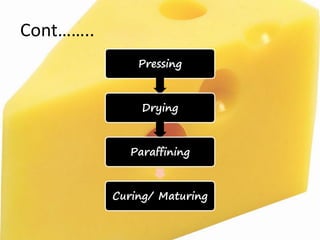
Pressing
Drying
Paraffining
Curing/ Maturing
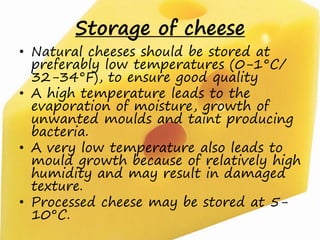
Storage of cheese
• Natural cheeses should be stored at
preferably low temperatures (0-1°C/
32-34°F), to ensure good quality
• A high temperature leads to the
evaporation of moisture, growth of
unwanted moulds and taint producing
bacteria.
• A very low temperature also leads to
mould growth because of relatively high
humidity and may result in damaged
texture.
• Processed cheese may be stored at 5-
10°C.
Judging and grading of cheese
Quality of cheese can be determined
by following factors:
• Tempering : holding cheese for
sufficient time so as to determine its
true body and texture characteristics
• Sensory parameters: Appearance,
Color, Body and Texture, Flavor.
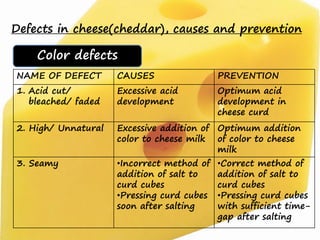
Defects in cheese(cheddar), causes and prevention
NAME OF DEFECT CAUSES PREVENTION
1. Acid cut/
bleached/ faded
Excessive acid
development
Optimum acid
development in
cheese curd
2. High/ Unnatural Excessive addition of
color to cheese milk
Optimum addition
of color to cheese
milk
3. Seamy •Incorrect method of
addition of salt to
curd cubes
•Pressing curd cubes
soon after salting
•Correct method of
addition of salt to
curd cubes
•Pressing curd cubes
with sufficient time-
gap after salting
Color defects
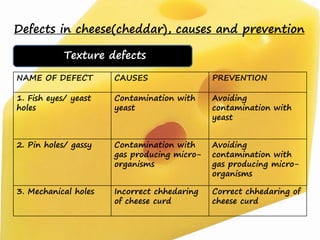
Defects in cheese(cheddar), causes and prevention
NAME OF DEFECT CAUSES PREVENTION
1. Fish eyes/ yeast
holes
Contamination with
yeast
Avoiding
contamination with
yeast
2. Pin holes/ gassy Contamination with
gas producing micro-
organisms
Avoiding
contamination with
gas producing micro-
organisms
3. Mechanical holes Incorrect chhedaring
of cheese curd
Correct chhedaring of
cheese curd
Texture defects
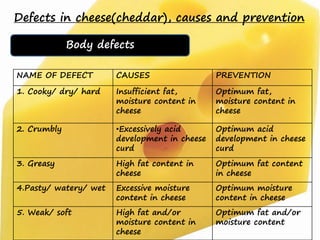
Defects in cheese(cheddar), causes and prevention
Body defects
NAME OF DEFECT CAUSES PREVENTION
1. Cooky/ dry/ hard Insufficient fat,
moisture content in
cheese
Optimum fat,
moisture content in
cheese
2. Crumbly •Excessively acid
development in cheese
curd
Optimum acid
development in cheese
curd
3. Greasy High fat content in
cheese
Optimum fat content
in cheese
4.Pasty/ watery/ wet Excessive moisture
content in cheese
Optimum moisture
content in cheese
5. Weak/ soft High fat and/or
moisture content in
cheese
Optimum fat and/or
moisture content
Defects in cheese(cheddar), causes and prevention
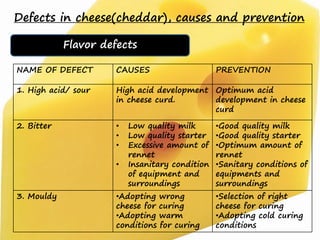
Flavor defects
NAME OF DEFECT CAUSES PREVENTION
1. High acid/ sour High acid development
in cheese curd.
Optimum acid
development in cheese
curd
2. Bitter • Low quality milk
• Low quality starter
• Excessive amount of
rennet
• Insanitary condition
of equipment and
surroundings
•Good quality milk
•Good quality starter
•Optimum amount of
rennet
•Sanitary conditions of
equipments and
surroundings
3. Mouldy •Adopting wrong
cheese for curing
•Adopting warm
conditions for curing
•Selection of right
cheese for curing
•Adopting cold curing
conditions
Popular cheese brands in India
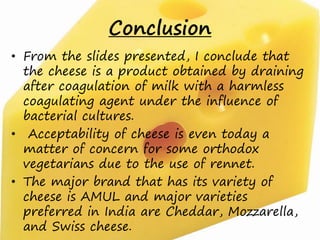
Conclusion
• From the slides presented, I conclude that
the cheese is a product obtained by draining
after coagulation of milk with a harmless
coagulating agent under the influence of
bacterial cultures.
• Acceptability of cheese is even today a
matter of concern for some orthodox
vegetarians due to the use of rennet.
• The major brand that has its variety of
cheese is AMUL and major varieties
preferred in India are Cheddar, Mozzarella,
and Swiss cheese.
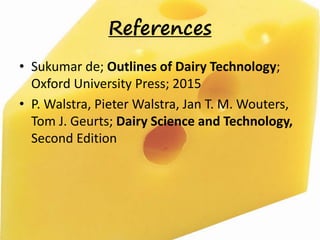
References
• Sukumar de; Outlines of Dairy Technology;
Oxford University Press; 2015
• P. Walstra, Pieter Walstra, Jan T. M. Wouters,
Tom J. Geurts; Dairy Science and Technology,
Second Edition
THANK YOU

ankurppt-161127175132 (1).pdf

  • 1.
    Center for FoodTechnology Jiwaji University, Gwalior Presentation Topic: CHEESE Presented By: Ankur Gupta M.Sc. 3rd Semester ( 2015-17 )
  • 2.
    Introduction Cheese has beendefined as a product made from the curd obtained from milk by coagulating the casein with the help of rennet or similar enzymes in the presence of lactic acid produced by added or adventitious micro-organisms ,from which part of the moisture has been removed by the cutting ,cooking and pressing ,which has been shaped in a mould, then ripened by holding it for some time at suitable temprerature and humidities.
  • 3.
    Classification of cheese Typeof cheese Moisture % Examples SOFT CHEESE 40-80 % Cottage , Neufchatel , Mozzarella etc. SEMI HARD CHEESE 36-40% Limburger , Brick , Munster etc HARD CHEESE 25-36% Cheddar , Gruyere , Gouda etc VERY HARD CHEESE Less than 25 % Parmesan
  • 4.
  • 5.
    Hard cheese ( gouda, cheddar) Veryhard cheese (parmesan)
  • 6.
    General manufacturing methodof cheese Processed milk Storage and ripening Preparation of cheese mil Heat treatment Standardization Pre-ripening Pretreated cheese milk
  • 7.
    Cont…. Protein coagulation Cheese mass Curdpreparation and treatment Treated curd Moulding Pressing
  • 8.
  • 9.
    Percentage composition ofcheeses Name Moisture (%) Fat (%) Protein(%) Cottage 69.8 1.0 23.3 Gouda 38.1 24.5 29.6 Swiss 33.0 30.5 30.4 Edam 38.1 22.7 30.9 Camembert 47.9 26.3 22.2 Cheddar 36.8 33.8 23.7 Parmesan 17.0 22.7 49.4
  • 10.
    Manufacturing method ofcottage cheese Receiving (pasteurized) skim milk Addition of calcium chloride Addition of starter Addition of rennet Setting Cutting Cooking Drainage of whey Washing and draining curd Salting Creaming Packaging and storage
  • 11.
    Manufacturing method ofcheddar cheese Receiving milk Pre-heating(35-40°C) Filtration/clarification Standardization Pasteurization (63°C/30 min.) Addition of starter(ripening at 31°C) Addition of color Adding rennet (renneting at 31°C)
  • 12.
    Cont….. Cutting Cooking (up to37-39°C0 Drainage of whey Cheddaring Milling Salting Hooping Dressing Coagulation/ Setting
  • 13.
  • 14.
    Storage of cheese •Natural cheeses should be stored at preferably low temperatures (0-1°C/ 32-34°F), to ensure good quality • A high temperature leads to the evaporation of moisture, growth of unwanted moulds and taint producing bacteria. • A very low temperature also leads to mould growth because of relatively high humidity and may result in damaged texture. • Processed cheese may be stored at 5- 10°C.
  • 15.
    Judging and gradingof cheese Quality of cheese can be determined by following factors: • Tempering : holding cheese for sufficient time so as to determine its true body and texture characteristics • Sensory parameters: Appearance, Color, Body and Texture, Flavor.
  • 16.
    Defects in cheese(cheddar),causes and prevention NAME OF DEFECT CAUSES PREVENTION 1. Acid cut/ bleached/ faded Excessive acid development Optimum acid development in cheese curd 2. High/ Unnatural Excessive addition of color to cheese milk Optimum addition of color to cheese milk 3. Seamy •Incorrect method of addition of salt to curd cubes •Pressing curd cubes soon after salting •Correct method of addition of salt to curd cubes •Pressing curd cubes with sufficient time- gap after salting Color defects
  • 17.
    Defects in cheese(cheddar),causes and prevention NAME OF DEFECT CAUSES PREVENTION 1. Fish eyes/ yeast holes Contamination with yeast Avoiding contamination with yeast 2. Pin holes/ gassy Contamination with gas producing micro- organisms Avoiding contamination with gas producing micro- organisms 3. Mechanical holes Incorrect chhedaring of cheese curd Correct chhedaring of cheese curd Texture defects
  • 18.
    Defects in cheese(cheddar),causes and prevention Body defects NAME OF DEFECT CAUSES PREVENTION 1. Cooky/ dry/ hard Insufficient fat, moisture content in cheese Optimum fat, moisture content in cheese 2. Crumbly •Excessively acid development in cheese curd Optimum acid development in cheese curd 3. Greasy High fat content in cheese Optimum fat content in cheese 4.Pasty/ watery/ wet Excessive moisture content in cheese Optimum moisture content in cheese 5. Weak/ soft High fat and/or moisture content in cheese Optimum fat and/or moisture content
  • 19.
    Defects in cheese(cheddar),causes and prevention Flavor defects NAME OF DEFECT CAUSES PREVENTION 1. High acid/ sour High acid development in cheese curd. Optimum acid development in cheese curd 2. Bitter • Low quality milk • Low quality starter • Excessive amount of rennet • Insanitary condition of equipment and surroundings •Good quality milk •Good quality starter •Optimum amount of rennet •Sanitary conditions of equipments and surroundings 3. Mouldy •Adopting wrong cheese for curing •Adopting warm conditions for curing •Selection of right cheese for curing •Adopting cold curing conditions
  • 20.
  • 21.
    Conclusion • From theslides presented, I conclude that the cheese is a product obtained by draining after coagulation of milk with a harmless coagulating agent under the influence of bacterial cultures. • Acceptability of cheese is even today a matter of concern for some orthodox vegetarians due to the use of rennet. • The major brand that has its variety of cheese is AMUL and major varieties preferred in India are Cheddar, Mozzarella, and Swiss cheese.
  • 22.
    References • Sukumar de;Outlines of Dairy Technology; Oxford University Press; 2015 • P. Walstra, Pieter Walstra, Jan T. M. Wouters, Tom J. Geurts; Dairy Science and Technology, Second Edition
  • 23.