STANDARDISATION,
PASTEURISATION, NEUTRALISATION
OF CREAM
Class Lecture
Dr. Sanjeev Kumar
Associate Professor
Department of Dairy Technology
SGIDT, Patna-14
Standardisation of cream refers to the
adjustment of the fat content in cream to the
desired percentage.
 The fat % in cream is adjusted using adequate amount
of skim milk , calculated usually by Pearson's method.
 PURPOSE:
1) To prepare consumer cream products with fat
content to meet legal/quality standards.
2) To avoid economic losses accompanying excess fat
content in prepared product.
3) To minimize fat losses in buttermilk.
STANDARDISATION
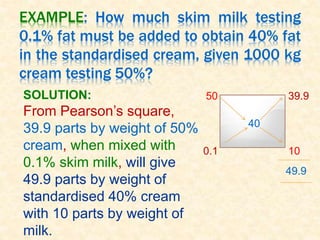
EXAMPLE: How much skim milk testing
0.1% fat must be added to obtain 40% fat
in the standardised cream, given 1000 kg
cream testing 50%?
50
40
39.9
0.1 10
49.9
SOLUTION:
From Pearson’s square,
39.9 parts by weight of 50%
cream, when mixed with
0.1% skim milk, will give
49.9 parts by weight of
standardised 40% cream
with 10 parts by weight of
milk.
PASTEURISATION
Pasteurization of cream refers to the
process of heating every particle of cream
to not less than 71°C and holding it at
such a temperature for at least 20
minutes, or to any suitable temperature-
time combination, using approved and
properly-operated equipment.
OBJECTIVES OF PASTEURISATION
• To destroy the pathogenic organisms in
cream.
• To destroy the undesirable micro organisms
and inactivate the enzymes.
• To complete the neutralization process in the
manufacture of butter.
• To eliminate some of the gaseous tainting
substances.
• To make possible the removal of some
volatile off flavours by vacreation.
METHODS OF
PASTEURISATION
HOLDER
PASTEURISATION
(71°C FOR 20
MINUTES)
HTST(Plate)
PASTEURIZATION
(95-100°C FOR
15-16 SECONDS)
VACCUM
PASTEURISATION
OR VACREATION
(high pressure
steam is injected
after diluting
cream to 6 to 8 %
fat)
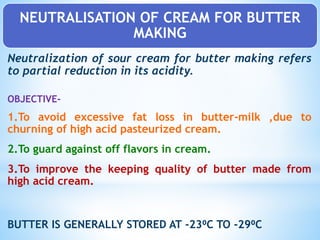
NEUTRALISATION OF CREAM FOR BUTTER
MAKING
Neutralization of sour cream for butter making refers
to partial reduction in its acidity.
OBJECTIVE-
1.To avoid excessive fat loss in butter-milk ,due to
churning of high acid pasteurized cream.
2.To guard against off flavors in cream.
3.To improve the keeping quality of butter made from
high acid cream.
BUTTER IS GENERALLY STORED AT -23⁰C TO -29⁰C
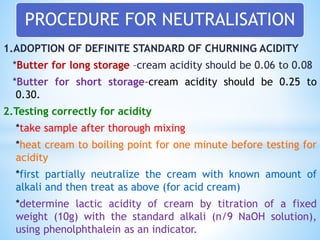
1.ADOPTION OF DEFINITE STANDARD OF CHURNING ACIDITY
*Butter for long storage –cream acidity should be 0.06 to 0.08
*Butter for short storage-cream acidity should be 0.25 to
0.30.
2.Testing correctly for acidity
*take sample after thorough mixing
*heat cream to boiling point for one minute before testing for
acidity
*first partially neutralize the cream with known amount of
alkali and then treat as above (for acid cream)
*determine lactic acidity of cream by titration of a fixed
weight (10g) with the standard alkali (n/9 NaOH solution),
using phenolphthalein as an indicator.
PROCEDURE FOR NEUTRALISATION
Type of
Neutralizer
Theoretical
value (in kg)
Practical value
(in kg)
Sodium
bicarbonate
0.93 0.83
Calcium
hydroxide
0.41 0.49
Correct Amount Of Neutralizer
To Be Added
The practical value of sodium bicarbonate
neutralizer used is lower than theoretical value due to
the presence of variable amount of carbon-dioxide
which raises the titrable value.
Carbon dioxide doesn’t react with sodium
bicarbonate neutralizer and consequently results in
over neutralization.
The actual neutralizing capacity of Lime is only 80
percent of the amount used, since nearly 20 % of it
reacts with casein and phosphate, and so is not
available for acid neutralization.
Particulars Lime Soda
Purity Low High
Solubility Low High
Neutralizing speed Low High
Foam production none Variable
Cost Low High
Over neutralization
effect
Limy flavor Soapy flavor
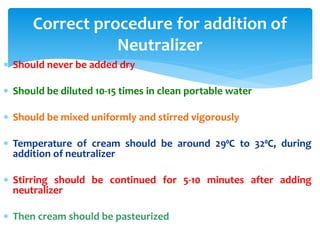
Correct procedure for addition of
Neutralizer
 Should never be added dry
 Should be diluted 10-15 times in clean portable water
 Should be mixed uniformly and stirred vigorously
 Temperature of cream should be around 29⁰C to 32⁰C, during
addition of neutralizer
 Stirring should be continued for 5-10 minutes after adding
neutralizer
 Then cream should be pasteurized
First use lime as neutralizer to bring the cream
acidity down to 0.3 -0.4% L.A.
Next use soda neutralizer to bring the cream
acidity to desired level.
Objectives
To reduce intense flavor effect of single
neutralizer used whether lime or soda
To avoid production of excessive carbon dioxide
by the use of sodium bicarbonate with high acid
cream.

Various-Process-_Cream.pptx

  • 1.
    STANDARDISATION, PASTEURISATION, NEUTRALISATION OF CREAM ClassLecture Dr. Sanjeev Kumar Associate Professor Department of Dairy Technology SGIDT, Patna-14
  • 2.
    Standardisation of creamrefers to the adjustment of the fat content in cream to the desired percentage.  The fat % in cream is adjusted using adequate amount of skim milk , calculated usually by Pearson's method.  PURPOSE: 1) To prepare consumer cream products with fat content to meet legal/quality standards. 2) To avoid economic losses accompanying excess fat content in prepared product. 3) To minimize fat losses in buttermilk. STANDARDISATION
  • 3.
    EXAMPLE: How muchskim milk testing 0.1% fat must be added to obtain 40% fat in the standardised cream, given 1000 kg cream testing 50%? 50 40 39.9 0.1 10 49.9 SOLUTION: From Pearson’s square, 39.9 parts by weight of 50% cream, when mixed with 0.1% skim milk, will give 49.9 parts by weight of standardised 40% cream with 10 parts by weight of milk.
  • 4.
    PASTEURISATION Pasteurization of creamrefers to the process of heating every particle of cream to not less than 71°C and holding it at such a temperature for at least 20 minutes, or to any suitable temperature- time combination, using approved and properly-operated equipment.
  • 5.
    OBJECTIVES OF PASTEURISATION •To destroy the pathogenic organisms in cream. • To destroy the undesirable micro organisms and inactivate the enzymes. • To complete the neutralization process in the manufacture of butter. • To eliminate some of the gaseous tainting substances. • To make possible the removal of some volatile off flavours by vacreation.
  • 6.
    METHODS OF PASTEURISATION HOLDER PASTEURISATION (71°C FOR20 MINUTES) HTST(Plate) PASTEURIZATION (95-100°C FOR 15-16 SECONDS) VACCUM PASTEURISATION OR VACREATION (high pressure steam is injected after diluting cream to 6 to 8 % fat)
  • 7.
    NEUTRALISATION OF CREAMFOR BUTTER MAKING Neutralization of sour cream for butter making refers to partial reduction in its acidity. OBJECTIVE- 1.To avoid excessive fat loss in butter-milk ,due to churning of high acid pasteurized cream. 2.To guard against off flavors in cream. 3.To improve the keeping quality of butter made from high acid cream. BUTTER IS GENERALLY STORED AT -23⁰C TO -29⁰C
  • 8.
    1.ADOPTION OF DEFINITESTANDARD OF CHURNING ACIDITY *Butter for long storage –cream acidity should be 0.06 to 0.08 *Butter for short storage-cream acidity should be 0.25 to 0.30. 2.Testing correctly for acidity *take sample after thorough mixing *heat cream to boiling point for one minute before testing for acidity *first partially neutralize the cream with known amount of alkali and then treat as above (for acid cream) *determine lactic acidity of cream by titration of a fixed weight (10g) with the standard alkali (n/9 NaOH solution), using phenolphthalein as an indicator. PROCEDURE FOR NEUTRALISATION
  • 9.
    Type of Neutralizer Theoretical value (inkg) Practical value (in kg) Sodium bicarbonate 0.93 0.83 Calcium hydroxide 0.41 0.49 Correct Amount Of Neutralizer To Be Added
  • 10.
    The practical valueof sodium bicarbonate neutralizer used is lower than theoretical value due to the presence of variable amount of carbon-dioxide which raises the titrable value. Carbon dioxide doesn’t react with sodium bicarbonate neutralizer and consequently results in over neutralization. The actual neutralizing capacity of Lime is only 80 percent of the amount used, since nearly 20 % of it reacts with casein and phosphate, and so is not available for acid neutralization.
  • 11.
    Particulars Lime Soda PurityLow High Solubility Low High Neutralizing speed Low High Foam production none Variable Cost Low High Over neutralization effect Limy flavor Soapy flavor
  • 12.
    Correct procedure foraddition of Neutralizer  Should never be added dry  Should be diluted 10-15 times in clean portable water  Should be mixed uniformly and stirred vigorously  Temperature of cream should be around 29⁰C to 32⁰C, during addition of neutralizer  Stirring should be continued for 5-10 minutes after adding neutralizer  Then cream should be pasteurized
  • 13.
    First use limeas neutralizer to bring the cream acidity down to 0.3 -0.4% L.A. Next use soda neutralizer to bring the cream acidity to desired level. Objectives To reduce intense flavor effect of single neutralizer used whether lime or soda To avoid production of excessive carbon dioxide by the use of sodium bicarbonate with high acid cream.

Editor's Notes

  • #14 Xksahsahkhcshdh fifoifoi