Unit-II
Microbiology of Condensed, Evaporated and Dried
products
 Condensed milk is a milk product obtained by evaporating part of water of whole
milk, or fully or partly skimmed milk, with or without the addition of sugar. They are
intended for use as such or for pre-condensing the fluid milk or fluid milk by–
product preparatory to the manufacture of dried milk products.
 The term ‘condensed milk’ is commonly used when referring to full cream sweetened
condensed milk whereas the term evaporated milk is generally used while referring
to full cream unsweetened condensed skim milk. Skimmed milk products are known
as sweetened condensed skim and unsweetened condensed skim milk respectively.
Condensed milk
Sweetened condensed milk
 Sweetened condensed milks are milk products which can be obtained by the partial
removal of water from milk with the addition of sugar, or by any other process which
leads to a product of the same composition and characteristics. The fat and/or protein
content of the milk may have been adjusted, only to comply with the compositional
requirements by the addition and/or withdrawal of milk constituents in such a way as not
to alter the whey protein to casein ratio of the milk being adjusted.
Evaporated Milks
 Evaporated milks are milk products which can be obtained by the partial removal of water
from milk by heat, or by any other process which leads to a product of the same
composition and characteristics. The fat and/or protein content of the milk may have been
adjusted, only to comply with the compositional requirements by the addition and/or
withdrawal of milk constituents in such a way as not to alter the whey protein to casein ratio
of the milk being adjusted.
MICROBIOLOGY OF SWEETENED CONDENSED MILK
 Sweetened condensed milk is not sterile. It contains living microbes and spores. The low
water activity (~0.83) or, rather, the high sugar content prohibits growth of most but not all
microorganisms.
 The water activity (a w) of a food is the ratio between the vapor pressure of the food itself,
when in a completely undisturbed balance with the surrounding air media, and the vapor
pressure of distilled water under identical conditions.
 A water activity of 0.83 means the vapor pressure is 83 percent of that of pure water. The
water activity increases with temperature.
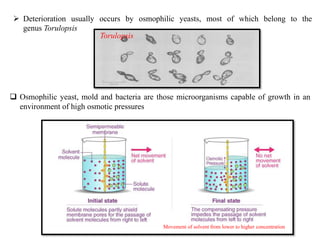
 Deterioration usually occurs by osmophilic yeasts, most of which belong to the
genus Torulopsis
 Osmophilic yeast, mold and bacteria are those microorganisms capable of growth in an
environment of high osmotic pressures
Torulopsis
Movement of solvent from lower to higher concentration
Yeast Mold
Unicellular fungus Multicellular filaments of fungi
Reproduction of yeast happens through
budding
Reproduces by the creation of sexual or
sexual spores
They are saprophytes that live externally
decomposing organic material and
absorbing nutrients via their cell walls
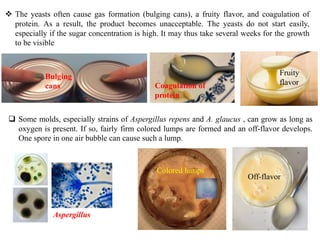
 The yeasts often cause gas formation (bulging cans), a fruity flavor, and coagulation of
protein. As a result, the product becomes unacceptable. The yeasts do not start easily,
especially if the sugar concentration is high. It may thus take several weeks for the growth
to be visible
Bulging
cans
Fruity
flavor
 Some molds, especially strains of Aspergillus repens and A. glaucus , can grow as long as
oxygen is present. If so, fairly firm colored lumps are formed and an off-flavor develops.
One spore in one air bubble can cause such a lump.
Aspergillus
Colored lumps
Coagulation of
protein
Off-flavor
Spore
Some micrococci may grow in sweetened condensed milk, although slowly, especially if
water activity and temperature are high. Presumably, the presence of oxygen is required.
It may happen that they grow to reach a colony count of, say, 105 ml−1 and then stop growing,
without causing noticeable defects. If they keep growing, coagulates eventually form and
several off-flavors develop.
 Bacterial spores cannot germinate in sweetened condensed milk.
 Growth of harmful microorganisms in the dairy plant should be rigorously avoided.
 No sugar and residues of the milk should be left about.
 Satisfactory hygienic standards must therefore be maintained, especially in the packaging
room.
 Harmful microorganisms cannot grow during concentrating, but the machinery must be
thoroughly cleaned, immediately after evaporation.
 Mold spores can be removed by air filtration.
 Packaging machine should fill the cans very accurately with a safety margin of 1 g.
 Too little condensed milk in the cans means that more air is left, which increases the chance
of growth of molds and micrococci. If the cans are overfilled, the milk may spill over the
side and encourage growth of osmophilic yeasts.
Micrococci
Off-flavors
Micrococci
Mold Button Formation
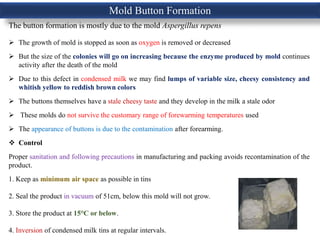
The button formation is mostly due to the mold Aspergillus repens
 The growth of mold is stopped as soon as oxygen is removed or decreased
 But the size of the colonies will go on increasing because the enzyme produced by mold continues
activity after the death of the mold
 Due to this defect in condensed milk we may find lumps of variable size, cheesy consistency and
whitish yellow to reddish brown colors
 The buttons themselves have a stale cheesy taste and they develop in the milk a stale odor
 These molds do not survive the customary range of forewarming temperatures used
 The appearance of buttons is due to the contamination after forearming.
 Control
Proper sanitation and following precautions in manufacturing and packing avoids recontamination of the
product.
1. Keep as minimum air space as possible in tins
2. Seal the product in vacuum of 51cm, below this mold will not grow.
3. Store the product at 15°C or below.
4. Inversion of condensed milk tins at regular intervals.
Bacterial Age Thickening
1. Micrococcus lactic albidus
2. Micrococcus freudenreichii
 This defect is usually accompanied by a high germ count, a disagreeable stale and often
cheesy flavor and taste
 When the thickened milk is diluted with water and heated, the curd separates
 Large number of S. pyogenes, Staphylococcus aureus, B. subtilis and Bacillus
megentricus and yeasts are also present in such milk
 It is observed that the acidity factor is non-important and the thickening is due to the
production of rennin like enzyme
 Control Measures
1. Elimination of sources of contamination by cleaning and sterilization.
2. Selecting milk of good quality
3. Raising sucrose concentration. The sugar ratio should not exceed 64.5 %, other-wise it may
involve problem of sucrose crystallization.
4. Storing at low temperature
Bloat
The sucrose is inverted by the enzyme invertase contained in and secreted by yeast cells. In
this inversion, the molecule of sucrose takes on one molecule of water and breaks down
into 2 molecules of monosaccharide. The monosaccharides are readily fermented by this
yeast.
 Controls
1. The most likely and most direct cause of bloat of sweetened condensed milk is contaminated sugar. Keep the sugar
sealed in its original package until needed.
2. Use barrels in preference to sacks. Keep it protected from dampness and insects such as bees, flies cockroaches.
Insects plus dampness cause inversion and fermentation.
3. Adding the sugar to the milk in the pan in the form of concentrated syrup in boiling hot water (~ 65% sugar-in-water)
is a dependable safe guard.
4. Sanitation of all equipment's, from hot well to filling mechanism, and protecting the condensed milk from prolonged
exposure to air by filling into the final container as soon as possible after manufacture, are important additional
precautions. Container should be filled as full as reasonable allowance for heat expansion will permit.
5. Keep less air space.
6. Store below room temperature.

Dye reduction test

  • 1.
    Unit-II Microbiology of Condensed,Evaporated and Dried products
  • 2.
     Condensed milkis a milk product obtained by evaporating part of water of whole milk, or fully or partly skimmed milk, with or without the addition of sugar. They are intended for use as such or for pre-condensing the fluid milk or fluid milk by– product preparatory to the manufacture of dried milk products.  The term ‘condensed milk’ is commonly used when referring to full cream sweetened condensed milk whereas the term evaporated milk is generally used while referring to full cream unsweetened condensed skim milk. Skimmed milk products are known as sweetened condensed skim and unsweetened condensed skim milk respectively. Condensed milk
  • 3.
    Sweetened condensed milk Sweetened condensed milks are milk products which can be obtained by the partial removal of water from milk with the addition of sugar, or by any other process which leads to a product of the same composition and characteristics. The fat and/or protein content of the milk may have been adjusted, only to comply with the compositional requirements by the addition and/or withdrawal of milk constituents in such a way as not to alter the whey protein to casein ratio of the milk being adjusted.
  • 4.
    Evaporated Milks  Evaporatedmilks are milk products which can be obtained by the partial removal of water from milk by heat, or by any other process which leads to a product of the same composition and characteristics. The fat and/or protein content of the milk may have been adjusted, only to comply with the compositional requirements by the addition and/or withdrawal of milk constituents in such a way as not to alter the whey protein to casein ratio of the milk being adjusted.
  • 5.
    MICROBIOLOGY OF SWEETENEDCONDENSED MILK  Sweetened condensed milk is not sterile. It contains living microbes and spores. The low water activity (~0.83) or, rather, the high sugar content prohibits growth of most but not all microorganisms.  The water activity (a w) of a food is the ratio between the vapor pressure of the food itself, when in a completely undisturbed balance with the surrounding air media, and the vapor pressure of distilled water under identical conditions.  A water activity of 0.83 means the vapor pressure is 83 percent of that of pure water. The water activity increases with temperature.
  • 7.
     Deterioration usuallyoccurs by osmophilic yeasts, most of which belong to the genus Torulopsis  Osmophilic yeast, mold and bacteria are those microorganisms capable of growth in an environment of high osmotic pressures Torulopsis Movement of solvent from lower to higher concentration
  • 8.
    Yeast Mold Unicellular fungusMulticellular filaments of fungi Reproduction of yeast happens through budding Reproduces by the creation of sexual or sexual spores They are saprophytes that live externally decomposing organic material and absorbing nutrients via their cell walls
  • 9.
     The yeastsoften cause gas formation (bulging cans), a fruity flavor, and coagulation of protein. As a result, the product becomes unacceptable. The yeasts do not start easily, especially if the sugar concentration is high. It may thus take several weeks for the growth to be visible Bulging cans Fruity flavor  Some molds, especially strains of Aspergillus repens and A. glaucus , can grow as long as oxygen is present. If so, fairly firm colored lumps are formed and an off-flavor develops. One spore in one air bubble can cause such a lump. Aspergillus Colored lumps Coagulation of protein Off-flavor Spore
  • 10.
    Some micrococci maygrow in sweetened condensed milk, although slowly, especially if water activity and temperature are high. Presumably, the presence of oxygen is required. It may happen that they grow to reach a colony count of, say, 105 ml−1 and then stop growing, without causing noticeable defects. If they keep growing, coagulates eventually form and several off-flavors develop.  Bacterial spores cannot germinate in sweetened condensed milk.  Growth of harmful microorganisms in the dairy plant should be rigorously avoided.  No sugar and residues of the milk should be left about.  Satisfactory hygienic standards must therefore be maintained, especially in the packaging room.  Harmful microorganisms cannot grow during concentrating, but the machinery must be thoroughly cleaned, immediately after evaporation.  Mold spores can be removed by air filtration.  Packaging machine should fill the cans very accurately with a safety margin of 1 g.  Too little condensed milk in the cans means that more air is left, which increases the chance of growth of molds and micrococci. If the cans are overfilled, the milk may spill over the side and encourage growth of osmophilic yeasts. Micrococci Off-flavors Micrococci
  • 11.
    Mold Button Formation Thebutton formation is mostly due to the mold Aspergillus repens  The growth of mold is stopped as soon as oxygen is removed or decreased  But the size of the colonies will go on increasing because the enzyme produced by mold continues activity after the death of the mold  Due to this defect in condensed milk we may find lumps of variable size, cheesy consistency and whitish yellow to reddish brown colors  The buttons themselves have a stale cheesy taste and they develop in the milk a stale odor  These molds do not survive the customary range of forewarming temperatures used  The appearance of buttons is due to the contamination after forearming.  Control Proper sanitation and following precautions in manufacturing and packing avoids recontamination of the product. 1. Keep as minimum air space as possible in tins 2. Seal the product in vacuum of 51cm, below this mold will not grow. 3. Store the product at 15°C or below. 4. Inversion of condensed milk tins at regular intervals.
  • 12.
    Bacterial Age Thickening 1.Micrococcus lactic albidus 2. Micrococcus freudenreichii  This defect is usually accompanied by a high germ count, a disagreeable stale and often cheesy flavor and taste  When the thickened milk is diluted with water and heated, the curd separates  Large number of S. pyogenes, Staphylococcus aureus, B. subtilis and Bacillus megentricus and yeasts are also present in such milk  It is observed that the acidity factor is non-important and the thickening is due to the production of rennin like enzyme  Control Measures 1. Elimination of sources of contamination by cleaning and sterilization. 2. Selecting milk of good quality 3. Raising sucrose concentration. The sugar ratio should not exceed 64.5 %, other-wise it may involve problem of sucrose crystallization. 4. Storing at low temperature
  • 13.
    Bloat The sucrose isinverted by the enzyme invertase contained in and secreted by yeast cells. In this inversion, the molecule of sucrose takes on one molecule of water and breaks down into 2 molecules of monosaccharide. The monosaccharides are readily fermented by this yeast.  Controls 1. The most likely and most direct cause of bloat of sweetened condensed milk is contaminated sugar. Keep the sugar sealed in its original package until needed. 2. Use barrels in preference to sacks. Keep it protected from dampness and insects such as bees, flies cockroaches. Insects plus dampness cause inversion and fermentation. 3. Adding the sugar to the milk in the pan in the form of concentrated syrup in boiling hot water (~ 65% sugar-in-water) is a dependable safe guard. 4. Sanitation of all equipment's, from hot well to filling mechanism, and protecting the condensed milk from prolonged exposure to air by filling into the final container as soon as possible after manufacture, are important additional precautions. Container should be filled as full as reasonable allowance for heat expansion will permit. 5. Keep less air space. 6. Store below room temperature.