SENSORS
FIVE DAY SHORT TERM COURSE
ON
ARDUINO PROGRAMMING FUNDAMENTALS AND
PROTEOUS DESIGN SUITE 8.0
Prepared by
Shashank M Gowda
Asst. Prof. Dept., of ECE, YIT, Moodbidri
SENSORS
What are Sensors?
American National Standards Institute (ANSI) Definition
A device which provides a usable output in response to a
specified measurand
A sensor acquires a physical parameter and converts it into a signal
suitable for processing (e.g. optical, electrical, mechanical)
Each sensor is based on a transduction principle - conversion of
energy from one form to another
 Also known as transducers
SENSORS
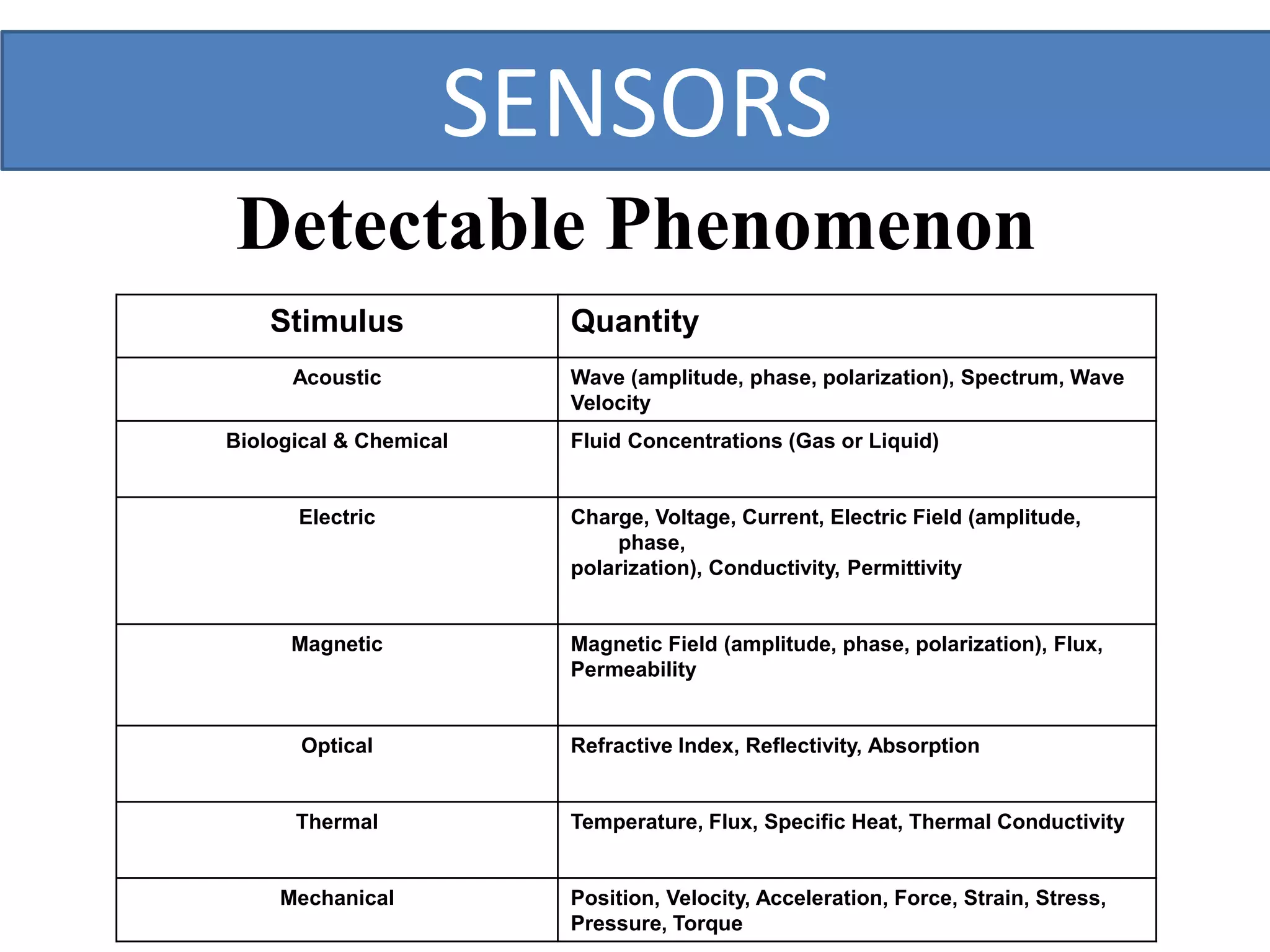
Detectable Phenomenon
Stimulus Quantity
Acoustic Wave (amplitude, phase, polarization), Spectrum, Wave
Velocity
Biological & Chemical Fluid Concentrations (Gas or Liquid)
Electric Charge, Voltage, Current, Electric Field (amplitude,
phase,
polarization), Conductivity, Permittivity
Magnetic Magnetic Field (amplitude, phase, polarization), Flux,
Permeability
Optical Refractive Index, Reflectivity, Absorption
Thermal Temperature, Flux, Specific Heat, Thermal Conductivity
Mechanical Position, Velocity, Acceleration, Force, Strain, Stress,
Pressure, Torque
SENSORS
Why Do Robots Need Sensors?
Provides “awareness” of surroundings
What’s ahead, around, “out there”?
Allows interaction with environment
Robot lawn mower can “see” cut grass
Protection & Self-Preservation
Safety, Damage Prevention, Stairwell sensor
Gives the robot capability to goal-seek
Find colorful objects, seek goals
Makes robots “interesting”
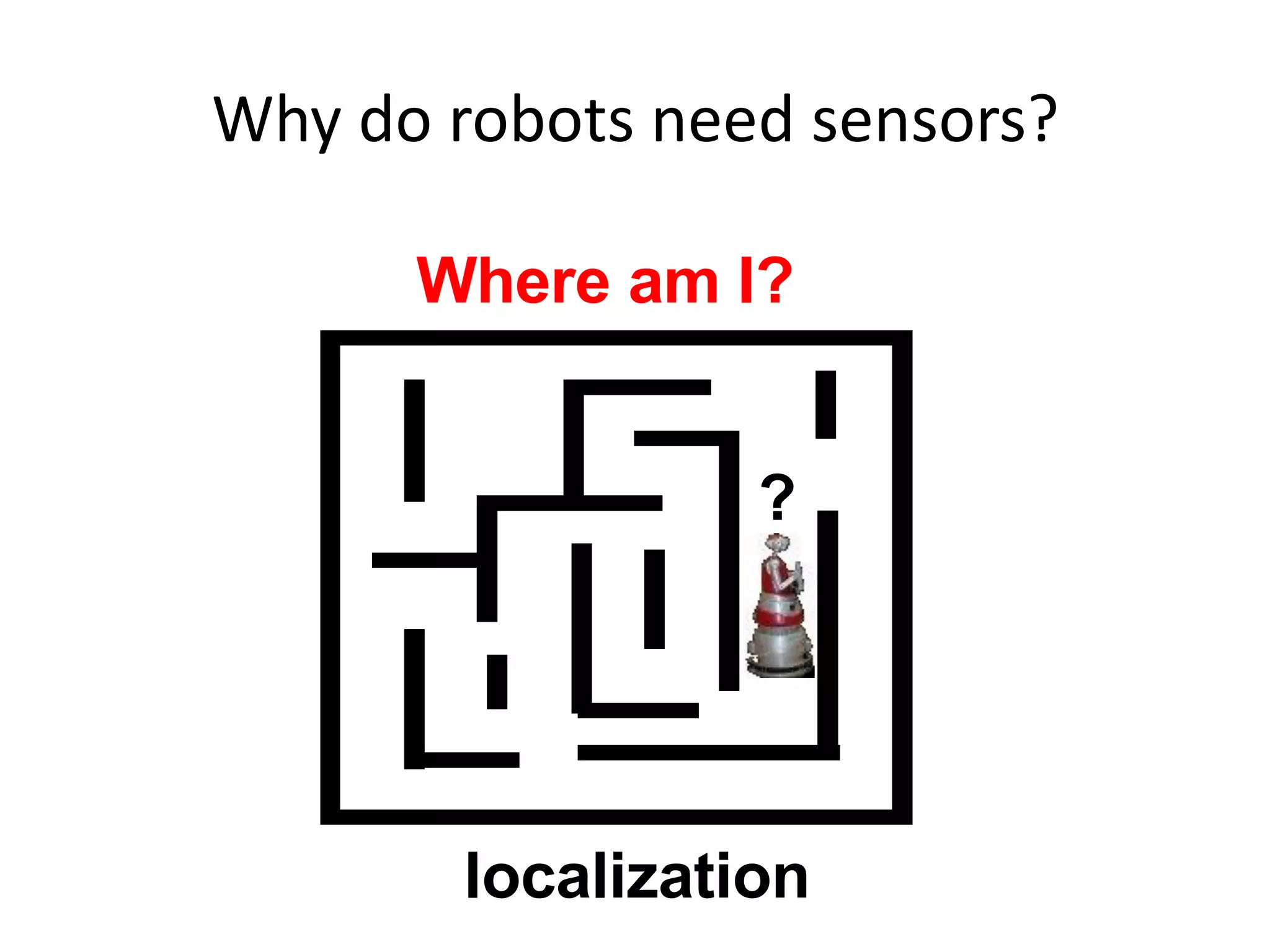
Why do robots need sensors?
Where am I?
localization
?
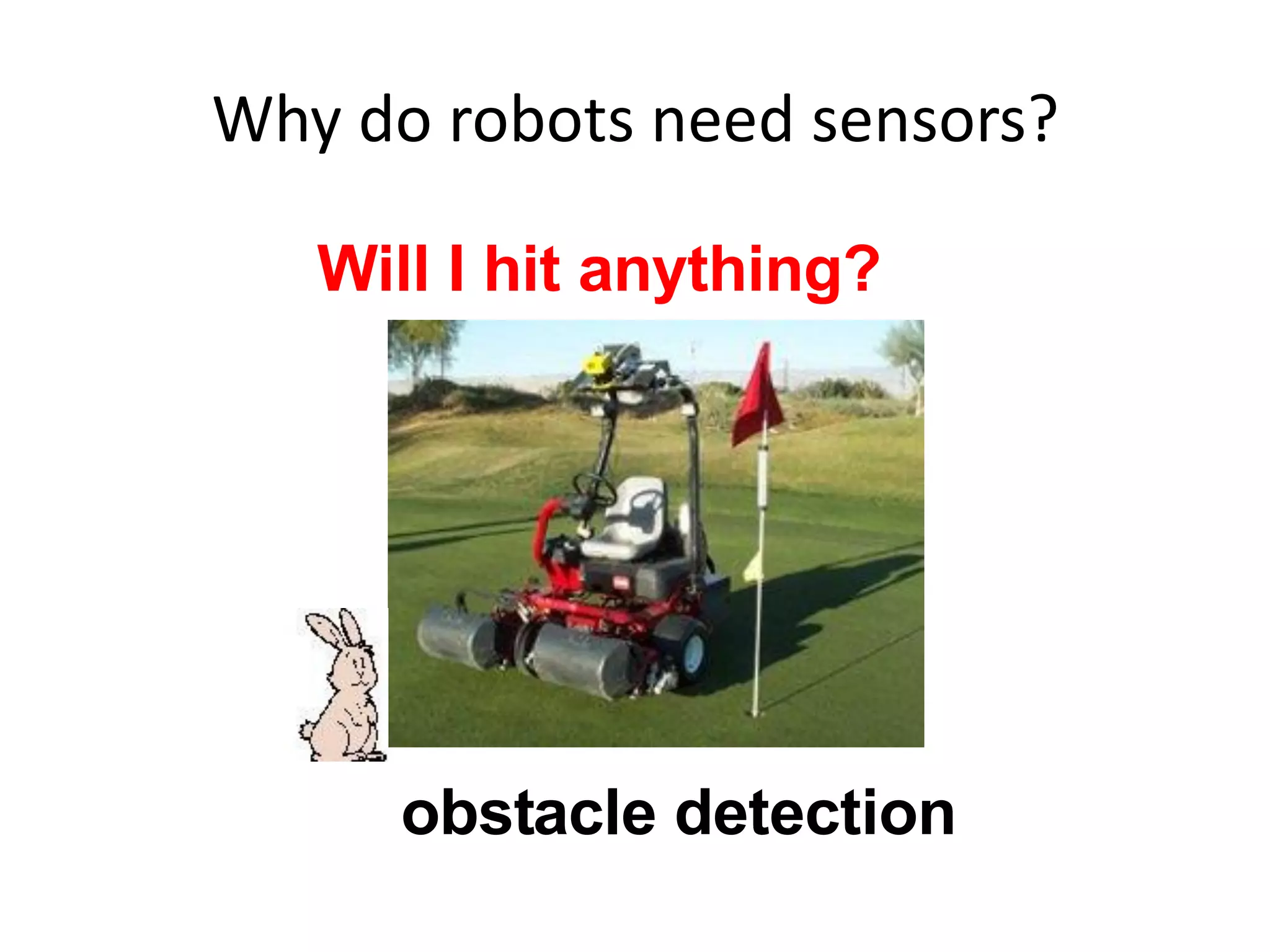
Why do robots need sensors?
Will I hit anything?
obstacle detection
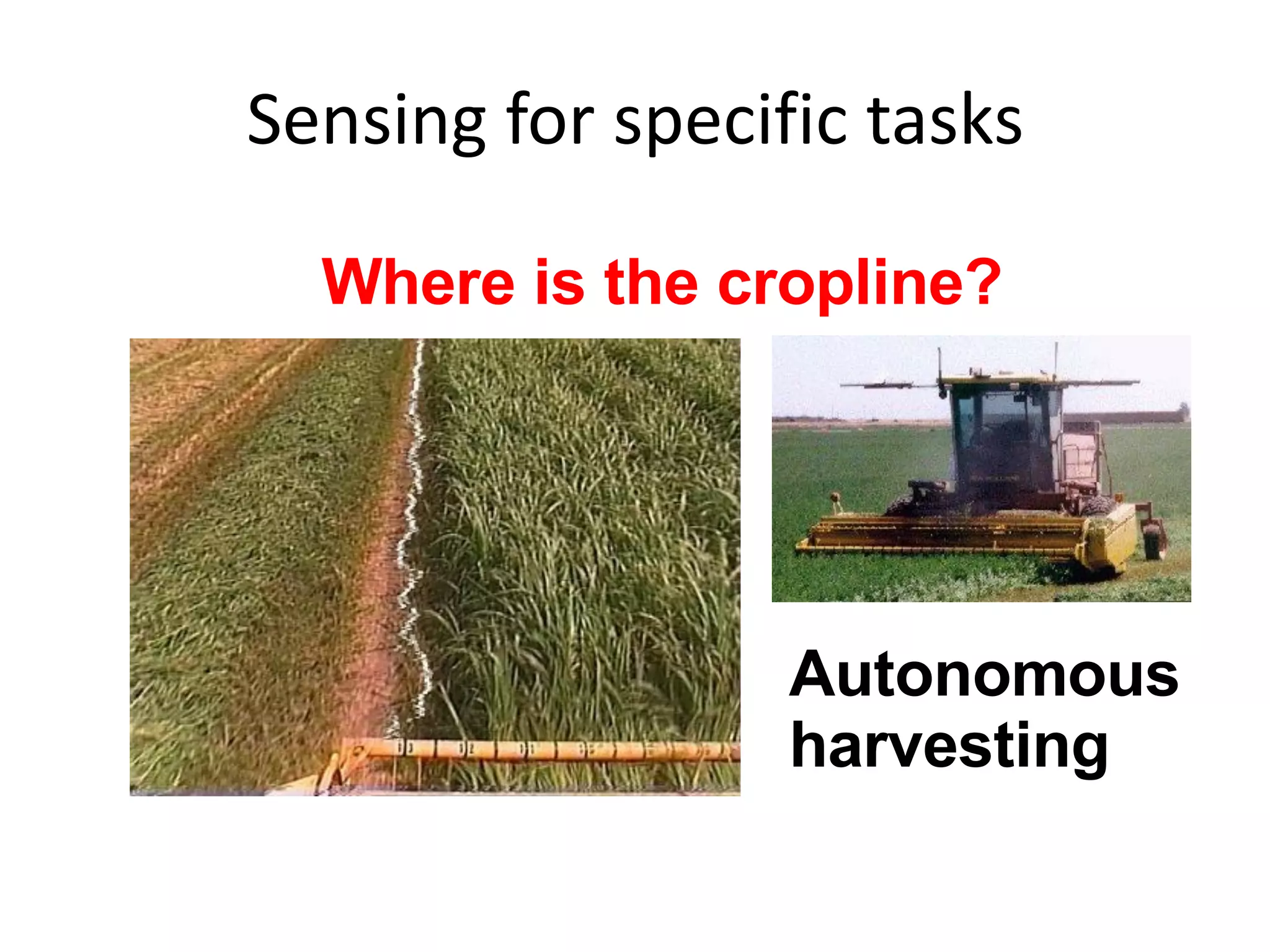
Sensing for specific tasks
Where is the cropline?
Autonomous
harvesting
Sensing for specific tasks
Autonomous material handling
Where are the forkholes?
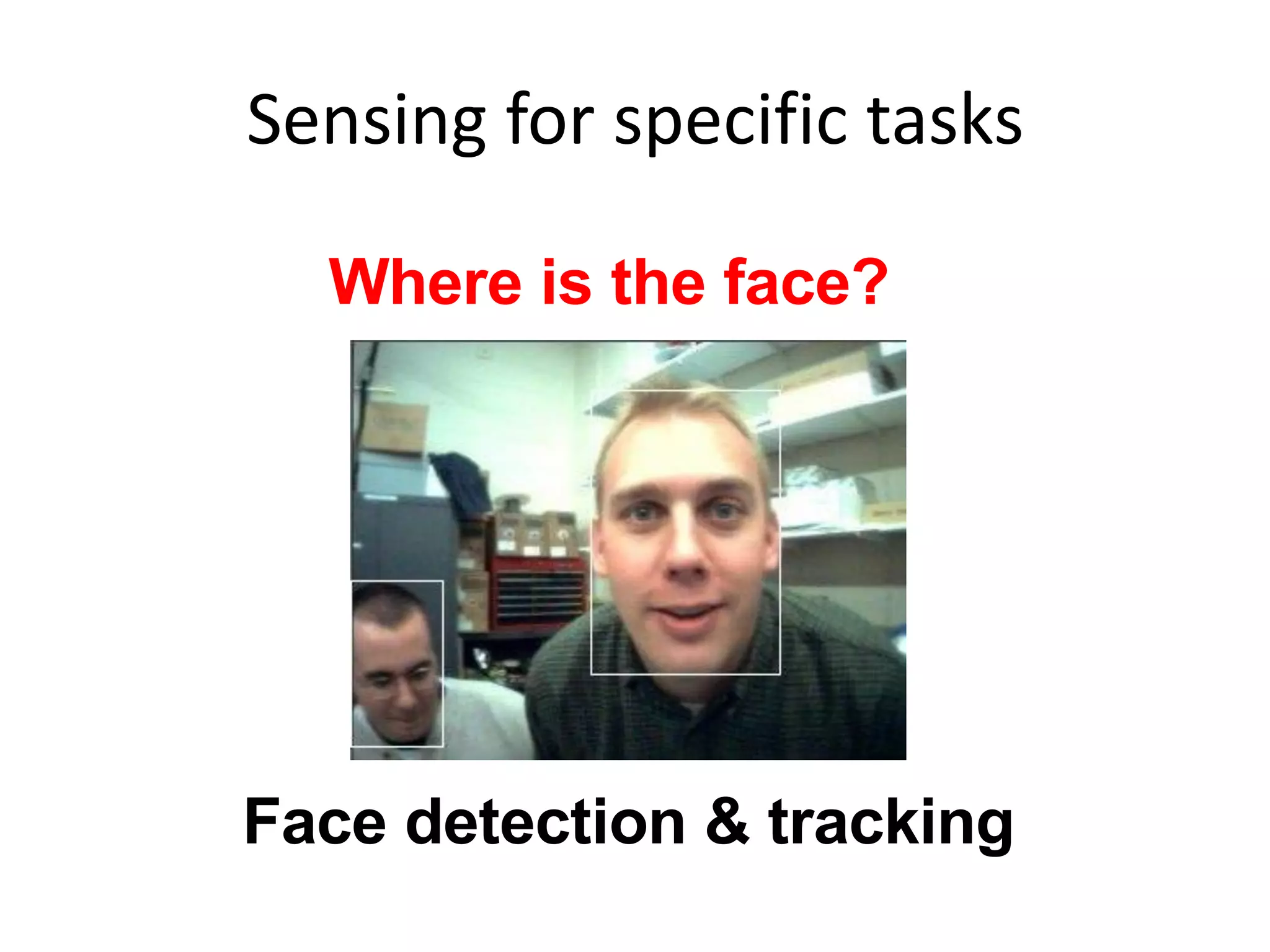
Sensing for specific tasks
Where is the face?
Face detection & tracking
SENSORS
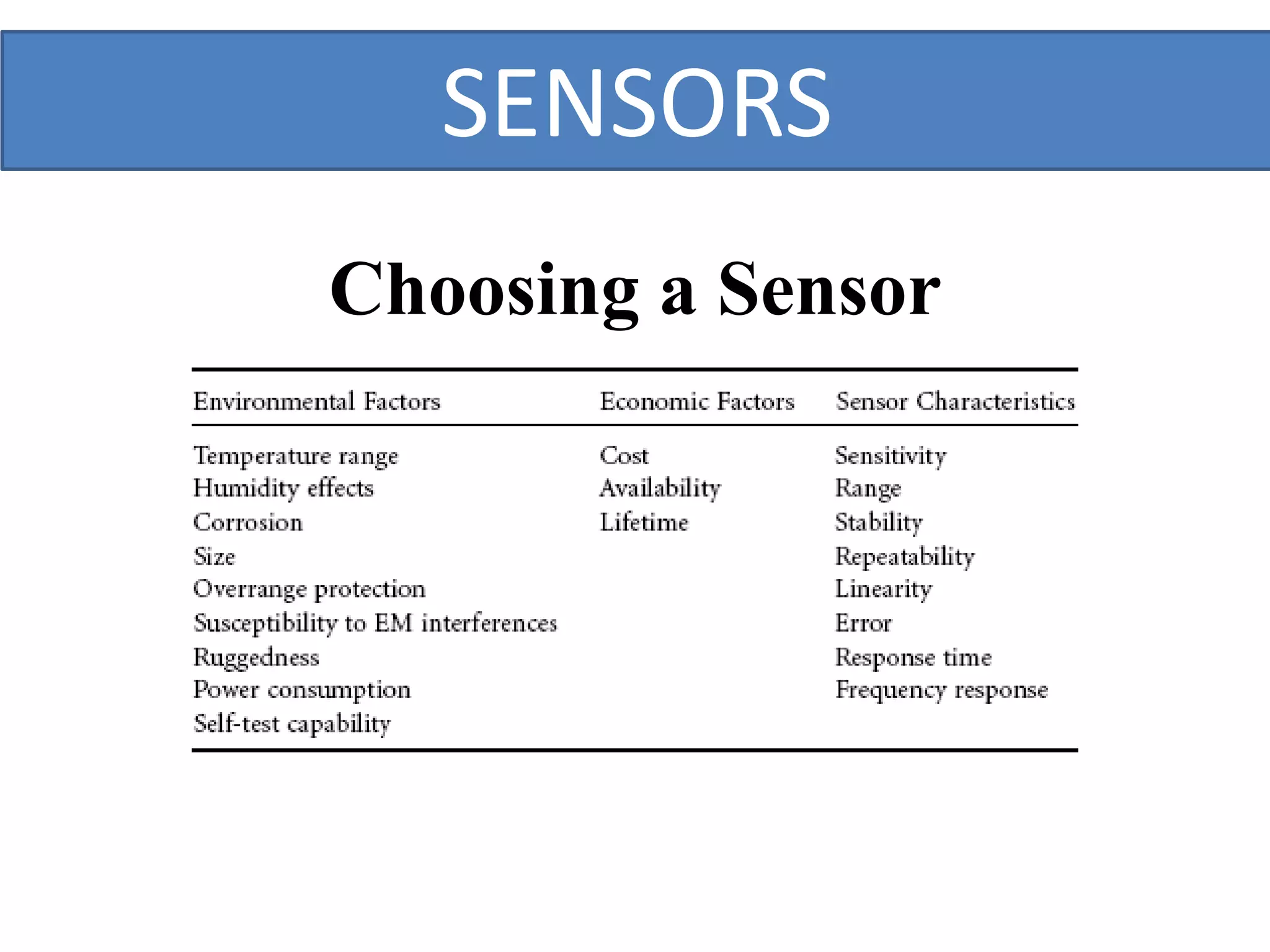
Choosing a Sensor
SENSORS
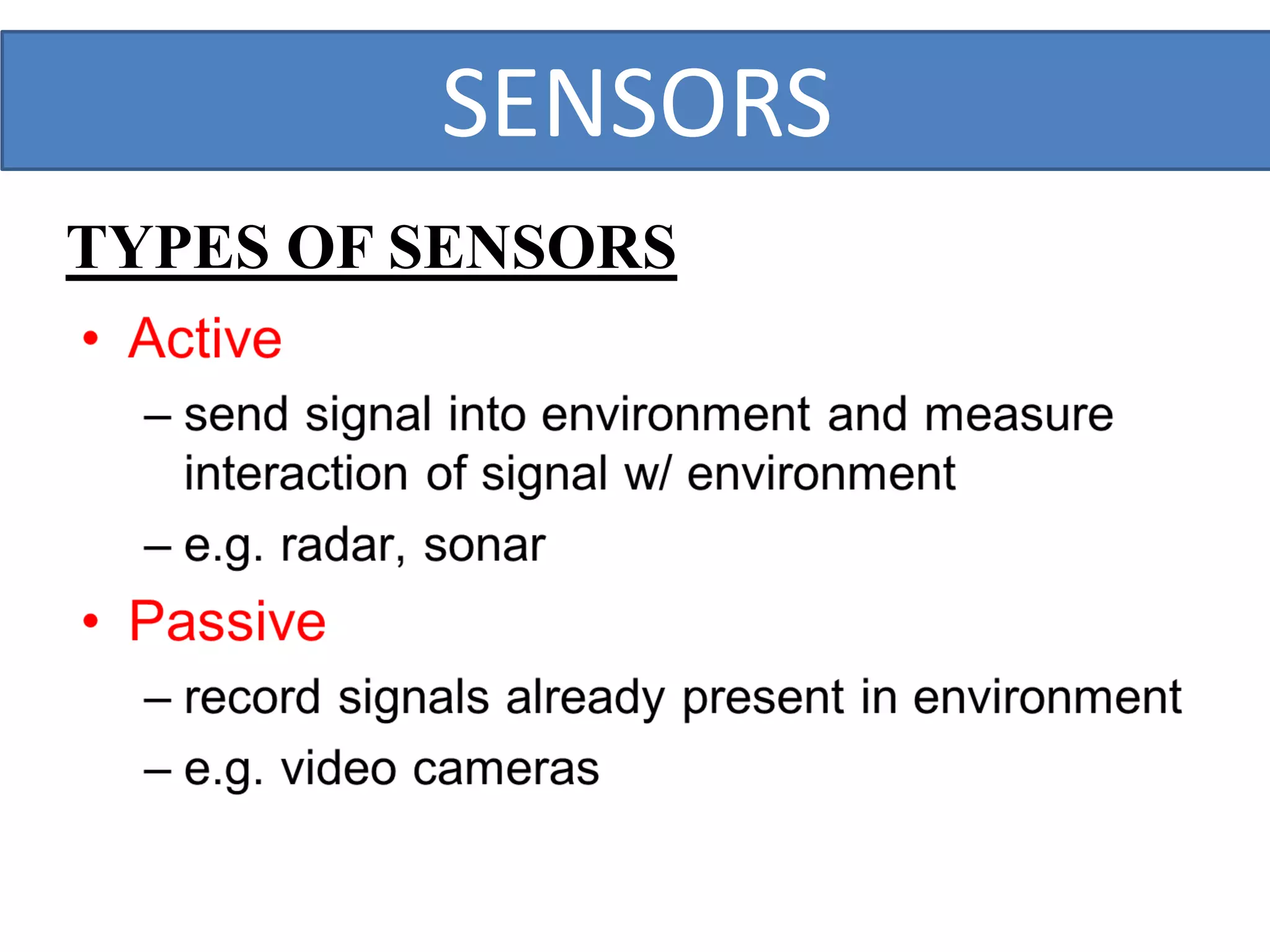
TYPES OF SENSORS
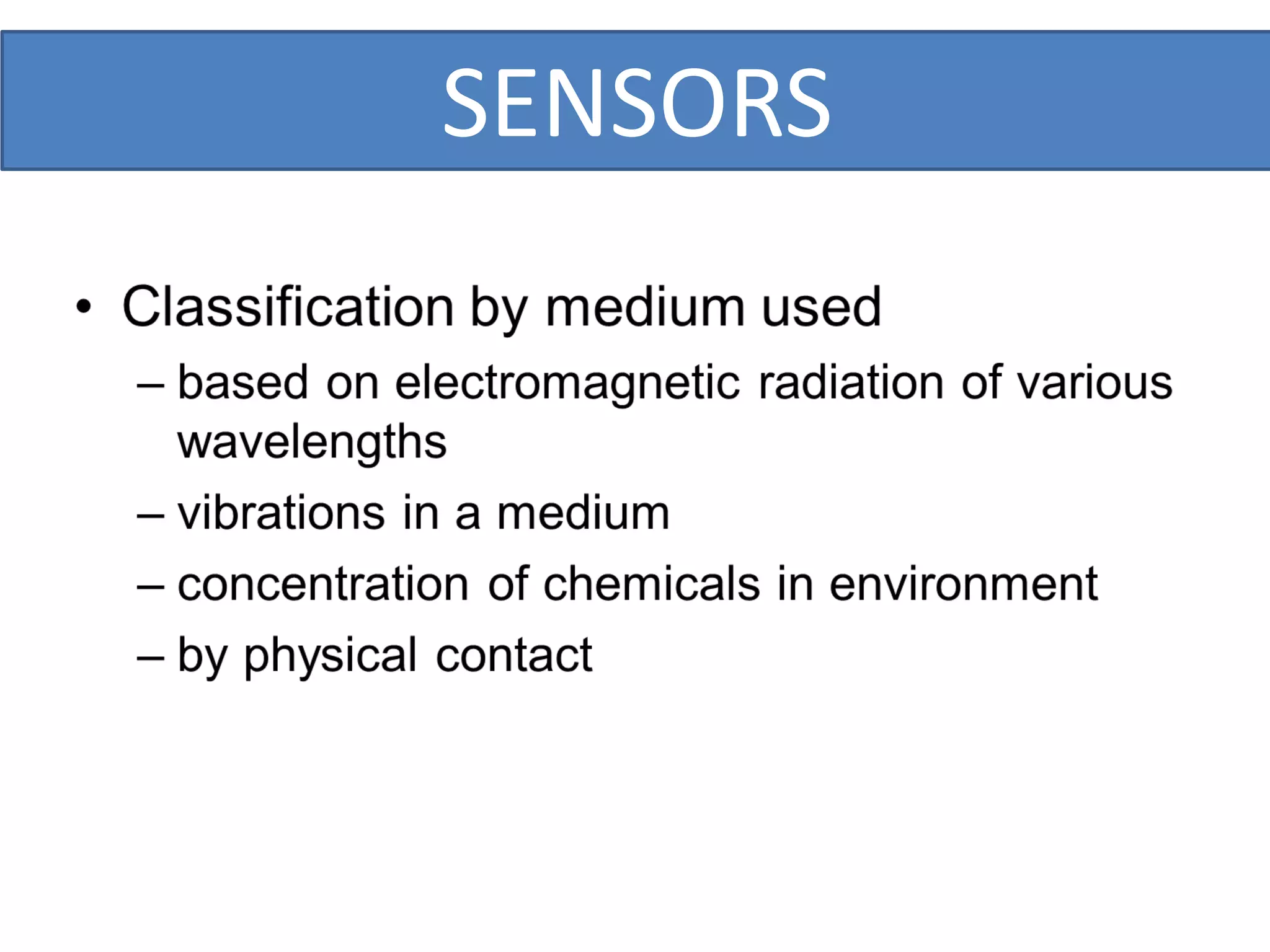
SENSORS
SENSORS
LDR (Light Dependent Resistor)
It is also known as photo-resistor
 a resistor whose resistance varies
with the amount of light falling
on it.
SENSORS
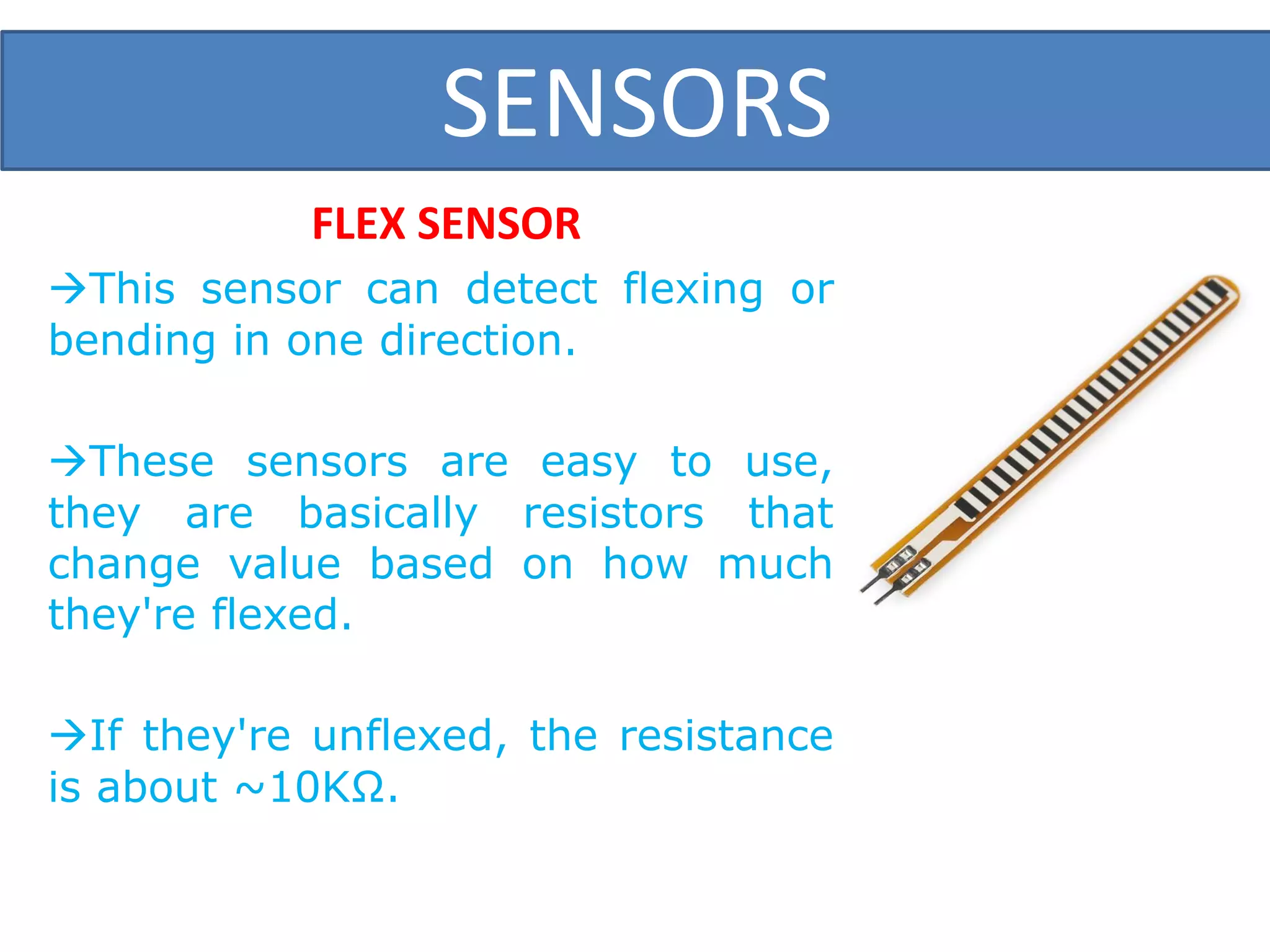
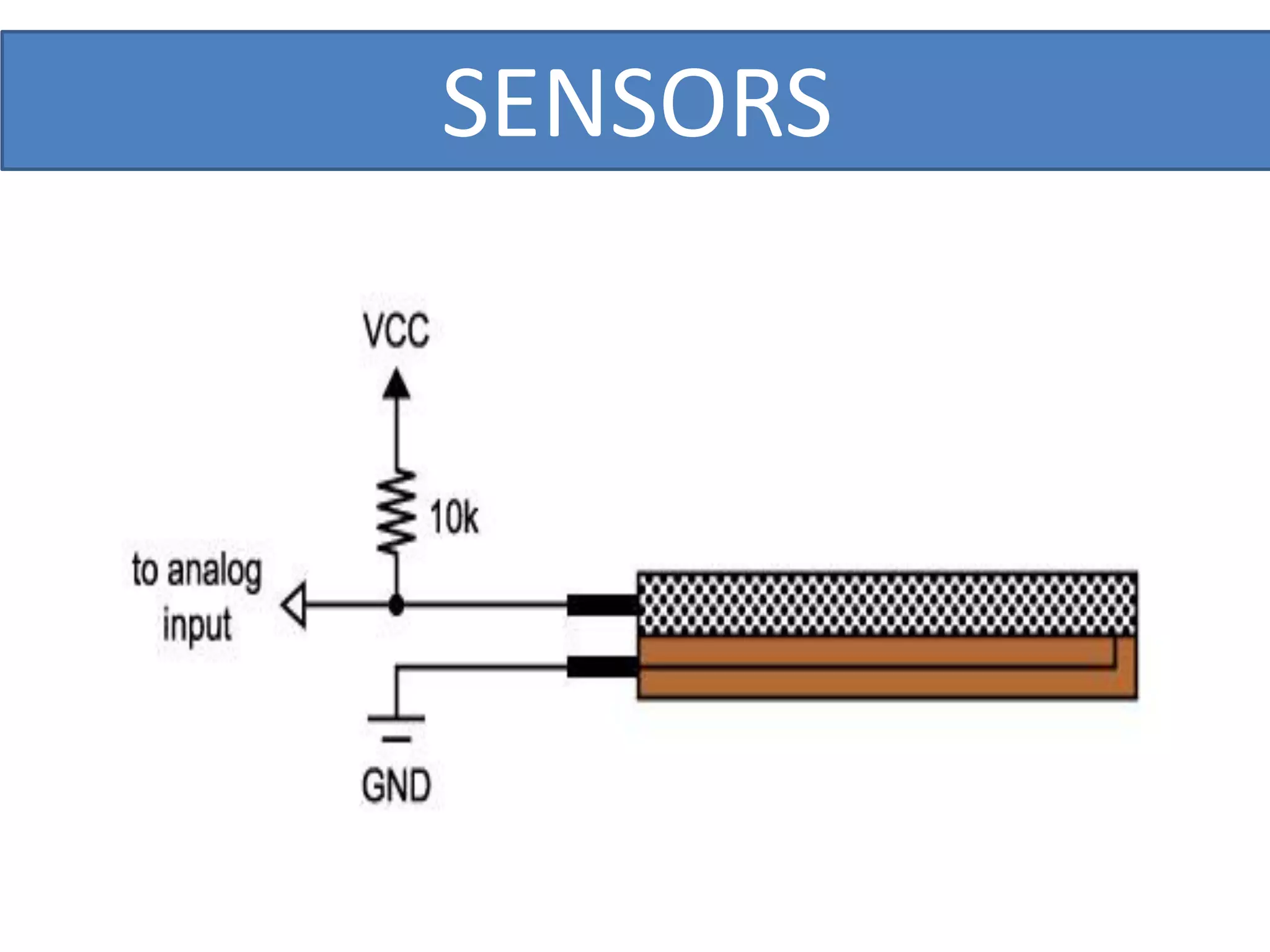
FLEX SENSOR
This sensor can detect flexing or
bending in one direction.
These sensors are easy to use,
they are basically resistors that
change value based on how much
they're flexed.
If they're unflexed, the resistance
is about ~10KΩ.
SENSORS
SENSORS
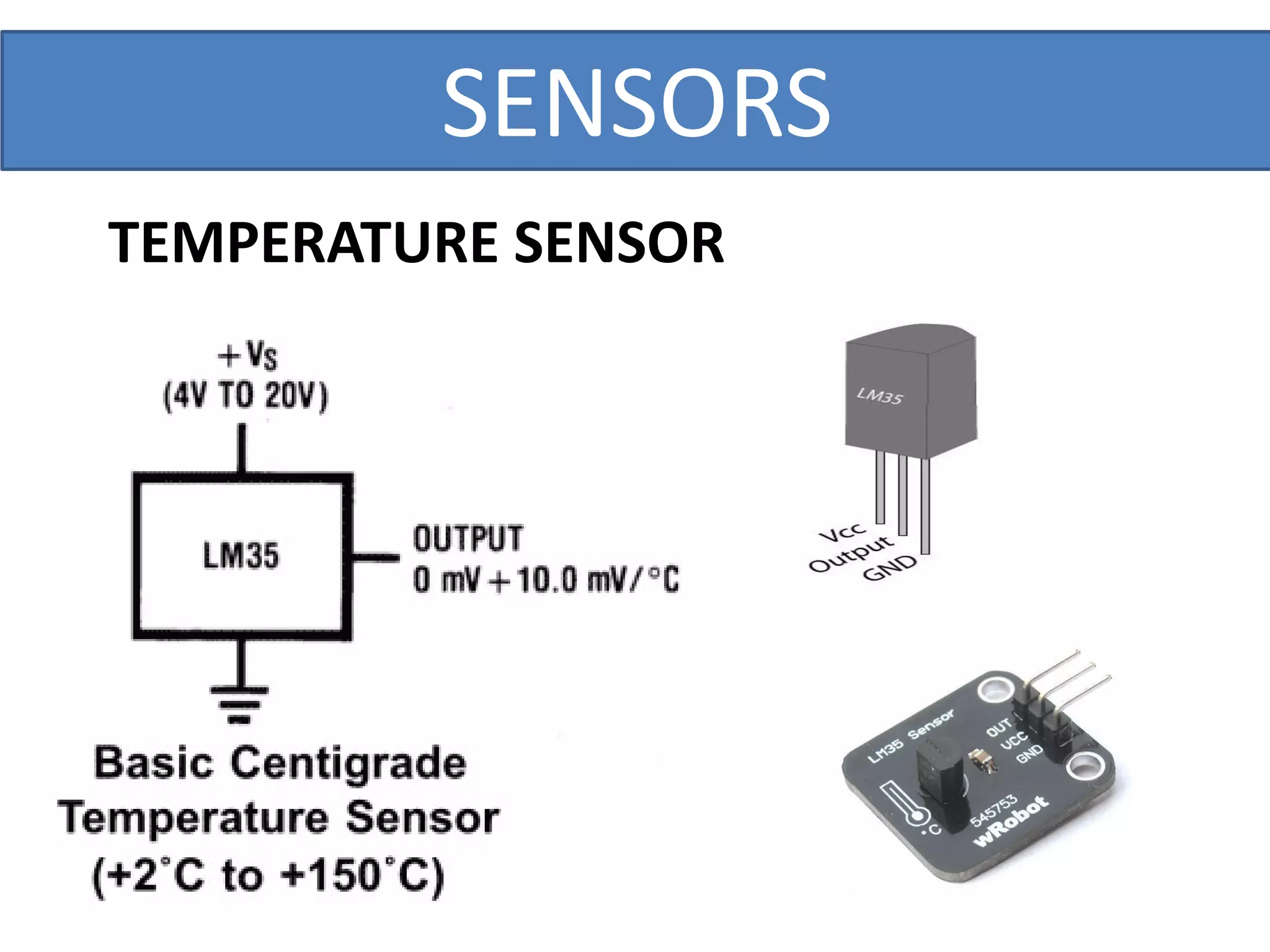
TEMPERATURE SENSOR
SENSORS
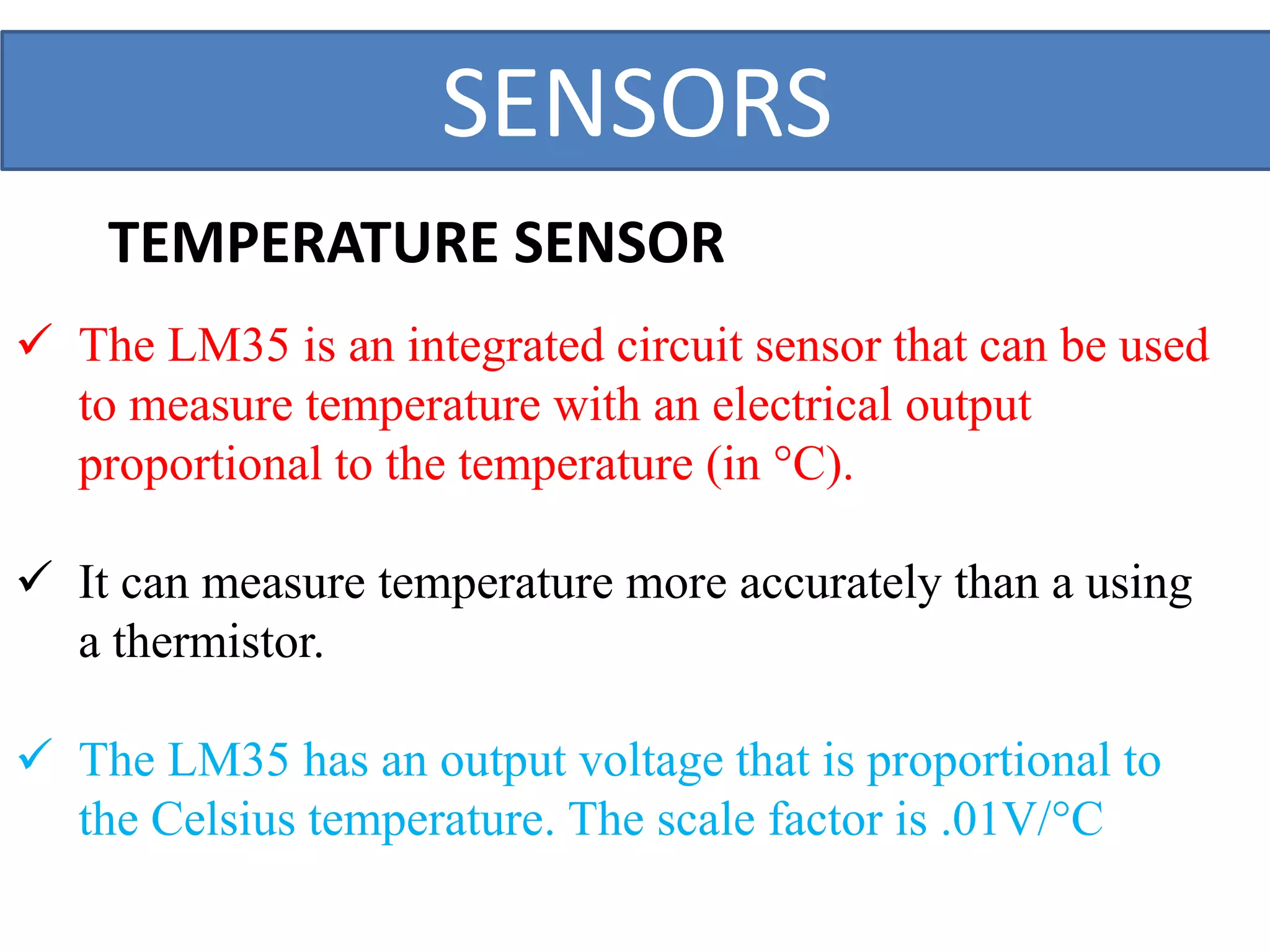
 The LM35 is an integrated circuit sensor that can be used
to measure temperature with an electrical output
proportional to the temperature (in °C).
 It can measure temperature more accurately than a using
a thermistor.
 The LM35 has an output voltage that is proportional to
the Celsius temperature. The scale factor is .01V/°C
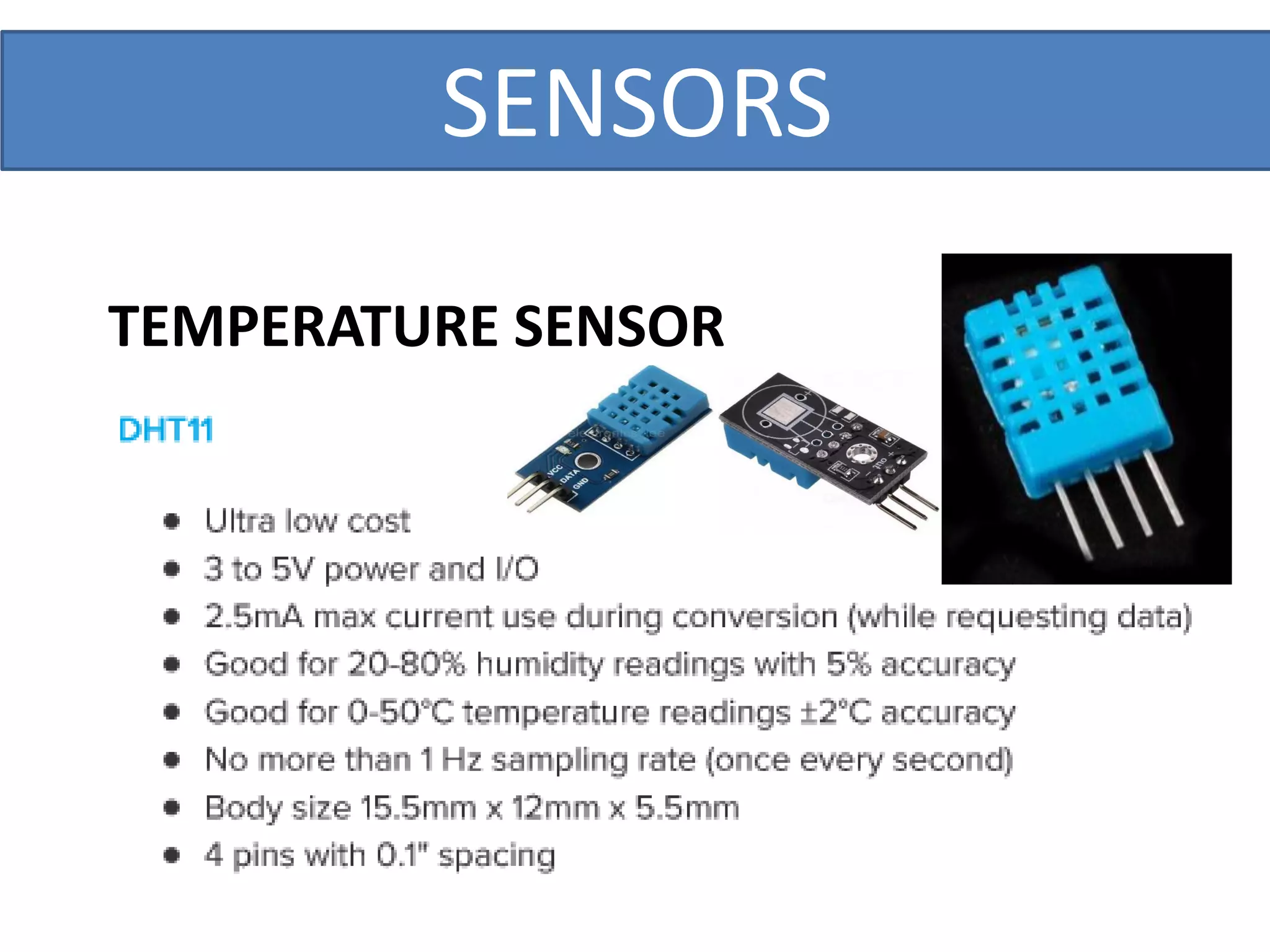
TEMPERATURE SENSOR
SENSORS
TEMPERATURE SENSOR
SENSORS
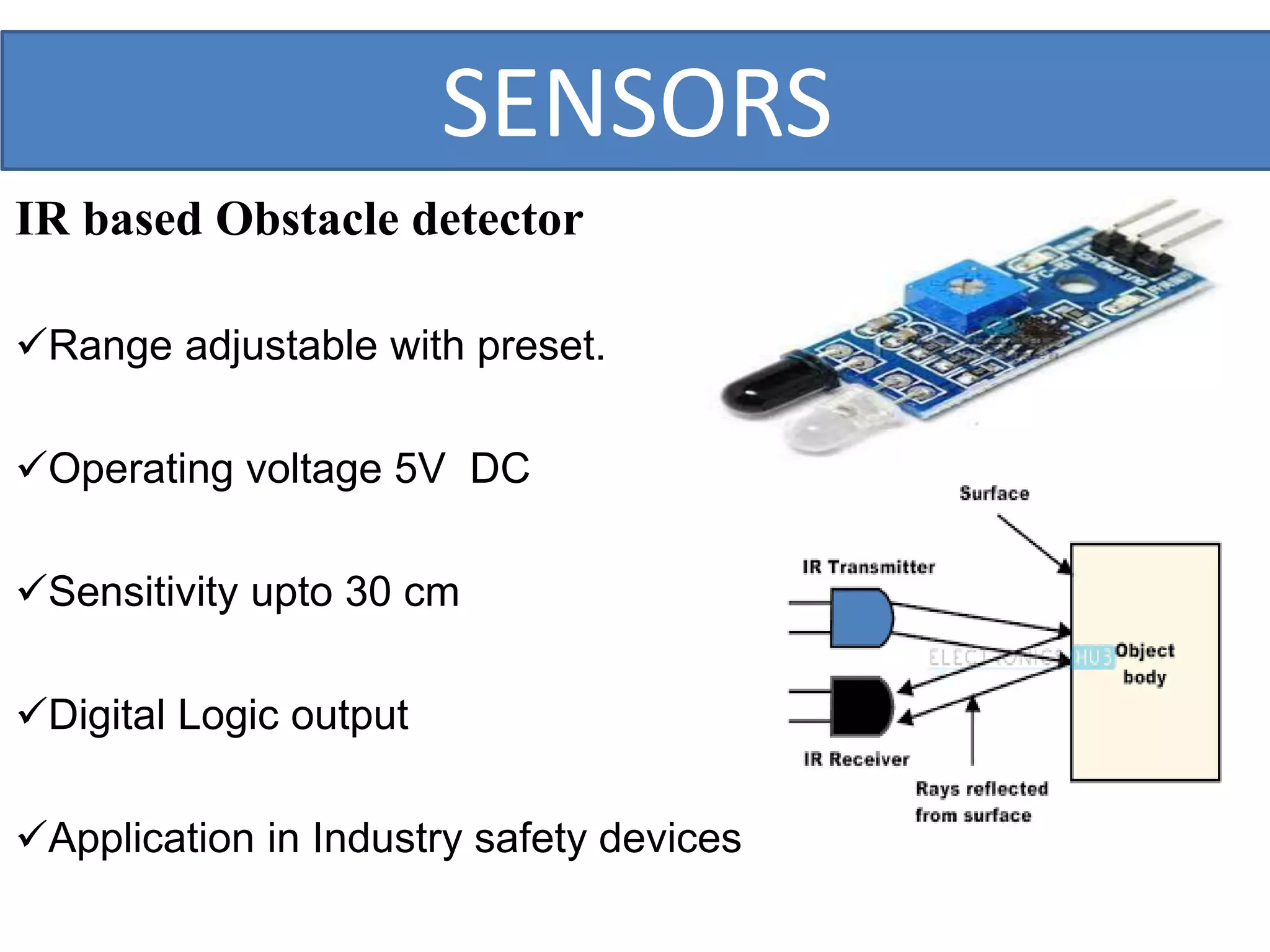
IR based Obstacle detector
Range adjustable with preset.
Operating voltage 5V DC
Sensitivity upto 30 cm
Digital Logic output
Application in Industry safety devices
SENSORS
SENSORS
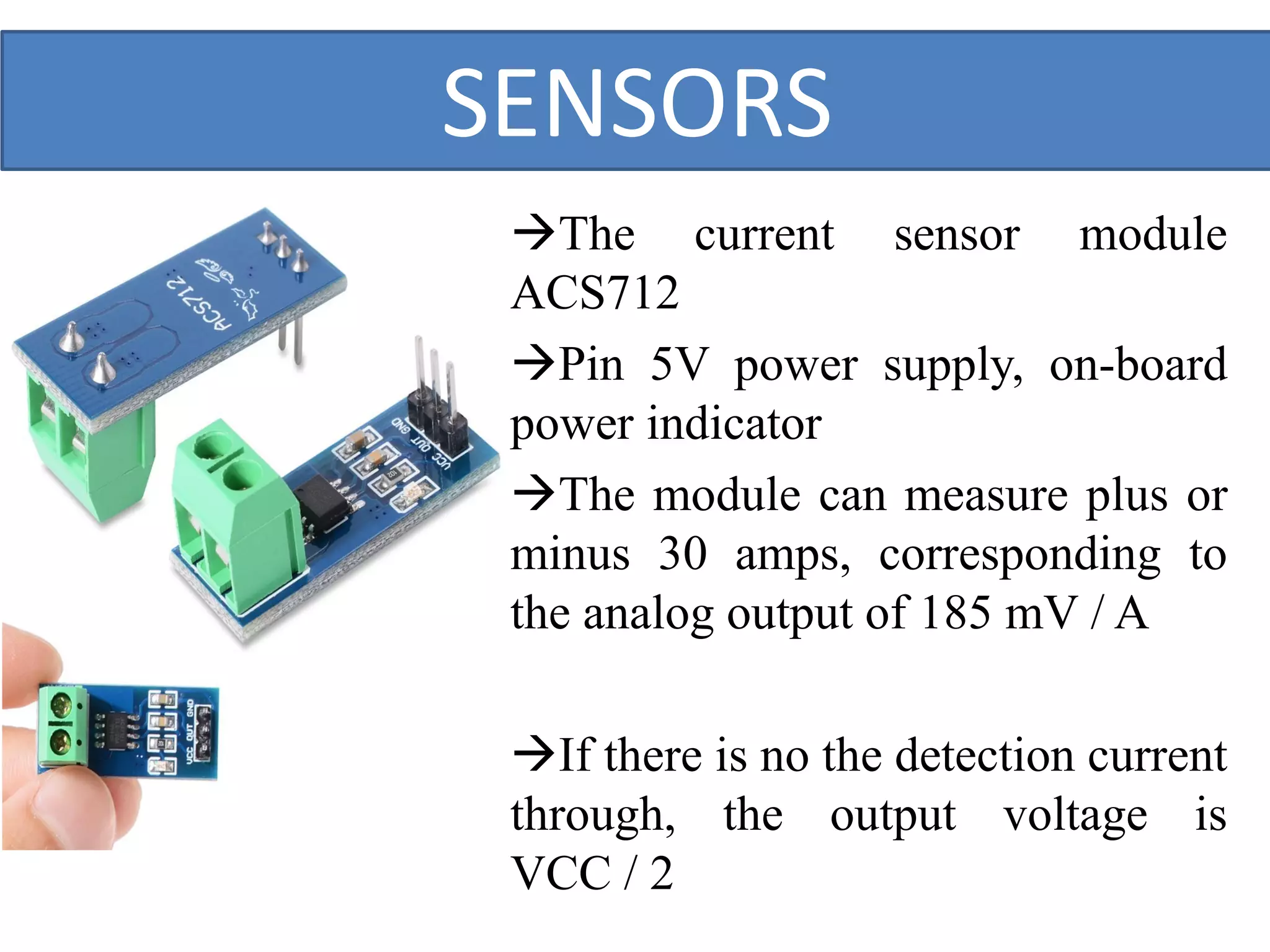
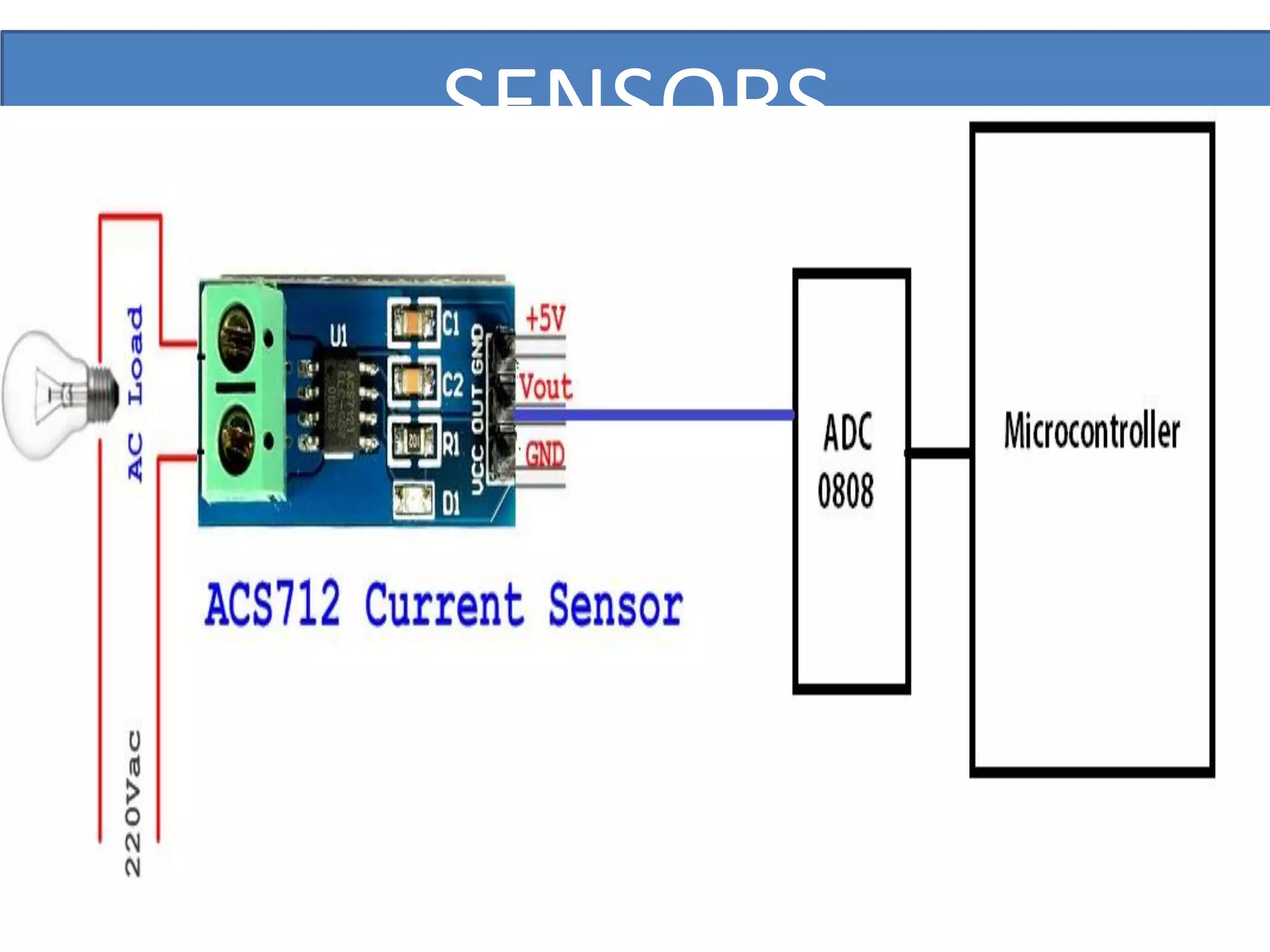
The current sensor module
ACS712
Pin 5V power supply, on-board
power indicator
The module can measure plus or
minus 30 amps, corresponding to
the analog output of 185 mV / A
If there is no the detection current
through, the output voltage is
VCC / 2
SENSORS
SENSORS
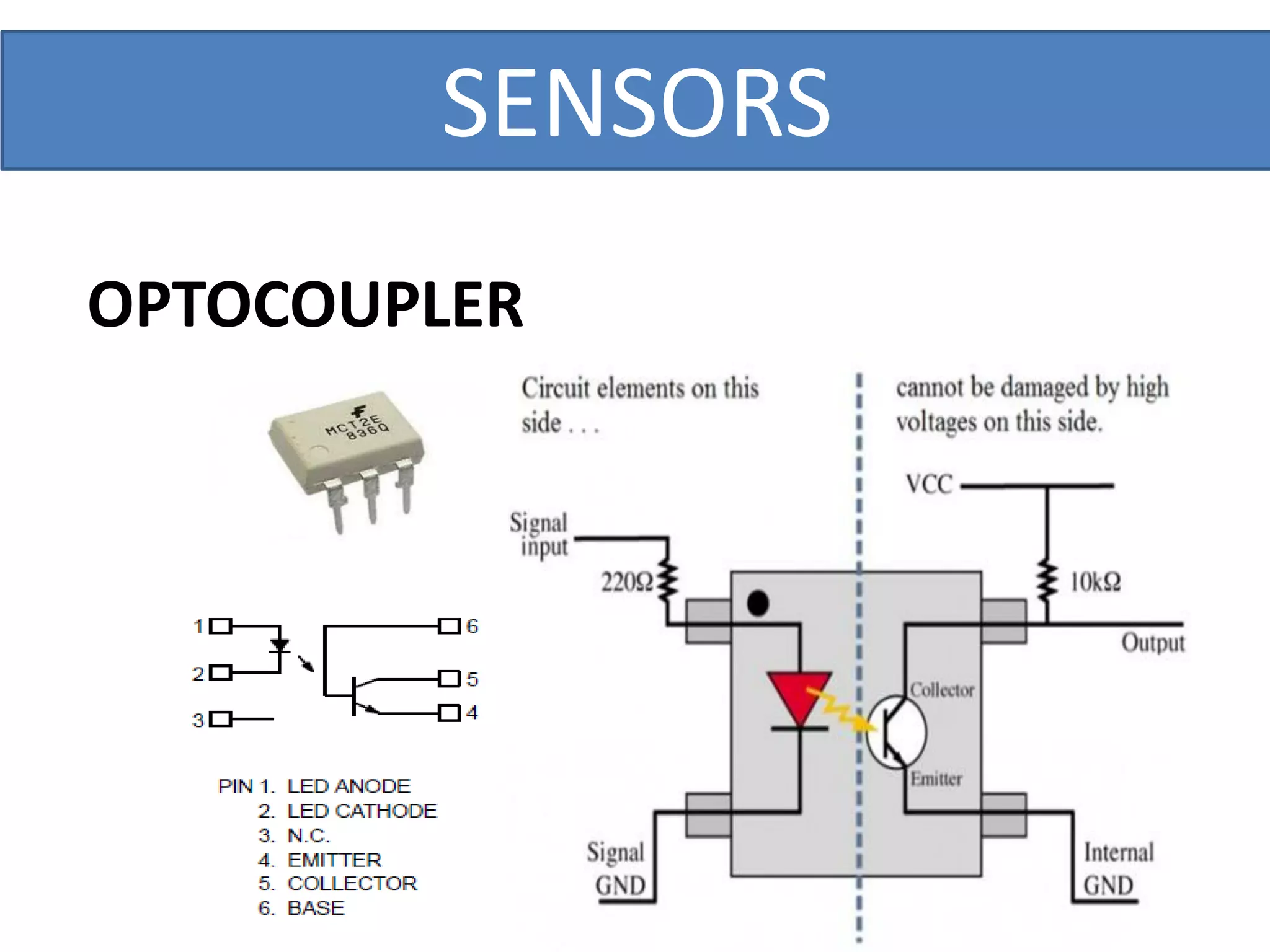
OPTOCOUPLER
SENSORS
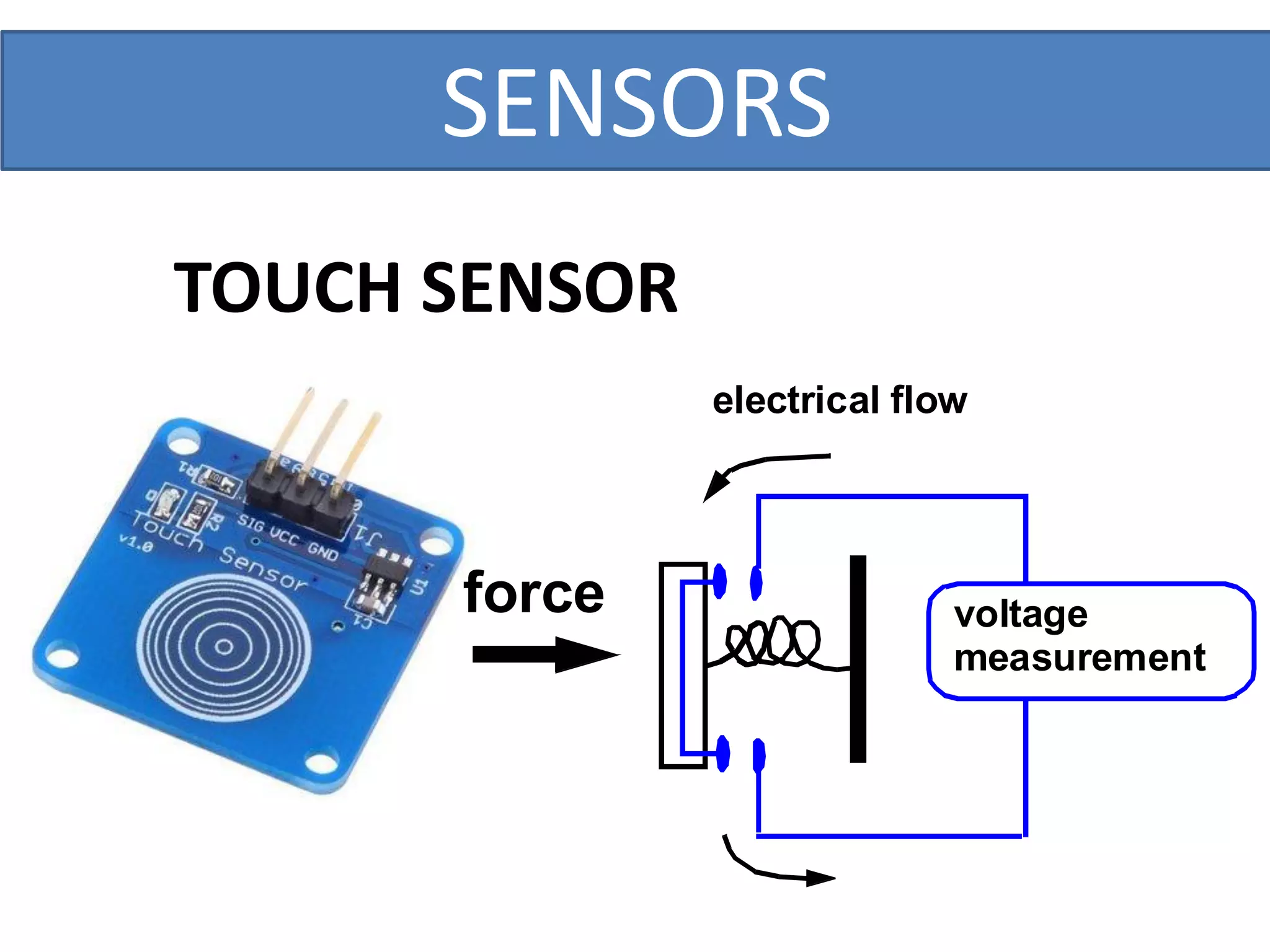
TOUCH SENSOR
force voltage
measurement
electrical flow
SENSORS
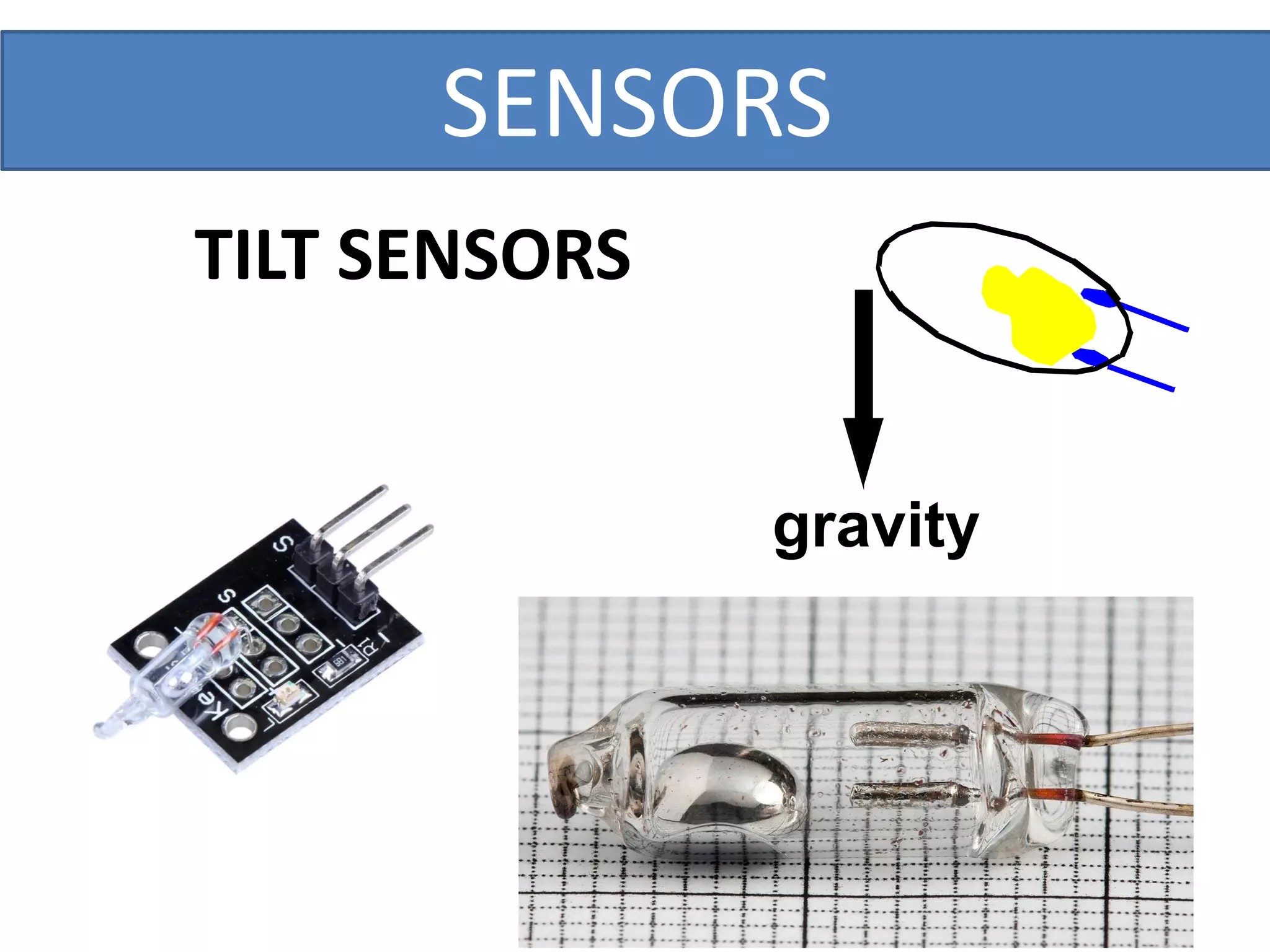
TILT SENSORS
gravity
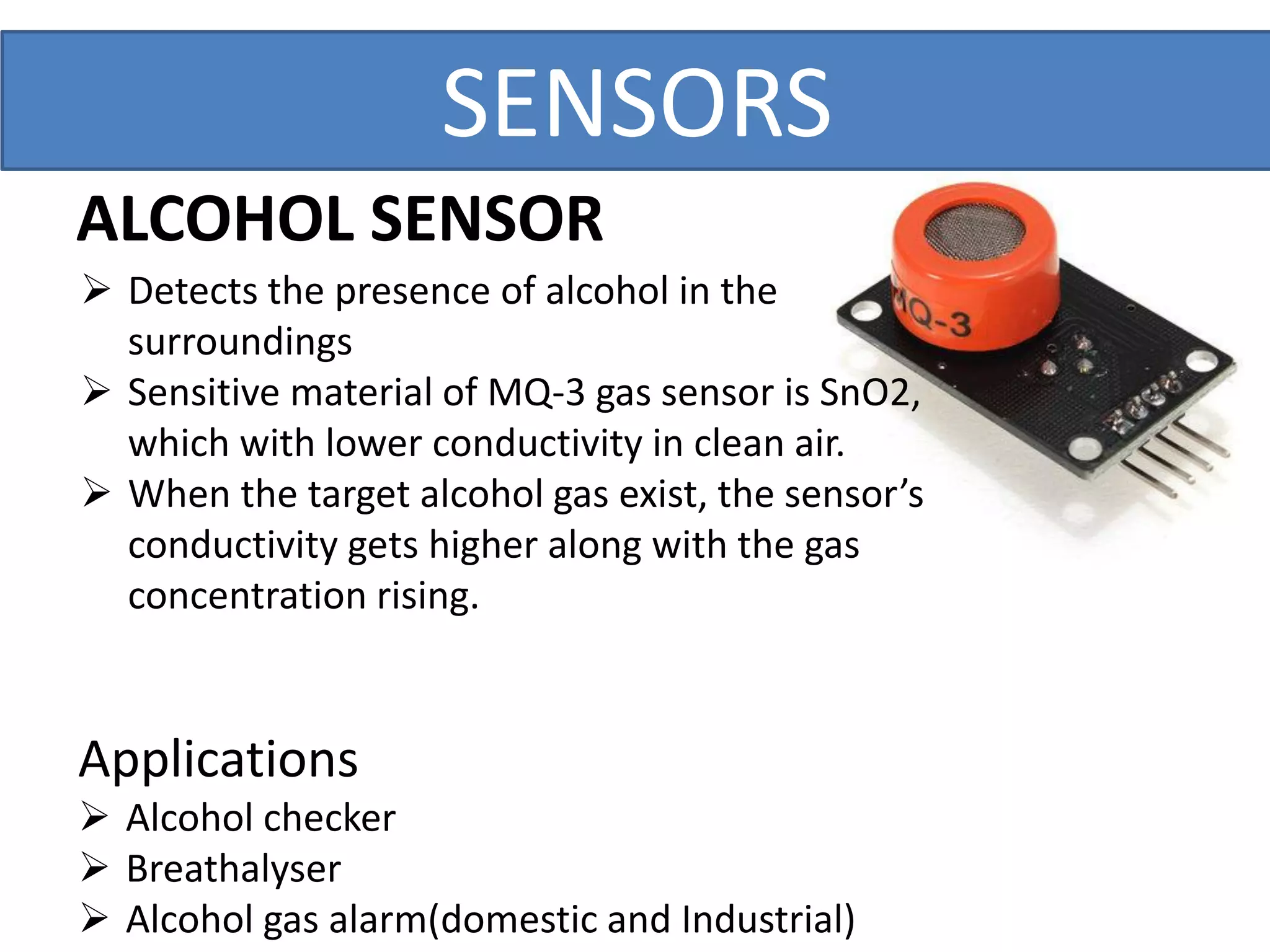
ALCOHOL SENSOR
 Detects the presence of alcohol in the
surroundings
 Sensitive material of MQ-3 gas sensor is SnO2,
which with lower conductivity in clean air.
 When the target alcohol gas exist, the sensor’s
conductivity gets higher along with the gas
concentration rising.
Applications
 Alcohol checker
 Breathalyser
 Alcohol gas alarm(domestic and Industrial)
SENSORS
SENSORS
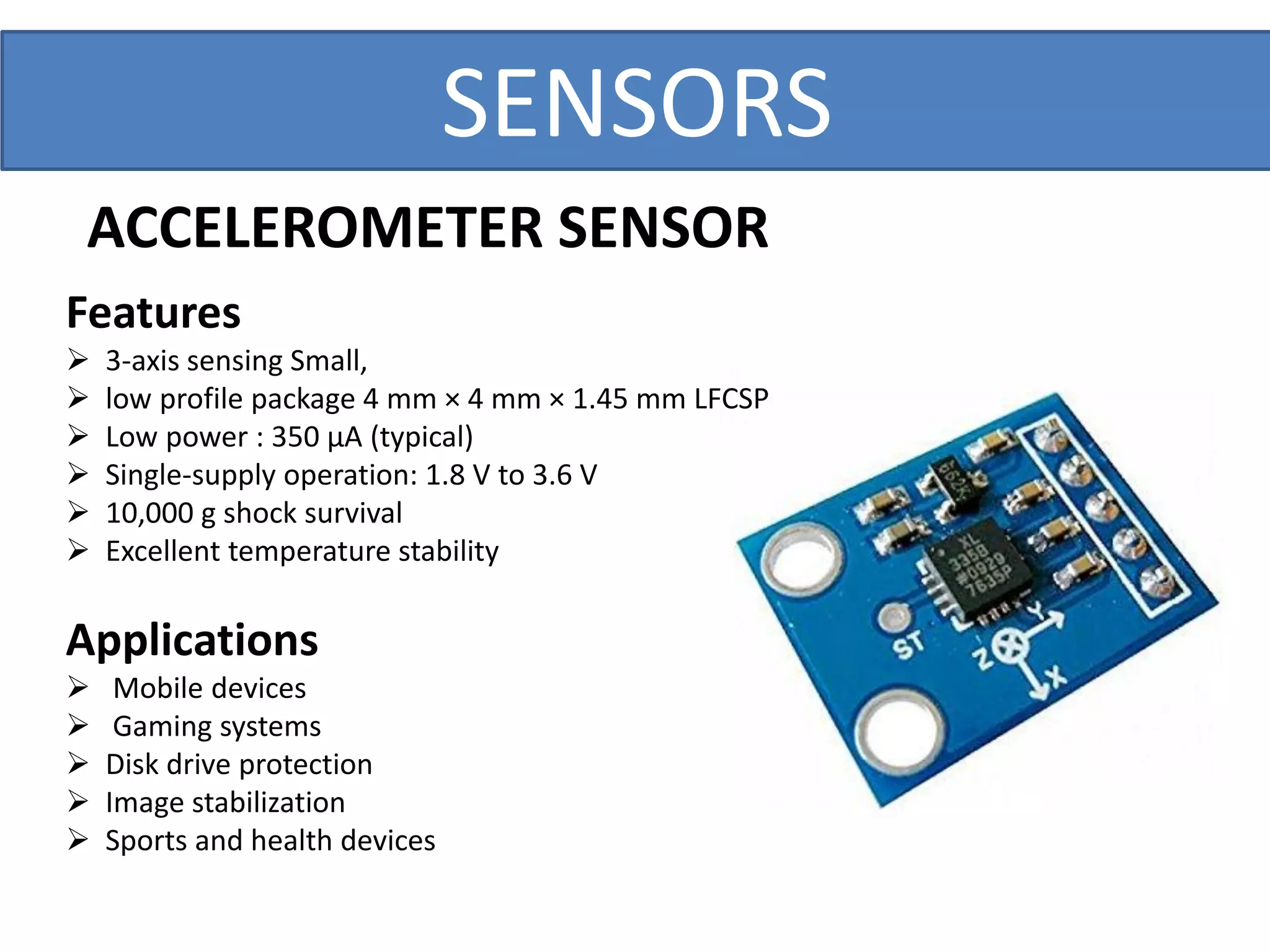
ACCELEROMETER SENSOR
Applications
 Mobile devices
 Gaming systems
 Disk drive protection
 Image stabilization
 Sports and health devices
Features
 3-axis sensing Small,
 low profile package 4 mm × 4 mm × 1.45 mm LFCSP
 Low power : 350 μA (typical)
 Single-supply operation: 1.8 V to 3.6 V
 10,000 g shock survival
 Excellent temperature stability
SENSORS
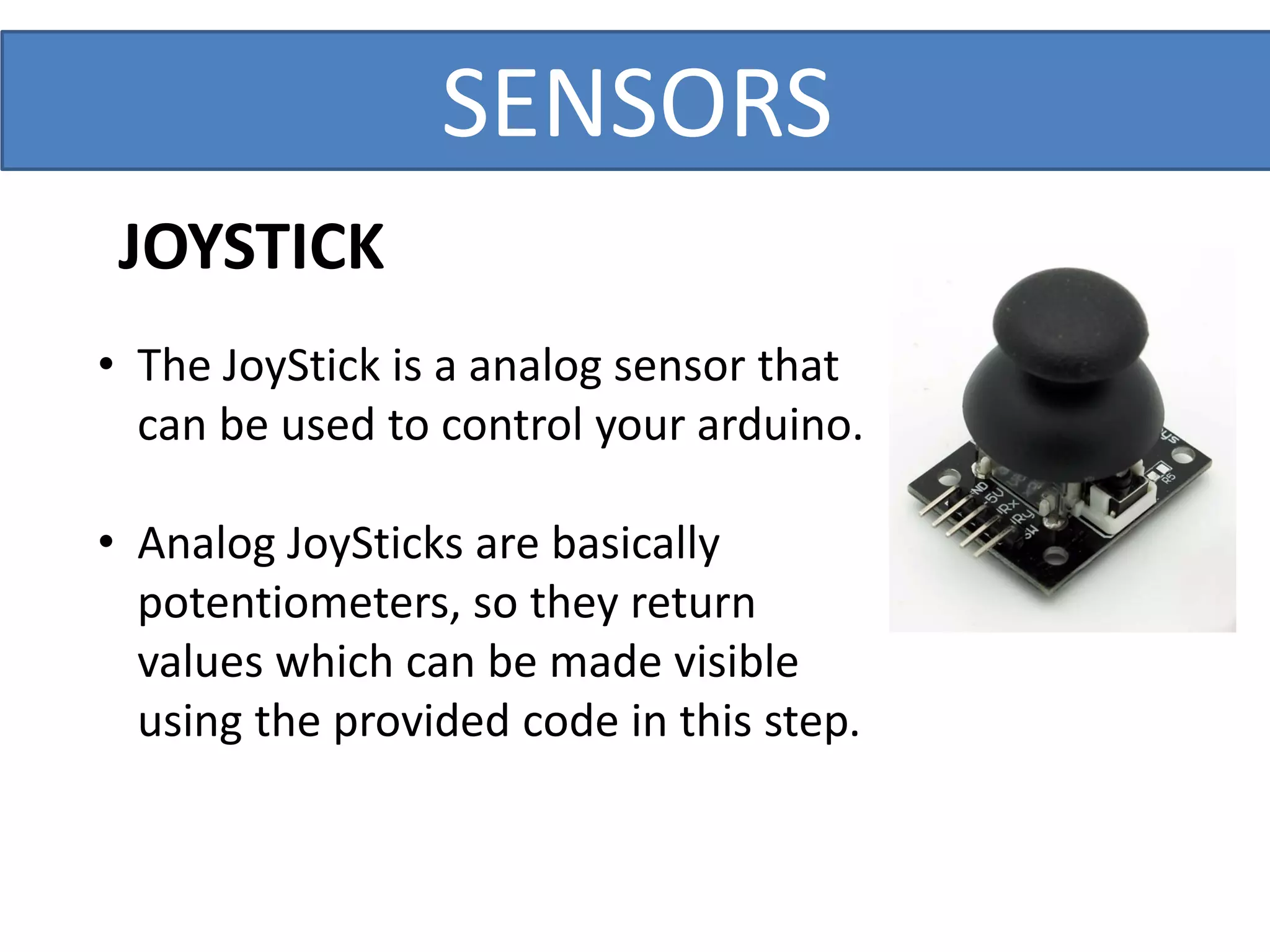
• The JoyStick is a analog sensor that
can be used to control your arduino.
• Analog JoySticks are basically
potentiometers, so they return
values which can be made visible
using the provided code in this step.
JOYSTICK
SENSORS
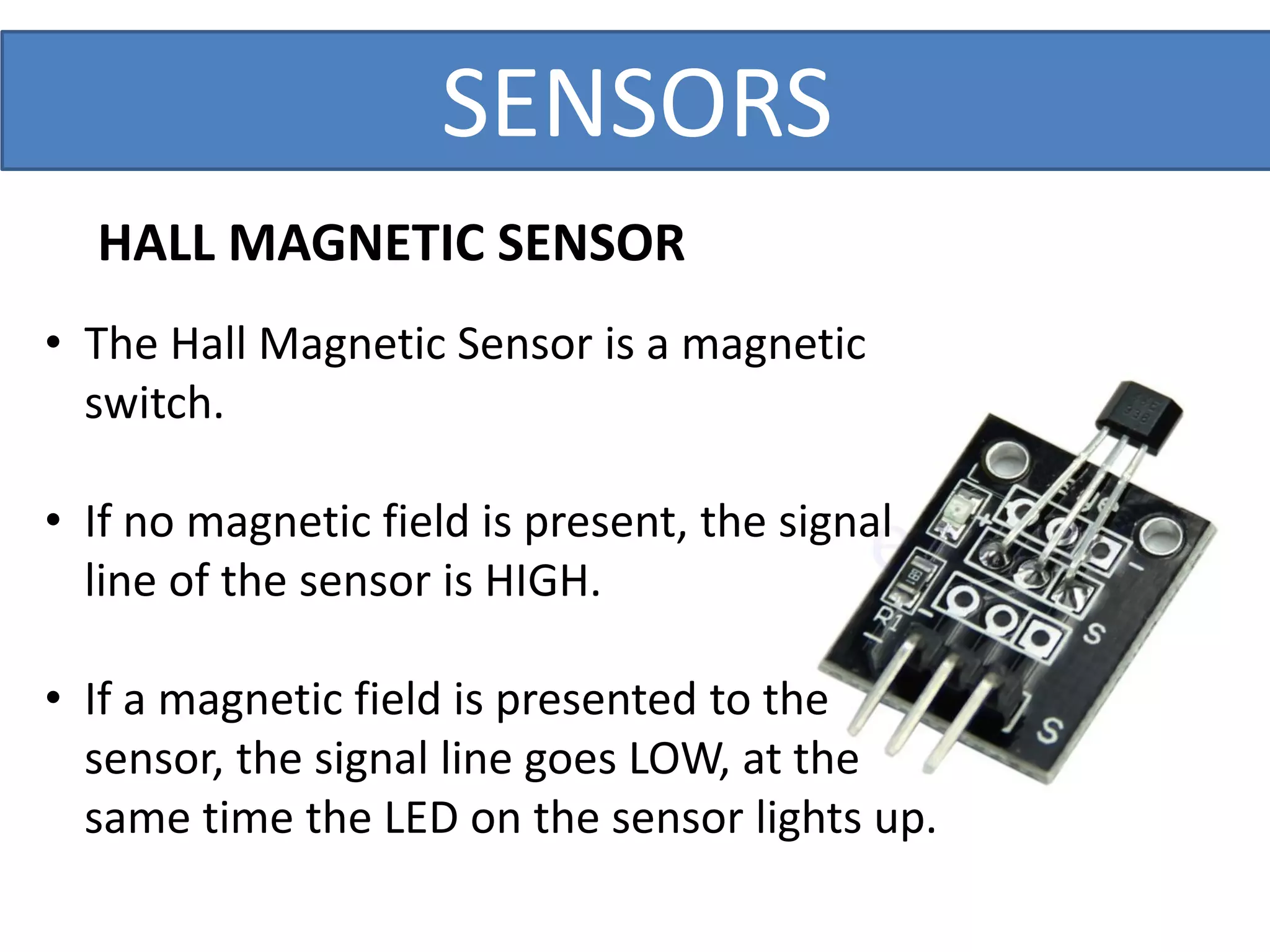
• The Hall Magnetic Sensor is a magnetic
switch.
• If no magnetic field is present, the signal
line of the sensor is HIGH.
• If a magnetic field is presented to the
sensor, the signal line goes LOW, at the
same time the LED on the sensor lights up.
HALL MAGNETIC SENSOR
SENSORS
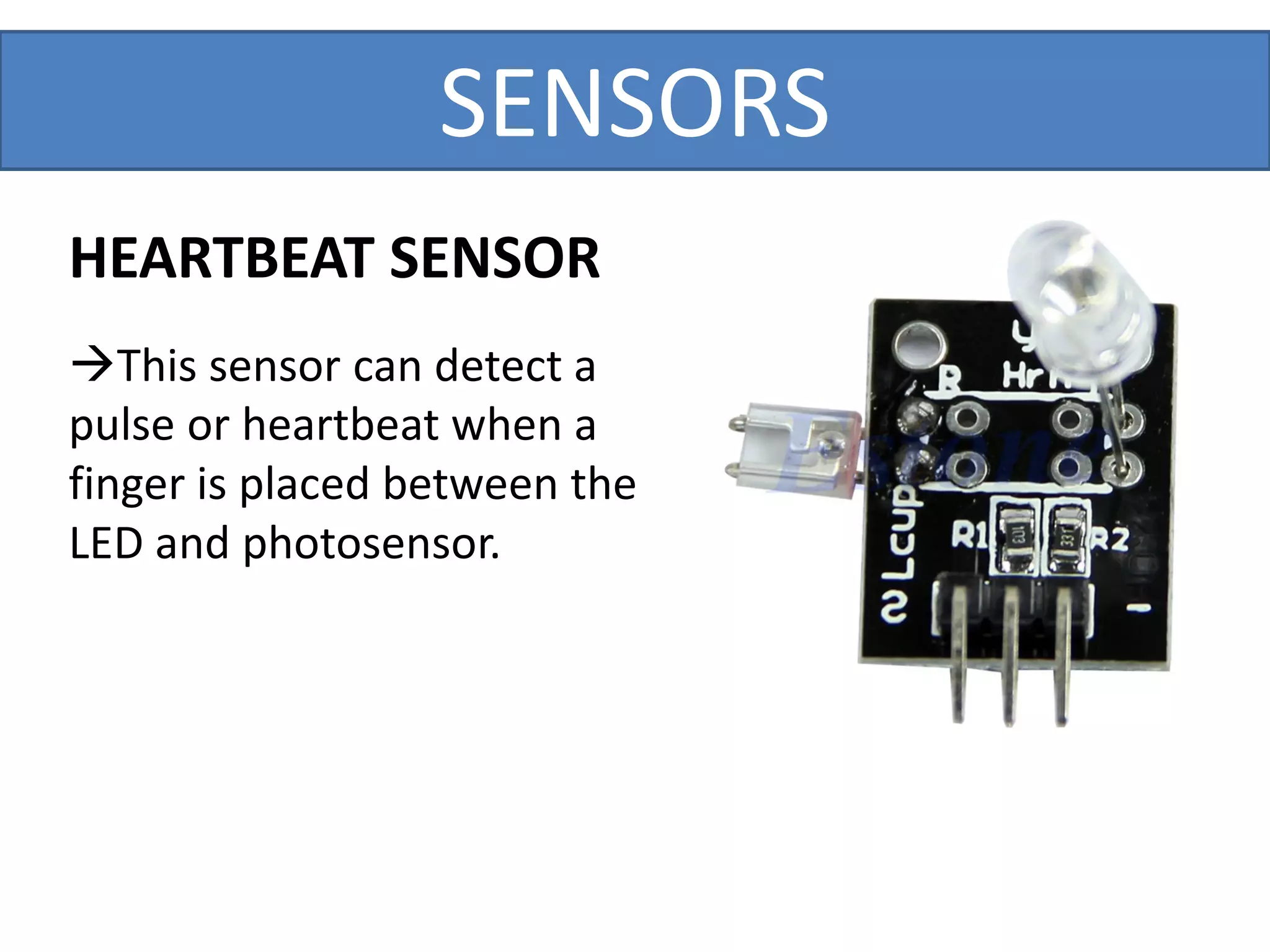
HEARTBEAT SENSOR
This sensor can detect a
pulse or heartbeat when a
finger is placed between the
LED and photosensor.
PIR SENSOR
SENSORS
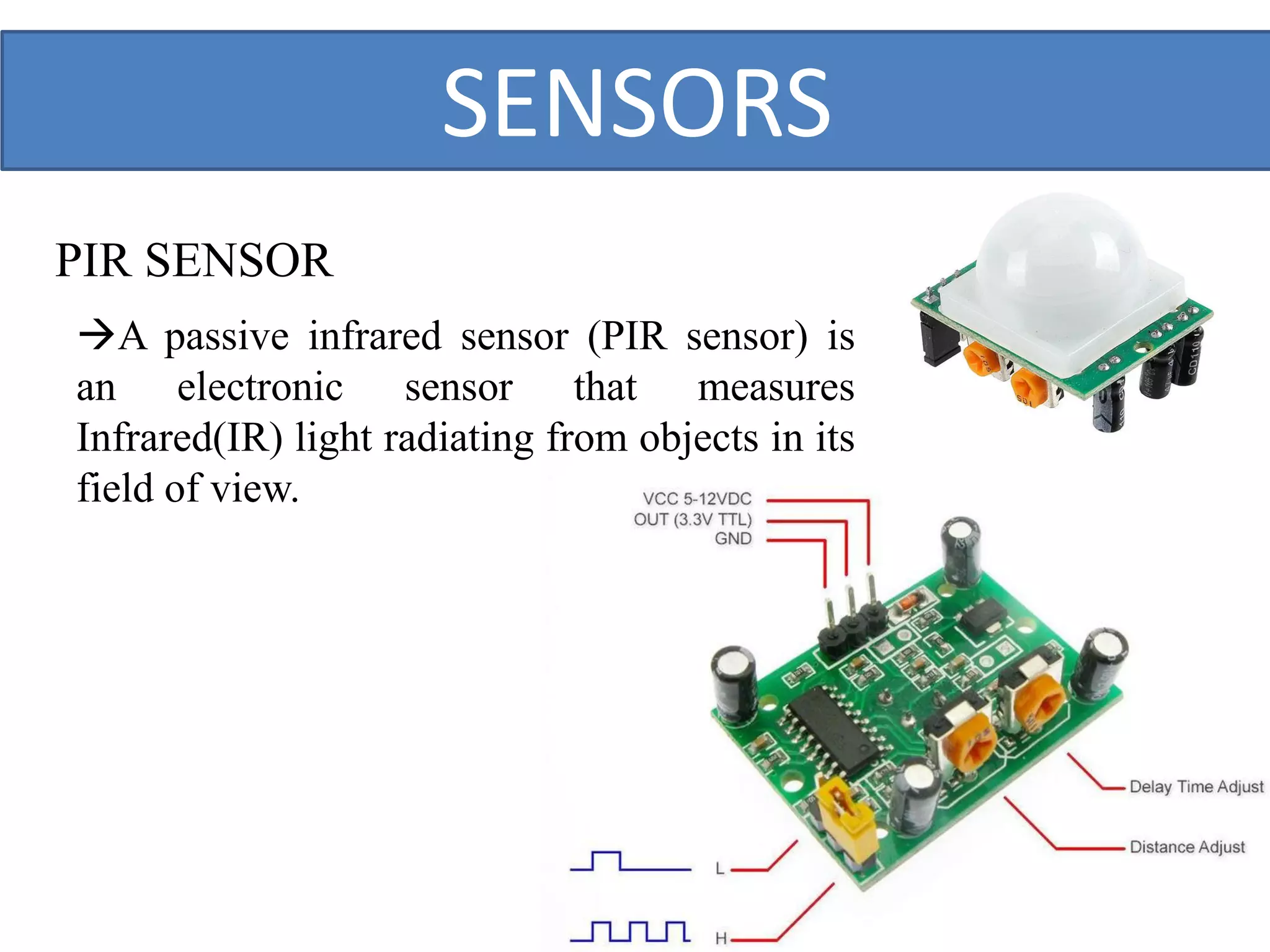
A passive infrared sensor (PIR sensor) is
an electronic sensor that measures
Infrared(IR) light radiating from objects in its
field of view.
SENSORS
Temperature above ABSOLUTE ZERO Heat Radiation
Its called as Passive…???
SENSORS
SENSORS
SENSORS
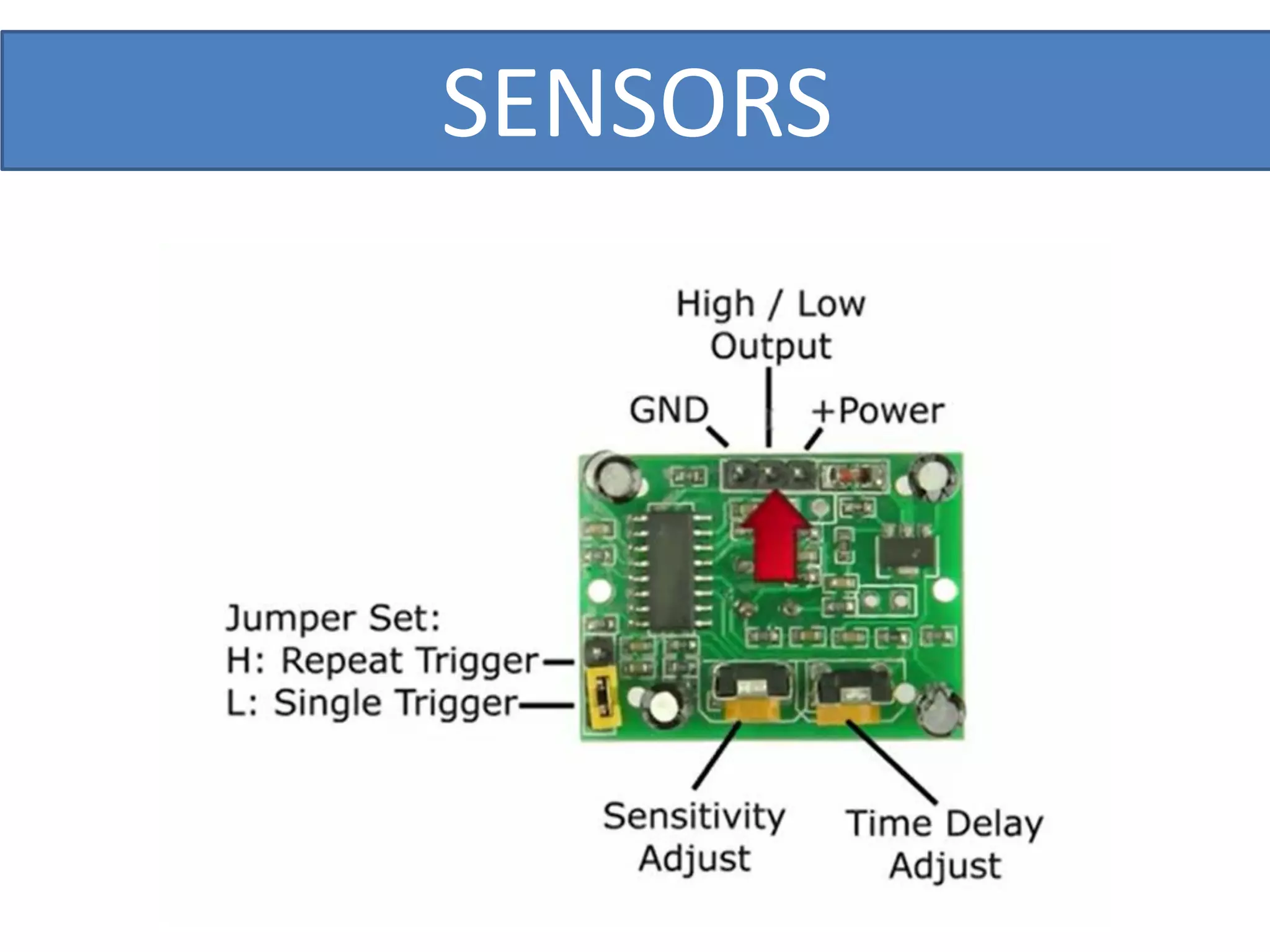
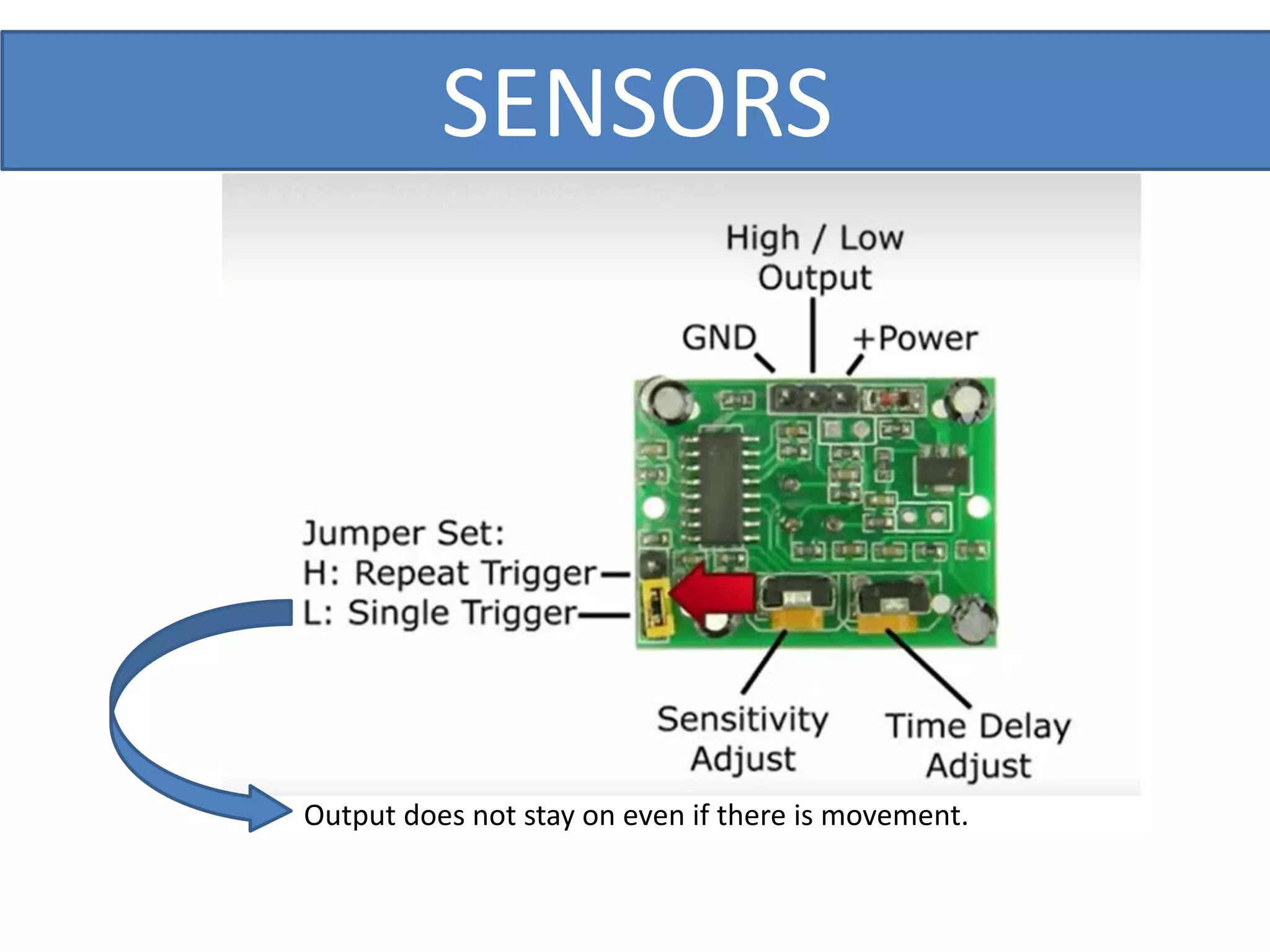
Output does not stay on even if there is movement.
SENSORS
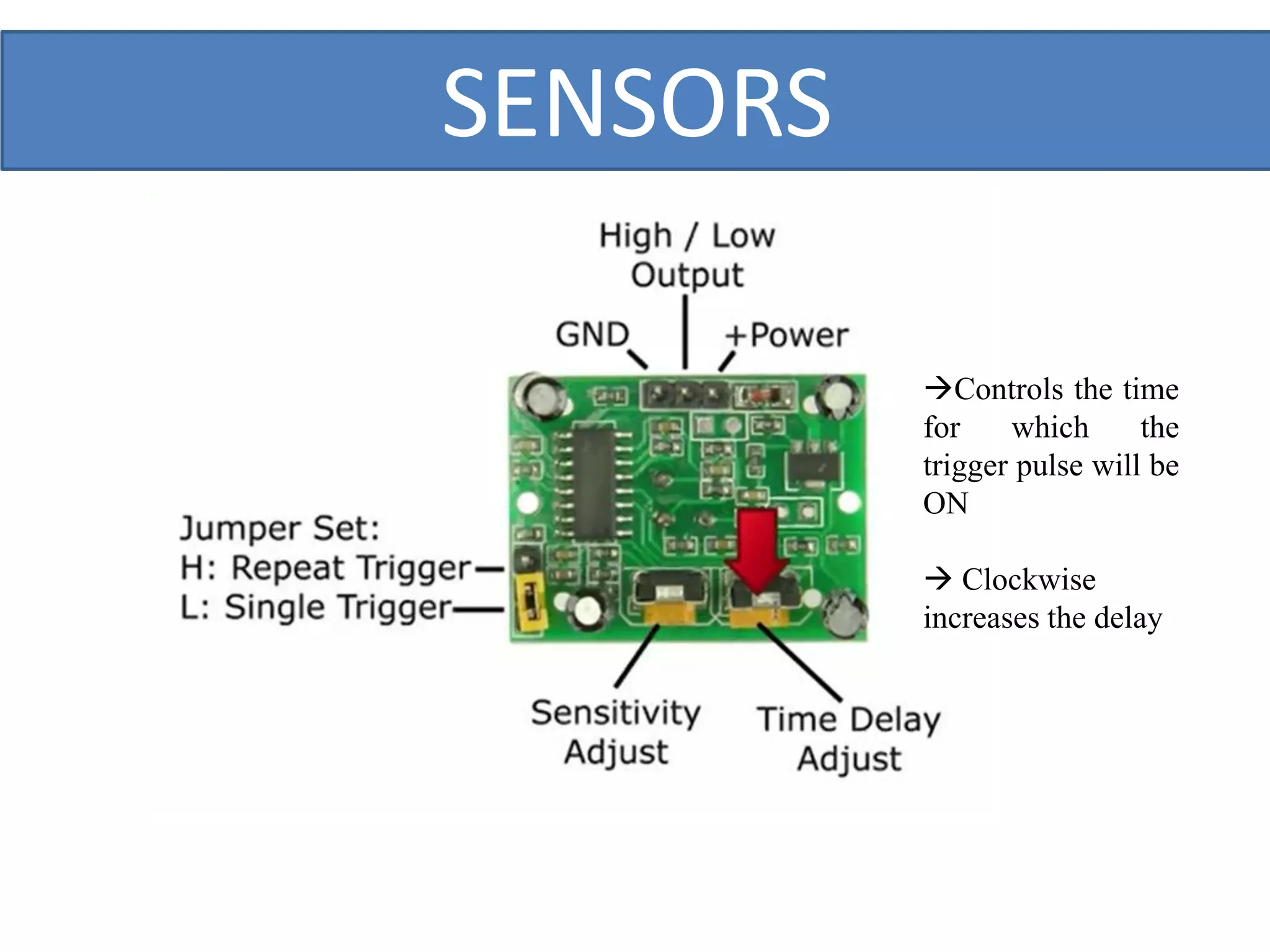
Controls the time
for which the
trigger pulse will be
ON
 Clockwise
increases the delay
SENSORS
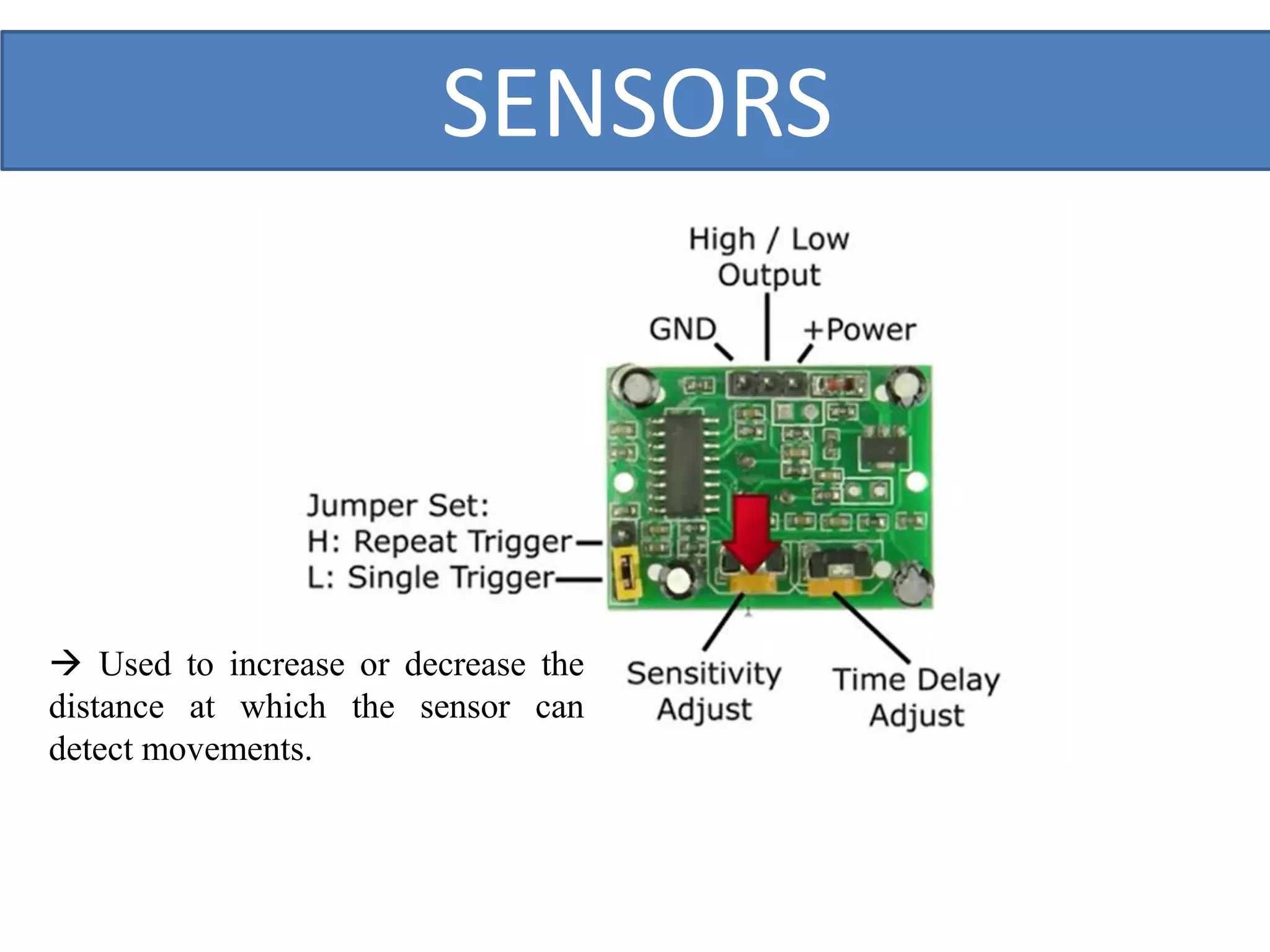
 Used to increase or decrease the
distance at which the sensor can
detect movements.
SENSORS
SENSORS
SENSORS
SENSORS
SENSORS
SENSORS
SENSORS
SENSORS
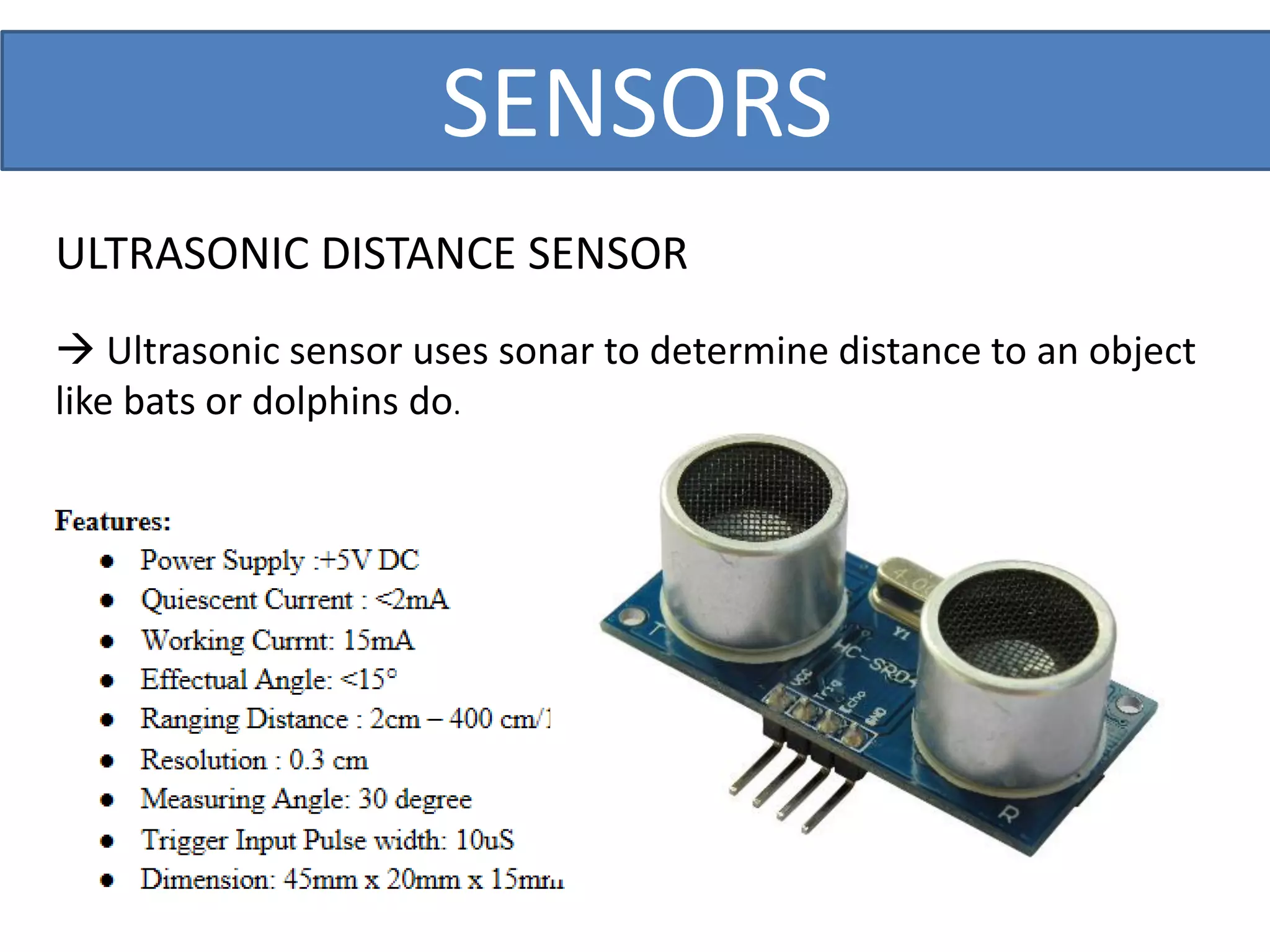
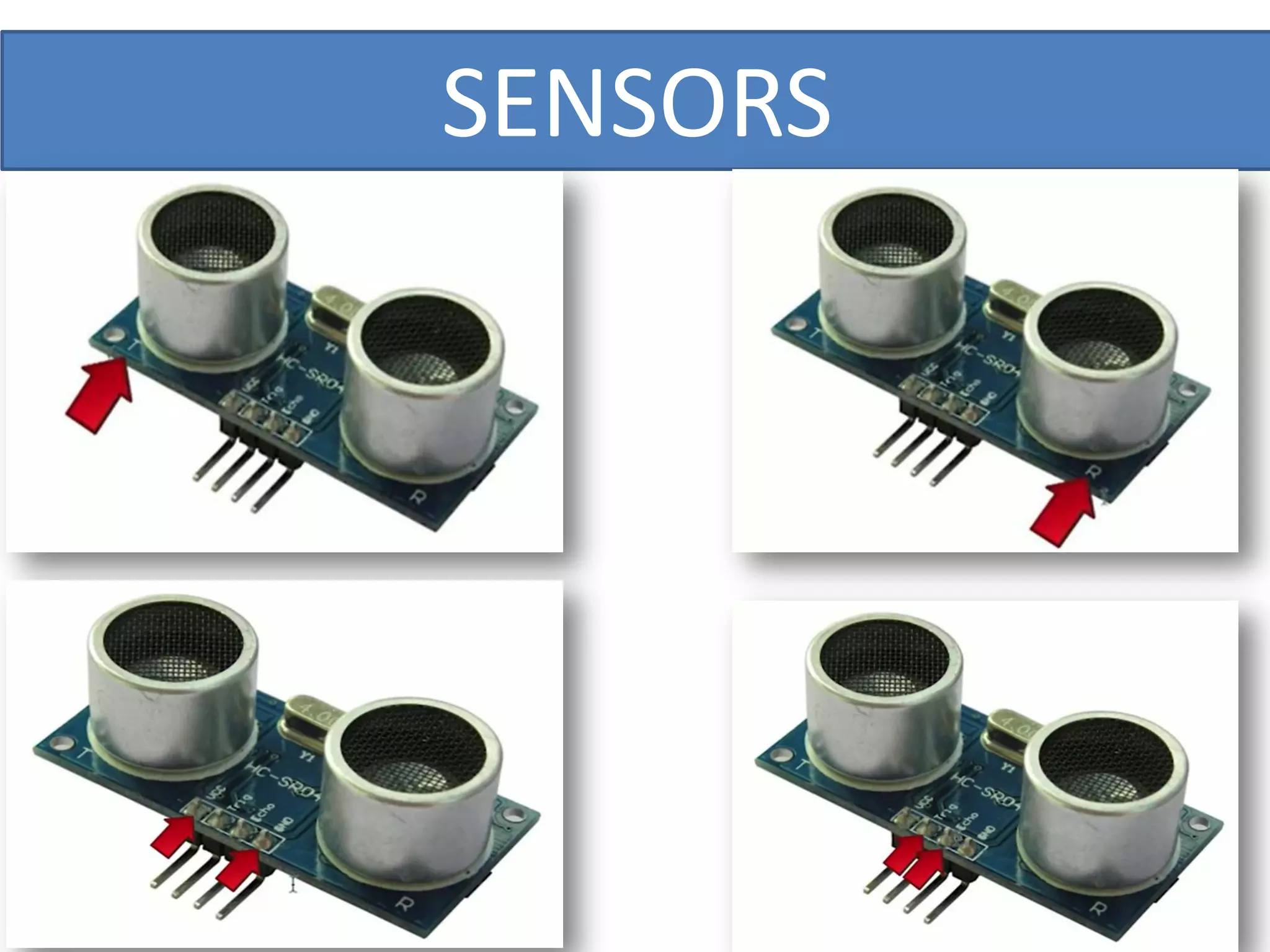
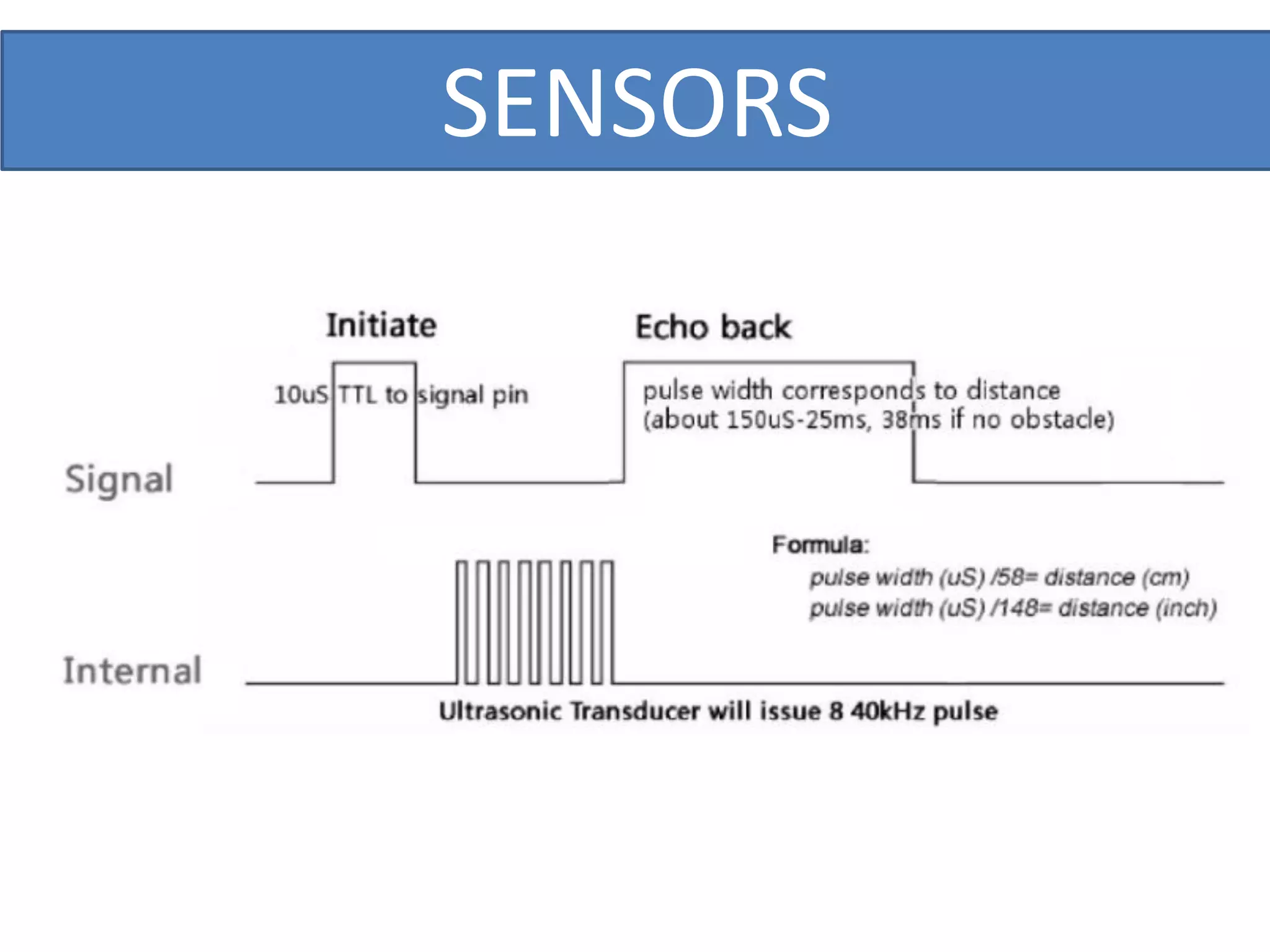
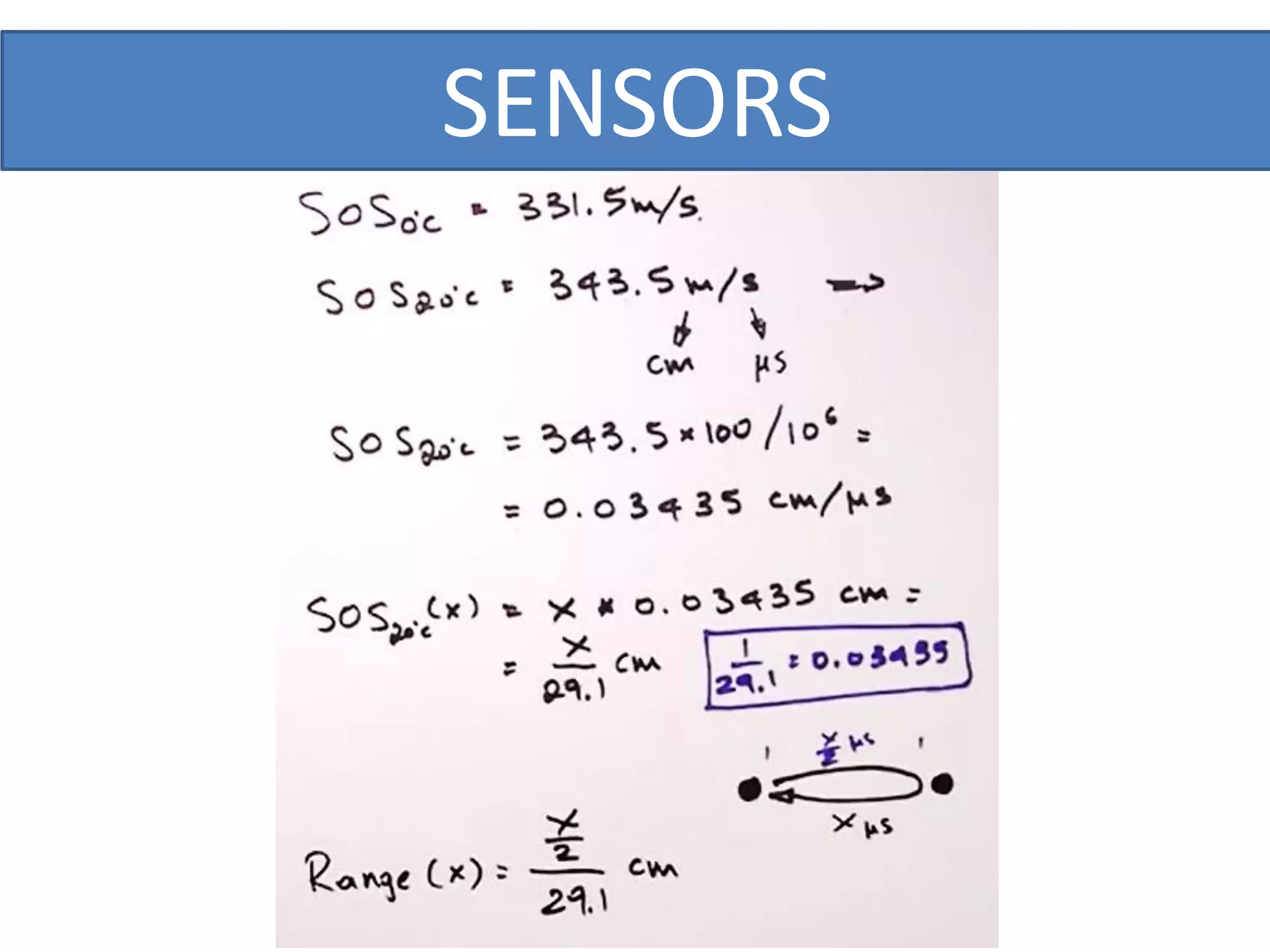
ULTRASONIC DISTANCE SENSOR
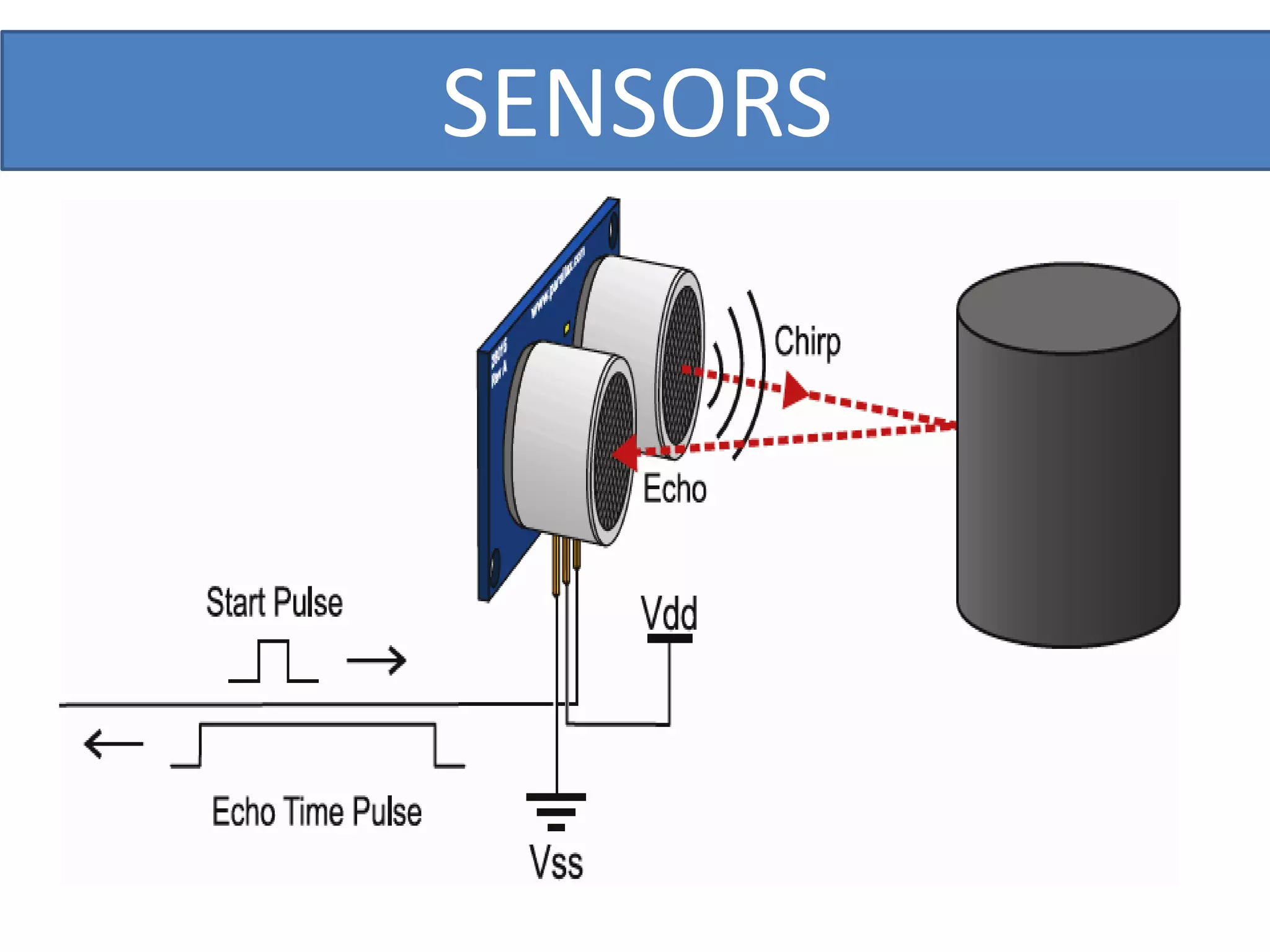
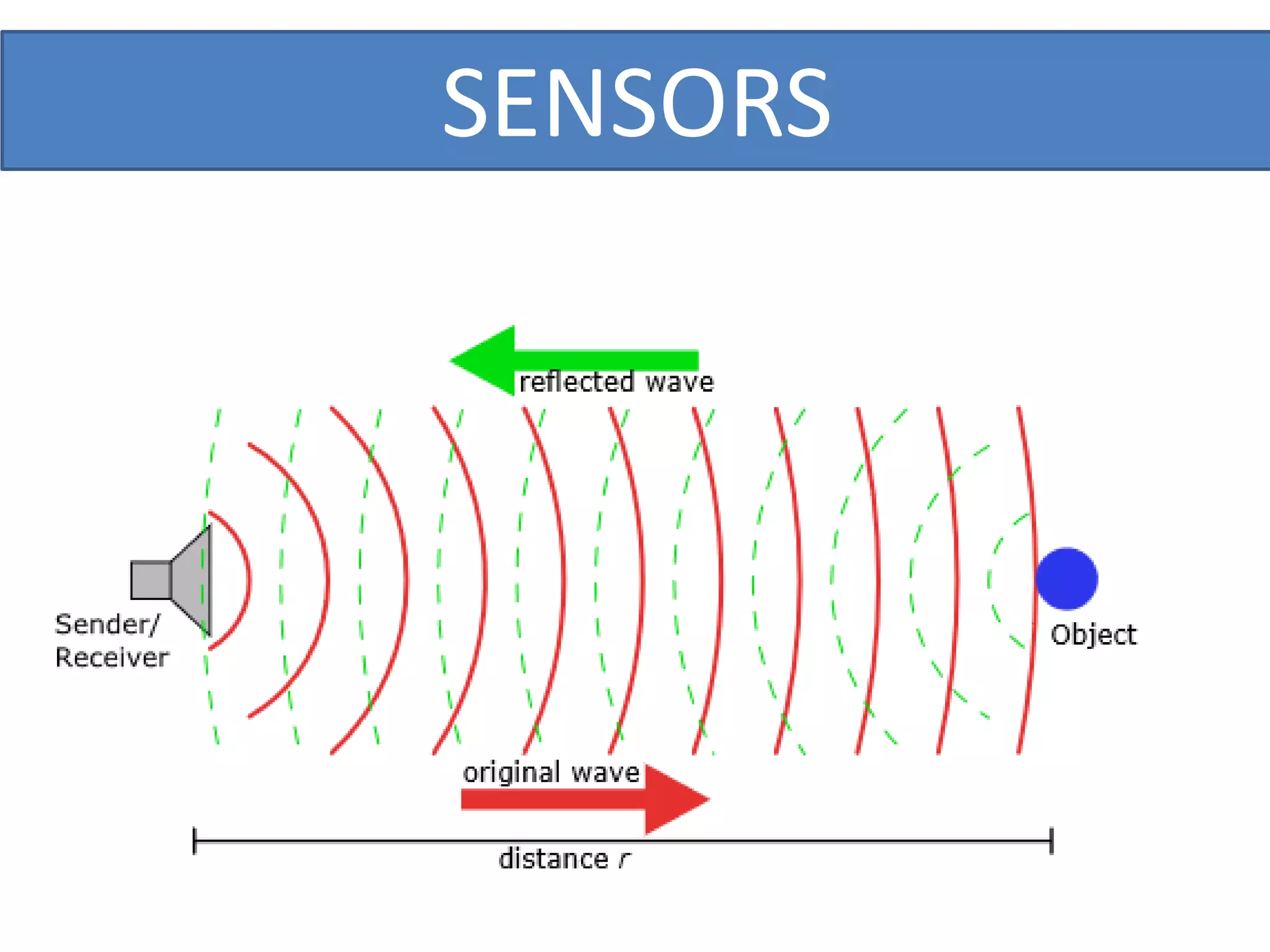
 Ultrasonic sensor uses sonar to determine distance to an object
like bats or dolphins do.
SENSORS
SENSORS
 Operation is not affected by sunlight or black material.
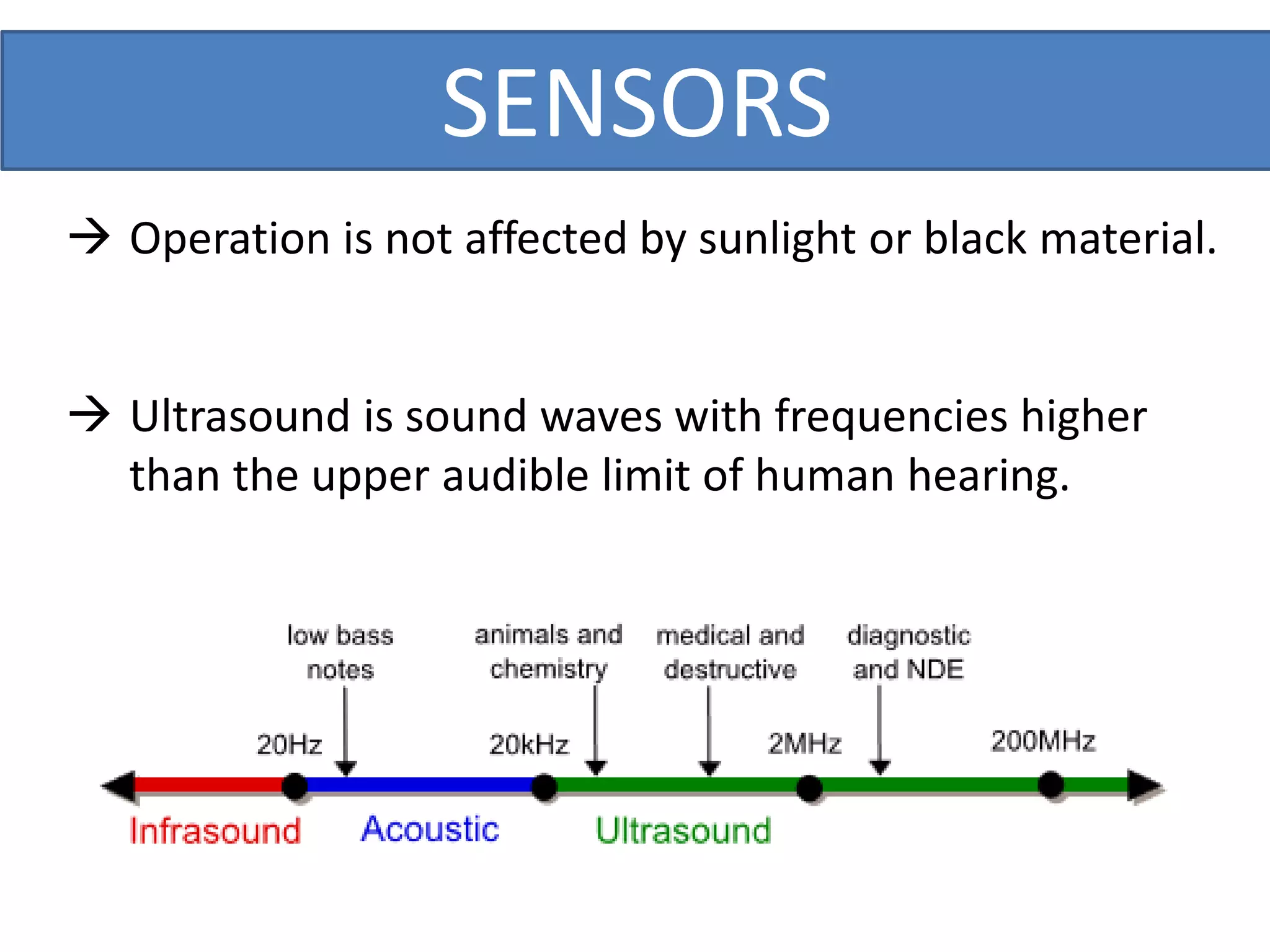
 Ultrasound is sound waves with frequencies higher
than the upper audible limit of human hearing.
SENSORS
SENSORS
SENSORS
SENSORS
SENSORS
SENSORS
SENSORS
SENSORS
Sensors for Arduino- Shashank M Gowda, YIT, Moodbidri.

Sensors for Arduino- Shashank M Gowda, YIT, Moodbidri.

  • 1.
    SENSORS FIVE DAY SHORTTERM COURSE ON ARDUINO PROGRAMMING FUNDAMENTALS AND PROTEOUS DESIGN SUITE 8.0 Prepared by Shashank M Gowda Asst. Prof. Dept., of ECE, YIT, Moodbidri
  • 2.
    SENSORS What are Sensors? AmericanNational Standards Institute (ANSI) Definition A device which provides a usable output in response to a specified measurand A sensor acquires a physical parameter and converts it into a signal suitable for processing (e.g. optical, electrical, mechanical) Each sensor is based on a transduction principle - conversion of energy from one form to another  Also known as transducers
  • 3.
    SENSORS Detectable Phenomenon Stimulus Quantity AcousticWave (amplitude, phase, polarization), Spectrum, Wave Velocity Biological & Chemical Fluid Concentrations (Gas or Liquid) Electric Charge, Voltage, Current, Electric Field (amplitude, phase, polarization), Conductivity, Permittivity Magnetic Magnetic Field (amplitude, phase, polarization), Flux, Permeability Optical Refractive Index, Reflectivity, Absorption Thermal Temperature, Flux, Specific Heat, Thermal Conductivity Mechanical Position, Velocity, Acceleration, Force, Strain, Stress, Pressure, Torque
  • 4.
    SENSORS Why Do RobotsNeed Sensors? Provides “awareness” of surroundings What’s ahead, around, “out there”? Allows interaction with environment Robot lawn mower can “see” cut grass Protection & Self-Preservation Safety, Damage Prevention, Stairwell sensor Gives the robot capability to goal-seek Find colorful objects, seek goals Makes robots “interesting”
  • 5.
    Why do robotsneed sensors? Where am I? localization ?
  • 6.
    Why do robotsneed sensors? Will I hit anything? obstacle detection
  • 7.
    Sensing for specifictasks Where is the cropline? Autonomous harvesting
  • 8.
    Sensing for specifictasks Autonomous material handling Where are the forkholes?
  • 9.
    Sensing for specifictasks Where is the face? Face detection & tracking
  • 10.
  • 11.
  • 12.
  • 13.
    SENSORS LDR (Light DependentResistor) It is also known as photo-resistor  a resistor whose resistance varies with the amount of light falling on it.
  • 14.
    SENSORS FLEX SENSOR This sensorcan detect flexing or bending in one direction. These sensors are easy to use, they are basically resistors that change value based on how much they're flexed. If they're unflexed, the resistance is about ~10KΩ.
  • 15.
  • 16.
  • 17.
    SENSORS  The LM35is an integrated circuit sensor that can be used to measure temperature with an electrical output proportional to the temperature (in °C).  It can measure temperature more accurately than a using a thermistor.  The LM35 has an output voltage that is proportional to the Celsius temperature. The scale factor is .01V/°C TEMPERATURE SENSOR
  • 18.
  • 19.
    SENSORS IR based Obstacledetector Range adjustable with preset. Operating voltage 5V DC Sensitivity upto 30 cm Digital Logic output Application in Industry safety devices
  • 20.
  • 21.
    SENSORS The current sensormodule ACS712 Pin 5V power supply, on-board power indicator The module can measure plus or minus 30 amps, corresponding to the analog output of 185 mV / A If there is no the detection current through, the output voltage is VCC / 2
  • 22.
  • 23.
  • 24.
  • 25.
  • 26.
    ALCOHOL SENSOR  Detectsthe presence of alcohol in the surroundings  Sensitive material of MQ-3 gas sensor is SnO2, which with lower conductivity in clean air.  When the target alcohol gas exist, the sensor’s conductivity gets higher along with the gas concentration rising. Applications  Alcohol checker  Breathalyser  Alcohol gas alarm(domestic and Industrial) SENSORS
  • 27.
    SENSORS ACCELEROMETER SENSOR Applications  Mobiledevices  Gaming systems  Disk drive protection  Image stabilization  Sports and health devices Features  3-axis sensing Small,  low profile package 4 mm × 4 mm × 1.45 mm LFCSP  Low power : 350 μA (typical)  Single-supply operation: 1.8 V to 3.6 V  10,000 g shock survival  Excellent temperature stability
  • 28.
    SENSORS • The JoyStickis a analog sensor that can be used to control your arduino. • Analog JoySticks are basically potentiometers, so they return values which can be made visible using the provided code in this step. JOYSTICK
  • 29.
    SENSORS • The HallMagnetic Sensor is a magnetic switch. • If no magnetic field is present, the signal line of the sensor is HIGH. • If a magnetic field is presented to the sensor, the signal line goes LOW, at the same time the LED on the sensor lights up. HALL MAGNETIC SENSOR
  • 30.
    SENSORS HEARTBEAT SENSOR This sensorcan detect a pulse or heartbeat when a finger is placed between the LED and photosensor.
  • 31.
    PIR SENSOR SENSORS A passiveinfrared sensor (PIR sensor) is an electronic sensor that measures Infrared(IR) light radiating from objects in its field of view.
  • 32.
    SENSORS Temperature above ABSOLUTEZERO Heat Radiation Its called as Passive…???
  • 33.
  • 34.
  • 35.
    SENSORS Output does notstay on even if there is movement.
  • 36.
    SENSORS Controls the time forwhich the trigger pulse will be ON  Clockwise increases the delay
  • 37.
    SENSORS  Used toincrease or decrease the distance at which the sensor can detect movements.
  • 38.
  • 39.
  • 40.
  • 41.
  • 42.
  • 43.
  • 44.
  • 45.
    SENSORS ULTRASONIC DISTANCE SENSOR Ultrasonic sensor uses sonar to determine distance to an object like bats or dolphins do.
  • 46.
  • 47.
    SENSORS  Operation isnot affected by sunlight or black material.  Ultrasound is sound waves with frequencies higher than the upper audible limit of human hearing.
  • 48.
  • 49.
  • 50.
  • 51.
  • 52.
  • 53.
  • 54.
  • 55.