Who Wants To Be
 A Millionaire?

  Sensitivity
Question 1
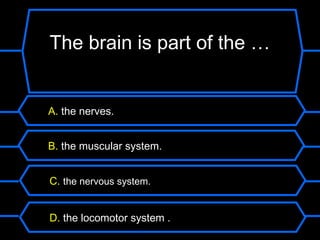
The brain is part of the …


A. the nerves.


B. the muscular system.


C. the nervous system.


D. the locomotor system .
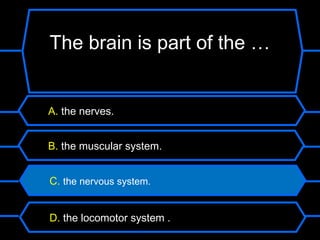
The brain is part of the …


A. the nerves.


B. the muscular system.


C. the nervous system.


D. the locomotor system .
100 points
Question 2
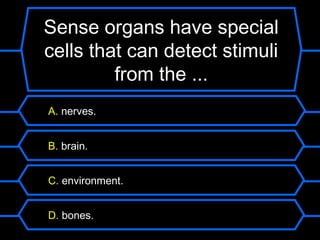
Sense organs have special
cells that can detect stimuli
         from the ...
A. nerves.


B. brain.


C. environment.


D. bones.
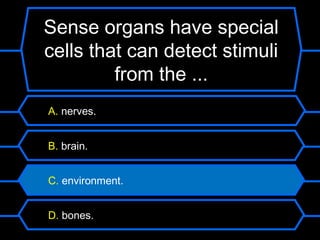
Sense organs have special
cells that can detect stimuli
         from the ...
A. nerves.


B. brain.


C. environment.


D. bones.
200 points
Question 3
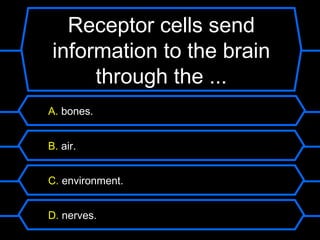
Receptor cells send
 information to the brain
      through the ...
A. bones.


B. air.


C. environment.


D. nerves.
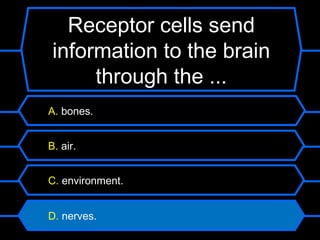
Receptor cells send
 information to the brain
      through the ...
A. bones.


B. air.


C. environment.


D. nerves.
300 points
Question 4
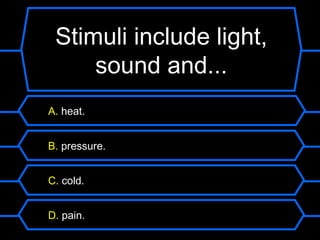
Stimuli include light,
     sound and...
A. heat.


B. pressure.


C. cold.


D. pain.
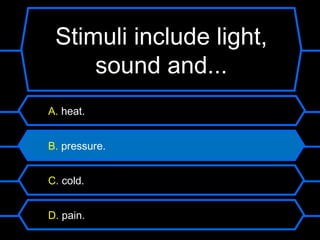
Stimuli include light,
     sound and...
A. heat.


B. pressure.


C. cold.


D. pain.
400 points
Question 5
The locomotor system is
      formed by …
 A. the muscular system and the skeletal system.


 B. the muscular system and the nervous system.


 C. the muscular system and the receptor cells .


 D. the skeletal system and the nervous system.
The locomotor system is
      formed by …
 A. the muscular system and the skeletal system.


 B. the muscular system and the nervous system.


 C. the muscular system and the receptor cells .


 D. the skeletal system and the nervous system.
400 points
Question 6
The locomotor system is
      formed by ...
 A. sense and muscles.


 B. bones and organs.


 C. organs and muscles.


 D. bones and muscles.
The locomotor system is
      formed by ...
 A. sense and muscles.


 B. bones and organs.


 C. organs and muscles.


 D. bones and muscles.
4   400 points
Question 7
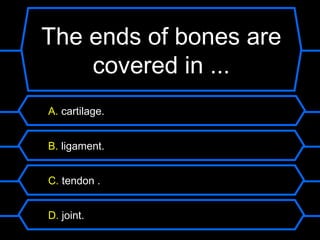
The ends of bones are
    covered in ...
A. cartilage.


B. ligament.


C. tendon .


D. joint.
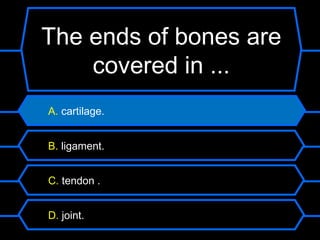
The ends of bones are
    covered in ...
A. cartilage.


B. ligament.


C. tendon .


D. joint.
400 points
Question 8
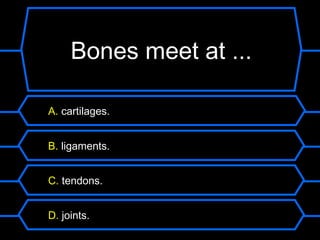
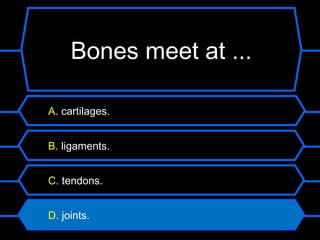
Bones meet at ...

A. cartilages.


B. ligaments.


C. tendons.


D. joints.
Bones meet at ...

A. cartilages.


B. ligaments.


C. tendons.


D. joints.
500 points
Question 9
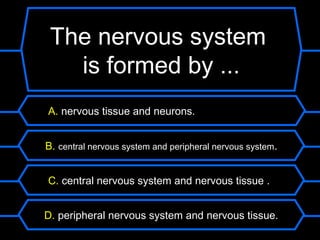
What nutrients system
 The nervous are found
    is formed by ...
    in vegetables?
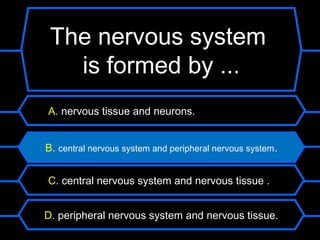
 A. nervous tissue and neurons.


 B. central nervous system and peripheral nervous system.


 C. central nervous system and nervous tissue .


 D. peripheral nervous system and nervous tissue.
What nutrients system
 The nervous are found
    is formed by ...
    in vegetables?
 A. nervous tissue and neurons.


 B. central nervous system and peripheral nervous system.


 C. central nervous system and nervous tissue .


 D. peripheral nervous system and nervous tissue.
500 points
Question 10
What nutrients are found
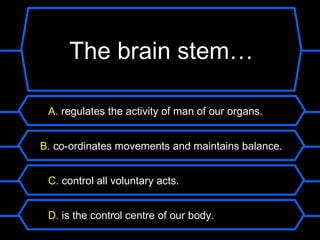
  The brain stem…
    in vegetables?
 A. regulates the activity of man of our organs.


B. co-ordinates movements and maintains balance.


 C. control all voluntary acts.


 D. is the control centre of our body.
What nutrients are found
  The brain stem…
    in vegetables?
 A. regulates the activity of man of our organs.


B. co-ordinates movements and maintains balance.


 C. control all voluntary acts.


 D. is the control centre of our body.
500 points
Question 11
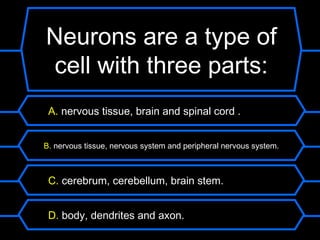
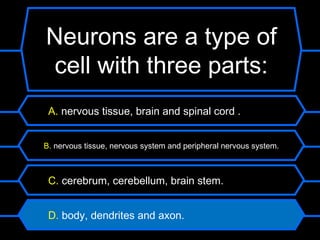
Neurons are a type of
 cell with three parts:
 A. nervous tissue, brain and spinal cord .


B. nervous tissue, nervous system and peripheral nervous system.


 C. cerebrum, cerebellum, brain stem.


 D. body, dendrites and axon.
Neurons are a type of
 cell with three parts:
 A. nervous tissue, brain and spinal cord .


B. nervous tissue, nervous system and peripheral nervous system.


 C. cerebrum, cerebellum, brain stem.


 D. body, dendrites and axon.

500 points
Question 12
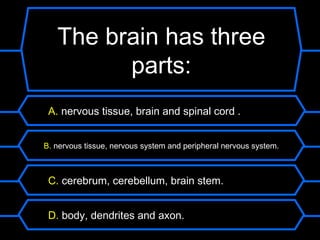
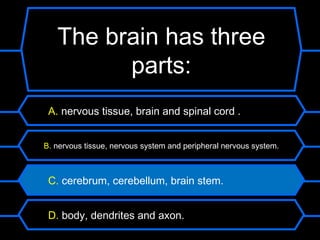
The brain has three
         parts:
 A. nervous tissue, brain and spinal cord .

B. nervous tissue, nervous system and peripheral nervous system.


 C. cerebrum, cerebellum, brain stem.


 D. body, dendrites and axon.
The brain has three
         parts:
 A. nervous tissue, brain and spinal cord .


B. nervous tissue, nervous system and peripheral nervous system.


 C. cerebrum, cerebellum, brain stem.


 D. body, dendrites and axon.
500 points
Question 13
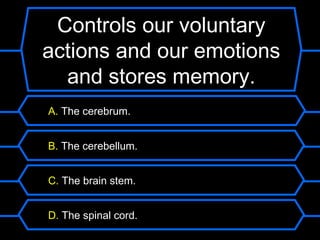
Controls our voluntary
actions and our emotions
  and stores memory.
A. The cerebrum.


B. The cerebellum.


C. The brain stem.


D. The spinal cord.
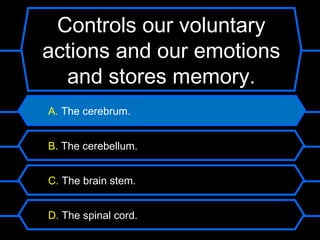
Controls our voluntary
actions and our emotions
  and stores memory.
A. The cerebrum.


B. The cerebellum.


C. The brain stem.


D. The spinal cord.
600 points
Question 14
The internal co-ordination is part
               of...

 A. environment.


 B. movement.


 C. sensitivity.


 D. nerves.
The internal co-ordination is part
               of...

 A. environment.


 B. movement.


 C. sensitivity.


 D. nerves.
700 points
Question 15
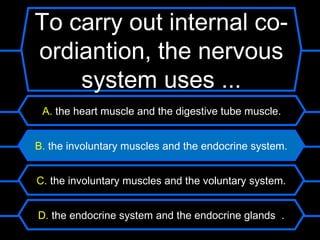
To carry out internal co-
ordiantion, the nervous
    system uses ...
 A. the heart muscle and the digestive tube muscle.


B. the involuntary muscles and the endocrine system.


C. the involuntary muscles and the voluntary system.


D. the endocrine system and the endocrine glands .
To carry out internal co-
ordiantion, the nervous
    system uses ...
 A. the heart muscle and the digestive tube muscle.


B. the involuntary muscles and the endocrine system.


C. the involuntary muscles and the voluntary system.


D. the endocrine system and the endocrine glands .
800 points
Question 16
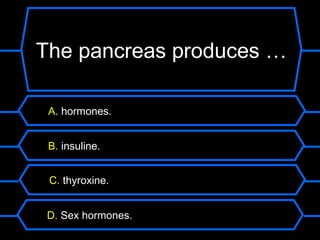
The pancreas produces …

 A. hormones.


 B. insuline.


 C. thyroxine.


 D. Sex hormones.
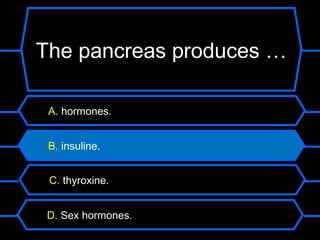
The pancreas produces …

 A. hormones.


 B. insuline.


 C. thyroxine.


 D. Sex hormones.
900 points
Question 17
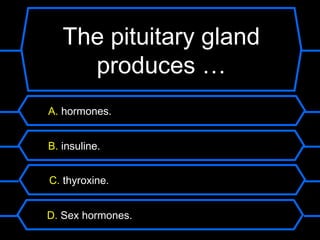
The pituitary gland
     produces …
A. hormones.


B. insuline.


C. thyroxine.


D. Sex hormones.
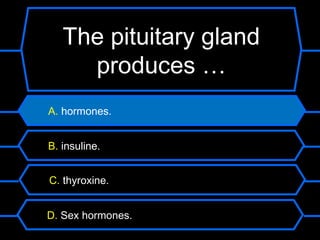
The pituitary gland
     produces …
A. hormones.


B. insuline.


C. thyroxine.


D. Sex hormones.
1.000 points
And the winner is …?

Sensitivity

  • 1.
    Who Wants ToBe A Millionaire? Sensitivity
  • 2.
  • 3.
    The brain ispart of the … A. the nerves. B. the muscular system. C. the nervous system. D. the locomotor system .
  • 4.
    The brain ispart of the … A. the nerves. B. the muscular system. C. the nervous system. D. the locomotor system .
  • 5.
  • 6.
  • 7.
    Sense organs havespecial cells that can detect stimuli from the ... A. nerves. B. brain. C. environment. D. bones.
  • 8.
    Sense organs havespecial cells that can detect stimuli from the ... A. nerves. B. brain. C. environment. D. bones.
  • 9.
  • 10.
  • 11.
    Receptor cells send information to the brain through the ... A. bones. B. air. C. environment. D. nerves.
  • 12.
    Receptor cells send information to the brain through the ... A. bones. B. air. C. environment. D. nerves.
  • 13.
  • 14.
  • 15.
    Stimuli include light, sound and... A. heat. B. pressure. C. cold. D. pain.
  • 16.
    Stimuli include light, sound and... A. heat. B. pressure. C. cold. D. pain.
  • 17.
  • 18.
  • 19.
    The locomotor systemis formed by … A. the muscular system and the skeletal system. B. the muscular system and the nervous system. C. the muscular system and the receptor cells . D. the skeletal system and the nervous system.
  • 20.
    The locomotor systemis formed by … A. the muscular system and the skeletal system. B. the muscular system and the nervous system. C. the muscular system and the receptor cells . D. the skeletal system and the nervous system.
  • 21.
  • 22.
  • 23.
    The locomotor systemis formed by ... A. sense and muscles. B. bones and organs. C. organs and muscles. D. bones and muscles.
  • 24.
    The locomotor systemis formed by ... A. sense and muscles. B. bones and organs. C. organs and muscles. D. bones and muscles.
  • 25.
    4 400 points
  • 26.
  • 27.
    The ends ofbones are covered in ... A. cartilage. B. ligament. C. tendon . D. joint.
  • 28.
    The ends ofbones are covered in ... A. cartilage. B. ligament. C. tendon . D. joint.
  • 29.
  • 30.
  • 31.
    Bones meet at... A. cartilages. B. ligaments. C. tendons. D. joints.
  • 32.
    Bones meet at... A. cartilages. B. ligaments. C. tendons. D. joints.
  • 33.
  • 34.
  • 35.
    What nutrients system The nervous are found is formed by ... in vegetables? A. nervous tissue and neurons. B. central nervous system and peripheral nervous system. C. central nervous system and nervous tissue . D. peripheral nervous system and nervous tissue.
  • 36.
    What nutrients system The nervous are found is formed by ... in vegetables? A. nervous tissue and neurons. B. central nervous system and peripheral nervous system. C. central nervous system and nervous tissue . D. peripheral nervous system and nervous tissue.
  • 37.
  • 38.
  • 39.
    What nutrients arefound The brain stem… in vegetables? A. regulates the activity of man of our organs. B. co-ordinates movements and maintains balance. C. control all voluntary acts. D. is the control centre of our body.
  • 40.
    What nutrients arefound The brain stem… in vegetables? A. regulates the activity of man of our organs. B. co-ordinates movements and maintains balance. C. control all voluntary acts. D. is the control centre of our body.
  • 41.
  • 42.
  • 43.
    Neurons are atype of cell with three parts: A. nervous tissue, brain and spinal cord . B. nervous tissue, nervous system and peripheral nervous system. C. cerebrum, cerebellum, brain stem. D. body, dendrites and axon.
  • 44.
    Neurons are atype of cell with three parts: A. nervous tissue, brain and spinal cord . B. nervous tissue, nervous system and peripheral nervous system. C. cerebrum, cerebellum, brain stem. D. body, dendrites and axon.
  • 45.
  • 46.
  • 47.
    The brain hasthree parts: A. nervous tissue, brain and spinal cord . B. nervous tissue, nervous system and peripheral nervous system. C. cerebrum, cerebellum, brain stem. D. body, dendrites and axon.
  • 48.
    The brain hasthree parts: A. nervous tissue, brain and spinal cord . B. nervous tissue, nervous system and peripheral nervous system. C. cerebrum, cerebellum, brain stem. D. body, dendrites and axon.
  • 49.
  • 50.
  • 51.
    Controls our voluntary actionsand our emotions and stores memory. A. The cerebrum. B. The cerebellum. C. The brain stem. D. The spinal cord.
  • 52.
    Controls our voluntary actionsand our emotions and stores memory. A. The cerebrum. B. The cerebellum. C. The brain stem. D. The spinal cord.
  • 53.
  • 54.
  • 55.
    The internal co-ordinationis part of... A. environment. B. movement. C. sensitivity. D. nerves.
  • 56.
    The internal co-ordinationis part of... A. environment. B. movement. C. sensitivity. D. nerves.
  • 57.
  • 58.
  • 59.
    To carry outinternal co- ordiantion, the nervous system uses ... A. the heart muscle and the digestive tube muscle. B. the involuntary muscles and the endocrine system. C. the involuntary muscles and the voluntary system. D. the endocrine system and the endocrine glands .
  • 60.
    To carry outinternal co- ordiantion, the nervous system uses ... A. the heart muscle and the digestive tube muscle. B. the involuntary muscles and the endocrine system. C. the involuntary muscles and the voluntary system. D. the endocrine system and the endocrine glands .
  • 61.
  • 62.
  • 63.
    The pancreas produces… A. hormones. B. insuline. C. thyroxine. D. Sex hormones.
  • 64.
    The pancreas produces… A. hormones. B. insuline. C. thyroxine. D. Sex hormones.
  • 65.
  • 66.
  • 67.
    The pituitary gland produces … A. hormones. B. insuline. C. thyroxine. D. Sex hormones.
  • 68.
    The pituitary gland produces … A. hormones. B. insuline. C. thyroxine. D. Sex hormones.
  • 69.
  • 70.