WELCOME
PARAMETRIC STUDIES ON
AUTOMOTIVE RADIATORS
PRESENTED BY
JACKSON JOHNY
Roll No:127
GUIDED BY
Mr. SUMESH C.K
Assistant professor
SREE CHITRA THIRUNAL
COLLEGE OF ENGINEERING TVM-18
CONTENTS
1. INTRODUCTION
2. NECESSITY OF COOLING
3. TYPES OF RADIATOR
4. GEOMETRY DESCRIPTION
5. WORKING CONDITION
1/26
6. PARAMETRIC STUDIES ON RADIATOR
 AIR AND COOLANT MASS FLOW
INFERENCE
 AIR INLET TEMPERATURE INFLUENCE
 COOLANT FLUID INFUENCE
 FIN PITCH INFLUENCE
 LOUVER ANGLE INFERENCE
 COOLANT FLOW LAYOUT INFLUENCE
7. CONCLUSION
8. REFERENCE
2/26
 An important role in its weight and also in the design of
its front-end module.
 The automotive industry is continuously involved in a
strong competitive career to obtain the best automobile
design in multiple aspects.
 An experimental testing on two radiators of the same
flow area but with the tubes in vertical or horizontal
position.
INTRODUCTION
3/26
 There are two type of automotive radiator.
o Down flow type.
o Cross flow type.
 Parameters radiator are:
o Air flow
o Coolant flow
o Material
o Size
4/26
Necessity of cooling IC
engine
 To keep the engine at its most efficient operating
temperature.
 To control the pollution.
 Safe guard the engine parts.
 Higher the fuel efficiency.
 To avoid excess engine oil consumption.
5/26
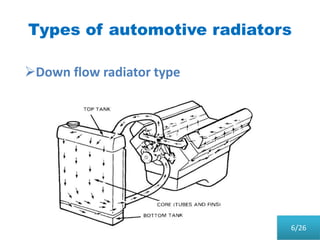
Types of automotive radiators
Down flow radiator type
6/26
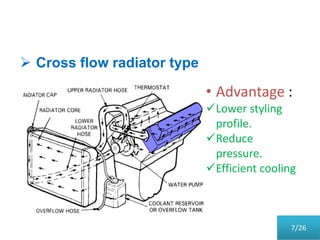
 Cross flow radiator type
• Advantage :
Lower styling
profile.
Reduce
pressure.
Efficient cooling
7/26
Geometry description of the
automobile radiator under study
 Core depth (mm) :23
 Core height (mm) :133
 Core length (mm) :184
 Circuiting (passes) :I
 Rows (no) :1
 Total tubes (no) :12
 Tube dimensions (mm) :22 *2.1
 Tube thickness (mm) :0.32
 Tube pitch (mm) :10.40
 Fin pitch (mm) :1.19
 Fin thickness (mm) :0.1
 Louver angle (O) :26
 Louver pitch (mm) :0.9 8/26
working conditions for the automobile
radiator under study
 Air inlet temperature (C) :25
 Air inlet humidity (%) :50
 Air mass flow (kg/s) :0.08/0.14/0.21/0.28/0.40
 Coolant fluid :Water/ethylene glycol (50%)
 Coolant inlet temperature (C) :95.0
 Coolant mass flow (kg/h) :500/1000/1500/2000/2500
9/26
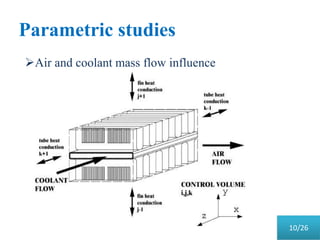
Parametric studies
Air and coolant mass flow influence
10/26
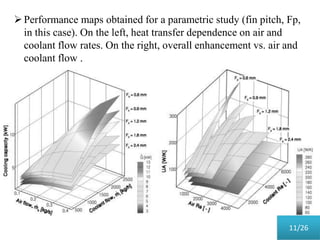
Performance maps obtained for a parametric study (fin pitch, Fp,
in this case). On the left, heat transfer dependence on air and
coolant flow rates. On the right, overall enhancement vs. air and
coolant flow .
11/26
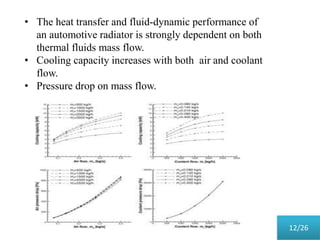
• The heat transfer and fluid-dynamic performance of
an automotive radiator is strongly dependent on both
thermal fluids mass flow.
• Cooling capacity increases with both air and coolant
flow.
• Pressure drop on mass flow.
12/26
 AIR INLET TEMPERATURE
INFLUENCE
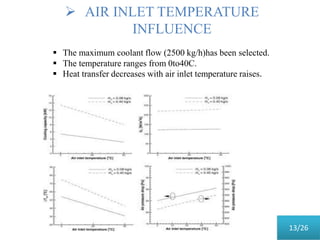
 The maximum coolant flow (2500 kg/h)has been selected.
 The temperature ranges from 0to40C.
 Heat transfer decreases with air inlet temperature raises.
13/26
Coolant fluid influence
The selection of a particular coolant fluid is
depend on the environmental conditions of
certain country.
 The radiator is analysed working with seven
different thermal fluids: water,
ethylene glycol,and propylene glycol
14/26
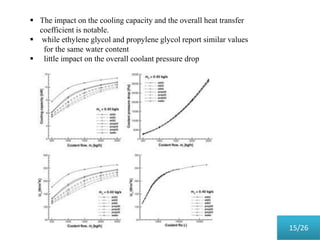
 The impact on the cooling capacity and the overall heat transfer
coefficient is notable.
 while ethylene glycol and propylene glycol report similar values
for the same water content
 little impact on the overall coolant pressure drop
15/26
 Fin pitch influence
16/26
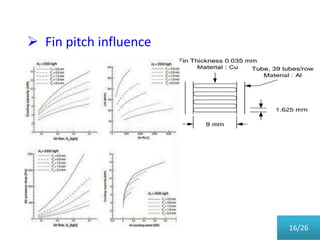
 Fin pitch is one of the most important design
parameters in this kind of heat exchangers.
 Fin pitches from 0.6 to 2.4 mm have been considered.
 UA has been taken as the enhancement parameter.
 smaller fin spacing imply higher heat transfer
capacity and air pressure drop at fixed air flow rate.
 High coolant flow is provided.
17/26
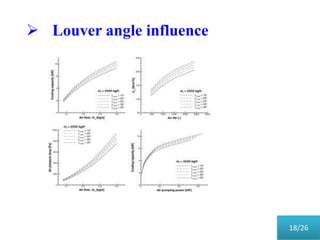
 Louver angle influence
18/26
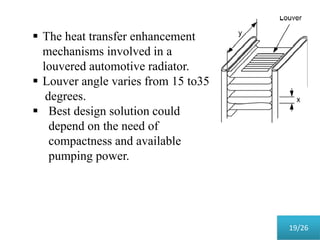
 The heat transfer enhancement
mechanisms involved in a
louvered automotive radiator.
 Louver angle varies from 15 to35
degrees.
 Best design solution could
depend on the need of
compactness and available
pumping power.
19/26
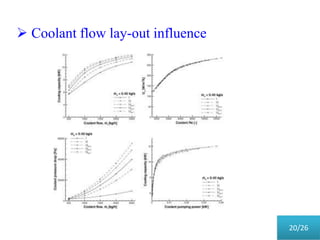
 Coolant flow lay-out influence
20/26
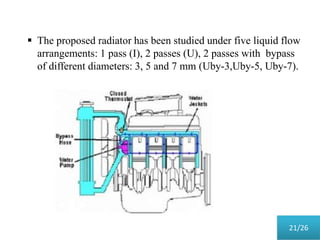
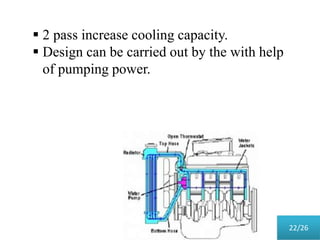
 The proposed radiator has been studied under five liquid flow
arrangements: 1 pass (I), 2 passes (U), 2 passes with bypass
of different diameters: 3, 5 and 7 mm (Uby-3,Uby-5, Uby-7).
21/26
 2 pass increase cooling capacity.
 Design can be carried out by the with help
of pumping power.
22/26
Conclusions
 Parametric study on automotive radiator
help to design high performance radiator.
 Performance of cooling system increases
with increase in coolant circulation.
 Heat exchange rate depend on the
temperature gradient between radiator
temperature and inlet air temperature.
 Better coolant can increase cooling
capacity.
23/26
REFERENCE
C. Oliet, A. Oliva *, J. Castro, C.D. Pe´rez-Segarra,Parametric
studies on automotive radiators, Centre Tecnolo` gic de
Transfere`ncia de Calor (CTTC), Universitat Polite`cnica de
Catalunya (UPC), ETSEIAT,
Colom 11, 08222 Terrassa (Barcelona), Spain.
 C. Lin, J. Saunders, S. Watkins, The effect of changes in ambient
and coolant radiator inlet temperatures and coolant flowrate on
specific dissipation, SAE Technical Paper Series (2000-01-
0579), 2000.
24/26
 J.J. Juger, R.F. Crook, Heat transfer performance of propylene
glycol versus ethylene glycol coolant solutions in laboratory
testing, SAE Technical Paper Series SP-1456, 1999-01-0129,
 M. Gollin, D. Bjork, Comparative performance of ethylene
glycol/ water and propylene glycol/water coolants in automobile
radiators,SAE Technical Paper Series SP-1175, 960372, 1996, pp.
115–123.
 Dr.Kripal Singh,automobile engineering,vol-2.
 www.howautowork.com
25/26
26/26

PARAMETRIC STUDES ON AUTOMOTIVE RADIATOR

  • 1.
  • 2.
    PARAMETRIC STUDIES ON AUTOMOTIVERADIATORS PRESENTED BY JACKSON JOHNY Roll No:127 GUIDED BY Mr. SUMESH C.K Assistant professor SREE CHITRA THIRUNAL COLLEGE OF ENGINEERING TVM-18
  • 3.
    CONTENTS 1. INTRODUCTION 2. NECESSITYOF COOLING 3. TYPES OF RADIATOR 4. GEOMETRY DESCRIPTION 5. WORKING CONDITION 1/26
  • 4.
    6. PARAMETRIC STUDIESON RADIATOR  AIR AND COOLANT MASS FLOW INFERENCE  AIR INLET TEMPERATURE INFLUENCE  COOLANT FLUID INFUENCE  FIN PITCH INFLUENCE  LOUVER ANGLE INFERENCE  COOLANT FLOW LAYOUT INFLUENCE 7. CONCLUSION 8. REFERENCE 2/26
  • 5.
     An importantrole in its weight and also in the design of its front-end module.  The automotive industry is continuously involved in a strong competitive career to obtain the best automobile design in multiple aspects.  An experimental testing on two radiators of the same flow area but with the tubes in vertical or horizontal position. INTRODUCTION 3/26
  • 6.
     There aretwo type of automotive radiator. o Down flow type. o Cross flow type.  Parameters radiator are: o Air flow o Coolant flow o Material o Size 4/26
  • 7.
    Necessity of coolingIC engine  To keep the engine at its most efficient operating temperature.  To control the pollution.  Safe guard the engine parts.  Higher the fuel efficiency.  To avoid excess engine oil consumption. 5/26
  • 8.
    Types of automotiveradiators Down flow radiator type 6/26
  • 9.
     Cross flowradiator type • Advantage : Lower styling profile. Reduce pressure. Efficient cooling 7/26
  • 10.
    Geometry description ofthe automobile radiator under study  Core depth (mm) :23  Core height (mm) :133  Core length (mm) :184  Circuiting (passes) :I  Rows (no) :1  Total tubes (no) :12  Tube dimensions (mm) :22 *2.1  Tube thickness (mm) :0.32  Tube pitch (mm) :10.40  Fin pitch (mm) :1.19  Fin thickness (mm) :0.1  Louver angle (O) :26  Louver pitch (mm) :0.9 8/26
  • 11.
    working conditions forthe automobile radiator under study  Air inlet temperature (C) :25  Air inlet humidity (%) :50  Air mass flow (kg/s) :0.08/0.14/0.21/0.28/0.40  Coolant fluid :Water/ethylene glycol (50%)  Coolant inlet temperature (C) :95.0  Coolant mass flow (kg/h) :500/1000/1500/2000/2500 9/26
  • 12.
    Parametric studies Air andcoolant mass flow influence 10/26
  • 13.
    Performance maps obtainedfor a parametric study (fin pitch, Fp, in this case). On the left, heat transfer dependence on air and coolant flow rates. On the right, overall enhancement vs. air and coolant flow . 11/26
  • 14.
    • The heattransfer and fluid-dynamic performance of an automotive radiator is strongly dependent on both thermal fluids mass flow. • Cooling capacity increases with both air and coolant flow. • Pressure drop on mass flow. 12/26
  • 15.
     AIR INLETTEMPERATURE INFLUENCE  The maximum coolant flow (2500 kg/h)has been selected.  The temperature ranges from 0to40C.  Heat transfer decreases with air inlet temperature raises. 13/26
  • 16.
    Coolant fluid influence Theselection of a particular coolant fluid is depend on the environmental conditions of certain country.  The radiator is analysed working with seven different thermal fluids: water, ethylene glycol,and propylene glycol 14/26
  • 17.
     The impacton the cooling capacity and the overall heat transfer coefficient is notable.  while ethylene glycol and propylene glycol report similar values for the same water content  little impact on the overall coolant pressure drop 15/26
  • 18.
     Fin pitchinfluence 16/26
  • 19.
     Fin pitchis one of the most important design parameters in this kind of heat exchangers.  Fin pitches from 0.6 to 2.4 mm have been considered.  UA has been taken as the enhancement parameter.  smaller fin spacing imply higher heat transfer capacity and air pressure drop at fixed air flow rate.  High coolant flow is provided. 17/26
  • 20.
     Louver angleinfluence 18/26
  • 21.
     The heattransfer enhancement mechanisms involved in a louvered automotive radiator.  Louver angle varies from 15 to35 degrees.  Best design solution could depend on the need of compactness and available pumping power. 19/26
  • 22.
     Coolant flowlay-out influence 20/26
  • 23.
     The proposedradiator has been studied under five liquid flow arrangements: 1 pass (I), 2 passes (U), 2 passes with bypass of different diameters: 3, 5 and 7 mm (Uby-3,Uby-5, Uby-7). 21/26
  • 24.
     2 passincrease cooling capacity.  Design can be carried out by the with help of pumping power. 22/26
  • 25.
    Conclusions  Parametric studyon automotive radiator help to design high performance radiator.  Performance of cooling system increases with increase in coolant circulation.  Heat exchange rate depend on the temperature gradient between radiator temperature and inlet air temperature.  Better coolant can increase cooling capacity. 23/26
  • 26.
    REFERENCE C. Oliet, A.Oliva *, J. Castro, C.D. Pe´rez-Segarra,Parametric studies on automotive radiators, Centre Tecnolo` gic de Transfere`ncia de Calor (CTTC), Universitat Polite`cnica de Catalunya (UPC), ETSEIAT, Colom 11, 08222 Terrassa (Barcelona), Spain.  C. Lin, J. Saunders, S. Watkins, The effect of changes in ambient and coolant radiator inlet temperatures and coolant flowrate on specific dissipation, SAE Technical Paper Series (2000-01- 0579), 2000. 24/26
  • 27.
     J.J. Juger,R.F. Crook, Heat transfer performance of propylene glycol versus ethylene glycol coolant solutions in laboratory testing, SAE Technical Paper Series SP-1456, 1999-01-0129,  M. Gollin, D. Bjork, Comparative performance of ethylene glycol/ water and propylene glycol/water coolants in automobile radiators,SAE Technical Paper Series SP-1175, 960372, 1996, pp. 115–123.  Dr.Kripal Singh,automobile engineering,vol-2.  www.howautowork.com 25/26
  • 28.