INTRODUCTION:-
1. History
1.1. Early systems
1.2. Modern systems
2. Operation
3. Components
4. Use
5. Brake types
6. Effectiveness
7. ABS on motorcycles
7.1. History of motorcycle ABS
7.2. Basic principle
7.3. Anti-lock Braking System (ABS)
7.4. Combined Braking System (CBS)
7.5. CBS and ABS
8. Perception and legislation
An anti-lock braking system (ABS) is a safety anti-skid braking system used on aircraft and on land
vehicals, such as cars, motorcycles, trucks and buses ABS operates by preventing the wheels from locking
up during braking.
ABS is an automated system that uses the principles of
threshold braking and cadence braking , techniques which were once practised by skilful drivers before ABS
braking systems were widespread. ABS operates at a much faster rate and more effectively than most
drivers could manage. Although ABS generally offers improved vehicle control and decreases stopping
distances on dry and some slippery surfaces.
 OPERATION:-
 The anti-lock brake controller is also known as the CAB (Controller Anti-lock Brake).
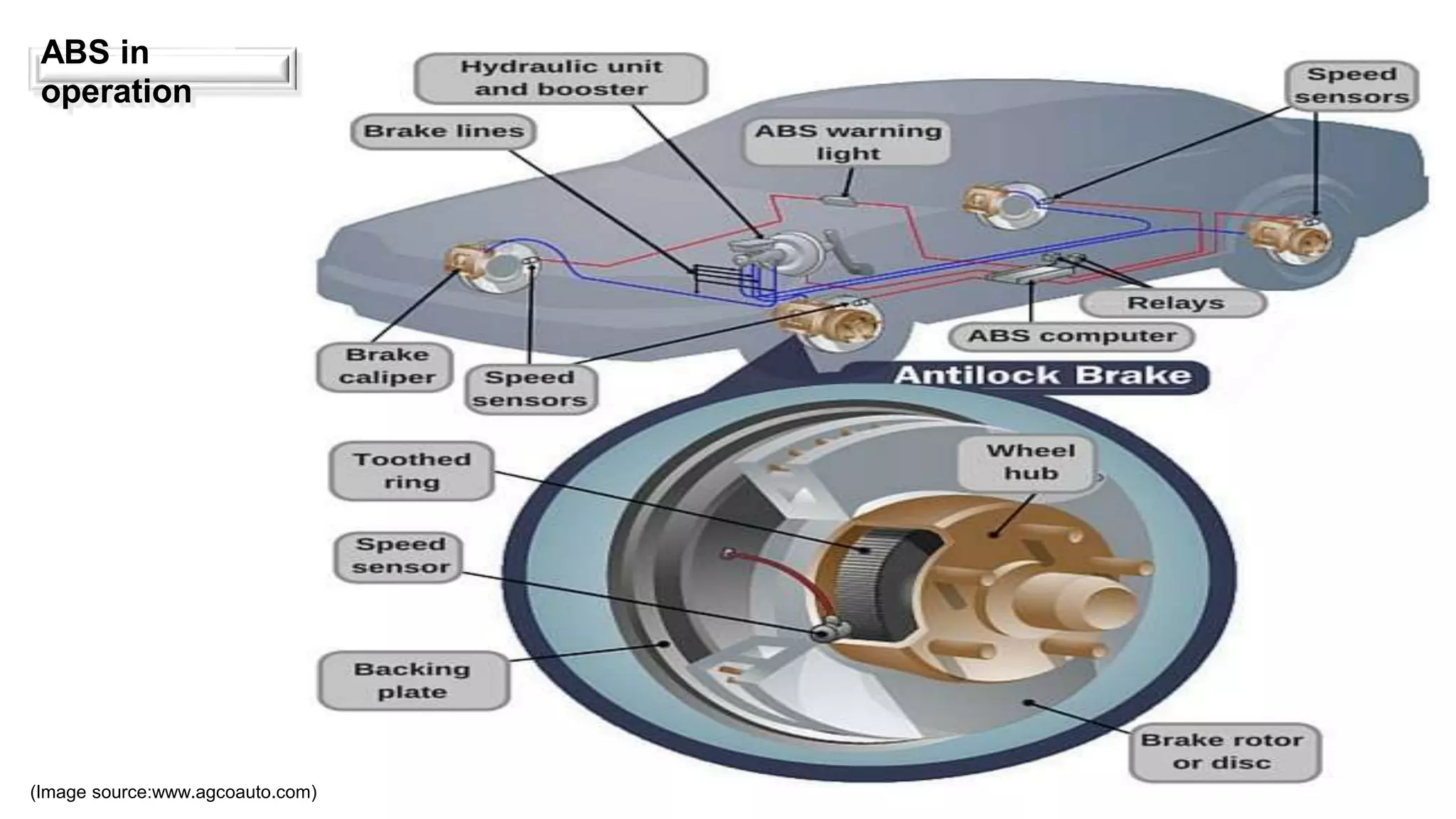
 Typically ABS includes a central electronic control unit (ECU), four wheel speed sensors, and at least two hydraulic
valves within the brake hydraulics. The ECU constantly monitors the rotational speed of each wheel; if it detects
the wheel rotating significantly slower than the speed of the vehicle, a condition indicative of impending wheel
lock, it actuates the valves to reduce hydraulic pressure to the brake at the affected wheel, thus reducing the
braking force on that wheel; the wheel then turns faster.
 ABS equipment may also be used to implement a traction control system (TCS) on acceleration of the vehicle. If,
when accelerating, the tire loses traction, the ABS controller can detect the situation and take suitable action so
that traction is regained. More sophisticated versions of this can also control throttle levels and brakes
simultaneously.
 The speed sensors of ABS are sometimes used in indirect tire pressure monitoring system (TPMS), which can detect
under-inflation of tire(s) by difference in rotational speed of wheels.
ABS in
operation
(Image source:www.agcoauto.com)
Working components of an ABS:-
• While braking, if a wheel-locking situation is detected or anticipated, the ECU alerts the HCU
by sending a current and commands it to release the brake pressure, allowing the wheel
velocity to increase and the wheel slip to decrease. When the wheel velocity increases, the
ECU reapplies the brake pressure and restricts the wheel slip to a certain degree (Note: When
the braking action is initiated, a slippage between the tire and the road surface in contact
will occur, which makes the speed of the vehicle different from that of the tire). The Hydraulic
Control Unit controls the brake pressure in each wheel cylinder based on the inputs from the
system sensor. As a result, this controls the wheel speed. This process is repeated for the
next braking operation.
• ABS is classified based on the number of sensors and the types of brakes used. Brakes can
also be differentiated by the number of channels, i.e how many valves are individually
controlled and the number of speed sensors.
Four-channel, four-sensor ABS
• This is the best combination for an effective ABS system. There is a speed sensor on all four wheels and
a separate valve for all four wheels. With this setup, the controller monitors each wheel individually to
ensure that it is achieving maximum braking force.
Three-channel, three-sensor ABS
• This combination, which is commonly found on pickup trucks with four-wheel ABS, has a speed sensor
and a valve for each of the front wheels, along with one valve and one sensor for both rear wheels. The
speed sensor for the rear wheels is located in the rear axle.
Similarly, there are also two-channel and one-channel ABS. The one-channel variant is the least
effective, as you might expect.
• Most new cars come equipped with ABS, as it is considered one of the most important safety features in
cars. Current research shows that cars equipped with ABS are far less likely to be involved in multi-car
accidents, because they still have access to steering capabilities. ABS has completely revolutionized the
automobile industry to the point where a car without ABS is like a coffee mug without a handle!
ABS has four major components:
1) Speed Sensor
This sensor monitors the speed of each wheel and determines the
necessary acceleration and deceleration of the wheels. It consists
of an exciter (a ring with V-shaped teeth) and a wire coil/magnet
assembly, which generates the pulses of electricity as the teeth of the
exciter pass in front of it.
The speed sensor
(Image Source: www.toyota.lk)
Components of ABS braking
(Image source:www.agcoauto.com)
Valves
Electronic control modulefour-channel hydraulic control
unit containing motor, pump
and valves
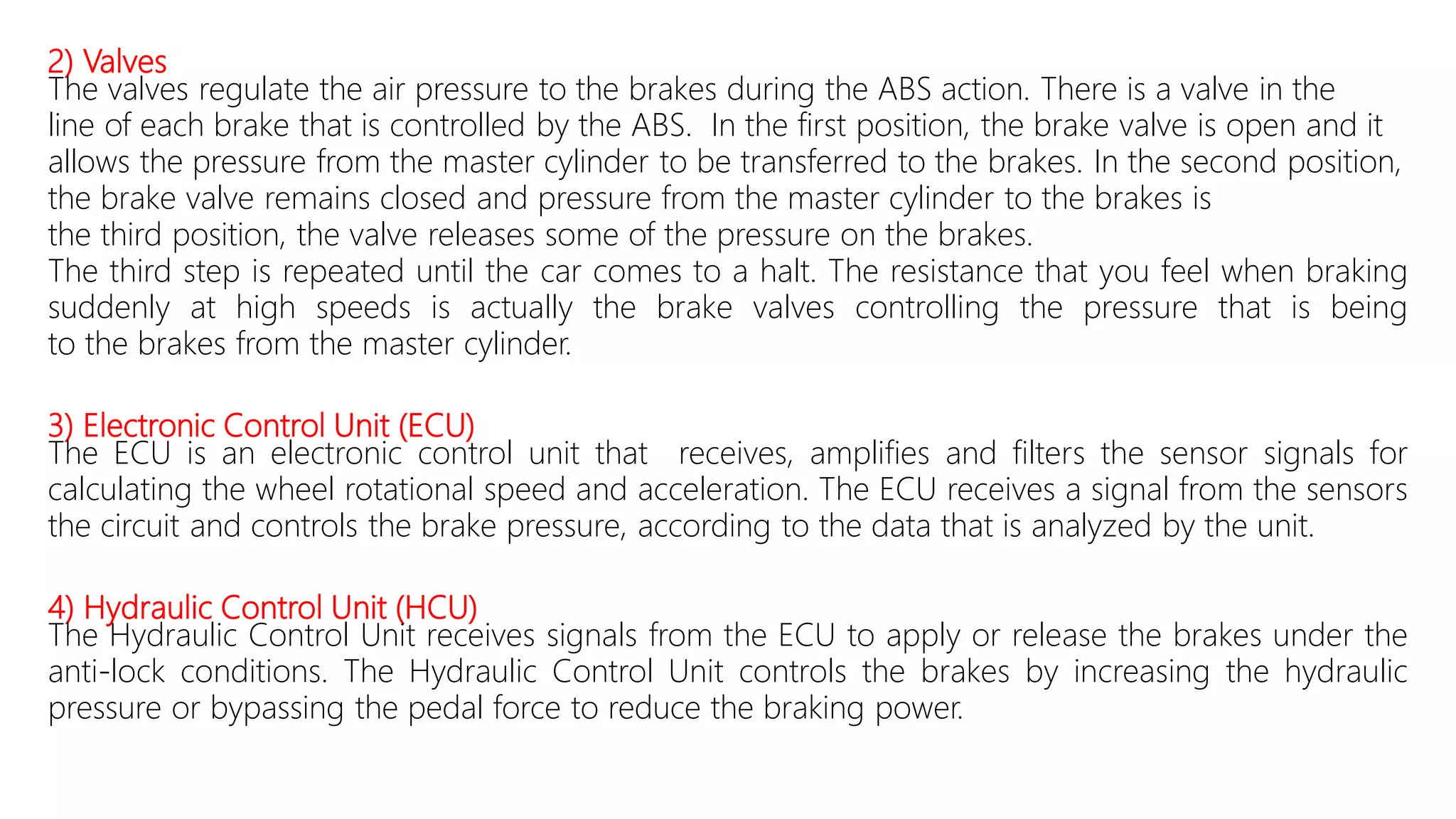
2) Valves
The valves regulate the air pressure to the brakes during the ABS action. There is a valve in the
line of each brake that is controlled by the ABS. In the first position, the brake valve is open and it
allows the pressure from the master cylinder to be transferred to the brakes. In the second position,
the brake valve remains closed and pressure from the master cylinder to the brakes is
the third position, the valve releases some of the pressure on the brakes.
The third step is repeated until the car comes to a halt. The resistance that you feel when braking
suddenly at high speeds is actually the brake valves controlling the pressure that is being
to the brakes from the master cylinder.
3) Electronic Control Unit (ECU)
The ECU is an electronic control unit that receives, amplifies and filters the sensor signals for
calculating the wheel rotational speed and acceleration. The ECU receives a signal from the sensors
the circuit and controls the brake pressure, according to the data that is analyzed by the unit.
4) Hydraulic Control Unit (HCU)
The Hydraulic Control Unit receives signals from the ECU to apply or release the brakes under the
anti-lock conditions. The Hydraulic Control Unit controls the brakes by increasing the hydraulic
pressure or bypassing the pedal force to reduce the braking power.
ABS Working principle
The basic theory behind anti-lock brakes is simple. It prevents the wheels from
locking up, thus avoiding uncontrolled skidding. ABS generally offers improved
vehicle control and decreases stopping distances on dry and slippery surfaces. A
skidding wheel (where the tire contact patch is sliding relative to the road) has less
traction (grip of the tire on the road) than a non-skidding wheel. For example, if your car
drives over a road covered in ice, it is unable to move forward and the wheels will keep
spinning, since no traction is present. This is because the contact point of the wheel is
sliding relative to the ice.
ABS modifies the brake fluid pressure, independent of the amount of pressure being
applied on the brakes, to bring the speed of the wheel back to the minimum slip level
that is mandatory for optimal braking performance.
(Image Source: www.toyota.lk)
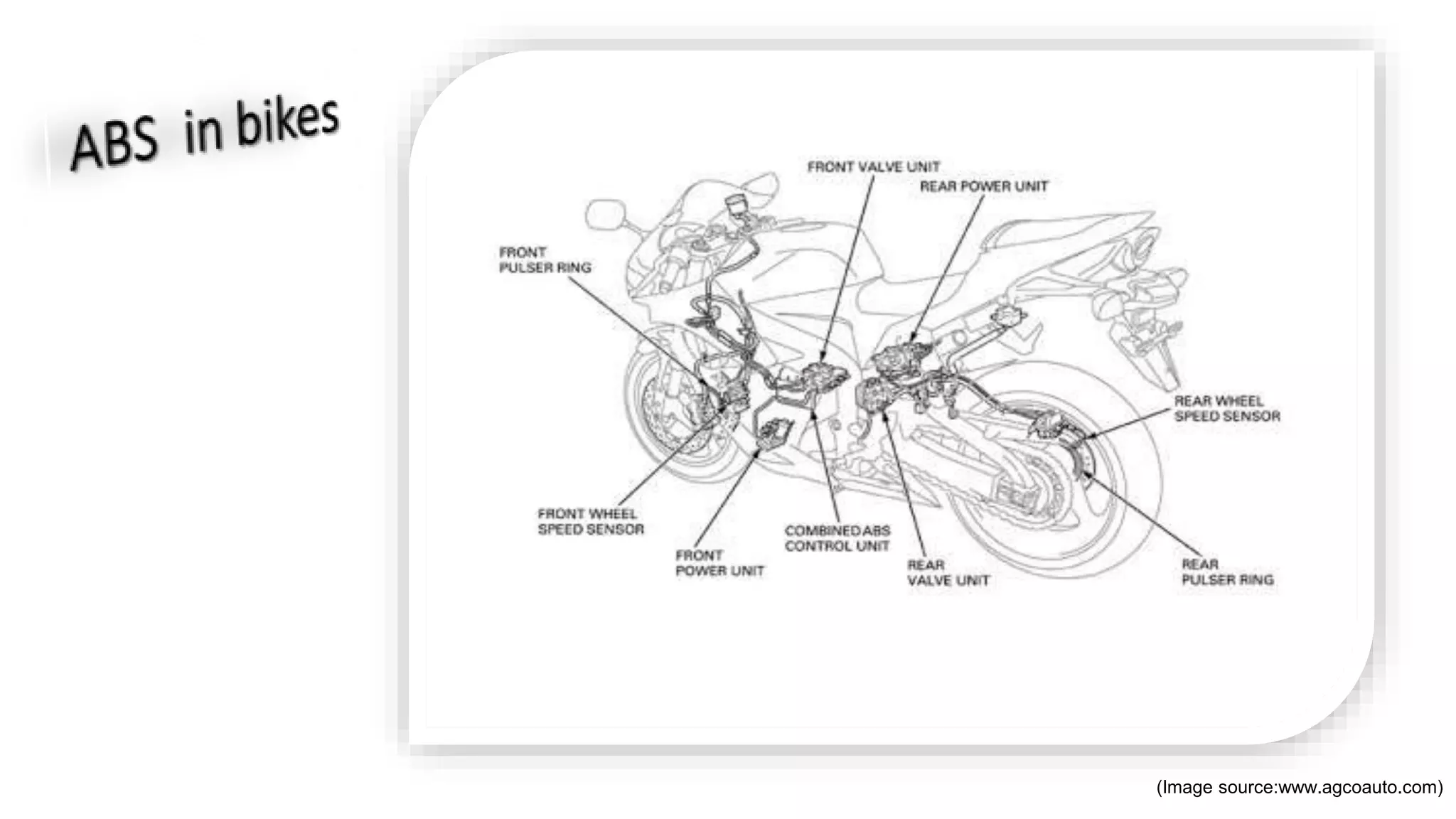
ABS on motorcycles
The ABS sensor of a BMW K 1100 LT
brake discs on a BMW
R1150GS
 On a motorcycle, an anti-lock brake system prevents the wheels of
a powered two wheeler from locking during braking situations.
 Based on information from wheel speed sensors the ABS unit adjusts the
pressure of the brake fluid in order to keep traction during deceleration to
avoid accidents.
 Motorcycle ABS helps the rider to maintain stability during braking and to
decrease the stopping distance. It provides traction even on
low friction surfaces.
 While older ABS models are derived from cars, recent ABS are the
result of research, oriented on the specifics of motorcycles in case of
size, weight and functionality.
 National and international organizations evaluate Motorcycle ABS as an
important factor to increase safety and reduce motorcycle accident
numbers.
 "ABS is commonly offered on large, expensive models, but it has been
spreading to several entry-level sport bikes and midsized bikes".
(Image source:www.agcoauto.com)
CBS and ABS
 CBS helps to reduce the danger of wheel locks and fall downs but in certain situations it is possible that CBS
causes a fall down. If brake pressure is distributed from the rear wheel to the front wheel and the friction of
the surfaces changes suddenly (puddle, ice on the street) the front wheel might lock even if only the rear
brake has been applied.
 This would lead to a loss of stability and a fall down.
 CBS is therefore combined with ABS to avoid this on a motorcycle.
 Different approaches are possible to realize this combination: Without active pressure Build up Single
Version: A third additional channel links the rear wheel circuit through a delay valve to the front brake.
 Strong brake pressure at the rear wheel (or both wheels) pressurises both brake circuits however this
pressure is adjusted according to wheel speed and brake slip.
 The dual version combines Hondas Dual CBS with a secondary master cylinder and a proportional control
valve [with Piston ABS] A modulator regulates the pressure for each With Active Pressure Build up In 2009,
Honda introduced the electronic controlled combined ABS for its high performance sports bikes which
utilizes brake by wire technology. The brake input of the rider is measured by pressure sensors and the
information is provided to an ECU.
 Together with the information of the wheel speed sensors the ECU calculates the optimal distribution of
pressure to prevent lockups and to provide best possible deceleration.
 Based on this output a motor for each wheel operates a pump which builds up and regulates the brake
pressure on the wheel. This system offers a fast reaction time because of the brake by wire functionality.
(Image source:www.agcoauto.com)
Thank you
Source:-
Google & wikipedia
Professor sign:______________________

ABS system

  • 3.
    INTRODUCTION:- 1. History 1.1. Earlysystems 1.2. Modern systems 2. Operation 3. Components 4. Use 5. Brake types 6. Effectiveness 7. ABS on motorcycles 7.1. History of motorcycle ABS 7.2. Basic principle 7.3. Anti-lock Braking System (ABS) 7.4. Combined Braking System (CBS) 7.5. CBS and ABS 8. Perception and legislation
  • 4.
    An anti-lock brakingsystem (ABS) is a safety anti-skid braking system used on aircraft and on land vehicals, such as cars, motorcycles, trucks and buses ABS operates by preventing the wheels from locking up during braking. ABS is an automated system that uses the principles of threshold braking and cadence braking , techniques which were once practised by skilful drivers before ABS braking systems were widespread. ABS operates at a much faster rate and more effectively than most drivers could manage. Although ABS generally offers improved vehicle control and decreases stopping distances on dry and some slippery surfaces.  OPERATION:-  The anti-lock brake controller is also known as the CAB (Controller Anti-lock Brake).  Typically ABS includes a central electronic control unit (ECU), four wheel speed sensors, and at least two hydraulic valves within the brake hydraulics. The ECU constantly monitors the rotational speed of each wheel; if it detects the wheel rotating significantly slower than the speed of the vehicle, a condition indicative of impending wheel lock, it actuates the valves to reduce hydraulic pressure to the brake at the affected wheel, thus reducing the braking force on that wheel; the wheel then turns faster.  ABS equipment may also be used to implement a traction control system (TCS) on acceleration of the vehicle. If, when accelerating, the tire loses traction, the ABS controller can detect the situation and take suitable action so that traction is regained. More sophisticated versions of this can also control throttle levels and brakes simultaneously.  The speed sensors of ABS are sometimes used in indirect tire pressure monitoring system (TPMS), which can detect under-inflation of tire(s) by difference in rotational speed of wheels.
  • 5.
  • 6.
    Working components ofan ABS:- • While braking, if a wheel-locking situation is detected or anticipated, the ECU alerts the HCU by sending a current and commands it to release the brake pressure, allowing the wheel velocity to increase and the wheel slip to decrease. When the wheel velocity increases, the ECU reapplies the brake pressure and restricts the wheel slip to a certain degree (Note: When the braking action is initiated, a slippage between the tire and the road surface in contact will occur, which makes the speed of the vehicle different from that of the tire). The Hydraulic Control Unit controls the brake pressure in each wheel cylinder based on the inputs from the system sensor. As a result, this controls the wheel speed. This process is repeated for the next braking operation. • ABS is classified based on the number of sensors and the types of brakes used. Brakes can also be differentiated by the number of channels, i.e how many valves are individually controlled and the number of speed sensors.
  • 7.
    Four-channel, four-sensor ABS •This is the best combination for an effective ABS system. There is a speed sensor on all four wheels and a separate valve for all four wheels. With this setup, the controller monitors each wheel individually to ensure that it is achieving maximum braking force. Three-channel, three-sensor ABS • This combination, which is commonly found on pickup trucks with four-wheel ABS, has a speed sensor and a valve for each of the front wheels, along with one valve and one sensor for both rear wheels. The speed sensor for the rear wheels is located in the rear axle. Similarly, there are also two-channel and one-channel ABS. The one-channel variant is the least effective, as you might expect. • Most new cars come equipped with ABS, as it is considered one of the most important safety features in cars. Current research shows that cars equipped with ABS are far less likely to be involved in multi-car accidents, because they still have access to steering capabilities. ABS has completely revolutionized the automobile industry to the point where a car without ABS is like a coffee mug without a handle!
  • 8.
    ABS has fourmajor components: 1) Speed Sensor This sensor monitors the speed of each wheel and determines the necessary acceleration and deceleration of the wheels. It consists of an exciter (a ring with V-shaped teeth) and a wire coil/magnet assembly, which generates the pulses of electricity as the teeth of the exciter pass in front of it. The speed sensor (Image Source: www.toyota.lk)
  • 9.
    Components of ABSbraking (Image source:www.agcoauto.com) Valves Electronic control modulefour-channel hydraulic control unit containing motor, pump and valves
  • 10.
    2) Valves The valvesregulate the air pressure to the brakes during the ABS action. There is a valve in the line of each brake that is controlled by the ABS. In the first position, the brake valve is open and it allows the pressure from the master cylinder to be transferred to the brakes. In the second position, the brake valve remains closed and pressure from the master cylinder to the brakes is the third position, the valve releases some of the pressure on the brakes. The third step is repeated until the car comes to a halt. The resistance that you feel when braking suddenly at high speeds is actually the brake valves controlling the pressure that is being to the brakes from the master cylinder. 3) Electronic Control Unit (ECU) The ECU is an electronic control unit that receives, amplifies and filters the sensor signals for calculating the wheel rotational speed and acceleration. The ECU receives a signal from the sensors the circuit and controls the brake pressure, according to the data that is analyzed by the unit. 4) Hydraulic Control Unit (HCU) The Hydraulic Control Unit receives signals from the ECU to apply or release the brakes under the anti-lock conditions. The Hydraulic Control Unit controls the brakes by increasing the hydraulic pressure or bypassing the pedal force to reduce the braking power.
  • 11.
    ABS Working principle Thebasic theory behind anti-lock brakes is simple. It prevents the wheels from locking up, thus avoiding uncontrolled skidding. ABS generally offers improved vehicle control and decreases stopping distances on dry and slippery surfaces. A skidding wheel (where the tire contact patch is sliding relative to the road) has less traction (grip of the tire on the road) than a non-skidding wheel. For example, if your car drives over a road covered in ice, it is unable to move forward and the wheels will keep spinning, since no traction is present. This is because the contact point of the wheel is sliding relative to the ice. ABS modifies the brake fluid pressure, independent of the amount of pressure being applied on the brakes, to bring the speed of the wheel back to the minimum slip level that is mandatory for optimal braking performance. (Image Source: www.toyota.lk)
  • 12.
    ABS on motorcycles TheABS sensor of a BMW K 1100 LT brake discs on a BMW R1150GS  On a motorcycle, an anti-lock brake system prevents the wheels of a powered two wheeler from locking during braking situations.  Based on information from wheel speed sensors the ABS unit adjusts the pressure of the brake fluid in order to keep traction during deceleration to avoid accidents.  Motorcycle ABS helps the rider to maintain stability during braking and to decrease the stopping distance. It provides traction even on low friction surfaces.  While older ABS models are derived from cars, recent ABS are the result of research, oriented on the specifics of motorcycles in case of size, weight and functionality.  National and international organizations evaluate Motorcycle ABS as an important factor to increase safety and reduce motorcycle accident numbers.  "ABS is commonly offered on large, expensive models, but it has been spreading to several entry-level sport bikes and midsized bikes".
  • 13.
  • 14.
    CBS and ABS CBS helps to reduce the danger of wheel locks and fall downs but in certain situations it is possible that CBS causes a fall down. If brake pressure is distributed from the rear wheel to the front wheel and the friction of the surfaces changes suddenly (puddle, ice on the street) the front wheel might lock even if only the rear brake has been applied.  This would lead to a loss of stability and a fall down.  CBS is therefore combined with ABS to avoid this on a motorcycle.  Different approaches are possible to realize this combination: Without active pressure Build up Single Version: A third additional channel links the rear wheel circuit through a delay valve to the front brake.  Strong brake pressure at the rear wheel (or both wheels) pressurises both brake circuits however this pressure is adjusted according to wheel speed and brake slip.  The dual version combines Hondas Dual CBS with a secondary master cylinder and a proportional control valve [with Piston ABS] A modulator regulates the pressure for each With Active Pressure Build up In 2009, Honda introduced the electronic controlled combined ABS for its high performance sports bikes which utilizes brake by wire technology. The brake input of the rider is measured by pressure sensors and the information is provided to an ECU.  Together with the information of the wheel speed sensors the ECU calculates the optimal distribution of pressure to prevent lockups and to provide best possible deceleration.  Based on this output a motor for each wheel operates a pump which builds up and regulates the brake pressure on the wheel. This system offers a fast reaction time because of the brake by wire functionality.
  • 15.
  • 16.
    Thank you Source:- Google &wikipedia Professor sign:______________________