SemiBoost : Boosting for Semi-supervised LearningPavan Kumar Mallapragada, Student Member, IEEE, Rong Jin, Member, IEEE,Anil K. Jain, Fellow, IEEE, and Yi Liu, Student Member, IEEEPresented by Yueng-Tien ,LoReference:SemiBoost: Boosting for Semi-supervised Learning  P. K. Mallapragada, R. Jin, A. K. Jain, and Y. Liu, IEEE Transaction on Pattern Analysis and Machine Intelligence(PAMI), 31(11):2000-2014, 2009
outlineIntroductionRelated WorkSemi-Supervised BoostingResults and DiscussionConclusions and Future WorkGaussian Fields and Harmonic Functions
IntroductionThe key idea of semi-supervised learning, specifically semi-supervised classification, is to exploit both labeled and unlabeled data to learn a classification model.There is an immense need for algorithms that can utilize the small amount of labeled data, combined with the large amount of unlabeled data to build efficient classification systems.
IntroductionExisting semi-supervised classification algorithms may be classified into two categories based on their underlying assumptions.manifold assumption cluster assumption
Introductionmanifold assumption : the data lie on a low dimensional manifold in the input spacecluster assumption : the data samples with high similarity between them must share the same label.
IntroductionMost semi-supervised learning approaches design specialized learning algorithms to effectively utilize both labeled and unlabeled data.We refer to this problem of improving the performance of any supervised learning algorithm using unlabeled data as Semi-supervise Improvement, to distinguish our work from the standard semi-supervised learning problems.
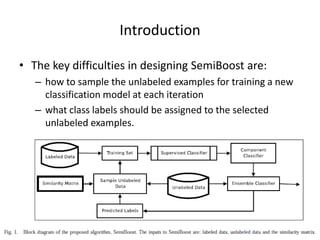
IntroductionThe key difficulties in designing SemiBoost are: how to sample the unlabeled examples for training a new classification model at each iteration what class labels should be assigned to the selected unlabeled examples.
IntroductionOne way to address the above questions is to exploit both the clustering assumption and the large margin criterionSelecting the unlabeled examples with the highest classification confidence and assign them the class labels that are predicted by the current classifier.A problem with this strategy is that the introduction of examples with predicted class labels may only help to increase the classification margin, without actually providing any novel information to the classifier.
IntroductionTo overcome the above problem, we propose using the pairwise similarity measurements to guide the selection of unlabeled examples at each iteration, as well as for assigning class labels to them.
Related Work
Related WorkAn inductive algorithm can be used to predict the labels of samples that are unseen during training (irrespective of it being labeled or unlabeled).Transductivealgorithms are limited to predicting only the labels of the unlabeled samples seen during training.
Related WorkA popular way to define the inconsistency between the labels                of the samples           and the pairwise similarities Sij is the quadratic criterion:	where L is the combinatorial graph Laplacian.The task is to assign values to the unknown labels in such a way that the overall inconsistency is minimized.
Semi-Supervised Improvementdenote the entire data set, including both the labeled and the unlabeled examples.the first nl examples are labeled, given by the imputed class labels of unlabeled examplesLet                 denote the symmetric similarity matrix, where              represents the similarity between xi and xj.       denote  the              submatrix of the similarity matrix       denote the               submatrix of the similarity matrix‘A’ denote the given supervised learning algorithm
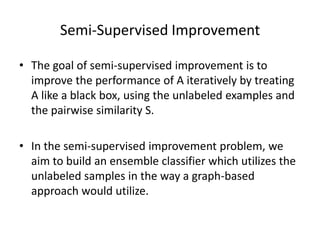
Semi-Supervised ImprovementThe goal of semi-supervised improvement is to improve the performance of A iteratively by treating A like a black box, using the unlabeled examples and the pairwise similarity S.In the semi-supervised improvement problem, we aim to build an ensemble classifier which utilizes the unlabeled samples in the way a graph-based approach would utilize.
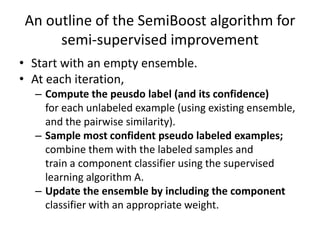
An outline of the SemiBoost algorithm for semi-supervised improvementStart with an empty ensemble.At each iteration,Compute the peusdo label (and its confidence)for each unlabeled example (using existing ensemble,	and the pairwise similarity).Sample most confident pseudo labeled examples;combine them with the labeled samples and	train a component classifier using the supervised 	learning algorithm A.Update the ensemble by including the componentclassifier with an appropriate weight.
SemiBoostThe unlabeled samples must be assigned labels following two main criteria: The points with high similarity among unlabeled samples must share the same label  Those unlabeled samples which are highly similar to a labeled sample must share its label.Our objective function            is a combination of two terms: one measuring the inconsistency between labeled and unlabeled examples                and the other measuring the inconsistency among the unlabeled examples
SemiBoostInspired by the harmonic function approach, we define               , the inconsistency between class labels y and the similarity measurement S, asNote that (1) can be expanded as	and due to the symmetry of S
SemiBoostWe have	where                                                                     is the hyperbolic cosine function.Rewriting (1) using the               function reveals the connection between the quadratic penalty used in the graph-Laplacian-based approaches, and the exponential penalty used in the current approach
SemiBoostUsing a               penalty not only facilitates the derivation of boosting-based algorithms but also increases the classification margin.The inconsistency between labeled and unlabeled examples              is defined as
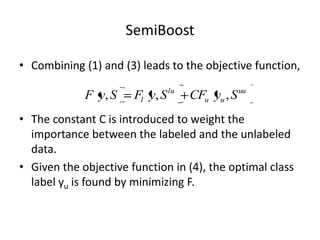
SemiBoostCombining (1) and (3) leads to the objective function,The constant C is introduced to weight the importance between the labeled and the unlabeled data. Given the objective function in (4), the optimal class label yu is found by minimizing F.
SemiBoostThe problem can now be formally expressed asThe following procedure is adopted to derive the boosting algorithm:The labels for the unlabeled samples yiuare replaced by the ensemble predictions over the corresponding data sample.A bound-optimization-based approach is then used to find the ensemble classifier minimizing the objective function.The bounds are simplified further to obtain the sampling scheme, and other required parameters.
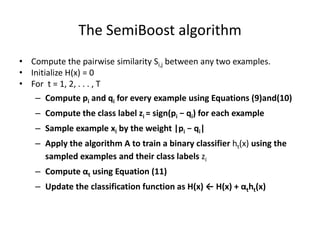
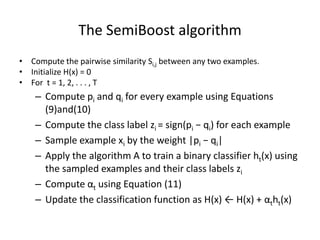
The SemiBoost algorithmCompute the pairwise similarity Si,j between any two examples.Initialize H(x) = 0For  t = 1, 2, . . . , TCompute pi and qi for every example using Equations (9)and(10)Compute the class label zi= sign(pi − qi) for each exampleSample example xi by the weight |pi − qi|Apply the algorithm A to train a binary classifier ht(x) using the sampled examples and their class labels ziCompute αt using Equation (11)Update the classification function as H(x) ← H(x) + αtht(x)
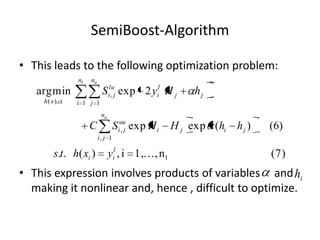
SemiBoost-AlgorithmLet                                denote the two-class classifi-cation model that is learned at the t-th iteration by the algorithm A. Let                        denote the combined classification model learned after the first T iterations.	where        is the combination weight.
SemiBoost-AlgorithmThis leads to the following optimization problem:
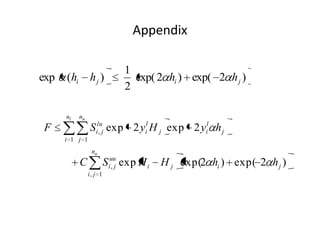
This expression involves products of variables     and      making it nonlinear and, hence , difficult to optimize.Appendix
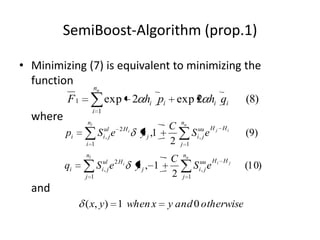
SemiBoost-Algorithm (prop.1)Minimizing (7) is equivalent to minimizing the function	where	and
Appendix
SemiBoost-Algorithm (prop.2)The expression in (8) is difficult to optimize since the weight  and the classifier h(x) are coupled together.Minimizing (8) is equivalent to minimizingWe denote the upper bound in the above equation by F2.
SemiBoost-Algorithm (prop.3)To minimize F2, the optimal class label zi for the example xi is zi= sign(pi – qi) and the weight for sampling example xi is |pi-qi|. The optimal       that minimizes F1 is
SemiBoost-AlgorithmAt each relaxation, the “touch-point” is maintained between the objective function and the upper bound. As a result, the procedure guarantees: The objective function always decreases through iterationsThe final solution converges to a local minimum.
The SemiBoost algorithmCompute the pairwise similarity Si,j between any two examples.Initialize H(x) = 0For  t = 1, 2, . . . , TCompute pi and qi for every example using Equations (9)and(10)Compute the class label zi= sign(pi − qi) for each exampleSample example xi by the weight |pi − qi|Apply the algorithm A to train a binary classifier ht(x) using the sampled examples and their class labels ziCompute αt using Equation (11)Update the classification function as H(x) ← H(x) + αtht(x)
SemiBoost-AlgorithmLet       be the weighted error made by the classifier, whereAs in the case of AdaBoost,     can be expressed as 	which is very similar to the weighting factor of AdaBoost, differing only by a constant factor of 1/2 .
SemiBoost-AlgorithmTheorem 1. Let                  be the combination weights that are computed by running the SemiBoost algorithm (Fig. 1). Then, the objective function at the et t 1Tst iteration, i.e., Ftt1, is bounded as follows:where
Results and Discussion
X. Zhu, Z. Ghahramani, and J. Lafferty, “Semi-supervised learning using gaussian fields and harmonic functions,” in Proc. 20t International Conference on Machine Learning, pp. 912–919, 2003

SemiBoost: Boosting for Semi-supervised Learning

  • 1.
    SemiBoost : Boostingfor Semi-supervised LearningPavan Kumar Mallapragada, Student Member, IEEE, Rong Jin, Member, IEEE,Anil K. Jain, Fellow, IEEE, and Yi Liu, Student Member, IEEEPresented by Yueng-Tien ,LoReference:SemiBoost: Boosting for Semi-supervised Learning P. K. Mallapragada, R. Jin, A. K. Jain, and Y. Liu, IEEE Transaction on Pattern Analysis and Machine Intelligence(PAMI), 31(11):2000-2014, 2009
  • 2.
    outlineIntroductionRelated WorkSemi-Supervised BoostingResultsand DiscussionConclusions and Future WorkGaussian Fields and Harmonic Functions
  • 3.
    IntroductionThe key ideaof semi-supervised learning, specifically semi-supervised classification, is to exploit both labeled and unlabeled data to learn a classification model.There is an immense need for algorithms that can utilize the small amount of labeled data, combined with the large amount of unlabeled data to build efficient classification systems.
  • 4.
    IntroductionExisting semi-supervised classificationalgorithms may be classified into two categories based on their underlying assumptions.manifold assumption cluster assumption
  • 5.
    Introductionmanifold assumption :the data lie on a low dimensional manifold in the input spacecluster assumption : the data samples with high similarity between them must share the same label.
  • 6.
    IntroductionMost semi-supervised learningapproaches design specialized learning algorithms to effectively utilize both labeled and unlabeled data.We refer to this problem of improving the performance of any supervised learning algorithm using unlabeled data as Semi-supervise Improvement, to distinguish our work from the standard semi-supervised learning problems.
  • 7.
    IntroductionThe key difficultiesin designing SemiBoost are: how to sample the unlabeled examples for training a new classification model at each iteration what class labels should be assigned to the selected unlabeled examples.
  • 8.
    IntroductionOne way toaddress the above questions is to exploit both the clustering assumption and the large margin criterionSelecting the unlabeled examples with the highest classification confidence and assign them the class labels that are predicted by the current classifier.A problem with this strategy is that the introduction of examples with predicted class labels may only help to increase the classification margin, without actually providing any novel information to the classifier.
  • 9.
    IntroductionTo overcome theabove problem, we propose using the pairwise similarity measurements to guide the selection of unlabeled examples at each iteration, as well as for assigning class labels to them.
  • 10.
  • 11.
    Related WorkAn inductivealgorithm can be used to predict the labels of samples that are unseen during training (irrespective of it being labeled or unlabeled).Transductivealgorithms are limited to predicting only the labels of the unlabeled samples seen during training.
  • 12.
    Related WorkA popularway to define the inconsistency between the labels of the samples and the pairwise similarities Sij is the quadratic criterion: where L is the combinatorial graph Laplacian.The task is to assign values to the unknown labels in such a way that the overall inconsistency is minimized.
  • 13.
    Semi-Supervised Improvementdenote theentire data set, including both the labeled and the unlabeled examples.the first nl examples are labeled, given by the imputed class labels of unlabeled examplesLet denote the symmetric similarity matrix, where represents the similarity between xi and xj. denote the submatrix of the similarity matrix denote the submatrix of the similarity matrix‘A’ denote the given supervised learning algorithm
  • 14.
    Semi-Supervised ImprovementThe goalof semi-supervised improvement is to improve the performance of A iteratively by treating A like a black box, using the unlabeled examples and the pairwise similarity S.In the semi-supervised improvement problem, we aim to build an ensemble classifier which utilizes the unlabeled samples in the way a graph-based approach would utilize.
  • 15.
    An outline ofthe SemiBoost algorithm for semi-supervised improvementStart with an empty ensemble.At each iteration,Compute the peusdo label (and its confidence)for each unlabeled example (using existing ensemble, and the pairwise similarity).Sample most confident pseudo labeled examples;combine them with the labeled samples and train a component classifier using the supervised learning algorithm A.Update the ensemble by including the componentclassifier with an appropriate weight.
  • 16.
    SemiBoostThe unlabeled samplesmust be assigned labels following two main criteria: The points with high similarity among unlabeled samples must share the same label Those unlabeled samples which are highly similar to a labeled sample must share its label.Our objective function is a combination of two terms: one measuring the inconsistency between labeled and unlabeled examples and the other measuring the inconsistency among the unlabeled examples
  • 17.
    SemiBoostInspired by theharmonic function approach, we define , the inconsistency between class labels y and the similarity measurement S, asNote that (1) can be expanded as and due to the symmetry of S
  • 18.
    SemiBoostWe have where is the hyperbolic cosine function.Rewriting (1) using the function reveals the connection between the quadratic penalty used in the graph-Laplacian-based approaches, and the exponential penalty used in the current approach
  • 19.
    SemiBoostUsing a penalty not only facilitates the derivation of boosting-based algorithms but also increases the classification margin.The inconsistency between labeled and unlabeled examples is defined as
  • 20.
    SemiBoostCombining (1) and(3) leads to the objective function,The constant C is introduced to weight the importance between the labeled and the unlabeled data. Given the objective function in (4), the optimal class label yu is found by minimizing F.
  • 21.
    SemiBoostThe problem cannow be formally expressed asThe following procedure is adopted to derive the boosting algorithm:The labels for the unlabeled samples yiuare replaced by the ensemble predictions over the corresponding data sample.A bound-optimization-based approach is then used to find the ensemble classifier minimizing the objective function.The bounds are simplified further to obtain the sampling scheme, and other required parameters.
  • 22.
    The SemiBoost algorithmComputethe pairwise similarity Si,j between any two examples.Initialize H(x) = 0For t = 1, 2, . . . , TCompute pi and qi for every example using Equations (9)and(10)Compute the class label zi= sign(pi − qi) for each exampleSample example xi by the weight |pi − qi|Apply the algorithm A to train a binary classifier ht(x) using the sampled examples and their class labels ziCompute αt using Equation (11)Update the classification function as H(x) ← H(x) + αtht(x)
  • 23.
    SemiBoost-AlgorithmLet denote the two-class classifi-cation model that is learned at the t-th iteration by the algorithm A. Let denote the combined classification model learned after the first T iterations. where is the combination weight.
  • 24.
    SemiBoost-AlgorithmThis leads tothe following optimization problem:
  • 25.
    This expression involvesproducts of variables and making it nonlinear and, hence , difficult to optimize.Appendix
  • 26.
    SemiBoost-Algorithm (prop.1)Minimizing (7)is equivalent to minimizing the function where and
  • 27.
  • 28.
    SemiBoost-Algorithm (prop.2)The expressionin (8) is difficult to optimize since the weight and the classifier h(x) are coupled together.Minimizing (8) is equivalent to minimizingWe denote the upper bound in the above equation by F2.
  • 29.
    SemiBoost-Algorithm (prop.3)To minimizeF2, the optimal class label zi for the example xi is zi= sign(pi – qi) and the weight for sampling example xi is |pi-qi|. The optimal that minimizes F1 is
  • 30.
    SemiBoost-AlgorithmAt each relaxation,the “touch-point” is maintained between the objective function and the upper bound. As a result, the procedure guarantees: The objective function always decreases through iterationsThe final solution converges to a local minimum.
  • 31.
    The SemiBoost algorithmComputethe pairwise similarity Si,j between any two examples.Initialize H(x) = 0For t = 1, 2, . . . , TCompute pi and qi for every example using Equations (9)and(10)Compute the class label zi= sign(pi − qi) for each exampleSample example xi by the weight |pi − qi|Apply the algorithm A to train a binary classifier ht(x) using the sampled examples and their class labels ziCompute αt using Equation (11)Update the classification function as H(x) ← H(x) + αtht(x)
  • 32.
    SemiBoost-AlgorithmLet be the weighted error made by the classifier, whereAs in the case of AdaBoost, can be expressed as which is very similar to the weighting factor of AdaBoost, differing only by a constant factor of 1/2 .
  • 33.
    SemiBoost-AlgorithmTheorem 1. Let be the combination weights that are computed by running the SemiBoost algorithm (Fig. 1). Then, the objective function at the et t 1Tst iteration, i.e., Ftt1, is bounded as follows:where
  • 34.
  • 35.
    X. Zhu, Z.Ghahramani, and J. Lafferty, “Semi-supervised learning using gaussian fields and harmonic functions,” in Proc. 20t International Conference on Machine Learning, pp. 912–919, 2003