Pragmalinguistics and
Language Teaching:
Semantics vs Pragmatics
2 March 2023
PhD Course Presentation
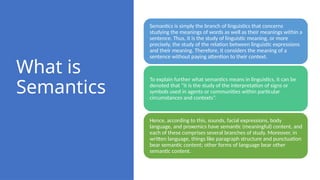
What is
Semantics
Semantics is simply the branch of linguistics that concerns
studying the meanings of words as well as their meanings within a
sentence. Thus, it is the study of linguistic meaning, or more
precisely, the study of the relation between linguistic expressions
and their meaning. Therefore, it considers the meaning of a
sentence without paying attention to their context.
To explain further what semantics means in linguistics, it can be
denoted that “it is the study of the interpretation of signs or
symbols used in agents or communities within particular
circumstances and contexts”.
Hence, according to this, sounds, facial expressions, body
language, and proxemics have semantic (meaningful) content, and
each of these comprises several branches of study. Moreover, in
written language, things like paragraph structure and punctuation
bear semantic content; other forms of language bear other
semantic content.
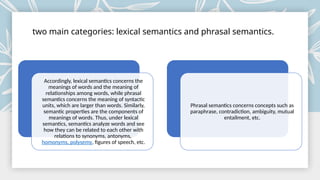
two main categories: lexical semantics and phrasal semantics.
Accordingly, lexical semantics concerns the
meanings of words and the meaning of
relationships among words, while phrasal
semantics concerns the meaning of syntactic
units, which are larger than words. Similarly,
semantic properties are the components of
meanings of words. Thus, under lexical
semantics, semantics analyze words and see
how they can be related to each other with
relations to synonyms, antonyms,
homonyms, polysemy, figures of speech, etc.
Phrasal semantics concerns concepts such as
paraphrase, contradiction, ambiguity, mutual
entailment, etc.
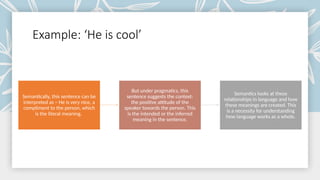
Example: ‘He is cool’
Semantically, this sentence can be
interpreted as – He is very nice, a
compliment to the person, which
is the literal meaning.
But under pragmatics, this
sentence suggests the context:
the positive attitude of the
speaker towards the person. This
is the intended or the inferred
meaning in the sentence.
Semantics looks at these
relationships in language and how
these meanings are created. This
is a necessity for understanding
how language works as a whole.
What is
Pragmatics
Pragmatics is another branch of linguistics. Similar to
semantics, pragmatics also studies the meanings of words,
but it pays emphasis on their context. In other words,
pragmatics is “the study of the use of linguistic signs, words,
and sentences, in actual situations.”
Thus, it looks beyond the literal meaning of an utterance or
a sentence, considering how the context impacts its
meaning to be constructed as well the implied meanings.
Therefore, unlike semantics, pragmatics concern the context
of that particular words and how that context impacts their
meaning.
For example, think of a situation when you and your friends are planning to give a surprise birthday
party to one of your colleagues, and after everything is ready you see the colleague is on the way to
the classroom and suddenly one of your friends shout “Candles?”. “Candles?” might indicate that you
forgot to put candles on the birthday cake. Therefore, here that single word ‘candles’ convey a lot of
meaning to you and your friends except for the colleague who has no idea that you have planned a
surprise birthday party for him/her.
This is what pragmatics is about. Unlike semantics, which only concerns the meaning of the words,
pragmatics goes a step further by looking at the same word in relation to its context. Thus, pragmatics
explains how language users are able to overcome apparent ambiguity since it explains the meaning
relies on the manner, time, place, etc. of an utterance.
• As the Linguist Jenny Thomas points out, pragmatics
considers three basic principles:
• The negotiation of meaning between speaker and
listener.
• The context of the utterance.
• The meaning potential of an utterance.
• Even though semantics is concerned only with the
exact, literal meaning of the words and their
interrelations, pragmatics focuses on the inferred
meaning the speakers and listeners perceive.
Similarities Between
Semantics and
Pragmatics
• Both semantics and
pragmatics are main
branches of linguistics.
• Semantics and
pragmatics both
basically focus on
studying the meanings
of words in a language.
Difference
Between
Semantics and
Pragmatics
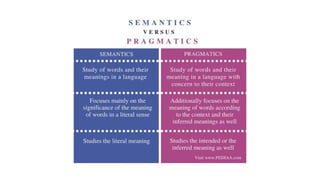
Definition
• Semantics is the
study of words and
their meanings in a
language while
pragmatics is the
study of words and
their meaning in a
language with
concern to their
context.
Significance of Words
• While semantics focuses
mainly on the significance
of the meaning of words
in a literal sense,
pragmatics additionally
focuses on the meaning of
words according to the
context and their inferred
meanings as well.
Meaning
• Semantics studies the
literal meaning whereas
pragmatics studies the
intended or the inferred
meaning as well.
Conclusion
Linguistics is the scientific study of
language; semantics and pragmatics are
two basic branches of linguistics. Though
both these concern the study of words and
their meanings in a language, they are
different from each other. Semantics focus
on the meanings of words without laying
emphasis on their context whereas
pragmatics do lay emphasis on the context
in addition to studying the meaning of the
same words. This is the main difference
between semantics and pragmatics.
Reference:
https://pediaa.com/difference-between-semantics-and-pragmatics/

Pragmalinguistics- Semantics and Pragmatics

  • 1.
    Pragmalinguistics and Language Teaching: Semanticsvs Pragmatics 2 March 2023 PhD Course Presentation
  • 3.
    What is Semantics Semantics issimply the branch of linguistics that concerns studying the meanings of words as well as their meanings within a sentence. Thus, it is the study of linguistic meaning, or more precisely, the study of the relation between linguistic expressions and their meaning. Therefore, it considers the meaning of a sentence without paying attention to their context. To explain further what semantics means in linguistics, it can be denoted that “it is the study of the interpretation of signs or symbols used in agents or communities within particular circumstances and contexts”. Hence, according to this, sounds, facial expressions, body language, and proxemics have semantic (meaningful) content, and each of these comprises several branches of study. Moreover, in written language, things like paragraph structure and punctuation bear semantic content; other forms of language bear other semantic content.
  • 4.
    two main categories:lexical semantics and phrasal semantics. Accordingly, lexical semantics concerns the meanings of words and the meaning of relationships among words, while phrasal semantics concerns the meaning of syntactic units, which are larger than words. Similarly, semantic properties are the components of meanings of words. Thus, under lexical semantics, semantics analyze words and see how they can be related to each other with relations to synonyms, antonyms, homonyms, polysemy, figures of speech, etc. Phrasal semantics concerns concepts such as paraphrase, contradiction, ambiguity, mutual entailment, etc.
  • 5.
    Example: ‘He iscool’ Semantically, this sentence can be interpreted as – He is very nice, a compliment to the person, which is the literal meaning. But under pragmatics, this sentence suggests the context: the positive attitude of the speaker towards the person. This is the intended or the inferred meaning in the sentence. Semantics looks at these relationships in language and how these meanings are created. This is a necessity for understanding how language works as a whole.
  • 6.
    What is Pragmatics Pragmatics isanother branch of linguistics. Similar to semantics, pragmatics also studies the meanings of words, but it pays emphasis on their context. In other words, pragmatics is “the study of the use of linguistic signs, words, and sentences, in actual situations.” Thus, it looks beyond the literal meaning of an utterance or a sentence, considering how the context impacts its meaning to be constructed as well the implied meanings. Therefore, unlike semantics, pragmatics concern the context of that particular words and how that context impacts their meaning.
  • 7.
    For example, thinkof a situation when you and your friends are planning to give a surprise birthday party to one of your colleagues, and after everything is ready you see the colleague is on the way to the classroom and suddenly one of your friends shout “Candles?”. “Candles?” might indicate that you forgot to put candles on the birthday cake. Therefore, here that single word ‘candles’ convey a lot of meaning to you and your friends except for the colleague who has no idea that you have planned a surprise birthday party for him/her. This is what pragmatics is about. Unlike semantics, which only concerns the meaning of the words, pragmatics goes a step further by looking at the same word in relation to its context. Thus, pragmatics explains how language users are able to overcome apparent ambiguity since it explains the meaning relies on the manner, time, place, etc. of an utterance.
  • 9.
    • As theLinguist Jenny Thomas points out, pragmatics considers three basic principles: • The negotiation of meaning between speaker and listener. • The context of the utterance. • The meaning potential of an utterance. • Even though semantics is concerned only with the exact, literal meaning of the words and their interrelations, pragmatics focuses on the inferred meaning the speakers and listeners perceive.
  • 10.
    Similarities Between Semantics and Pragmatics •Both semantics and pragmatics are main branches of linguistics. • Semantics and pragmatics both basically focus on studying the meanings of words in a language.
  • 11.
    Difference Between Semantics and Pragmatics Definition • Semanticsis the study of words and their meanings in a language while pragmatics is the study of words and their meaning in a language with concern to their context.
  • 12.
    Significance of Words •While semantics focuses mainly on the significance of the meaning of words in a literal sense, pragmatics additionally focuses on the meaning of words according to the context and their inferred meanings as well. Meaning • Semantics studies the literal meaning whereas pragmatics studies the intended or the inferred meaning as well.
  • 13.
    Conclusion Linguistics is thescientific study of language; semantics and pragmatics are two basic branches of linguistics. Though both these concern the study of words and their meanings in a language, they are different from each other. Semantics focus on the meanings of words without laying emphasis on their context whereas pragmatics do lay emphasis on the context in addition to studying the meaning of the same words. This is the main difference between semantics and pragmatics.
  • 14.