2.06
Understand data-collection
methods to evaluate their
appropriateness for the
research problem/issue
   Primary Data: Data obtained for the first time
    and used specifically for the particular
    problem or issue under study

   Secondary Data: Data that has already been
    collected for some purpose other than the
    current study

   Secondary data is less expensive to collect
    than primary data

   It is most effective for companies to decide
    what secondary data it will use before
    collecting primary data.
Methods of collecting primary
  data
1. Survey method – a research technique in which information is
gathered from people through the use of surveys or questionnaires.
Surveyors usually use a sample of the entire target population to get
results
    Personal interview – involves questioning people face-to-face.
      Often conducted in central locations. Advantage: People are
      likely to respond. Disadvantage: Costly
    Focus group interview- involves eight to twelve people who are
      brought together to evaluate a product, design, or strategy
      under the direction of a skilled moderator
    Telephone interview – quick, efficient, and relatively
      inexpensive. Disadvantage: some people are unwilling to
      participate
    Mail survey – relatively inexpensive way to reach a large
      audience. Respondents are generally honest and find this type
      of survey less intrusive. Disadvantage: return rate for mail surveys
      is only 10%.
    Internet survey – includes wide-open polls, anybody-can-answer
      polls, invitation-only surveys, password protected research sites,
      and Internet – based panels.
Methods of collecting primary
  data
2. Observation method – a research technique in
which the actions of people are watched and
recorded either by cameras or observers.
   Mystery shopper – a researcher who poses as a
    customer
   Point-of-sale research – a research technique
    that combines natural observation with personal
    interviews to get people to explain buying
    behavior
3. Experimental method – a research technique in
which a researcher observes the results of changing
one or more marketing variables while keeping
certain other variables constant under controlled
conditions. Often used to test new package designs,
media usage, and new promotions.
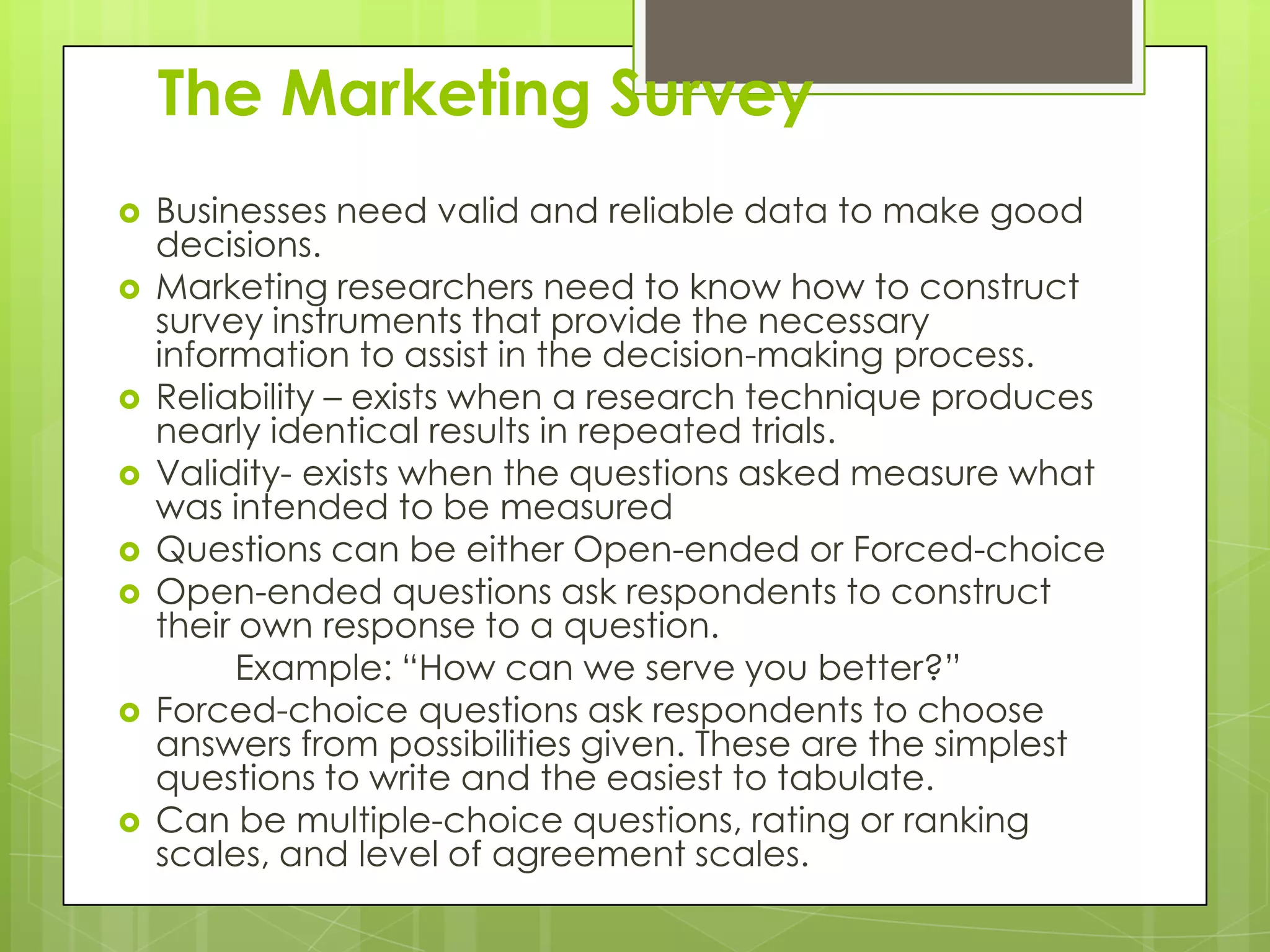
The Marketing Survey
   Businesses need valid and reliable data to make good
    decisions.
   Marketing researchers need to know how to construct
    survey instruments that provide the necessary
    information to assist in the decision-making process.
   Reliability – exists when a research technique produces
    nearly identical results in repeated trials.
   Validity- exists when the questions asked measure what
    was intended to be measured
   Questions can be either Open-ended or Forced-choice
   Open-ended questions ask respondents to construct
    their own response to a question.
          Example: “How can we serve you better?”
   Forced-choice questions ask respondents to choose
    answers from possibilities given. These are the simplest
    questions to write and the easiest to tabulate.
   Can be multiple-choice questions, rating or ranking
    scales, and level of agreement scales.
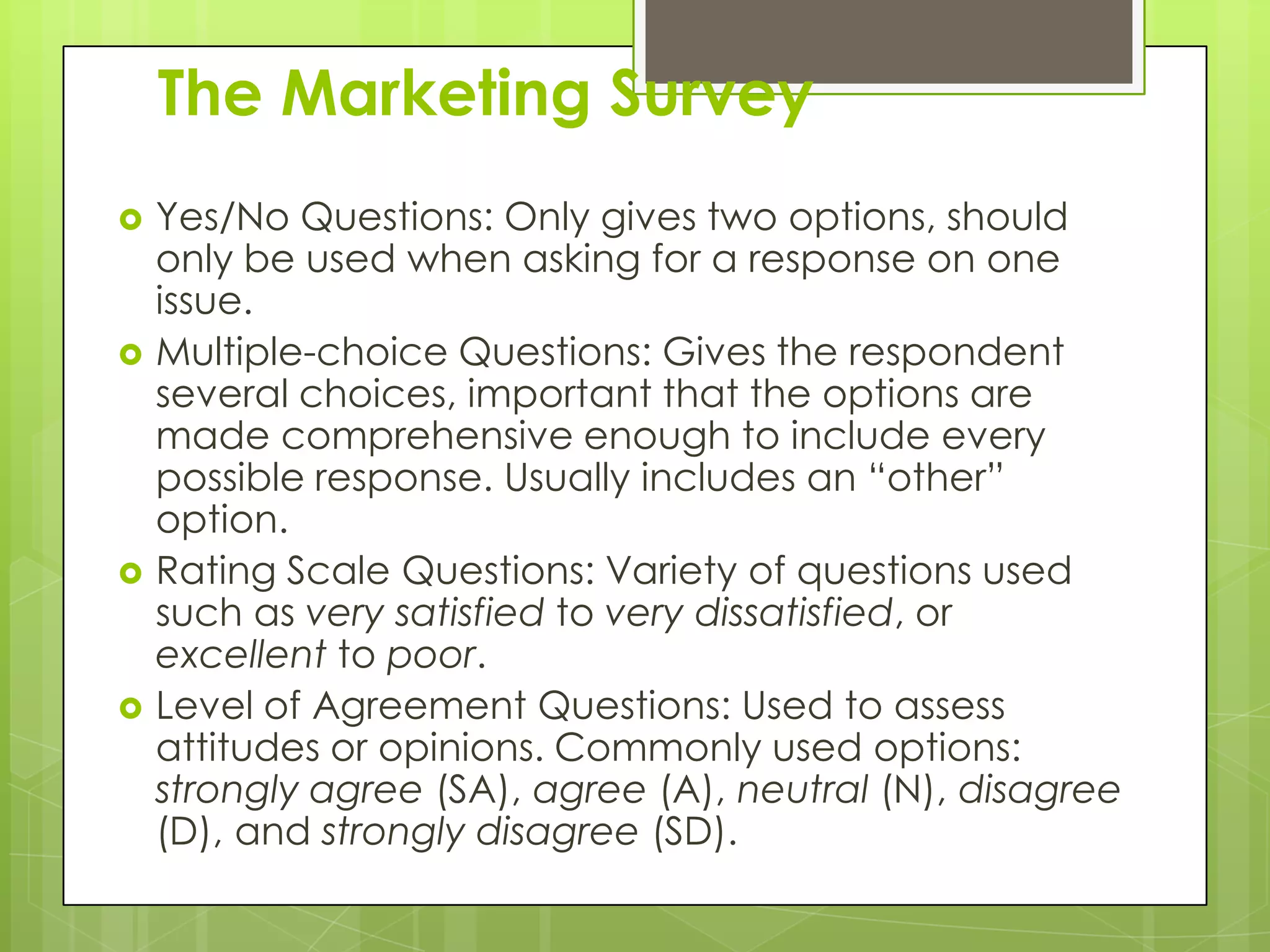
The Marketing Survey
   Yes/No Questions: Only gives two options, should
    only be used when asking for a response on one
    issue.
   Multiple-choice Questions: Gives the respondent
    several choices, important that the options are
    made comprehensive enough to include every
    possible response. Usually includes an “other”
    option.
   Rating Scale Questions: Variety of questions used
    such as very satisfied to very dissatisfied, or
    excellent to poor.
   Level of Agreement Questions: Used to assess
    attitudes or opinions. Commonly used options:
    strongly agree (SA), agree (A), neutral (N), disagree
    (D), and strongly disagree (SD).
Basic Guidelines for Writing
  Questions

 Should  be written clearly
 Should be as brief as possible
 Do not ask leading questions which suggest a
  correct answer
 Avoid bias
 Avoid questions that might cause a respondent
  to guess at the meaning of your question.
 Pretest – allows for correction of any misleading
  questions, directions, or problems
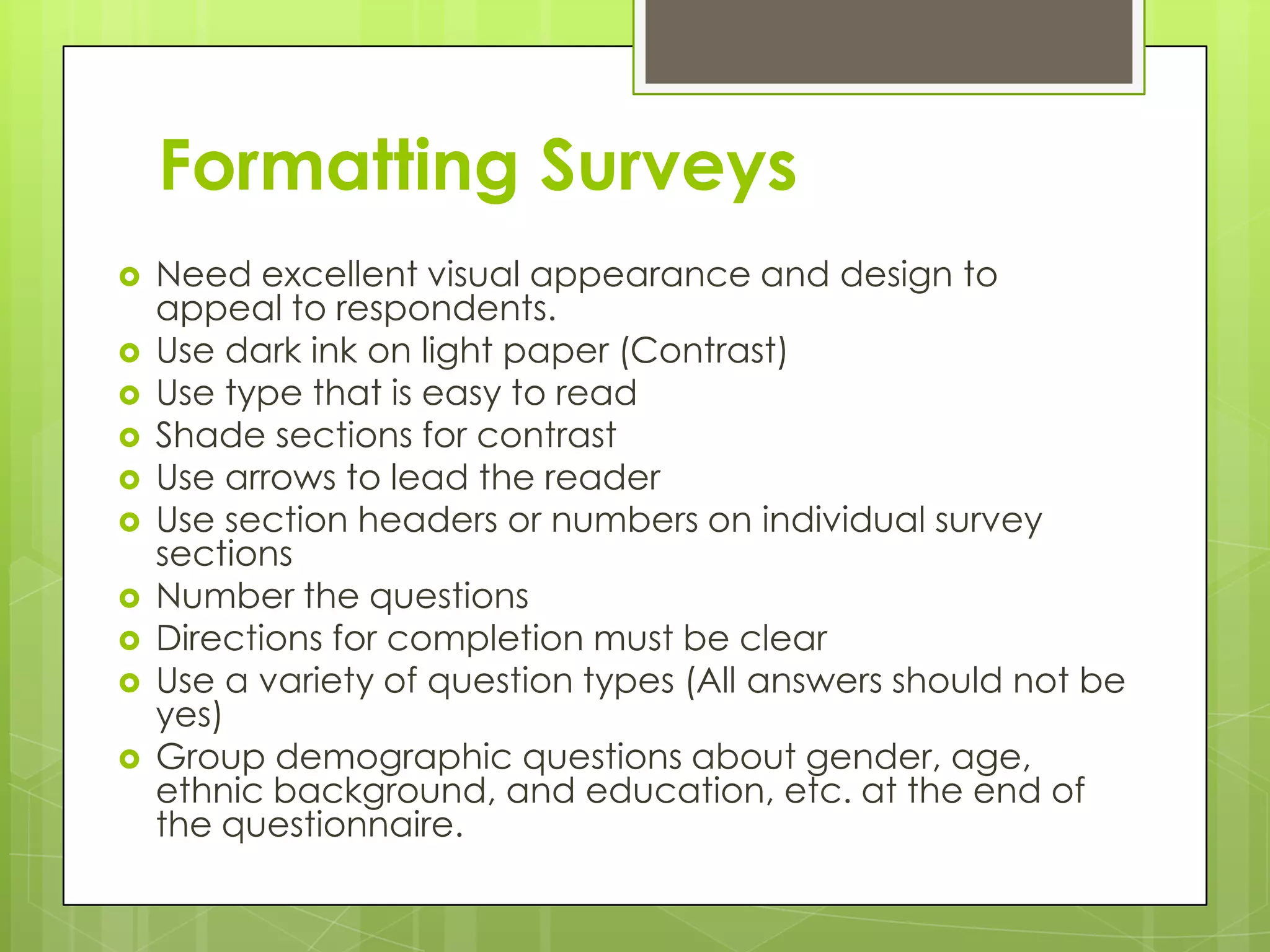
Formatting Surveys
   Need excellent visual appearance and design to
    appeal to respondents.
   Use dark ink on light paper (Contrast)
   Use type that is easy to read
   Shade sections for contrast
   Use arrows to lead the reader
   Use section headers or numbers on individual survey
    sections
   Number the questions
   Directions for completion must be clear
   Use a variety of question types (All answers should not be
    yes)
   Group demographic questions about gender, age,
    ethnic background, and education, etc. at the end of
    the questionnaire.

Sem i objective 2.06 powerpoint

  • 1.
    2.06 Understand data-collection methods toevaluate their appropriateness for the research problem/issue
  • 2.
    Primary Data: Data obtained for the first time and used specifically for the particular problem or issue under study  Secondary Data: Data that has already been collected for some purpose other than the current study  Secondary data is less expensive to collect than primary data  It is most effective for companies to decide what secondary data it will use before collecting primary data.
  • 3.
    Methods of collectingprimary data 1. Survey method – a research technique in which information is gathered from people through the use of surveys or questionnaires. Surveyors usually use a sample of the entire target population to get results  Personal interview – involves questioning people face-to-face. Often conducted in central locations. Advantage: People are likely to respond. Disadvantage: Costly  Focus group interview- involves eight to twelve people who are brought together to evaluate a product, design, or strategy under the direction of a skilled moderator  Telephone interview – quick, efficient, and relatively inexpensive. Disadvantage: some people are unwilling to participate  Mail survey – relatively inexpensive way to reach a large audience. Respondents are generally honest and find this type of survey less intrusive. Disadvantage: return rate for mail surveys is only 10%.  Internet survey – includes wide-open polls, anybody-can-answer polls, invitation-only surveys, password protected research sites, and Internet – based panels.
  • 4.
    Methods of collectingprimary data 2. Observation method – a research technique in which the actions of people are watched and recorded either by cameras or observers.  Mystery shopper – a researcher who poses as a customer  Point-of-sale research – a research technique that combines natural observation with personal interviews to get people to explain buying behavior 3. Experimental method – a research technique in which a researcher observes the results of changing one or more marketing variables while keeping certain other variables constant under controlled conditions. Often used to test new package designs, media usage, and new promotions.
  • 5.
    The Marketing Survey  Businesses need valid and reliable data to make good decisions.  Marketing researchers need to know how to construct survey instruments that provide the necessary information to assist in the decision-making process.  Reliability – exists when a research technique produces nearly identical results in repeated trials.  Validity- exists when the questions asked measure what was intended to be measured  Questions can be either Open-ended or Forced-choice  Open-ended questions ask respondents to construct their own response to a question. Example: “How can we serve you better?”  Forced-choice questions ask respondents to choose answers from possibilities given. These are the simplest questions to write and the easiest to tabulate.  Can be multiple-choice questions, rating or ranking scales, and level of agreement scales.
  • 6.
    The Marketing Survey  Yes/No Questions: Only gives two options, should only be used when asking for a response on one issue.  Multiple-choice Questions: Gives the respondent several choices, important that the options are made comprehensive enough to include every possible response. Usually includes an “other” option.  Rating Scale Questions: Variety of questions used such as very satisfied to very dissatisfied, or excellent to poor.  Level of Agreement Questions: Used to assess attitudes or opinions. Commonly used options: strongly agree (SA), agree (A), neutral (N), disagree (D), and strongly disagree (SD).
  • 7.
    Basic Guidelines forWriting Questions  Should be written clearly  Should be as brief as possible  Do not ask leading questions which suggest a correct answer  Avoid bias  Avoid questions that might cause a respondent to guess at the meaning of your question.  Pretest – allows for correction of any misleading questions, directions, or problems
  • 8.
    Formatting Surveys  Need excellent visual appearance and design to appeal to respondents.  Use dark ink on light paper (Contrast)  Use type that is easy to read  Shade sections for contrast  Use arrows to lead the reader  Use section headers or numbers on individual survey sections  Number the questions  Directions for completion must be clear  Use a variety of question types (All answers should not be yes)  Group demographic questions about gender, age, ethnic background, and education, etc. at the end of the questionnaire.