
 General Introduction about Questionnaire design
 Stages of questionnaire development to prune
and refine the questionnaire
 Relationship between Objective, Hypothesis,
Data Analysis with examples
 Example of a research questionnaire
 Group exercise
 A QUESTIONNAIRE IS A LIST OF QUESTIONS
SENT TO A NUMBER OF PERSONS FOR THEM
TO ANSWER.
 A QUESTIONNAIRE WHETHER IT IS CALLED A
SCHEDULE, INTERVIEW FORM OR
MEASURING INSTRUMENTS IS A
FORMALIZED SET OF QUESTIONS FOR
OBTAINING INFORMATION FROM
RESPONDENTS.
 Much of the data in clinical research is gathered
using questionnaires or interviews.
 The reliability and validity of the results depends
on the quality of these instruments.
◦Good questionnaires are difficult to
construct; bad questionnaires are
difficult to analyze.
4
 SUPERFICIAL- difficult to capture the richness
of meaning
 INFORMATION IS SELF REPORT-does not
necessarily reflect true
behavior
 POOLING OF IGNORANCE
 STRUCTURED
 UN STRUCTURED
 PICTORIAL
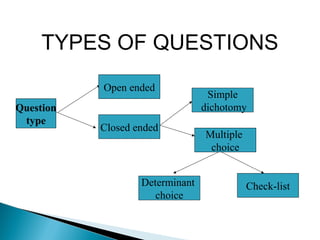
Question
type
Open ended
Closed ended
Simple
dichotomy
Multiple
choice
Determinant
choice
Check-list
TYPES OF QUESTIONS
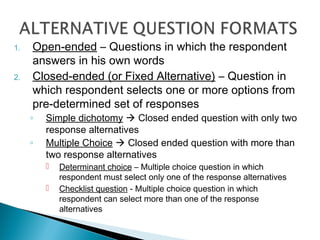
1. Open-ended – Questions in which the respondent
answers in his own words
2. Closed-ended (or Fixed Alternative) – Question in
which respondent selects one or more options from
pre-determined set of responses
◦ Simple dichotomy  Closed ended question with only two
response alternatives
◦ Multiple Choice  Closed ended question with more than
two response alternatives
 Determinant choice – Multiple choice question in which
respondent must select only one of the response alternatives
 Checklist question - Multiple choice question in which
respondent can select more than one of the response
alternatives
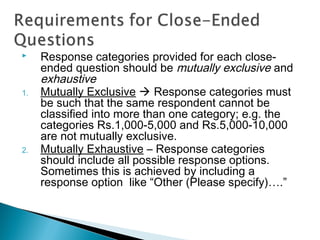
 Response categories provided for each close-
ended question should be mutually exclusive and
exhaustive
1. Mutually Exclusive  Response categories must
be such that the same respondent cannot be
classified into more than one category; e.g. the
categories Rs.1,000-5,000 and Rs.5,000-10,000
are not mutually exclusive.
2. Mutually Exhaustive – Response categories
should include all possible response options.
Sometimes this is achieved by including a
response option like “Other (Please specify)….”
CONCEPTUAL FRAMEWORK
QUESTIONNAIRE/QUESTIONS FORMAT
 STRUCTURED
 UNSTRUCTURED
 LANGUAGE
 TYPE OF QUESTIONS
 ADMINISTRATION
 WORDING OF QUESTIONS
 GENERAL TO SPECIFIC ( INVERTED FUNNEL APPROACH)
 SEQUENCE OF QUESTIONS
 EASY QUESTION FORMATS
 PERSONAL QUESTIONS AT THE END
 DOUBLE BARREL QUESTION SHOULD BE AVOIDED
 QUESTIONS SHOULD BE HELPFUL IN TABULATIONS &
ANALYSIS
 QUESTIONNAIRE ITEMS
• Keep questionnaire short if possible, but not too short that you
sacrifice needed information
• Do not over crowd questionnaire
• Provide decent margin space
• Use multiple- grid layout for questions with similar responses
• Use good quality print paper.
• Use booklet form if possible
 Sometimes, several questions are needed to obtain the required
information in an unambiguous manner. Consider the question:
“Do you think Coca-Cola is a tasty and refreshing soft
drink?” (Incorrect)
 Such a question is called a double-barreled question, because
two or more questions are combined into one. To obtain the
required information, two distinct questions should be asked:  
“Do you think Coca-Cola is a tasty soft drink?” and
“Do you think Coca-Cola is a refreshing soft drink?”
(Correct)
How many gallons of soft drinks did you
consume during the last four weeks? (Incorrect)
How often do you consume soft drinks in a
typical week? (Correct)
1.                  ___ Less than once a week
2.                  ___ 1 to 3 times per week
3.                  ___ 4 to 6 times per week
4.                  ___ 7 or more times per week
In a typical month, how often do you shop in department stores?
_____ Never
_____ Occasionally
_____ Sometimes
_____ Often
_____ Regularly
(Incorrect)
In a typical month, how often do you shop in department stores?
_____ Less than once
_____ 1 or 2 times
_____ 3 or 4 times
_____ More than 4 times (Correct)
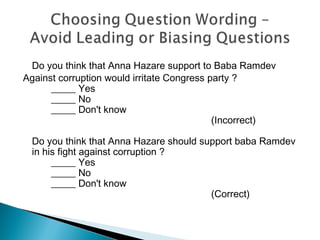
Do you think that Anna Hazare support to Baba Ramdev
Against corruption would irritate Congress party ?
_____ Yes
_____ No
_____ Don't know
(Incorrect)
Do you think that Anna Hazare should support baba Ramdev
in his fight against corruption ?
_____ Yes
_____ No
_____ Don't know
(Correct)
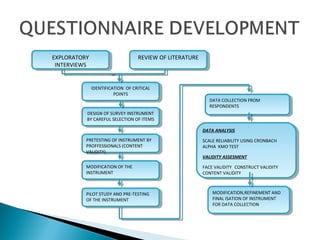
EXPLORATORY
INTERVIEWS
EXPLORATORY
INTERVIEWS
PILOT STUDY AND PRE-TESTING
OF THE INSTRUMENT
PILOT STUDY AND PRE-TESTING
OF THE INSTRUMENT
MODIFICATION OF THE
INSTRUMENT
MODIFICATION OF THE
INSTRUMENT
PRETESTING OF INSTRUMENT BY
PROFFESSIONALS (CONTENT
VALIDITY)
PRETESTING OF INSTRUMENT BY
PROFFESSIONALS (CONTENT
VALIDITY)
REVIEW OF LITERATUREREVIEW OF LITERATURE
IDENTIFICATION OF CRITICAL
POINTS
IDENTIFICATION OF CRITICAL
POINTS
DESIGN OF SURVEY INSTRUMENT
BY CAREFUL SELECTION OF ITEMS
DESIGN OF SURVEY INSTRUMENT
BY CAREFUL SELECTION OF ITEMS
DATA COLLECTION FROM
RESPONDENTS
DATA COLLECTION FROM
RESPONDENTS
DATA ANALYSIS
SCALE RELIABILITY USING CRONBACH
ALPHA KMO TEST
VALIDITY ASSESMENT
FACE VALIDITY CONSTRUCT VALIDITY
CONTENT VALIDITY
DATA ANALYSIS
SCALE RELIABILITY USING CRONBACH
ALPHA KMO TEST
VALIDITY ASSESMENT
FACE VALIDITY CONSTRUCT VALIDITY
CONTENT VALIDITY
MODIFICATION,REFINEMENT AND
FINAL ISATION OF INSTRUMENT
FOR DATA COLLECTION
MODIFICATION,REFINEMENT AND
FINAL ISATION OF INSTRUMENT
FOR DATA COLLECTION
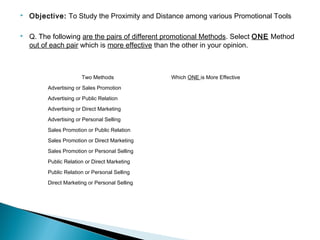
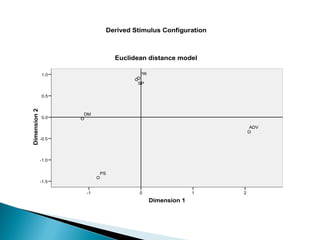
 Objective: To Study the Proximity and Distance among various Promotional Tools
  
 Q. The following are the pairs of different promotional Methods. Select ONE Method
out of each pair which is more effective than the other in your opinion.
 
Two Methods Which ONE is More Effective
Advertising or Sales Promotion
Advertising or Public Relation
Advertising or Direct Marketing
Advertising or Personal Selling
Sales Promotion or Public Relation
Sales Promotion or Direct Marketing
Sales Promotion or Personal Selling
Public Relation or Direct Marketing
Public Relation or Personal Selling
Direct Marketing or Personal Selling
Dimension 1
210-1
Dimension2
1.0
0.5
0.0
-0.5
-1.0
-1.5
PS
DM
PR
SP
ADV
Derived Stimulus Configuration
Euclidean distance model
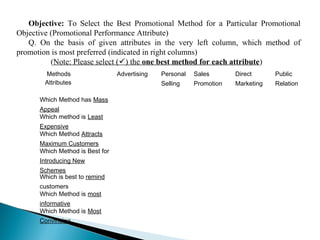
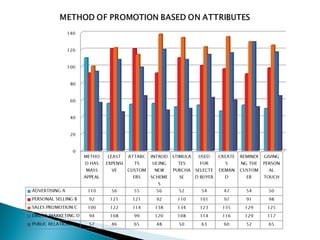
Objective: To Select the Best Promotional Method for a Particular Promotional
Objective (Promotional Performance Attribute)
Q. On the basis of given attributes in the very left column, which method of
promotion is most preferred (indicated in right columns)
(Note: Please select () the one best method for each attribute)
Methods Advertising Personal
Selling
Sales
Promotion
Direct
Marketing
Public
RelationAttributes
Which Method has Mass
Appeal
Which method is Least
Expensive
Which Method Attracts
Maximum Customers
Which Method is Best for
Introducing New
Schemes
Which is best to remind
customers
Which Method is most
informative
Which Method is Most
Convincing
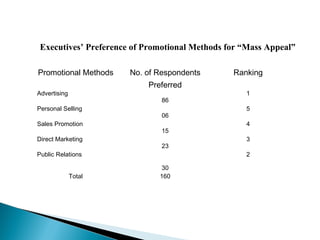
Promotional Methods No. of Respondents
Preferred
Ranking
Advertising
86
1
Personal Selling
06
5
Sales Promotion
15
4
Direct Marketing
23
3
Public Relations
30
2
Total 160
Executives’ Preference of Promotional Methods for “Mass Appeal”
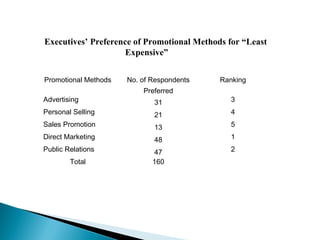
Executives’ Preference of Promotional Methods for “Least
Expensive”
Promotional Methods No. of Respondents
Preferred
Ranking
Advertising 31 3
Personal Selling 21 4
Sales Promotion 13 5
Direct Marketing 48 1
Public Relations 47 2
Total 160
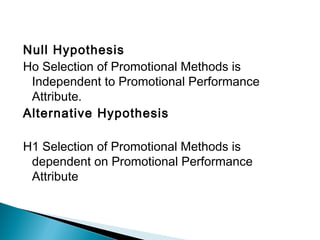
Null Hypothesis
Ho Selection of Promotional Methods is
Independent to Promotional Performance
Attribute.
Alternative Hypothesis
H1 Selection of Promotional Methods is
dependent on Promotional Performance
Attribute
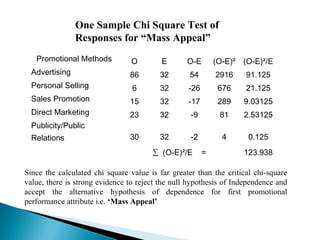
Promotional Methods O E O-E (O-E)² (O-E)²/E
Advertising 86 32 54 2916 91.125
Personal Selling 6 32 -26 676 21.125
Sales Promotion 15 32 -17 289 9.03125
Direct Marketing 23 32 -9 81 2.53125
Publicity/Public
Relations 30 32 -2 4 0.125
∑  (O-E)²/E = 123.938
One Sample Chi Square Test of
Responses for “Mass Appeal”
Since the calculated chi square value is far greater than the critical chi-square
value, there is strong evidence to reject the null hypothesis of Independence and
accept the alternative hypothesis of dependence for first promotional
performance attribute i.e. ‘Mass Appeal’
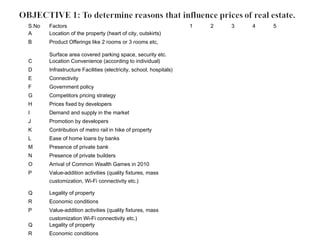
S.No Factors 1 2 3 4 5
A Location of the property (heart of city, outskirts)
B Product Offerings like 2 rooms or 3 rooms etc,
Surface area covered parking space, security etc.
C Location Convenience (according to individual)
D Infrastructure Facilities (electricity, school, hospitals)
E Connectivity
F Government policy
G Competitors pricing strategy
H Prices fixed by developers
I Demand and supply in the market
J Promotion by developers
K Contribution of metro rail in hike of property
L Ease of home loans by banks
M Presence of private bank
N Presence of private builders
O Arrival of Common Wealth Games in 2010
P Value-addition activities (quality fixtures, mass
customization, Wi-Fi connectivity etc.)
Q Legality of property
R Economic conditions
P Value-addition activities (quality fixtures, mass
customization Wi-Fi connectivity etc.)
Q Legality of property
R Economic conditions
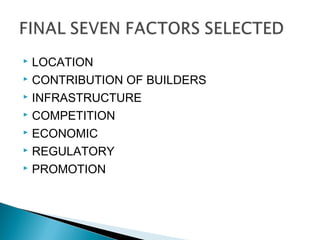
 LOCATION
 CONTRIBUTION OF BUILDERS
 INFRASTRUCTURE
 COMPETITION
 ECONOMIC
 REGULATORY
 PROMOTION
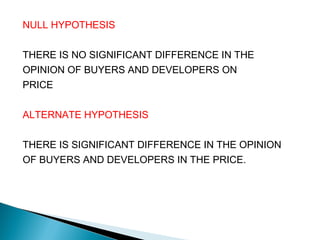
NULL HYPOTHESIS
THERE IS NO SIGNIFICANT DIFFERENCE IN THE
OPINION OF BUYERS AND DEVELOPERS ON
PRICE
ALTERNATE HYPOTHESIS
THERE IS SIGNIFICANT DIFFERENCE IN THE OPINION
OF BUYERS AND DEVELOPERS IN THE PRICE.

Questionnaire design dr. s l gupta

  • 2.
     General Introductionabout Questionnaire design  Stages of questionnaire development to prune and refine the questionnaire  Relationship between Objective, Hypothesis, Data Analysis with examples  Example of a research questionnaire  Group exercise
  • 3.
     A QUESTIONNAIREIS A LIST OF QUESTIONS SENT TO A NUMBER OF PERSONS FOR THEM TO ANSWER.  A QUESTIONNAIRE WHETHER IT IS CALLED A SCHEDULE, INTERVIEW FORM OR MEASURING INSTRUMENTS IS A FORMALIZED SET OF QUESTIONS FOR OBTAINING INFORMATION FROM RESPONDENTS.
  • 4.
     Much ofthe data in clinical research is gathered using questionnaires or interviews.  The reliability and validity of the results depends on the quality of these instruments. ◦Good questionnaires are difficult to construct; bad questionnaires are difficult to analyze. 4
  • 6.
     SUPERFICIAL- difficultto capture the richness of meaning  INFORMATION IS SELF REPORT-does not necessarily reflect true behavior  POOLING OF IGNORANCE
  • 7.
     STRUCTURED  UNSTRUCTURED  PICTORIAL
  • 8.
  • 9.
    1. Open-ended –Questions in which the respondent answers in his own words 2. Closed-ended (or Fixed Alternative) – Question in which respondent selects one or more options from pre-determined set of responses ◦ Simple dichotomy  Closed ended question with only two response alternatives ◦ Multiple Choice  Closed ended question with more than two response alternatives  Determinant choice – Multiple choice question in which respondent must select only one of the response alternatives  Checklist question - Multiple choice question in which respondent can select more than one of the response alternatives
  • 10.
     Response categoriesprovided for each close- ended question should be mutually exclusive and exhaustive 1. Mutually Exclusive  Response categories must be such that the same respondent cannot be classified into more than one category; e.g. the categories Rs.1,000-5,000 and Rs.5,000-10,000 are not mutually exclusive. 2. Mutually Exhaustive – Response categories should include all possible response options. Sometimes this is achieved by including a response option like “Other (Please specify)….”
  • 11.
    CONCEPTUAL FRAMEWORK QUESTIONNAIRE/QUESTIONS FORMAT STRUCTURED  UNSTRUCTURED  LANGUAGE  TYPE OF QUESTIONS  ADMINISTRATION
  • 12.
     WORDING OFQUESTIONS  GENERAL TO SPECIFIC ( INVERTED FUNNEL APPROACH)  SEQUENCE OF QUESTIONS  EASY QUESTION FORMATS  PERSONAL QUESTIONS AT THE END  DOUBLE BARREL QUESTION SHOULD BE AVOIDED  QUESTIONS SHOULD BE HELPFUL IN TABULATIONS & ANALYSIS  QUESTIONNAIRE ITEMS
  • 13.
    • Keep questionnaireshort if possible, but not too short that you sacrifice needed information • Do not over crowd questionnaire • Provide decent margin space • Use multiple- grid layout for questions with similar responses • Use good quality print paper. • Use booklet form if possible
  • 14.
     Sometimes, severalquestions are needed to obtain the required information in an unambiguous manner. Consider the question: “Do you think Coca-Cola is a tasty and refreshing soft drink?” (Incorrect)  Such a question is called a double-barreled question, because two or more questions are combined into one. To obtain the required information, two distinct questions should be asked:   “Do you think Coca-Cola is a tasty soft drink?” and “Do you think Coca-Cola is a refreshing soft drink?” (Correct)
  • 15.
    How many gallonsof soft drinks did you consume during the last four weeks? (Incorrect) How often do you consume soft drinks in a typical week? (Correct) 1.                  ___ Less than once a week 2.                  ___ 1 to 3 times per week 3.                  ___ 4 to 6 times per week 4.                  ___ 7 or more times per week
  • 16.
    In a typicalmonth, how often do you shop in department stores? _____ Never _____ Occasionally _____ Sometimes _____ Often _____ Regularly (Incorrect) In a typical month, how often do you shop in department stores? _____ Less than once _____ 1 or 2 times _____ 3 or 4 times _____ More than 4 times (Correct)
  • 17.
    Do you thinkthat Anna Hazare support to Baba Ramdev Against corruption would irritate Congress party ? _____ Yes _____ No _____ Don't know (Incorrect) Do you think that Anna Hazare should support baba Ramdev in his fight against corruption ? _____ Yes _____ No _____ Don't know (Correct)
  • 18.
    EXPLORATORY INTERVIEWS EXPLORATORY INTERVIEWS PILOT STUDY ANDPRE-TESTING OF THE INSTRUMENT PILOT STUDY AND PRE-TESTING OF THE INSTRUMENT MODIFICATION OF THE INSTRUMENT MODIFICATION OF THE INSTRUMENT PRETESTING OF INSTRUMENT BY PROFFESSIONALS (CONTENT VALIDITY) PRETESTING OF INSTRUMENT BY PROFFESSIONALS (CONTENT VALIDITY) REVIEW OF LITERATUREREVIEW OF LITERATURE IDENTIFICATION OF CRITICAL POINTS IDENTIFICATION OF CRITICAL POINTS DESIGN OF SURVEY INSTRUMENT BY CAREFUL SELECTION OF ITEMS DESIGN OF SURVEY INSTRUMENT BY CAREFUL SELECTION OF ITEMS DATA COLLECTION FROM RESPONDENTS DATA COLLECTION FROM RESPONDENTS DATA ANALYSIS SCALE RELIABILITY USING CRONBACH ALPHA KMO TEST VALIDITY ASSESMENT FACE VALIDITY CONSTRUCT VALIDITY CONTENT VALIDITY DATA ANALYSIS SCALE RELIABILITY USING CRONBACH ALPHA KMO TEST VALIDITY ASSESMENT FACE VALIDITY CONSTRUCT VALIDITY CONTENT VALIDITY MODIFICATION,REFINEMENT AND FINAL ISATION OF INSTRUMENT FOR DATA COLLECTION MODIFICATION,REFINEMENT AND FINAL ISATION OF INSTRUMENT FOR DATA COLLECTION
  • 20.
     Objective: ToStudy the Proximity and Distance among various Promotional Tools     Q. The following are the pairs of different promotional Methods. Select ONE Method out of each pair which is more effective than the other in your opinion.   Two Methods Which ONE is More Effective Advertising or Sales Promotion Advertising or Public Relation Advertising or Direct Marketing Advertising or Personal Selling Sales Promotion or Public Relation Sales Promotion or Direct Marketing Sales Promotion or Personal Selling Public Relation or Direct Marketing Public Relation or Personal Selling Direct Marketing or Personal Selling
  • 21.
  • 22.
    Objective: To Selectthe Best Promotional Method for a Particular Promotional Objective (Promotional Performance Attribute) Q. On the basis of given attributes in the very left column, which method of promotion is most preferred (indicated in right columns) (Note: Please select () the one best method for each attribute) Methods Advertising Personal Selling Sales Promotion Direct Marketing Public RelationAttributes Which Method has Mass Appeal Which method is Least Expensive Which Method Attracts Maximum Customers Which Method is Best for Introducing New Schemes Which is best to remind customers Which Method is most informative Which Method is Most Convincing
  • 23.
    Promotional Methods No.of Respondents Preferred Ranking Advertising 86 1 Personal Selling 06 5 Sales Promotion 15 4 Direct Marketing 23 3 Public Relations 30 2 Total 160 Executives’ Preference of Promotional Methods for “Mass Appeal”
  • 24.
    Executives’ Preference ofPromotional Methods for “Least Expensive” Promotional Methods No. of Respondents Preferred Ranking Advertising 31 3 Personal Selling 21 4 Sales Promotion 13 5 Direct Marketing 48 1 Public Relations 47 2 Total 160
  • 25.
    Null Hypothesis Ho Selectionof Promotional Methods is Independent to Promotional Performance Attribute. Alternative Hypothesis H1 Selection of Promotional Methods is dependent on Promotional Performance Attribute
  • 26.
    Promotional Methods OE O-E (O-E)² (O-E)²/E Advertising 86 32 54 2916 91.125 Personal Selling 6 32 -26 676 21.125 Sales Promotion 15 32 -17 289 9.03125 Direct Marketing 23 32 -9 81 2.53125 Publicity/Public Relations 30 32 -2 4 0.125 ∑  (O-E)²/E = 123.938 One Sample Chi Square Test of Responses for “Mass Appeal” Since the calculated chi square value is far greater than the critical chi-square value, there is strong evidence to reject the null hypothesis of Independence and accept the alternative hypothesis of dependence for first promotional performance attribute i.e. ‘Mass Appeal’
  • 28.
    S.No Factors 12 3 4 5 A Location of the property (heart of city, outskirts) B Product Offerings like 2 rooms or 3 rooms etc, Surface area covered parking space, security etc. C Location Convenience (according to individual) D Infrastructure Facilities (electricity, school, hospitals) E Connectivity F Government policy G Competitors pricing strategy H Prices fixed by developers I Demand and supply in the market J Promotion by developers K Contribution of metro rail in hike of property L Ease of home loans by banks M Presence of private bank N Presence of private builders O Arrival of Common Wealth Games in 2010 P Value-addition activities (quality fixtures, mass customization, Wi-Fi connectivity etc.) Q Legality of property R Economic conditions P Value-addition activities (quality fixtures, mass customization Wi-Fi connectivity etc.) Q Legality of property R Economic conditions
  • 29.
     LOCATION  CONTRIBUTIONOF BUILDERS  INFRASTRUCTURE  COMPETITION  ECONOMIC  REGULATORY  PROMOTION
  • 30.
    NULL HYPOTHESIS THERE ISNO SIGNIFICANT DIFFERENCE IN THE OPINION OF BUYERS AND DEVELOPERS ON PRICE ALTERNATE HYPOTHESIS THERE IS SIGNIFICANT DIFFERENCE IN THE OPINION OF BUYERS AND DEVELOPERS IN THE PRICE.