MKTG RESEARCH,MKIS AND DEMAND
FORECASTING
Course: MBA
Subject: MM II
Unit: I
Marketing Research
• Marketing research involves collecting,
organizing, analyzing and communicating
information that can be used in order to make
an informed marketing decision.
• Performing market research will complement
your marketing mix strategy as it enables you
to make educated decisions regarding
selecting markets, your image or branding and
products or services.
According to American Marketing Association, “Marketing
Research is the function that links the consumer, customer and
public to the marketer through information-information used to
identify and define marketing opportunities and problems,
generate, refine and evaluate marketing actions; monitor
marketing performance; and improve understanding of marketing
as a process.”
Scope of M.R
Marketing Research is of use to the following:-
Producers
•To know about his product potential in the market vis-à-vis
the total product;
•New Products;
•Various brands;
•Pricing;
•Market Structures and selection of product strategy, etc.
Business and Government Marketing Research helps
businesses and government in focusing attention on
the complex nature of problems faced by them. For
example:
• Determination of Gross National Product; Price indices,
and per capita income;
• Expenditure levels and budgeting;
• Agricultural Pricing;
• The economic policies of Government; and
• Operational and planning problems of business and
industry.
Market Research Agencies Marketing Research is
being used extensively by professionals to help
conducting various studies in Marketing
Research. Most prominent agencies being:-
• Linta India Ltd;
• British Market Research Bureau (BMRB);
• Hindustan Thompson Associate Ltd;
• eSurveysPro.com;
• MARG
5 key steps in Marketing Research
1. Define the Problem
2. Collect the Data
3. Analyse and interpret the data
4. Reach a conclusion
5. Implement your research
Define the Problem
• In this stage you need to identify the actual
problems that are relating to the apparent
symptoms.
• What information is needed in order to solve
the problem?
• For example, poor sales within a business are
not the problem, they are the symptom of a
larger issue such as a weak marketing strategy.
Further business problems may include:
• Who are your target customers?
• What method could be implemented to reach
these customers?
• Who are your customers and what advantages
and disadvantages do they have over your
business?
• What size is the consumer market you are
trying to engage?
Collect the Data
• There are two types of market research that can
be performed:
1. Primary research - involves collecting
information from sources directly by conducting
interviews and surveys, and by talking to
customers and established businesses.
2. Secondary research - involves collecting
information from sources where the primary
research has already been conducted. Such
information includes industry statistics, market
research reports, news paper articles, etc.
Collection methods and techniques
• Qualitative research is where you seek an
understanding of why things are a certain way.
For example, a researcher may stop a shopper
and ask them why they bought a particular
product or brand.
• Quantitative research refers to measuring
market phenomena in a numerical sense, such
as when a bank asks consumers to rate their
service on a scale of one to ten.
Analyze and interpret the data
• You must attach meaning to the data you have
collected during your market research to make
sense of it and to develop alternative
solutions that could potentially solve your
business problem.
• You should determine how the knowledge you
have gained through researching your market
can be applied and used to develop effective
business strategies.
Reach a conclusion
• With the alternatives you have developed to
solve your problem in mind, perform a cost-
benefit analysis of each alternative keeping in
mind the potentially limited resources
available to your business.
• You may also need to perform further
investigation into each alternative solution to
arrive at the best decision for your business in
regards to meeting consumer demands.
Implement your research
• Put your final solution into practice.
• Without completing this step your research
could potentially have been a waste of your
time and resources.
DATA COLLECTION
• Compilation and interpretation of primary
and secondary sources of information.
• The integration of different sources will
consolidate the write up of the report.
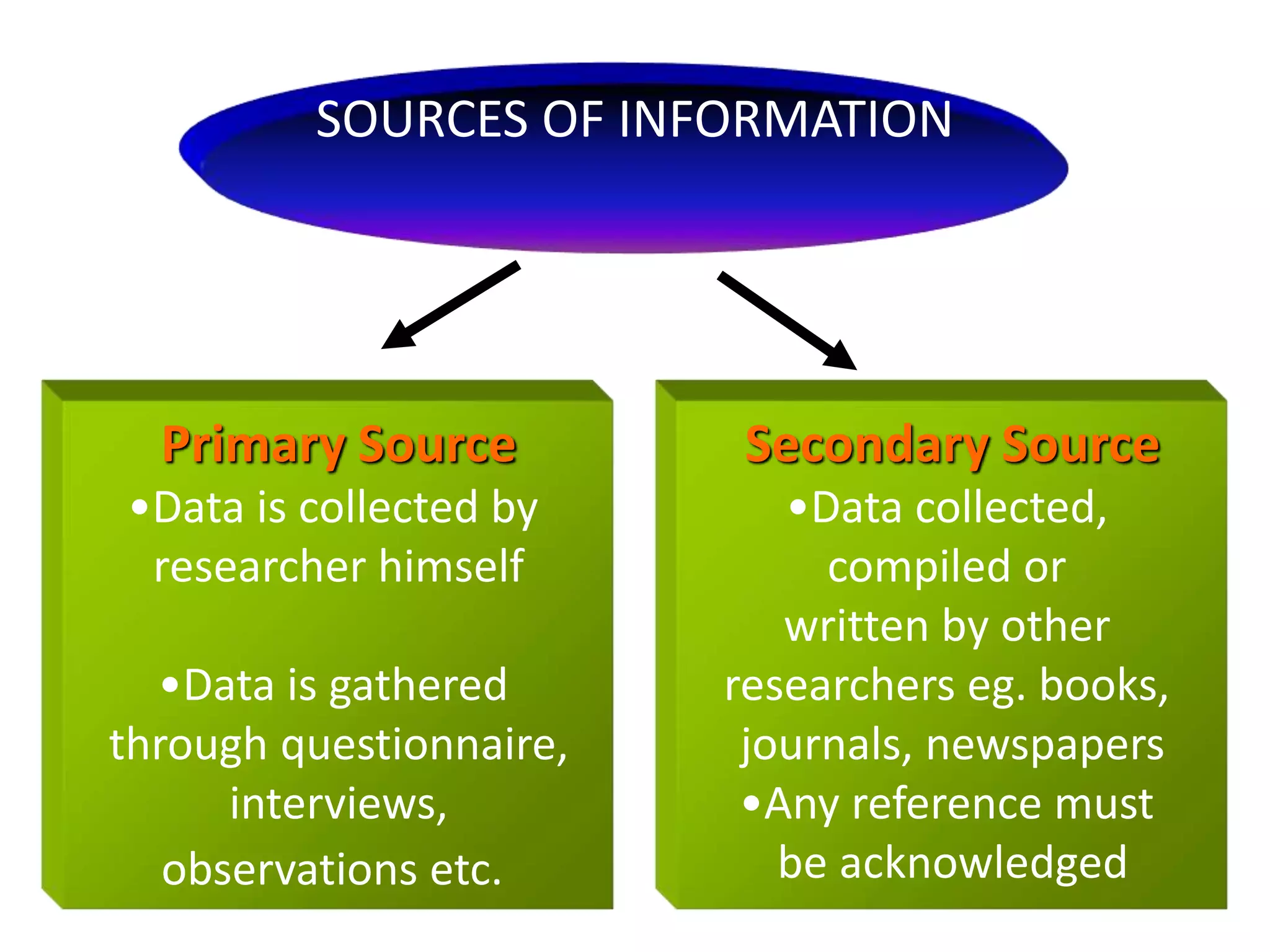
SOURCES OF INFORMATION
Primary Source
•Data is collected by
researcher himself
•Data is gathered
through questionnaire,
interviews,
observations etc.
Secondary Source
•Data collected,
compiled or
written by other
researchers eg. books,
journals, newspapers
•Any reference must
be acknowledged
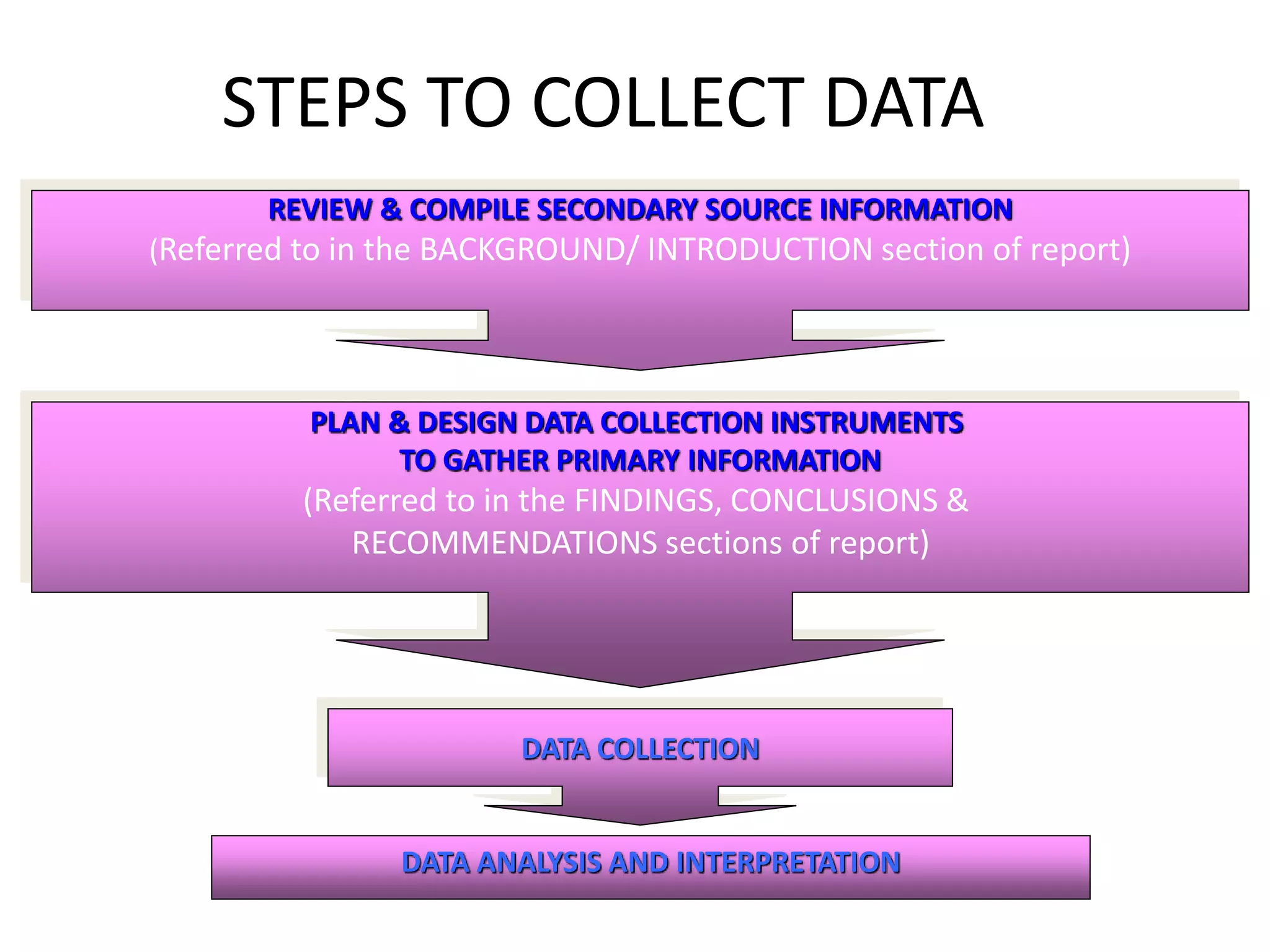
STEPS TO COLLECT DATA
DATA ANALYSIS AND INTERPRETATION
REVIEW & COMPILE SECONDARY SOURCE INFORMATION
(Referred to in the BACKGROUND/ INTRODUCTION section of report)
PLAN & DESIGN DATA COLLECTION INSTRUMENTS
TO GATHER PRIMARY INFORMATION
(Referred to in the FINDINGS, CONCLUSIONS &
RECOMMENDATIONS sections of report)
DATA COLLECTION
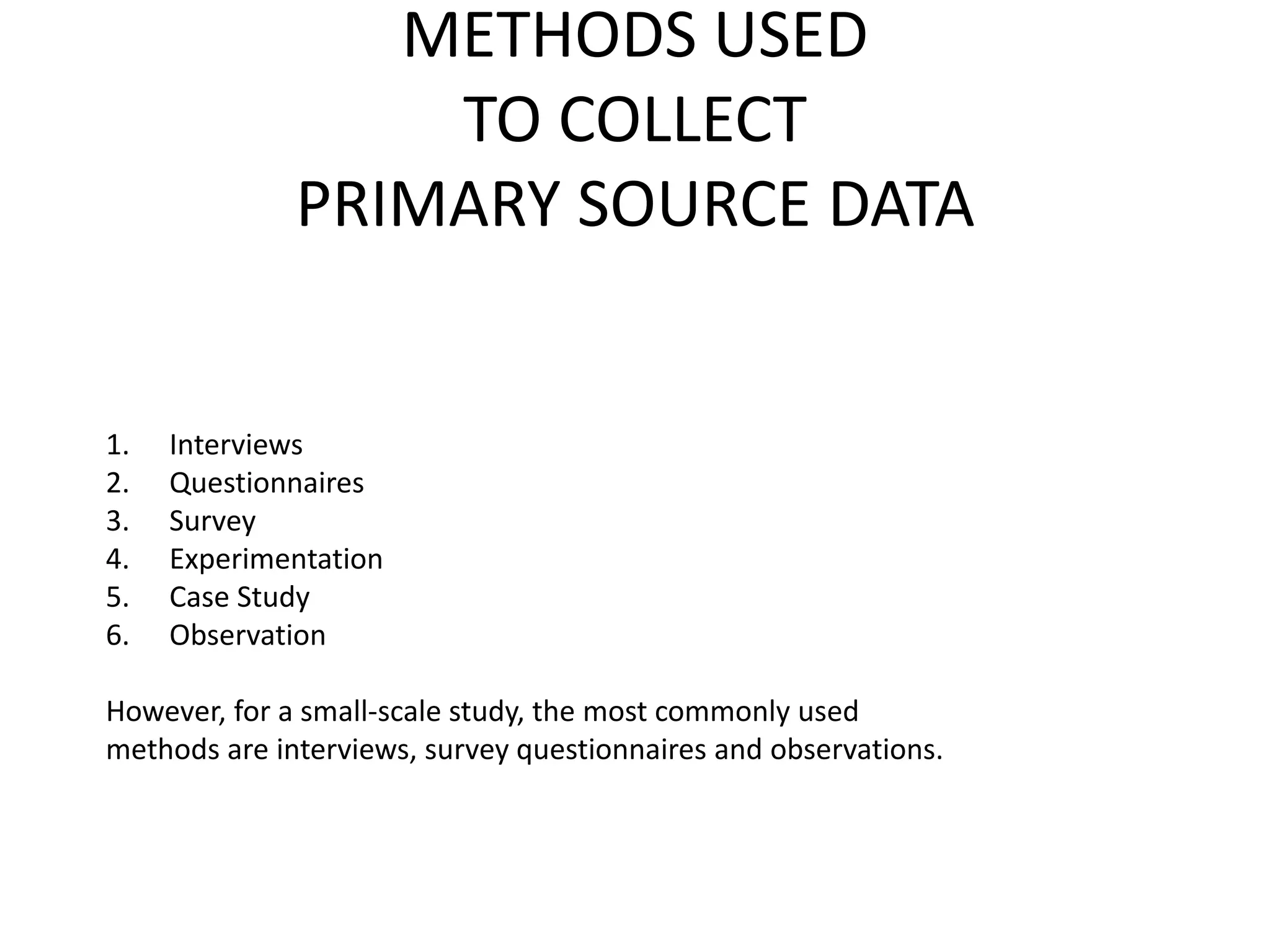
METHODS USED
TO COLLECT
PRIMARY SOURCE DATA
1. Interviews
2. Questionnaires
3. Survey
4. Experimentation
5. Case Study
6. Observation
However, for a small-scale study, the most commonly used
methods are interviews, survey questionnaires and observations.
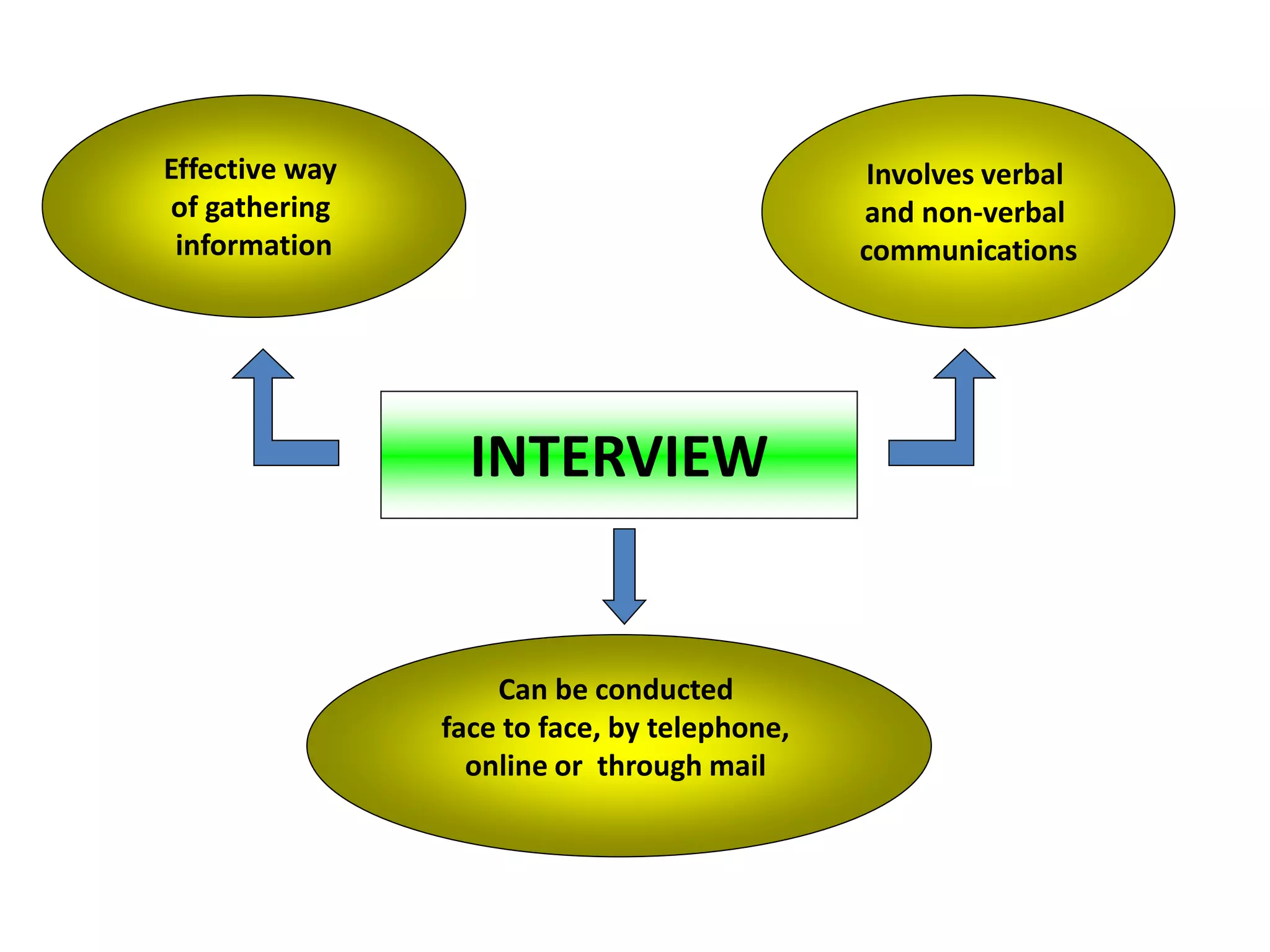
Effective way
of gathering
information
INTERVIEW
Involves verbal
and non-verbal
communications
Can be conducted
face to face, by telephone,
online or through mail
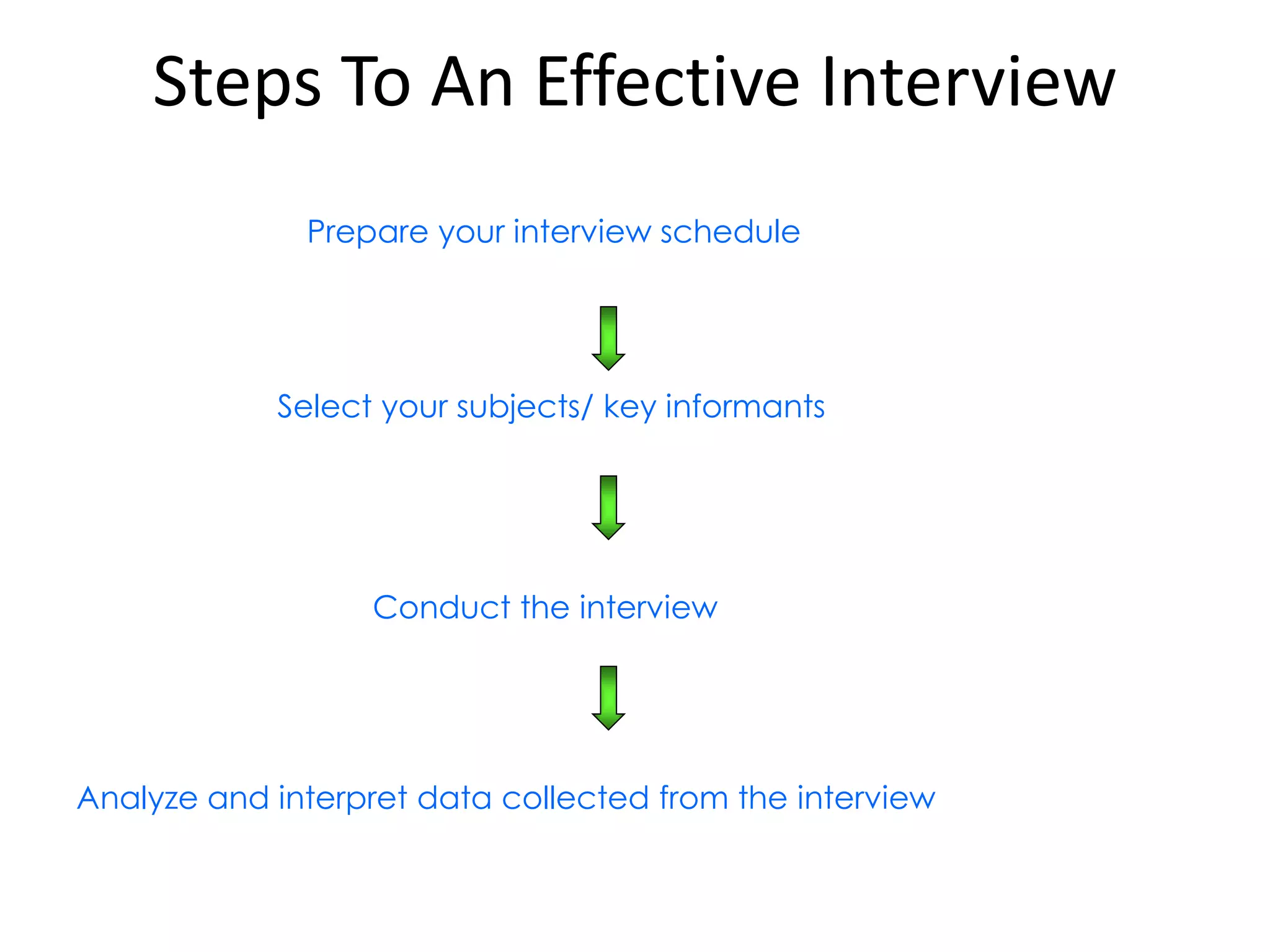
Steps To An Effective Interview
Prepare your interview schedule
Select your subjects/ key informants
Conduct the interview
Analyze and interpret data collected from the interview
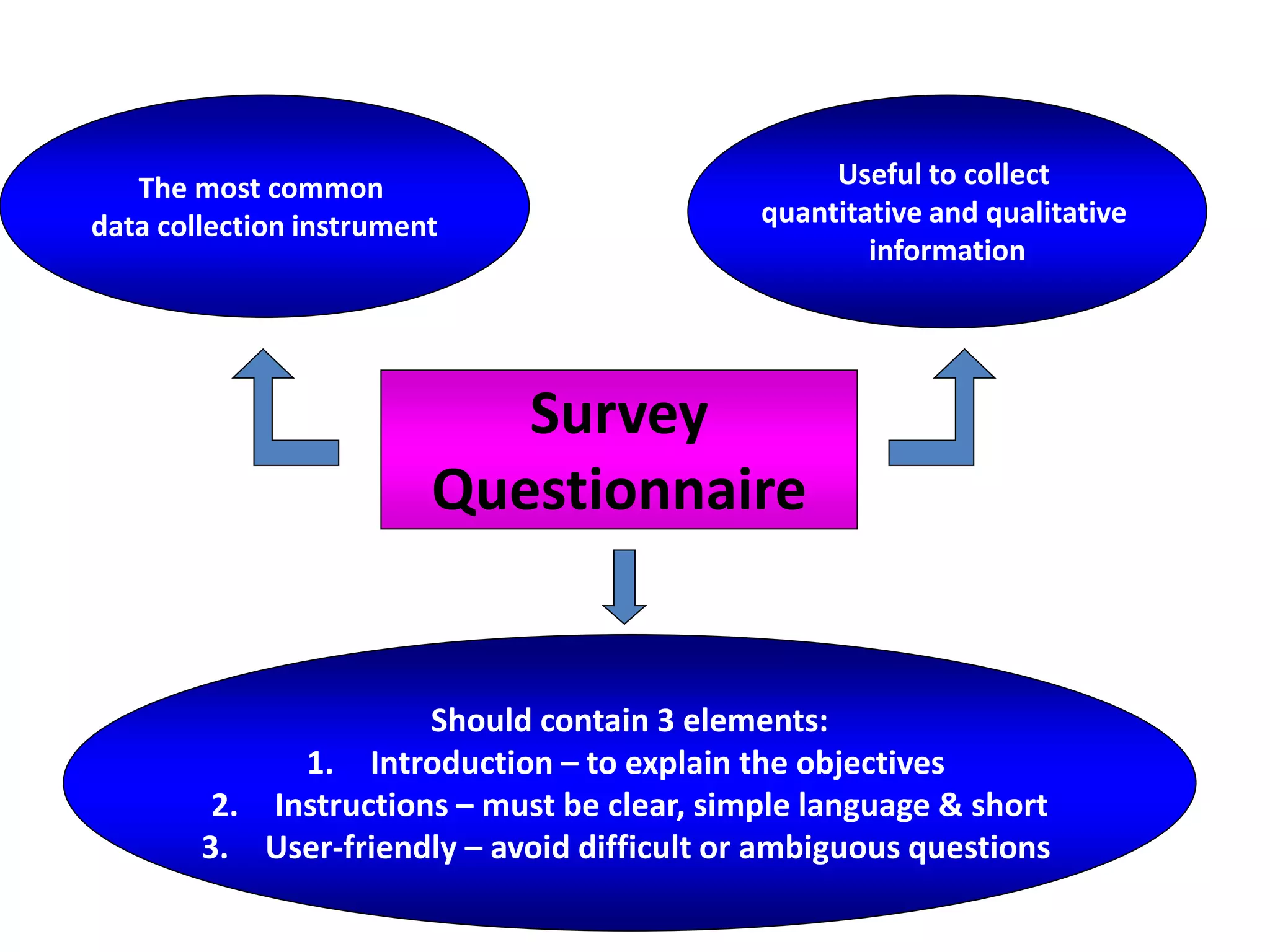
The most common
data collection instrument
Survey
Questionnaire
Useful to collect
quantitative and qualitative
information
Should contain 3 elements:
1. Introduction – to explain the objectives
2. Instructions – must be clear, simple language & short
3. User-friendly – avoid difficult or ambiguous questions
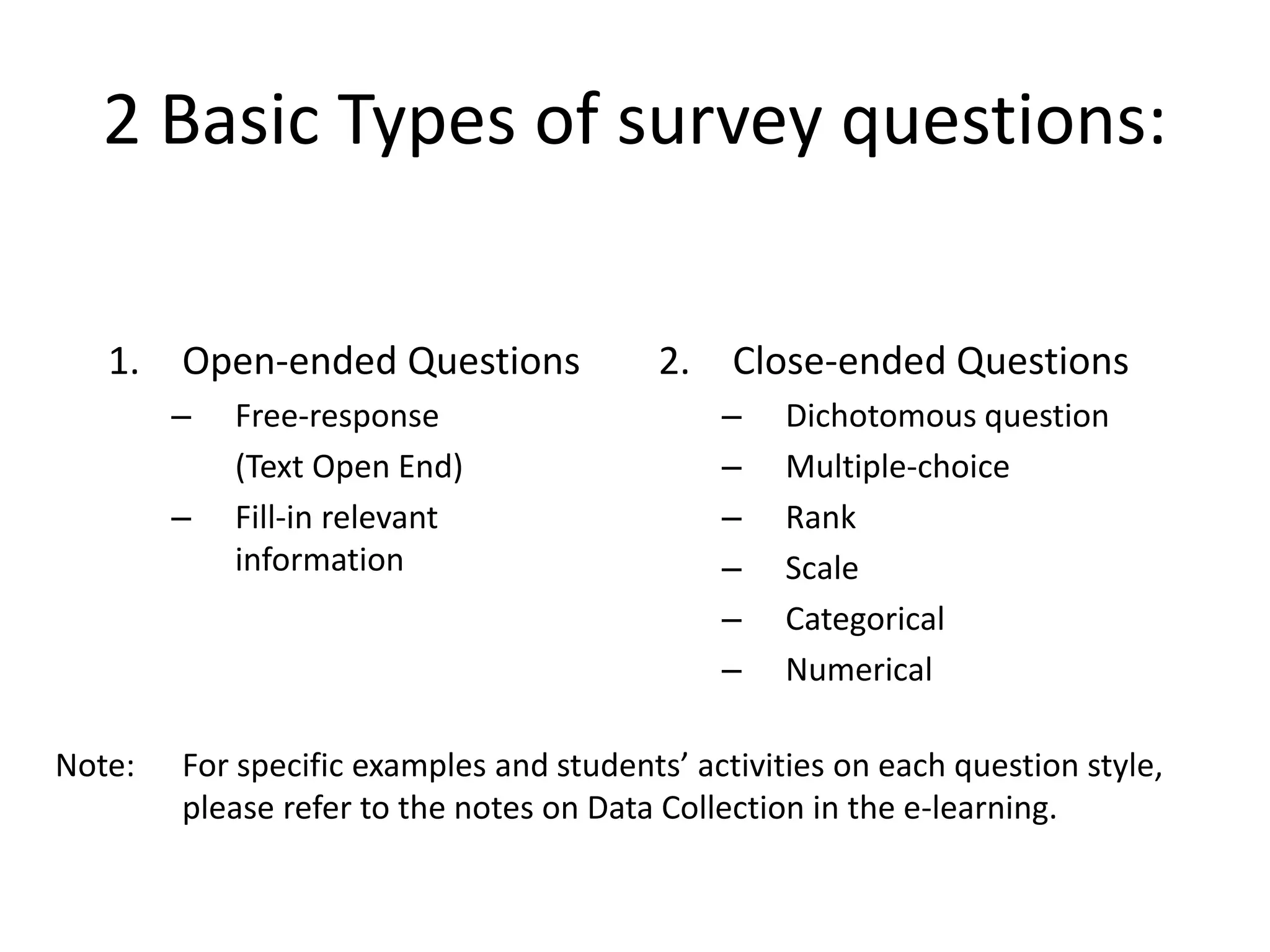
2 Basic Types of survey questions:
1. Open-ended Questions
– Free-response
(Text Open End)
– Fill-in relevant
information
2. Close-ended Questions
– Dichotomous question
– Multiple-choice
– Rank
– Scale
– Categorical
– Numerical
Note: For specific examples and students’ activities on each question style,
please refer to the notes on Data Collection in the e-learning.
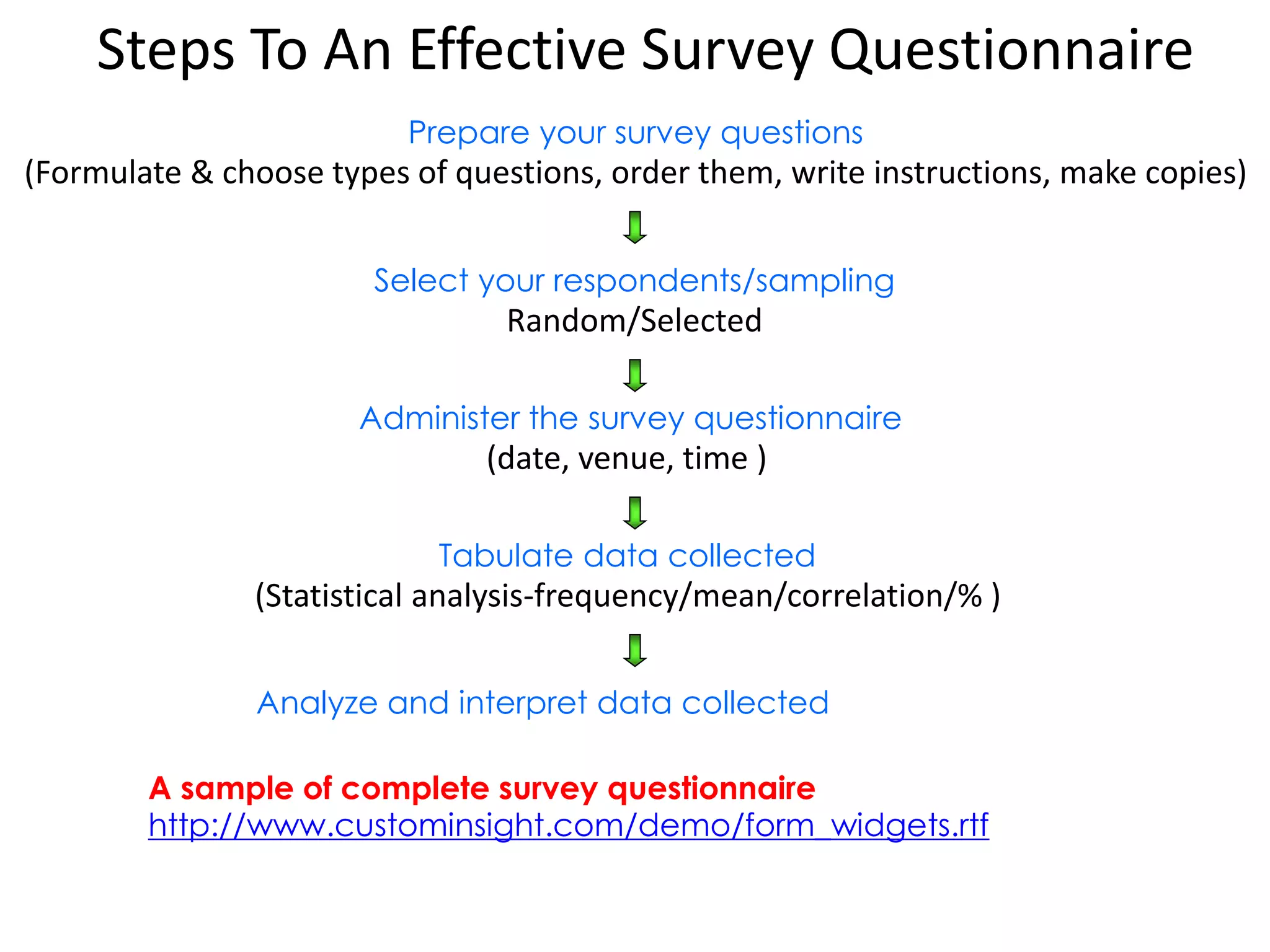
Steps To An Effective Survey Questionnaire
Prepare your survey questions
(Formulate & choose types of questions, order them, write instructions, make copies)
Select your respondents/sampling
Random/Selected
Administer the survey questionnaire
(date, venue, time )
Analyze and interpret data collected
Tabulate data collected
(Statistical analysis-frequency/mean/correlation/% )
A sample of complete survey questionnaire
http://www.custominsight.com/demo/form_widgets.rtf
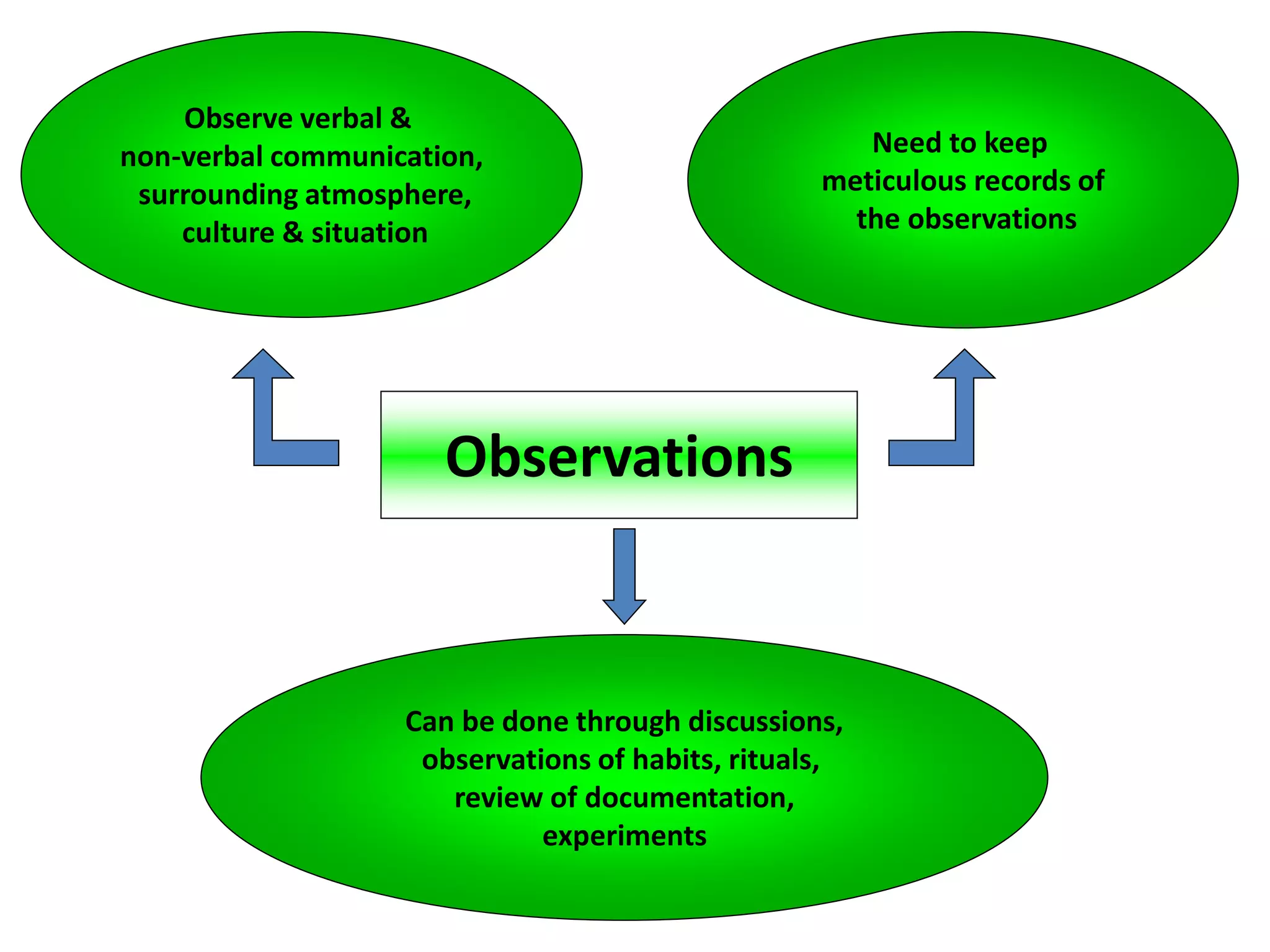
Observe verbal &
non-verbal communication,
surrounding atmosphere,
culture & situation
Observations
Need to keep
meticulous records of
the observations
Can be done through discussions,
observations of habits, rituals,
review of documentation,
experiments
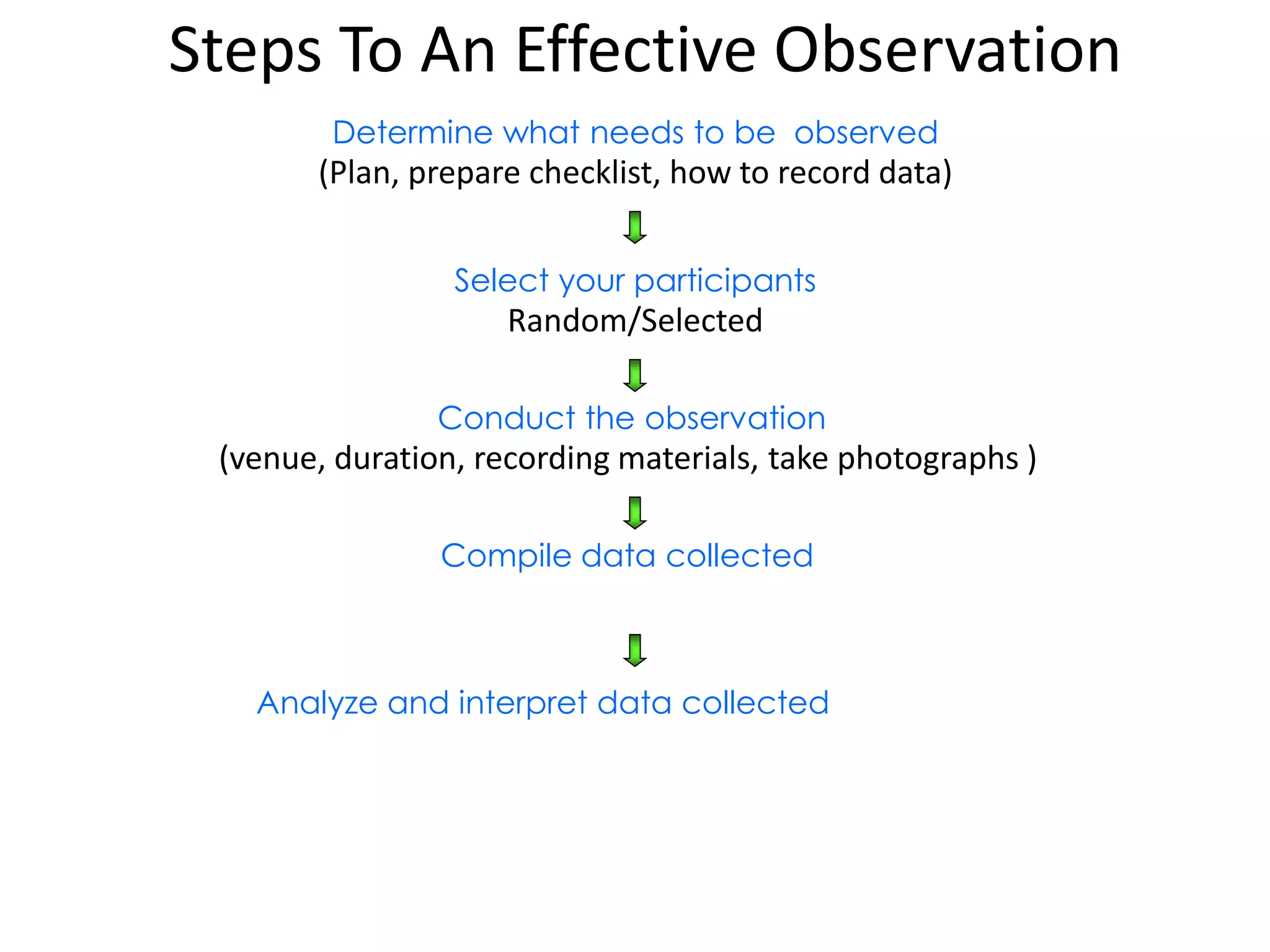
Steps To An Effective Observation
Determine what needs to be observed
(Plan, prepare checklist, how to record data)
Select your participants
Random/Selected
Conduct the observation
(venue, duration, recording materials, take photographs )
Analyze and interpret data collected
Compile data collected
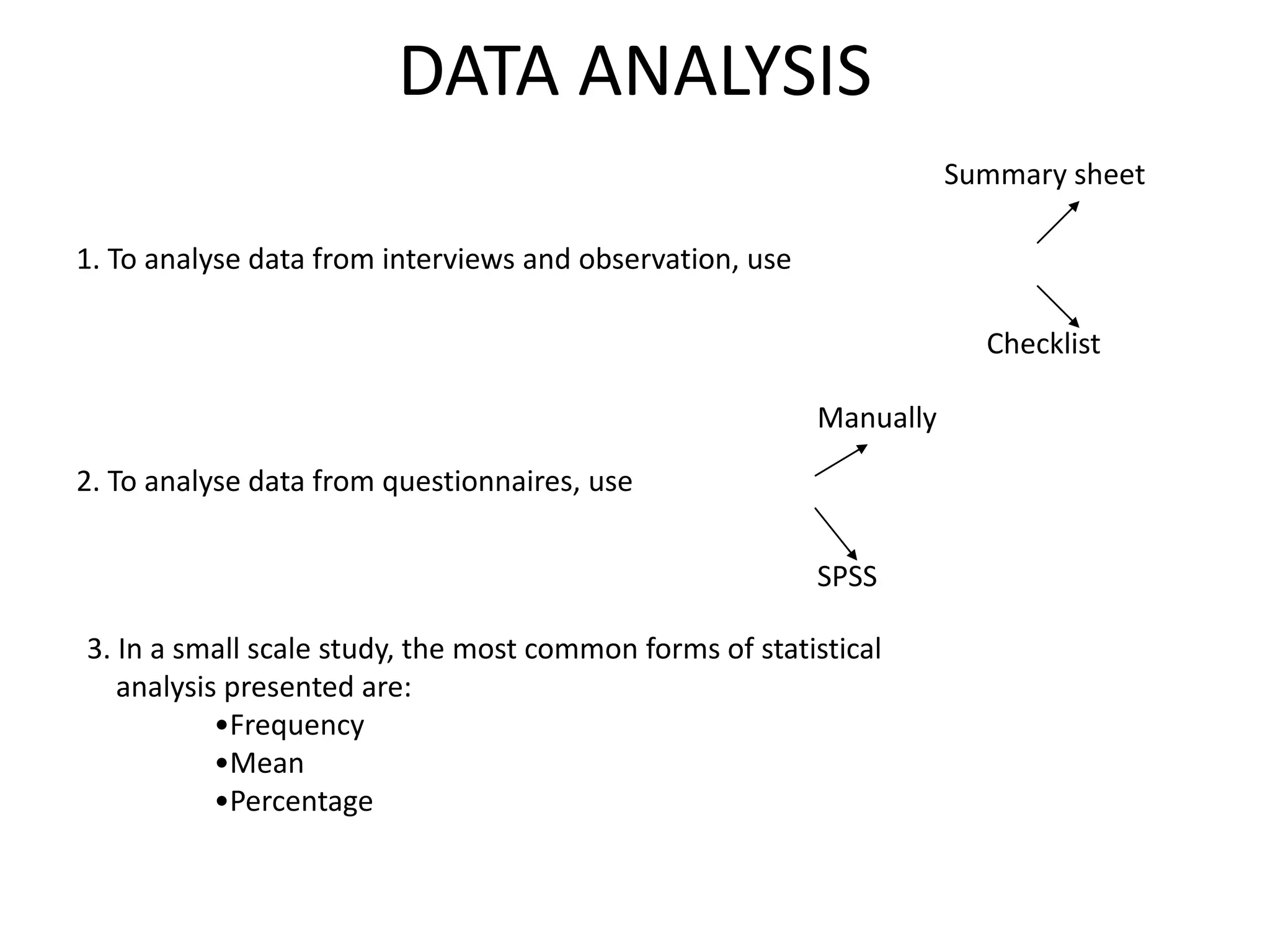
DATA ANALYSIS
3. In a small scale study, the most common forms of statistical
analysis presented are:
•Frequency
•Mean
•Percentage
1. To analyse data from interviews and observation, use
Summary sheet
Checklist
2. To analyse data from questionnaires, use
Manually
SPSS
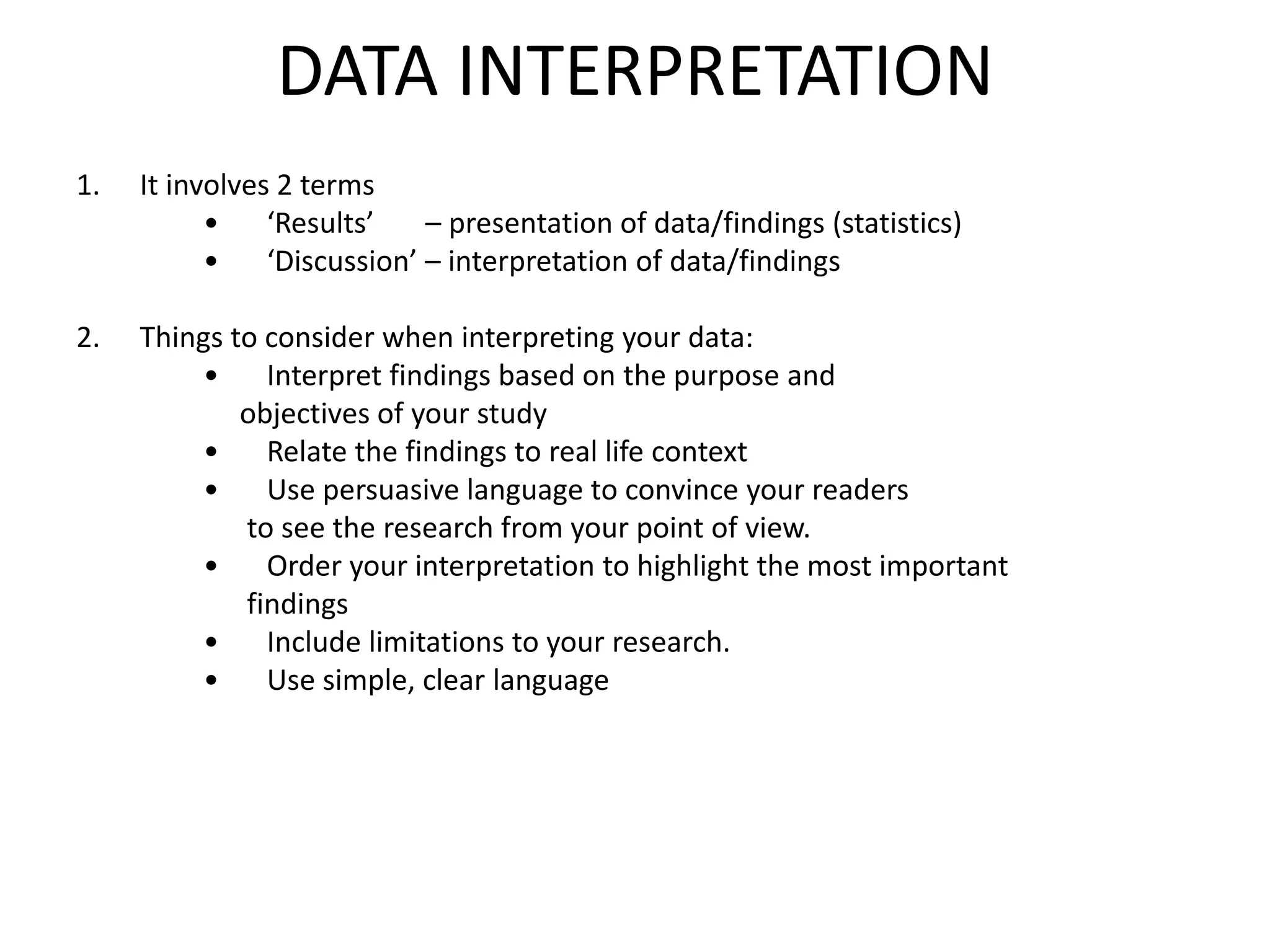
DATA INTERPRETATION
1. It involves 2 terms
• ‘Results’ – presentation of data/findings (statistics)
• ‘Discussion’ – interpretation of data/findings
2. Things to consider when interpreting your data:
• Interpret findings based on the purpose and
objectives of your study
• Relate the findings to real life context
• Use persuasive language to convince your readers
to see the research from your point of view.
• Order your interpretation to highlight the most important
findings
• Include limitations to your research.
• Use simple, clear language
http://www.slideshare.net/NITCALICUT_SOMS/marketing-research-ppt-
15981252
http://www.managementstudyguide.com/marketing_research.h
tm
Sources:-

Mm unit 1point1

  • 1.
    MKTG RESEARCH,MKIS ANDDEMAND FORECASTING Course: MBA Subject: MM II Unit: I
  • 2.
    Marketing Research • Marketingresearch involves collecting, organizing, analyzing and communicating information that can be used in order to make an informed marketing decision. • Performing market research will complement your marketing mix strategy as it enables you to make educated decisions regarding selecting markets, your image or branding and products or services.
  • 3.
    According to AmericanMarketing Association, “Marketing Research is the function that links the consumer, customer and public to the marketer through information-information used to identify and define marketing opportunities and problems, generate, refine and evaluate marketing actions; monitor marketing performance; and improve understanding of marketing as a process.”
  • 4.
    Scope of M.R MarketingResearch is of use to the following:- Producers •To know about his product potential in the market vis-à-vis the total product; •New Products; •Various brands; •Pricing; •Market Structures and selection of product strategy, etc.
  • 5.
    Business and GovernmentMarketing Research helps businesses and government in focusing attention on the complex nature of problems faced by them. For example: • Determination of Gross National Product; Price indices, and per capita income; • Expenditure levels and budgeting; • Agricultural Pricing; • The economic policies of Government; and • Operational and planning problems of business and industry.
  • 6.
    Market Research AgenciesMarketing Research is being used extensively by professionals to help conducting various studies in Marketing Research. Most prominent agencies being:- • Linta India Ltd; • British Market Research Bureau (BMRB); • Hindustan Thompson Associate Ltd; • eSurveysPro.com; • MARG
  • 7.
    5 key stepsin Marketing Research 1. Define the Problem 2. Collect the Data 3. Analyse and interpret the data 4. Reach a conclusion 5. Implement your research
  • 8.
    Define the Problem •In this stage you need to identify the actual problems that are relating to the apparent symptoms. • What information is needed in order to solve the problem? • For example, poor sales within a business are not the problem, they are the symptom of a larger issue such as a weak marketing strategy.
  • 9.
    Further business problemsmay include: • Who are your target customers? • What method could be implemented to reach these customers? • Who are your customers and what advantages and disadvantages do they have over your business? • What size is the consumer market you are trying to engage?
  • 10.
    Collect the Data •There are two types of market research that can be performed: 1. Primary research - involves collecting information from sources directly by conducting interviews and surveys, and by talking to customers and established businesses. 2. Secondary research - involves collecting information from sources where the primary research has already been conducted. Such information includes industry statistics, market research reports, news paper articles, etc.
  • 11.
    Collection methods andtechniques • Qualitative research is where you seek an understanding of why things are a certain way. For example, a researcher may stop a shopper and ask them why they bought a particular product or brand. • Quantitative research refers to measuring market phenomena in a numerical sense, such as when a bank asks consumers to rate their service on a scale of one to ten.
  • 12.
    Analyze and interpretthe data • You must attach meaning to the data you have collected during your market research to make sense of it and to develop alternative solutions that could potentially solve your business problem. • You should determine how the knowledge you have gained through researching your market can be applied and used to develop effective business strategies.
  • 13.
    Reach a conclusion •With the alternatives you have developed to solve your problem in mind, perform a cost- benefit analysis of each alternative keeping in mind the potentially limited resources available to your business. • You may also need to perform further investigation into each alternative solution to arrive at the best decision for your business in regards to meeting consumer demands.
  • 14.
    Implement your research •Put your final solution into practice. • Without completing this step your research could potentially have been a waste of your time and resources.
  • 15.
    DATA COLLECTION • Compilationand interpretation of primary and secondary sources of information. • The integration of different sources will consolidate the write up of the report.
  • 16.
    SOURCES OF INFORMATION PrimarySource •Data is collected by researcher himself •Data is gathered through questionnaire, interviews, observations etc. Secondary Source •Data collected, compiled or written by other researchers eg. books, journals, newspapers •Any reference must be acknowledged
  • 17.
    STEPS TO COLLECTDATA DATA ANALYSIS AND INTERPRETATION REVIEW & COMPILE SECONDARY SOURCE INFORMATION (Referred to in the BACKGROUND/ INTRODUCTION section of report) PLAN & DESIGN DATA COLLECTION INSTRUMENTS TO GATHER PRIMARY INFORMATION (Referred to in the FINDINGS, CONCLUSIONS & RECOMMENDATIONS sections of report) DATA COLLECTION
  • 18.
    METHODS USED TO COLLECT PRIMARYSOURCE DATA 1. Interviews 2. Questionnaires 3. Survey 4. Experimentation 5. Case Study 6. Observation However, for a small-scale study, the most commonly used methods are interviews, survey questionnaires and observations.
  • 19.
    Effective way of gathering information INTERVIEW Involvesverbal and non-verbal communications Can be conducted face to face, by telephone, online or through mail
  • 20.
    Steps To AnEffective Interview Prepare your interview schedule Select your subjects/ key informants Conduct the interview Analyze and interpret data collected from the interview
  • 21.
    The most common datacollection instrument Survey Questionnaire Useful to collect quantitative and qualitative information Should contain 3 elements: 1. Introduction – to explain the objectives 2. Instructions – must be clear, simple language & short 3. User-friendly – avoid difficult or ambiguous questions
  • 22.
    2 Basic Typesof survey questions: 1. Open-ended Questions – Free-response (Text Open End) – Fill-in relevant information 2. Close-ended Questions – Dichotomous question – Multiple-choice – Rank – Scale – Categorical – Numerical Note: For specific examples and students’ activities on each question style, please refer to the notes on Data Collection in the e-learning.
  • 23.
    Steps To AnEffective Survey Questionnaire Prepare your survey questions (Formulate & choose types of questions, order them, write instructions, make copies) Select your respondents/sampling Random/Selected Administer the survey questionnaire (date, venue, time ) Analyze and interpret data collected Tabulate data collected (Statistical analysis-frequency/mean/correlation/% ) A sample of complete survey questionnaire http://www.custominsight.com/demo/form_widgets.rtf
  • 24.
    Observe verbal & non-verbalcommunication, surrounding atmosphere, culture & situation Observations Need to keep meticulous records of the observations Can be done through discussions, observations of habits, rituals, review of documentation, experiments
  • 25.
    Steps To AnEffective Observation Determine what needs to be observed (Plan, prepare checklist, how to record data) Select your participants Random/Selected Conduct the observation (venue, duration, recording materials, take photographs ) Analyze and interpret data collected Compile data collected
  • 26.
    DATA ANALYSIS 3. Ina small scale study, the most common forms of statistical analysis presented are: •Frequency •Mean •Percentage 1. To analyse data from interviews and observation, use Summary sheet Checklist 2. To analyse data from questionnaires, use Manually SPSS
  • 27.
    DATA INTERPRETATION 1. Itinvolves 2 terms • ‘Results’ – presentation of data/findings (statistics) • ‘Discussion’ – interpretation of data/findings 2. Things to consider when interpreting your data: • Interpret findings based on the purpose and objectives of your study • Relate the findings to real life context • Use persuasive language to convince your readers to see the research from your point of view. • Order your interpretation to highlight the most important findings • Include limitations to your research. • Use simple, clear language
  • 28.