Marketing Indicator 2.08

Understand sales processes and techniques to
     enhance customer relationships and to
    increase the likelihood of making sales.
Identify the components of the selling
process.

1. Approach Customer
2. Determine Needs
3. Present the Product
4. Overcome Objections
5. Close the Sale
6. Suggestion Selling
7. Build Relationships
http://www.youtube.com/watch?v=bH4zIyGi6mk&NR=1
Describe the importance of establishing
relationships with customers.
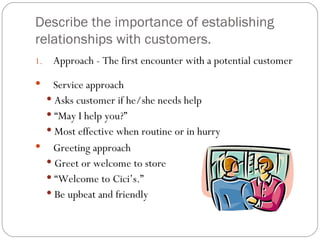
1.   Approach - The first encounter with a potential customer
  Service approach
  Asks customer if he/she needs help
  “May I help you?”
  Most effective when routine or in hurry
 Greeting approach
  Greet or welcome to store
  “Welcome to Cici’s.”
  Be upbeat and friendly
Describe the importance of establishing
relationships with customers.
1.   Approach Continued….
  Merchandise approach
  Comments on product
  Features / Benefits
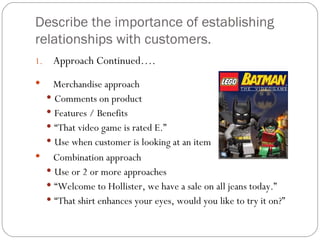
  “That video game is rated E.”
  Use when customer is looking at an item
 Combination approach
  Use or 2 or more approaches
  “Welcome to Hollister, we have a sale on all jeans today.”
  “That shirt enhances your eyes, would you like to try it on?”
Describe ways to discover customer
needs.
2. Determine Needs - find customer’s reasons for buying as
early as possible
   Observing
     Nonverbal cues for interest
   Listening
     Cues for wants and needs
   Questioning and Engaging
     Wants, use, previous experience
     Open ended
       More than yes or no answers
Describe the components of prescribing
 solutions to customer needs.

 3. Present the Product
 What does this product do? Demonstrate – Show them
   No more than 3 products at a time.
   Show a medium-priced product first!
   Highlight the features and benefits
     Descriptive adjectives and action verbs
     Avoid: nice, pretty, & fine
Describe the possibility of the customer not
wanting to buy
4. Handle Objections
   Legitimate reason, doubt, or hesitation for not buying
Objection vs. Excuse
Objection based on:
       -Need - urgency
       -Product – color, size, style
       -Source – past experience
       -Price – most common
       -Time – not ready to buy right “now”
Describe how to deal with objections
 Substitution
   Identify other products to meet needs
   “We have the same model in other colors.”
 Boomerang
   Toss objection back as a selling point
   “The engine has be reengineered and has more power.”
 Question
   Ask to learn more about the objection
   “Do you have children?”
Describe how to deal with objections
 Superior-point
   Offset objection with features & benefits
   “It is more expensive because of the superior sound system.”


 Denial
   Customer is misinformed
   “The elastic fabric will fit anyone’s foot.”
Describe how to deal with objections
 Demonstration
   Seeing is believing
   Let the customer sample or try


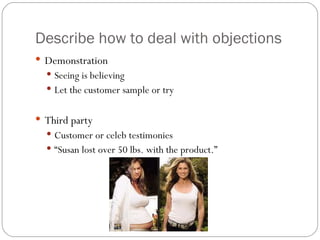
 Third party
   Customer or celeb testimonies
   “Susan lost over 50 lbs. with the product.”
Explain the importance of reaching
    closure in sales situations.

5. Close – Obtaining an agreement to buy
Looking for buying signals & be ready to close at all times
Help customers make decisions
Create ownership mentality
    “You” statements
    “You will enjoy driving this car on family vacations.”
Describe aspects of reaching closure in
sales situations.
 Which – Choose between 2 items
   “Which do you prefer, blue or red?”
 Standing-room only – limited # or price change, create
  urgency
   “I can’t promise I will have it tomorrow.”
 Direct – Ask for sale.
   “How many can I sign you up for?”
 Service – Mention services that are included
   “It is back by a 100% money back guarantee.”
Describe the use of suggestions selling
6. Suggestion Selling - Selling additional goods to enhance
the original purchase
    After a commitment to buy
    Make recommendations
    Suggestion should be helpful
Describe the use of suggestions selling
 Cross selling – Related merchandise
   Buying sneakers, suggest


 Upselling – lager quantities at a lower prices
   Buying a meal McDonalds, suggest


 Special sales opportunities – inform about any sales
   Buying pants, mention sale on shoes.
Describe the importance of reaffirming
the buyer-seller relationship.
7. Build Relationships
Follow-up
    Ensure satisfaction, call, card, email
Customer service
    Handle inquiries and complaints, keep customers satisfies
Keeping a client file
    Useful info. for future reference
Evaluate sales efforts
    What went well?, What can be improved?


http://www.youtube.com/watch?v=q9Mqibu1UPY
Describe ways to reaffirm the buyer-
seller relationship.
 Order processing
   In retail bag merchandise
   B2B necessary paperwork
 Departure
   Reassuring & thanking the customers
 Order fulfillment
   Retail – customer pays
   E-comm.- payment, packed, shipped
   Returns, exchanges, & refunds
Explain similarities/differences in the ways
businesses implement the selling process.
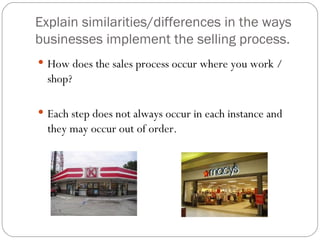
 How does the sales process occur where you work /
  shop?

 Each step does not always occur in each instance and
  they may occur out of order.
Explain the importance of using a
selling process.

 Each step may not occur in the same order
 But each step is critical in building a relationship with the
  customer and retaining their future business
 The sales process can be applied outside our sales, any
  persuasive situation
Explain techniques for establishing relationships with
customers/clients during the initial contact with them.

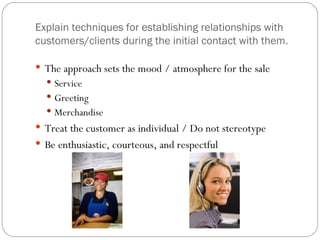
 The approach sets the mood / atmosphere for the sale
   Service
   Greeting
   Merchandise
 Treat the customer as individual / Do not stereotype
 Be enthusiastic, courteous, and respectful
Identify factors affecting the choice of techniques to use in
establishing relationships with customers/clients during initial
contact.
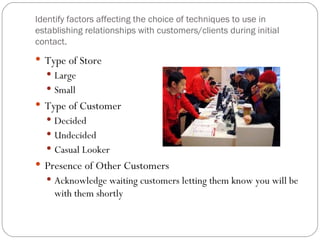
 Type of Store
   Large
   Small
 Type of Customer
   Decided
   Undecided
   Casual Looker
 Presence of Other Customers
   Acknowledge waiting customers letting them know you will be
     with them shortly
Describe characteristics of effective sales
openings.

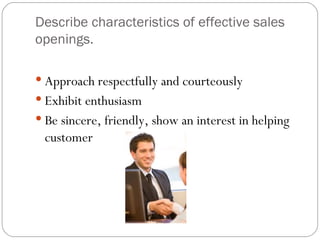
 Approach respectfully and courteously
 Exhibit enthusiasm
 Be sincere, friendly, show an interest in helping
 customer
Explain procedures for establishing relationships
with customers/clients during initial contacts.

 Be prepared to approach
 Appropriate timing
 Acknowledge all customers as quickly as possible and
  appropriate
 Determine appropriate opening statement
 Be prepared to move from approach to determine needs
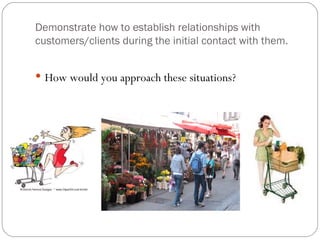
Demonstrate how to establish relationships with
customers/clients during the initial contact with them.


 How would you approach these situations?
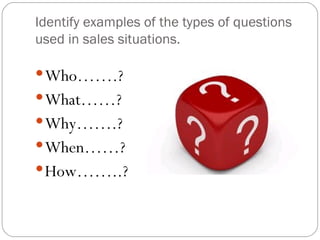
Identify examples of the types of questions
used in sales situations.

 Who…….?
 What……?
 Why…….?
 When……?
 How……..?
Explain the importance of questioning in
selling.

 Questioning should be used to uncover the customer’s
  needs or reasoning for buying

 It is important to ask the right questions so that you can
  match the customer’s needs with the appropriate
  product
Explain the timing of questions in selling.
 If you ask too soon
   Customer discouraged
   Customer confused
 If you ask too slowly
   Loose customer’s attention


 Pace questions with the pace of the customers responses
Describe the relationship of customer type
to questioning style.

 Decided – Ask immediately to determine merchandise
  desired
 Undecided – Ask about intended use to help select
  merchandise
 Just Looking – Be ready with a list of questions, open ended
  work best
Explain guidelines for questioning
customers.
 Show concern for customer
 Have a purpose for your questions
 Ask it simple
 Space questions out
 Limit questions to 3
   Material
   Style
   Intended Use
 Tailor questions to the customer type
 Encourage customer to ask questions
Types of Questions to ask:
 Open-ended questions – is designed to encourage a full,
  meaningful answer using the subject's own knowledge
  and/or feelings.
      Can not be answered with a “yes” or a “no”

 Assumptive questions – Leading questions either include the
  answer, point the listener in the right direction or include
  some form or carrot or stick to send them to the 'right'
  answer.
 Interpretive questions – can have more than one answer;
  sometimes you have to “read between the lines”
Explain the importance of meeting customers’
needs when recommending specific products.


 The benefits of the product should meet the customer’s
  needs
 By meeting a customer’s needs, he/she is likely to be satisfy
  and is more likely to return to the business in the future
Explain guidelines for using buying motives
when recommending specific products.

 What would motivate the customer to buy this product?
 Which features of this product meets the customer’s needs?
 ?
 ?
 ?
Explain guidelines for recommending a
specific product to customers.


 Show advertised / popular items
 Show medium priced items
 Limit the items to 3
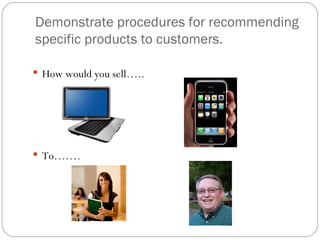
Demonstrate procedures for recommending
specific products to customers.

 How would you sell…..


 To…….

Marketing obj. 2.08

  • 1.
    Marketing Indicator 2.08 Understandsales processes and techniques to enhance customer relationships and to increase the likelihood of making sales.
  • 2.
    Identify the componentsof the selling process. 1. Approach Customer 2. Determine Needs 3. Present the Product 4. Overcome Objections 5. Close the Sale 6. Suggestion Selling 7. Build Relationships http://www.youtube.com/watch?v=bH4zIyGi6mk&NR=1
  • 3.
    Describe the importanceof establishing relationships with customers. 1. Approach - The first encounter with a potential customer  Service approach  Asks customer if he/she needs help  “May I help you?”  Most effective when routine or in hurry  Greeting approach  Greet or welcome to store  “Welcome to Cici’s.”  Be upbeat and friendly
  • 4.
    Describe the importanceof establishing relationships with customers. 1. Approach Continued….  Merchandise approach  Comments on product  Features / Benefits  “That video game is rated E.”  Use when customer is looking at an item  Combination approach  Use or 2 or more approaches  “Welcome to Hollister, we have a sale on all jeans today.”  “That shirt enhances your eyes, would you like to try it on?”
  • 5.
    Describe ways todiscover customer needs. 2. Determine Needs - find customer’s reasons for buying as early as possible  Observing  Nonverbal cues for interest  Listening  Cues for wants and needs  Questioning and Engaging  Wants, use, previous experience  Open ended  More than yes or no answers
  • 6.
    Describe the componentsof prescribing solutions to customer needs.  3. Present the Product  What does this product do? Demonstrate – Show them  No more than 3 products at a time.  Show a medium-priced product first!  Highlight the features and benefits  Descriptive adjectives and action verbs  Avoid: nice, pretty, & fine
  • 7.
    Describe the possibilityof the customer not wanting to buy 4. Handle Objections  Legitimate reason, doubt, or hesitation for not buying Objection vs. Excuse Objection based on: -Need - urgency -Product – color, size, style -Source – past experience -Price – most common -Time – not ready to buy right “now”
  • 8.
    Describe how todeal with objections  Substitution  Identify other products to meet needs  “We have the same model in other colors.”  Boomerang  Toss objection back as a selling point  “The engine has be reengineered and has more power.”  Question  Ask to learn more about the objection  “Do you have children?”
  • 9.
    Describe how todeal with objections  Superior-point  Offset objection with features & benefits  “It is more expensive because of the superior sound system.”  Denial  Customer is misinformed  “The elastic fabric will fit anyone’s foot.”
  • 10.
    Describe how todeal with objections  Demonstration  Seeing is believing  Let the customer sample or try  Third party  Customer or celeb testimonies  “Susan lost over 50 lbs. with the product.”
  • 11.
    Explain the importanceof reaching closure in sales situations. 5. Close – Obtaining an agreement to buy Looking for buying signals & be ready to close at all times Help customers make decisions Create ownership mentality  “You” statements  “You will enjoy driving this car on family vacations.”
  • 12.
    Describe aspects ofreaching closure in sales situations.  Which – Choose between 2 items  “Which do you prefer, blue or red?”  Standing-room only – limited # or price change, create urgency  “I can’t promise I will have it tomorrow.”  Direct – Ask for sale.  “How many can I sign you up for?”  Service – Mention services that are included  “It is back by a 100% money back guarantee.”
  • 13.
    Describe the useof suggestions selling 6. Suggestion Selling - Selling additional goods to enhance the original purchase  After a commitment to buy  Make recommendations  Suggestion should be helpful
  • 14.
    Describe the useof suggestions selling  Cross selling – Related merchandise  Buying sneakers, suggest  Upselling – lager quantities at a lower prices  Buying a meal McDonalds, suggest  Special sales opportunities – inform about any sales  Buying pants, mention sale on shoes.
  • 15.
    Describe the importanceof reaffirming the buyer-seller relationship. 7. Build Relationships Follow-up  Ensure satisfaction, call, card, email Customer service  Handle inquiries and complaints, keep customers satisfies Keeping a client file  Useful info. for future reference Evaluate sales efforts  What went well?, What can be improved? http://www.youtube.com/watch?v=q9Mqibu1UPY
  • 16.
    Describe ways toreaffirm the buyer- seller relationship.  Order processing  In retail bag merchandise  B2B necessary paperwork  Departure  Reassuring & thanking the customers  Order fulfillment  Retail – customer pays  E-comm.- payment, packed, shipped  Returns, exchanges, & refunds
  • 17.
    Explain similarities/differences inthe ways businesses implement the selling process.  How does the sales process occur where you work / shop?  Each step does not always occur in each instance and they may occur out of order.
  • 18.
    Explain the importanceof using a selling process.  Each step may not occur in the same order  But each step is critical in building a relationship with the customer and retaining their future business  The sales process can be applied outside our sales, any persuasive situation
  • 19.
    Explain techniques forestablishing relationships with customers/clients during the initial contact with them.  The approach sets the mood / atmosphere for the sale  Service  Greeting  Merchandise  Treat the customer as individual / Do not stereotype  Be enthusiastic, courteous, and respectful
  • 20.
    Identify factors affectingthe choice of techniques to use in establishing relationships with customers/clients during initial contact.  Type of Store  Large  Small  Type of Customer  Decided  Undecided  Casual Looker  Presence of Other Customers  Acknowledge waiting customers letting them know you will be with them shortly
  • 21.
    Describe characteristics ofeffective sales openings.  Approach respectfully and courteously  Exhibit enthusiasm  Be sincere, friendly, show an interest in helping customer
  • 22.
    Explain procedures forestablishing relationships with customers/clients during initial contacts.  Be prepared to approach  Appropriate timing  Acknowledge all customers as quickly as possible and appropriate  Determine appropriate opening statement  Be prepared to move from approach to determine needs
  • 23.
    Demonstrate how toestablish relationships with customers/clients during the initial contact with them.  How would you approach these situations?
  • 24.
    Identify examples ofthe types of questions used in sales situations.  Who…….?  What……?  Why…….?  When……?  How……..?
  • 25.
    Explain the importanceof questioning in selling.  Questioning should be used to uncover the customer’s needs or reasoning for buying  It is important to ask the right questions so that you can match the customer’s needs with the appropriate product
  • 26.
    Explain the timingof questions in selling.  If you ask too soon  Customer discouraged  Customer confused  If you ask too slowly  Loose customer’s attention  Pace questions with the pace of the customers responses
  • 27.
    Describe the relationshipof customer type to questioning style.  Decided – Ask immediately to determine merchandise desired  Undecided – Ask about intended use to help select merchandise  Just Looking – Be ready with a list of questions, open ended work best
  • 28.
    Explain guidelines forquestioning customers.  Show concern for customer  Have a purpose for your questions  Ask it simple  Space questions out  Limit questions to 3  Material  Style  Intended Use  Tailor questions to the customer type  Encourage customer to ask questions
  • 29.
    Types of Questionsto ask:  Open-ended questions – is designed to encourage a full, meaningful answer using the subject's own knowledge and/or feelings.  Can not be answered with a “yes” or a “no”  Assumptive questions – Leading questions either include the answer, point the listener in the right direction or include some form or carrot or stick to send them to the 'right' answer.  Interpretive questions – can have more than one answer; sometimes you have to “read between the lines”
  • 30.
    Explain the importanceof meeting customers’ needs when recommending specific products.  The benefits of the product should meet the customer’s needs  By meeting a customer’s needs, he/she is likely to be satisfy and is more likely to return to the business in the future
  • 31.
    Explain guidelines forusing buying motives when recommending specific products.  What would motivate the customer to buy this product?  Which features of this product meets the customer’s needs?  ?  ?  ?
  • 32.
    Explain guidelines forrecommending a specific product to customers.  Show advertised / popular items  Show medium priced items  Limit the items to 3
  • 33.
    Demonstrate procedures forrecommending specific products to customers.  How would you sell…..  To…….