Self-training with Noisy Student
improves ImageNet classification
Qizhe Xie , Minh-Thang Luong , Eduard Hovy , Quoc V. Le
Google Research, Brain Team, Carnegie Mellon University
1. Introduction
By showing the models only labeled images, we limit ourselves from making use of unlabeled images available in much
larger quantities to improve accuracy and robustness of state-of-the-art models.
They use a much larger corpus of unlabeled images, where a large fraction of images do not belong to ImageNet
training set distribution (i.e., they do not belong to any category in ImageNet).
teacher
labeled
images
train
teacher
unlabeled
images
1.
2.
pseudo
labels
generate
student
labeled
& pseudo
3.
train
4.
Summary of key results compared to previous state-of-the-art models
2. Self-training with Noisy Student
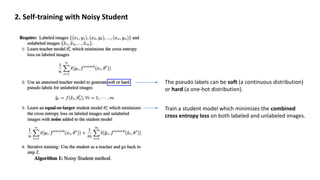
The pseudo labels can be soft (a continuous distribution)
or hard (a one-hot distribution).
Train a student model which minimizes the combined
cross entropy loss on both labeled and unlabeled images.
2. Self-training with Noisy Student
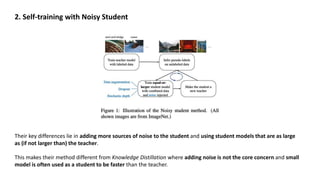
Their key differences lie in adding more sources of noise to the student and using student models that are as large
as (if not larger than) the teacher.
This makes their method different from Knowledge Distillation where adding noise is not the core concern and small
model is often used as a student to be faster than the teacher.
2. Self-training with Noisy Student
Noising Student (Input noise : data augmentation, Model noise : dropout & stochastic depth)
With data augmentation noise, the student must ensure that an image, when translated for example, should have
the same category as a non-translated image. This invariant encourages the student model to learn beyond the
teacher to make predictions with more difficult images.
When dropout and stochastic depth function are used as noise, the teacher behaves like an ensemble at inference
time (during which it generates pseudo labels), whereas the student behaves like a single model. In other words,
the student is forced to mimic a more powerful ensemble model.
Other Techniques (data filtering, balancing, soft pseudo labels)
Filter images that the teacher model has low confidences on since they are usually out-of-domain images.
As all classes in ImageNet have a similar number of labeled images, they duplicate images in classes where there
are not enough images of unlabeled images. For classes where they have too many images, they take the images
with the highest confidence.
3. Experiments
3.1. Experiment Details
• Labeled dataset. ImageNet 2012 ILSVRC challenge prediction task
• Unlabeled dataset. JFT-300M (ignore the labels and treat them as unlabeled data)
Run an EfficientNet-B0 trained on ImageNet over the JFT dataset to predict a label for each
image. Then select images that have confidence of the label higher than 0.3. For each class,
select at most 130K images that have the highest confidence.
• Architecture. EfficientNets as baseline models.
They also further scale up EfficientNetB7 and obtain EfficientNet-L2.
EfficientNet-L2 is wider and deeper than EfficientNet-B7 but uses a lower resolution, which
gives it more parameters to fit a large number of unlabeled images.
• Noise. They use stochastic depth, dropout, and RandAugment to noise the student.
3. Experiments
3.2. ImageNet Results
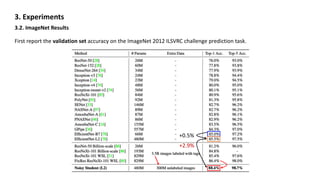
First report the validation set accuracy on the ImageNet 2012 ILSVRC challenge prediction task.
+0.5%
+2.9%
3. Experiments
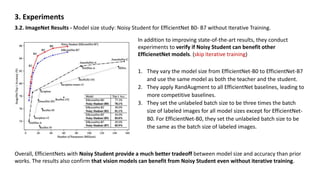
3.2. ImageNet Results - Model size study: Noisy Student for EfficientNet B0- B7 without Iterative Training.
In addition to improving state-of-the-art results, they conduct
experiments to verify if Noisy Student can benefit other
EfficienetNet models. (skip iterative training)
1. They vary the model size from EfficientNet-B0 to EfficientNet-B7
and use the same model as both the teacher and the student.
2. They apply RandAugment to all EfficientNet baselines, leading to
more competitive baselines.
3. They set the unlabeled batch size to be three times the batch
size of labeled images for all model sizes except for EfficientNet-
B0. For EfficientNet-B0, they set the unlabeled batch size to be
the same as the batch size of labeled images.
Overall, EfficientNets with Noisy Student provide a much better tradeoff between model size and accuracy than prior
works. The results also confirm that vision models can benefit from Noisy Student even without iterative training.
3. Experiments
3.3. Robustness Results on ImageNet-A, ImageNet-C and ImageNet-P
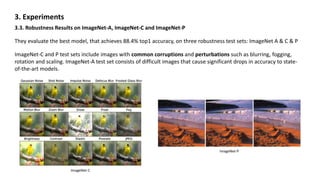
They evaluate the best model, that achieves 88.4% top1 accuracy, on three robustness test sets: ImageNet A & C & P
ImageNet-C and P test sets include images with common corruptions and perturbations such as blurring, fogging,
rotation and scaling. ImageNet-A test set consists of difficult images that cause significant drops in accuracy to state-
of-the-art models.
ImageNet-C
ImageNet-P
3. Experiments
3.3. Robustness Results on ImageNet-A, ImageNet-C and ImageNet-P
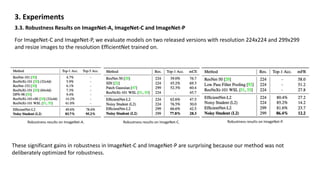
For ImageNet-C and ImageNet-P, we evaluate models on two released versions with resolution 224x224 and 299x299
and resize images to the resolution EfficientNet trained on.
Robustness results on ImageNet-A. Robustness results on ImageNet-C. Robustness results on ImageNet-P.
These significant gains in robustness in ImageNet-C and ImageNet-P are surprising because our method was not
deliberately optimized for robustness.
3. Experiments
3.3. Robustness Results on ImageNet-A, ImageNet-C and ImageNet-P
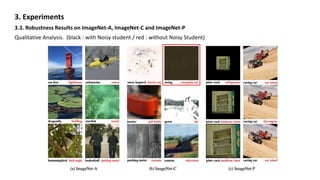
Qualitative Analysis. (black : with Noisy student / red : without Noisy Student)
3. Experiments
3.4. Adversarial Robustness Results
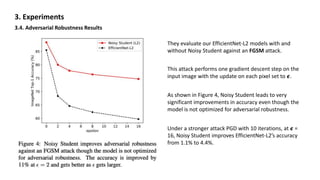
They evaluate our EfficientNet-L2 models with and
without Noisy Student against an FGSM attack.
This attack performs one gradient descent step on the
input image with the update on each pixel set to 𝟄.
As shown in Figure 4, Noisy Student leads to very
significant improvements in accuracy even though the
model is not optimized for adversarial robustness.
Under a stronger attack PGD with 10 iterations, at 𝟄 =
16, Noisy Student improves EfficientNet-L2’s accuracy
from 1.1% to 4.4%.
4. Ablation Study
4.1. The Importance of Noise in Self-training
Since they use soft pseudo labels generated from the teacher model, when the student is trained to be exactly the
same as the teacher model, the cross entropy loss on unlabeled data would be zero and the training signal would
vanish. Hence, a question that naturally arises is why the student can outperform the teacher with soft pseudo labels.
They investigate the importance of noising in two scenarios with different amounts of unlabeled data and different
teacher model accuracies.
In both cases, they gradually remove augmentation, stochastic depth and dropout for unlabeled images when training
the student model, while keeping them for labeled images. This way, the can isolate the influence of noising on
unlabeled images from the influence of preventing overfitting for labeled images.
In addition, they compare using a noised teacher and an unnoised teacher to study if it is necessary to disable noise
when generating pseudo labels.
4. Ablation Study
4.1. The Importance of Noise in Self-training
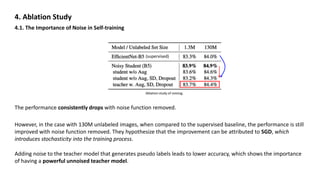
Ablation study of noising.
(supervised)
The performance consistently drops with noise function removed.
However, in the case with 130M unlabeled images, when compared to the supervised baseline, the performance is still
improved with noise function removed. They hypothesize that the improvement can be attributed to SGD, which
introduces stochasticity into the training process.
Adding noise to the teacher model that generates pseudo labels leads to lower accuracy, which shows the importance
of having a powerful unnoised teacher model.
4. Ablation Study
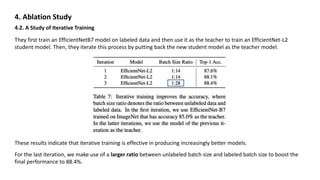
4.2. A Study of Iterative Training
They first train an EfficientNetB7 model on labeled data and then use it as the teacher to train an EfficientNet-L2
student model. Then, they iterate this process by putting back the new student model as the teacher model.
These results indicate that iterative training is effective in producing increasingly better models.
For the last iteration, we make use of a larger ratio between unlabeled batch size and labeled batch size to boost the
final performance to 88.4%.
4. Ablation Study
4.3. Additional Ablation Study Summarization
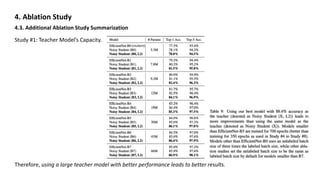
Study #1: Teacher Model’s Capacity.
Therefore, using a large teacher model with better performance leads to better results.
(student)
4. Ablation Study
4.3. Additional Ablation Study Summarization
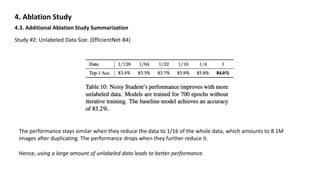
Study #2: Unlabeled Data Size. (EfficientNet-B4)
The performance stays similar when they reduce the data to 1/16 of the whole data, which amounts to 8.1M
images after duplicating. The performance drops when they further reduce it.
Hence, using a large amount of unlabeled data leads to better performance.
4. Ablation Study
4.3. Additional Ablation Study Summarization
Study #3: Hard Pseudo-Label vs. Soft Pseudo-Label on Out-of-domain Data. (EfficientNet-B0)
Since a teacher model’s confidence on an image can be a good indicator of whether it is an out-of-domain image, they
consider the high-confidence images as in-domain images and the low-confidence images as out-of-domain images.
They sample 1.3M images in each confidence interval [0.0, 0.1], [0.1, 0.2], · · · , [0.9, 1.0].
(1) Soft pseudo labels and hard pseudo labels can both lead to
significant improvements with in-domain unlabeled images i.e.,
high-confidence images.
(2) With out-of-domain unlabeled images, hard pseudo labels can
hurt the performance while soft pseudo labels lead to robust
performance.
4. Ablation Study
4.3. Additional Ablation Study Summarization
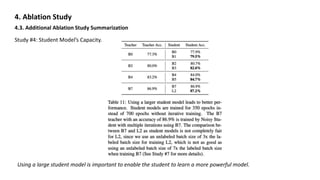
Study #4: Student Model’s Capacity.
Using a large student model is important to enable the student to learn a more powerful model.
4. Ablation Study
4.3. Additional Ablation Study Summarization
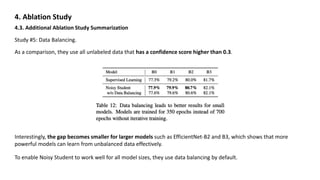
Study #5: Data Balancing.
As a comparison, they use all unlabeled data that has a confidence score higher than 0.3.
Interestingly, the gap becomes smaller for larger models such as EfficientNet-B2 and B3, which shows that more
powerful models can learn from unbalanced data effectively.
To enable Noisy Student to work well for all model sizes, they use data balancing by default.
4. Ablation Study
4.3. Additional Ablation Study Summarization
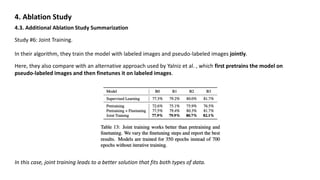
In their algorithm, they train the model with labeled images and pseudo-labeled images jointly.
Here, they also compare with an alternative approach used by Yalniz et al. , which first pretrains the model on
pseudo-labeled images and then finetunes it on labeled images.
In this case, joint training leads to a better solution that fits both types of data.
Study #6: Joint Training.
4. Ablation Study
4.3. Additional Ablation Study Summarization
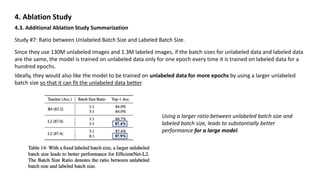
Study #7: Ratio between Unlabeled Batch Size and Labeled Batch Size.
Since they use 130M unlabeled images and 1.3M labeled images, if the batch sizes for unlabeled data and labeled data
are the same, the model is trained on unlabeled data only for one epoch every time it is trained on labeled data for a
hundred epochs.
Ideally, they would also like the model to be trained on unlabeled data for more epochs by using a larger unlabeled
batch size so that it can fit the unlabeled data better.
Using a larger ratio between unlabeled batch size and
labeled batch size, leads to substantially better
performance for a large model.
4. Ablation Study
4.3. Additional Ablation Study Summarization
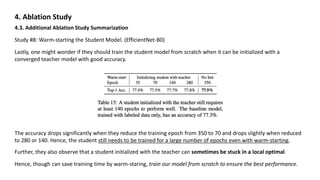
Study #8: Warm-starting the Student Model. (EfficientNet-B0)
Lastly, one might wonder if they should train the student model from scratch when it can be initialized with a
converged teacher model with good accuracy.
Further, they also observe that a student initialized with the teacher can sometimes be stuck in a local optimal.
Hence, though can save training time by warm-staring, train our model from scratch to ensure the best performance.
The accuracy drops significantly when they reduce the training epoch from 350 to 70 and drops slightly when reduced
to 280 or 140. Hence, the student still needs to be trained for a large number of epochs even with warm-starting.
6. Conclusion
Prior works on weakly-supervised learning required billions of weakly labeled data to improve state-of-the-art
ImageNet models. In this work, they showed that it is possible to use unlabeled images to significantly advance both
accuracy and robustness of state-of-the-art ImageNet models.
They improved self-training by adding noise to the student, hence the name Noisy Student, to learn beyond the
teacher’s knowledge.
Their experiments showed that self-training with Noisy Student and EfficientNet can achieve an accuracy of 88.4%
which is 2.9% higher than without Noisy Student. This result is also a new state-of-the-art and 2.0% better than the
previous best method that used an order of magnitude more weakly labeled data.
An important contribution of their work was to show that Noisy Student boosts robustness in computer vision models.
Their experiments showed that their model significantly improves performances on ImageNet-A, C and P.

Self-training with Noisy Student improves ImageNet classification

  • 1.
    Self-training with NoisyStudent improves ImageNet classification Qizhe Xie , Minh-Thang Luong , Eduard Hovy , Quoc V. Le Google Research, Brain Team, Carnegie Mellon University
  • 2.
    1. Introduction By showingthe models only labeled images, we limit ourselves from making use of unlabeled images available in much larger quantities to improve accuracy and robustness of state-of-the-art models. They use a much larger corpus of unlabeled images, where a large fraction of images do not belong to ImageNet training set distribution (i.e., they do not belong to any category in ImageNet). teacher labeled images train teacher unlabeled images 1. 2. pseudo labels generate student labeled & pseudo 3. train 4. Summary of key results compared to previous state-of-the-art models
  • 3.
    2. Self-training withNoisy Student The pseudo labels can be soft (a continuous distribution) or hard (a one-hot distribution). Train a student model which minimizes the combined cross entropy loss on both labeled and unlabeled images.
  • 4.
    2. Self-training withNoisy Student Their key differences lie in adding more sources of noise to the student and using student models that are as large as (if not larger than) the teacher. This makes their method different from Knowledge Distillation where adding noise is not the core concern and small model is often used as a student to be faster than the teacher.
  • 5.
    2. Self-training withNoisy Student Noising Student (Input noise : data augmentation, Model noise : dropout & stochastic depth) With data augmentation noise, the student must ensure that an image, when translated for example, should have the same category as a non-translated image. This invariant encourages the student model to learn beyond the teacher to make predictions with more difficult images. When dropout and stochastic depth function are used as noise, the teacher behaves like an ensemble at inference time (during which it generates pseudo labels), whereas the student behaves like a single model. In other words, the student is forced to mimic a more powerful ensemble model. Other Techniques (data filtering, balancing, soft pseudo labels) Filter images that the teacher model has low confidences on since they are usually out-of-domain images. As all classes in ImageNet have a similar number of labeled images, they duplicate images in classes where there are not enough images of unlabeled images. For classes where they have too many images, they take the images with the highest confidence.
  • 6.
    3. Experiments 3.1. ExperimentDetails • Labeled dataset. ImageNet 2012 ILSVRC challenge prediction task • Unlabeled dataset. JFT-300M (ignore the labels and treat them as unlabeled data) Run an EfficientNet-B0 trained on ImageNet over the JFT dataset to predict a label for each image. Then select images that have confidence of the label higher than 0.3. For each class, select at most 130K images that have the highest confidence. • Architecture. EfficientNets as baseline models. They also further scale up EfficientNetB7 and obtain EfficientNet-L2. EfficientNet-L2 is wider and deeper than EfficientNet-B7 but uses a lower resolution, which gives it more parameters to fit a large number of unlabeled images. • Noise. They use stochastic depth, dropout, and RandAugment to noise the student.
  • 7.
    3. Experiments 3.2. ImageNetResults First report the validation set accuracy on the ImageNet 2012 ILSVRC challenge prediction task. +0.5% +2.9%
  • 8.
    3. Experiments 3.2. ImageNetResults - Model size study: Noisy Student for EfficientNet B0- B7 without Iterative Training. In addition to improving state-of-the-art results, they conduct experiments to verify if Noisy Student can benefit other EfficienetNet models. (skip iterative training) 1. They vary the model size from EfficientNet-B0 to EfficientNet-B7 and use the same model as both the teacher and the student. 2. They apply RandAugment to all EfficientNet baselines, leading to more competitive baselines. 3. They set the unlabeled batch size to be three times the batch size of labeled images for all model sizes except for EfficientNet- B0. For EfficientNet-B0, they set the unlabeled batch size to be the same as the batch size of labeled images. Overall, EfficientNets with Noisy Student provide a much better tradeoff between model size and accuracy than prior works. The results also confirm that vision models can benefit from Noisy Student even without iterative training.
  • 9.
    3. Experiments 3.3. RobustnessResults on ImageNet-A, ImageNet-C and ImageNet-P They evaluate the best model, that achieves 88.4% top1 accuracy, on three robustness test sets: ImageNet A & C & P ImageNet-C and P test sets include images with common corruptions and perturbations such as blurring, fogging, rotation and scaling. ImageNet-A test set consists of difficult images that cause significant drops in accuracy to state- of-the-art models. ImageNet-C ImageNet-P
  • 10.
    3. Experiments 3.3. RobustnessResults on ImageNet-A, ImageNet-C and ImageNet-P For ImageNet-C and ImageNet-P, we evaluate models on two released versions with resolution 224x224 and 299x299 and resize images to the resolution EfficientNet trained on. Robustness results on ImageNet-A. Robustness results on ImageNet-C. Robustness results on ImageNet-P. These significant gains in robustness in ImageNet-C and ImageNet-P are surprising because our method was not deliberately optimized for robustness.
  • 11.
    3. Experiments 3.3. RobustnessResults on ImageNet-A, ImageNet-C and ImageNet-P Qualitative Analysis. (black : with Noisy student / red : without Noisy Student)
  • 12.
    3. Experiments 3.4. AdversarialRobustness Results They evaluate our EfficientNet-L2 models with and without Noisy Student against an FGSM attack. This attack performs one gradient descent step on the input image with the update on each pixel set to 𝟄. As shown in Figure 4, Noisy Student leads to very significant improvements in accuracy even though the model is not optimized for adversarial robustness. Under a stronger attack PGD with 10 iterations, at 𝟄 = 16, Noisy Student improves EfficientNet-L2’s accuracy from 1.1% to 4.4%.
  • 13.
    4. Ablation Study 4.1.The Importance of Noise in Self-training Since they use soft pseudo labels generated from the teacher model, when the student is trained to be exactly the same as the teacher model, the cross entropy loss on unlabeled data would be zero and the training signal would vanish. Hence, a question that naturally arises is why the student can outperform the teacher with soft pseudo labels. They investigate the importance of noising in two scenarios with different amounts of unlabeled data and different teacher model accuracies. In both cases, they gradually remove augmentation, stochastic depth and dropout for unlabeled images when training the student model, while keeping them for labeled images. This way, the can isolate the influence of noising on unlabeled images from the influence of preventing overfitting for labeled images. In addition, they compare using a noised teacher and an unnoised teacher to study if it is necessary to disable noise when generating pseudo labels.
  • 14.
    4. Ablation Study 4.1.The Importance of Noise in Self-training Ablation study of noising. (supervised) The performance consistently drops with noise function removed. However, in the case with 130M unlabeled images, when compared to the supervised baseline, the performance is still improved with noise function removed. They hypothesize that the improvement can be attributed to SGD, which introduces stochasticity into the training process. Adding noise to the teacher model that generates pseudo labels leads to lower accuracy, which shows the importance of having a powerful unnoised teacher model.
  • 15.
    4. Ablation Study 4.2.A Study of Iterative Training They first train an EfficientNetB7 model on labeled data and then use it as the teacher to train an EfficientNet-L2 student model. Then, they iterate this process by putting back the new student model as the teacher model. These results indicate that iterative training is effective in producing increasingly better models. For the last iteration, we make use of a larger ratio between unlabeled batch size and labeled batch size to boost the final performance to 88.4%.
  • 16.
    4. Ablation Study 4.3.Additional Ablation Study Summarization Study #1: Teacher Model’s Capacity. Therefore, using a large teacher model with better performance leads to better results. (student)
  • 17.
    4. Ablation Study 4.3.Additional Ablation Study Summarization Study #2: Unlabeled Data Size. (EfficientNet-B4) The performance stays similar when they reduce the data to 1/16 of the whole data, which amounts to 8.1M images after duplicating. The performance drops when they further reduce it. Hence, using a large amount of unlabeled data leads to better performance.
  • 18.
    4. Ablation Study 4.3.Additional Ablation Study Summarization Study #3: Hard Pseudo-Label vs. Soft Pseudo-Label on Out-of-domain Data. (EfficientNet-B0) Since a teacher model’s confidence on an image can be a good indicator of whether it is an out-of-domain image, they consider the high-confidence images as in-domain images and the low-confidence images as out-of-domain images. They sample 1.3M images in each confidence interval [0.0, 0.1], [0.1, 0.2], · · · , [0.9, 1.0]. (1) Soft pseudo labels and hard pseudo labels can both lead to significant improvements with in-domain unlabeled images i.e., high-confidence images. (2) With out-of-domain unlabeled images, hard pseudo labels can hurt the performance while soft pseudo labels lead to robust performance.
  • 19.
    4. Ablation Study 4.3.Additional Ablation Study Summarization Study #4: Student Model’s Capacity. Using a large student model is important to enable the student to learn a more powerful model.
  • 20.
    4. Ablation Study 4.3.Additional Ablation Study Summarization Study #5: Data Balancing. As a comparison, they use all unlabeled data that has a confidence score higher than 0.3. Interestingly, the gap becomes smaller for larger models such as EfficientNet-B2 and B3, which shows that more powerful models can learn from unbalanced data effectively. To enable Noisy Student to work well for all model sizes, they use data balancing by default.
  • 21.
    4. Ablation Study 4.3.Additional Ablation Study Summarization In their algorithm, they train the model with labeled images and pseudo-labeled images jointly. Here, they also compare with an alternative approach used by Yalniz et al. , which first pretrains the model on pseudo-labeled images and then finetunes it on labeled images. In this case, joint training leads to a better solution that fits both types of data. Study #6: Joint Training.
  • 22.
    4. Ablation Study 4.3.Additional Ablation Study Summarization Study #7: Ratio between Unlabeled Batch Size and Labeled Batch Size. Since they use 130M unlabeled images and 1.3M labeled images, if the batch sizes for unlabeled data and labeled data are the same, the model is trained on unlabeled data only for one epoch every time it is trained on labeled data for a hundred epochs. Ideally, they would also like the model to be trained on unlabeled data for more epochs by using a larger unlabeled batch size so that it can fit the unlabeled data better. Using a larger ratio between unlabeled batch size and labeled batch size, leads to substantially better performance for a large model.
  • 23.
    4. Ablation Study 4.3.Additional Ablation Study Summarization Study #8: Warm-starting the Student Model. (EfficientNet-B0) Lastly, one might wonder if they should train the student model from scratch when it can be initialized with a converged teacher model with good accuracy. Further, they also observe that a student initialized with the teacher can sometimes be stuck in a local optimal. Hence, though can save training time by warm-staring, train our model from scratch to ensure the best performance. The accuracy drops significantly when they reduce the training epoch from 350 to 70 and drops slightly when reduced to 280 or 140. Hence, the student still needs to be trained for a large number of epochs even with warm-starting.
  • 24.
    6. Conclusion Prior workson weakly-supervised learning required billions of weakly labeled data to improve state-of-the-art ImageNet models. In this work, they showed that it is possible to use unlabeled images to significantly advance both accuracy and robustness of state-of-the-art ImageNet models. They improved self-training by adding noise to the student, hence the name Noisy Student, to learn beyond the teacher’s knowledge. Their experiments showed that self-training with Noisy Student and EfficientNet can achieve an accuracy of 88.4% which is 2.9% higher than without Noisy Student. This result is also a new state-of-the-art and 2.0% better than the previous best method that used an order of magnitude more weakly labeled data. An important contribution of their work was to show that Noisy Student boosts robustness in computer vision models. Their experiments showed that their model significantly improves performances on ImageNet-A, C and P.