SELF EMULSIFYING DRUG DELIVERY
SYSTEM
BY
Dipesh Adesh Gamare
CONTENT
• Introduction
• Mechanism of action
• Advantages/ Disadvantages
• Composition of SEDDS
• Preparation of SEDDS
• Stability testing
• References
Introduction
• Concept introduced by Hoar and Schulman in 1940's who generated a clear single
phase solution by titrating a milky emulsion with hexanol.
• Alternative names for these systems are often used, such as transparent emulsion,
swollen micelle, micellar solution, and solubilized oil.
• Schulman and co-worker in 1959 subsequently coined the term microemulsion.
• Microemulsions are an isotropic mixture of natural or synthetic oils, solid or liquid
surfactants, co-surfactant and drugs.
• Upon mild agitation followed by dilution in aqueous media, such as gastrointestinal
(GI) fluids, the system can form fine oil in water (O/W) microemulsions which
usually have droplet size less than 100 nm.
• Micro emulsion have been successively used to improve the solubility, chemical
stability and oral bioavailability of poorly water soluble drugs. (class II & IV as per
BCS classification)
Mechanism of SEDDS
The generation of microemulsion droplets is thought to be caused by surfactant-mediated
intricate film formation at the oil–water interface.
• Emulsification happens when the transformation in entropy favoring dispersion is better than
the energy required for dispersion surface area amplification and the free energy (G) is
negative, according to the thermodynamic theory of microemulsion production.
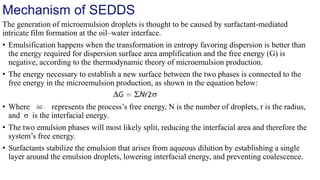
• The energy necessary to establish a new surface between the two phases is connected to the
free energy in the microemulsion production, as shown in the equation below:
• Where represents the process’s free energy, N is the number of droplets, r is the radius,
and σ is the interfacial energy.
• The two emulsion phases will most likely split, reducing the interfacial area and therefore the
system’s free energy.
• Surfactants stabilize the emulsion that arises from aqueous dilution by establishing a single
layer around the emulsion droplets, lowering interfacial energy, and preventing coalescence.
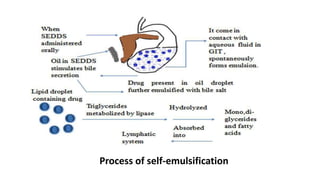
Process of self-emulsification
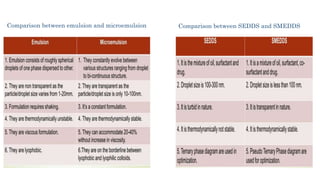
Comparison between emulsion and microemulsion Comparison between SEDDS and SMEDDS
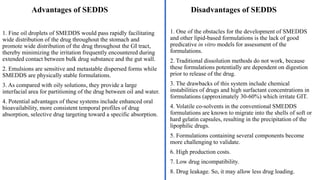
Advantages of SEDDS
1. Fine oil droplets of SMEDDS would pass rapidly facilitating
wide distribution of the drug throughout the stomach and
promote wide distribution of the drug throughout the GI tract,
thereby minimizing the irritation frequently encountered during
extended contact between bulk drug substance and the gut wall.
2. Emulsions are sensitive and metastable dispersed forms while
SMEDDS are physically stable formulations.
3. As compared with oily solutions, they provide a large
interfacial area for partitioning of the drug between oil and water.
4. Potential advantages of these systems include enhanced oral
bioavailability, more consistent temporal profiles of drug
absorption, selective drug targeting toward a specific absorption.
Disadvantages of SEDDS
1. One of the obstacles for the development of SMEDDS
and other lipid-based formulations is the lack of good
predicative in vitro models for assessment of the
formulations.
2. Traditional dissolution methods do not work, because
these formulations potentially are dependent on digestion
prior to release of the drug.
3. The drawbacks of this system include chemical
instabilities of drugs and high surfactant concentrations in
formulations (approximately 30-60%) which irritate GIT.
4. Volatile co-solvents in the conventional SMEDDS
formulations are known to migrate into the shells of soft or
hard gelatin capsules, resulting in the precipitation of the
lipophilic drugs.
5. Formulations containing several components become
more challenging to validate.
6. High production costs.
7. Low drug incompatibility.
8. Drug leakage. So, it may allow less drug loading.
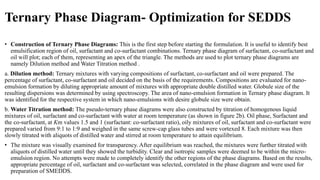
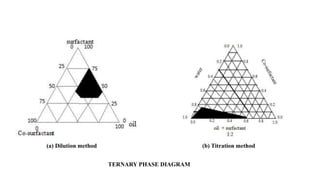
Ternary Phase Diagram- Optimization for SEDDS
• Construction of Ternary Phase Diagrams: This is the first step before starting the formulation. It is useful to identify best
emulsification region of oil, surfactant and co-surfactant combinations. Ternary phase diagram of surfactant, co-surfactant and
oil will plot; each of them, representing an apex of the triangle. The methods are used to plot ternary phase diagrams are
namely Dilution method and Water Titration method .
a. Dilution method: Ternary mixtures with varying compositions of surfactant, co-surfactant and oil were prepared. The
percentage of surfactant, co-surfactant and oil decided on the basis of the requirements. Compositions are evaluated for nano-
emulsion formation by diluting appropriate amount of mixtures with appropriate double distilled water. Globule size of the
resulting dispersions was determined by using spectroscopy. The area of nano-emulsion formation in Ternary phase diagram. It
was identified for the respective system in which nano-emulsions with desire globule size were obtain.
b. Water Titration method: The pseudo-ternary phase diagrams were also constructed by titration of homogenous liquid
mixtures of oil, surfactant and co-surfactant with water at room temperature (as shown in figure 2b). Oil phase, Surfactant and
the co-surfactant, at Km values 1.5 and 1 (surfactant: co-surfactant ratio), oily mixtures of oil, surfactant and co-surfactant were
prepared varied from 9:1 to 1:9 and weighed in the same screw-cap glass tubes and were vortexed 8. Each mixture was then
slowly titrated with aliquots of distilled water and stirred at room temperature to attain equilibrium.
• The mixture was visually examined for transparency. After equilibrium was reached, the mixtures were further titrated with
aliquots of distilled water until they showed the turbidity. Clear and isotropic samples were deemed to be within the micro-
emulsion region. No attempts were made to completely identify the other regions of the phase diagrams. Based on the results,
appropriate percentage of oil, surfactant and co-surfactant was selected, correlated in the phase diagram and were used for
preparation of SMEDDS.
(a) Dilution method (b) Titration method
TERNARY PHASE DIAGRAM
Composition of SEDDS
• These isotropic systems are usually easier to formulate than ordinary emulsion. The type of associated structure
formed from these components at particular temperature depends not only on the chemical nature of each
component but also on their relative concentration. SMEDDS formulation contains following 4 components:
1) Oil phase: Oils from natural sources and their derivatives. The extension of a microemulsion region generally
depends on the nature of oil. This is due to the differences in oil penetration onto the surfactant layer.
• Examples: castor oil, sunflower oil, sesame oil, hydrogenated specialty oils
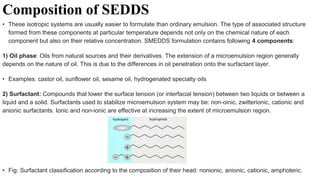
2) Surfactant: Compounds that lower the surface tension (or interfacial tension) between two liquids or between a
liquid and a solid. Surfactants used to stabilize microemulsion system may be: non-oinic, zwitterionic, cationic and
anionic surfactants. Ionic and non-ionic are effective at increasing the extent of microemulsion region.
• Fig: Surfactant classification according to the composition of their head: nonionic, anionic, cationic, amphoteric.
• Microemulsion formulations can be administered as a form of water-in-oil microemulsion of surfactant-oil mixture,
and are expected to convert to oil-in- water microemulsion in small intestine.
• Examples: Polyoxethylene (20) sorbitan monooleate (Tween 80) Polyoxyethylene glyceryl trioleate (Tagat TO)
Propylene glycol monocaprylate (Capryl 90).
3) Co-surfactant: Under certain condition, a combination of oil, water and surfactant will result in a phase where there
are orderly planes of oil and water separated by monolayer of surfactant. Co-surfactants are added to further lower the
interfacial tension between the oil and water phase, to fluidize the hydrocarbon region of interfacial-film, and to
influence the film curvature.
• Examples: short chained alcohol (ethanol, propanol, butanol) Glycols (propylene glycols)
4) Co-solvents: The production of an optimum SMEDDS require relatively high concentrations (generally more then
30% w/w) of surfactants. Organic solvents like ethanol, propylene glycol (PG), polyethylene glycol (PEG) are suitable
for oral delivery.
• They enable dissolution of large quantities of either the hydrophilic surfactant or the drug in lipid base.
• Alcohol-free formulations drug dissolution ability is limited. have been designed, but their lipophilic
Preparation of SEDDS
1) High pressure homogenizer
• High pressure is required for the preparation of nano-formulation.
• Fine emulsion is formed depending upon the application of high sheer stress. There are two theories that
can explain the droplet size including turbulence and cavitation.
• Nano-emulsion of smaller than 100nm droplet size can be produced by this method. Various factors are
responsible for the production of droplet size of nanoemulsion using high pressure homogenizers, i.e.
type of homogenizer, composition of sample and the operating conditions of homogenizer including time,
intensity, and temperature.
• High pressure homogenization is commonly applied to produce nanoemulsions of food, medicinal, and
biotechnological ingredients.
2) High energy approach
• High mechanical energy is required for the high energyapproach which leads the formation of
nanoemulsion by mixing surfactants, oil, and co-solvent.
• Formulation of nanoemulsion extensively uses high energy methods.
• Strong disruptive forces are provided by the high mechanical energy that are used for breaking up the
droplets of large size intodroplets of nano size so that nanoemulsions produced would be of high kinetic
energy.
• Basically, SNEDDS require low energy and depend upon the phenomena of self-emulsification
3) Micro-fluidization
• Micro-fluidizer is a device required by the method of microfluidization.
• The product is pushed toward the interaction chamber by the positive displacement pump.
• A microchannel is a small droplet channel found in this system.
• The product formed is then transferred to the impingement area through the microchannels
where nanoemulsion of very fine droplets is produced.
• Then, course emulsion is produced when the mixture of aqueous phase and oil phase is added
into the homogenizer.
• Further processing leads to the formation of a transparent and homogeneously stable
nanoemulsion
4) Sonication method
• One of the useful methods for the formation of SNEDDS issonication method.
• With regard to cleaning and operation, the method of ultrasonication is better as compared to
other methods of high energy. In the emulsifications by ultrasonication, the macroemulsions
are broken down into nanoemulsion by the cavitation forces provided by the ultrasonic waves.
• This process reduces the droplet size of the emulsion and leads to an emulsion of nano size.
Preparation of SMEDDS
• Drug has to dissolve into oil phase(lipophilic part) of microemulsion. Water phase is combined with the surfactant
and then cosurfactant is added slowly with constant stirring until the system is become transparent.
• The amount of surfactant and co-surfactant to be added and the parent oil phase that can be incorporated is
determined with the help of pseud ternary phase diagram.
• Ultrasonicator can finally use to achieve the desired range for the dispersed phase.
• It is then allowed to equilibrate.
• Gel may be prepared by the addition of the gelling agent to above microemulsion.
METHOD OF PREPARATION :
1. Phase Titration Method
2. Phase inversion Method
1. Phase Titration Method
• Dilution of an oil-surfactant mixture with water.(w/o)
• Dilution of a water surfactant mixture with oil (o/w)
• Mixing all components at once. In some systems, the order of ingredient addition may determine whether
a microemulsion forms.
2. Phase inversion method
• Phase Inversion Temperature (PIT), i.e, the temperature range in which an o/w microemulsion inverts to
a w/o type or vice versa.
Stability of SEDDS
• Temperature stability: SMEEDS is diluted with purified distilled water and to check
the temperature stability, they were kept at 3 different temperature range (4°C,
25°C,40°C) and evidence of any phase separation, flocculation or precipitation is
observed.
• Centrifugation: SMEDDS formulation was diluted with purified distilled water and
was centrifuged at 1000 rpm for 15 min at 0°C and observed for any change in
homogeneity.
• In vitro release: SMEDDS was placed in dialysis bag during release period to
compare the release pattern with conventional tablet. 10ml of sample solution was
withdrawn at predetermined time intervals, filtered through 0.45 micrometer
membrane filter, dilute suitably and analysed spectrophotometrically.
• Percentage drug dissolved at different time intervals was calculated using Beer
Lambert's equation.
Marketed formulations of SMEDDS
References
1. Emulsifying drug delivery system: a review. (2013). International Journal of
Pharmaceutical Sciences and Research, 4(12). https://doi.org/10.13040/ijpsr.0975-
8232.4(12).4494-07
2. Salawi, A. (2022). Self-emulsifying drug delivery systems: a novel approach to deliver
drugs. Drug Delivery, 29(1), 1811–1823. https://doi.org/10.1080/10717544.2022.2083724
THANK YOU!

SELF-EMULSIFYING DRUG DELIVERY SYSTEM (SEDDS).pptx

  • 1.
    SELF EMULSIFYING DRUGDELIVERY SYSTEM BY Dipesh Adesh Gamare
  • 2.
    CONTENT • Introduction • Mechanismof action • Advantages/ Disadvantages • Composition of SEDDS • Preparation of SEDDS • Stability testing • References
  • 3.
    Introduction • Concept introducedby Hoar and Schulman in 1940's who generated a clear single phase solution by titrating a milky emulsion with hexanol. • Alternative names for these systems are often used, such as transparent emulsion, swollen micelle, micellar solution, and solubilized oil. • Schulman and co-worker in 1959 subsequently coined the term microemulsion. • Microemulsions are an isotropic mixture of natural or synthetic oils, solid or liquid surfactants, co-surfactant and drugs. • Upon mild agitation followed by dilution in aqueous media, such as gastrointestinal (GI) fluids, the system can form fine oil in water (O/W) microemulsions which usually have droplet size less than 100 nm. • Micro emulsion have been successively used to improve the solubility, chemical stability and oral bioavailability of poorly water soluble drugs. (class II & IV as per BCS classification)
  • 4.
    Mechanism of SEDDS Thegeneration of microemulsion droplets is thought to be caused by surfactant-mediated intricate film formation at the oil–water interface. • Emulsification happens when the transformation in entropy favoring dispersion is better than the energy required for dispersion surface area amplification and the free energy (G) is negative, according to the thermodynamic theory of microemulsion production. • The energy necessary to establish a new surface between the two phases is connected to the free energy in the microemulsion production, as shown in the equation below: • Where represents the process’s free energy, N is the number of droplets, r is the radius, and σ is the interfacial energy. • The two emulsion phases will most likely split, reducing the interfacial area and therefore the system’s free energy. • Surfactants stabilize the emulsion that arises from aqueous dilution by establishing a single layer around the emulsion droplets, lowering interfacial energy, and preventing coalescence.
  • 5.
  • 6.
    Comparison between emulsionand microemulsion Comparison between SEDDS and SMEDDS
  • 7.
    Advantages of SEDDS 1.Fine oil droplets of SMEDDS would pass rapidly facilitating wide distribution of the drug throughout the stomach and promote wide distribution of the drug throughout the GI tract, thereby minimizing the irritation frequently encountered during extended contact between bulk drug substance and the gut wall. 2. Emulsions are sensitive and metastable dispersed forms while SMEDDS are physically stable formulations. 3. As compared with oily solutions, they provide a large interfacial area for partitioning of the drug between oil and water. 4. Potential advantages of these systems include enhanced oral bioavailability, more consistent temporal profiles of drug absorption, selective drug targeting toward a specific absorption. Disadvantages of SEDDS 1. One of the obstacles for the development of SMEDDS and other lipid-based formulations is the lack of good predicative in vitro models for assessment of the formulations. 2. Traditional dissolution methods do not work, because these formulations potentially are dependent on digestion prior to release of the drug. 3. The drawbacks of this system include chemical instabilities of drugs and high surfactant concentrations in formulations (approximately 30-60%) which irritate GIT. 4. Volatile co-solvents in the conventional SMEDDS formulations are known to migrate into the shells of soft or hard gelatin capsules, resulting in the precipitation of the lipophilic drugs. 5. Formulations containing several components become more challenging to validate. 6. High production costs. 7. Low drug incompatibility. 8. Drug leakage. So, it may allow less drug loading.
  • 8.
    Ternary Phase Diagram-Optimization for SEDDS • Construction of Ternary Phase Diagrams: This is the first step before starting the formulation. It is useful to identify best emulsification region of oil, surfactant and co-surfactant combinations. Ternary phase diagram of surfactant, co-surfactant and oil will plot; each of them, representing an apex of the triangle. The methods are used to plot ternary phase diagrams are namely Dilution method and Water Titration method . a. Dilution method: Ternary mixtures with varying compositions of surfactant, co-surfactant and oil were prepared. The percentage of surfactant, co-surfactant and oil decided on the basis of the requirements. Compositions are evaluated for nano- emulsion formation by diluting appropriate amount of mixtures with appropriate double distilled water. Globule size of the resulting dispersions was determined by using spectroscopy. The area of nano-emulsion formation in Ternary phase diagram. It was identified for the respective system in which nano-emulsions with desire globule size were obtain. b. Water Titration method: The pseudo-ternary phase diagrams were also constructed by titration of homogenous liquid mixtures of oil, surfactant and co-surfactant with water at room temperature (as shown in figure 2b). Oil phase, Surfactant and the co-surfactant, at Km values 1.5 and 1 (surfactant: co-surfactant ratio), oily mixtures of oil, surfactant and co-surfactant were prepared varied from 9:1 to 1:9 and weighed in the same screw-cap glass tubes and were vortexed 8. Each mixture was then slowly titrated with aliquots of distilled water and stirred at room temperature to attain equilibrium. • The mixture was visually examined for transparency. After equilibrium was reached, the mixtures were further titrated with aliquots of distilled water until they showed the turbidity. Clear and isotropic samples were deemed to be within the micro- emulsion region. No attempts were made to completely identify the other regions of the phase diagrams. Based on the results, appropriate percentage of oil, surfactant and co-surfactant was selected, correlated in the phase diagram and were used for preparation of SMEDDS.
  • 9.
    (a) Dilution method(b) Titration method TERNARY PHASE DIAGRAM
  • 10.
    Composition of SEDDS •These isotropic systems are usually easier to formulate than ordinary emulsion. The type of associated structure formed from these components at particular temperature depends not only on the chemical nature of each component but also on their relative concentration. SMEDDS formulation contains following 4 components: 1) Oil phase: Oils from natural sources and their derivatives. The extension of a microemulsion region generally depends on the nature of oil. This is due to the differences in oil penetration onto the surfactant layer. • Examples: castor oil, sunflower oil, sesame oil, hydrogenated specialty oils 2) Surfactant: Compounds that lower the surface tension (or interfacial tension) between two liquids or between a liquid and a solid. Surfactants used to stabilize microemulsion system may be: non-oinic, zwitterionic, cationic and anionic surfactants. Ionic and non-ionic are effective at increasing the extent of microemulsion region. • Fig: Surfactant classification according to the composition of their head: nonionic, anionic, cationic, amphoteric.
  • 11.
    • Microemulsion formulationscan be administered as a form of water-in-oil microemulsion of surfactant-oil mixture, and are expected to convert to oil-in- water microemulsion in small intestine. • Examples: Polyoxethylene (20) sorbitan monooleate (Tween 80) Polyoxyethylene glyceryl trioleate (Tagat TO) Propylene glycol monocaprylate (Capryl 90). 3) Co-surfactant: Under certain condition, a combination of oil, water and surfactant will result in a phase where there are orderly planes of oil and water separated by monolayer of surfactant. Co-surfactants are added to further lower the interfacial tension between the oil and water phase, to fluidize the hydrocarbon region of interfacial-film, and to influence the film curvature. • Examples: short chained alcohol (ethanol, propanol, butanol) Glycols (propylene glycols) 4) Co-solvents: The production of an optimum SMEDDS require relatively high concentrations (generally more then 30% w/w) of surfactants. Organic solvents like ethanol, propylene glycol (PG), polyethylene glycol (PEG) are suitable for oral delivery. • They enable dissolution of large quantities of either the hydrophilic surfactant or the drug in lipid base. • Alcohol-free formulations drug dissolution ability is limited. have been designed, but their lipophilic
  • 12.
    Preparation of SEDDS 1)High pressure homogenizer • High pressure is required for the preparation of nano-formulation. • Fine emulsion is formed depending upon the application of high sheer stress. There are two theories that can explain the droplet size including turbulence and cavitation. • Nano-emulsion of smaller than 100nm droplet size can be produced by this method. Various factors are responsible for the production of droplet size of nanoemulsion using high pressure homogenizers, i.e. type of homogenizer, composition of sample and the operating conditions of homogenizer including time, intensity, and temperature. • High pressure homogenization is commonly applied to produce nanoemulsions of food, medicinal, and biotechnological ingredients. 2) High energy approach • High mechanical energy is required for the high energyapproach which leads the formation of nanoemulsion by mixing surfactants, oil, and co-solvent. • Formulation of nanoemulsion extensively uses high energy methods. • Strong disruptive forces are provided by the high mechanical energy that are used for breaking up the droplets of large size intodroplets of nano size so that nanoemulsions produced would be of high kinetic energy. • Basically, SNEDDS require low energy and depend upon the phenomena of self-emulsification
  • 13.
    3) Micro-fluidization • Micro-fluidizeris a device required by the method of microfluidization. • The product is pushed toward the interaction chamber by the positive displacement pump. • A microchannel is a small droplet channel found in this system. • The product formed is then transferred to the impingement area through the microchannels where nanoemulsion of very fine droplets is produced. • Then, course emulsion is produced when the mixture of aqueous phase and oil phase is added into the homogenizer. • Further processing leads to the formation of a transparent and homogeneously stable nanoemulsion 4) Sonication method • One of the useful methods for the formation of SNEDDS issonication method. • With regard to cleaning and operation, the method of ultrasonication is better as compared to other methods of high energy. In the emulsifications by ultrasonication, the macroemulsions are broken down into nanoemulsion by the cavitation forces provided by the ultrasonic waves. • This process reduces the droplet size of the emulsion and leads to an emulsion of nano size.
  • 15.
    Preparation of SMEDDS •Drug has to dissolve into oil phase(lipophilic part) of microemulsion. Water phase is combined with the surfactant and then cosurfactant is added slowly with constant stirring until the system is become transparent. • The amount of surfactant and co-surfactant to be added and the parent oil phase that can be incorporated is determined with the help of pseud ternary phase diagram. • Ultrasonicator can finally use to achieve the desired range for the dispersed phase. • It is then allowed to equilibrate. • Gel may be prepared by the addition of the gelling agent to above microemulsion. METHOD OF PREPARATION : 1. Phase Titration Method 2. Phase inversion Method
  • 16.
    1. Phase TitrationMethod • Dilution of an oil-surfactant mixture with water.(w/o) • Dilution of a water surfactant mixture with oil (o/w) • Mixing all components at once. In some systems, the order of ingredient addition may determine whether a microemulsion forms. 2. Phase inversion method • Phase Inversion Temperature (PIT), i.e, the temperature range in which an o/w microemulsion inverts to a w/o type or vice versa.
  • 17.
    Stability of SEDDS •Temperature stability: SMEEDS is diluted with purified distilled water and to check the temperature stability, they were kept at 3 different temperature range (4°C, 25°C,40°C) and evidence of any phase separation, flocculation or precipitation is observed. • Centrifugation: SMEDDS formulation was diluted with purified distilled water and was centrifuged at 1000 rpm for 15 min at 0°C and observed for any change in homogeneity. • In vitro release: SMEDDS was placed in dialysis bag during release period to compare the release pattern with conventional tablet. 10ml of sample solution was withdrawn at predetermined time intervals, filtered through 0.45 micrometer membrane filter, dilute suitably and analysed spectrophotometrically. • Percentage drug dissolved at different time intervals was calculated using Beer Lambert's equation.
  • 18.
  • 19.
    References 1. Emulsifying drugdelivery system: a review. (2013). International Journal of Pharmaceutical Sciences and Research, 4(12). https://doi.org/10.13040/ijpsr.0975- 8232.4(12).4494-07 2. Salawi, A. (2022). Self-emulsifying drug delivery systems: a novel approach to deliver drugs. Drug Delivery, 29(1), 1811–1823. https://doi.org/10.1080/10717544.2022.2083724
  • 20.