Self Micro-Emulsifying
Drug Delivery System
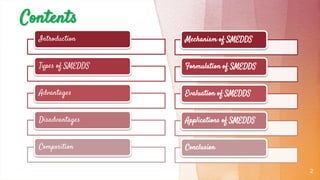
Contents
2
Introduction
Types of SMEDDS
Advantages
Disadvantages
Composition
Mechanism of SMEDDS
Formulation of SMEDDS
Evaluation of SMEDDS
Applications of SMEDDS
Conclusion
Introduction
Lipid based formulations offer a wide variety of formula-tions like solutions,
suspensions, solid dispersions and self-micro emulsifying drug delivery systems
(SMEDDS).
The SMEDDS have attracted considerable interest after com-mercial success of
immunosuppressive agent cyclosporine A (Neoral®) and the two HIV protease inhibitor
ritonavir (Norvir®) and saquinavir (Fortovase®).
 Self- emulsifying formulations comprise isotropic mixtures of natural orsyn-thetic oils
with lipophilic or hydrophilic surfactants and co-solvents which spontaneously emulsify
when exposed to the fluids of the gastrointestinal tract (GIT) to form oil-in-water emulsion
or micro emulsion. 3
4
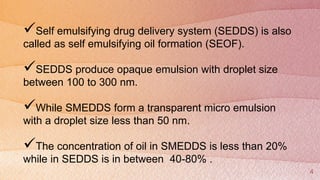
Self emulsifying drug delivery system (SEDDS) is also
called as self emulsifying oil formation (SEOF).
SEDDS produce opaque emulsion with droplet size
between 100 to 300 nm.
While SMEDDS form a transparent micro emulsion
with a droplet size less than 50 nm.
The concentration of oil in SMEDDS is less than 20%
while in SEDDS is in between 40-80% .
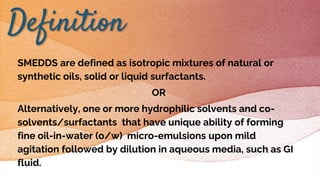
SMEDDS are defined as isotropic mixtures of natural or
synthetic oils, solid or liquid surfactants.
OR
Alternatively, one or more hydrophilic solvents and co-
solvents/surfactants that have unique ability of forming
fine oil-in-water (o/w) micro-emulsions upon mild
agitation followed by dilution in aqueous media, such as GI
fluid.
Definition
Types of self Microemulsion
6
1.
2
Main purpose is to prepare
SMEDDS for “Oral bioavailibility
enhancement of a poorly water
soluble drug”
7
8
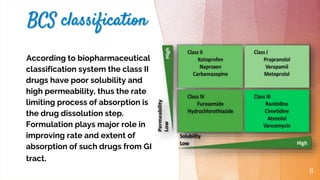
According to biopharmaceutical
classification system the class II
drugs have poor solubility and
high permeability, thus the rate
limiting process of absorption is
the drug dissolution step.
Formulation plays major role in
improving rate and extent of
absorption of such drugs from GI
tract.
9
 Thermodynamic steadiness
 Enhanced solubilization of bioactive substances.
 Improvement in oral bioavailability by increasing solubility and efficient drug transport.
 Improved patient compliance.
 Reduced dosing frequency.
 Ease of manufacture and scale-up as compare to other lipid dosage forms.
 Reduction in inter-subject and intra-subject variability and food effects.
 Ability to deliver active bimolecules including peptides that are sensitive towards
enzymatic hydrolysis in GIT.
 No influence of lipid digestion process unlike the other lipid-based drug delivery
systems.
 When polymer is incorporated in composition of SMEDDS it gives prolonged release
of medicament.
 Lack of good predicative in vitro models for assessment of the formulations.
 This in vitro model needs further development and vali-dation before its
strength can be evaluated.
 Further development will be based on in vitro - in vivo correlations and
therefore different prototype lipid based formulations needs to be developed
and tested in vivo in a suitable animal model.
 Another is chemical instabilities of drugs and high sur-factant concentrations in
formulations (approximately 30-60%) which irritate GIT. 10
11
Surfactants
Oil
Co-solvent
Co-surfactant
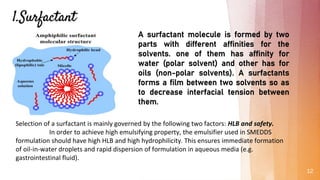
1.Surfactant
12
A surfactant molecule is formed by two
parts with different affinities for the
solvents. one of them has affinity for
water (polar solvent) and other has for
oils (non-polar solvents). A surfactants
forms a film between two solvents so as
to decrease interfacial tension between
them.
Selection of a surfactant is mainly governed by the following two factors: HLB and safety.
In order to achieve high emulsifying property, the emulsifier used in SMEDDS
formulation should have high HLB and high hydrophilicity. This ensures immediate formation
of oil-in-water droplets and rapid dispersion of formulation in aqueous media (e.g.
gastrointestinal fluid).
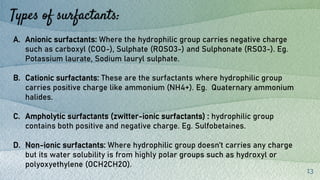
Types of surfactants:
13
A. Anionic surfactants: Where the hydrophilic group carries negative charge
such as carboxyl (COO-), Sulphate (ROSO3-) and Sulphonate (RSO3-). Eg.
Potassium laurate, Sodium lauryl sulphate.
B. Cationic surfactants: These are the surfactants where hydrophilic group
carries positive charge like ammonium (NH4+). Eg. Quaternary ammonium
halides.
C. Ampholytic surfactants (zwitter-ionic surfactants) : hydrophilic group
contains both positive and negative charge. Eg. Sulfobetaines.
D. Non-ionic surfactants: Where hydrophilic group doesn’t carries any charge
but its water solubility is from highly polar groups such as hydroxyl or
polyoxyethylene (OCH2CH2O).
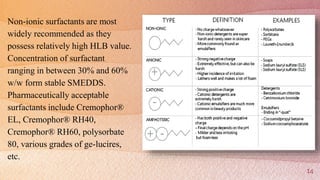
Non-ionic surfactants are most
widely recommended as they
possess relatively high HLB value.
Concentration of surfactant
ranging in between 30% and 60%
w/w form stable SMEDDS.
Pharmaceutically acceptable
surfactants include Cremophor®
EL, Cremophor® RH40,
Cremophor® RH60, polysorbate
80, various grades of ge-lucires,
etc.
14
Lipids are the important component of SMEDDS, as solubilization and access of the
drug to the lymphatic circulation of poor water soluble drugs depend on the type and
concentration of oil used in the formulation. Digestive lipids such as triglycerides,
diglycerides, fatty acids, phospholipids, cholesterol and other lipids based on synthetic
origin offer improvement in bioavailability of the drug.
Lipids are generally insoluble in water and are often identified by their fatty acid
composition, melting point, Hydrophilic Lipophilic Balance (HLB), and solubility in non-
polar organic solvents.
Lipids with low HLB and high melting point are suitable for sustained release. Semi-
solid excipients and those with high HLB serve as immediate release and bioavailability
enhancement excipients.
Lipid based excipients include dietary oils composed of medium (palm seed oil or
coconut oil) or long chain triglycerides (corn, olive, peanut, sesame oil).
15
2.Lipid (Oil)
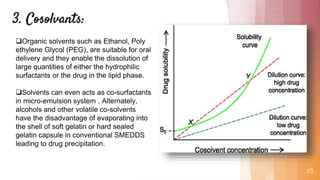
3. Cosolvants:
16
Organic solvents such as Ethanol, Poly
ethylene Glycol (PEG), are suitable for oral
delivery and they enable the dissolution of
large quantities of either the hydrophilic
surfactants or the drug in the lipid phase.
Solvents can even acts as co-surfactants
in micro-emulsion system . Alternately,
alcohols and other volatile co-solvents
have the disadvantage of evaporating into
the shell of soft gelatin or hard sealed
gelatin capsule in conventional SMEDDS
leading to drug precipitation.
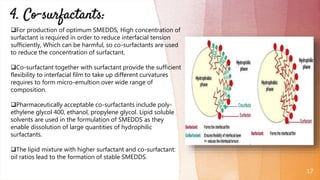
4. Co-surfactants:
17
For production of optimum SMEDDS, High concentration of
surfactant is required in order to reduce interfacial tension
sufficiently, Which can be harmful, so co-surfactants are used
to reduce the concentration of surfactant.
Co-surfactant together with surfactant provide the sufficient
flexibility to interfacial film to take up different curvatures
requires to form micro-emultion over wide range of
composition.
Pharmaceutically acceptable co-surfactants include poly-
ethylene glycol 400, ethanol, propylene glycol. Lipid soluble
solvents are used in the formulation of SMEDDS as they
enable dissolution of large quantities of hydrophilic
surfactants.
The lipid mixture with higher surfactant and co-surfactant:
oil ratios lead to the formation of stable SMEDDS.
4.Mechanism of SMEDDS
 Self emulsification occurs when the entropy change that fevers dispersion
greater than the energy required to increase the surface area of the dispersion.
 The free energy of conventional emulsion formulation is a direct function of the
energy required to create a new surface between two phases and can be
described by equation-
ΔG is the free energy, N is the number of droplets, r is the radius of droplets,
and ϭ is the interfacial energy.
 From this equation, it is evident that the lower the interfacial energy the lower the
free energy. Self-emulsification occurs when the energy involvement in the dispersion is
greater than the energy required for the formation of droplets.
18
Formulation
The following parameters must be considered during the formulation
of SMEDDS:
1. Solubility of the drug in different oil, surfactants and co-solvents.
2. Selection of oil, surfactant and co-solvent based on the solubility
of the drug, and preparation of the phase diagram.
20
Formulation
21
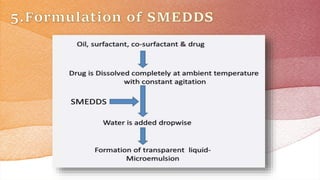
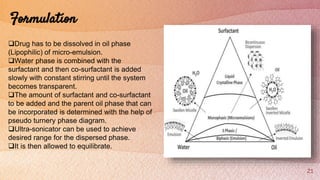
Drug has to be dissolved in oil phase
(Lipophilic) of micro-emulsion.
Water phase is combined with the
surfactant and then co-surfactant is added
slowly with constant stirring until the system
becomes transparent.
The amount of surfactant and co-surfactant
to be added and the parent oil phase that can
be incorporated is determined with the help of
pseudo turnery phase diagram.
Ultra-sonicator can be used to achieve
desired range for the dispersed phase.
It is then allowed to equilibrate.
22
Methods of preparation:
Dilution of an oil-surfactant mixture with water. (w/o)
Dilution of water-surfactant mixture with oil. (o/w)
Mixing all components at once. In some systems, the order of
ingredient addition may determine weather micro-emulsion forms.
The temperature range in which an o/w micro-emulsion
inverts to a w/o type of micro-emulsion.
23
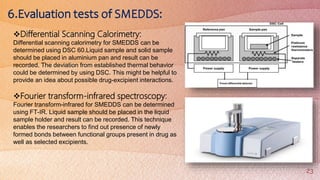
Differential Scanning Calorimetry:
Differential scanning calorimetry for SMEDDS can be
determined using DSC 60.Liquid sample and solid sample
should be placed in aluminium pan and result can be
recorded. The deviation from established thermal behavior
could be determined by using DSC. This might be helpful to
provide an idea about possible drug-excipient interactions.
Fourier transform-infrared spectroscopy:
Fourier transform-infrared for SMEDDS can be determined
using FT-IR. Liquid sample should be placed in the liquid
sample holder and result can be recorded. This technique
enables the researchers to find out presence of newly
formed bonds between functional groups present in drug as
well as selected excipients.
Evaluation
24
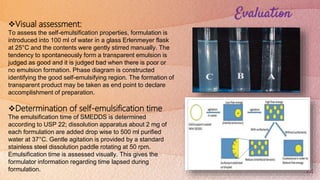
Visual assessment:
To assess the self-emulsification properties, formulation is
introduced into 100 ml of water in a glass Erlenmeyer flask
at 25°C and the contents were gently stirred manually. The
tendency to spontaneously form a transparent emulsion is
judged as good and it is judged bad when there is poor or
no emulsion formation. Phase diagram is constructed
identifying the good self-emulsifying region. The formation of
transparent product may be taken as end point to declare
accomplishment of preparation.
Determination of self-emulsification time
The emulsification time of SMEDDS is determined
according to USP 22; dissolution apparatus about 2 mg of
each formulation are added drop wise to 500 ml purified
water at 37°C. Gentle agitation is provided by a standard
stainless steel dissolution paddle rotating at 50 rpm.
Emulsification time is assessed visually. This gives the
formulator information regarding time lapsed during
formulation.
evaluation
25
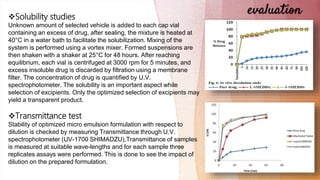
Solubility studies
Unknown amount of selected vehicle is added to each cap vial
containing an excess of drug, after sealing, the mixture is heated at
40°C in a water bath to facilitate the solubilization. Mixing of the
system is performed using a vortex mixer. Formed suspensions are
then shaken with a shaker at 25°C for 48 hours. After reaching
equilibrium, each vial is centrifuged at 3000 rpm for 5 minutes, and
excess insoluble drug is discarded by filtration using a membrane
filter. The concentration of drug is quantified by U.V.
spectrophotometer. The solubility is an important aspect while
selection of excipients. Only the optimized selection of excipients may
yield a transparent product.
Transmittance test
Stability of optimized micro emulsion formulation with respect to
dilution is checked by measuring Transmittance through U.V.
spectrophotometer (UV-1700 SHIMADZU),Transmittance of samples
is measured at suitable wave-lengths and for each sample three
replicates assays were performed. This is done to see the impact of
dilution on the prepared formulation.
evaluation
26
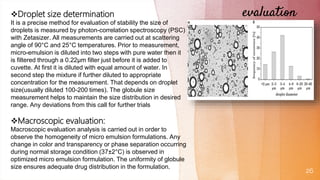
Droplet size determination
It is a precise method for evaluation of stability the size of
droplets is measured by photon-correlation spectroscopy (PSC)
with Zetasizer. All measurements are carried out at scattering
angle of 90°C and 25°C temperatures. Prior to measurement,
micro-emulsion is diluted into two steps with pure water then it
is filtered through a 0.22μm filter just before it is added to
cuvette. At first it is diluted with equal amount of water. In
second step the mixture if further diluted to appropriate
concentration for the measurement. That depends on droplet
size(usually diluted 100-200 times). The globule size
measurement helps to maintain the size distribution in desired
range. Any deviations from this call for further trials
Macroscopic evaluation:
Macroscopic evaluation analysis is carried out in order to
observe the homogeneity of micro emulsion formulations. Any
change in color and transparency or phase separation occurring
during normal storage condition (37±2°C) is observed in
optimized micro emulsion formulation. The uniformity of globule
size ensures adequate drug distribution in the formulation.
evaluation
Zeta potential measurement
Zeta potential for micro emulsion is determined using Zetasizer HAS 3000.
Samples are placed in clear disposable zeta cells and results are recorded.
Before putting the fresh sample cuvettes are washed with the methanol and
rinsed using the sample to be measured before each experiment. The zeta
potential values represent the surface charge of the dispersed globules.
The higher the value of zeta potential more the stability is. This may be
because of repulsion caused by individual globules during random
movements in the continuous medium.
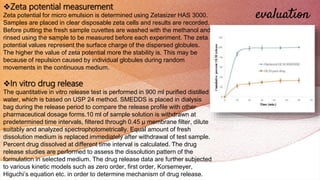
In vitro drug release
The quantitative in vitro release test is performed in 900 ml purified distilled
water, which is based on USP 24 method. SMEDDS is placed in dialysis
bag during the release period to compare the release profile with other
pharmaceutical dosage forms.10 ml of sample solution is withdrawn at
predetermined time intervals, filtered through 0.45 μ membrane filter, dilute
suitably and analyzed spectrophotometrically. Equal amount of fresh
dissolution medium is replaced immediately after withdrawal of test sample.
Percent drug dissolved at different time interval is calculated. The drug
release studies are performed to assess the dissolution pattern of the
formulation in selected medium. The drug release data are further subjected
to various kinetic models such as zero order, first order, Korsemeyer,
Higuchi’s equation etc. in order to determine mechanism of drug release.
evaluation
Stability:
1. Temperature Stability
Shelf life is a function of time and storage temperature is evaluated by
visual inspection of the SMEDDS system at different time period.
SMEDDS is diluted with purified water and to check the temperature
stability of samples, they are kept at three different temperature range
[2-8°C (refrigerator), room temperature etc.] and observe for any
evidence of phase separation, flocculation or precipitation so that an
appropriate storage condition may be prescribed for the developed
product.
2. Centrifugation
In order to estimate meta-stable system, the optimized SMEDDS
formulation is diluted with purified distilled water. Then micro emulsion
is centrifuged at 1000 rpm for 15 minute at 0°C and observed for any
change in homogeneity of micro emulsions. This indicates the stability
of product upon dilution.
29
1.Super-saturable SMEDDS (S-SMEDDS):
The high surfactant level typically present in SMEDDS formulation can lead to GI side effects and
new class of super-saturable formulation including super-saturable SMEDDS. (S-SMEDDS)
formulations have been designed and developed to reduce the surfactant side effects and achieve
rapid absorption of poorly soluble drugs.
2.Solid SMEDDS:
SMEDDS are normally prepared as liquid dosage forms that can be administered in soft gelatin
capsule, which have some disadvantages especially in the manufacturing process.An alternative
method is the incorporation of liquid self emulsifying ingreedients into a powder in order to creat a
solid dosage form ( Tablet, capsule )
Techniques of SMEDDS:
a. Spray drying
b. Adsorption to solid carrier
c. Melt granulation
d. Melt extrusion/extrusion Spheronization
Eg. A pallet fo rmulation of progesterone in SMEDDS has been prepared by the process of
extrusion/ speronization to provide a good in vitro release (100% within 30 min, T50% at 13 min).
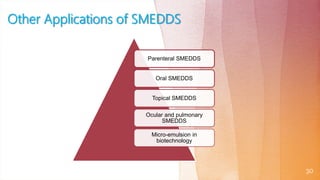
Other Applications of SMEDDS
30
Parenteral SMEDDS
Oral SMEDDS
Topical SMEDDS
Ocular and pulmonary
SMEDDS
Micro-emulsion in
biotechnology
31
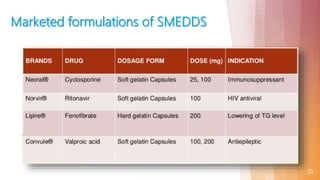
Marketed formulations of SMEDDS
32
SMEDDS are a promising approach for the formulation of drugs with poor aqueous solubility. The oral
delivery of hydrophobic drugs can be made possible by SMEDDS, which have been shown to
substantially improve oral Bio-availability.
As mentioned above, numerous studies have confirmed that SMEDDS substantially improved
solubility/dissolution, absorption and bioavailability of poorly water-soluble drugs; some of such drugs are
listed in table. As improvements or alternatives of conventional liquid SMEDDS, S-SMEDDS are superior
in reducing production cost, simplifying industrial manufacture, and improving stability as well as patient
compliance.
Most importantly, S-SMEDDS are very flexible to develop various solid dosage forms for oral and
parenteral administration.
Moreover, GI irritation is avoidable and controlled/sustained release of drug is achievable. There is still
a long way to go, however, before more solid SME dosage forms (except for SME capsules) appear on
the market. Because there exist some fields of S-SMEDDS to be further exploited, such as studies about
human bioavailability and correlation of in vitro/in vivo.
Conclusion
33
References
1.Talegaonkar S, Azeem A, Ahmad FJ, Khar RK, Pathan SA, Khan ZI. Microemulsions: A Novel Approach
to Enhanced Drug Delivery. Recent Pat Drug Deliv Formul. 2008; 2:238-257.
2.Pouton CW. Lipid formulations for oral administration of drugs: non-emulsifying, self-emulsifying and
self-microe-mulsifying’ drug delivery systems. Eur J Pharm Sci. 2000; 11 Suppl 2: S93-8.
3.Jaiswal P, Aggrewal G, Kaur A. Bioavailability enhancement of poorly soluble drugs by SMEDDS- A
review. J Drug Deliv Ther. 2013; 3(1): 98-109.
4.Shukla JB, Koli AR, Ranch KM, Parikh RK. Self microemulsi-fying drug delivery system. Int J Pharm
Pharm Sci. 2010;1(2): 13-33.
5.Kumar A, Sharma S, Kamble R. Self emulsifying drug delivery system (SEDDS): future aspects. Int J
Pharm Pharm Sci. 2010; 2(4): 7-13.
6.Verma A, Singh MK, Kumar B. Development and characteri-zation of Flutamide containing self micro
emulsifying drug delivery system (SMEDDS). Int J Pharm Pharm Sci. 2011;3(4): 60-65.
34

smeddsarifseminar-201213095211.pdf

  • 1.
  • 2.
    Contents 2 Introduction Types of SMEDDS Advantages Disadvantages Composition Mechanismof SMEDDS Formulation of SMEDDS Evaluation of SMEDDS Applications of SMEDDS Conclusion
  • 3.
    Introduction Lipid based formulationsoffer a wide variety of formula-tions like solutions, suspensions, solid dispersions and self-micro emulsifying drug delivery systems (SMEDDS). The SMEDDS have attracted considerable interest after com-mercial success of immunosuppressive agent cyclosporine A (Neoral®) and the two HIV protease inhibitor ritonavir (Norvir®) and saquinavir (Fortovase®).  Self- emulsifying formulations comprise isotropic mixtures of natural orsyn-thetic oils with lipophilic or hydrophilic surfactants and co-solvents which spontaneously emulsify when exposed to the fluids of the gastrointestinal tract (GIT) to form oil-in-water emulsion or micro emulsion. 3
  • 4.
    4 Self emulsifying drugdelivery system (SEDDS) is also called as self emulsifying oil formation (SEOF). SEDDS produce opaque emulsion with droplet size between 100 to 300 nm. While SMEDDS form a transparent micro emulsion with a droplet size less than 50 nm. The concentration of oil in SMEDDS is less than 20% while in SEDDS is in between 40-80% .
  • 5.
    SMEDDS are definedas isotropic mixtures of natural or synthetic oils, solid or liquid surfactants. OR Alternatively, one or more hydrophilic solvents and co- solvents/surfactants that have unique ability of forming fine oil-in-water (o/w) micro-emulsions upon mild agitation followed by dilution in aqueous media, such as GI fluid. Definition
  • 6.
    Types of selfMicroemulsion 6 1. 2
  • 7.
    Main purpose isto prepare SMEDDS for “Oral bioavailibility enhancement of a poorly water soluble drug” 7
  • 8.
    8 According to biopharmaceutical classificationsystem the class II drugs have poor solubility and high permeability, thus the rate limiting process of absorption is the drug dissolution step. Formulation plays major role in improving rate and extent of absorption of such drugs from GI tract.
  • 9.
    9  Thermodynamic steadiness Enhanced solubilization of bioactive substances.  Improvement in oral bioavailability by increasing solubility and efficient drug transport.  Improved patient compliance.  Reduced dosing frequency.  Ease of manufacture and scale-up as compare to other lipid dosage forms.  Reduction in inter-subject and intra-subject variability and food effects.  Ability to deliver active bimolecules including peptides that are sensitive towards enzymatic hydrolysis in GIT.  No influence of lipid digestion process unlike the other lipid-based drug delivery systems.  When polymer is incorporated in composition of SMEDDS it gives prolonged release of medicament.
  • 10.
     Lack ofgood predicative in vitro models for assessment of the formulations.  This in vitro model needs further development and vali-dation before its strength can be evaluated.  Further development will be based on in vitro - in vivo correlations and therefore different prototype lipid based formulations needs to be developed and tested in vivo in a suitable animal model.  Another is chemical instabilities of drugs and high sur-factant concentrations in formulations (approximately 30-60%) which irritate GIT. 10
  • 11.
  • 12.
    1.Surfactant 12 A surfactant moleculeis formed by two parts with different affinities for the solvents. one of them has affinity for water (polar solvent) and other has for oils (non-polar solvents). A surfactants forms a film between two solvents so as to decrease interfacial tension between them. Selection of a surfactant is mainly governed by the following two factors: HLB and safety. In order to achieve high emulsifying property, the emulsifier used in SMEDDS formulation should have high HLB and high hydrophilicity. This ensures immediate formation of oil-in-water droplets and rapid dispersion of formulation in aqueous media (e.g. gastrointestinal fluid).
  • 13.
    Types of surfactants: 13 A.Anionic surfactants: Where the hydrophilic group carries negative charge such as carboxyl (COO-), Sulphate (ROSO3-) and Sulphonate (RSO3-). Eg. Potassium laurate, Sodium lauryl sulphate. B. Cationic surfactants: These are the surfactants where hydrophilic group carries positive charge like ammonium (NH4+). Eg. Quaternary ammonium halides. C. Ampholytic surfactants (zwitter-ionic surfactants) : hydrophilic group contains both positive and negative charge. Eg. Sulfobetaines. D. Non-ionic surfactants: Where hydrophilic group doesn’t carries any charge but its water solubility is from highly polar groups such as hydroxyl or polyoxyethylene (OCH2CH2O).
  • 14.
    Non-ionic surfactants aremost widely recommended as they possess relatively high HLB value. Concentration of surfactant ranging in between 30% and 60% w/w form stable SMEDDS. Pharmaceutically acceptable surfactants include Cremophor® EL, Cremophor® RH40, Cremophor® RH60, polysorbate 80, various grades of ge-lucires, etc. 14
  • 15.
    Lipids are theimportant component of SMEDDS, as solubilization and access of the drug to the lymphatic circulation of poor water soluble drugs depend on the type and concentration of oil used in the formulation. Digestive lipids such as triglycerides, diglycerides, fatty acids, phospholipids, cholesterol and other lipids based on synthetic origin offer improvement in bioavailability of the drug. Lipids are generally insoluble in water and are often identified by their fatty acid composition, melting point, Hydrophilic Lipophilic Balance (HLB), and solubility in non- polar organic solvents. Lipids with low HLB and high melting point are suitable for sustained release. Semi- solid excipients and those with high HLB serve as immediate release and bioavailability enhancement excipients. Lipid based excipients include dietary oils composed of medium (palm seed oil or coconut oil) or long chain triglycerides (corn, olive, peanut, sesame oil). 15 2.Lipid (Oil)
  • 16.
    3. Cosolvants: 16 Organic solventssuch as Ethanol, Poly ethylene Glycol (PEG), are suitable for oral delivery and they enable the dissolution of large quantities of either the hydrophilic surfactants or the drug in the lipid phase. Solvents can even acts as co-surfactants in micro-emulsion system . Alternately, alcohols and other volatile co-solvents have the disadvantage of evaporating into the shell of soft gelatin or hard sealed gelatin capsule in conventional SMEDDS leading to drug precipitation.
  • 17.
    4. Co-surfactants: 17 For productionof optimum SMEDDS, High concentration of surfactant is required in order to reduce interfacial tension sufficiently, Which can be harmful, so co-surfactants are used to reduce the concentration of surfactant. Co-surfactant together with surfactant provide the sufficient flexibility to interfacial film to take up different curvatures requires to form micro-emultion over wide range of composition. Pharmaceutically acceptable co-surfactants include poly- ethylene glycol 400, ethanol, propylene glycol. Lipid soluble solvents are used in the formulation of SMEDDS as they enable dissolution of large quantities of hydrophilic surfactants. The lipid mixture with higher surfactant and co-surfactant: oil ratios lead to the formation of stable SMEDDS.
  • 18.
    4.Mechanism of SMEDDS Self emulsification occurs when the entropy change that fevers dispersion greater than the energy required to increase the surface area of the dispersion.  The free energy of conventional emulsion formulation is a direct function of the energy required to create a new surface between two phases and can be described by equation- ΔG is the free energy, N is the number of droplets, r is the radius of droplets, and ϭ is the interfacial energy.  From this equation, it is evident that the lower the interfacial energy the lower the free energy. Self-emulsification occurs when the energy involvement in the dispersion is greater than the energy required for the formation of droplets. 18
  • 20.
    Formulation The following parametersmust be considered during the formulation of SMEDDS: 1. Solubility of the drug in different oil, surfactants and co-solvents. 2. Selection of oil, surfactant and co-solvent based on the solubility of the drug, and preparation of the phase diagram. 20
  • 21.
    Formulation 21 Drug has tobe dissolved in oil phase (Lipophilic) of micro-emulsion. Water phase is combined with the surfactant and then co-surfactant is added slowly with constant stirring until the system becomes transparent. The amount of surfactant and co-surfactant to be added and the parent oil phase that can be incorporated is determined with the help of pseudo turnery phase diagram. Ultra-sonicator can be used to achieve desired range for the dispersed phase. It is then allowed to equilibrate.
  • 22.
    22 Methods of preparation: Dilutionof an oil-surfactant mixture with water. (w/o) Dilution of water-surfactant mixture with oil. (o/w) Mixing all components at once. In some systems, the order of ingredient addition may determine weather micro-emulsion forms. The temperature range in which an o/w micro-emulsion inverts to a w/o type of micro-emulsion.
  • 23.
    23 Differential Scanning Calorimetry: Differentialscanning calorimetry for SMEDDS can be determined using DSC 60.Liquid sample and solid sample should be placed in aluminium pan and result can be recorded. The deviation from established thermal behavior could be determined by using DSC. This might be helpful to provide an idea about possible drug-excipient interactions. Fourier transform-infrared spectroscopy: Fourier transform-infrared for SMEDDS can be determined using FT-IR. Liquid sample should be placed in the liquid sample holder and result can be recorded. This technique enables the researchers to find out presence of newly formed bonds between functional groups present in drug as well as selected excipients.
  • 24.
    Evaluation 24 Visual assessment: To assessthe self-emulsification properties, formulation is introduced into 100 ml of water in a glass Erlenmeyer flask at 25°C and the contents were gently stirred manually. The tendency to spontaneously form a transparent emulsion is judged as good and it is judged bad when there is poor or no emulsion formation. Phase diagram is constructed identifying the good self-emulsifying region. The formation of transparent product may be taken as end point to declare accomplishment of preparation. Determination of self-emulsification time The emulsification time of SMEDDS is determined according to USP 22; dissolution apparatus about 2 mg of each formulation are added drop wise to 500 ml purified water at 37°C. Gentle agitation is provided by a standard stainless steel dissolution paddle rotating at 50 rpm. Emulsification time is assessed visually. This gives the formulator information regarding time lapsed during formulation.
  • 25.
    evaluation 25 Solubility studies Unknown amountof selected vehicle is added to each cap vial containing an excess of drug, after sealing, the mixture is heated at 40°C in a water bath to facilitate the solubilization. Mixing of the system is performed using a vortex mixer. Formed suspensions are then shaken with a shaker at 25°C for 48 hours. After reaching equilibrium, each vial is centrifuged at 3000 rpm for 5 minutes, and excess insoluble drug is discarded by filtration using a membrane filter. The concentration of drug is quantified by U.V. spectrophotometer. The solubility is an important aspect while selection of excipients. Only the optimized selection of excipients may yield a transparent product. Transmittance test Stability of optimized micro emulsion formulation with respect to dilution is checked by measuring Transmittance through U.V. spectrophotometer (UV-1700 SHIMADZU),Transmittance of samples is measured at suitable wave-lengths and for each sample three replicates assays were performed. This is done to see the impact of dilution on the prepared formulation.
  • 26.
    evaluation 26 Droplet size determination Itis a precise method for evaluation of stability the size of droplets is measured by photon-correlation spectroscopy (PSC) with Zetasizer. All measurements are carried out at scattering angle of 90°C and 25°C temperatures. Prior to measurement, micro-emulsion is diluted into two steps with pure water then it is filtered through a 0.22μm filter just before it is added to cuvette. At first it is diluted with equal amount of water. In second step the mixture if further diluted to appropriate concentration for the measurement. That depends on droplet size(usually diluted 100-200 times). The globule size measurement helps to maintain the size distribution in desired range. Any deviations from this call for further trials Macroscopic evaluation: Macroscopic evaluation analysis is carried out in order to observe the homogeneity of micro emulsion formulations. Any change in color and transparency or phase separation occurring during normal storage condition (37±2°C) is observed in optimized micro emulsion formulation. The uniformity of globule size ensures adequate drug distribution in the formulation.
  • 27.
    evaluation Zeta potential measurement Zetapotential for micro emulsion is determined using Zetasizer HAS 3000. Samples are placed in clear disposable zeta cells and results are recorded. Before putting the fresh sample cuvettes are washed with the methanol and rinsed using the sample to be measured before each experiment. The zeta potential values represent the surface charge of the dispersed globules. The higher the value of zeta potential more the stability is. This may be because of repulsion caused by individual globules during random movements in the continuous medium. In vitro drug release The quantitative in vitro release test is performed in 900 ml purified distilled water, which is based on USP 24 method. SMEDDS is placed in dialysis bag during the release period to compare the release profile with other pharmaceutical dosage forms.10 ml of sample solution is withdrawn at predetermined time intervals, filtered through 0.45 μ membrane filter, dilute suitably and analyzed spectrophotometrically. Equal amount of fresh dissolution medium is replaced immediately after withdrawal of test sample. Percent drug dissolved at different time interval is calculated. The drug release studies are performed to assess the dissolution pattern of the formulation in selected medium. The drug release data are further subjected to various kinetic models such as zero order, first order, Korsemeyer, Higuchi’s equation etc. in order to determine mechanism of drug release.
  • 28.
    evaluation Stability: 1. Temperature Stability Shelflife is a function of time and storage temperature is evaluated by visual inspection of the SMEDDS system at different time period. SMEDDS is diluted with purified water and to check the temperature stability of samples, they are kept at three different temperature range [2-8°C (refrigerator), room temperature etc.] and observe for any evidence of phase separation, flocculation or precipitation so that an appropriate storage condition may be prescribed for the developed product. 2. Centrifugation In order to estimate meta-stable system, the optimized SMEDDS formulation is diluted with purified distilled water. Then micro emulsion is centrifuged at 1000 rpm for 15 minute at 0°C and observed for any change in homogeneity of micro emulsions. This indicates the stability of product upon dilution.
  • 29.
    29 1.Super-saturable SMEDDS (S-SMEDDS): Thehigh surfactant level typically present in SMEDDS formulation can lead to GI side effects and new class of super-saturable formulation including super-saturable SMEDDS. (S-SMEDDS) formulations have been designed and developed to reduce the surfactant side effects and achieve rapid absorption of poorly soluble drugs. 2.Solid SMEDDS: SMEDDS are normally prepared as liquid dosage forms that can be administered in soft gelatin capsule, which have some disadvantages especially in the manufacturing process.An alternative method is the incorporation of liquid self emulsifying ingreedients into a powder in order to creat a solid dosage form ( Tablet, capsule ) Techniques of SMEDDS: a. Spray drying b. Adsorption to solid carrier c. Melt granulation d. Melt extrusion/extrusion Spheronization Eg. A pallet fo rmulation of progesterone in SMEDDS has been prepared by the process of extrusion/ speronization to provide a good in vitro release (100% within 30 min, T50% at 13 min).
  • 30.
    Other Applications ofSMEDDS 30 Parenteral SMEDDS Oral SMEDDS Topical SMEDDS Ocular and pulmonary SMEDDS Micro-emulsion in biotechnology
  • 31.
  • 32.
    32 SMEDDS are apromising approach for the formulation of drugs with poor aqueous solubility. The oral delivery of hydrophobic drugs can be made possible by SMEDDS, which have been shown to substantially improve oral Bio-availability. As mentioned above, numerous studies have confirmed that SMEDDS substantially improved solubility/dissolution, absorption and bioavailability of poorly water-soluble drugs; some of such drugs are listed in table. As improvements or alternatives of conventional liquid SMEDDS, S-SMEDDS are superior in reducing production cost, simplifying industrial manufacture, and improving stability as well as patient compliance. Most importantly, S-SMEDDS are very flexible to develop various solid dosage forms for oral and parenteral administration. Moreover, GI irritation is avoidable and controlled/sustained release of drug is achievable. There is still a long way to go, however, before more solid SME dosage forms (except for SME capsules) appear on the market. Because there exist some fields of S-SMEDDS to be further exploited, such as studies about human bioavailability and correlation of in vitro/in vivo. Conclusion
  • 33.
    33 References 1.Talegaonkar S, AzeemA, Ahmad FJ, Khar RK, Pathan SA, Khan ZI. Microemulsions: A Novel Approach to Enhanced Drug Delivery. Recent Pat Drug Deliv Formul. 2008; 2:238-257. 2.Pouton CW. Lipid formulations for oral administration of drugs: non-emulsifying, self-emulsifying and self-microe-mulsifying’ drug delivery systems. Eur J Pharm Sci. 2000; 11 Suppl 2: S93-8. 3.Jaiswal P, Aggrewal G, Kaur A. Bioavailability enhancement of poorly soluble drugs by SMEDDS- A review. J Drug Deliv Ther. 2013; 3(1): 98-109. 4.Shukla JB, Koli AR, Ranch KM, Parikh RK. Self microemulsi-fying drug delivery system. Int J Pharm Pharm Sci. 2010;1(2): 13-33. 5.Kumar A, Sharma S, Kamble R. Self emulsifying drug delivery system (SEDDS): future aspects. Int J Pharm Pharm Sci. 2010; 2(4): 7-13. 6.Verma A, Singh MK, Kumar B. Development and characteri-zation of Flutamide containing self micro emulsifying drug delivery system (SMEDDS). Int J Pharm Pharm Sci. 2011;3(4): 60-65.
  • 34.