Formulation of SMEDDS
Megha
Assistant Professor
Formulation of SMEDDS
(1) Screening Of Excipients
(2) Construction Of Pseudo ternary Phase Diagram
(3) Preparation Of SMEDDS
(4) Characterization Of SMEDDS
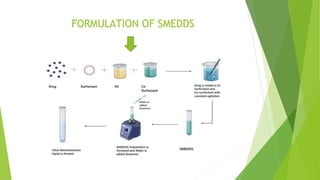
FORMULATION OF SMEDDS
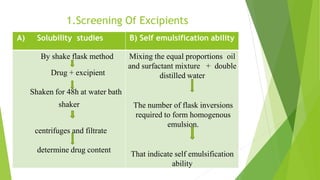
1.Screening Of Excipients
A) Solubility studies B) Self emulsification ability
By shake flask method
Drug + excipient
Shaken for 48h at water bath
shaker
centrifuges and filtrate
determine drug content
Mixing the equal proportions oil
and surfactant mixture + double
distilled water
The number of flask inversions
required to form homogenous
emulsion.
That indicate self emulsification
ability
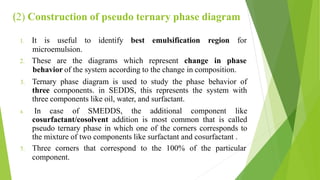
(2) Construction of pseudo ternary phase diagram
1. It is useful to identify best emulsification region for
microemulsion.
2. These are the diagrams which represent change in phase
behavior of the system according to the change in composition.
3. Ternary phase diagram is used to study the phase behavior of
three components. in SEDDS, this represents the system with
three components like oil, water, and surfactant.
4. In case of SMEDDS, the additional component like
cosurfactant/cosolvent addition is most common that is called
pseudo ternary phase in which one of the corners corresponds to
the mixture of two components like surfactant and cosurfactant .
5. Three corners that correspond to the 100% of the particular
component.
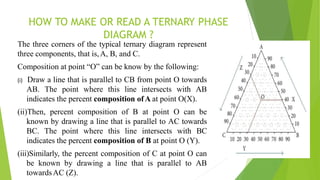
HOW TO MAKE OR READ A TERNARY PHASE
DIAGRAM ?
The three corners of the typical ternary diagram represent
three components, that is,A, B, and C.
Composition at point “O” can be know by the following:
(i) Draw a line that is parallel to CB from point O towards
AB. The point where this line intersects with AB
indicates the percent composition ofA at point O(X).
(ii)Then, percent composition of B at point O can be
known by drawing a line that is parallel to AC towards
BC. The point where this line intersects with BC
indicates the percent composition of B at point O (Y).
(iii)Similarly, the percent composition of C at point O can
be known by drawing a line that is parallel to AB
towardsAC (Z).
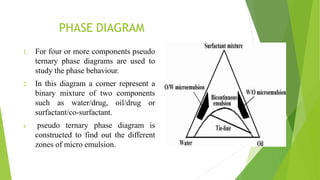
PHASE DIAGRAM
1. For four or more components pseudo
ternary phase diagrams are used to
study the phase behaviour.
2. In this diagram a corner represent a
binary mixture of two components
such as water/drug, oil/drug or
surfactant/co-surfactant.
3. pseudo ternary phase diagram is
constructed to find out the different
zones of micro emulsion.
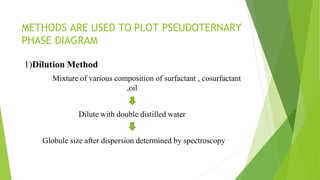
METHODS ARE USED TO PLOT PSEUDOTERNARY
PHASE DIAGRAM
1)Dilution Method
Mixture of various composition of surfactant , cosurfactant
,oil
Dilute with double distilled water
Globule size after dispersion determined by spectroscopy
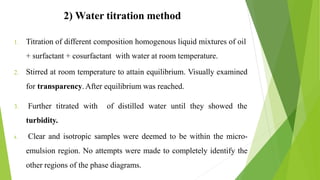
2) Water titration method
1. Titration of different composition homogenous liquid mixtures of oil
+ surfactant + cosurfactant with water at room temperature.
2. Stirred at room temperature to attain equilibrium. Visually examined
for transparency.After equilibrium was reached.
3. Further titrated with of distilled water until they showed the
turbidity.
4. Clear and isotropic samples were deemed to be within the micro-
emulsion region. No attempts were made to completely identify the
other regions of the phase diagrams.
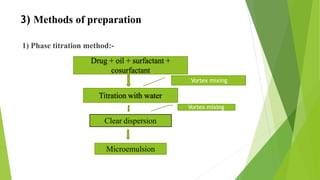
3) Methods of preparation
1) Phase titration method:-
Drug + oil + surfactant +
cosurfactant
Titration with water
Clear dispersion
Microemulsion
Vortex mixing
Vortex mixing
2) Phase inversion method
Phase Inversion Temperature (PIT) i.e. at particular the temperature
range in which an o/w microemulsion inverts to a w/o microemulsion
type or vice versa or by addition of excess dispersed phase.
Formulation of smedds.pptx

Formulation of smedds.pptx

  • 1.
  • 2.
    Formulation of SMEDDS (1)Screening Of Excipients (2) Construction Of Pseudo ternary Phase Diagram (3) Preparation Of SMEDDS (4) Characterization Of SMEDDS
  • 3.
  • 4.
    1.Screening Of Excipients A)Solubility studies B) Self emulsification ability By shake flask method Drug + excipient Shaken for 48h at water bath shaker centrifuges and filtrate determine drug content Mixing the equal proportions oil and surfactant mixture + double distilled water The number of flask inversions required to form homogenous emulsion. That indicate self emulsification ability
  • 5.
    (2) Construction ofpseudo ternary phase diagram 1. It is useful to identify best emulsification region for microemulsion. 2. These are the diagrams which represent change in phase behavior of the system according to the change in composition. 3. Ternary phase diagram is used to study the phase behavior of three components. in SEDDS, this represents the system with three components like oil, water, and surfactant. 4. In case of SMEDDS, the additional component like cosurfactant/cosolvent addition is most common that is called pseudo ternary phase in which one of the corners corresponds to the mixture of two components like surfactant and cosurfactant . 5. Three corners that correspond to the 100% of the particular component.
  • 6.
    HOW TO MAKEOR READ A TERNARY PHASE DIAGRAM ? The three corners of the typical ternary diagram represent three components, that is,A, B, and C. Composition at point “O” can be know by the following: (i) Draw a line that is parallel to CB from point O towards AB. The point where this line intersects with AB indicates the percent composition ofA at point O(X). (ii)Then, percent composition of B at point O can be known by drawing a line that is parallel to AC towards BC. The point where this line intersects with BC indicates the percent composition of B at point O (Y). (iii)Similarly, the percent composition of C at point O can be known by drawing a line that is parallel to AB towardsAC (Z).
  • 7.
    PHASE DIAGRAM 1. Forfour or more components pseudo ternary phase diagrams are used to study the phase behaviour. 2. In this diagram a corner represent a binary mixture of two components such as water/drug, oil/drug or surfactant/co-surfactant. 3. pseudo ternary phase diagram is constructed to find out the different zones of micro emulsion.
  • 8.
    METHODS ARE USEDTO PLOT PSEUDOTERNARY PHASE DIAGRAM 1)Dilution Method Mixture of various composition of surfactant , cosurfactant ,oil Dilute with double distilled water Globule size after dispersion determined by spectroscopy
  • 9.
    2) Water titrationmethod 1. Titration of different composition homogenous liquid mixtures of oil + surfactant + cosurfactant with water at room temperature. 2. Stirred at room temperature to attain equilibrium. Visually examined for transparency.After equilibrium was reached. 3. Further titrated with of distilled water until they showed the turbidity. 4. Clear and isotropic samples were deemed to be within the micro- emulsion region. No attempts were made to completely identify the other regions of the phase diagrams.
  • 10.
    3) Methods ofpreparation 1) Phase titration method:- Drug + oil + surfactant + cosurfactant Titration with water Clear dispersion Microemulsion Vortex mixing Vortex mixing
  • 11.
    2) Phase inversionmethod Phase Inversion Temperature (PIT) i.e. at particular the temperature range in which an o/w microemulsion inverts to a w/o microemulsion type or vice versa or by addition of excess dispersed phase.