Novel Drug Delivery
System
By- Dipesh Adesh Gamare
ABSTARCT
Drug delivery systems are defined as formulations aiming for transportation of a
drug to the desired area of action within the body. The basic component of drug
delivery systems is an appropriate carrier that protects the drug from rapid
degradation or clearance and thereby enhances drug concentration in target
tissues. Based on their biodegradable, biocompatible, and non-immunogenic
structure, Niosomes are promising drug carriers that are formed by self-
association of nonionic surfactants and cholesterol in an aqueous phase. In
recent years, numerous research articles have been published in scientific
journals reporting the potential of niosomes to serve as a carrier for the delivery
of different types of drugs. The information describes preparation methods, and
recent studies on niosomal drug delivery systems and also gives up to date
information regarding recent applications of niosomes in drug delivery.
INTRODUCTION
Niosomes are one of the promising drug carriers that have a bilayer structure
and are formed by self-association of nonionic surfactants and cholesterol in an
aqueous phase. Niosomes are biodegradable, biocompatible, and
nonimmunogenic. They have long shelf life, exhibit high stability, and enable the
delivery of drug at target site in a controlled and/or sustained manner .
In recent years, the potential of niosomes as a drug carrier has been extensively
studied . Various types of nonionic surfactants have been reported to form
niosomes and enable the entrapment of a large number of drugs with a wide
range of solubility . The composition, size, number of lamellae, and surface
charge of niosomes can be varied and optimized to enhance the performance of
niosomes for drug delivery.
STRUCTURE OF NIOSOME
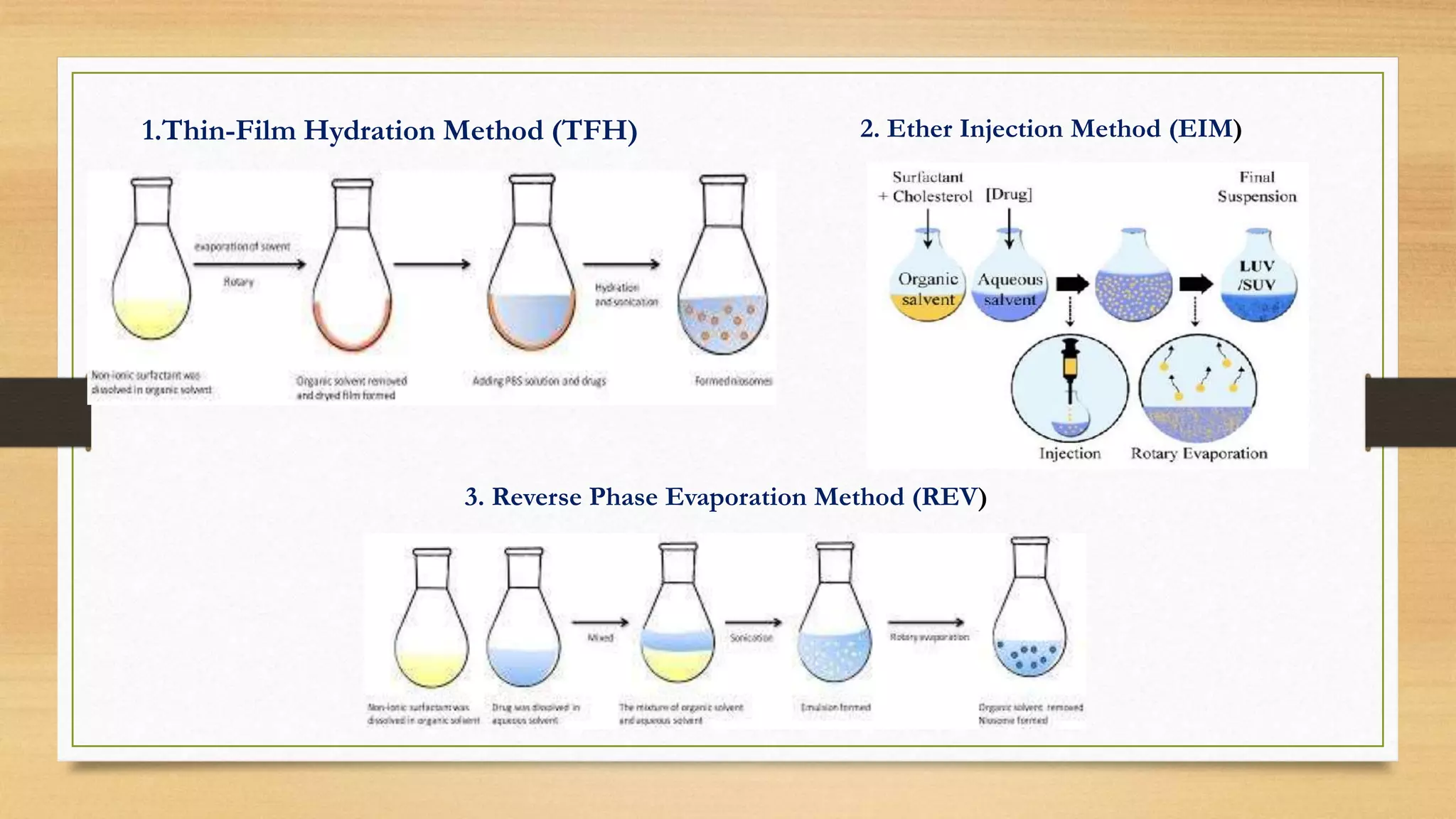
1.Thin-Film
Hydration
Method (TFH)
2. Ether
Injection
Method (EIM)
3. Reverse Phase
Evaporation
Method (REV)
4. Supercritical
Carbon Dioxide
Fluid (scCO2)
5. Proniosome
6. The “Bubble”
Method
METHODS OF PREPARATION
1.Thin-Film Hydration Method (TFH) 2. Ether Injection Method (EIM)
3. Reverse Phase Evaporation Method (REV)
5. Proniosome
4. Supercritical Carbon Dioxide Fluid (scCO2)
6. The “Bubble” Method
NIOSOMES AS DRUG CARRIERS
• Niosomes are very promising carriers for the delivery of numerous
pharmacological and diagnostic agents. A number of publications have reported
the preparation, characterization, and use of niosomes as drug carriers.
Because of their nonionic nature, they offer excellent biocompatibility and low
toxicity. The unique structure of niosomes allows the development of effective
novel drug delivery systems with ability of loading both hydrophilic and
lipophilic drugs. Hydrophilic drugs and lipophilic drugs are entrapped into the
aqueous core and membrane bilayer of niosome
RECENT STUDY
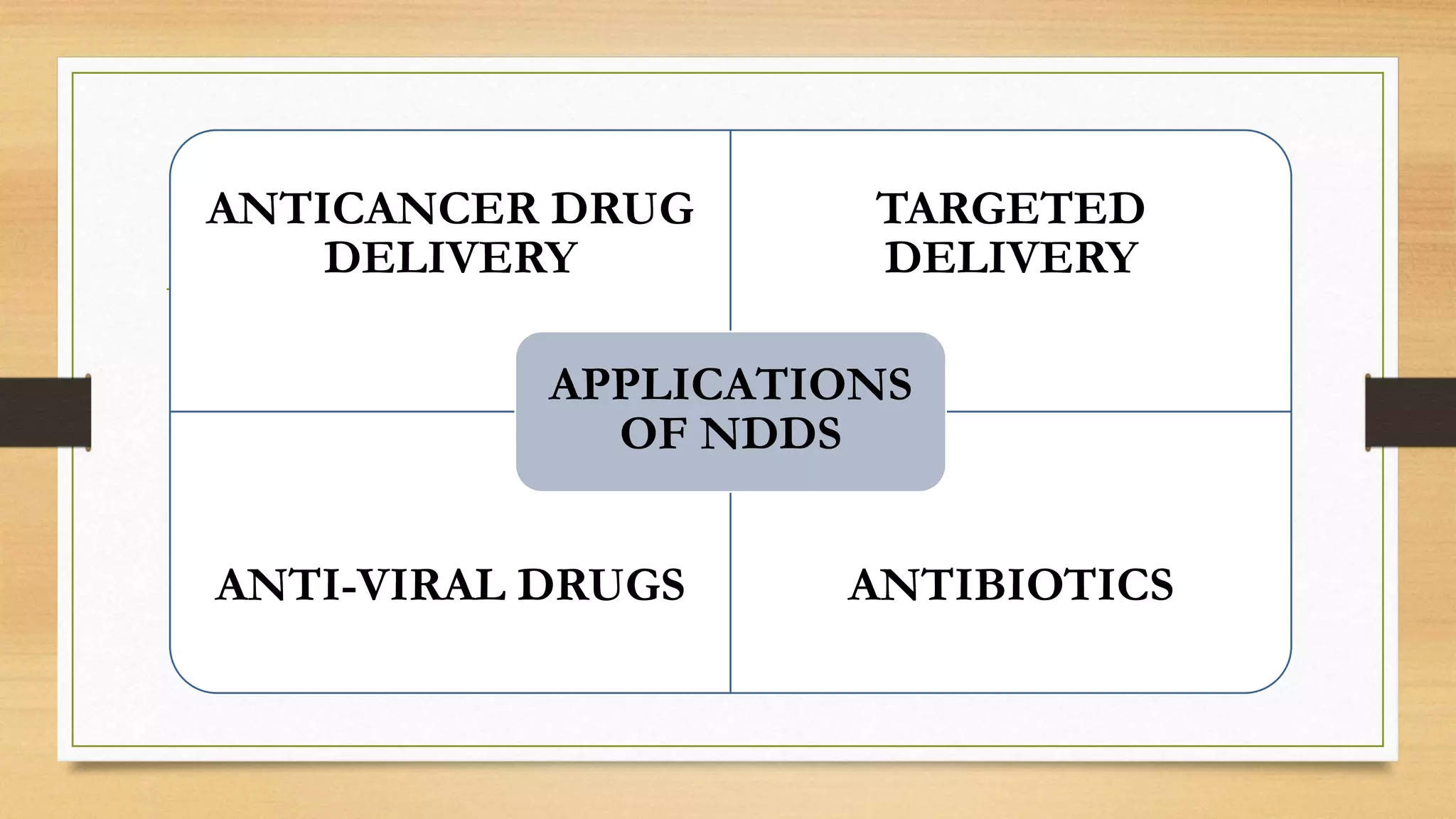
ANTICANCER DRUG
DELIVERY
TARGETED
DELIVERY
ANTI-VIRAL DRUGS ANTIBIOTICS
APPLICATIONS
OF NDDS
Antibiotics
 Niosomal carriers are also suitable for the delivery of antibiotics and
anti-inflammatory agents. These carriers have been used extensively to
improve poor skin penetration and as well as enhance skin retention of
the drugs.
 Begum and coworkers designed rifampicin, a broad spectrum
antibiotic, encapsulated in a niosomal delivery system.
 They investigated the activity of this system in in vitro conditions and
this study showed that niosomal formulation of rifampicin is able to
provide consistent and prolonged release of the drug.
Antiviral Drugs
 Zidovudine, which is the first anti-HIV compound approved for clinical use,
encapsulated niosomes, and examined their entrapment efficiency and as well as
sustainability of release.
 The niosomes were formulated by combining the proportions of Tween, Span, and
cholesterol. Niosomes composed Tween 80 entrapped large amounts of zidovudine and
the addition of dicetyl phosphate enhanced drug release for a longer time .
 The drug leakage from Tween 80 formulations stored at room temperature was
significant compared to niosomes stored at 4°C for 90 days.
 Besides, the results of a pharmacokinetic study in rabbits also confirmed that Tween
80 formulations with dicetyl phosphate were cleared from the circulation within five
hours .
CONCLUSION
Niosomes are novel nano drug carriers to design effective drug delivery systems.
They offer a great opportunity for loading hydrophilic, lipophilic drugs, or both
drugs together. Numbers of studies have been performed with different types of
niosomes in delivery of the anticancer agents, anti-inflammatory agents, anti-
infective agents, and so forth.
The relevant studies demonstrated that niosomes improve the stability of the
entrapped drug, reduce the dose, and enable targeted delivery to a specific type of
tissue. The structural properties and characteristics of the niosomes can be
enhanced by using novel preparations, loading, and modification methods for
particular routes of administration. Thus, niosomes present itself as promising
tools in commercially available therapeutics.
REFERENCE :https://www.hindawi.com/journals/jnm/2016/7372306
Novel Drug Delivery System PPT(Niosomes).pptx

Novel Drug Delivery System PPT(Niosomes).pptx

  • 1.
    Novel Drug Delivery System By-Dipesh Adesh Gamare
  • 2.
    ABSTARCT Drug delivery systemsare defined as formulations aiming for transportation of a drug to the desired area of action within the body. The basic component of drug delivery systems is an appropriate carrier that protects the drug from rapid degradation or clearance and thereby enhances drug concentration in target tissues. Based on their biodegradable, biocompatible, and non-immunogenic structure, Niosomes are promising drug carriers that are formed by self- association of nonionic surfactants and cholesterol in an aqueous phase. In recent years, numerous research articles have been published in scientific journals reporting the potential of niosomes to serve as a carrier for the delivery of different types of drugs. The information describes preparation methods, and recent studies on niosomal drug delivery systems and also gives up to date information regarding recent applications of niosomes in drug delivery.
  • 3.
    INTRODUCTION Niosomes are oneof the promising drug carriers that have a bilayer structure and are formed by self-association of nonionic surfactants and cholesterol in an aqueous phase. Niosomes are biodegradable, biocompatible, and nonimmunogenic. They have long shelf life, exhibit high stability, and enable the delivery of drug at target site in a controlled and/or sustained manner . In recent years, the potential of niosomes as a drug carrier has been extensively studied . Various types of nonionic surfactants have been reported to form niosomes and enable the entrapment of a large number of drugs with a wide range of solubility . The composition, size, number of lamellae, and surface charge of niosomes can be varied and optimized to enhance the performance of niosomes for drug delivery.
  • 4.
  • 5.
    1.Thin-Film Hydration Method (TFH) 2. Ether Injection Method(EIM) 3. Reverse Phase Evaporation Method (REV) 4. Supercritical Carbon Dioxide Fluid (scCO2) 5. Proniosome 6. The “Bubble” Method METHODS OF PREPARATION
  • 6.
    1.Thin-Film Hydration Method(TFH) 2. Ether Injection Method (EIM) 3. Reverse Phase Evaporation Method (REV)
  • 7.
    5. Proniosome 4. SupercriticalCarbon Dioxide Fluid (scCO2) 6. The “Bubble” Method
  • 8.
    NIOSOMES AS DRUGCARRIERS • Niosomes are very promising carriers for the delivery of numerous pharmacological and diagnostic agents. A number of publications have reported the preparation, characterization, and use of niosomes as drug carriers. Because of their nonionic nature, they offer excellent biocompatibility and low toxicity. The unique structure of niosomes allows the development of effective novel drug delivery systems with ability of loading both hydrophilic and lipophilic drugs. Hydrophilic drugs and lipophilic drugs are entrapped into the aqueous core and membrane bilayer of niosome
  • 9.
  • 10.
  • 11.
    Antibiotics  Niosomal carriersare also suitable for the delivery of antibiotics and anti-inflammatory agents. These carriers have been used extensively to improve poor skin penetration and as well as enhance skin retention of the drugs.  Begum and coworkers designed rifampicin, a broad spectrum antibiotic, encapsulated in a niosomal delivery system.  They investigated the activity of this system in in vitro conditions and this study showed that niosomal formulation of rifampicin is able to provide consistent and prolonged release of the drug.
  • 12.
    Antiviral Drugs  Zidovudine,which is the first anti-HIV compound approved for clinical use, encapsulated niosomes, and examined their entrapment efficiency and as well as sustainability of release.  The niosomes were formulated by combining the proportions of Tween, Span, and cholesterol. Niosomes composed Tween 80 entrapped large amounts of zidovudine and the addition of dicetyl phosphate enhanced drug release for a longer time .  The drug leakage from Tween 80 formulations stored at room temperature was significant compared to niosomes stored at 4°C for 90 days.  Besides, the results of a pharmacokinetic study in rabbits also confirmed that Tween 80 formulations with dicetyl phosphate were cleared from the circulation within five hours .
  • 13.
    CONCLUSION Niosomes are novelnano drug carriers to design effective drug delivery systems. They offer a great opportunity for loading hydrophilic, lipophilic drugs, or both drugs together. Numbers of studies have been performed with different types of niosomes in delivery of the anticancer agents, anti-inflammatory agents, anti- infective agents, and so forth. The relevant studies demonstrated that niosomes improve the stability of the entrapped drug, reduce the dose, and enable targeted delivery to a specific type of tissue. The structural properties and characteristics of the niosomes can be enhanced by using novel preparations, loading, and modification methods for particular routes of administration. Thus, niosomes present itself as promising tools in commercially available therapeutics. REFERENCE :https://www.hindawi.com/journals/jnm/2016/7372306