DEVELOPMENT OF
SELF-IMAGE AND
SELF- CONCEPT
STUDENT FORMATION DEVELOPMENT
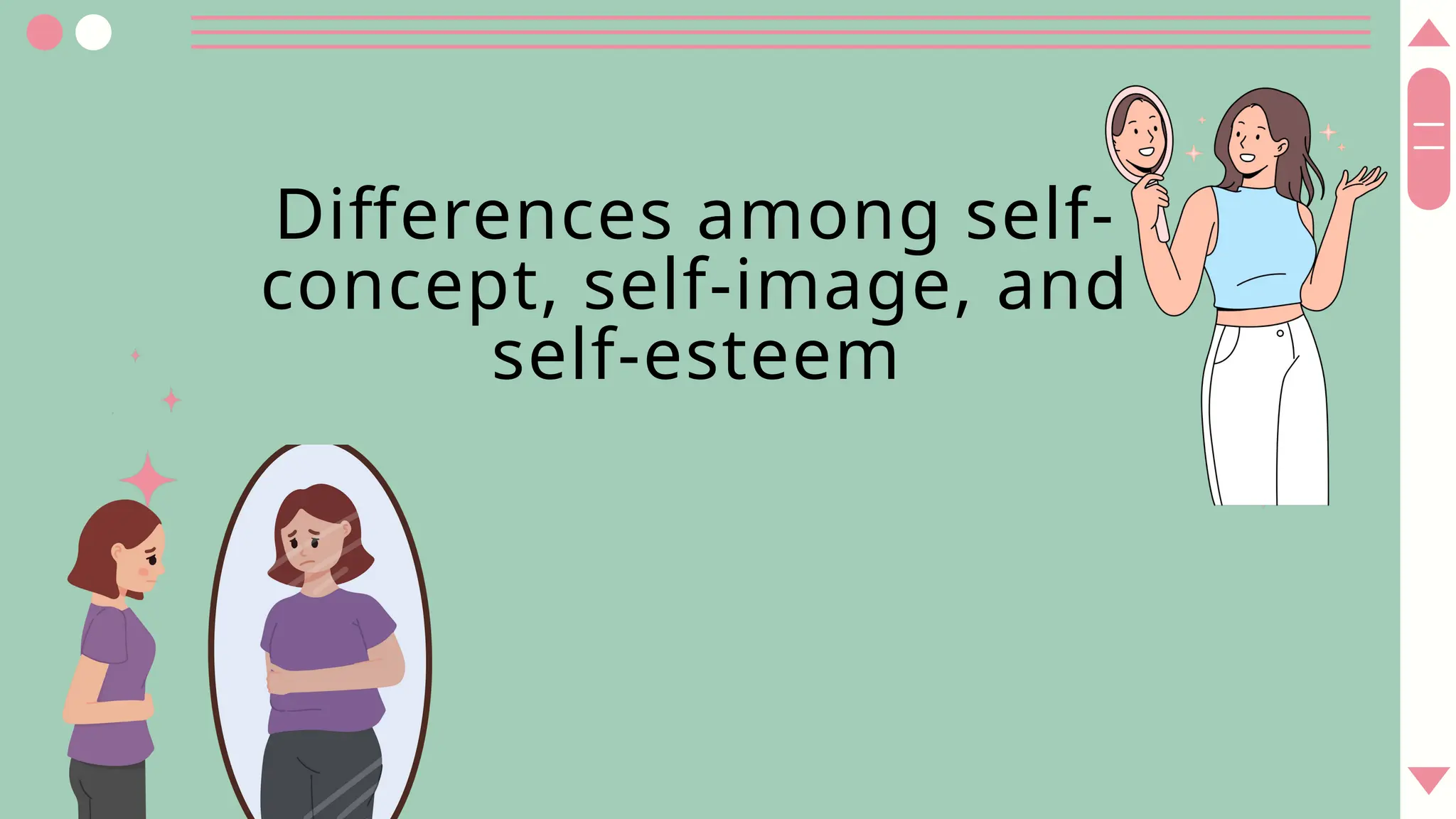
Differences among self-
concept, self-image, and
self-esteem
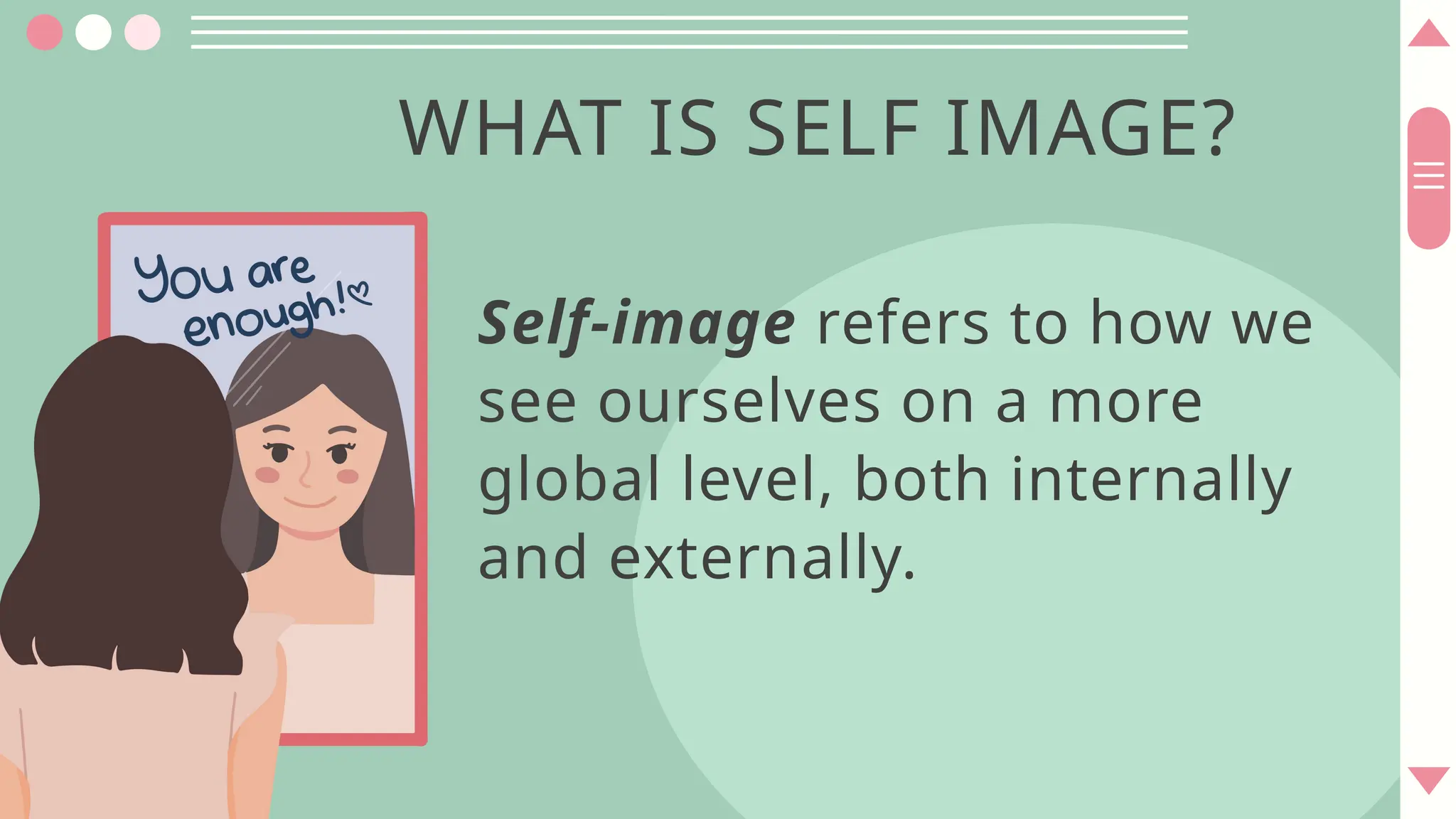
Self-image refers to how we
see ourselves on a more
global level, both internally
and externally.
WHAT IS SELF IMAGE?
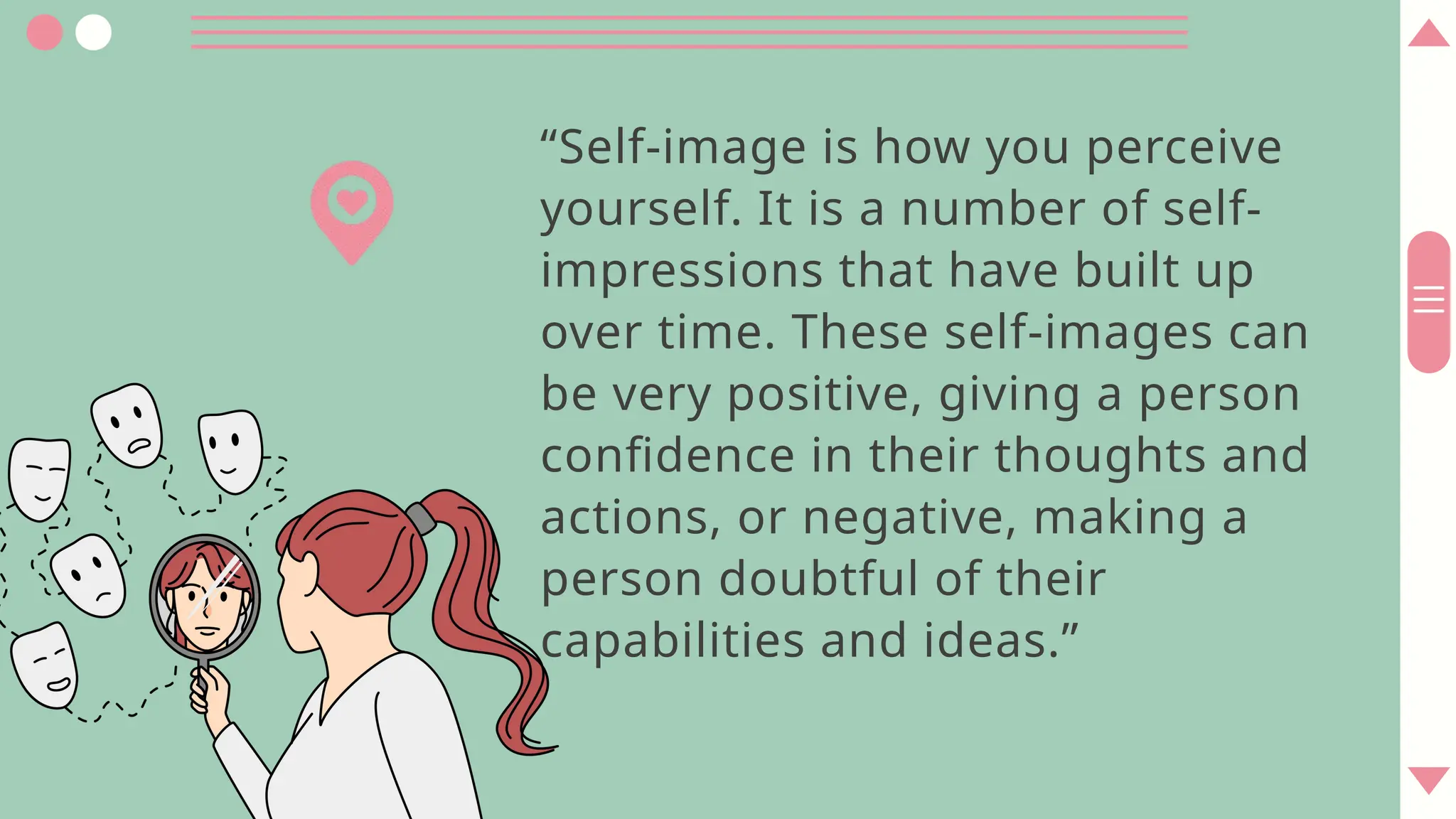
“Self-image is how you perceive
yourself. It is a number of self-
impressions that have built up
over time. These self-images can
be very positive, giving a person
confidence in their thoughts and
actions, or negative, making a
person doubtful of their
capabilities and ideas.”
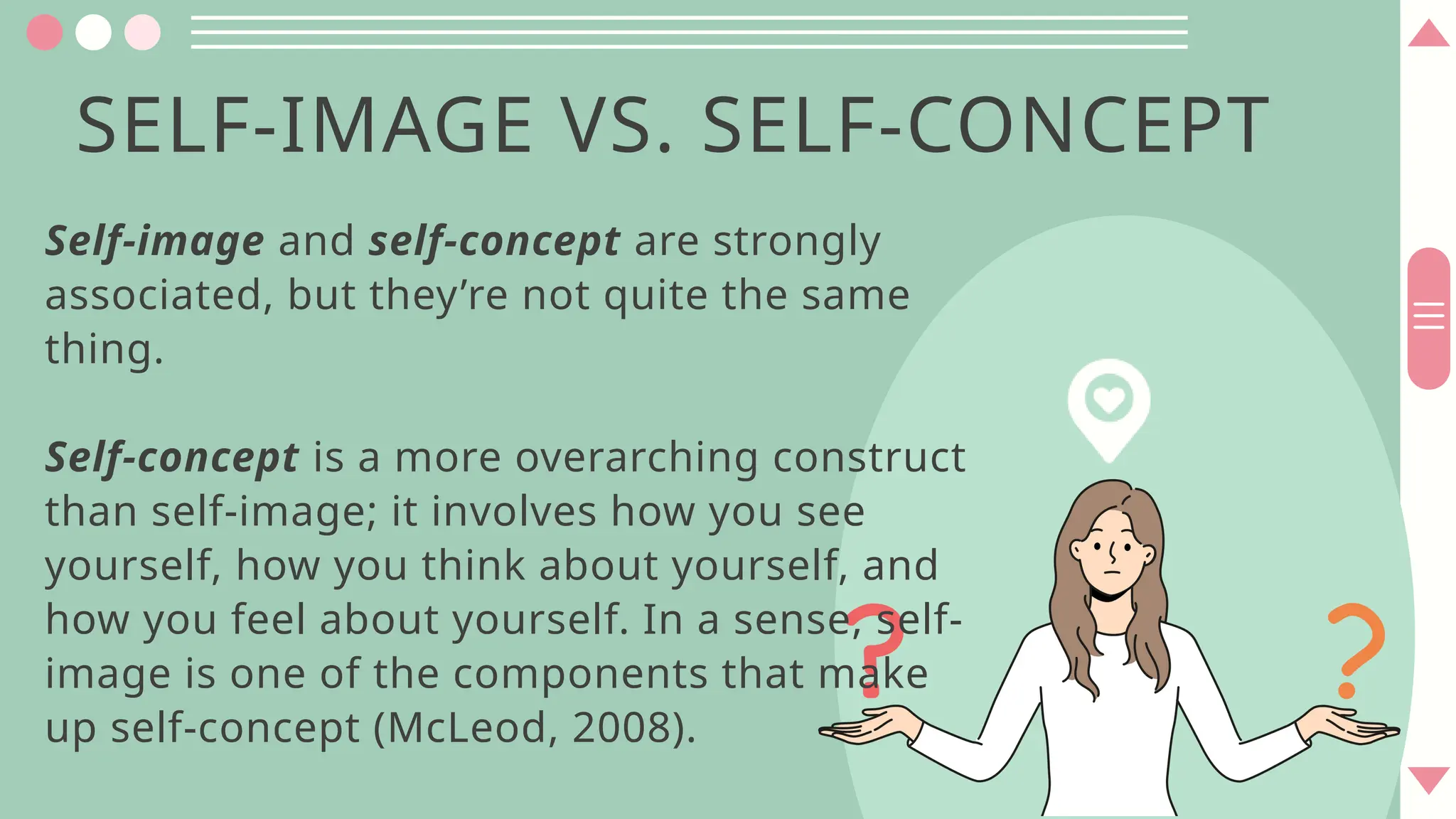
Self-image and self-concept are strongly
associated, but they’re not quite the same
thing.
Self-concept is a more overarching construct
than self-image; it involves how you see
yourself, how you think about yourself, and
how you feel about yourself. In a sense, self-
image is one of the components that make
up self-concept (McLeod, 2008).
SELF-IMAGE VS. SELF-CONCEPT
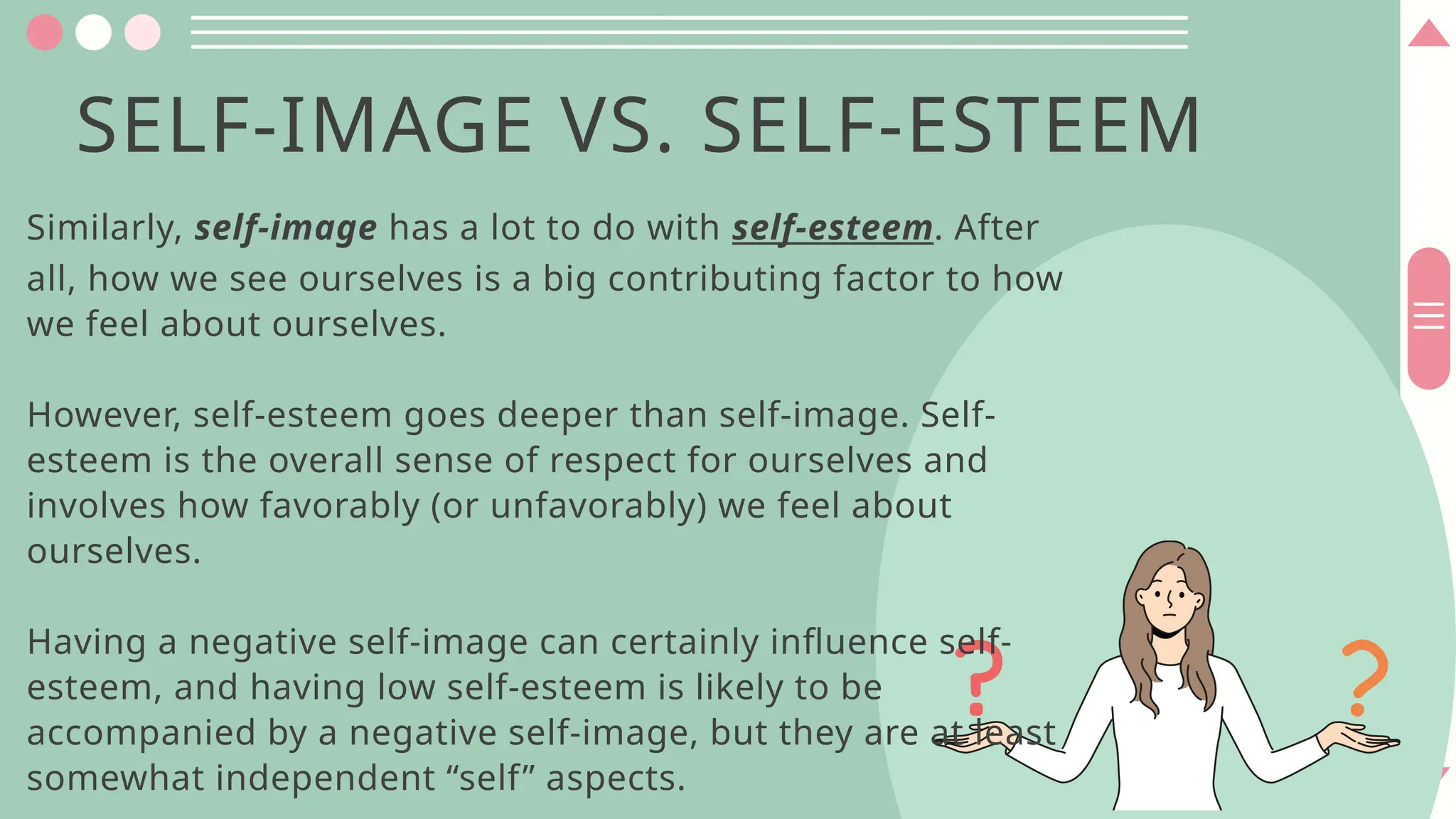
Similarly, self-image has a lot to do with self-esteem. After
all, how we see ourselves is a big contributing factor to how
we feel about ourselves.
However, self-esteem goes deeper than self-image. Self-
esteem is the overall sense of respect for ourselves and
involves how favorably (or unfavorably) we feel about
ourselves.
Having a negative self-image can certainly influence self-
esteem, and having low self-esteem is likely to be
accompanied by a negative self-image, but they are at least
somewhat independent “self” aspects.
SELF-IMAGE VS. SELF-ESTEEM
THE ELEMENTS AND
DIMENSIONS OF
SELF-IMAGE
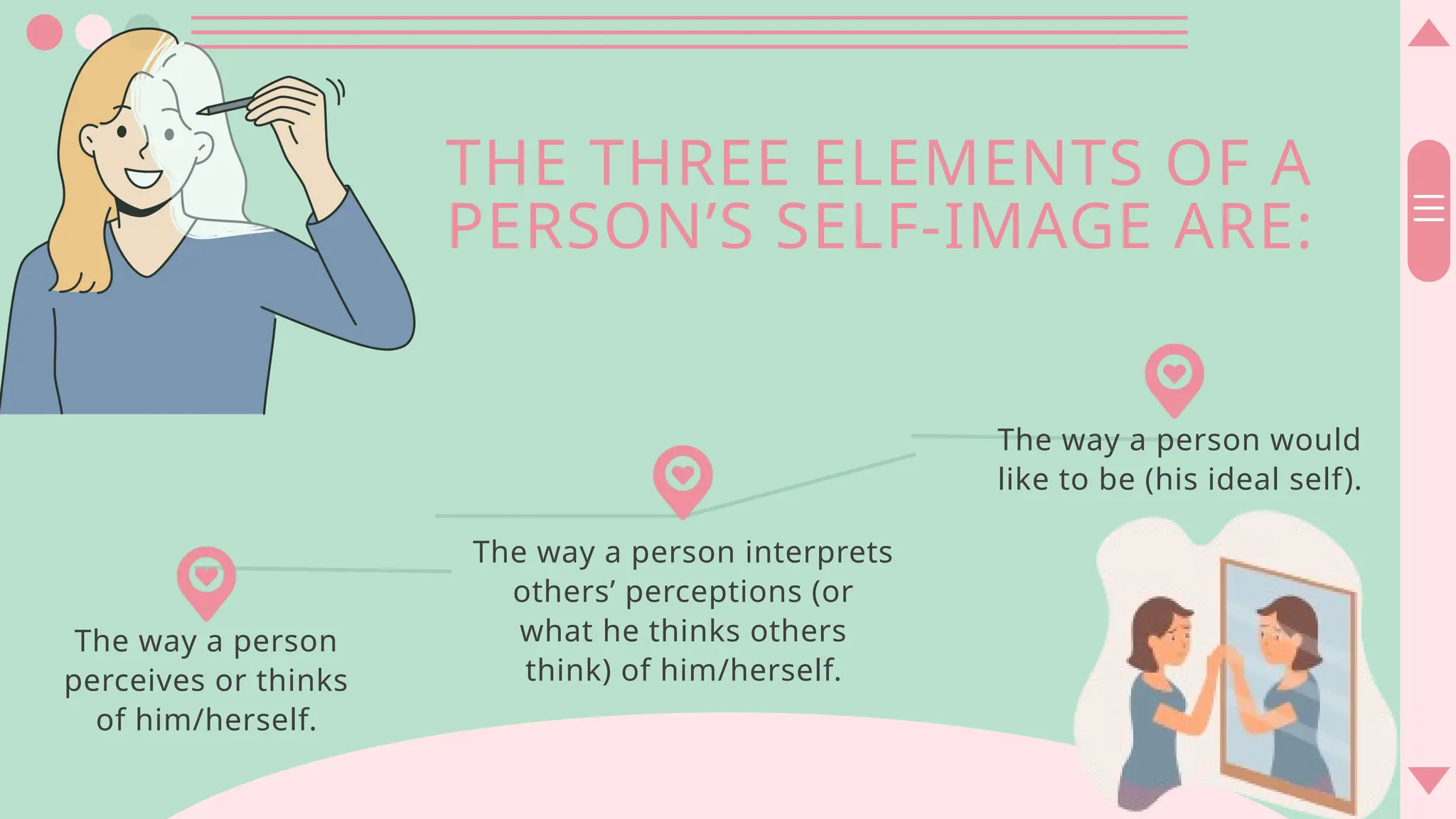
The way a person
perceives or thinks
of him/herself.
The way a person would
like to be (his ideal self).
The way a person interprets
others’ perceptions (or
what he thinks others
think) of him/herself.
THE THREE ELEMENTS OF A
PERSON’S SELF-IMAGE ARE:
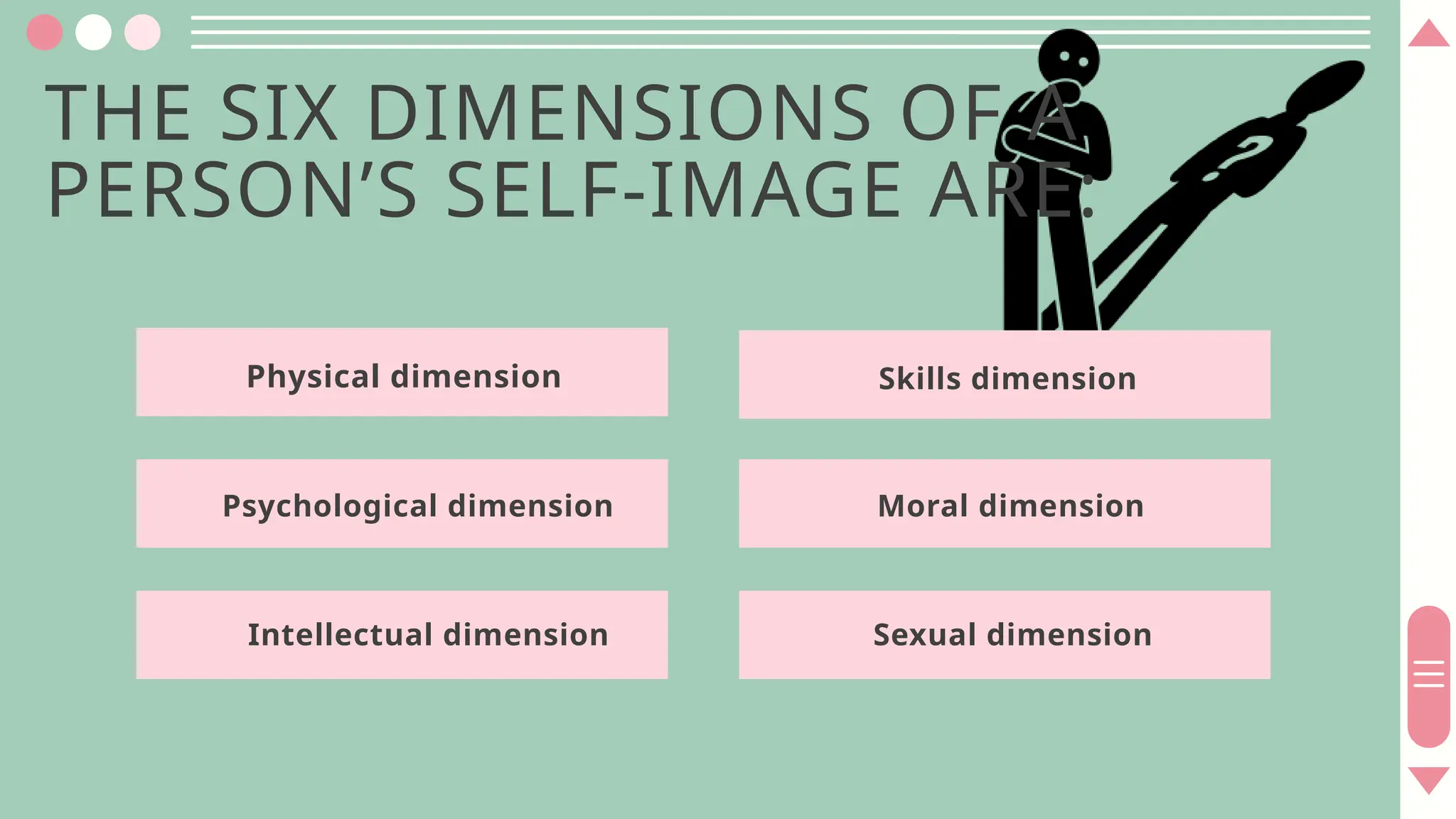
THE SIX DIMENSIONS OF A
PERSON’S SELF-IMAGE ARE:
Psychological dimension
Intellectual dimension Sexual dimension
Moral dimension
Physical dimension Skills dimension
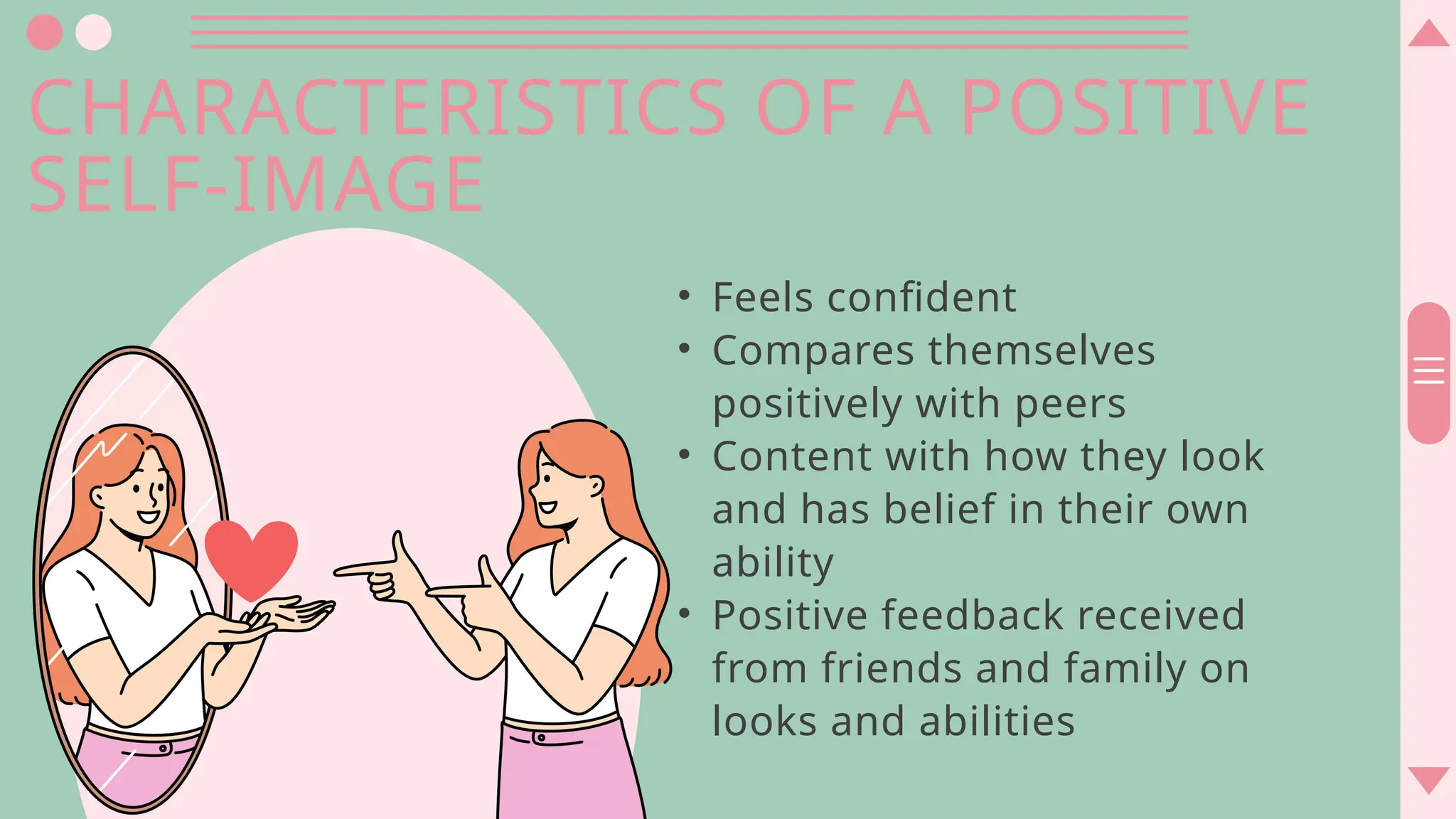
CHARACTERISTICS OF A POSITIVE
SELF-IMAGE
• Feels confident
• Compares themselves
positively with peers
• Content with how they look
and has belief in their own
ability
• Positive feedback received
from friends and family on
looks and abilities
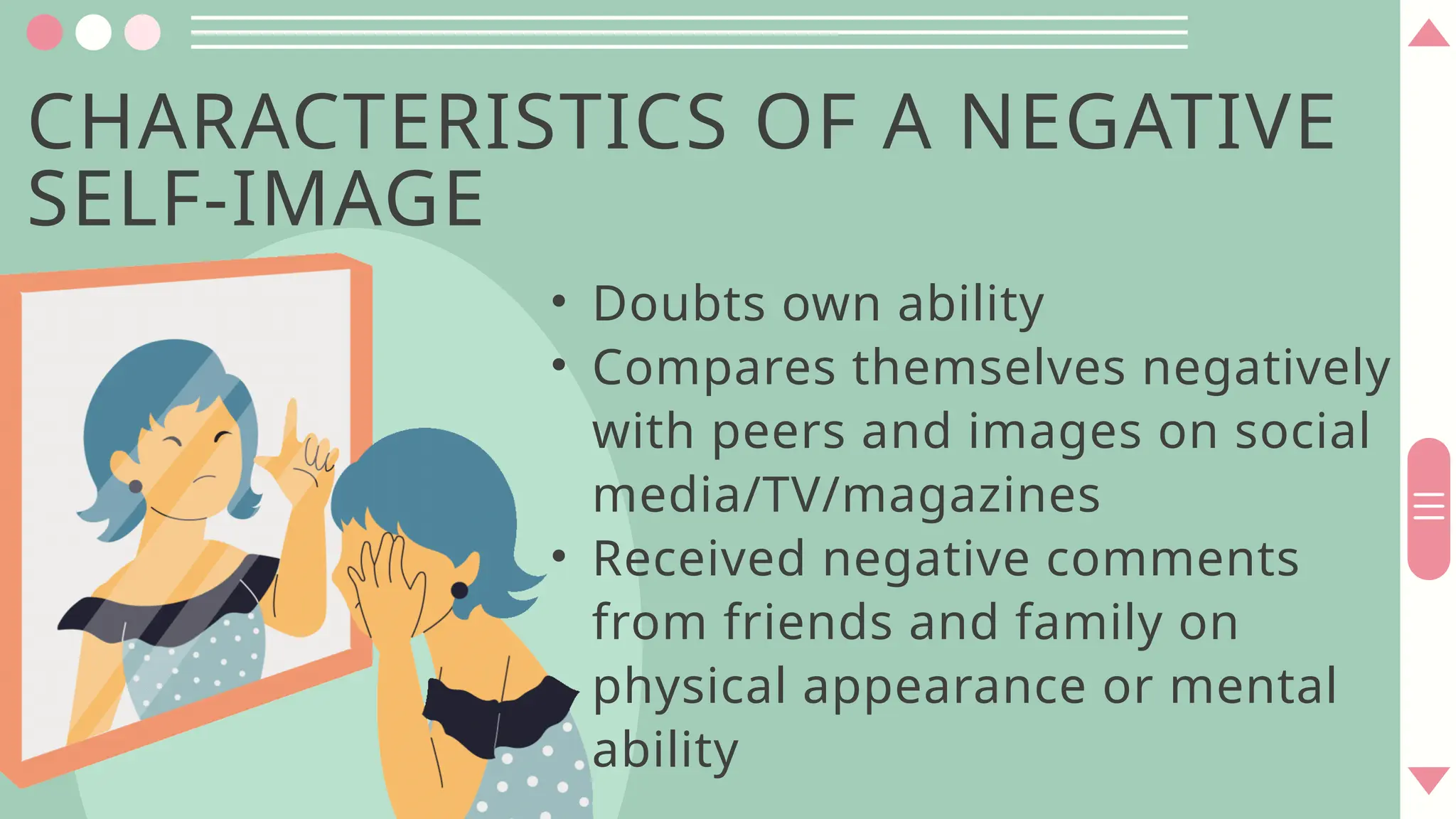
CHARACTERISTICS OF A NEGATIVE
SELF-IMAGE
• Doubts own ability
• Compares themselves negatively
with peers and images on social
media/TV/magazines
• Received negative comments
from friends and family on
physical appearance or mental
ability
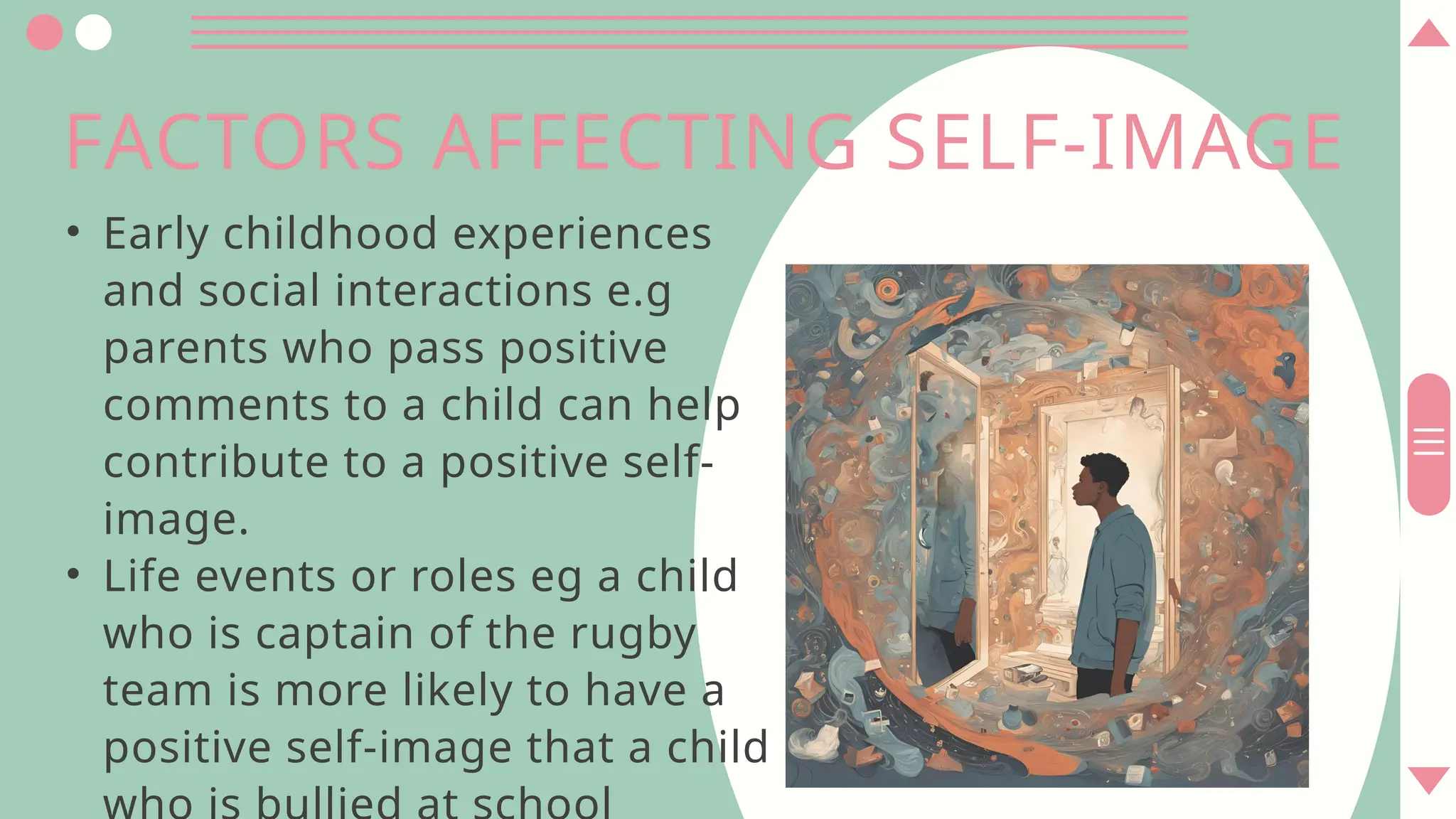
FACTORS AFFECTING SELF-IMAGE
• Early childhood experiences
and social interactions e.g
parents who pass positive
comments to a child can help
contribute to a positive self-
image.
• Life events or roles eg a child
who is captain of the rugby
team is more likely to have a
positive self-image that a child
IMPROVING SELF-IMAGE
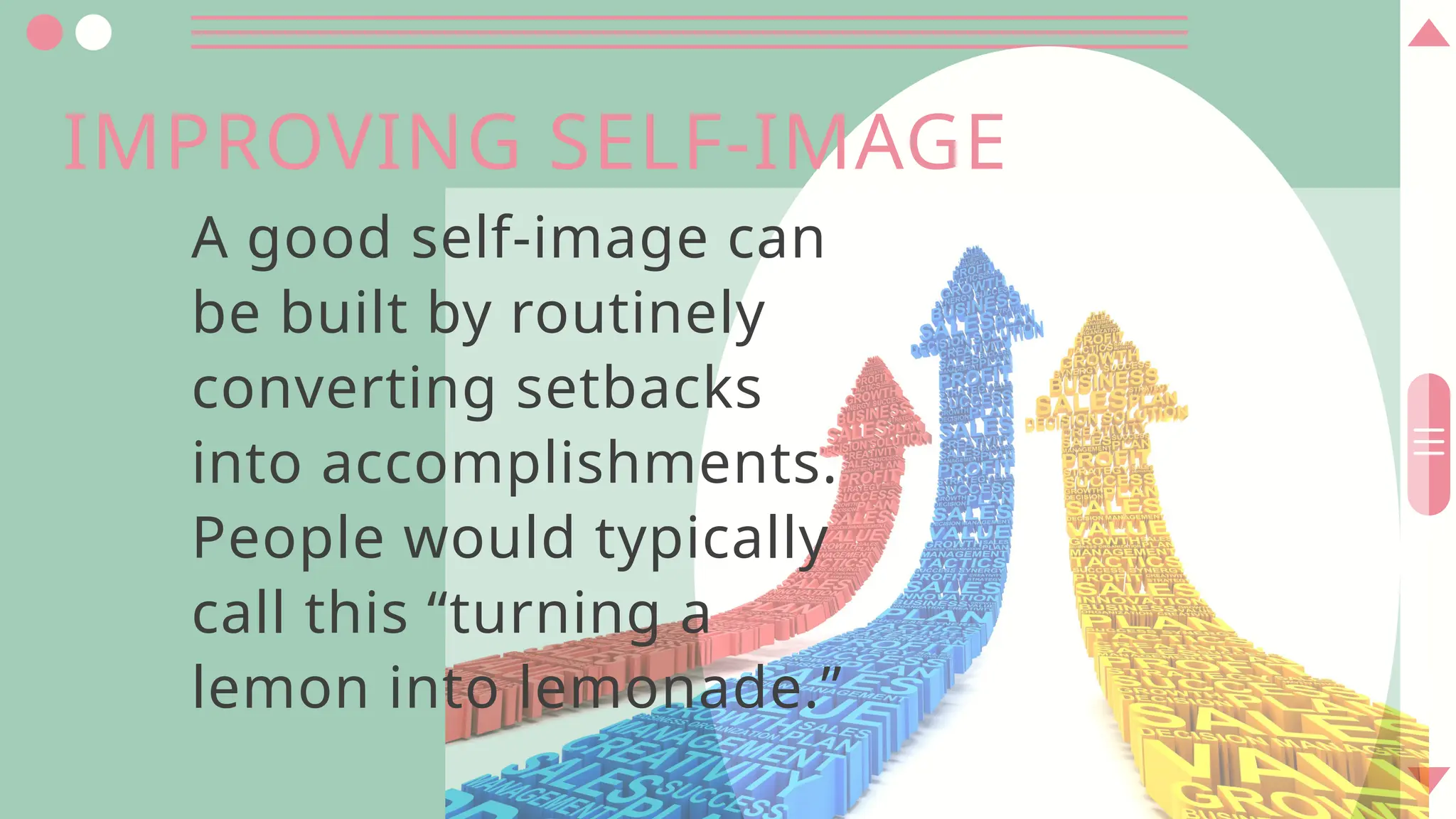
A good self-image can
be built by routinely
converting setbacks
into accomplishments.
People would typically
call this “turning a
lemon into lemonade.”
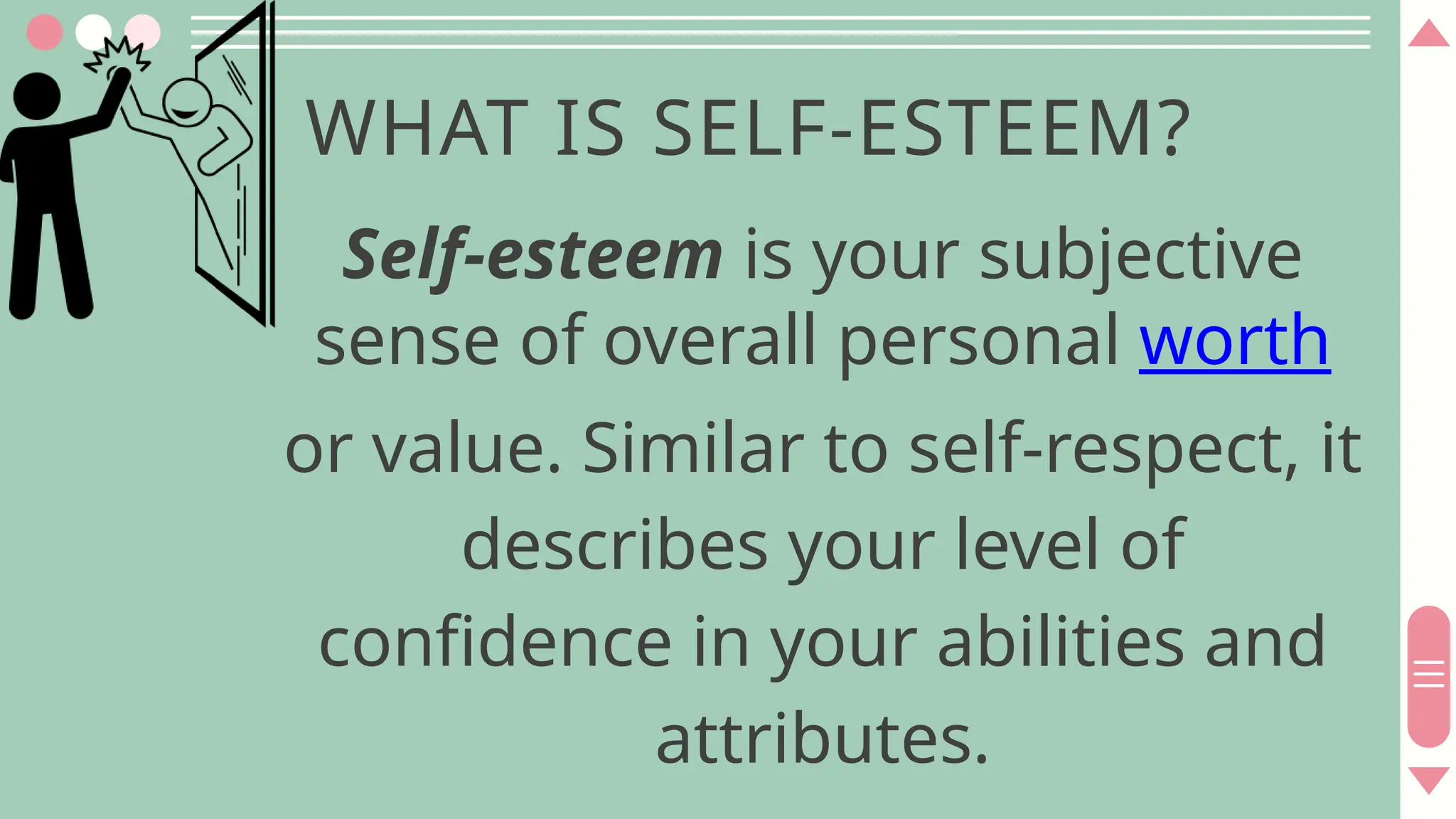
WHAT IS SELF-ESTEEM?
Self-esteem is your subjective
sense of overall personal worth
or value. Similar to self-respect, it
describes your level of
confidence in your abilities and
attributes.
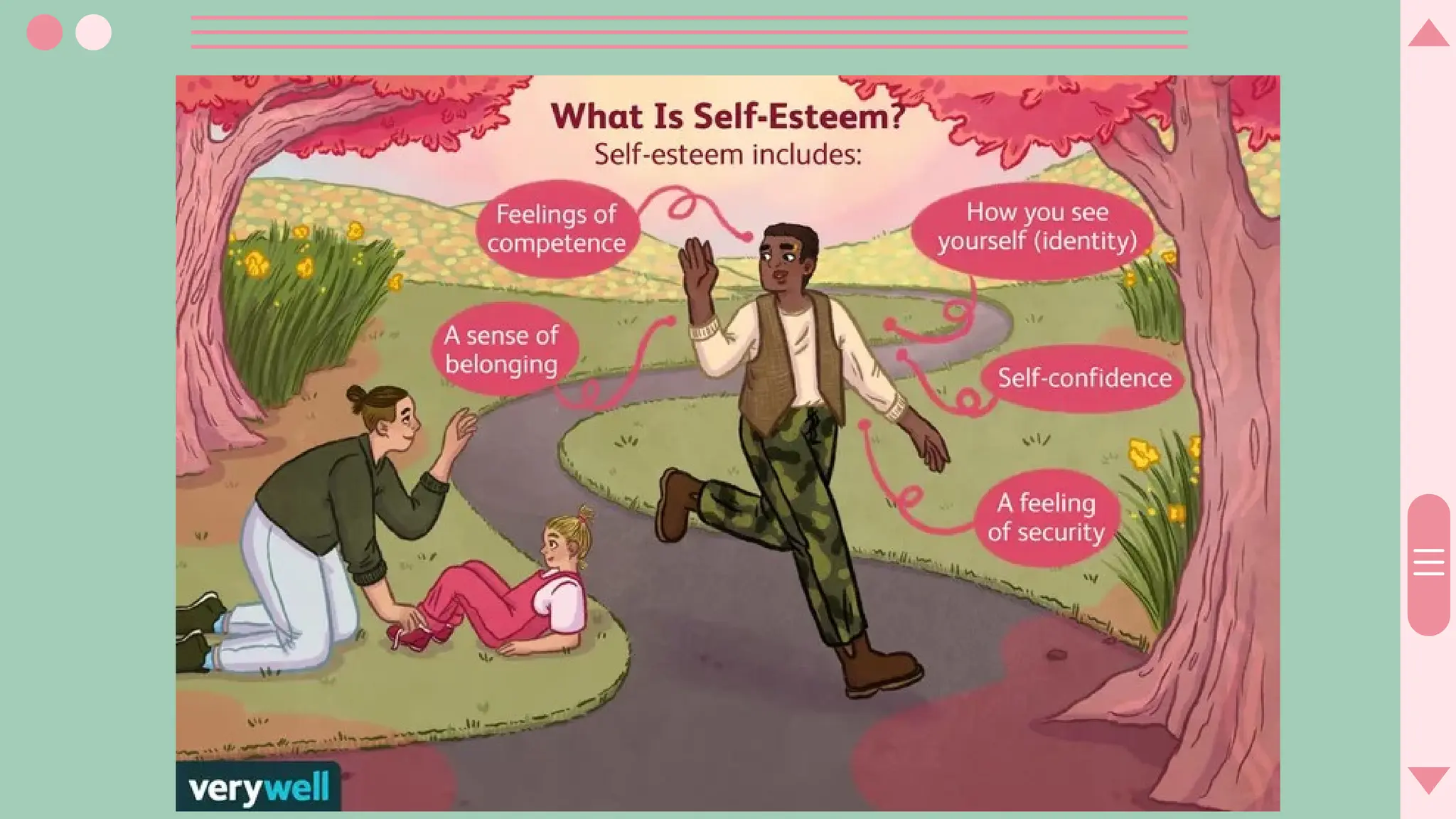
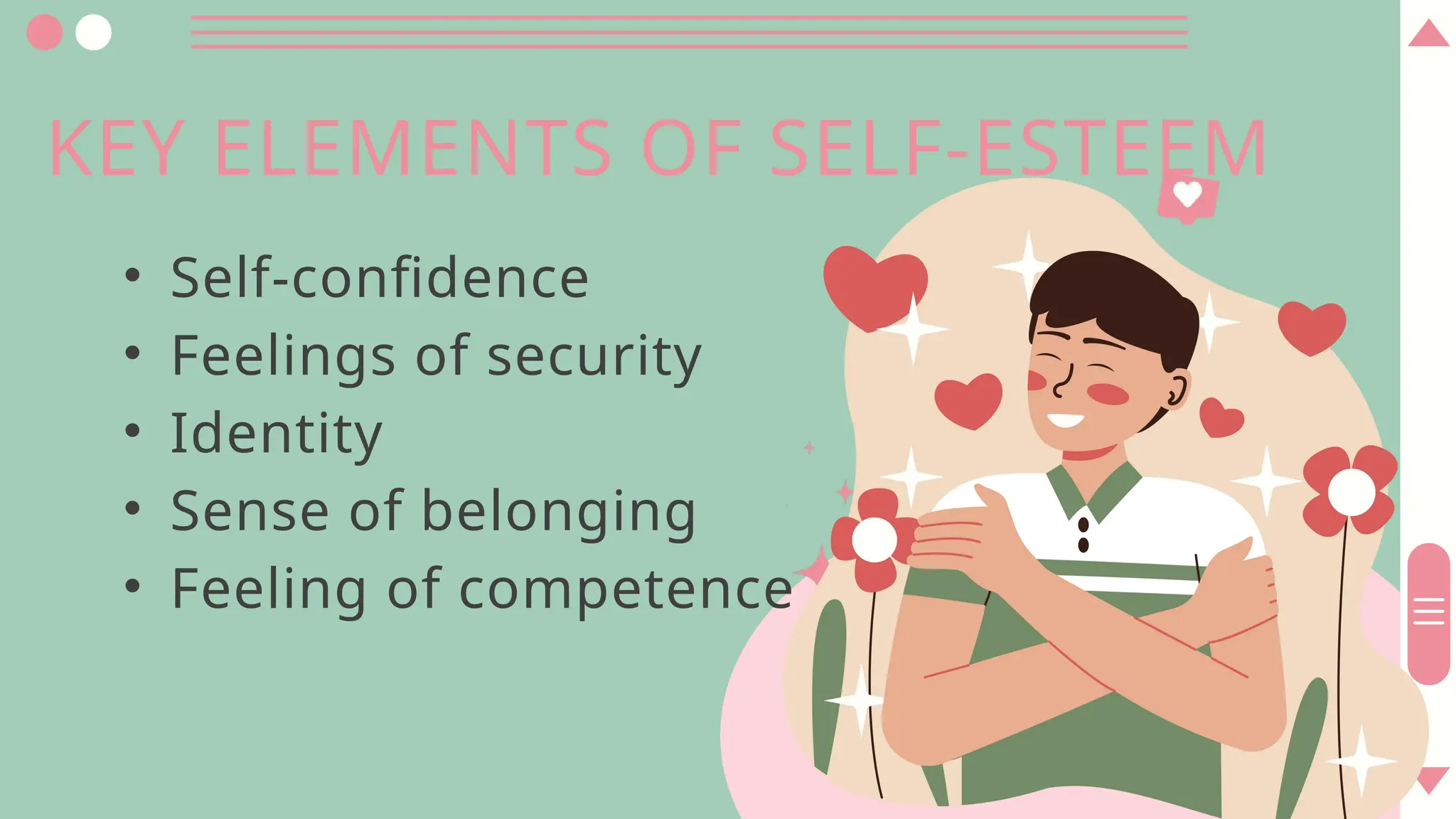
KEY ELEMENTS OF SELF-ESTEEM
• Self-confidence
• Feelings of security
• Identity
• Sense of belonging
• Feeling of competence
WHY SELF-ESTEEM IS
IMPORTANT
Self-esteem impacts your decision-
making process, your relationships,
your emotional health, and your
overall well-being. It also influence a
motivation, as people with a healthy,
positive view of themselves
understand their potential and may
feel inspired to take on new
challenges.
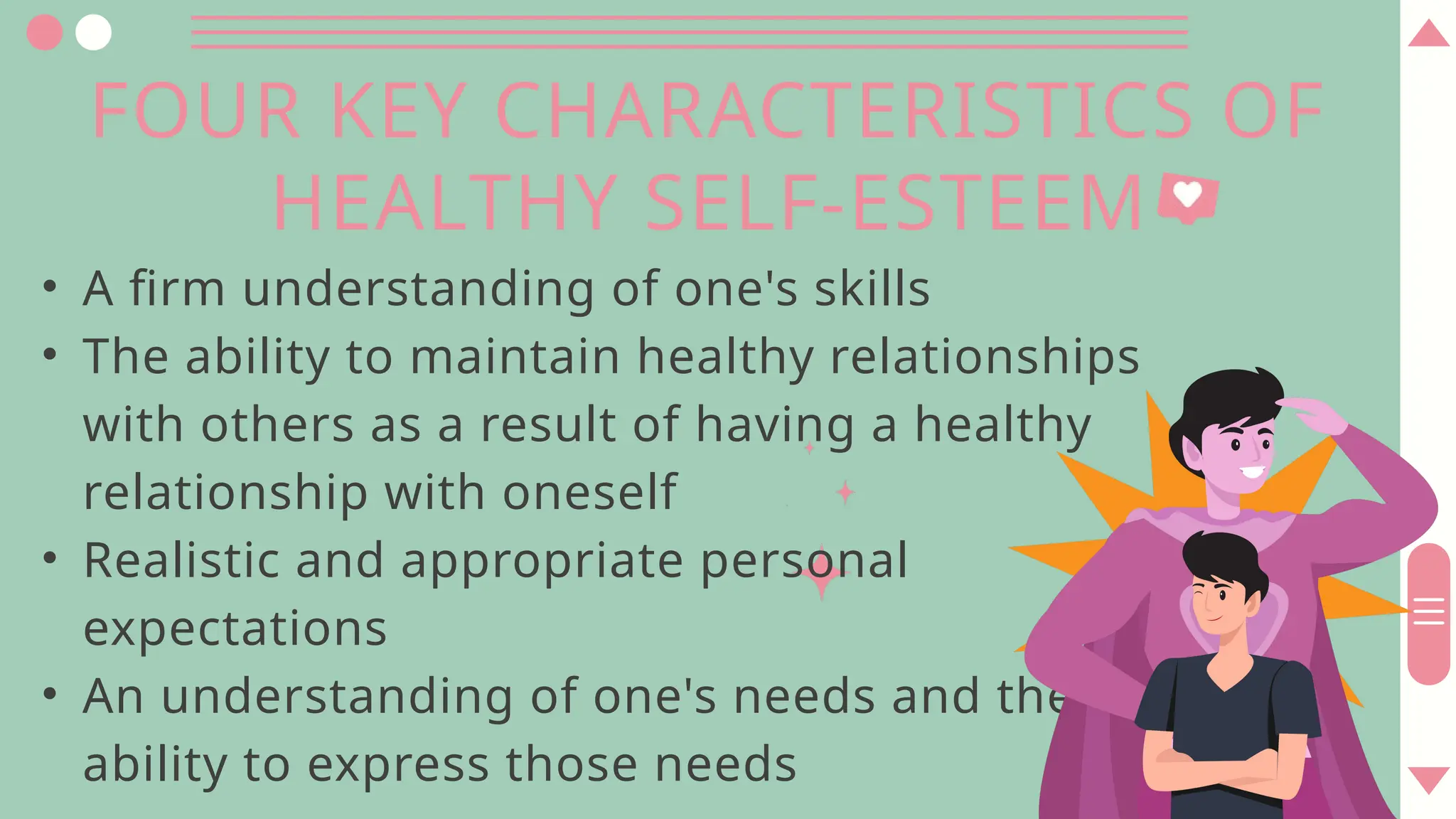
• A firm understanding of one's skills
• The ability to maintain healthy relationships
with others as a result of having a healthy
relationship with oneself
• Realistic and appropriate personal
expectations
• An understanding of one's needs and the
ability to express those needs
FOUR KEY CHARACTERISTICS OF
HEALTHY SELF-ESTEEM
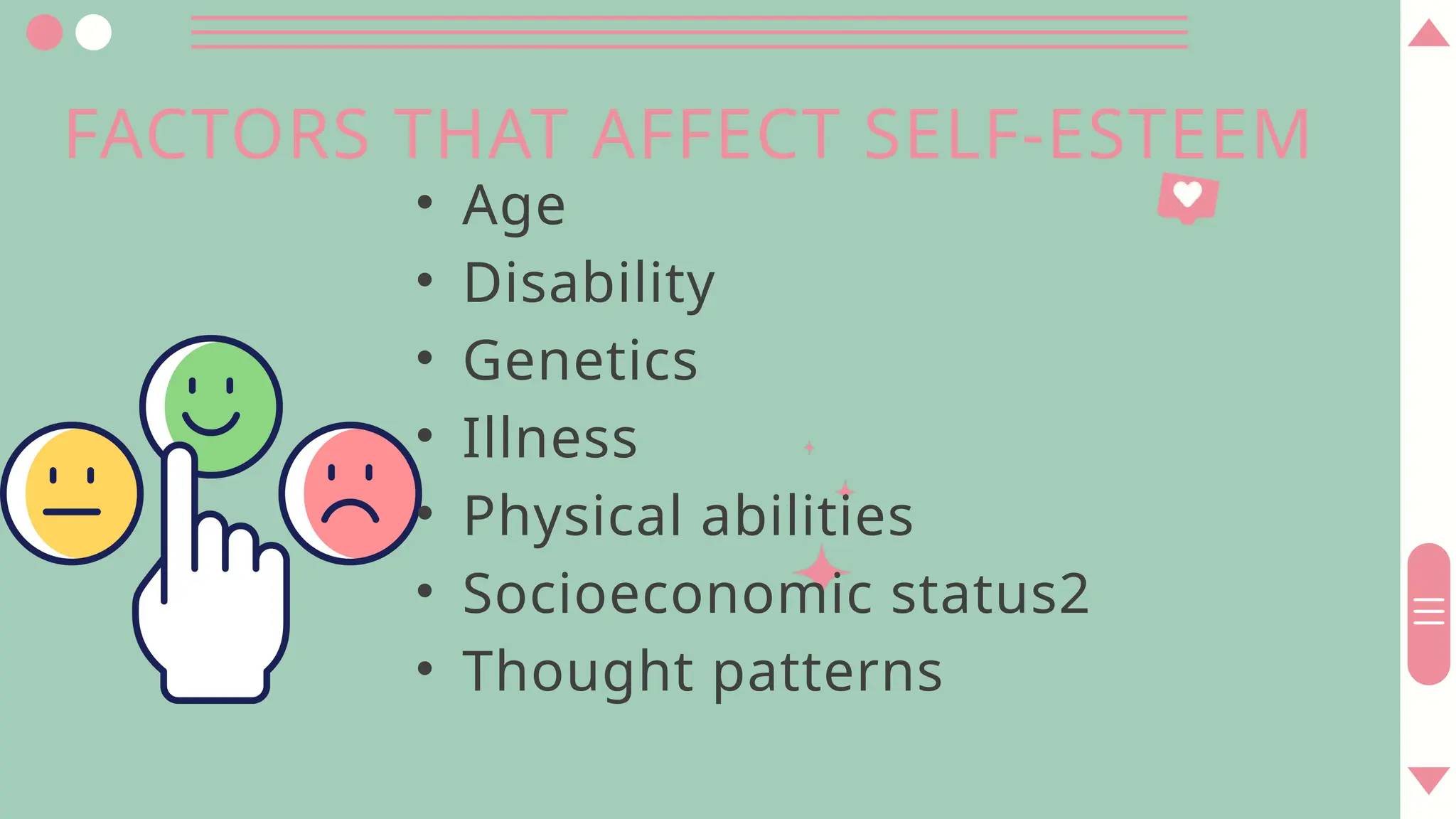
FACTORS THAT AFFECT SELF-ESTEEM
• Age
• Disability
• Genetics
• Illness
• Physical abilities
• Socioeconomic status2
• Thought patterns
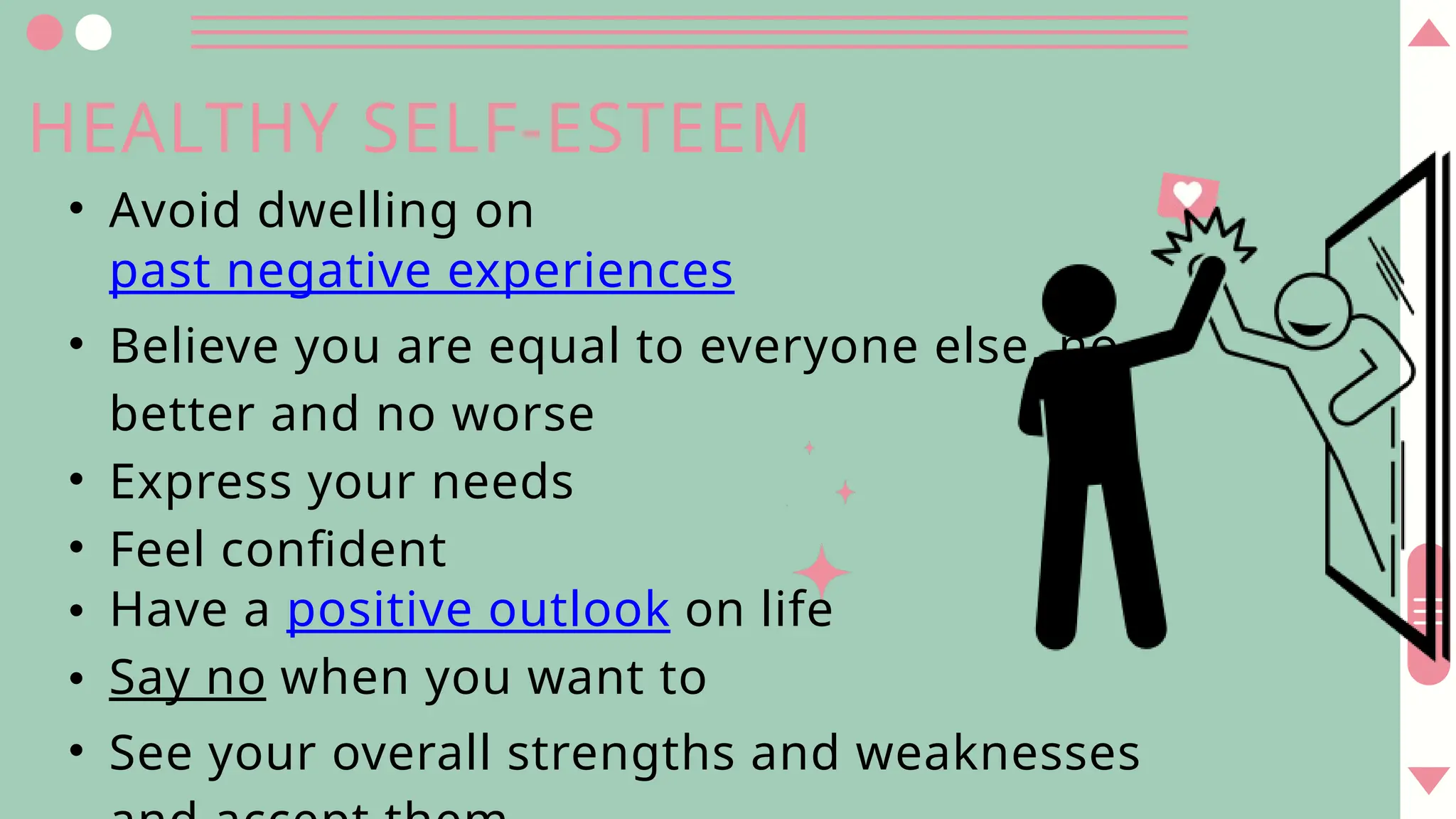
• Avoid dwelling on
past negative experiences
• Believe you are equal to everyone else, no
better and no worse
• Express your needs
• Feel confident
• Have a positive outlook on life
• Say no when you want to
• See your overall strengths and weaknesses
HEALTHY SELF-ESTEEM
LOW SELF-ESTEEM
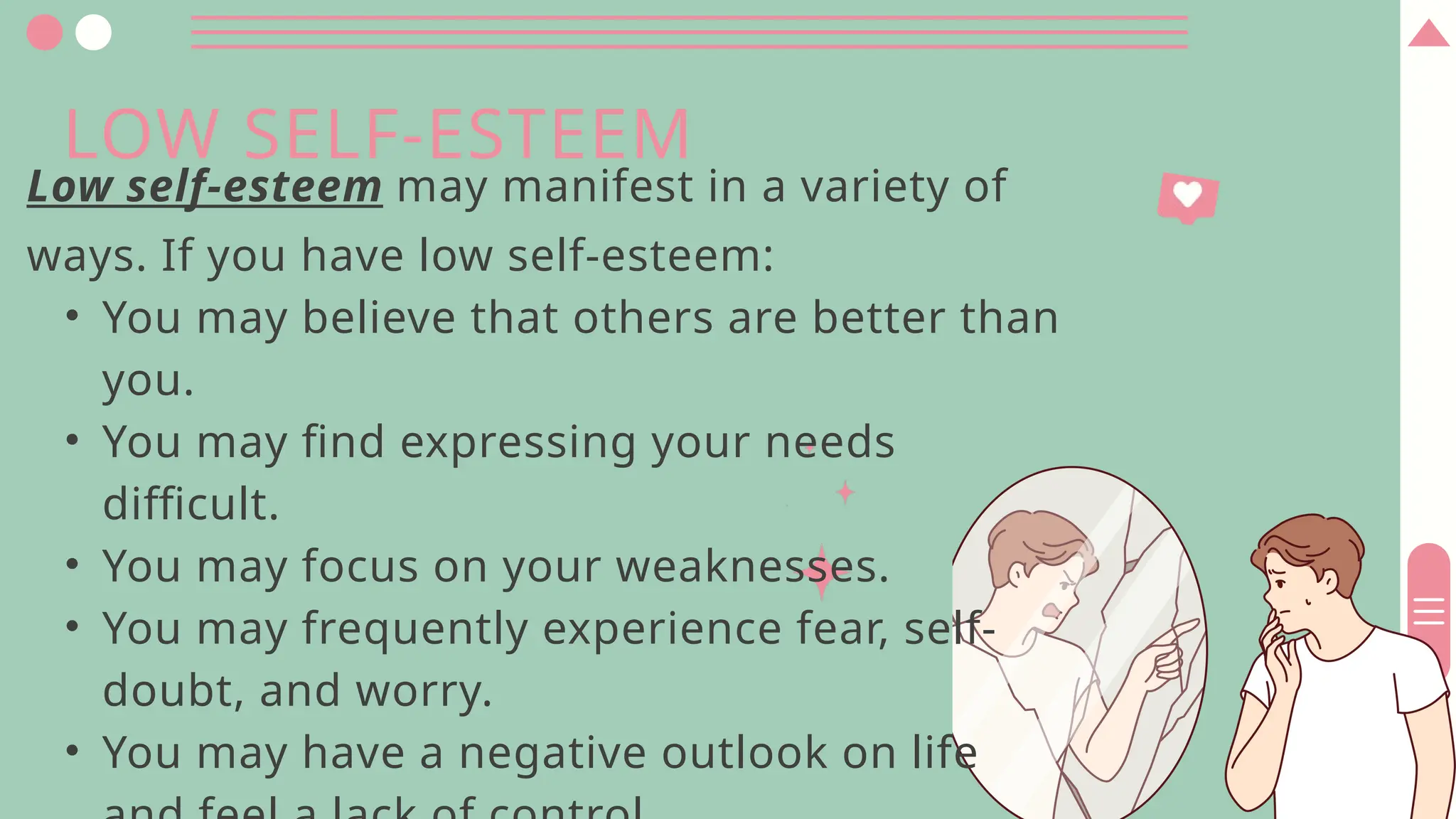
Low self-esteem may manifest in a variety of
ways. If you have low self-esteem:
• You may believe that others are better than
you.
• You may find expressing your needs
difficult.
• You may focus on your weaknesses.
• You may frequently experience fear, self-
doubt, and worry.
• You may have a negative outlook on life
LOW SELF-ESTEEM
• You may have an intense fear of failure.
• You may have trouble accepting positive feed
back.
• You may have trouble saying no and setting b
oundaries.
• You may put other people's needs before your
own.
• You may struggle with confidence.
Who are you? What makes you “you?”
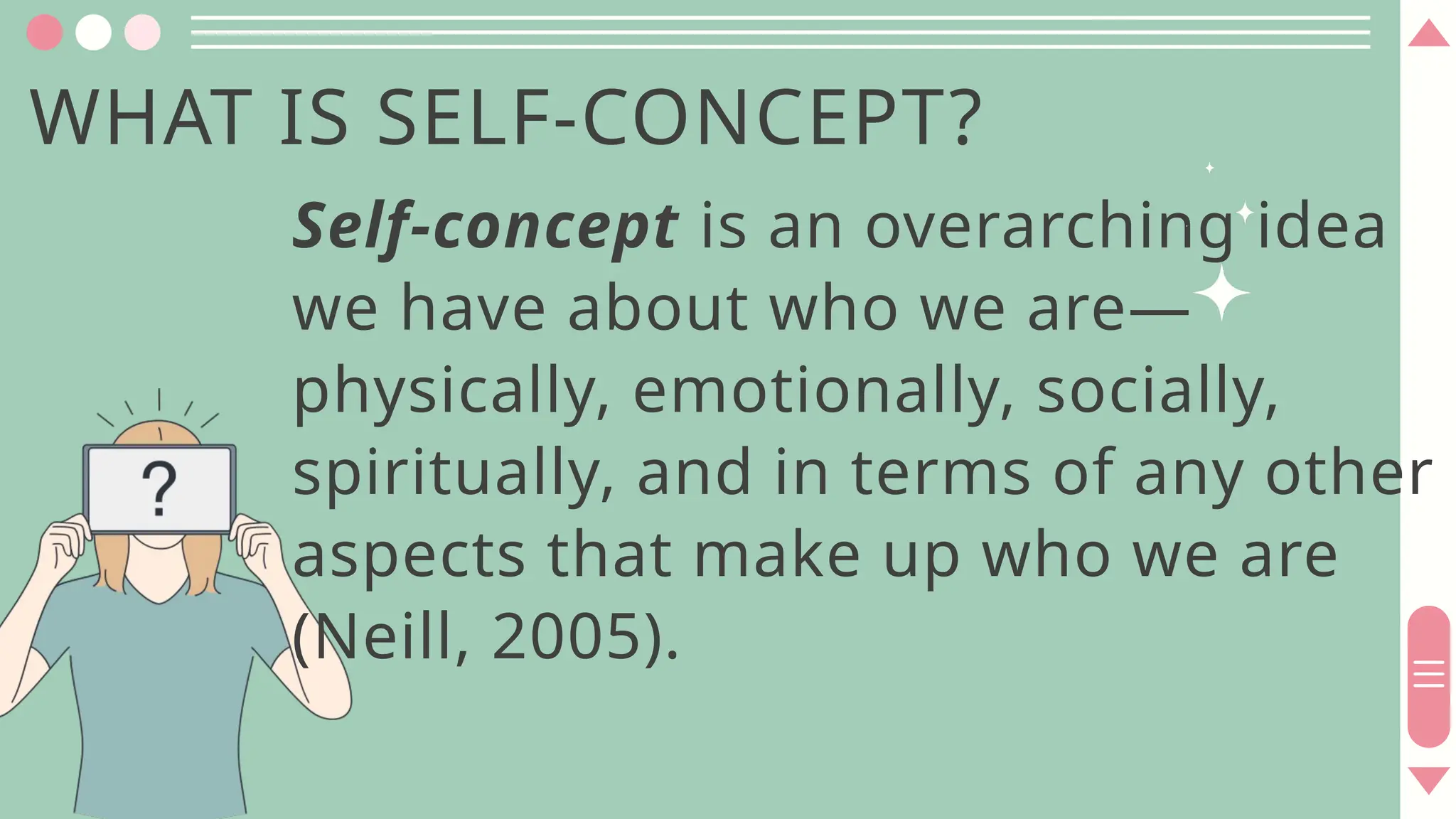
WHAT IS SELF-CONCEPT?
Self-concept is an overarching idea
we have about who we are—
physically, emotionally, socially,
spiritually, and in terms of any other
aspects that make up who we are
(Neill, 2005).
SELF-CONCEPT VS. SELF-ESTEEM
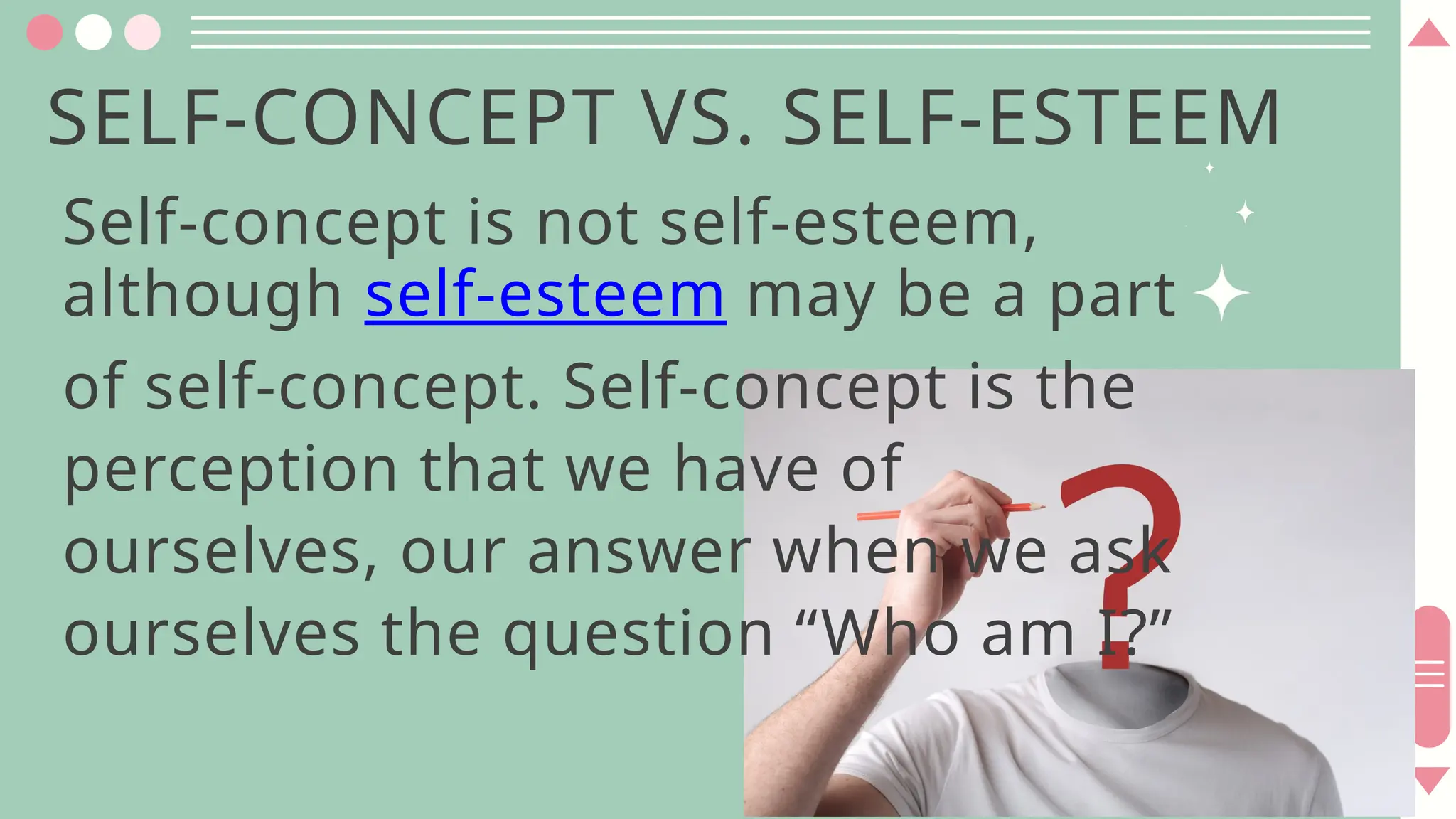
Self-concept is not self-esteem,
although self-esteem may be a part
of self-concept. Self-concept is the
perception that we have of
ourselves, our answer when we ask
ourselves the question “Who am I?”
SELF-CONCEPT VS. SELF-IMAGE
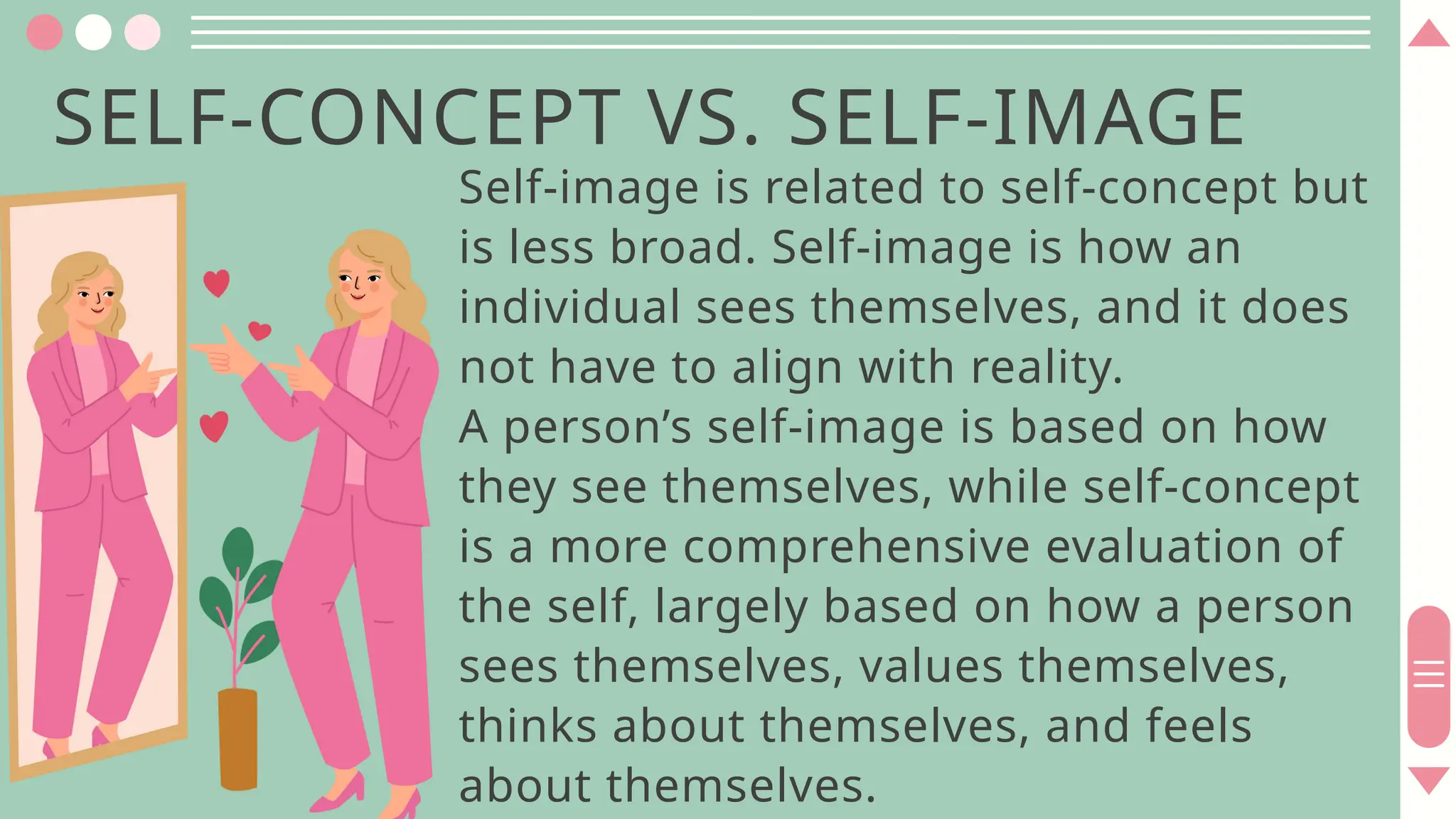
Self-image is related to self-concept but
is less broad. Self-image is how an
individual sees themselves, and it does
not have to align with reality.
A person’s self-image is based on how
they see themselves, while self-concept
is a more comprehensive evaluation of
the self, largely based on how a person
sees themselves, values themselves,
thinks about themselves, and feels
about themselves.
SELF-CONCEPT VS. SELF-EFFICACY?
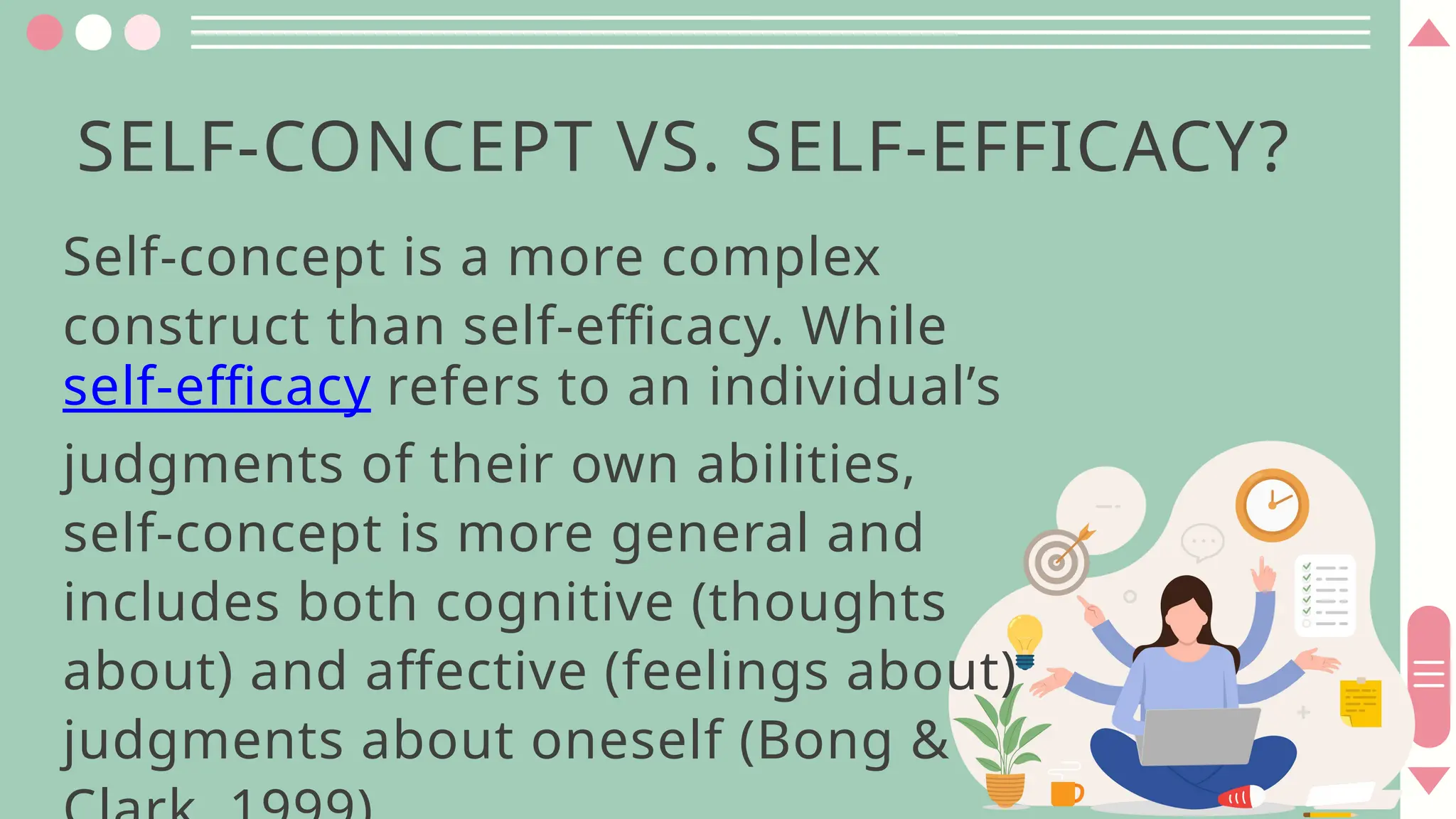
Self-concept is a more complex
construct than self-efficacy. While
self-efficacy refers to an individual’s
judgments of their own abilities,
self-concept is more general and
includes both cognitive (thoughts
about) and affective (feelings about)
judgments about oneself (Bong &
SELF-CONCEPT VS. SELF-AWARENESS?
Self-awareness also influences self-
concept. It is the quality or trait that
involves conscious awareness of one’s own
thoughts, feelings, behaviors, and traits
(Cherry, 2018A). To have a fully developed
self-concept (and one that is based in
reality), a person must have at least some
level of self-awareness.
CHARACTERISTICS OF SELF-CONCEPT
1.Displays uniquely with each person.
2.Vary from very positive to very
negative.
3.Carries emotional, intellectual, and
functional dimensions.
4.Changes with the context.
5.Changes over time.
6.Influence the individual’s life (Delmar
Learning, n.d.)
DIMENSIONS OF SELF-CONCEPT
• Self-esteem
• Self-worth
• Self-image (physical)
• Ideal self
• Identities or roles (social)
• Personal traits and qualities (Elliot,
1984; Gecas, 1982)
THE FORMATION OF SELF-CONCEPT
DURING EARLY CHILDHOOD
There are three general stages of self-concept development duri
ng early childhood:
• Stage 1: 0 to 2 years-old
a. Babies need consistent, loving relationships to develop a
positive sense of self.
b. Babies form preferences that align with their innate sense of s
elf.
c. Toddlers feel secure with gentle but firm limits
d. At age two, language skill develops and toddlers have a sense
THE FORMATION OF SELF-CONCEPT
DURING EARLY CHILDHOOD
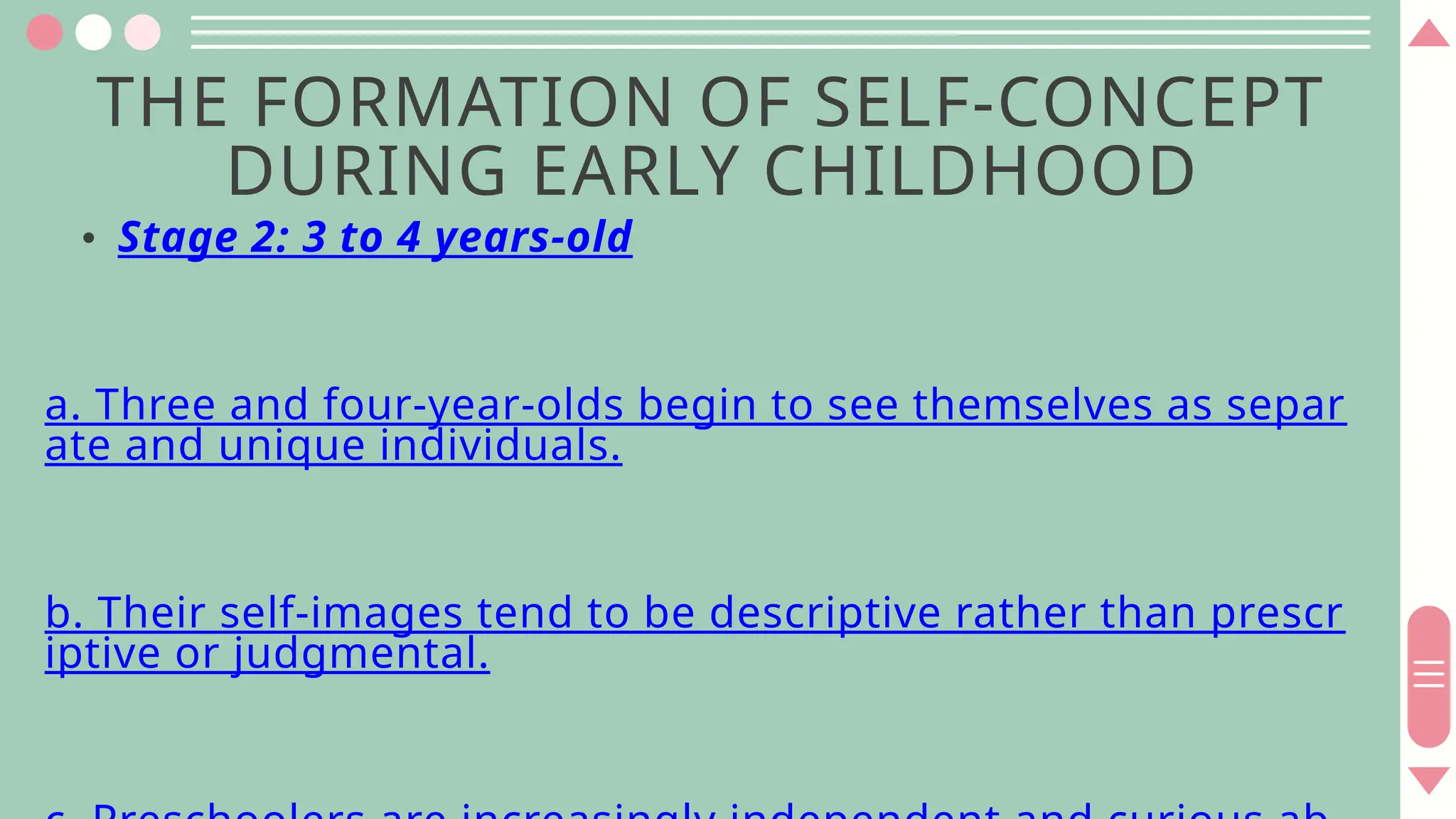
• Stage 2: 3 to 4 years-old
a. Three and four-year-olds begin to see themselves as separ
ate and unique individuals.
b. Their self-images tend to be descriptive rather than prescr
iptive or judgmental.
THE FORMATION OF SELF-CONCEPT
DURING EARLY CHILDHOOD
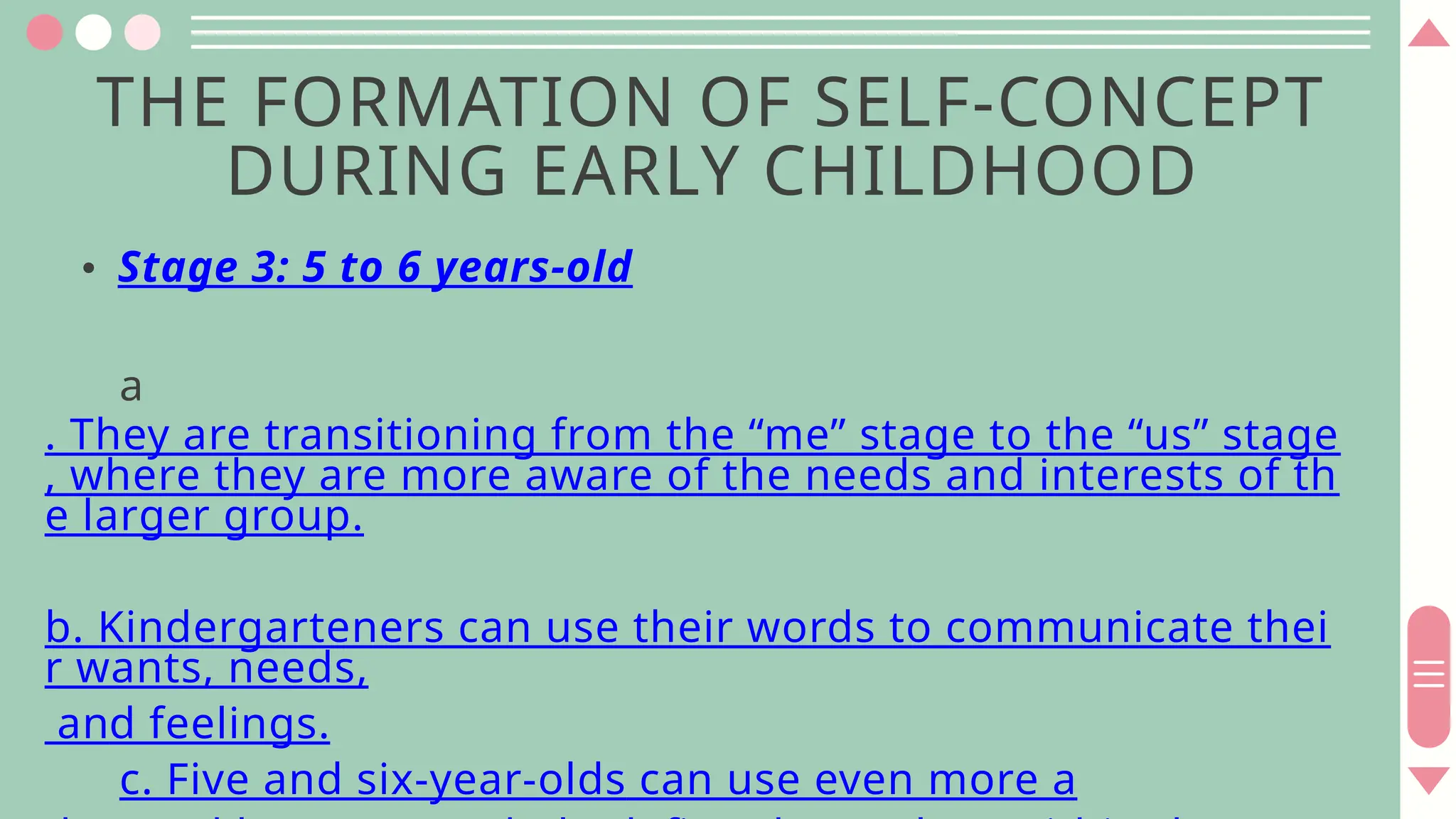
• Stage 3: 5 to 6 years-old
a
. They are transitioning from the “me” stage to the “us” stage
, where they are more aware of the needs and interests of th
e larger group.
b. Kindergarteners can use their words to communicate thei
r wants, needs,
and feelings.
c. Five and six-year-olds can use even more a
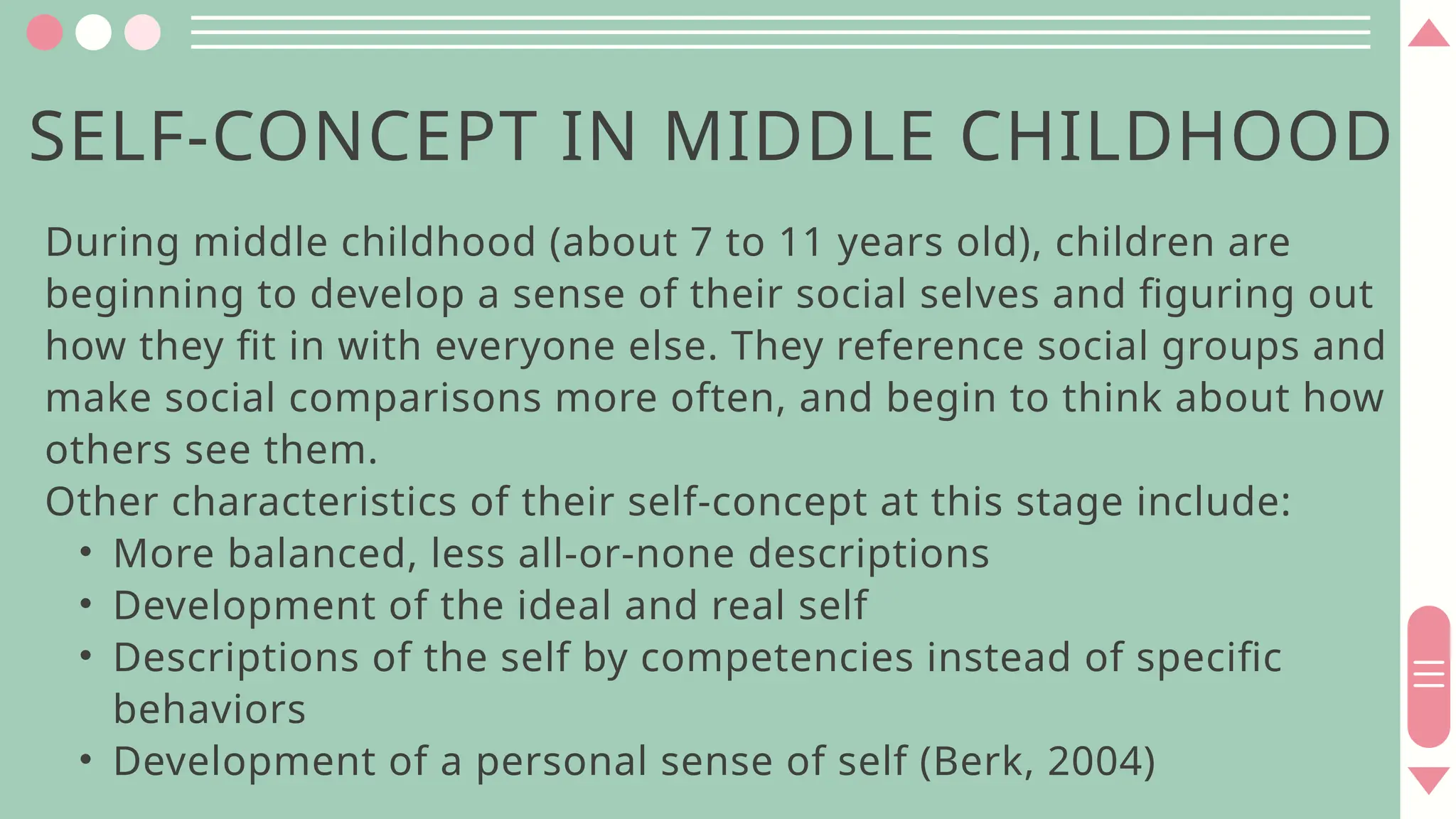
SELF-CONCEPT IN MIDDLE CHILDHOOD
During middle childhood (about 7 to 11 years old), children are
beginning to develop a sense of their social selves and figuring out
how they fit in with everyone else. They reference social groups and
make social comparisons more often, and begin to think about how
others see them.
Other characteristics of their self-concept at this stage include:
• More balanced, less all-or-none descriptions
• Development of the ideal and real self
• Descriptions of the self by competencies instead of specific
behaviors
• Development of a personal sense of self (Berk, 2004)
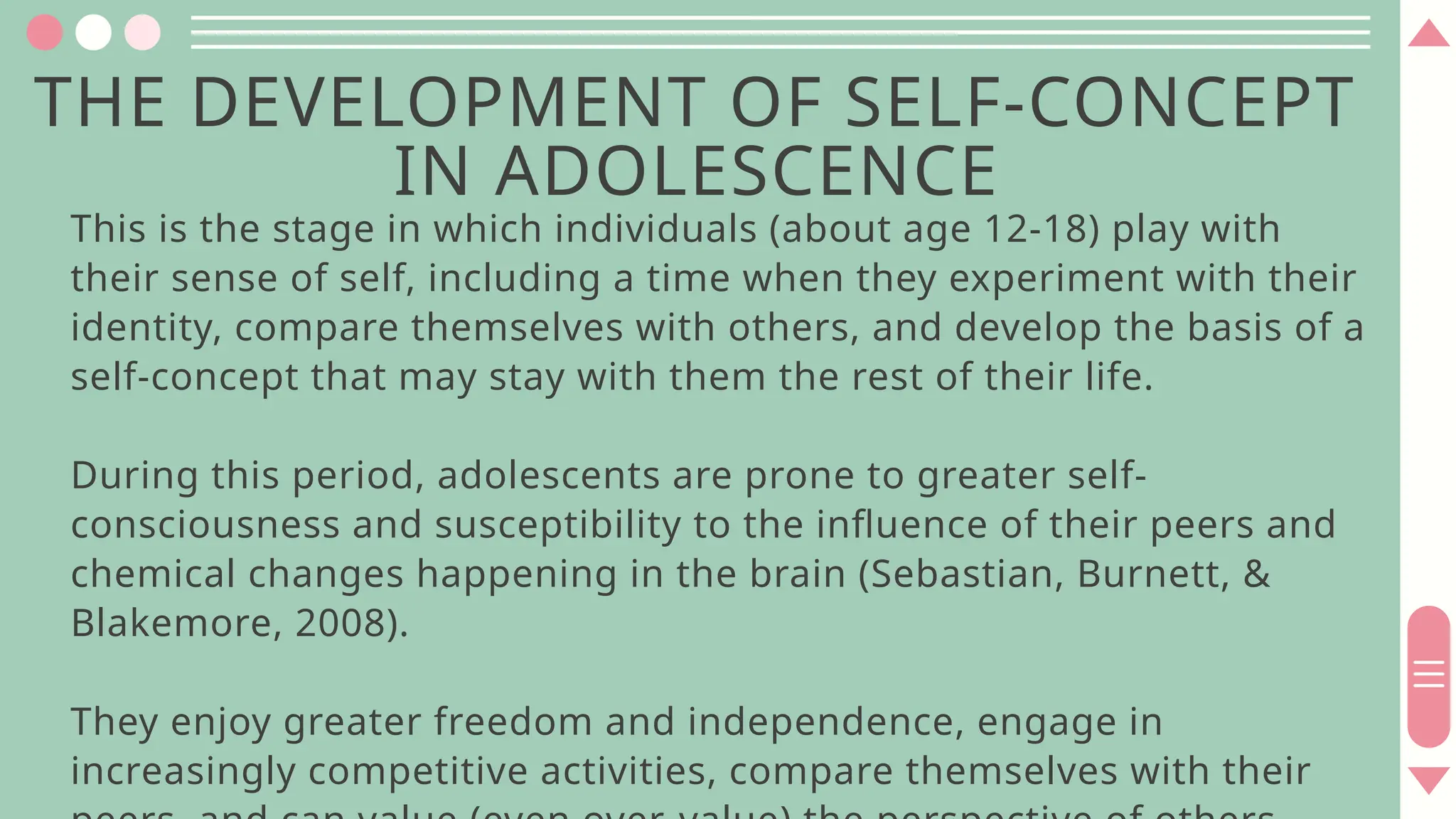
THE DEVELOPMENT OF SELF-CONCEPT
IN ADOLESCENCE
This is the stage in which individuals (about age 12-18) play with
their sense of self, including a time when they experiment with their
identity, compare themselves with others, and develop the basis of a
self-concept that may stay with them the rest of their life.
During this period, adolescents are prone to greater self-
consciousness and susceptibility to the influence of their peers and
chemical changes happening in the brain (Sebastian, Burnett, &
Blakemore, 2008).
They enjoy greater freedom and independence, engage in
increasingly competitive activities, compare themselves with their
Some examples of positive self-concepts include:
• A person sees herself as an intelligent person;
• A man perceives himself as an important member of his
community;
• A woman sees herself as an excellent spouse and friend;
• A person thinks of himself as a nurturing and caring person;
• A person views herself as a hard-working and competent
employee.
On the flip side, these people could have negative self-concepts
like:
• A person sees herself as stupid and slow;
• A man perceives himself as expendable and a burden on his
community;
• A woman sees herself as a terrible spouse and friend;
• A person thinks of himself as a cold and unapproachable
GET IN TOUCH
+123-456-7890
hello@reallygreatsite.com www.reallygreatsite.com
@reallygreatsite
GET IN TOUCH
+123-456-7890
hello@reallygreatsite.com www.reallygreatsite.com
@reallygreatsite

Development of Self-image and Self-esteem.pptx

  • 1.
    DEVELOPMENT OF SELF-IMAGE AND SELF-CONCEPT STUDENT FORMATION DEVELOPMENT
  • 2.
    Differences among self- concept,self-image, and self-esteem
  • 3.
    Self-image refers tohow we see ourselves on a more global level, both internally and externally. WHAT IS SELF IMAGE?
  • 4.
    “Self-image is howyou perceive yourself. It is a number of self- impressions that have built up over time. These self-images can be very positive, giving a person confidence in their thoughts and actions, or negative, making a person doubtful of their capabilities and ideas.”
  • 5.
    Self-image and self-conceptare strongly associated, but they’re not quite the same thing. Self-concept is a more overarching construct than self-image; it involves how you see yourself, how you think about yourself, and how you feel about yourself. In a sense, self- image is one of the components that make up self-concept (McLeod, 2008). SELF-IMAGE VS. SELF-CONCEPT
  • 6.
    Similarly, self-image hasa lot to do with self-esteem. After all, how we see ourselves is a big contributing factor to how we feel about ourselves. However, self-esteem goes deeper than self-image. Self- esteem is the overall sense of respect for ourselves and involves how favorably (or unfavorably) we feel about ourselves. Having a negative self-image can certainly influence self- esteem, and having low self-esteem is likely to be accompanied by a negative self-image, but they are at least somewhat independent “self” aspects. SELF-IMAGE VS. SELF-ESTEEM
  • 7.
  • 8.
    The way aperson perceives or thinks of him/herself. The way a person would like to be (his ideal self). The way a person interprets others’ perceptions (or what he thinks others think) of him/herself. THE THREE ELEMENTS OF A PERSON’S SELF-IMAGE ARE:
  • 9.
    THE SIX DIMENSIONSOF A PERSON’S SELF-IMAGE ARE: Psychological dimension Intellectual dimension Sexual dimension Moral dimension Physical dimension Skills dimension
  • 10.
    CHARACTERISTICS OF APOSITIVE SELF-IMAGE • Feels confident • Compares themselves positively with peers • Content with how they look and has belief in their own ability • Positive feedback received from friends and family on looks and abilities
  • 11.
    CHARACTERISTICS OF ANEGATIVE SELF-IMAGE • Doubts own ability • Compares themselves negatively with peers and images on social media/TV/magazines • Received negative comments from friends and family on physical appearance or mental ability
  • 12.
    FACTORS AFFECTING SELF-IMAGE •Early childhood experiences and social interactions e.g parents who pass positive comments to a child can help contribute to a positive self- image. • Life events or roles eg a child who is captain of the rugby team is more likely to have a positive self-image that a child
  • 13.
    IMPROVING SELF-IMAGE A goodself-image can be built by routinely converting setbacks into accomplishments. People would typically call this “turning a lemon into lemonade.”
  • 15.
    WHAT IS SELF-ESTEEM? Self-esteemis your subjective sense of overall personal worth or value. Similar to self-respect, it describes your level of confidence in your abilities and attributes.
  • 17.
    KEY ELEMENTS OFSELF-ESTEEM • Self-confidence • Feelings of security • Identity • Sense of belonging • Feeling of competence
  • 18.
    WHY SELF-ESTEEM IS IMPORTANT Self-esteemimpacts your decision- making process, your relationships, your emotional health, and your overall well-being. It also influence a motivation, as people with a healthy, positive view of themselves understand their potential and may feel inspired to take on new challenges.
  • 19.
    • A firmunderstanding of one's skills • The ability to maintain healthy relationships with others as a result of having a healthy relationship with oneself • Realistic and appropriate personal expectations • An understanding of one's needs and the ability to express those needs FOUR KEY CHARACTERISTICS OF HEALTHY SELF-ESTEEM
  • 20.
    FACTORS THAT AFFECTSELF-ESTEEM • Age • Disability • Genetics • Illness • Physical abilities • Socioeconomic status2 • Thought patterns
  • 21.
    • Avoid dwellingon past negative experiences • Believe you are equal to everyone else, no better and no worse • Express your needs • Feel confident • Have a positive outlook on life • Say no when you want to • See your overall strengths and weaknesses HEALTHY SELF-ESTEEM
  • 22.
    LOW SELF-ESTEEM Low self-esteemmay manifest in a variety of ways. If you have low self-esteem: • You may believe that others are better than you. • You may find expressing your needs difficult. • You may focus on your weaknesses. • You may frequently experience fear, self- doubt, and worry. • You may have a negative outlook on life
  • 23.
    LOW SELF-ESTEEM • Youmay have an intense fear of failure. • You may have trouble accepting positive feed back. • You may have trouble saying no and setting b oundaries. • You may put other people's needs before your own. • You may struggle with confidence.
  • 25.
    Who are you?What makes you “you?”
  • 26.
    WHAT IS SELF-CONCEPT? Self-conceptis an overarching idea we have about who we are— physically, emotionally, socially, spiritually, and in terms of any other aspects that make up who we are (Neill, 2005).
  • 27.
    SELF-CONCEPT VS. SELF-ESTEEM Self-conceptis not self-esteem, although self-esteem may be a part of self-concept. Self-concept is the perception that we have of ourselves, our answer when we ask ourselves the question “Who am I?”
  • 28.
    SELF-CONCEPT VS. SELF-IMAGE Self-imageis related to self-concept but is less broad. Self-image is how an individual sees themselves, and it does not have to align with reality. A person’s self-image is based on how they see themselves, while self-concept is a more comprehensive evaluation of the self, largely based on how a person sees themselves, values themselves, thinks about themselves, and feels about themselves.
  • 29.
    SELF-CONCEPT VS. SELF-EFFICACY? Self-conceptis a more complex construct than self-efficacy. While self-efficacy refers to an individual’s judgments of their own abilities, self-concept is more general and includes both cognitive (thoughts about) and affective (feelings about) judgments about oneself (Bong &
  • 30.
    SELF-CONCEPT VS. SELF-AWARENESS? Self-awarenessalso influences self- concept. It is the quality or trait that involves conscious awareness of one’s own thoughts, feelings, behaviors, and traits (Cherry, 2018A). To have a fully developed self-concept (and one that is based in reality), a person must have at least some level of self-awareness.
  • 31.
    CHARACTERISTICS OF SELF-CONCEPT 1.Displaysuniquely with each person. 2.Vary from very positive to very negative. 3.Carries emotional, intellectual, and functional dimensions. 4.Changes with the context. 5.Changes over time. 6.Influence the individual’s life (Delmar Learning, n.d.)
  • 32.
    DIMENSIONS OF SELF-CONCEPT •Self-esteem • Self-worth • Self-image (physical) • Ideal self • Identities or roles (social) • Personal traits and qualities (Elliot, 1984; Gecas, 1982)
  • 33.
    THE FORMATION OFSELF-CONCEPT DURING EARLY CHILDHOOD There are three general stages of self-concept development duri ng early childhood: • Stage 1: 0 to 2 years-old a. Babies need consistent, loving relationships to develop a positive sense of self. b. Babies form preferences that align with their innate sense of s elf. c. Toddlers feel secure with gentle but firm limits d. At age two, language skill develops and toddlers have a sense
  • 34.
    THE FORMATION OFSELF-CONCEPT DURING EARLY CHILDHOOD • Stage 2: 3 to 4 years-old a. Three and four-year-olds begin to see themselves as separ ate and unique individuals. b. Their self-images tend to be descriptive rather than prescr iptive or judgmental.

  • 35.
    THE FORMATION OFSELF-CONCEPT DURING EARLY CHILDHOOD • Stage 3: 5 to 6 years-old a . They are transitioning from the “me” stage to the “us” stage , where they are more aware of the needs and interests of th e larger group. b. Kindergarteners can use their words to communicate thei r wants, needs, and feelings. c. Five and six-year-olds can use even more a
  • 36.
    SELF-CONCEPT IN MIDDLECHILDHOOD During middle childhood (about 7 to 11 years old), children are beginning to develop a sense of their social selves and figuring out how they fit in with everyone else. They reference social groups and make social comparisons more often, and begin to think about how others see them. Other characteristics of their self-concept at this stage include: • More balanced, less all-or-none descriptions • Development of the ideal and real self • Descriptions of the self by competencies instead of specific behaviors • Development of a personal sense of self (Berk, 2004)
  • 37.
    THE DEVELOPMENT OFSELF-CONCEPT IN ADOLESCENCE This is the stage in which individuals (about age 12-18) play with their sense of self, including a time when they experiment with their identity, compare themselves with others, and develop the basis of a self-concept that may stay with them the rest of their life. During this period, adolescents are prone to greater self- consciousness and susceptibility to the influence of their peers and chemical changes happening in the brain (Sebastian, Burnett, & Blakemore, 2008). They enjoy greater freedom and independence, engage in increasingly competitive activities, compare themselves with their
  • 38.
    Some examples ofpositive self-concepts include: • A person sees herself as an intelligent person; • A man perceives himself as an important member of his community; • A woman sees herself as an excellent spouse and friend; • A person thinks of himself as a nurturing and caring person; • A person views herself as a hard-working and competent employee. On the flip side, these people could have negative self-concepts like: • A person sees herself as stupid and slow; • A man perceives himself as expendable and a burden on his community; • A woman sees herself as a terrible spouse and friend; • A person thinks of himself as a cold and unapproachable
  • 39.
    GET IN TOUCH +123-456-7890 hello@reallygreatsite.comwww.reallygreatsite.com @reallygreatsite
  • 40.
    GET IN TOUCH +123-456-7890 hello@reallygreatsite.comwww.reallygreatsite.com @reallygreatsite

Editor's Notes

  • #9 Physical dimension: how a person evaluates his or her appearance Psychological dimension: how a person evaluates his or her personality Intellectual dimension: how a person evaluates his or her intelligence Skills dimension: how a person evaluates his or her social and technical skills Moral dimension: how a person evaluates his or her values and principles Sexual dimension: how a person feels he or she fits into society’s masculine/feminine norms (Oltmann, 2014)
  • #25 You might answer with “I’m a mother,” or, “I’m a therapist,” or maybe, “I’m a believer,” “I’m a good friend,” “I’m a brother.” Maybe you answer with, “I am excellent at my job,” “I’m an accomplished musician,” or “I’m a successful athlete.” Other responses might fall into the category of traits: “I’m a kind-hearted person,” “I’m intelligent and hard-working,” or “I’m laid-back and easy-going.” These responses come from your internal sense of who you are. This sense is developed early in life, but it goes through constant evaluation and adjustment throughout the lifespan. In psychology, this sense of self has a specific term: self-concept.