Self Concept and Self-
Esteem
Dr/ Sabah A mohamed
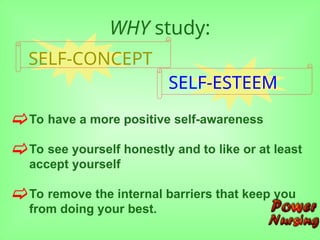
WHY study:
SELF-CONCEPT
SELF-ESTEEM
To have a more positive self-awareness
To see yourself honestly and to like or at least
accept yourself
To remove the internal barriers that keep you
from doing your best.
What is the
difference between
Self-Concept
Self-Esteem
and
Your VIEW of yourself - -
The ENTIRE picture...
S L O W L Y
It changes
You feel uncertain
and uncomfortable
about yourself - - -
you fear possible
rejection
NEGATIVE
Self-Concept
• Self-concept is an individual’s perception of
self and is what helps make each individual
unique.
• Positive and negative self-assessments in
the physical, emotional, intellectual, and
functional dimensions change over time.
• Self-concept affects the ability to function
and greatly influences health status.
Development of Self-Concept
• Self-concept evolves throughout life and
depends to an extent on an individual’s
developmental level.
Stages in Development of
Self
• Self-awareness (infancy)
• Self-recognition (18 months)
• Self-definition (3 years)
• Self-concept (6 to 7 years)
Formation of Self-
Concept
1. Infant learns physical self different from
environment.
2. If basic needs are met, child has positive
feelings of self.
3. Child internalizes others people’s attitudes
toward self.
4. Child or adult internalizes standards of society.
Factors Affecting Self-Concept
• Altered Health Status
• Experience
• Developmental considerations
• Culture
• Internal and external resources
• History of success and failure
• Crisis or life stressors
• Aging, illness, or trauma
Components of Self-Concept
• Identity
• Body image
• Self-esteem
• Role performance
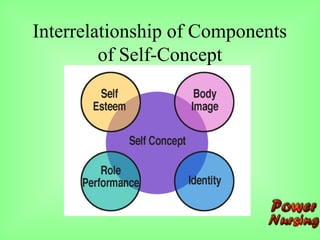
Interrelationship of Components
of Self-Concept
Components of Self-Concept
• A sense of personal identity is what sets one
person apart as a unique individual.
• Identity includes a person’s name, gender,
ethnic identity, family status, occupation,
and roles.
• One’s personal identity begins to develop
during childhood and is constantly
reinforced and modified throughout life.
Components of Self-Concept
• Body image is an attitude about one’s
physical attributes and characteristics,
appearance, and performance.
• Body image is dynamic because any change
in body structure or function, including the
normal changes of growth and
development, can affect it.
Components of Self-Concept
• Self-Ideal is the perception of behavior
based on personal standards and self-
expectations.
• Self-ideal serves as an internal regulator to
support self-respect and self-esteem.
Components of Self-Concept
• Self-esteem is the judgment of personal
performance compared with the self-ideal.
• Self-esteem is derived from a sense of
giving and receiving love, and being
respected by others.
Components of Self-Concept
• Role refers to a set of expected behaviors
determined by familial, cultural, and social
norms.
• The level of self-esteem is dependent upon
the self-perception of adequate role
performance in these various social roles.
Components of Self-Concept
• Stressors Affecting Role Performance
• Role overload
• Role conflict
– Whenever a person is unable to fulfill role
responsibilities, self-concept is impaired.
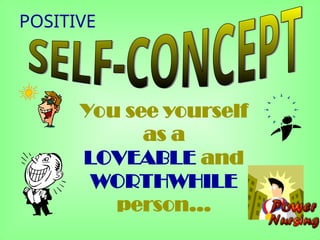
You see yourself
as a
LOVEABLE and
WORTHWHILE
person…
POSITIVE
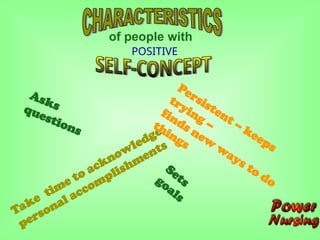
POSITIVE
Sets
goals
Take time to acknowledge
personal accomplishments
Persistent – keeps
trying –
finds new
w
ays to do
things
Asks
questions
of people with
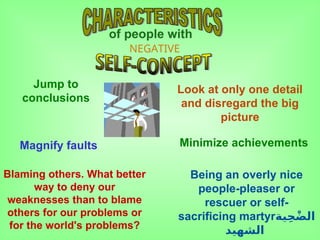
of people with
NEGATIVE
Blaming others. What better
way to deny our
weaknesses than to blame
others for our problems or
for the world's problems?
Being an overly nice
people-pleaser or
rescuer or self-
sacrificing martyr‫ية‬ِ‫ح‬ْ‫ض‬‫ال‬
‫الشهيد‬
Jump to
conclusions
Look at only one detail
and disregard the big
picture
Magnify faults Minimize achievements
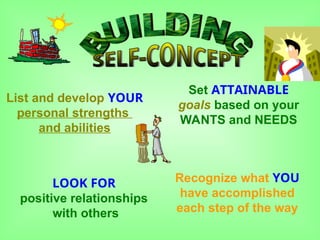
Recognize what YOU
have accomplished
each step of the way
Set ATTAINABLE
goals based on your
WANTS and NEEDS
List and develop YOUR
personal strengths
and abilities
LOOK FOR
positive relationships
with others
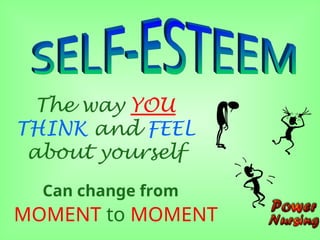
The way YOU
THINK and FEEL
about yourself
Can change from
MOMENT to MOMENT
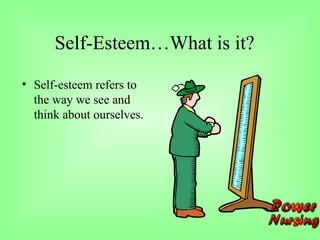
Self-Esteem…What is it?
• Self-esteem refers to
the way we see and
think about ourselves.
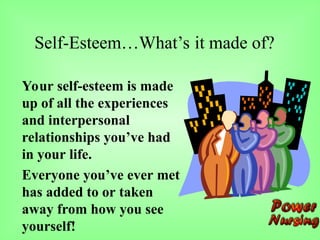
Self-Esteem…What’s it made of?
Your self-esteem is made
up of all the experiences
and interpersonal
relationships you’ve had
in your life.
Everyone you’ve ever met
has added to or taken
away from how you see
yourself!
The Importance of Self Esteem
People who feel good a bout themselves more
likely to have the confidence to try new health
behaviors
Building esteem is a first step towards your
happiness and a better life.
High self-esteem increases your confidence.
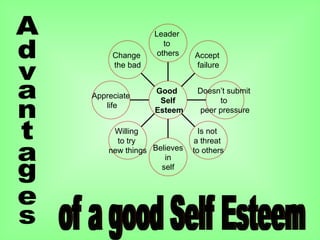
Change
the bad
Appreciate
life
Willing
to try
new things Believes
in
self
Is not
a threat
to others
Doesn’t submit
to
peer pressure
Accept
failure
Leader
to
others
Good
Self
Esteem
Feeling
POSITIVELY
about yourself,
your actions,
and your
future
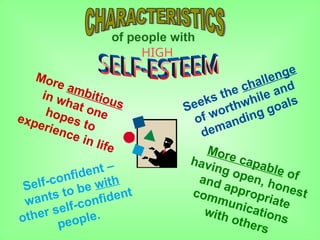
HIGH
of people with
More ambitious
in what one
hopes to
experience in life
Seeks the challenge
of worthwhile and
demanding goals
More capable of
having open, honest
and appropriate
communications
with others
Self-confident –
wants to be with
other self-confident
people.
Feeling
NEGATIVELY
about yourself,
your actions,
and your
future
Characteristics
•Able to accept and learn from their own
mistakes.
•Confident without being obnoxious or
conceited.
•Not devastated by criticism.
•Not overly defensive when questioned.
•Not easily defeated by setbacks and
obstacles.
• Unlikely to feel a need to put others
down.
• Open and assertive in communicating
their needs.
• Not overly worried about failing or
looking foolish.
• Not harshly or destructively critical of
themselves.
• Not aggressively driven to prove them.
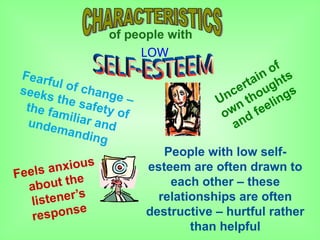
of people with
LOW
Fearful of change –
seeks the safety of
the familiar and
undemanding
Uncertain of
own thoughts
and feelings
Feels anxious
about the
listener’s
response
People with low self-
esteem are often drawn to
each other – these
relationships are often
destructive – hurtful rather
than helpful
Characteristics of People with low self
esteem
1-Self criticism
2-Self diminution:
3-Guilt& worry
4-physical manifestations
5-postponing decision
6-Denying one's self pleasure
7-Disturbed relationship:
8- Set unrealistic goals
9-Exaggerated sense of self
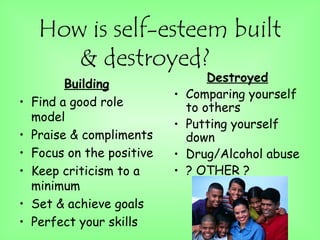
How is self-esteem built
& destroyed?
Building
• Find a good role
model
• Praise & compliments
• Focus on the positive
• Keep criticism to a
minimum
• Set & achieve goals
• Perfect your skills
Destroyed
• Comparing yourself
to others
• Putting yourself
down
• Drug/Alcohol abuse
• ? OTHER ?
What can you do to build your
self-esteem when you get out in
the “real world”?
• Accept yourself:
– Stop worrying about the things you can’t
change.
– Be more accepting of others and the things
they can’t change.
– Your self- worth SHOULD NOT be based
upon what others think of you, but how you
feel about yourself.
• Try not to compare with others.
– It’s unfair.
– You may compare their strengths with your
weaknesses.
– Judge yourself in terms of your own
growth.
• Face your fears
• Forget your failures
• Know what you want and ask for it.
• Reward yourself when you succeed
• Don't be defeated
• When you hear negative comments in your
head, tell yourself you to stop.
• Remember that there are things about
yourself you can't change
There are two different kinds
of people in the world.
The one that says “I wish I had”
and
The one that says “I’m glad I did”
Remember you can have
anything in this world if you
just believe in yourself.
Self-esteem building habits:
• Here six self-esteem building habits you
can use a daily basis :
•Reward yourself
•Stop comparing yourself to others.
•Laugh more
•Take care of yourself
•Do something for someone.
•Keep a diary of all the good things you
notice about yourself.
Lets Review
• Self-esteem comes from every experience of your
life.
• How you view yourself affects everything you do in
life.
• High self-esteem gives you a GOOD feeling about
yourself.
• Low self-esteem distorts your view of yourself.
• Self-esteem can me improved!
Final Thought
• You are a unique individual. No one else is
like you in the whole world. This makes
you special already!
• Our time in this world is limited. Make it
happen for you so you leave your mark in
history!
selfconceptandselfesteem-141021131649-conversion-gate01.ppt

  • 1.
    Self Concept andSelf- Esteem Dr/ Sabah A mohamed
  • 2.
    WHY study: SELF-CONCEPT SELF-ESTEEM To havea more positive self-awareness To see yourself honestly and to like or at least accept yourself To remove the internal barriers that keep you from doing your best.
  • 3.
    What is the differencebetween Self-Concept Self-Esteem and
  • 4.
    Your VIEW ofyourself - - The ENTIRE picture... S L O W L Y It changes
  • 5.
    You feel uncertain anduncomfortable about yourself - - - you fear possible rejection NEGATIVE
  • 6.
    Self-Concept • Self-concept isan individual’s perception of self and is what helps make each individual unique. • Positive and negative self-assessments in the physical, emotional, intellectual, and functional dimensions change over time. • Self-concept affects the ability to function and greatly influences health status.
  • 7.
    Development of Self-Concept •Self-concept evolves throughout life and depends to an extent on an individual’s developmental level.
  • 8.
    Stages in Developmentof Self • Self-awareness (infancy) • Self-recognition (18 months) • Self-definition (3 years) • Self-concept (6 to 7 years)
  • 9.
    Formation of Self- Concept 1.Infant learns physical self different from environment. 2. If basic needs are met, child has positive feelings of self. 3. Child internalizes others people’s attitudes toward self. 4. Child or adult internalizes standards of society.
  • 10.
    Factors Affecting Self-Concept •Altered Health Status • Experience • Developmental considerations • Culture • Internal and external resources • History of success and failure • Crisis or life stressors • Aging, illness, or trauma
  • 11.
    Components of Self-Concept •Identity • Body image • Self-esteem • Role performance
  • 12.
  • 13.
    Components of Self-Concept •A sense of personal identity is what sets one person apart as a unique individual. • Identity includes a person’s name, gender, ethnic identity, family status, occupation, and roles. • One’s personal identity begins to develop during childhood and is constantly reinforced and modified throughout life.
  • 14.
    Components of Self-Concept •Body image is an attitude about one’s physical attributes and characteristics, appearance, and performance. • Body image is dynamic because any change in body structure or function, including the normal changes of growth and development, can affect it.
  • 15.
    Components of Self-Concept •Self-Ideal is the perception of behavior based on personal standards and self- expectations. • Self-ideal serves as an internal regulator to support self-respect and self-esteem.
  • 16.
    Components of Self-Concept •Self-esteem is the judgment of personal performance compared with the self-ideal. • Self-esteem is derived from a sense of giving and receiving love, and being respected by others.
  • 17.
    Components of Self-Concept •Role refers to a set of expected behaviors determined by familial, cultural, and social norms. • The level of self-esteem is dependent upon the self-perception of adequate role performance in these various social roles.
  • 18.
    Components of Self-Concept •Stressors Affecting Role Performance • Role overload • Role conflict – Whenever a person is unable to fulfill role responsibilities, self-concept is impaired.
  • 19.
    You see yourself asa LOVEABLE and WORTHWHILE person… POSITIVE
  • 20.
    POSITIVE Sets goals Take time toacknowledge personal accomplishments Persistent – keeps trying – finds new w ays to do things Asks questions of people with
  • 21.
    of people with NEGATIVE Blamingothers. What better way to deny our weaknesses than to blame others for our problems or for the world's problems? Being an overly nice people-pleaser or rescuer or self- sacrificing martyr‫ية‬ِ‫ح‬ْ‫ض‬‫ال‬ ‫الشهيد‬ Jump to conclusions Look at only one detail and disregard the big picture Magnify faults Minimize achievements
  • 22.
    Recognize what YOU haveaccomplished each step of the way Set ATTAINABLE goals based on your WANTS and NEEDS List and develop YOUR personal strengths and abilities LOOK FOR positive relationships with others
  • 23.
    The way YOU THINKand FEEL about yourself Can change from MOMENT to MOMENT
  • 24.
    Self-Esteem…What is it? •Self-esteem refers to the way we see and think about ourselves.
  • 25.
    Self-Esteem…What’s it madeof? Your self-esteem is made up of all the experiences and interpersonal relationships you’ve had in your life. Everyone you’ve ever met has added to or taken away from how you see yourself!
  • 26.
    The Importance ofSelf Esteem People who feel good a bout themselves more likely to have the confidence to try new health behaviors Building esteem is a first step towards your happiness and a better life. High self-esteem increases your confidence.
  • 27.
    Change the bad Appreciate life Willing to try newthings Believes in self Is not a threat to others Doesn’t submit to peer pressure Accept failure Leader to others Good Self Esteem
  • 28.
  • 29.
    HIGH of people with Moreambitious in what one hopes to experience in life Seeks the challenge of worthwhile and demanding goals More capable of having open, honest and appropriate communications with others Self-confident – wants to be with other self-confident people.
  • 30.
  • 31.
    Characteristics •Able to acceptand learn from their own mistakes. •Confident without being obnoxious or conceited. •Not devastated by criticism. •Not overly defensive when questioned. •Not easily defeated by setbacks and obstacles.
  • 32.
    • Unlikely tofeel a need to put others down. • Open and assertive in communicating their needs. • Not overly worried about failing or looking foolish. • Not harshly or destructively critical of themselves. • Not aggressively driven to prove them.
  • 33.
    of people with LOW Fearfulof change – seeks the safety of the familiar and undemanding Uncertain of own thoughts and feelings Feels anxious about the listener’s response People with low self- esteem are often drawn to each other – these relationships are often destructive – hurtful rather than helpful
  • 34.
    Characteristics of Peoplewith low self esteem 1-Self criticism 2-Self diminution: 3-Guilt& worry 4-physical manifestations 5-postponing decision 6-Denying one's self pleasure 7-Disturbed relationship: 8- Set unrealistic goals 9-Exaggerated sense of self
  • 35.
    How is self-esteembuilt & destroyed? Building • Find a good role model • Praise & compliments • Focus on the positive • Keep criticism to a minimum • Set & achieve goals • Perfect your skills Destroyed • Comparing yourself to others • Putting yourself down • Drug/Alcohol abuse • ? OTHER ?
  • 36.
    What can youdo to build your self-esteem when you get out in the “real world”? • Accept yourself: – Stop worrying about the things you can’t change. – Be more accepting of others and the things they can’t change. – Your self- worth SHOULD NOT be based upon what others think of you, but how you feel about yourself. • Try not to compare with others. – It’s unfair. – You may compare their strengths with your weaknesses. – Judge yourself in terms of your own growth.
  • 37.
    • Face yourfears • Forget your failures • Know what you want and ask for it. • Reward yourself when you succeed • Don't be defeated • When you hear negative comments in your head, tell yourself you to stop. • Remember that there are things about yourself you can't change
  • 38.
    There are twodifferent kinds of people in the world. The one that says “I wish I had” and The one that says “I’m glad I did” Remember you can have anything in this world if you just believe in yourself.
  • 39.
    Self-esteem building habits: •Here six self-esteem building habits you can use a daily basis : •Reward yourself •Stop comparing yourself to others. •Laugh more •Take care of yourself •Do something for someone. •Keep a diary of all the good things you notice about yourself.
  • 40.
    Lets Review • Self-esteemcomes from every experience of your life. • How you view yourself affects everything you do in life. • High self-esteem gives you a GOOD feeling about yourself. • Low self-esteem distorts your view of yourself. • Self-esteem can me improved!
  • 41.
    Final Thought • Youare a unique individual. No one else is like you in the whole world. This makes you special already! • Our time in this world is limited. Make it happen for you so you leave your mark in history!