MEETING NUTRITIONAL NEEDS
R.Ruppamercy
M.Sc.Nursing I year,
INTRODUCTION
MEANING
Nutrition is the science of food and its components,
their actions, interactions and balance within the body.
It includes the study of processing food within the body
for its utilization for
• Provision of energy
• Building of body tissues and their repair
• Protection from microorganisms
DEFINITION
Human nutrition describes the process whereby cellular
organelles, cells, tissues, organs, systems and the body
as a whole obtain and use necessary substances
obtained from (nutrients) to maintain structural and
functional integrity
- Vorster and Haustvast, 2002.
NUTRIENT
Nutrient is a chemical substance inherently present in
numerous food sources that the body uses to obtain
energy, build tissues and regulate biological
functions.
CLASSIFICATION OF NUTRIENTS
• Macro nutrients
• Micro nutrients
WHICH IS NUTRIENT FOOD?
FACTORS AFFECTING NUTRITIONAL
NEEDS
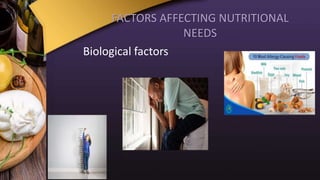
Biological factors
ENVIRONMENTAL FACTORS
• DEMOGRAPHY AND FAMILY STRUCTURE
RELIGIOUS FACTORS
ECONOMIC FACTORS
SOCIAL FACTORS
EDUCATION
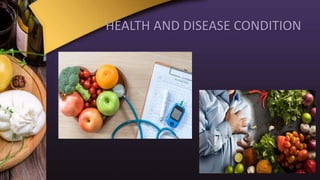
HEALTH AND DISEASE CONDITION
PYCHOLOGICAL FACTORS
ASSESSMENT OF NUTRITIONAL NEEDS
• DIRECT METHODS
• Anthropometric measurements and indices
• Biophysical methods/biochemical test
• Clinical examination
• Dietary methods
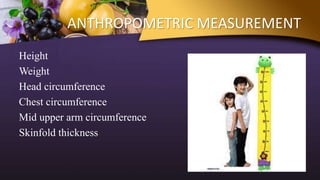
ANTHROPOMETRIC MEASUREMENT
Height
Weight
Head circumference
Chest circumference
Mid upper arm circumference
Skinfold thickness
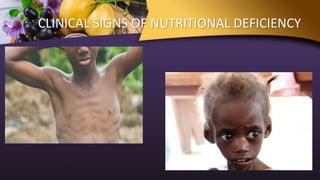
CLINICAL SIGNS OF NUTRITIONAL DEFICIENCY
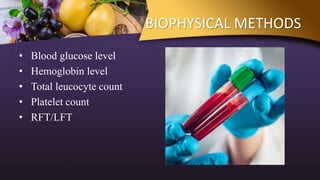
BIOPHYSICAL METHODS
• Blood glucose level
• Hemoglobin level
• Total leucocyte count
• Platelet count
• RFT/LFT
INDIRECT METHODS
• Vital statistics
• Assessment of socio economic status
• Diet surveys
 Food inventory method
 Food expenditure pattern method
 24 hours recall
 Diet history
 Weighment method
MEETING NUTRITIONAL NEEDS
There are certain principles in the diet therapy. They are
• The diet must be planned according to the food habits of the patient
based on culture, religion, socio economic status, personal
preferences, physiological and psychological conditions.
• Changes in the diet should be brought gradually
• The diet should not be forced
• There should be variety of food for selection
• Small and frequent feeds are preferred to the usual 3 meals
• Hot should be served hot and cold food should be served as cold
ROLE OF A NURSE
• Make sure that the therapeutic diet is prepared by the dietician
is taken by the patient.
• During mealtime of patient, nurses assist, support and
encourage the patient to take meals.
• Nurses plan for home care treatment for discharged patient
from hospital and give instruction to patient and their family
members to follow it well.
CONCLUSION
• Thus, nurses are very important number of the nutrition health
care team and play an active role in diet prescription,
motivating patients to consume therapeutic diets and thus aids
in speedy recovery.
JOURNAL REFERENCE
TOPIC: Key Aspects in Nutritional Management of COVID-19 Patients
AUTHOR: Alfredo, Quintela
JOURNAL: Journal of clinical medicine
PUBLISHED: Published online 2020 Aug 10
ABSTRACT: Deficient nutritional status is probably due to anorexia, nausea,
vomiting, diarrhea, hypoalbuminemia, hypermetabolism, and excessive
nitrogen loss. There is limited knowledge regarding the nutritional support
during hospital stay of COVID-19 patients.
However, nutritional therapy appears as first-line treatment and should be
implemented into standard practice.
To recaptitulate….
THANK YOU….

MEETING NUTRITIONAL NEEDS

  • 1.
  • 2.
  • 3.
    MEANING Nutrition is thescience of food and its components, their actions, interactions and balance within the body. It includes the study of processing food within the body for its utilization for • Provision of energy • Building of body tissues and their repair • Protection from microorganisms
  • 4.
    DEFINITION Human nutrition describesthe process whereby cellular organelles, cells, tissues, organs, systems and the body as a whole obtain and use necessary substances obtained from (nutrients) to maintain structural and functional integrity - Vorster and Haustvast, 2002.
  • 5.
    NUTRIENT Nutrient is achemical substance inherently present in numerous food sources that the body uses to obtain energy, build tissues and regulate biological functions. CLASSIFICATION OF NUTRIENTS • Macro nutrients • Micro nutrients WHICH IS NUTRIENT FOOD?
  • 6.
  • 7.
  • 8.
  • 9.
  • 10.
  • 11.
  • 12.
  • 13.
  • 14.
    ASSESSMENT OF NUTRITIONALNEEDS • DIRECT METHODS • Anthropometric measurements and indices • Biophysical methods/biochemical test • Clinical examination • Dietary methods
  • 15.
    ANTHROPOMETRIC MEASUREMENT Height Weight Head circumference Chestcircumference Mid upper arm circumference Skinfold thickness
  • 16.
    CLINICAL SIGNS OFNUTRITIONAL DEFICIENCY
  • 17.
    BIOPHYSICAL METHODS • Bloodglucose level • Hemoglobin level • Total leucocyte count • Platelet count • RFT/LFT
  • 18.
    INDIRECT METHODS • Vitalstatistics • Assessment of socio economic status • Diet surveys  Food inventory method  Food expenditure pattern method  24 hours recall  Diet history  Weighment method
  • 19.
    MEETING NUTRITIONAL NEEDS Thereare certain principles in the diet therapy. They are • The diet must be planned according to the food habits of the patient based on culture, religion, socio economic status, personal preferences, physiological and psychological conditions. • Changes in the diet should be brought gradually • The diet should not be forced • There should be variety of food for selection • Small and frequent feeds are preferred to the usual 3 meals • Hot should be served hot and cold food should be served as cold
  • 20.
    ROLE OF ANURSE • Make sure that the therapeutic diet is prepared by the dietician is taken by the patient. • During mealtime of patient, nurses assist, support and encourage the patient to take meals. • Nurses plan for home care treatment for discharged patient from hospital and give instruction to patient and their family members to follow it well.
  • 21.
    CONCLUSION • Thus, nursesare very important number of the nutrition health care team and play an active role in diet prescription, motivating patients to consume therapeutic diets and thus aids in speedy recovery.
  • 22.
    JOURNAL REFERENCE TOPIC: KeyAspects in Nutritional Management of COVID-19 Patients AUTHOR: Alfredo, Quintela JOURNAL: Journal of clinical medicine PUBLISHED: Published online 2020 Aug 10 ABSTRACT: Deficient nutritional status is probably due to anorexia, nausea, vomiting, diarrhea, hypoalbuminemia, hypermetabolism, and excessive nitrogen loss. There is limited knowledge regarding the nutritional support during hospital stay of COVID-19 patients. However, nutritional therapy appears as first-line treatment and should be implemented into standard practice.
  • 23.
  • 24.