Self and Society

Symbolic Interactionism
Objective
• To get you think about your own ‘authentic
  identity’ as a community development worker
• To get you to ‘imagine inside’ your roleplayed
  MI client, and the processes that led you to
  select that persons ‘identity’
• To see ‘taken for granted’ assumptions about
  identity, that form the basis of ‘prejudice’
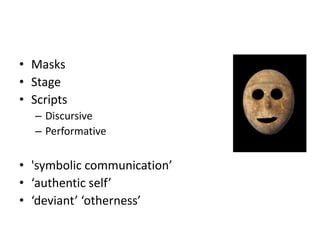
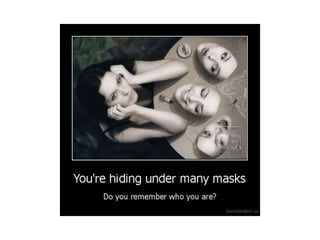
• Masks
• Stage
• Scripts
  – Discursive
  – Performative


• 'symbolic communication’
• ‘authentic self’
• ‘deviant’ ‘otherness’
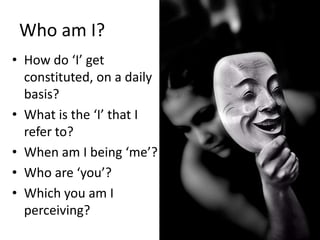
Who am I?
• How do ‘I’ get
  constituted, on a daily
  basis?
• What is the ‘I’ that I
  refer to?
• When am I being ‘me’?
• Who are ‘you’?
• Which you am I
  perceiving?
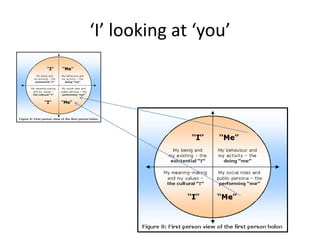
Mead: The ‘I’ and the ‘Me’
•     ‘I’ is the spontaneous unpredictable element of the self
•     'I' memory is a store of creativity, adaptability and novelty in
      the social process.
•     Where our most important values are located
•     Constitutes the realisation of the self - i.e. reveals a definite
      personality
•     Seen as an evolutionary process
•   'Me' is the conformist aspect of the self, and the
    reflexive, organised aspect of the self (Mead 1934: 197).
Erving Goffman
• Stigma (1963) Interaction Ritual (1967), Forms of Talk (1981)
• Presentation of the Self in Everyday life (1956),
• Dramaturgy - with human social behaviour seen as more or
  less well scripted and with humans as role-taking actors.

   – Role-taking is a key mechanism of interaction > reflexive awareness of
     self and others
   – Role-making a key mechanism of interaction in unaccustomed
     situations
• improvisational quality of roles, with human social behaviour
  seen as poorly scripted and with humans as role-making
  improvisers.
Blumer ‘meaning’
• meaning states that humans act toward
  people and things based upon the meanings
  that they have given to those people or things.
• Language gives humans a means by which to
  negotiate meaning through symbols.
• Thought, based on language, is a mental
  conversation or dialogue that requires role
  taking, or imagining different points of view
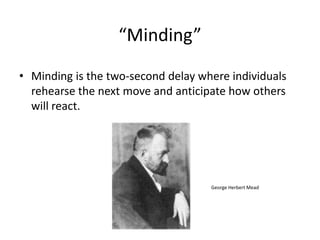
“Minding”
• Minding is the two-second delay where individuals
  rehearse the next move and anticipate how others
  will react.


                                    George Herbert Mead
‘I’ looking at ‘you’
Others
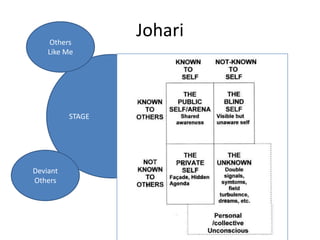
                  Johari
    Like Me


          STAGE


Deviant
Others
Learning/socialisation
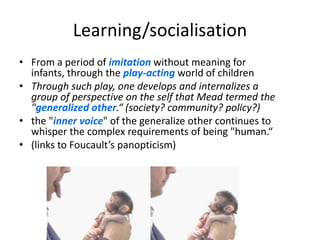
• From a period of imitation without meaning for
  infants, through the play-acting world of children
• Through such play, one develops and internalizes a
  group of perspective on the self that Mead termed the
  "generalized other.“ (society? community? policy?)
• the "inner voice" of the generalize other continues to
  whisper the complex requirements of being "human.“
• (links to Foucault’s panopticism)
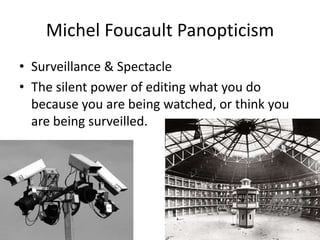
Michel Foucault Panopticism
• Surveillance & Spectacle
• The silent power of editing what you do
  because you are being watched, or think you
  are being surveilled.
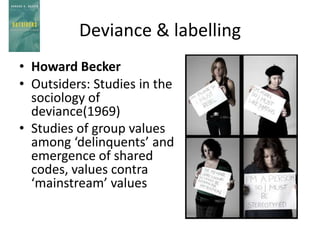
Deviance & labelling
• Howard Becker
• Outsiders: Studies in the
  sociology of
  deviance(1969)
• Studies of group values
  among ‘delinquents’ and
  emergence of shared
  codes, values contra
  ‘mainstream’ values
Becker, labelling
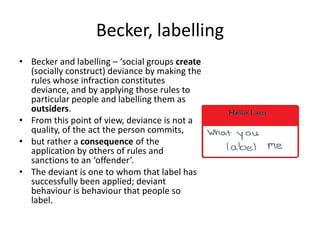
• Becker and labelling – ‘social groups create
  (socially construct) deviance by making the
  rules whose infraction constitutes
  deviance, and by applying those rules to
  particular people and labelling them as
  outsiders.
• From this point of view, deviance is not a
  quality, of the act the person commits,
• but rather a consequence of the
  application by others of rules and
  sanctions to an ‘offender’.
• The deviant is one to whom that label has
  successfully been applied; deviant
  behaviour is behaviour that people so
  label.
Taking the Role of the Other
• This is seeing the world through another’s
  eyes.

• Walking in someone else’s shoes

• Grown up version of having imaginary friends
  and talking to yourself.

Self and society

  • 1.
  • 2.
    Objective • To getyou think about your own ‘authentic identity’ as a community development worker • To get you to ‘imagine inside’ your roleplayed MI client, and the processes that led you to select that persons ‘identity’ • To see ‘taken for granted’ assumptions about identity, that form the basis of ‘prejudice’
  • 3.
    • Masks • Stage •Scripts – Discursive – Performative • 'symbolic communication’ • ‘authentic self’ • ‘deviant’ ‘otherness’
  • 4.
    Who am I? •How do ‘I’ get constituted, on a daily basis? • What is the ‘I’ that I refer to? • When am I being ‘me’? • Who are ‘you’? • Which you am I perceiving?
  • 5.
    Mead: The ‘I’and the ‘Me’ • ‘I’ is the spontaneous unpredictable element of the self • 'I' memory is a store of creativity, adaptability and novelty in the social process. • Where our most important values are located • Constitutes the realisation of the self - i.e. reveals a definite personality • Seen as an evolutionary process • 'Me' is the conformist aspect of the self, and the reflexive, organised aspect of the self (Mead 1934: 197).
  • 6.
    Erving Goffman • Stigma(1963) Interaction Ritual (1967), Forms of Talk (1981) • Presentation of the Self in Everyday life (1956), • Dramaturgy - with human social behaviour seen as more or less well scripted and with humans as role-taking actors. – Role-taking is a key mechanism of interaction > reflexive awareness of self and others – Role-making a key mechanism of interaction in unaccustomed situations • improvisational quality of roles, with human social behaviour seen as poorly scripted and with humans as role-making improvisers.
  • 7.
    Blumer ‘meaning’ • meaningstates that humans act toward people and things based upon the meanings that they have given to those people or things. • Language gives humans a means by which to negotiate meaning through symbols. • Thought, based on language, is a mental conversation or dialogue that requires role taking, or imagining different points of view
  • 8.
    “Minding” • Minding isthe two-second delay where individuals rehearse the next move and anticipate how others will react. George Herbert Mead
  • 9.
  • 10.
    Others Johari Like Me STAGE Deviant Others
  • 13.
    Learning/socialisation • From aperiod of imitation without meaning for infants, through the play-acting world of children • Through such play, one develops and internalizes a group of perspective on the self that Mead termed the "generalized other.“ (society? community? policy?) • the "inner voice" of the generalize other continues to whisper the complex requirements of being "human.“ • (links to Foucault’s panopticism)
  • 14.
    Michel Foucault Panopticism •Surveillance & Spectacle • The silent power of editing what you do because you are being watched, or think you are being surveilled.
  • 15.
    Deviance & labelling •Howard Becker • Outsiders: Studies in the sociology of deviance(1969) • Studies of group values among ‘delinquents’ and emergence of shared codes, values contra ‘mainstream’ values
  • 16.
    Becker, labelling • Beckerand labelling – ‘social groups create (socially construct) deviance by making the rules whose infraction constitutes deviance, and by applying those rules to particular people and labelling them as outsiders. • From this point of view, deviance is not a quality, of the act the person commits, • but rather a consequence of the application by others of rules and sanctions to an ‘offender’. • The deviant is one to whom that label has successfully been applied; deviant behaviour is behaviour that people so label.
  • 17.
    Taking the Roleof the Other • This is seeing the world through another’s eyes. • Walking in someone else’s shoes • Grown up version of having imaginary friends and talking to yourself.