FDN016 Week 8
Survey design & test
I’ve finished marking your Journal A work. This is your first ‘working at grade’
You should have completed your first draft by Week 6 (2 weeks ago)
Journal B Tasks should be completed before Christmas
1Tap in, sign-in, blah blah, you know the drill………
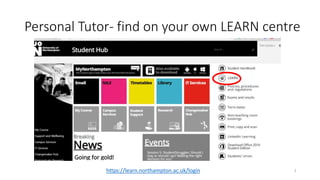
Personal Tutor- find on your own LEARN centre
2https://learn.northampton.ac.uk/login
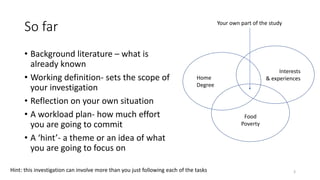
So far
• Background literature – what is
already known
• Working definition- sets the scope of
your investigation
• Reflection on your own situation
• A workload plan- how much effort
you are going to commit
• A ‘hint’- a theme or an idea of what
you are going to focus on
Home
Degree
Interests
& experiences
Food
Poverty
Your own part of the study
3Hint: this investigation can involve more than you just following each of the tasks
Next steps
• Survey
• Establishing patterns – is food poverty widespread?
• How many students experience what features of ‘food poverty’?
• What demographics of students- age, gender, ethnicity
• Do the issues affect a large group of people, or are they individual
inconveniences?
• Interviews
• Deep understanding of the lived experiences
• Danger of only understanding individual unique problems
• Need to collect a range of experiences
• We can collect a few stories each and share them across the module
4
5
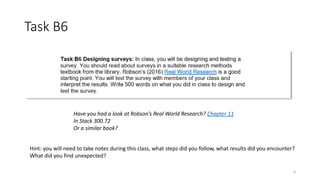
Task B6
6
Hint: you will need to take notes during this class, what steps did you follow, what results did you encounter?
What did you find unexpected?
Have you had a look at Robson’s Real World Research? Chapter 11
In Stack 300.72
Or a similar book?
ACTIVITY: questionnaire design & test
• In small groups, rapidly
• Design a 3-5 question survey
• Test it with another group
• Calculate the results
• Note your observations
• Did the questions work
• Did the other group understand the questions?
• What did you learn/observe from the data you collected?
7
What data will we need to collect?
• Quantitative: quantities: numbers: closed
• Not qualitative: qualities: stories: open- ended
• Results in a number
• Yes/No
• Multiple choice
8
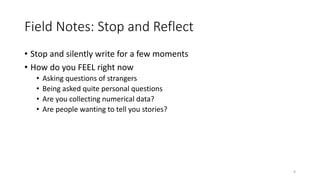
Field Notes: Stop and Reflect
• Stop and silently write for a few moments
• How do you FEEL right now
• Asking questions of strangers
• Being asked quite personal questions
• Are you collecting numerical data?
• Are people wanting to tell you stories?
9
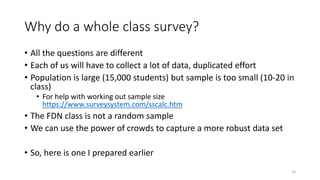
Why do a whole class survey?
• All the questions are different
• Each of us will have to collect a lot of data, duplicated effort
• Population is large (15,000 students) but sample is too small (10-20 in
class)
• For help with working out sample size
https://www.surveysystem.com/sscalc.htm
• The FDN class is not a random sample
• We can use the power of crowds to capture a more robust data set
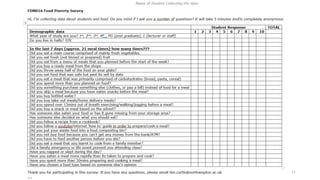
• So, here is one I prepared earlier
10
11
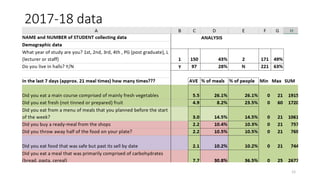
2017-18 data
12
13
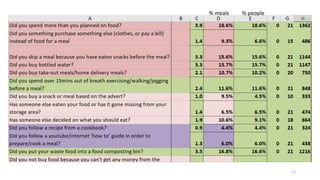
% meals % people
14
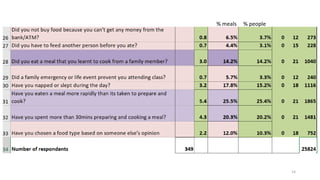
% meals % people
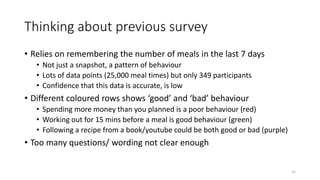
Thinking about previous survey
• Relies on remembering the number of meals in the last 7 days
• Not just a snapshot, a pattern of behaviour
• Lots of data points (25,000 meal times) but only 349 participants
• Confidence that this data is accurate, is low
• Different coloured rows shows ‘good’ and ‘bad’ behaviour
• Spending more money than you planned is a poor behaviour (red)
• Working out for 15 mins before a meal is good behaviour (green)
• Following a recipe from a book/youtube could be both good or bad (purple)
• Too many questions/ wording not clear enough
15
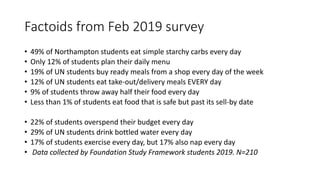
Factoids from Feb 2019 survey
• 49% of Northampton students eat simple starchy carbs every day
• Only 12% of students plan their daily menu
• 19% of UN students buy ready meals from a shop every day of the week
• 12% of UN students eat take-out/delivery meals EVERY day
• 9% of students throw away half their food every day
• Less than 1% of students eat food that is safe but past its sell-by date
• 22% of students overspend their budget every day
• 29% of UN students drink bottled water every day
• 17% of students exercise every day, but 17% also nap every day
• Data collected by Foundation Study Framework students 2019. N=210
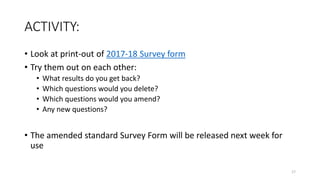
ACTIVITY:
• Look at print-out of 2017-18 Survey form
• Try them out on each other:
• What results do you get back?
• Which questions would you delete?
• Which questions would you amend?
• Any new questions?
• The amended standard Survey Form will be released next week for
use
17
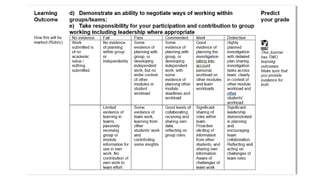
18
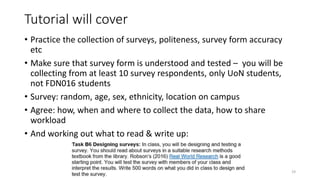
Tutorial will cover
• Practice the collection of surveys, politeness, survey form accuracy
etc
• Make sure that survey form is understood and tested – you will be
collecting from at least 10 survey respondents, only UoN students,
not FDN016 students
• Survey: random, age, sex, ethnicity, location on campus
• Agree: how, when and where to collect the data, how to share
workload
• And working out what to read & write up:
19

FDN016 Week 8 survey design and test

  • 1.
    FDN016 Week 8 Surveydesign & test I’ve finished marking your Journal A work. This is your first ‘working at grade’ You should have completed your first draft by Week 6 (2 weeks ago) Journal B Tasks should be completed before Christmas 1Tap in, sign-in, blah blah, you know the drill………
  • 2.
    Personal Tutor- findon your own LEARN centre 2https://learn.northampton.ac.uk/login
  • 3.
    So far • Backgroundliterature – what is already known • Working definition- sets the scope of your investigation • Reflection on your own situation • A workload plan- how much effort you are going to commit • A ‘hint’- a theme or an idea of what you are going to focus on Home Degree Interests & experiences Food Poverty Your own part of the study 3Hint: this investigation can involve more than you just following each of the tasks
  • 4.
    Next steps • Survey •Establishing patterns – is food poverty widespread? • How many students experience what features of ‘food poverty’? • What demographics of students- age, gender, ethnicity • Do the issues affect a large group of people, or are they individual inconveniences? • Interviews • Deep understanding of the lived experiences • Danger of only understanding individual unique problems • Need to collect a range of experiences • We can collect a few stories each and share them across the module 4
  • 5.
  • 6.
    Task B6 6 Hint: youwill need to take notes during this class, what steps did you follow, what results did you encounter? What did you find unexpected? Have you had a look at Robson’s Real World Research? Chapter 11 In Stack 300.72 Or a similar book?
  • 7.
    ACTIVITY: questionnaire design& test • In small groups, rapidly • Design a 3-5 question survey • Test it with another group • Calculate the results • Note your observations • Did the questions work • Did the other group understand the questions? • What did you learn/observe from the data you collected? 7
  • 8.
    What data willwe need to collect? • Quantitative: quantities: numbers: closed • Not qualitative: qualities: stories: open- ended • Results in a number • Yes/No • Multiple choice 8
  • 9.
    Field Notes: Stopand Reflect • Stop and silently write for a few moments • How do you FEEL right now • Asking questions of strangers • Being asked quite personal questions • Are you collecting numerical data? • Are people wanting to tell you stories? 9
  • 10.
    Why do awhole class survey? • All the questions are different • Each of us will have to collect a lot of data, duplicated effort • Population is large (15,000 students) but sample is too small (10-20 in class) • For help with working out sample size https://www.surveysystem.com/sscalc.htm • The FDN class is not a random sample • We can use the power of crowds to capture a more robust data set • So, here is one I prepared earlier 10
  • 11.
  • 12.
  • 13.
  • 14.
  • 15.
    Thinking about previoussurvey • Relies on remembering the number of meals in the last 7 days • Not just a snapshot, a pattern of behaviour • Lots of data points (25,000 meal times) but only 349 participants • Confidence that this data is accurate, is low • Different coloured rows shows ‘good’ and ‘bad’ behaviour • Spending more money than you planned is a poor behaviour (red) • Working out for 15 mins before a meal is good behaviour (green) • Following a recipe from a book/youtube could be both good or bad (purple) • Too many questions/ wording not clear enough 15
  • 16.
    Factoids from Feb2019 survey • 49% of Northampton students eat simple starchy carbs every day • Only 12% of students plan their daily menu • 19% of UN students buy ready meals from a shop every day of the week • 12% of UN students eat take-out/delivery meals EVERY day • 9% of students throw away half their food every day • Less than 1% of students eat food that is safe but past its sell-by date • 22% of students overspend their budget every day • 29% of UN students drink bottled water every day • 17% of students exercise every day, but 17% also nap every day • Data collected by Foundation Study Framework students 2019. N=210
  • 17.
    ACTIVITY: • Look atprint-out of 2017-18 Survey form • Try them out on each other: • What results do you get back? • Which questions would you delete? • Which questions would you amend? • Any new questions? • The amended standard Survey Form will be released next week for use 17
  • 18.
  • 19.
    Tutorial will cover •Practice the collection of surveys, politeness, survey form accuracy etc • Make sure that survey form is understood and tested – you will be collecting from at least 10 survey respondents, only UoN students, not FDN016 students • Survey: random, age, sex, ethnicity, location on campus • Agree: how, when and where to collect the data, how to share workload • And working out what to read & write up: 19