104- Ghanshyam Bheda
119- Anuj Shah
128- Aprajita Mehta
311- Lokesh Gada
327- Yuyutsu Tulshyan
ERP in Automotive Industry
Present Scenario
 At present time, Indian automobile industry is
making a major contribution in increasing the
country's GDP by 9% every year.
 New heights has been scaled by the industry in
the year 2011.
 In January 2012, total automobile sales
21,14,157 units, an increment of 44.9%
compared to the sales units of same period last
year.
 By 2050, the country is expected to top the
world in car volumes with approximately 611
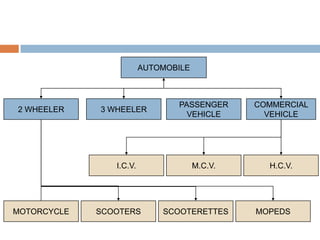
2 WHEELER
MOTORCYCLE
AUTOMOBILE
3 WHEELER
PASSENGER
VEHICLE
COMMERCIAL
VEHICLE
SCOOTERS SCOOTERETTES MOPEDS
I.C.V. M.C.V. H.C.V.
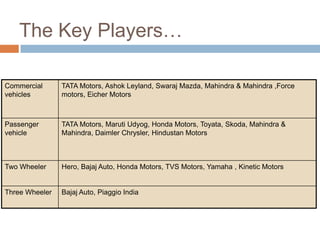
The Key Players…
Commercial
vehicles
TATA Motors, Ashok Leyland, Swaraj Mazda, Mahindra & Mahindra ,Force
motors, Eicher Motors
Passenger
vehicle
TATA Motors, Maruti Udyog, Honda Motors, Toyata, Skoda, Mahindra &
Mahindra, Daimler Chrysler, Hindustan Motors
Two Wheeler Hero, Bajaj Auto, Honda Motors, TVS Motors, Yamaha , Kinetic Motors
Three Wheeler Bajaj Auto, Piaggio India
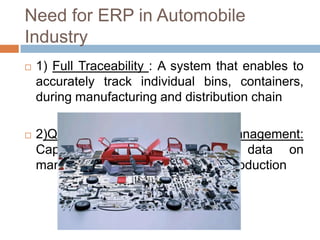
Need for ERP in Automobile
Industry
 1) Full Traceability : A system that enables to
accurately track individual bins, containers,
during manufacturing and distribution chain
 2)Quality and Supply Chain Management:
Capability to track real-time data on
manufacturing and supply during production
 3) Electronic Document Management: Not only
does this save employees time, it speeds up
overall operations, reduces waste, and
minimizes room for human error
 4) Inventory Optimization: excess inventory is an
unnecessary expense and contrary to the lean
manufacturing processes the enterprises are
embracing
 Inventory optimization is a “must-have” ERP feature
for automotive parts manufacturers as excess
inventory is unnecessary expense
 5) Integrated Financials: To trace costs
associated with individual products and
product lines right down to the raw materials
used in production.
 6) Built-in Barcode and OEM Shipping Labels:
Built-in support for printing, reading, encoding,
and utilizing barcode labels
 7) Built-in EDI (Electronic Data Interchange)
Templates
 8) Tooling and Maintenance: Specifically
tracks which tools are used as well as the raw
materials used in the making of the product
 how many parts are produced before
replacement or adjustment is necessary to
maintain proper quality specifications.
Industry Requirements
 Kanban : Controlling Production and Material
Flow.
 Planning/Scheduling for multiple models at
the same time in assembly line
 Warranty Management
 Just-in-sequence deliveries by suppliers
 Managing vehicle information for vehicle
lifecycle
 Managing dealer business
 Car leasing
Different vendors provide different
kind of industry specific solutions.
Selection depends upon the
company and their requirements
•Tata Motors
•Hero Honda
Company Implementation
Tata Motors
 Since 1945 the largest automotive company
 IT Solutions Provided by Tata Technologies
(Tata Motors subsidiary)
 Huge Employee Base (30000)
 Wide Scale production
 One of the key businesses of the Tata Group
 Very big distribution unit size
Why ERP?
 No online real time data available?
 Production Loss
 Legacy systems not integrated
 Inconsistent Data
 Difficult interpretations
 Independent planning systems
 Cumbersome information flow
 To scale up production and increase capacity
 Backward Integration required
Tata Motors - Enterprise Software
Vendor
Why SAP?
 30 years of working with automotive
organizations
 1600 automotive companies worldwide rely on
SAP
 SAP for automotive designed to help
automotive companies of virtually any size
 Ready made processes for auto
manufacturers
Success Factors: TM’s
Consideration
 Improved Sales Revenue
 Cost Reduction
 Reduced Inventory
 Improved Production Scheduling
 Improved Productivity
 Enhanced organization-wide communication
What SAP covered?
 Functional and Technical Consulting for
implementation of mySAP portfolio of products
 SAP R/3 Implementations including Industry Specific
Solutions
 BIW, CRM, SRM, APO, SCM, Enterprise Portals
 Change Management
 SAP Implémentation Audit
 Identification of Risk Factors
 Risk mitigation Planning
 Solution / System Optimization
 System Operations Plan
Project VECTOR
 Value Enhancement by Collaboration through
Technology & Operational Restructuring
 mySAP SRM 40 implementation
 Mission: Revolutionize the supply chain by
under covering the hidden value through
technology driven Sourcing & collaborative
Purchasing
Phases of Implementation
 Phase 1
 Pilot implementation covering:
 four locations for selected product categories and
 four vendors each for direct and indirect materials
 Was primed by SAP Consulting
 Phase 2
 Rollout of mySAP for Direct and Indirect Materials for
balance Product Categories and Vendors covering all
locations.
 Also implement Invoice entry and Approval Modules.
 Was primed by Tata Technologies Limited
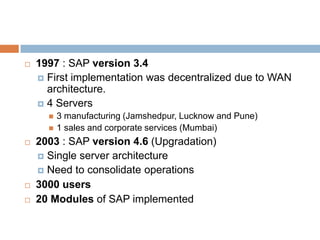
 1997 : SAP version 3.4
 First implementation was decentralized due to WAN
architecture.
 4 Servers
 3 manufacturing (Jamshedpur, Lucknow and Pune)
 1 sales and corporate services (Mumbai)
 2003 : SAP version 4.6 (Upgradation)
 Single server architecture
 Need to consolidate operations
 3000 users
 20 Modules of SAP implemented
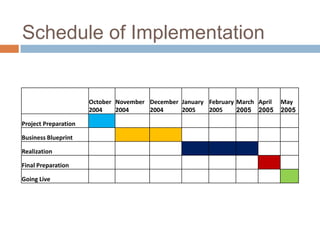
October
2004
November
2004
December
2004
January
2005
February
2005
March
2005
April
2005
May
2005
Project Preparation
Business Blueprint
Realization
Final Preparation
Going Live
Schedule of Implementation
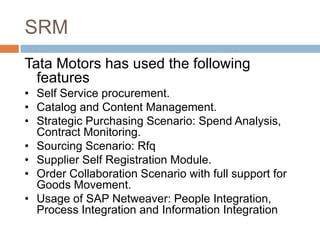
SRM
Tata Motors has used the following
features
• Self Service procurement.
• Catalog and Content Management.
• Strategic Purchasing Scenario: Spend Analysis,
Contract Monitoring.
• Sourcing Scenario: Rfq
• Supplier Self Registration Module.
• Order Collaboration Scenario with full support for
Goods Movement.
• Usage of SAP Netweaver: People Integration,
Process Integration and Information Integration
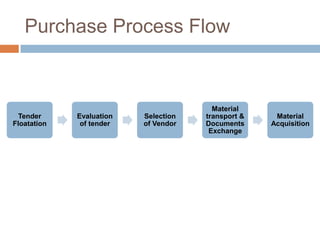
Tender
Floatation
Evaluation
of tender
Selection
of Vendor
Material
transport &
Documents
Exchange
Material
Acquisition
Purchase Process Flow
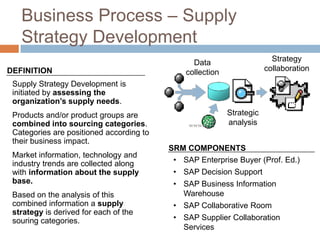
Business Process – Supply
Strategy Development
Supply Strategy Development is
initiated by assessing the
organization’s supply needs.
Products and/or product groups are
combined into sourcing categories.
Categories are positioned according to
their business impact.
Market information, technology and
industry trends are collected along
with information about the supply
base.
Based on the analysis of this
combined information a supply
strategy is derived for each of the
souring categories.
DEFINITION
SRM COMPONENTS
• SAP Enterprise Buyer (Prof. Ed.)
• SAP Decision Support
• SAP Business Information
Warehouse
• SAP Collaborative Room
• SAP Supplier Collaboration
Services
Data
collection
www..
Strategic
analysis
Strategy
collaboration
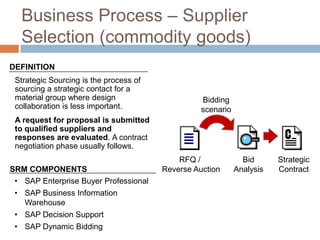
Business Process – Supplier
Selection (commodity goods)
Strategic Sourcing is the process of
sourcing a strategic contact for a
material group where design
collaboration is less important.
A request for proposal is submitted
to qualified suppliers and
responses are evaluated. A contract
negotiation phase usually follows.
DEFINITION
SRM COMPONENTS
• SAP Enterprise Buyer Professional
• SAP Business Information
Warehouse
• SAP Decision Support
• SAP Dynamic Bidding
Strategic
Contract
Bid
Analysis
RFQ /
Reverse Auction
Bidding
scenario
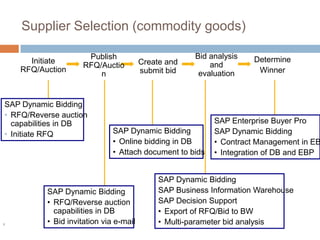
Supplier Selection (commodity goods)
Create and
submit bid
Initiate
RFQ/Auction
Bid analysis
and
evaluation
Determine
Winner
Publish
RFQ/Auctio
n
SAP Dynamic Bidding
• RFQ/Reverse auction
capabilities in DB
• Initiate RFQ
SAP Dynamic Bidding
• RFQ/Reverse auction
capabilities in DB
• Bid invitation via e-mail
SAP Dynamic Bidding
• Online bidding in DB
• Attach document to bids
SAP Enterprise Buyer Pro
SAP Dynamic Bidding
• Contract Management in EB
• Integration of DB and EBP
SAP Dynamic Bidding
SAP Business Information Warehouse
SAP Decision Support
• Export of RFQ/Bid to BW
• Multi-parameter bid analysis1
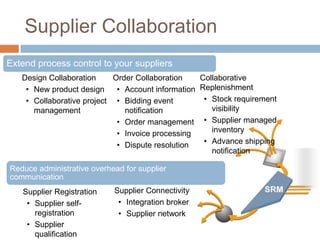
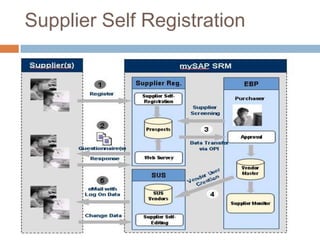
Supplier Registration
• Supplier self-
registration
• Supplier
qualification
Design Collaboration
• New product design
• Collaborative project
management
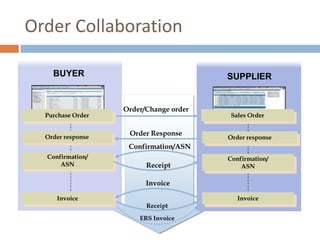
Order Collaboration
• Account information
• Bidding event
notification
• Order management
• Invoice processing
• Dispute resolution
Supplier Connectivity
• Integration broker
• Supplier network
Collaborative
Replenishment
• Stock requirement
visibility
• Supplier managed
inventory
• Advance shipping
notification
Reduce administrative overhead for supplier
communication
Extend process control to your suppliers
Supplier Collaboration
Supplier Self Registration
BUYER SUPPLIER
Invoice
Invoice
Sales Order
Invoice
Confirmation/
ASN
Purchase Order
Confirmation/
ASN
Order/Change order
Order responseOrder response
Receipt
Receipt
ERS Invoice
Confirmation/ASN
Order Collaboration
Benefits
• Overall Integration of the departments – Finance,
Sales, Production etc.
• On Demand Decision making data
• Backward Demand Integration
• Reduction in inventory cost as real time info is
available
• Reduction in production bottleneck with better
scheduling
• Seamless integration across the Supply Chain
• Standardization of processes across plants at various
locations
• Reduction in manual efforts of Invoice Capture
• Reduction in Transaction Cost & Compress Cycle time
Delivering Better Customer Service
Hero Honda
Hero Honda
 A joint venture between Hero group and
Honda motor company in 1984
 However split in 2010 year end
 Discussion Scenario: May 2008
The Speed Breaker Ahead
 In 2001 Hero Honda sold 1.3 Million bikes in a
single year creating record.
 However they had over 20 million customer
base and counting across all geographies.
 Handling customer complaints and after sales
service was a problem.
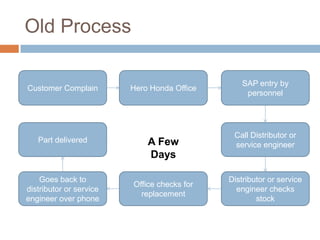
Old Process
Customer Complain Hero Honda Office
SAP entry by
personnel
Call Distributor or
service engineer
Distributor or service
engineer checks
stock
Office checks for
replacement
Goes back to
distributor or service
engineer over phone
Part delivered A Few
Days
Objective
 The objective was to equip people with information
even when they are not in office or where they are
not able to access the internet
 Since everyone carries a phone these days you can
push that information with a critical alert, to the right
person.
 Vijay Sethi, CIO , Hero Honda said:
“We wanted information to be available to decision
makers when they needed it.”
The Solution
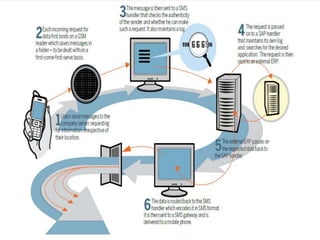
 The solution lay in an SMS-SAP implementation that
would ensure that the requested information is
available in real-time and the problems were
eliminated.
 The SMS based solution allows a Hero Honda staff to
share information with the company’s servers
irrespective of their location.
 The information is flashed to the key personnel’s
mobile phone nation wide, removing their need of
logging onto the website.
 It was termed as:
SMS PUSH-PULL service
The Solution cont…
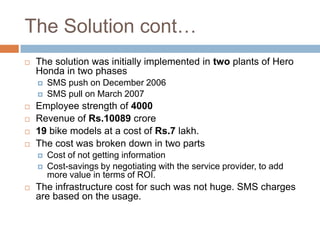
 The solution was initially implemented in two plants of Hero
Honda in two phases
 SMS push on December 2006
 SMS pull on March 2007
 Employee strength of 4000
 Revenue of Rs.10089 crore
 19 bike models at a cost of Rs.7 lakh.
 The cost was broken down in two parts
 Cost of not getting information
 Cost-savings by negotiating with the service provider, to add
more value in terms of ROI.
 The infrastructure cost for such was not huge. SMS charges
are based on the usage.
Benefits
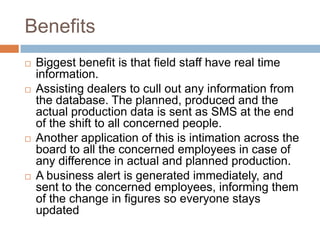
 Biggest benefit is that field staff have real time
information.
 Assisting dealers to cull out any information from
the database. The planned, produced and the
actual production data is sent as SMS at the end
of the shift to all concerned people.
 Another application of this is intimation across the
board to all the concerned employees in case of
any difference in actual and planned production.
 A business alert is generated immediately, and
sent to the concerned employees, informing them
of the change in figures so everyone stays
updated
Have a nice day 
Thank You

ERP - Automative Industry

  • 1.
    104- Ghanshyam Bheda 119-Anuj Shah 128- Aprajita Mehta 311- Lokesh Gada 327- Yuyutsu Tulshyan ERP in Automotive Industry
  • 2.
    Present Scenario  Atpresent time, Indian automobile industry is making a major contribution in increasing the country's GDP by 9% every year.  New heights has been scaled by the industry in the year 2011.  In January 2012, total automobile sales 21,14,157 units, an increment of 44.9% compared to the sales units of same period last year.  By 2050, the country is expected to top the world in car volumes with approximately 611
  • 3.
  • 4.
    The Key Players… Commercial vehicles TATAMotors, Ashok Leyland, Swaraj Mazda, Mahindra & Mahindra ,Force motors, Eicher Motors Passenger vehicle TATA Motors, Maruti Udyog, Honda Motors, Toyata, Skoda, Mahindra & Mahindra, Daimler Chrysler, Hindustan Motors Two Wheeler Hero, Bajaj Auto, Honda Motors, TVS Motors, Yamaha , Kinetic Motors Three Wheeler Bajaj Auto, Piaggio India
  • 5.
    Need for ERPin Automobile Industry  1) Full Traceability : A system that enables to accurately track individual bins, containers, during manufacturing and distribution chain  2)Quality and Supply Chain Management: Capability to track real-time data on manufacturing and supply during production
  • 6.
     3) ElectronicDocument Management: Not only does this save employees time, it speeds up overall operations, reduces waste, and minimizes room for human error  4) Inventory Optimization: excess inventory is an unnecessary expense and contrary to the lean manufacturing processes the enterprises are embracing  Inventory optimization is a “must-have” ERP feature for automotive parts manufacturers as excess inventory is unnecessary expense
  • 7.
     5) IntegratedFinancials: To trace costs associated with individual products and product lines right down to the raw materials used in production.  6) Built-in Barcode and OEM Shipping Labels: Built-in support for printing, reading, encoding, and utilizing barcode labels
  • 8.
     7) Built-inEDI (Electronic Data Interchange) Templates  8) Tooling and Maintenance: Specifically tracks which tools are used as well as the raw materials used in the making of the product  how many parts are produced before replacement or adjustment is necessary to maintain proper quality specifications.
  • 9.
    Industry Requirements  Kanban: Controlling Production and Material Flow.  Planning/Scheduling for multiple models at the same time in assembly line  Warranty Management  Just-in-sequence deliveries by suppliers  Managing vehicle information for vehicle lifecycle  Managing dealer business  Car leasing
  • 10.
    Different vendors providedifferent kind of industry specific solutions. Selection depends upon the company and their requirements
  • 11.
  • 12.
    Tata Motors  Since1945 the largest automotive company  IT Solutions Provided by Tata Technologies (Tata Motors subsidiary)  Huge Employee Base (30000)  Wide Scale production  One of the key businesses of the Tata Group  Very big distribution unit size
  • 13.
    Why ERP?  Noonline real time data available?  Production Loss  Legacy systems not integrated  Inconsistent Data  Difficult interpretations  Independent planning systems  Cumbersome information flow  To scale up production and increase capacity  Backward Integration required
  • 14.
    Tata Motors -Enterprise Software Vendor
  • 15.
    Why SAP?  30years of working with automotive organizations  1600 automotive companies worldwide rely on SAP  SAP for automotive designed to help automotive companies of virtually any size  Ready made processes for auto manufacturers
  • 16.
    Success Factors: TM’s Consideration Improved Sales Revenue  Cost Reduction  Reduced Inventory  Improved Production Scheduling  Improved Productivity  Enhanced organization-wide communication
  • 17.
    What SAP covered? Functional and Technical Consulting for implementation of mySAP portfolio of products  SAP R/3 Implementations including Industry Specific Solutions  BIW, CRM, SRM, APO, SCM, Enterprise Portals  Change Management  SAP Implémentation Audit  Identification of Risk Factors  Risk mitigation Planning  Solution / System Optimization  System Operations Plan
  • 18.
    Project VECTOR  ValueEnhancement by Collaboration through Technology & Operational Restructuring  mySAP SRM 40 implementation  Mission: Revolutionize the supply chain by under covering the hidden value through technology driven Sourcing & collaborative Purchasing
  • 19.
    Phases of Implementation Phase 1  Pilot implementation covering:  four locations for selected product categories and  four vendors each for direct and indirect materials  Was primed by SAP Consulting  Phase 2  Rollout of mySAP for Direct and Indirect Materials for balance Product Categories and Vendors covering all locations.  Also implement Invoice entry and Approval Modules.  Was primed by Tata Technologies Limited
  • 20.
     1997 :SAP version 3.4  First implementation was decentralized due to WAN architecture.  4 Servers  3 manufacturing (Jamshedpur, Lucknow and Pune)  1 sales and corporate services (Mumbai)  2003 : SAP version 4.6 (Upgradation)  Single server architecture  Need to consolidate operations  3000 users  20 Modules of SAP implemented
  • 21.
  • 22.
    SRM Tata Motors hasused the following features • Self Service procurement. • Catalog and Content Management. • Strategic Purchasing Scenario: Spend Analysis, Contract Monitoring. • Sourcing Scenario: Rfq • Supplier Self Registration Module. • Order Collaboration Scenario with full support for Goods Movement. • Usage of SAP Netweaver: People Integration, Process Integration and Information Integration
  • 23.
    Tender Floatation Evaluation of tender Selection of Vendor Material transport& Documents Exchange Material Acquisition Purchase Process Flow
  • 24.
    Business Process –Supply Strategy Development Supply Strategy Development is initiated by assessing the organization’s supply needs. Products and/or product groups are combined into sourcing categories. Categories are positioned according to their business impact. Market information, technology and industry trends are collected along with information about the supply base. Based on the analysis of this combined information a supply strategy is derived for each of the souring categories. DEFINITION SRM COMPONENTS • SAP Enterprise Buyer (Prof. Ed.) • SAP Decision Support • SAP Business Information Warehouse • SAP Collaborative Room • SAP Supplier Collaboration Services Data collection www.. Strategic analysis Strategy collaboration
  • 25.
    Business Process –Supplier Selection (commodity goods) Strategic Sourcing is the process of sourcing a strategic contact for a material group where design collaboration is less important. A request for proposal is submitted to qualified suppliers and responses are evaluated. A contract negotiation phase usually follows. DEFINITION SRM COMPONENTS • SAP Enterprise Buyer Professional • SAP Business Information Warehouse • SAP Decision Support • SAP Dynamic Bidding Strategic Contract Bid Analysis RFQ / Reverse Auction Bidding scenario
  • 26.
    Supplier Selection (commoditygoods) Create and submit bid Initiate RFQ/Auction Bid analysis and evaluation Determine Winner Publish RFQ/Auctio n SAP Dynamic Bidding • RFQ/Reverse auction capabilities in DB • Initiate RFQ SAP Dynamic Bidding • RFQ/Reverse auction capabilities in DB • Bid invitation via e-mail SAP Dynamic Bidding • Online bidding in DB • Attach document to bids SAP Enterprise Buyer Pro SAP Dynamic Bidding • Contract Management in EB • Integration of DB and EBP SAP Dynamic Bidding SAP Business Information Warehouse SAP Decision Support • Export of RFQ/Bid to BW • Multi-parameter bid analysis1
  • 27.
    Supplier Registration • Supplierself- registration • Supplier qualification Design Collaboration • New product design • Collaborative project management Order Collaboration • Account information • Bidding event notification • Order management • Invoice processing • Dispute resolution Supplier Connectivity • Integration broker • Supplier network Collaborative Replenishment • Stock requirement visibility • Supplier managed inventory • Advance shipping notification Reduce administrative overhead for supplier communication Extend process control to your suppliers Supplier Collaboration
  • 28.
  • 29.
    BUYER SUPPLIER Invoice Invoice Sales Order Invoice Confirmation/ ASN PurchaseOrder Confirmation/ ASN Order/Change order Order responseOrder response Receipt Receipt ERS Invoice Confirmation/ASN Order Collaboration
  • 30.
    Benefits • Overall Integrationof the departments – Finance, Sales, Production etc. • On Demand Decision making data • Backward Demand Integration • Reduction in inventory cost as real time info is available • Reduction in production bottleneck with better scheduling • Seamless integration across the Supply Chain • Standardization of processes across plants at various locations • Reduction in manual efforts of Invoice Capture • Reduction in Transaction Cost & Compress Cycle time
  • 31.
    Delivering Better CustomerService Hero Honda
  • 32.
    Hero Honda  Ajoint venture between Hero group and Honda motor company in 1984  However split in 2010 year end  Discussion Scenario: May 2008
  • 33.
    The Speed BreakerAhead  In 2001 Hero Honda sold 1.3 Million bikes in a single year creating record.  However they had over 20 million customer base and counting across all geographies.  Handling customer complaints and after sales service was a problem.
  • 34.
    Old Process Customer ComplainHero Honda Office SAP entry by personnel Call Distributor or service engineer Distributor or service engineer checks stock Office checks for replacement Goes back to distributor or service engineer over phone Part delivered A Few Days
  • 35.
    Objective  The objectivewas to equip people with information even when they are not in office or where they are not able to access the internet  Since everyone carries a phone these days you can push that information with a critical alert, to the right person.  Vijay Sethi, CIO , Hero Honda said: “We wanted information to be available to decision makers when they needed it.”
  • 36.
    The Solution  Thesolution lay in an SMS-SAP implementation that would ensure that the requested information is available in real-time and the problems were eliminated.  The SMS based solution allows a Hero Honda staff to share information with the company’s servers irrespective of their location.  The information is flashed to the key personnel’s mobile phone nation wide, removing their need of logging onto the website.  It was termed as: SMS PUSH-PULL service
  • 38.
    The Solution cont… The solution was initially implemented in two plants of Hero Honda in two phases  SMS push on December 2006  SMS pull on March 2007  Employee strength of 4000  Revenue of Rs.10089 crore  19 bike models at a cost of Rs.7 lakh.  The cost was broken down in two parts  Cost of not getting information  Cost-savings by negotiating with the service provider, to add more value in terms of ROI.  The infrastructure cost for such was not huge. SMS charges are based on the usage.
  • 39.
    Benefits  Biggest benefitis that field staff have real time information.  Assisting dealers to cull out any information from the database. The planned, produced and the actual production data is sent as SMS at the end of the shift to all concerned people.  Another application of this is intimation across the board to all the concerned employees in case of any difference in actual and planned production.  A business alert is generated immediately, and sent to the concerned employees, informing them of the change in figures so everyone stays updated
  • 40.
    Have a niceday  Thank You

Editor's Notes

  • #35 Customer wants to lodge a complaint or service requestGoes to Hero Honda officeEntry made In SAP system by personnelPersonnel from office would call the relevant distributor or service engineer and tell them about the defect.The distributor or engineer then checks his stock and revert back to the office.The office then checks for replacement stock and then go back to the distributor or customer over phoneFinally the desired part was sent to the customer.The whole process took a few days.