1
2
Introduction
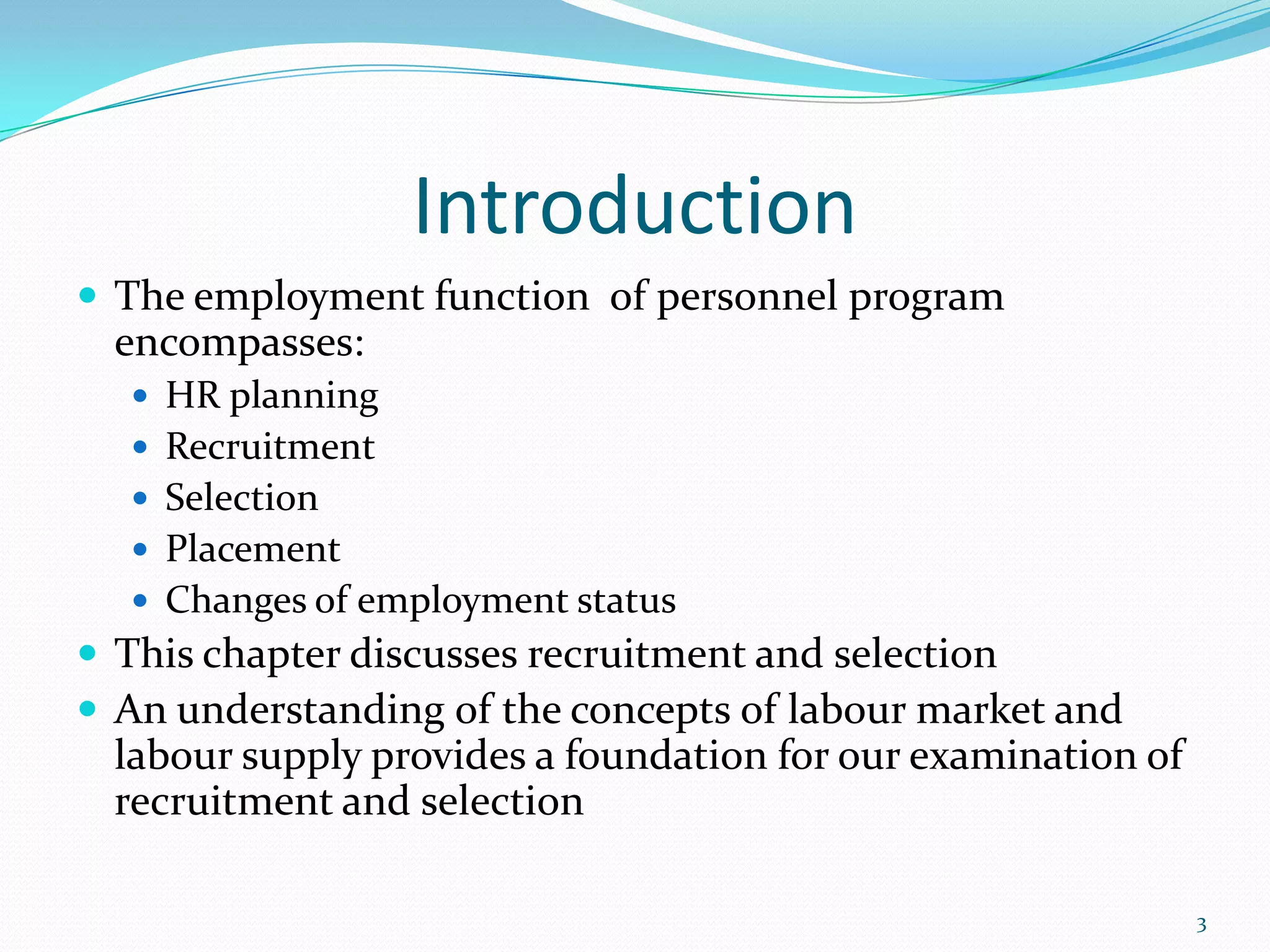
 The employment function of personnel program
encompasses:
 HR planning
 Recruitment
 Selection
 Placement
 Changes of employment status
 This chapter discusses recruitment and selection
 An understanding of the concepts of labour market and
labour supply provides a foundation for our examination of
recruitment and selection
3
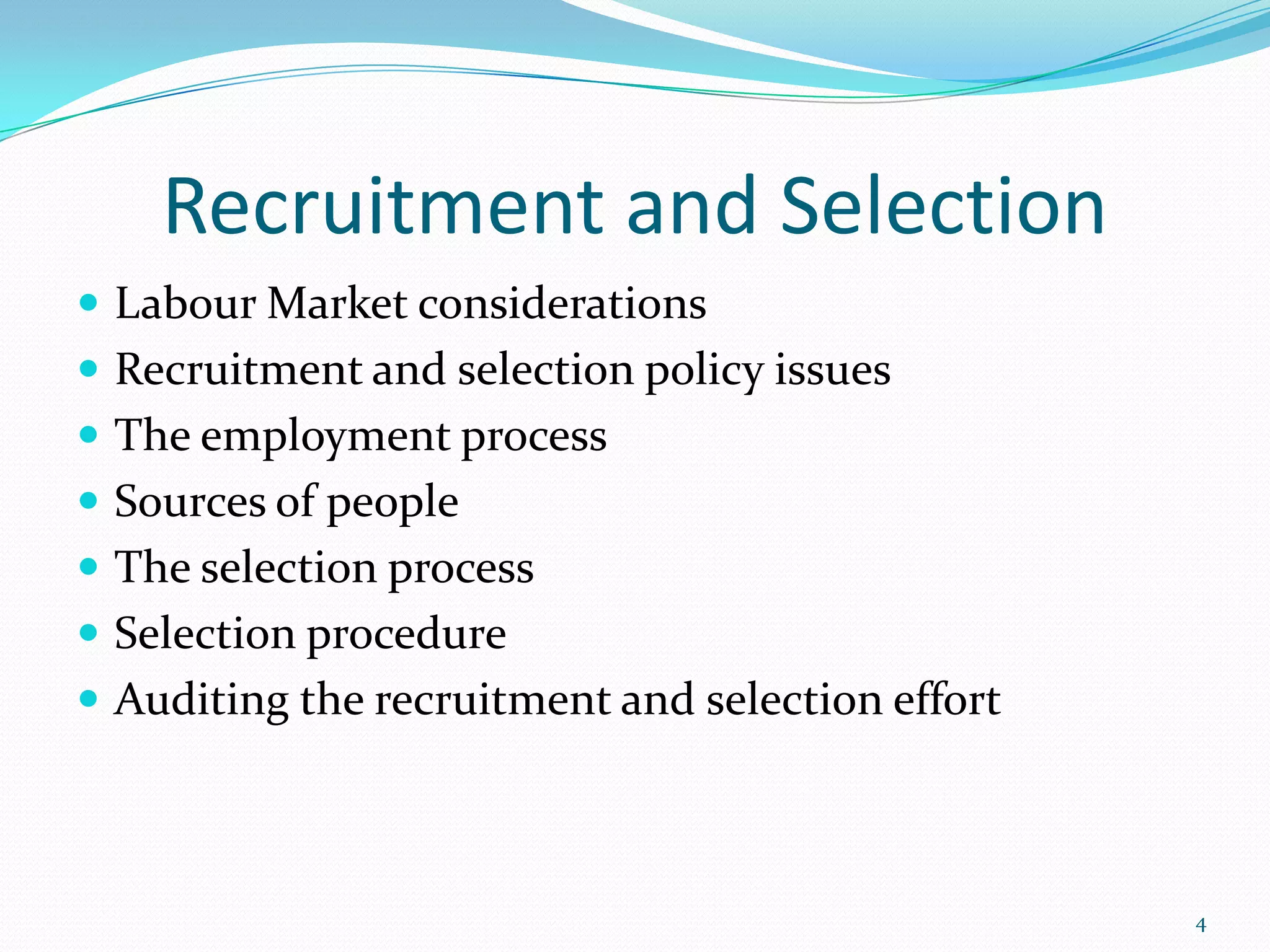
Recruitment and Selection
 Labour Market considerations
 Recruitment and selection policy issues
 The employment process
 Sources of people
 The selection process
 Selection procedure
 Auditing the recruitment and selection effort
4
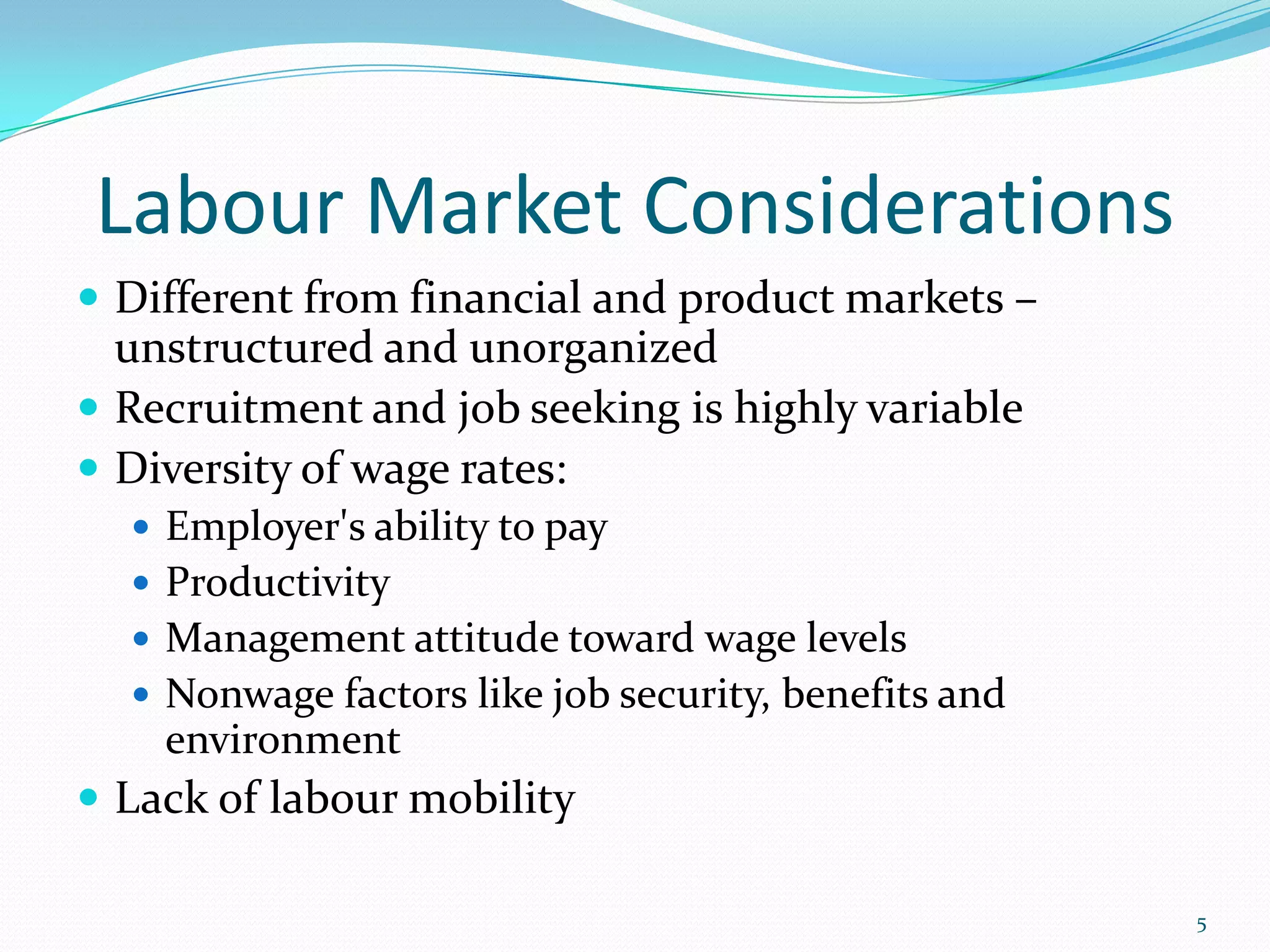
Labour Market Considerations
 Different from financial and product markets –
unstructured and unorganized
 Recruitment and job seeking is highly variable
 Diversity of wage rates:
 Employer's ability to pay
 Productivity
 Management attitude toward wage levels
 Nonwage factors like job security, benefits and
environment
 Lack of labour mobility
5
Labour Market Considerations
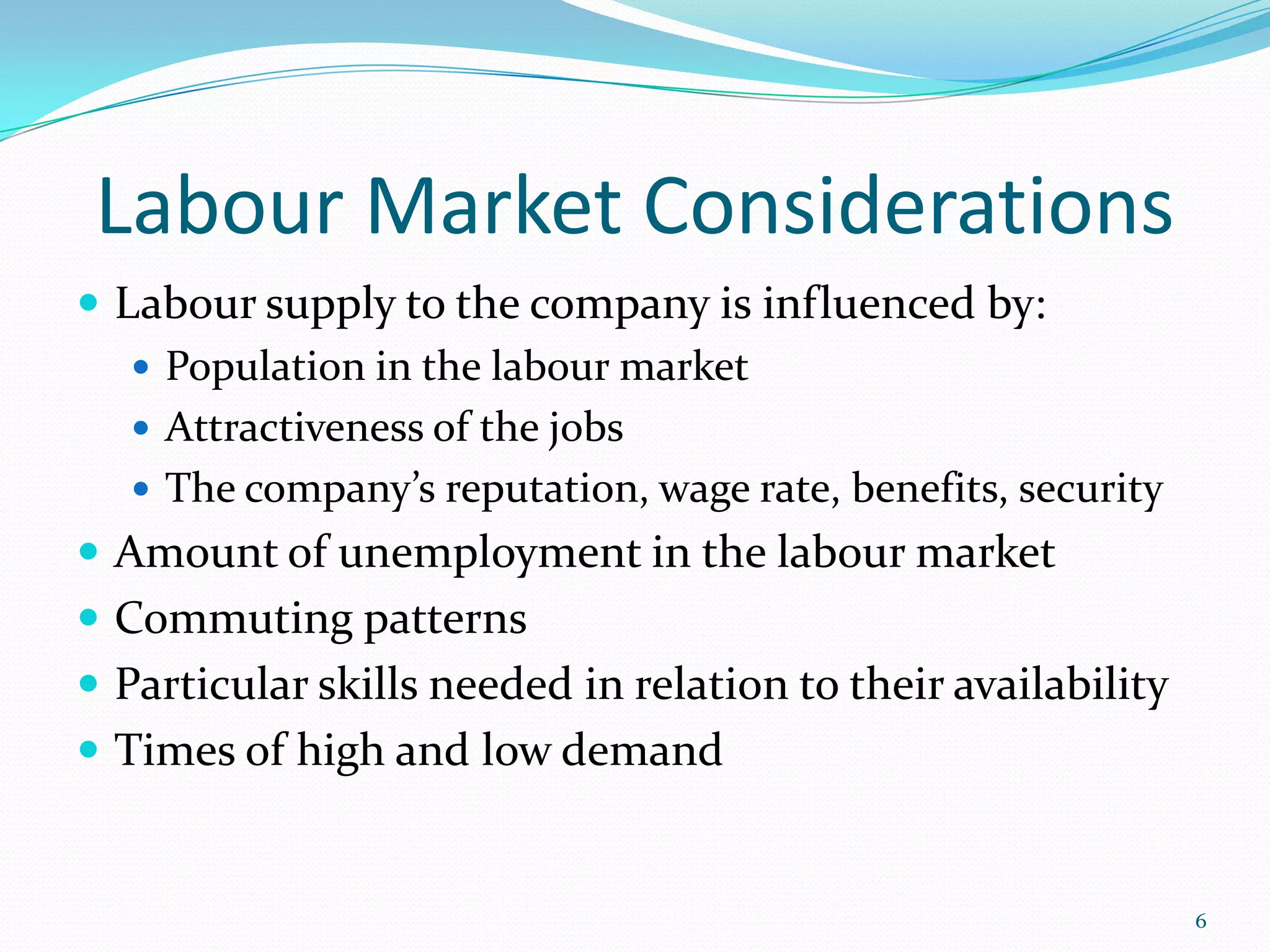
 Labour supply to the company is influenced by:
 Population in the labour market
 Attractiveness of the jobs
 The company’s reputation, wage rate, benefits, security
 Amount of unemployment in the labour market
 Commuting patterns
 Particular skills needed in relation to their availability
 Times of high and low demand
6
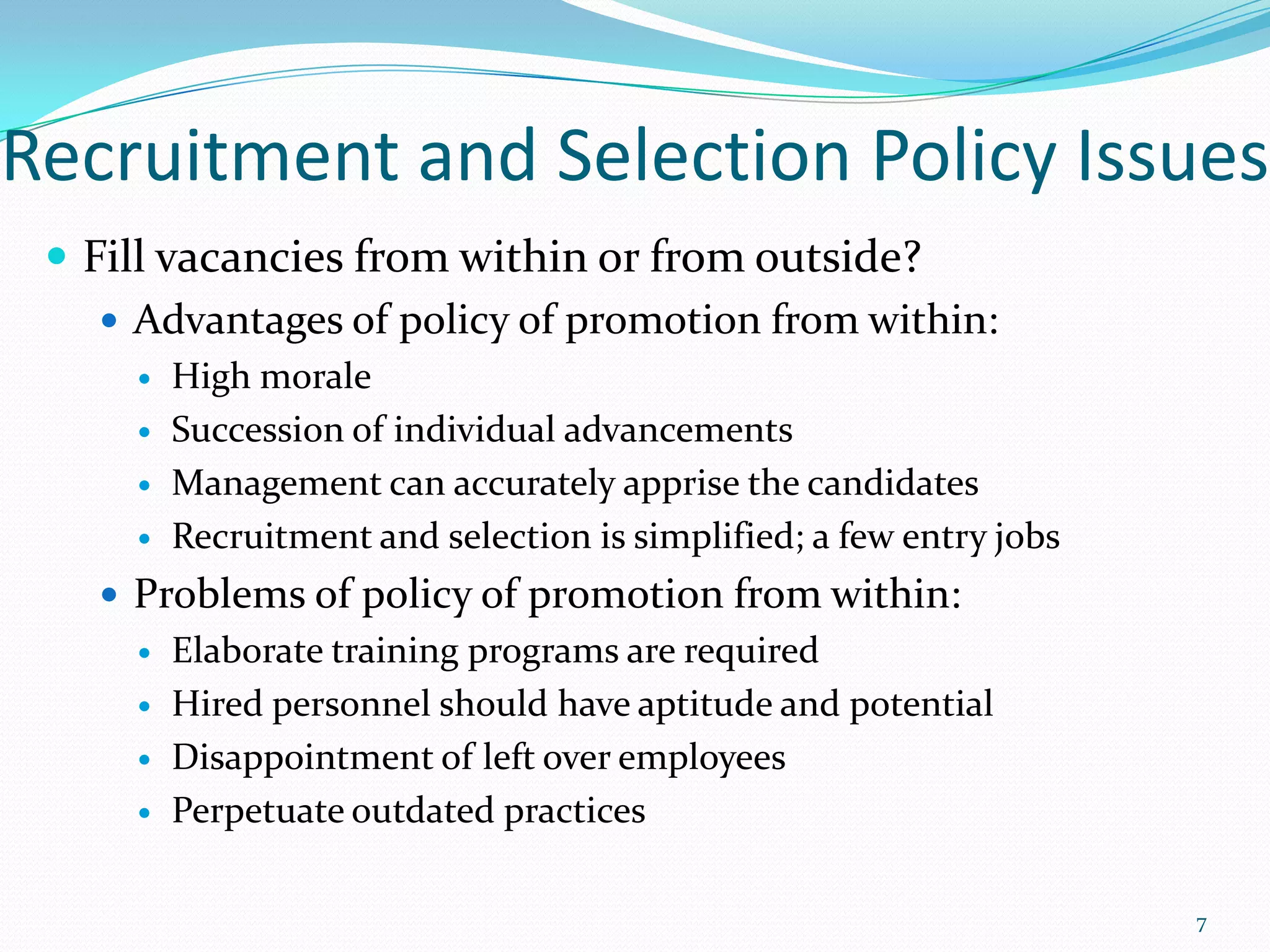
Recruitment and Selection Policy Issues
 Fill vacancies from within or from outside?
 Advantages of policy of promotion from within:
 High morale
 Succession of individual advancements
 Management can accurately apprise the candidates
 Recruitment and selection is simplified; a few entry jobs
 Problems of policy of promotion from within:
 Elaborate training programs are required
 Hired personnel should have aptitude and potential
 Disappointment of left over employees
 Perpetuate outdated practices
7
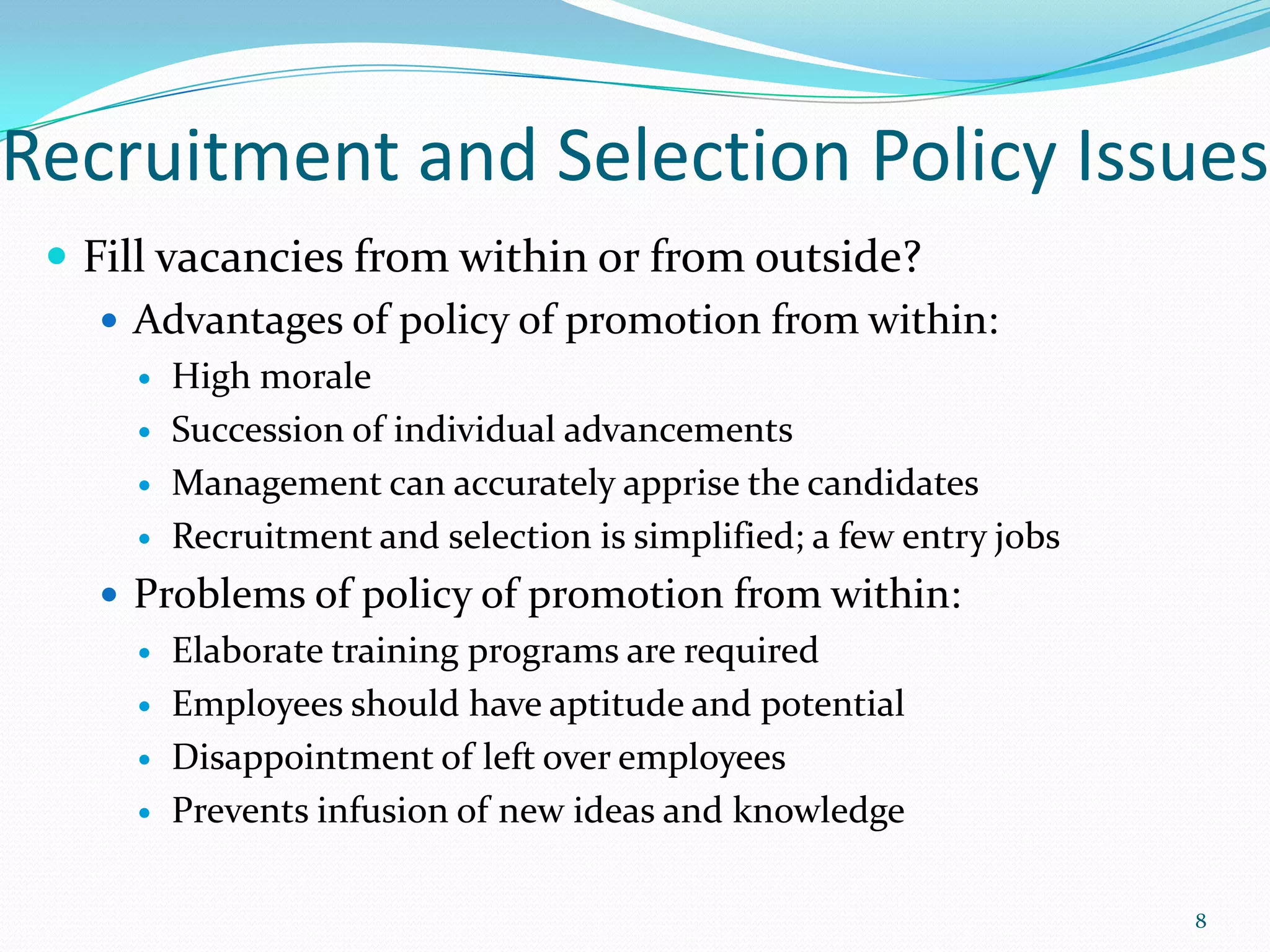
Recruitment and Selection Policy Issues
 Fill vacancies from within or from outside?
 Advantages of policy of promotion from within:
 High morale
 Succession of individual advancements
 Management can accurately apprise the candidates
 Recruitment and selection is simplified; a few entry jobs
 Problems of policy of promotion from within:
 Elaborate training programs are required
 Employees should have aptitude and potential
 Disappointment of left over employees
 Prevents infusion of new ideas and knowledge
8
Recruitment and Selection Policy Issues
 Equal employment opportunity
 There ought to be no discrimination
 Plan to hire and promote protected groups
 Adverse impact
9
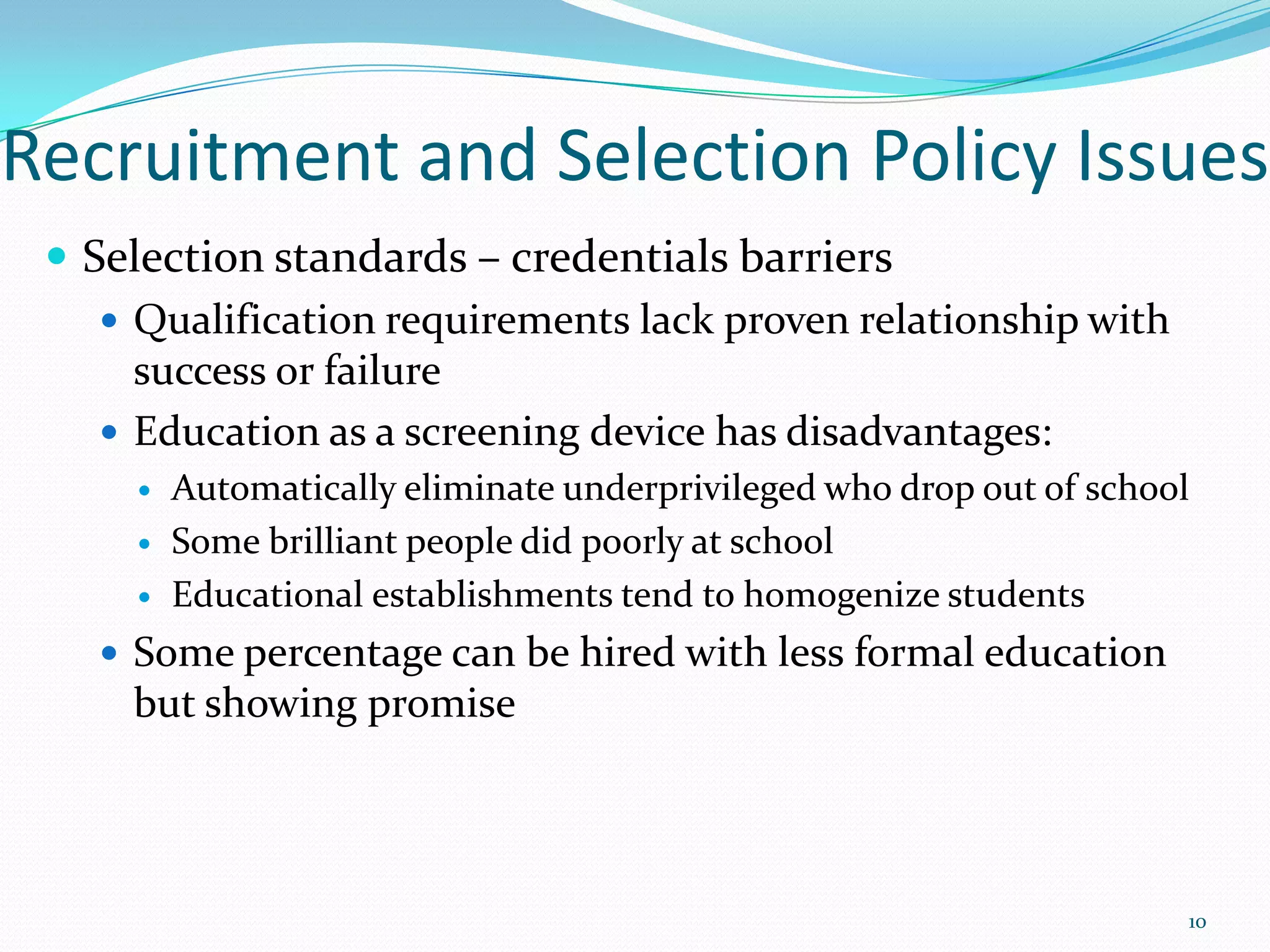
Recruitment and Selection Policy Issues
 Selection standards – credentials barriers
 Qualification requirements lack proven relationship with
success or failure
 Education as a screening device has disadvantages:
 Automatically eliminate underprivileged who drop out of school
 Some brilliant people did poorly at school
 Educational establishments tend to homogenize students
 Some percentage can be hired with less formal education
but showing promise
10
Recruitment and Selection Policy Issues
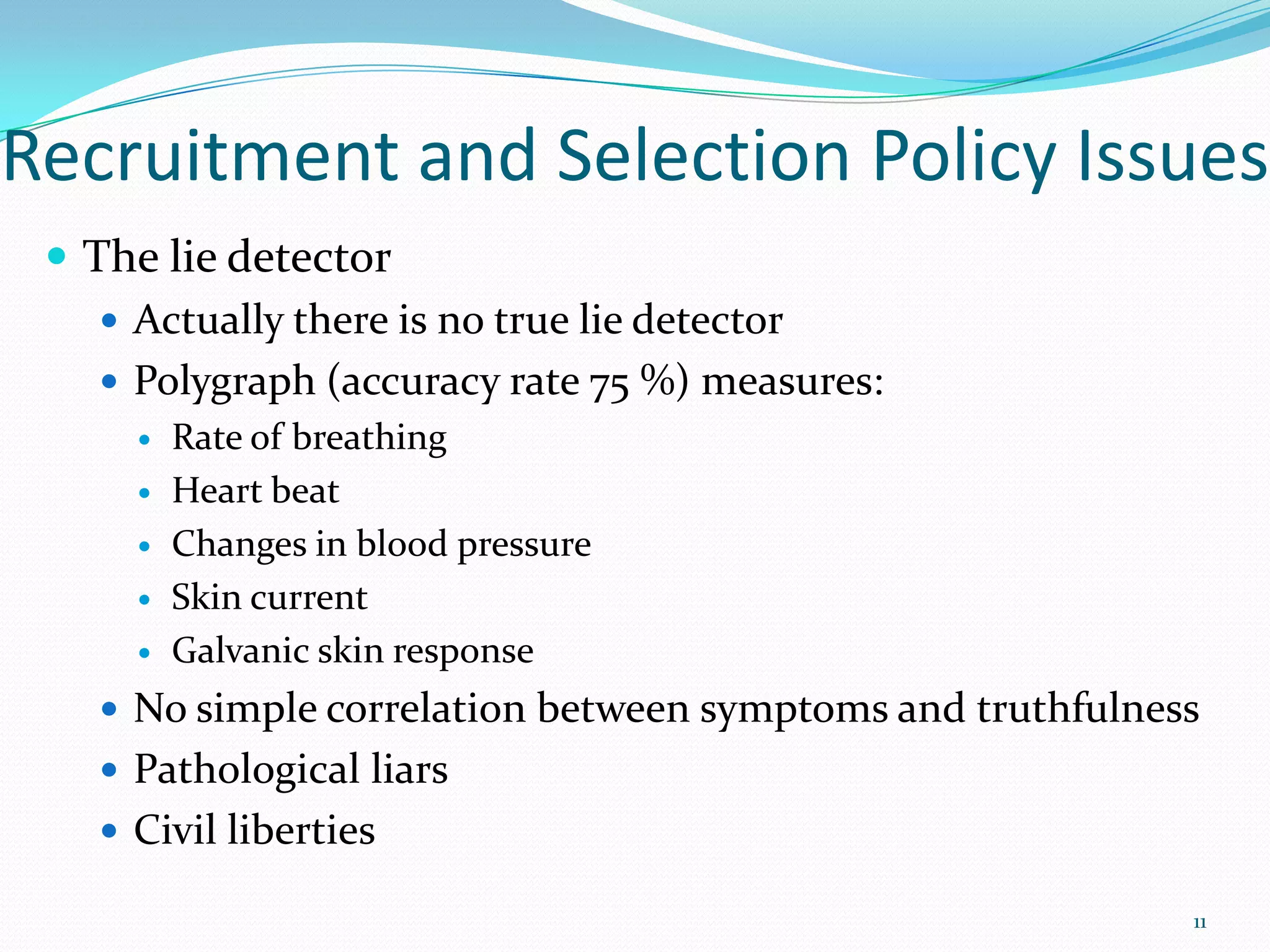
 The lie detector
 Actually there is no true lie detector
 Polygraph (accuracy rate 75 %) measures:
 Rate of breathing
 Heart beat
 Changes in blood pressure
 Skin current
 Galvanic skin response
 No simple correlation between symptoms and truthfulness
 Pathological liars
 Civil liberties
11
Recruitment and Selection Policy Issues
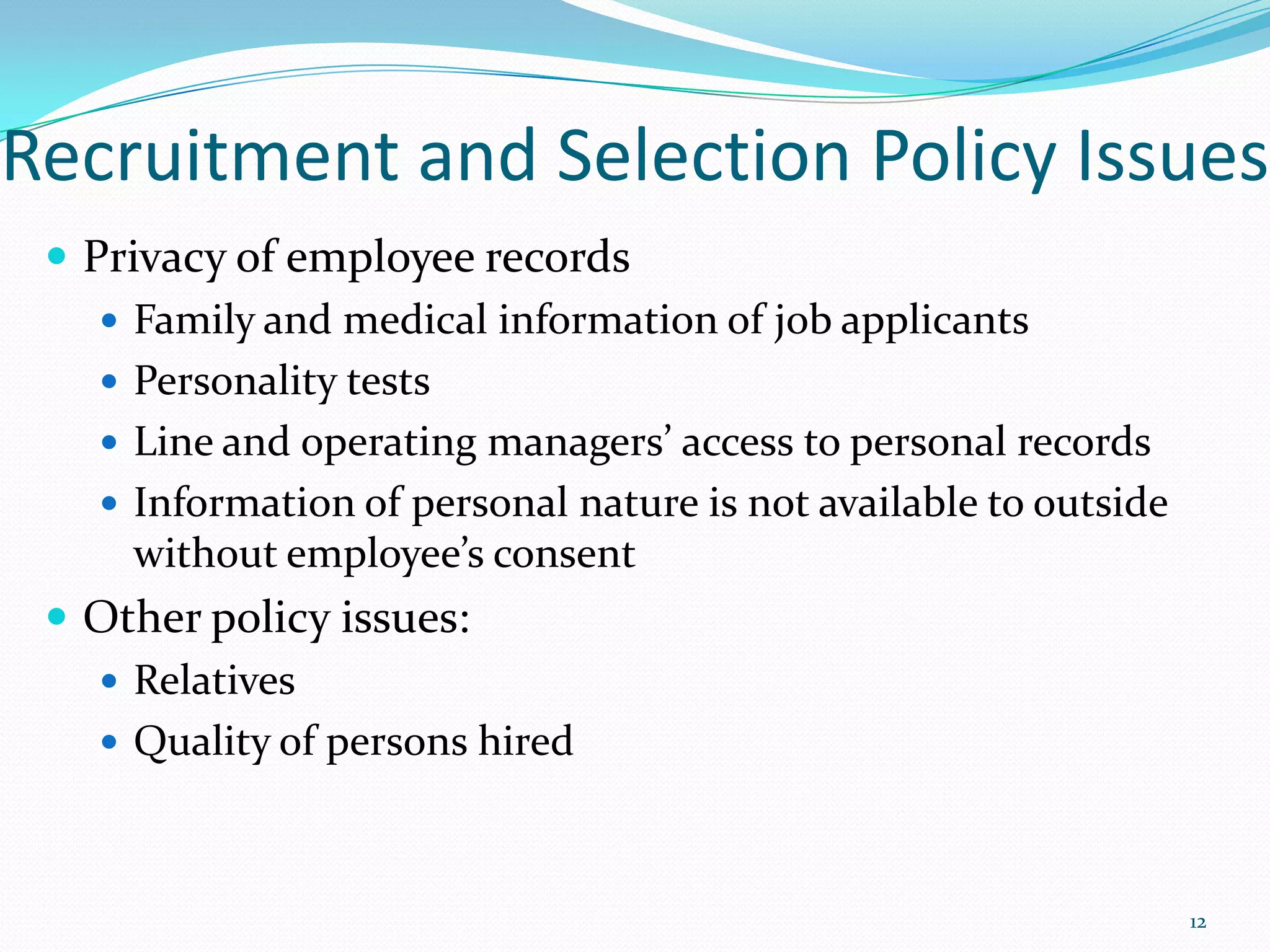
 Privacy of employee records
 Family and medical information of job applicants
 Personality tests
 Line and operating managers’ access to personal records
 Information of personal nature is not available to outside
without employee’s consent
 Other policy issues:
 Relatives
 Quality of persons hired
12
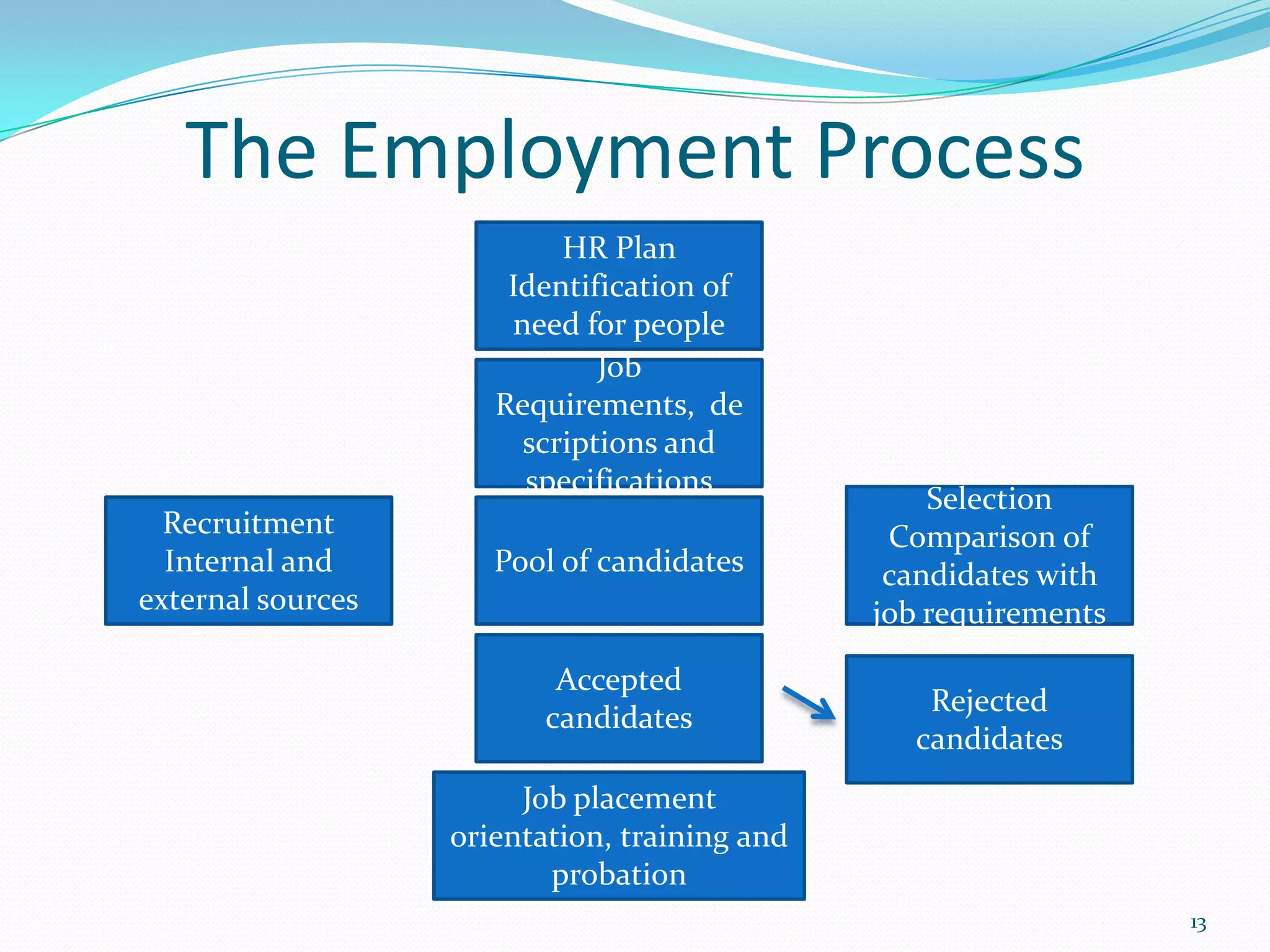
The Employment Process
HR Plan
Identification of
need for people
Job
Requirements, de
scriptions and
specifications
Recruitment
Internal and
external sources
Pool of candidates
Selection
Comparison of
candidates with
job requirements
Accepted
candidates
Rejected
candidates
Job placement
orientation, training and
probation
13
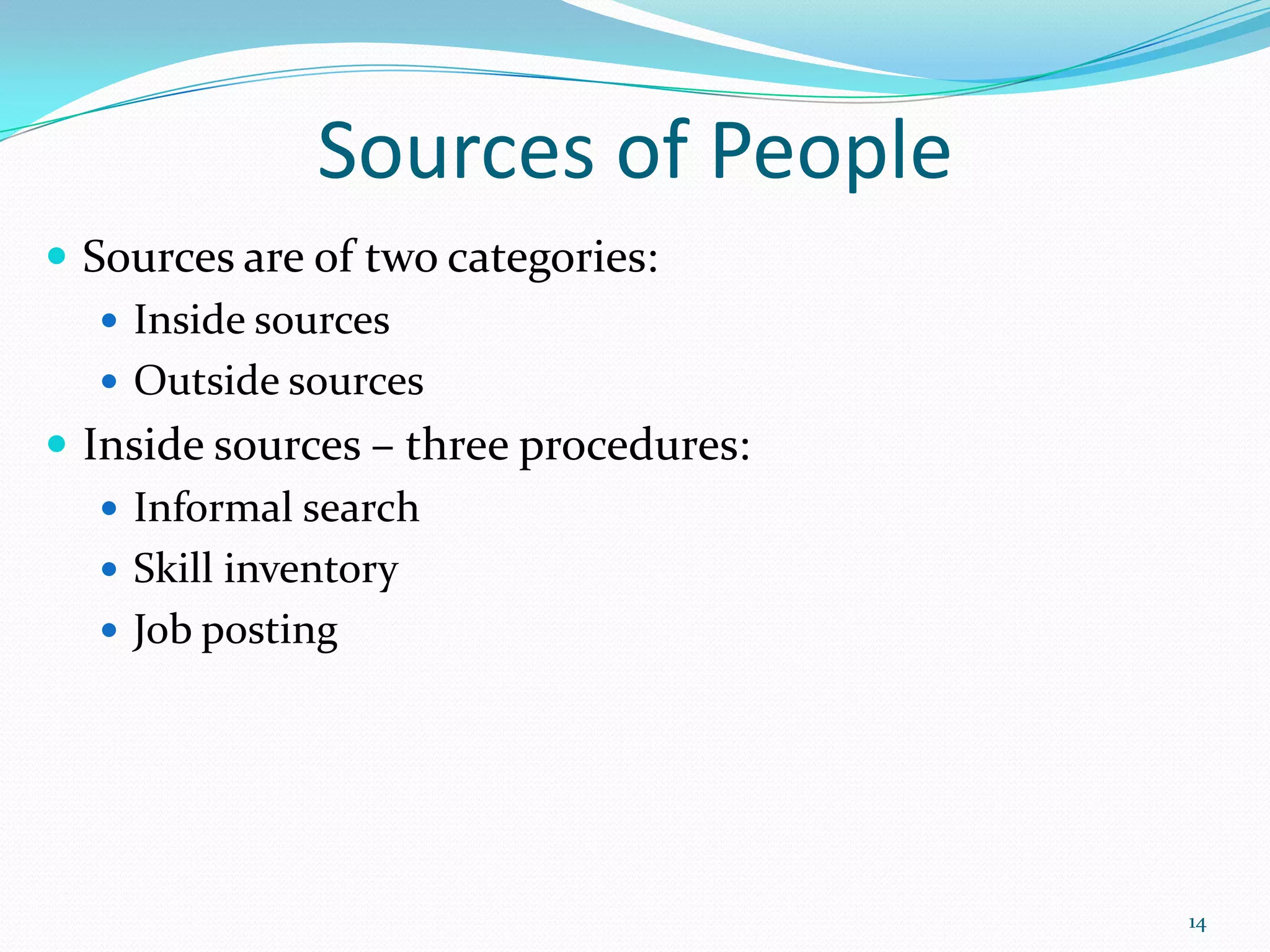
Sources of People
 Sources are of two categories:
 Inside sources
 Outside sources
 Inside sources – three procedures:
 Informal search
 Skill inventory
 Job posting
14
Sources of People
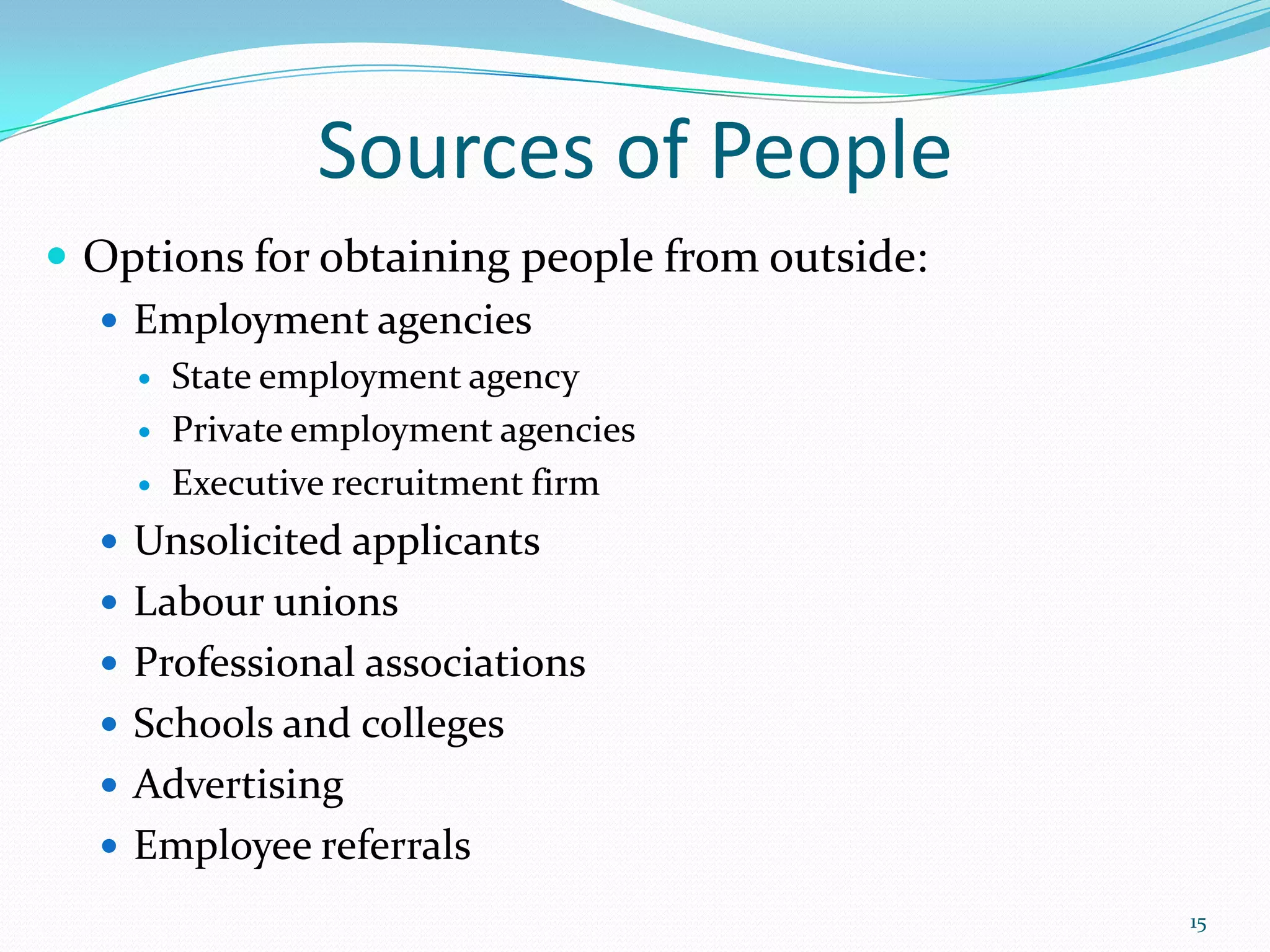
 Options for obtaining people from outside:
 Employment agencies
 State employment agency
 Private employment agencies
 Executive recruitment firm
 Unsolicited applicants
 Labour unions
 Professional associations
 Schools and colleges
 Advertising
 Employee referrals
15
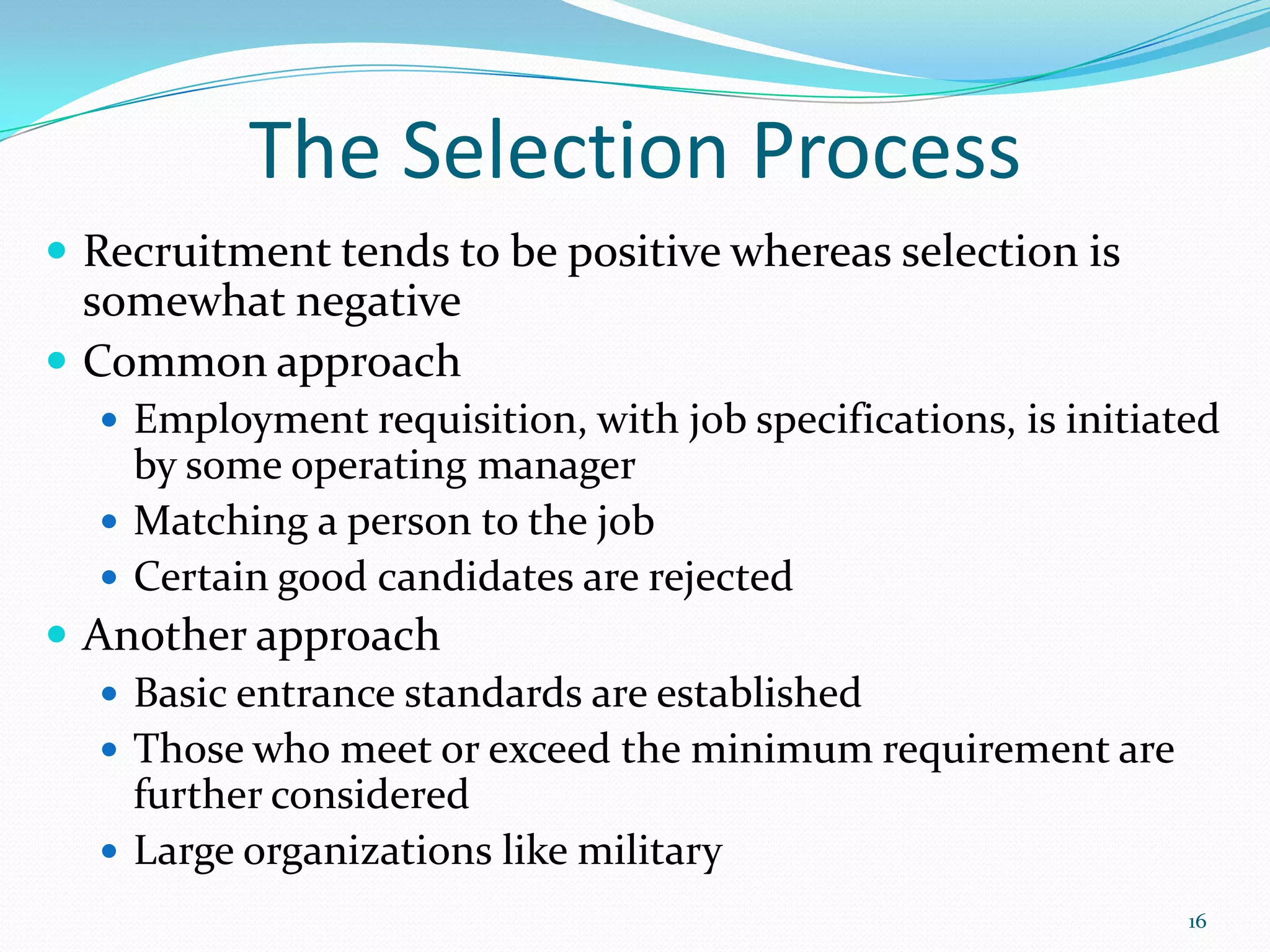
The Selection Process
 Recruitment tends to be positive whereas selection is
somewhat negative
 Common approach
 Employment requisition, with job specifications, is initiated
by some operating manager
 Matching a person to the job
 Certain good candidates are rejected
 Another approach
 Basic entrance standards are established
 Those who meet or exceed the minimum requirement are
further considered
 Large organizations like military
16
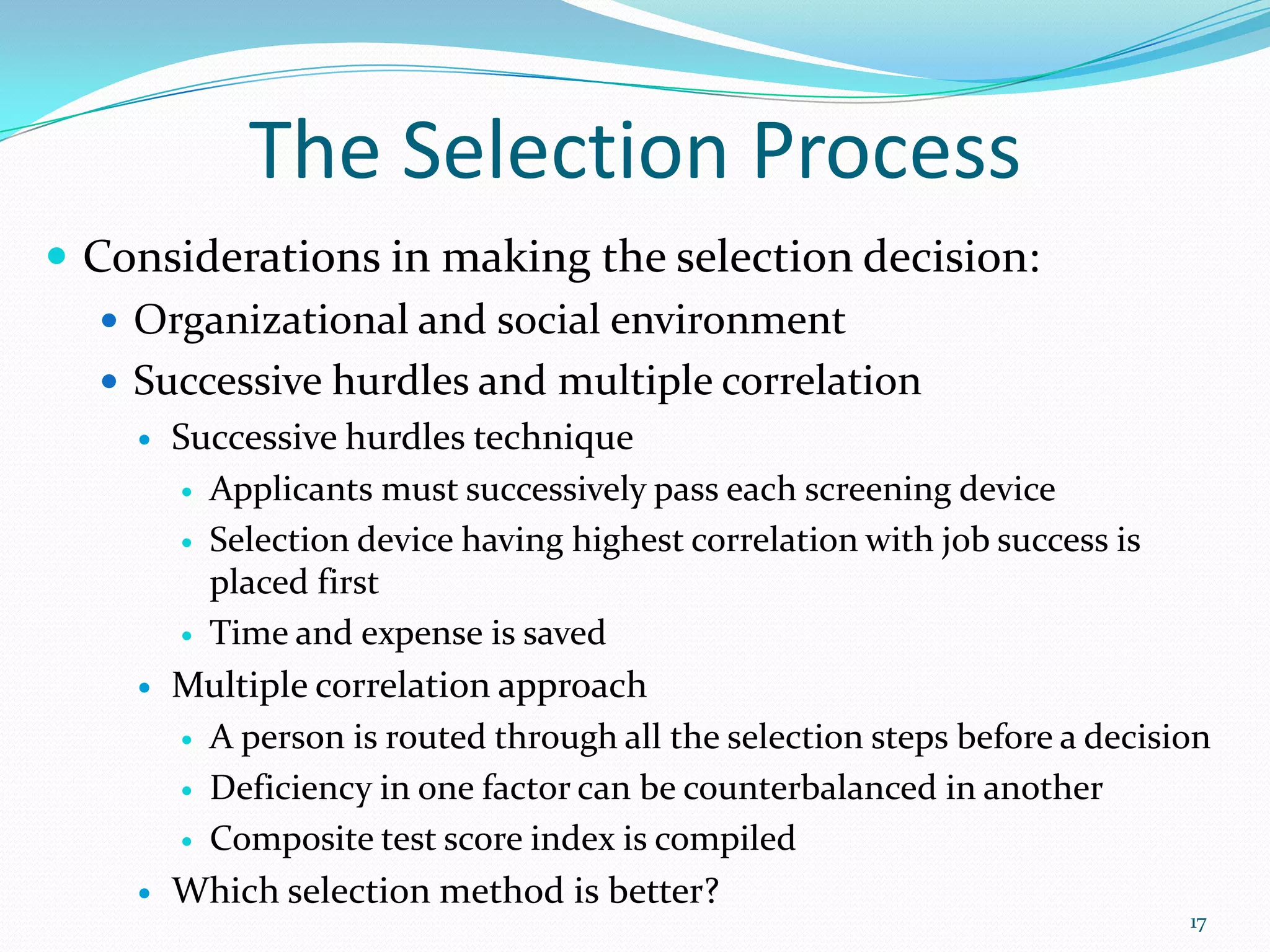
The Selection Process
 Considerations in making the selection decision:
 Organizational and social environment
 Successive hurdles and multiple correlation
 Successive hurdles technique
 Applicants must successively pass each screening device
 Selection device having highest correlation with job success is
placed first
 Time and expense is saved
 Multiple correlation approach
 A person is routed through all the selection steps before a decision
 Deficiency in one factor can be counterbalanced in another
 Composite test score index is compiled
 Which selection method is better?
17
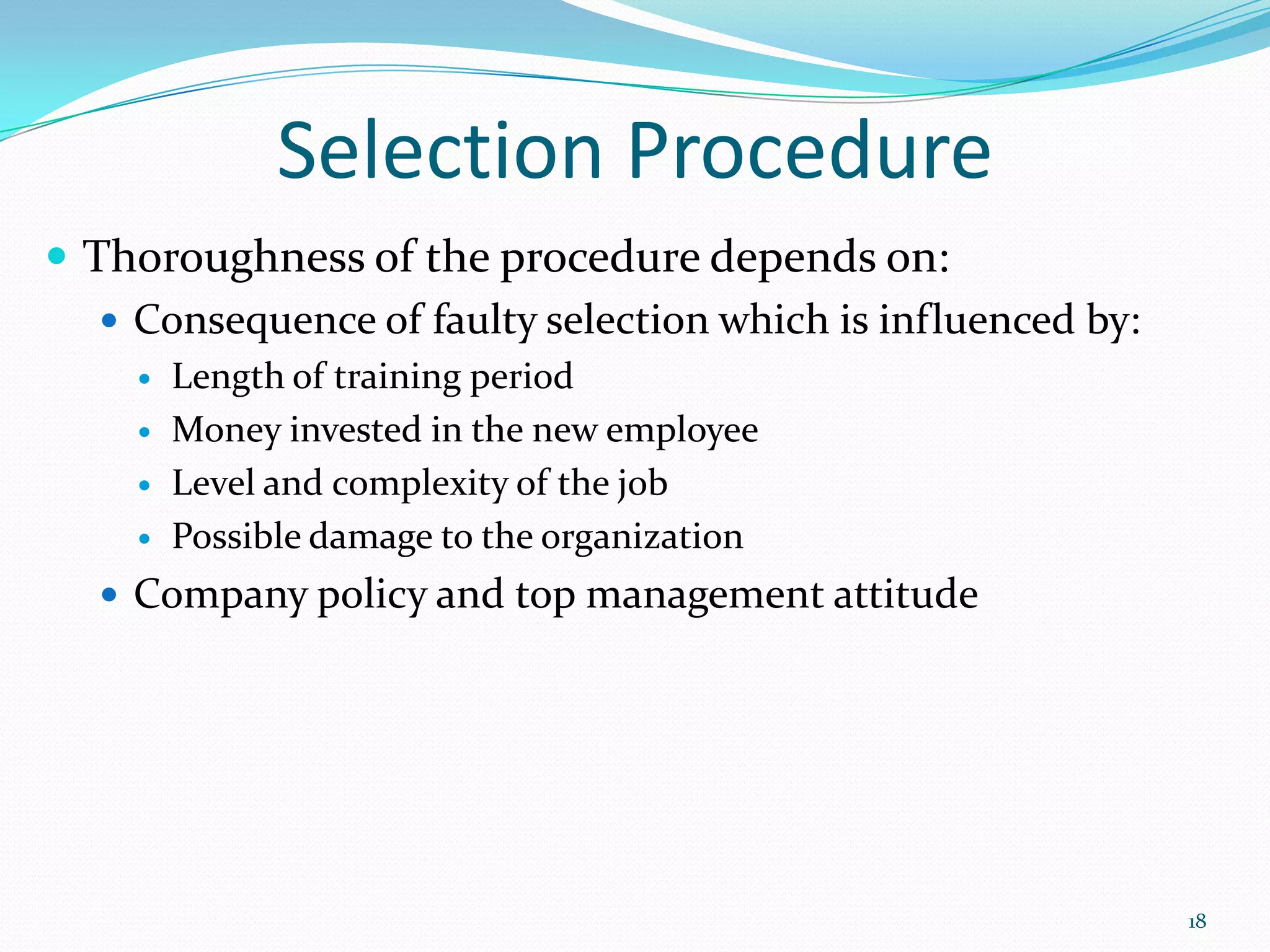
Selection Procedure
 Thoroughness of the procedure depends on:
 Consequence of faulty selection which is influenced by:
 Length of training period
 Money invested in the new employee
 Level and complexity of the job
 Possible damage to the organization
 Company policy and top management attitude
18
Selection Procedure
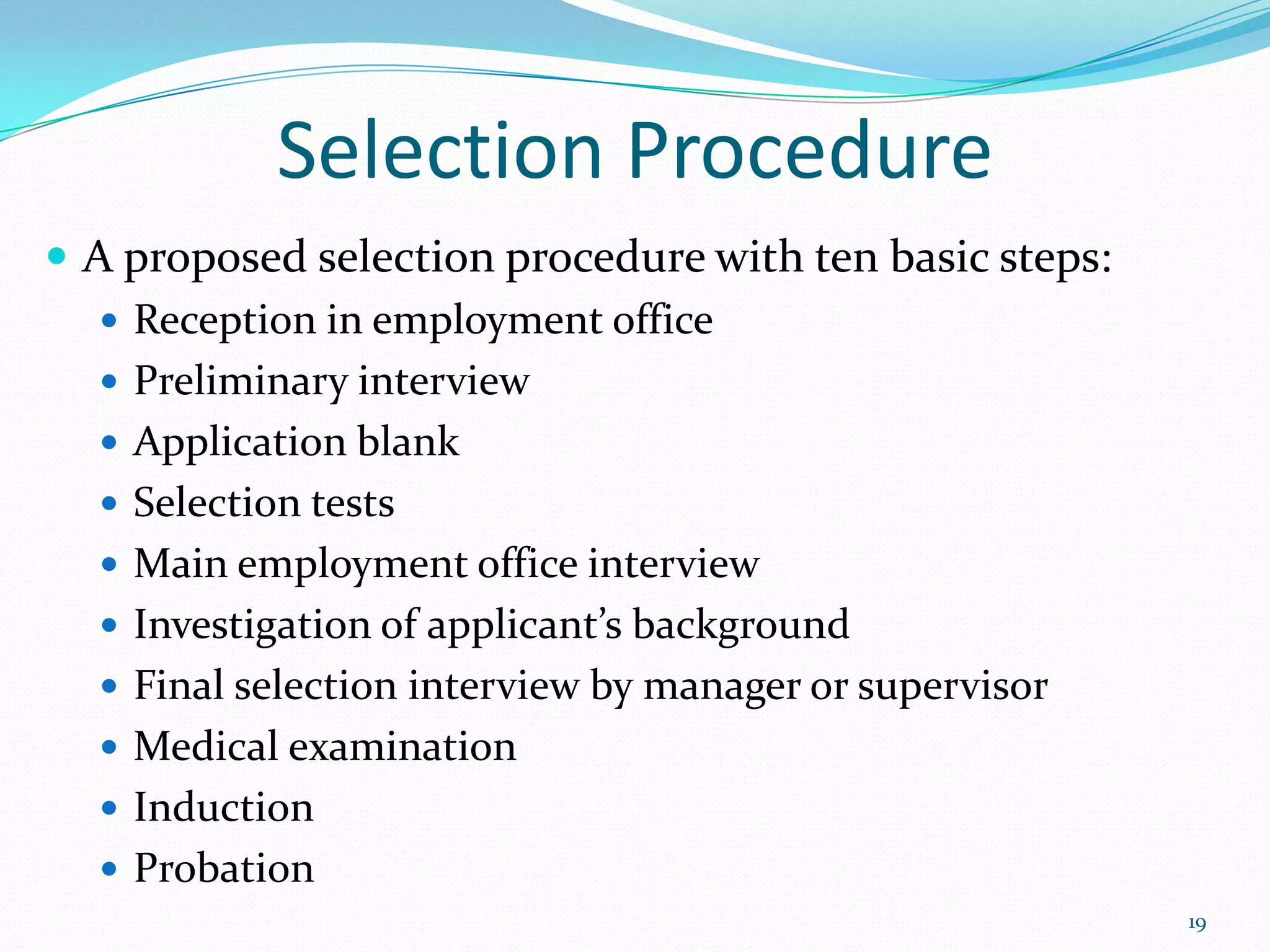
 A proposed selection procedure with ten basic steps:
 Reception in employment office
 Preliminary interview
 Application blank
 Selection tests
 Main employment office interview
 Investigation of applicant’s background
 Final selection interview by manager or supervisor
 Medical examination
 Induction
 Probation
19
Selection Procedure
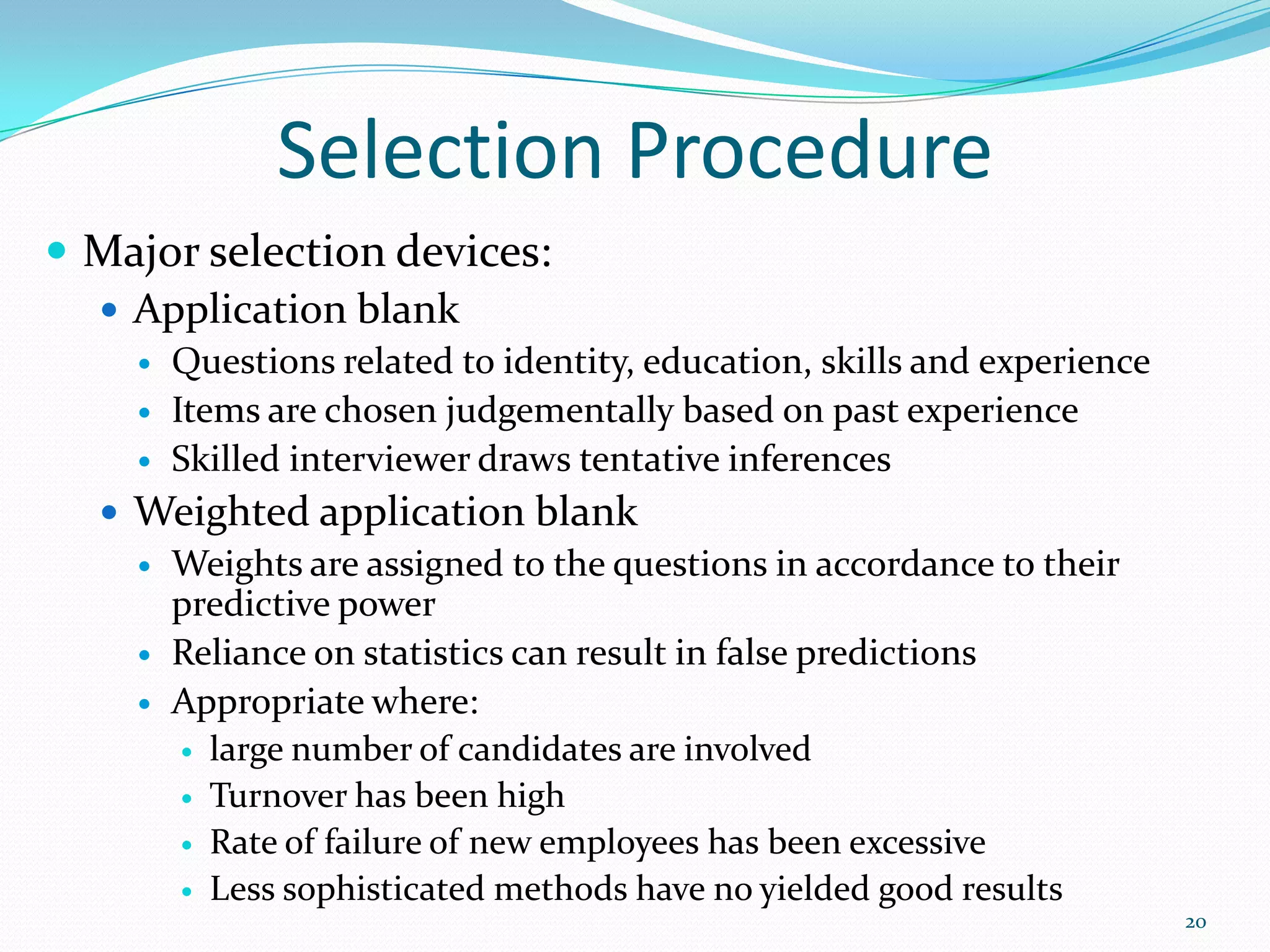
 Major selection devices:
 Application blank
 Questions related to identity, education, skills and experience
 Items are chosen judgementally based on past experience
 Skilled interviewer draws tentative inferences
 Weighted application blank
 Weights are assigned to the questions in accordance to their
predictive power
 Reliance on statistics can result in false predictions
 Appropriate where:
 large number of candidates are involved
 Turnover has been high
 Rate of failure of new employees has been excessive
 Less sophisticated methods have no yielded good results
20
Selection Procedure
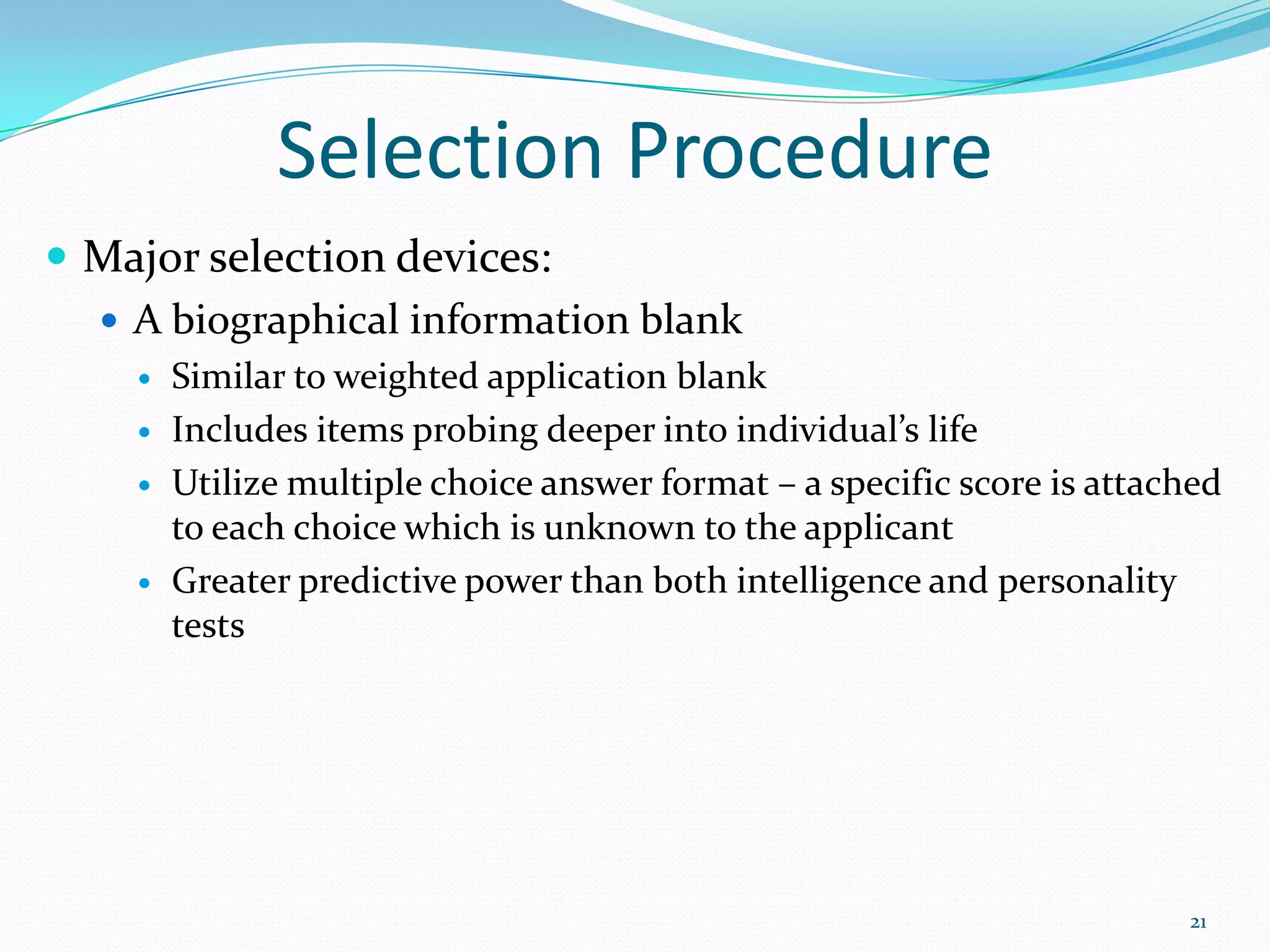
 Major selection devices:
 A biographical information blank
 Similar to weighted application blank
 Includes items probing deeper into individual’s life
 Utilize multiple choice answer format – a specific score is attached
to each choice which is unknown to the applicant
 Greater predictive power than both intelligence and personality
tests
21
Selection Procedure
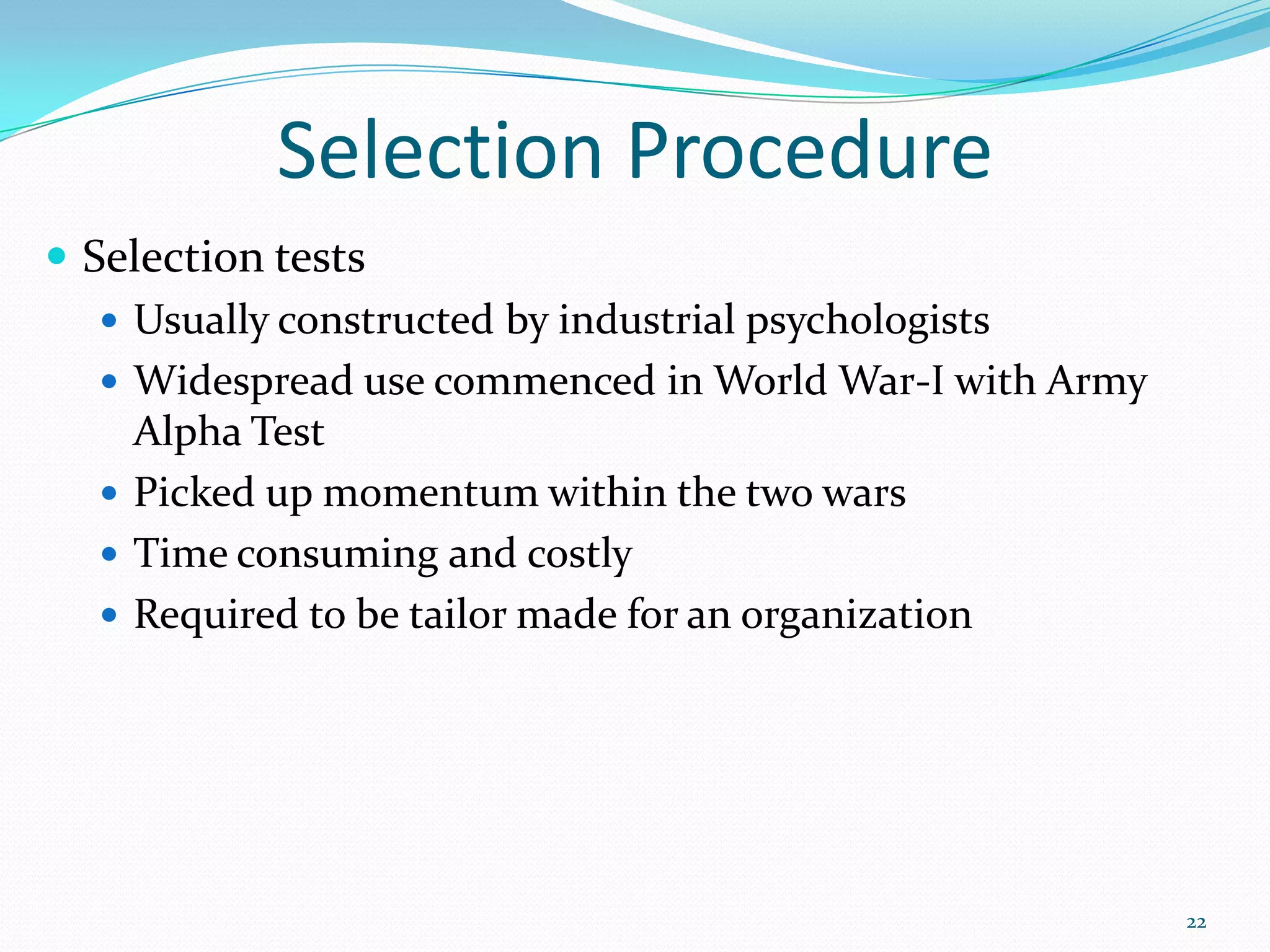
 Selection tests
 Usually constructed by industrial psychologists
 Widespread use commenced in World War-I with Army
Alpha Test
 Picked up momentum within the two wars
 Time consuming and costly
 Required to be tailor made for an organization
22
Selection Procedure
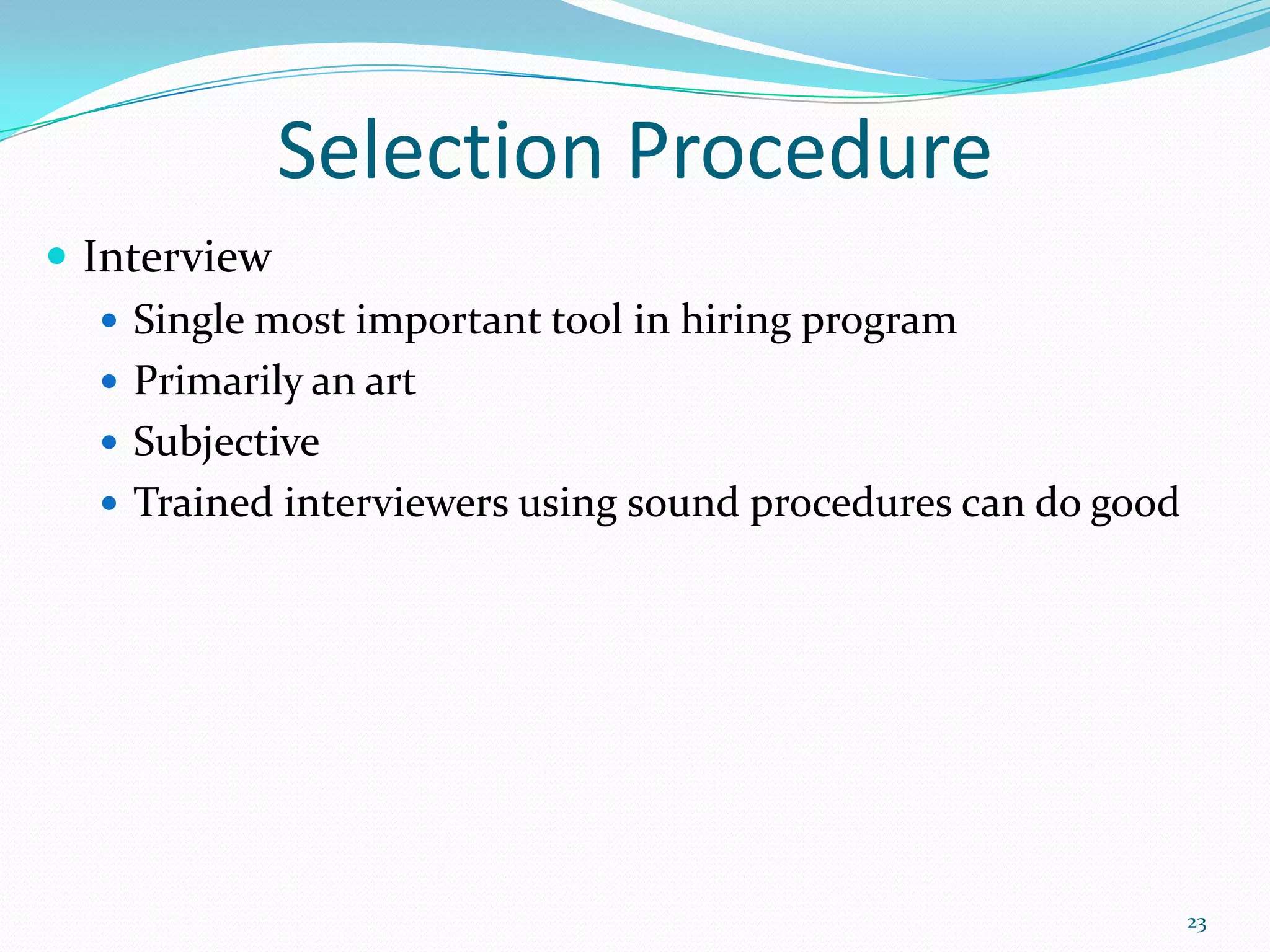
 Interview
 Single most important tool in hiring program
 Primarily an art
 Subjective
 Trained interviewers using sound procedures can do good
23
Selection Procedure
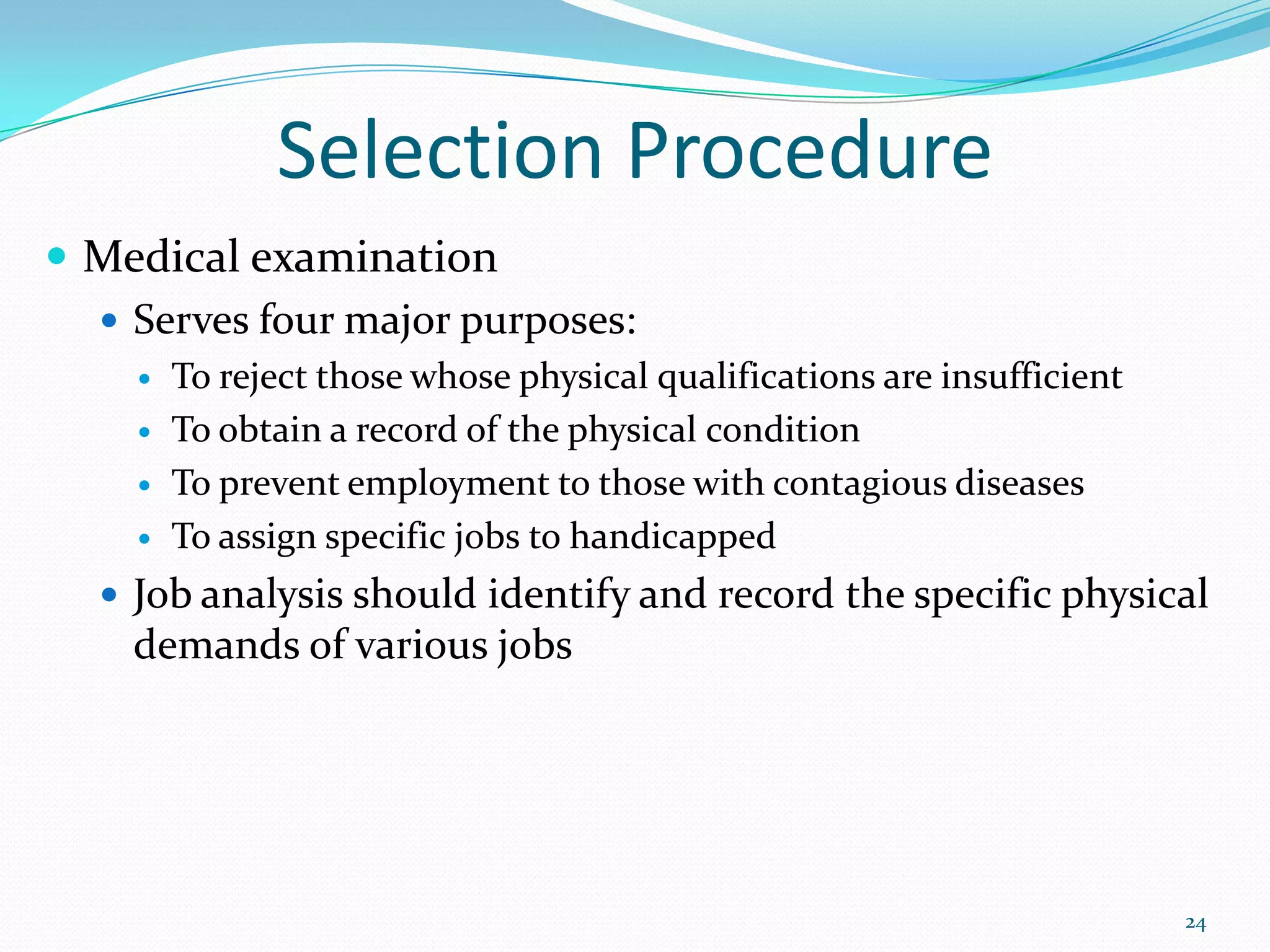
 Medical examination
 Serves four major purposes:
 To reject those whose physical qualifications are insufficient
 To obtain a record of the physical condition
 To prevent employment to those with contagious diseases
 To assign specific jobs to handicapped
 Job analysis should identify and record the specific physical
demands of various jobs
24
Selection Procedure
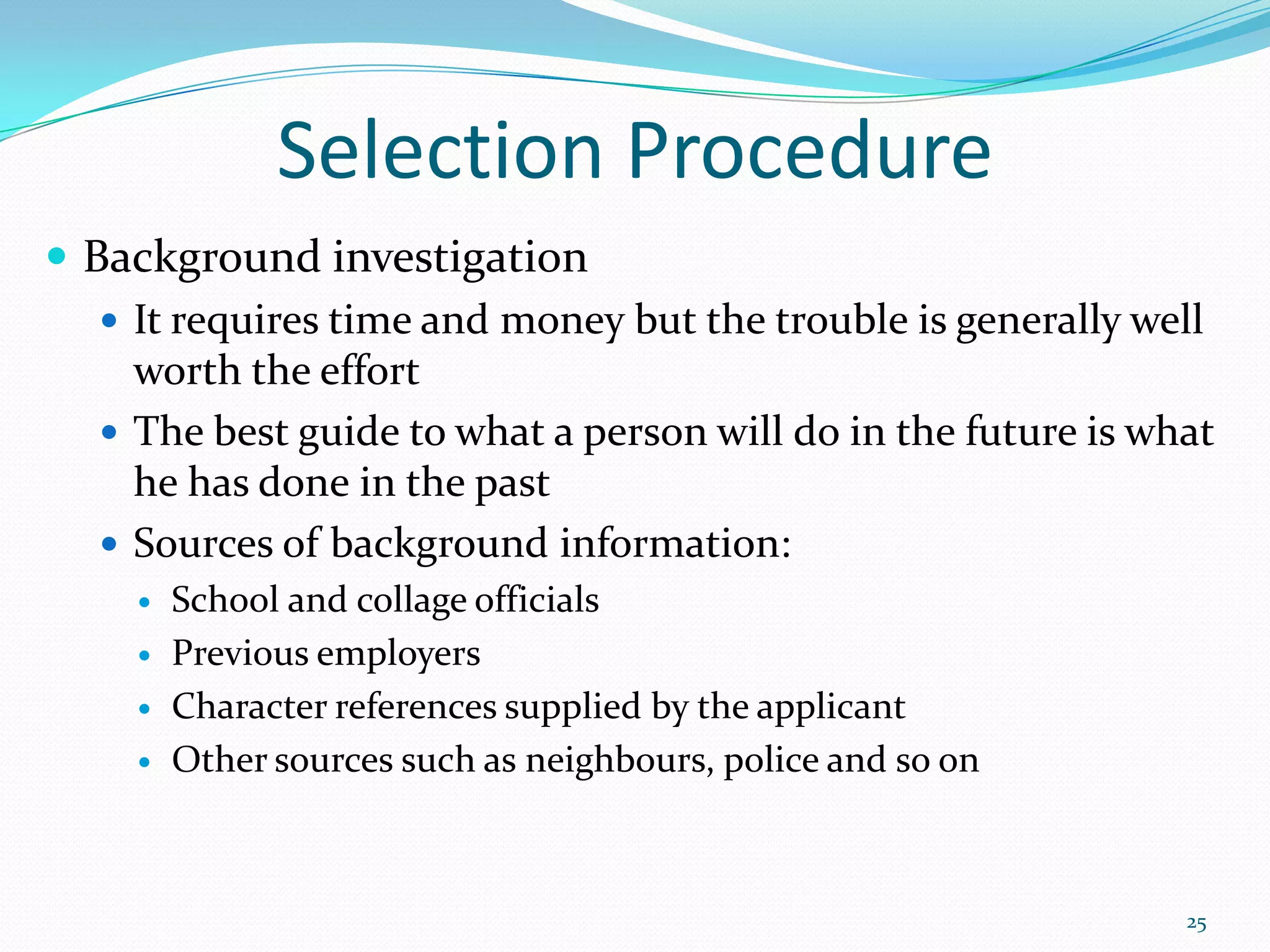
 Background investigation
 It requires time and money but the trouble is generally well
worth the effort
 The best guide to what a person will do in the future is what
he has done in the past
 Sources of background information:
 School and collage officials
 Previous employers
 Character references supplied by the applicant
 Other sources such as neighbours, police and so on
25
Selection Procedure
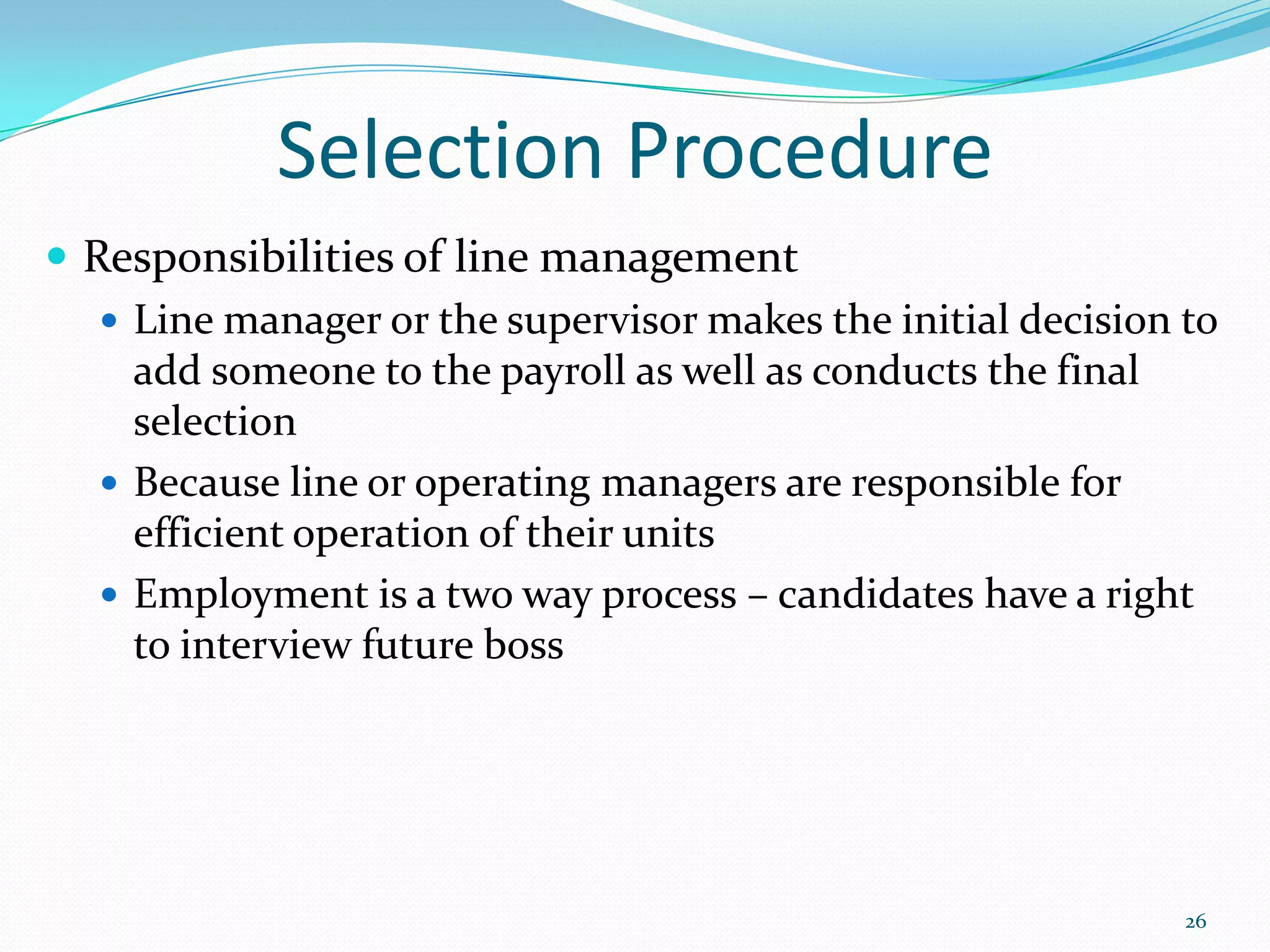
 Responsibilities of line management
 Line manager or the supervisor makes the initial decision to
add someone to the payroll as well as conducts the final
selection
 Because line or operating managers are responsible for
efficient operation of their units
 Employment is a two way process – candidates have a right
to interview future boss
26
Selection Procedure
 Rejecting applicants
 False hopes
 In case of expected openings
 Interviewer has threefold objectives:
 Maintaining the person’s ego and self concept
 Maintaining goodwill towards the organization
 Letting the applicant know that he or she is rejected
 There may be some mismatch with the existing job
specifications
 If there is no mismatch then diplomatic skills
27
Auditing the Recruitment and Selection
Effort
 Have well defined recruitment and selection policies and
procedures been developed?
 Do wage rates, employee benefits and level of employee
satisfaction have a positive effect upon the ability to
attract qualified people?
 Does the program meet equal employment opportunity
and affirmative action standards?
 Is there a sufficient pool of applicants from which to draw
 Is there a delay in filling job openings?
 Is the recruitment effort selective. Do those who apply
possess the necessary skills?
28
Auditing the Recruitment and Selection
Effort
 Which source provide the most qualified people?
 What percentage of those who apply are hired?
 What percentage of those hired resign or are discharged
during the probationary period?
 What is the cost of recruitment and selection per person
hired?
 How well do the predictions derived from each of the
selection techniques correlate with job performance?
How well do those hired perform on the job?
 Has feedback been obtained from applicants regarding
treatment received throughout the employment process?
29
30

Recruitment and selection

  • 1.
  • 2.
  • 3.
    Introduction  The employmentfunction of personnel program encompasses:  HR planning  Recruitment  Selection  Placement  Changes of employment status  This chapter discusses recruitment and selection  An understanding of the concepts of labour market and labour supply provides a foundation for our examination of recruitment and selection 3
  • 4.
    Recruitment and Selection Labour Market considerations  Recruitment and selection policy issues  The employment process  Sources of people  The selection process  Selection procedure  Auditing the recruitment and selection effort 4
  • 5.
    Labour Market Considerations Different from financial and product markets – unstructured and unorganized  Recruitment and job seeking is highly variable  Diversity of wage rates:  Employer's ability to pay  Productivity  Management attitude toward wage levels  Nonwage factors like job security, benefits and environment  Lack of labour mobility 5
  • 6.
    Labour Market Considerations Labour supply to the company is influenced by:  Population in the labour market  Attractiveness of the jobs  The company’s reputation, wage rate, benefits, security  Amount of unemployment in the labour market  Commuting patterns  Particular skills needed in relation to their availability  Times of high and low demand 6
  • 7.
    Recruitment and SelectionPolicy Issues  Fill vacancies from within or from outside?  Advantages of policy of promotion from within:  High morale  Succession of individual advancements  Management can accurately apprise the candidates  Recruitment and selection is simplified; a few entry jobs  Problems of policy of promotion from within:  Elaborate training programs are required  Hired personnel should have aptitude and potential  Disappointment of left over employees  Perpetuate outdated practices 7
  • 8.
    Recruitment and SelectionPolicy Issues  Fill vacancies from within or from outside?  Advantages of policy of promotion from within:  High morale  Succession of individual advancements  Management can accurately apprise the candidates  Recruitment and selection is simplified; a few entry jobs  Problems of policy of promotion from within:  Elaborate training programs are required  Employees should have aptitude and potential  Disappointment of left over employees  Prevents infusion of new ideas and knowledge 8
  • 9.
    Recruitment and SelectionPolicy Issues  Equal employment opportunity  There ought to be no discrimination  Plan to hire and promote protected groups  Adverse impact 9
  • 10.
    Recruitment and SelectionPolicy Issues  Selection standards – credentials barriers  Qualification requirements lack proven relationship with success or failure  Education as a screening device has disadvantages:  Automatically eliminate underprivileged who drop out of school  Some brilliant people did poorly at school  Educational establishments tend to homogenize students  Some percentage can be hired with less formal education but showing promise 10
  • 11.
    Recruitment and SelectionPolicy Issues  The lie detector  Actually there is no true lie detector  Polygraph (accuracy rate 75 %) measures:  Rate of breathing  Heart beat  Changes in blood pressure  Skin current  Galvanic skin response  No simple correlation between symptoms and truthfulness  Pathological liars  Civil liberties 11
  • 12.
    Recruitment and SelectionPolicy Issues  Privacy of employee records  Family and medical information of job applicants  Personality tests  Line and operating managers’ access to personal records  Information of personal nature is not available to outside without employee’s consent  Other policy issues:  Relatives  Quality of persons hired 12
  • 13.
    The Employment Process HRPlan Identification of need for people Job Requirements, de scriptions and specifications Recruitment Internal and external sources Pool of candidates Selection Comparison of candidates with job requirements Accepted candidates Rejected candidates Job placement orientation, training and probation 13
  • 14.
    Sources of People Sources are of two categories:  Inside sources  Outside sources  Inside sources – three procedures:  Informal search  Skill inventory  Job posting 14
  • 15.
    Sources of People Options for obtaining people from outside:  Employment agencies  State employment agency  Private employment agencies  Executive recruitment firm  Unsolicited applicants  Labour unions  Professional associations  Schools and colleges  Advertising  Employee referrals 15
  • 16.
    The Selection Process Recruitment tends to be positive whereas selection is somewhat negative  Common approach  Employment requisition, with job specifications, is initiated by some operating manager  Matching a person to the job  Certain good candidates are rejected  Another approach  Basic entrance standards are established  Those who meet or exceed the minimum requirement are further considered  Large organizations like military 16
  • 17.
    The Selection Process Considerations in making the selection decision:  Organizational and social environment  Successive hurdles and multiple correlation  Successive hurdles technique  Applicants must successively pass each screening device  Selection device having highest correlation with job success is placed first  Time and expense is saved  Multiple correlation approach  A person is routed through all the selection steps before a decision  Deficiency in one factor can be counterbalanced in another  Composite test score index is compiled  Which selection method is better? 17
  • 18.
    Selection Procedure  Thoroughnessof the procedure depends on:  Consequence of faulty selection which is influenced by:  Length of training period  Money invested in the new employee  Level and complexity of the job  Possible damage to the organization  Company policy and top management attitude 18
  • 19.
    Selection Procedure  Aproposed selection procedure with ten basic steps:  Reception in employment office  Preliminary interview  Application blank  Selection tests  Main employment office interview  Investigation of applicant’s background  Final selection interview by manager or supervisor  Medical examination  Induction  Probation 19
  • 20.
    Selection Procedure  Majorselection devices:  Application blank  Questions related to identity, education, skills and experience  Items are chosen judgementally based on past experience  Skilled interviewer draws tentative inferences  Weighted application blank  Weights are assigned to the questions in accordance to their predictive power  Reliance on statistics can result in false predictions  Appropriate where:  large number of candidates are involved  Turnover has been high  Rate of failure of new employees has been excessive  Less sophisticated methods have no yielded good results 20
  • 21.
    Selection Procedure  Majorselection devices:  A biographical information blank  Similar to weighted application blank  Includes items probing deeper into individual’s life  Utilize multiple choice answer format – a specific score is attached to each choice which is unknown to the applicant  Greater predictive power than both intelligence and personality tests 21
  • 22.
    Selection Procedure  Selectiontests  Usually constructed by industrial psychologists  Widespread use commenced in World War-I with Army Alpha Test  Picked up momentum within the two wars  Time consuming and costly  Required to be tailor made for an organization 22
  • 23.
    Selection Procedure  Interview Single most important tool in hiring program  Primarily an art  Subjective  Trained interviewers using sound procedures can do good 23
  • 24.
    Selection Procedure  Medicalexamination  Serves four major purposes:  To reject those whose physical qualifications are insufficient  To obtain a record of the physical condition  To prevent employment to those with contagious diseases  To assign specific jobs to handicapped  Job analysis should identify and record the specific physical demands of various jobs 24
  • 25.
    Selection Procedure  Backgroundinvestigation  It requires time and money but the trouble is generally well worth the effort  The best guide to what a person will do in the future is what he has done in the past  Sources of background information:  School and collage officials  Previous employers  Character references supplied by the applicant  Other sources such as neighbours, police and so on 25
  • 26.
    Selection Procedure  Responsibilitiesof line management  Line manager or the supervisor makes the initial decision to add someone to the payroll as well as conducts the final selection  Because line or operating managers are responsible for efficient operation of their units  Employment is a two way process – candidates have a right to interview future boss 26
  • 27.
    Selection Procedure  Rejectingapplicants  False hopes  In case of expected openings  Interviewer has threefold objectives:  Maintaining the person’s ego and self concept  Maintaining goodwill towards the organization  Letting the applicant know that he or she is rejected  There may be some mismatch with the existing job specifications  If there is no mismatch then diplomatic skills 27
  • 28.
    Auditing the Recruitmentand Selection Effort  Have well defined recruitment and selection policies and procedures been developed?  Do wage rates, employee benefits and level of employee satisfaction have a positive effect upon the ability to attract qualified people?  Does the program meet equal employment opportunity and affirmative action standards?  Is there a sufficient pool of applicants from which to draw  Is there a delay in filling job openings?  Is the recruitment effort selective. Do those who apply possess the necessary skills? 28
  • 29.
    Auditing the Recruitmentand Selection Effort  Which source provide the most qualified people?  What percentage of those who apply are hired?  What percentage of those hired resign or are discharged during the probationary period?  What is the cost of recruitment and selection per person hired?  How well do the predictions derived from each of the selection techniques correlate with job performance? How well do those hired perform on the job?  Has feedback been obtained from applicants regarding treatment received throughout the employment process? 29
  • 30.