





RECRUITMENT
• Overall process of attracting, obtaining as
many applications as possible from
eligible seekers.
PURPOSE AND IMPORTANCE
 Provide potentially qualified job candidates.
 Increases the success rate of selection process.
 Reduce employee turnover.
 Meet the organization's legal and social obligations.
 Increase organizations and individual effectiveness in
long and short term.
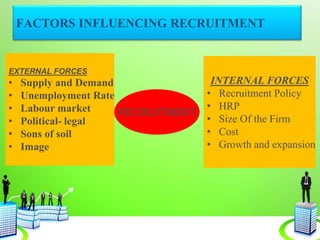
FACTORS INFLUENCING RECRUITMENT
EXTERNAL FORCES
• Supply and Demand
• Unemployment Rate
• Labour market
• Political- legal
• Sons of soil
• Image
RECRUITMENT
INTERNAL FORCES
• Recruitment Policy
• HRP
• Size Of the Firm
• Cost
• Growth and expansion
The process comprises five interrelated
Stages:
1. PLANNING
2. STRATEGY DEVELOPMENT
3. SEARCHING
4. SCREENING
5. EVALUATION AND CONTROL
RECRUITMENT PROCESS
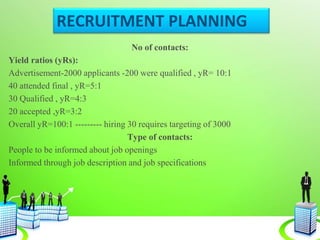
RECRUITMENT PLANNING
No of contacts:
Yield ratios (yRs):
Advertisement-2000 applicants -200 were qualified , yR= 10:1
40 attended final , yR=5:1
30 Qualified , yR=4:3
20 accepted ,yR=3:2
Overall yR=100:1 --------- hiring 30 requires targeting of 3000
Type of contacts:
People to be informed about job openings
Informed through job description and job specifications
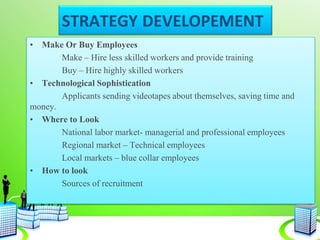
STRATEGY DEVELOPEMENT
• Make Or Buy Employees
Make – Hire less skilled workers and provide training
Buy – Hire highly skilled workers
• Technological Sophistication
Applicants sending videotapes about themselves, saving time and
money.
• Where to Look
National labor market- managerial and professional employees
Regional market – Technical employees
Local markets – blue collar employees
• How to look
Sources of recruitment
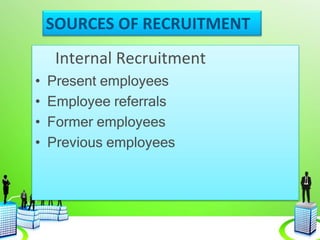
SOURCES OF RECRUITMENT
Internal Recruitment
• Present employees
• Employee referrals
• Former employees
• Previous employees
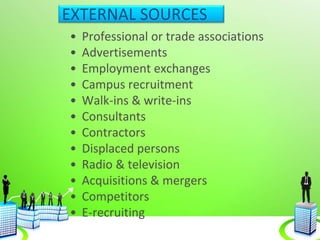
EXTERNAL SOURCES
• Professional or trade associations
• Advertisements
• Employment exchanges
• Campus recruitment
• Walk-ins & write-ins
• Consultants
• Contractors
• Displaced persons
• Radio & television
• Acquisitions & mergers
• Competitors
• E-recruiting
Searching
• Source Activation
Sources & search methods are activated by the
issuance of an employee requisition.
The Application received are then scanned. Those
passed are invited for interview and others sent a
letter of regret.
• Selling
The second issue to be addressed in the searching
process concerns communication to attract desirable
applicants.
Screening
• Scrutinizing and shortlisting the
applications received.
• To eliminate those unqualified.
• To Assure the potentially good employees
are not lost.
• To ensure women and minorities receive
fair consideration.
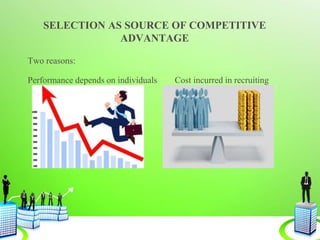
SELECTION AS SOURCE OF COMPETITIVE
ADVANTAGE
Two reasons:
Performance depends on individuals Cost incurred in recruiting
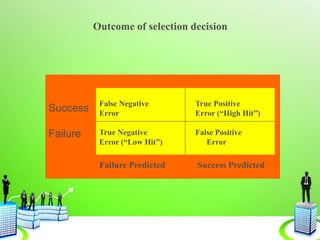
Outcome of selection decision
Success
Failure
False Negative True Positive
Error Error (“High Hit”)
True Negative False Positive
Error (“Low Hit”) Error
Failure Predicted Success Predicted
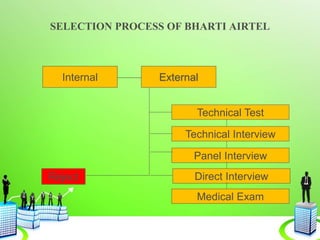
SELECTION PROCESS OF BHARTI AIRTEL
Internal External
Technical Test
Panel Interview
Direct Interview
Technical Interview
Medical Exam
Reject
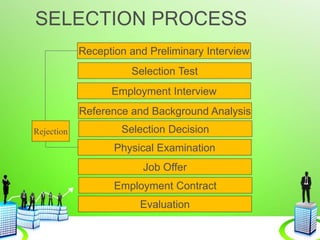
SELECTION PROCESS
Reception and Preliminary Interview
Selection Test
Employment Interview
Reference and Background Analysis
Selection Decision
Physical Examination
Job Offer
Employment Contract
Evaluation
Rejection
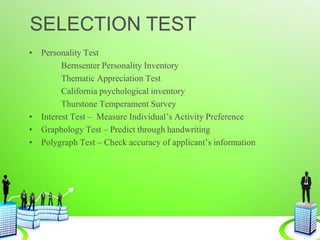
SELECTION TEST
• Personality Test
Bernsenter Personality Inventory
Thematic Appreciation Test
California psychological inventory
Thurstone Temperament Survey
• Interest Test – Measure Individual’s Activity Preference
• Graphology Test – Predict through handwriting
• Polygraph Test – Check accuracy of applicant’s information
Employee Interview
• One –to – One Panel
• Sequential
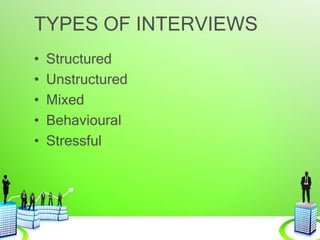
TYPES OF INTERVIEWS
• Structured
• Unstructured
• Mixed
• Behavioural
• Stressful
Common Interview Problems and Solutions
• Halo Effect
• External bias – swayed by negative information.
• Sex,race and attitudes similar to interviewer
• Favouritism
Solutions :
• Follow structured form
• Evaluate the interviewee immediately after interview
• Focus on desired traits
• Respect Reservation policy of the government
Reference and Background Check
• Criminal Record checks
• Previous employment check
• Educational record Checks
• Credit record checks
• Civil record checks
• Union Affiliation Checks
• Character Reference Checks
• Neighbourhood Reference Checks
Employment Contract
• Agreement specifying terms and conditions under which
a person consents to perform certain duties as directed and controlled by
an employer in return for an agreed upon wage or salary.
Employment Contract Checklist
• Job title
• Duties
• Rate of pay, allowance, overtime and shift rates, method of
payment
• Hours of working
• Holiday arrangement
• Sickness
• Grievance procedures
• Disciplinary Procedures
• Work rules
• Arrangement for termination
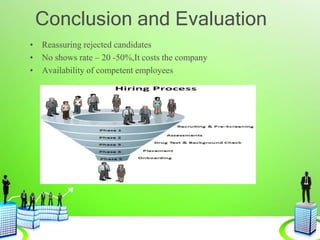
Conclusion and Evaluation
• Reassuring rejected candidates
• No shows rate – 20 -50%,It costs the company
• Availability of competent employees
EVALUATION AND CONTROL
Meaning of Evaluation
Evaluation is the systematic assessment
of information to provide useful feedback
about some object.
Meaning of Control
Control is a managerial function which
check the errors and take corrective
action so that there is no deviation from
the standards set.
Why evaluation and control
• Salaries for recruiters
• Time consumption
• Costs incurred
• Recruitment overheads and
administrative expenses
• Helps in checking the validity and
effectiveness
• To avoid making errors
Evaluation of recruitment process
• Return rate of applications sent out
• Number of suitable candidates for
selection
• Retention and performance of the
candidates selected
• Cost of the process
• Time lapse data
• Comments on the projected image
Evaluation of recruitment
methods
• Number of initial enquiries
• Number of candidates as a whole
• Retention rate
Philosophies of recruiting
• Traditional philosophy
• Realistic philosophy
Realistic job preview
Job compatibility questionnaire
Alternatives of recruitment
• Overtime
• Employee leasing
• Temporary employment
Meaning of selection
• Process of picking individuals with
requisite qualification and
competence to fill jobs in the
organisation.
Difference
RECRUITMENT
• Identifying prospective
employees to apply for
jobs
• Positive in approach
SELECTION
• Picking the right
candidate from a pool of
applicants
• Negative in approach
SELECTION IN INDIA
• Selection process of blue-collared and
white collared employees is unsystematic
in the country.
• Unorthodox means exist in hiring
managerial personnels too:
– Hiring from competing firm
– Attract and hire stars
INDUCTION
• Induction or orientation is a systematic and
planned introduction to provide a new
employees with information about their job,
their co-workers and the organisation
which help them to function comfortably
and effectively.
• A good orientation programme helps to
create a favourable impression of the firm
and its work and helps in reducing
absenteeism and turnover.
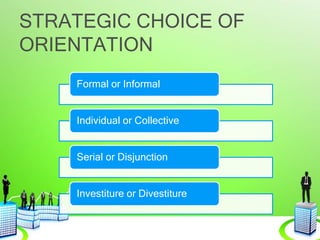
STRATEGIC CHOICE OF
ORIENTATION
Formal or Informal
Individual or Collective
Serial or Disjunction
Investiture or Divestiture
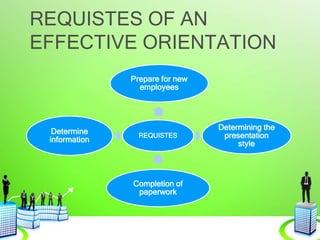
REQUISTES OF AN
EFFECTIVE ORIENTATION
REQUISTES
Prepare for new
employees
Determining the
presentation
style
Completion of
paperwork
Determine
information
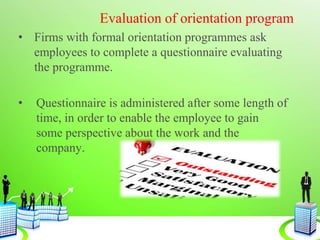
Evaluation of orientation program
• Firms with formal orientation programmes ask
employees to complete a questionnaire evaluating
the programme.
• Questionnaire is administered after some length of
time, in order to enable the employee to gain
some perspective about the work and the
company.
• HR representative or the officers may conduct follow-
up interviews to elicit the employee opinion
• GD sessions can also be held with new employees
who have settled comfortably into their jobs
• Feedback from the employees
• Orientation programmes are conducted for improving
the performance of the new employees
Problems of Orientation
 Supervisor who is entrusted with the job is not
trained or is too busy
 Employee is overloaded with forms to complete
 Employee is thrown into action soon
 Employees mistake can damage the company
 Employee may develop wrong perception because
of short periods spend on each job
 Given only menial tasks that discourage job
interest and company loyalty
 Pushed into the job with a sketchy orientation
under the mistaken belief that ‘trial by face’ is the
best orientation
Placement
• Refers to the allocation of the allocation of people to
jobs. Its includes initial assignment of new employees,
and promotion, transfer or demotion of present
employees.
FACTORS AFFECTING PLACEMENT
 Increased government pressure to hire and promote
women and the disadvantaged.
 Heightened awareness of the fact that firms have many
jobs but each individual has only one career.
Placement problems
• 1. Independent Jobs
• 2. The dependent jobs
• 3. The pooled jobs
Typical orientation program
• Tour Facility
• Introduce to Co-Workers
• Review Employee Handbook and Paperwork
• Review Goals and Job Expectations
• Provide Training and Shadowing
• Assign a Mentor
• Schedule a Lunch
PLACEMENT IN AIRTEL
The first round is the written test. The written test consist of
* Aptitude test
* Quantitative ability
* Verbal English
Second round was GD
Next round was a PI round
Recruitment and selection

Recruitment and selection

  • 2.
    RECRUITMENT • Overall processof attracting, obtaining as many applications as possible from eligible seekers.
  • 3.
    PURPOSE AND IMPORTANCE Provide potentially qualified job candidates.  Increases the success rate of selection process.  Reduce employee turnover.  Meet the organization's legal and social obligations.  Increase organizations and individual effectiveness in long and short term.
  • 4.
    FACTORS INFLUENCING RECRUITMENT EXTERNALFORCES • Supply and Demand • Unemployment Rate • Labour market • Political- legal • Sons of soil • Image RECRUITMENT INTERNAL FORCES • Recruitment Policy • HRP • Size Of the Firm • Cost • Growth and expansion
  • 5.
    The process comprisesfive interrelated Stages: 1. PLANNING 2. STRATEGY DEVELOPMENT 3. SEARCHING 4. SCREENING 5. EVALUATION AND CONTROL RECRUITMENT PROCESS
  • 6.
    RECRUITMENT PLANNING No ofcontacts: Yield ratios (yRs): Advertisement-2000 applicants -200 were qualified , yR= 10:1 40 attended final , yR=5:1 30 Qualified , yR=4:3 20 accepted ,yR=3:2 Overall yR=100:1 --------- hiring 30 requires targeting of 3000 Type of contacts: People to be informed about job openings Informed through job description and job specifications
  • 7.
    STRATEGY DEVELOPEMENT • MakeOr Buy Employees Make – Hire less skilled workers and provide training Buy – Hire highly skilled workers • Technological Sophistication Applicants sending videotapes about themselves, saving time and money. • Where to Look National labor market- managerial and professional employees Regional market – Technical employees Local markets – blue collar employees • How to look Sources of recruitment
  • 8.
    SOURCES OF RECRUITMENT InternalRecruitment • Present employees • Employee referrals • Former employees • Previous employees
  • 9.
    EXTERNAL SOURCES • Professionalor trade associations • Advertisements • Employment exchanges • Campus recruitment • Walk-ins & write-ins • Consultants • Contractors • Displaced persons • Radio & television • Acquisitions & mergers • Competitors • E-recruiting
  • 10.
    Searching • Source Activation Sources& search methods are activated by the issuance of an employee requisition. The Application received are then scanned. Those passed are invited for interview and others sent a letter of regret. • Selling The second issue to be addressed in the searching process concerns communication to attract desirable applicants.
  • 11.
    Screening • Scrutinizing andshortlisting the applications received. • To eliminate those unqualified. • To Assure the potentially good employees are not lost. • To ensure women and minorities receive fair consideration.
  • 12.
    SELECTION AS SOURCEOF COMPETITIVE ADVANTAGE Two reasons: Performance depends on individuals Cost incurred in recruiting
  • 13.
    Outcome of selectiondecision Success Failure False Negative True Positive Error Error (“High Hit”) True Negative False Positive Error (“Low Hit”) Error Failure Predicted Success Predicted
  • 14.
    SELECTION PROCESS OFBHARTI AIRTEL Internal External Technical Test Panel Interview Direct Interview Technical Interview Medical Exam Reject
  • 15.
    SELECTION PROCESS Reception andPreliminary Interview Selection Test Employment Interview Reference and Background Analysis Selection Decision Physical Examination Job Offer Employment Contract Evaluation Rejection
  • 16.
    SELECTION TEST • PersonalityTest Bernsenter Personality Inventory Thematic Appreciation Test California psychological inventory Thurstone Temperament Survey • Interest Test – Measure Individual’s Activity Preference • Graphology Test – Predict through handwriting • Polygraph Test – Check accuracy of applicant’s information
  • 17.
    Employee Interview • One–to – One Panel • Sequential
  • 18.
    TYPES OF INTERVIEWS •Structured • Unstructured • Mixed • Behavioural • Stressful
  • 19.
    Common Interview Problemsand Solutions • Halo Effect • External bias – swayed by negative information. • Sex,race and attitudes similar to interviewer • Favouritism Solutions : • Follow structured form • Evaluate the interviewee immediately after interview • Focus on desired traits • Respect Reservation policy of the government
  • 20.
    Reference and BackgroundCheck • Criminal Record checks • Previous employment check • Educational record Checks • Credit record checks • Civil record checks • Union Affiliation Checks • Character Reference Checks • Neighbourhood Reference Checks
  • 21.
    Employment Contract • Agreementspecifying terms and conditions under which a person consents to perform certain duties as directed and controlled by an employer in return for an agreed upon wage or salary.
  • 22.
    Employment Contract Checklist •Job title • Duties • Rate of pay, allowance, overtime and shift rates, method of payment • Hours of working • Holiday arrangement • Sickness • Grievance procedures • Disciplinary Procedures • Work rules • Arrangement for termination
  • 23.
    Conclusion and Evaluation •Reassuring rejected candidates • No shows rate – 20 -50%,It costs the company • Availability of competent employees
  • 24.
    EVALUATION AND CONTROL Meaningof Evaluation Evaluation is the systematic assessment of information to provide useful feedback about some object. Meaning of Control Control is a managerial function which check the errors and take corrective action so that there is no deviation from the standards set.
  • 25.
    Why evaluation andcontrol • Salaries for recruiters • Time consumption • Costs incurred • Recruitment overheads and administrative expenses • Helps in checking the validity and effectiveness • To avoid making errors
  • 26.
    Evaluation of recruitmentprocess • Return rate of applications sent out • Number of suitable candidates for selection • Retention and performance of the candidates selected • Cost of the process • Time lapse data • Comments on the projected image
  • 27.
    Evaluation of recruitment methods •Number of initial enquiries • Number of candidates as a whole • Retention rate
  • 28.
    Philosophies of recruiting •Traditional philosophy • Realistic philosophy Realistic job preview Job compatibility questionnaire
  • 29.
    Alternatives of recruitment •Overtime • Employee leasing • Temporary employment
  • 30.
    Meaning of selection •Process of picking individuals with requisite qualification and competence to fill jobs in the organisation.
  • 31.
    Difference RECRUITMENT • Identifying prospective employeesto apply for jobs • Positive in approach SELECTION • Picking the right candidate from a pool of applicants • Negative in approach
  • 32.
    SELECTION IN INDIA •Selection process of blue-collared and white collared employees is unsystematic in the country. • Unorthodox means exist in hiring managerial personnels too: – Hiring from competing firm – Attract and hire stars
  • 33.
    INDUCTION • Induction ororientation is a systematic and planned introduction to provide a new employees with information about their job, their co-workers and the organisation which help them to function comfortably and effectively. • A good orientation programme helps to create a favourable impression of the firm and its work and helps in reducing absenteeism and turnover.
  • 34.
    STRATEGIC CHOICE OF ORIENTATION Formalor Informal Individual or Collective Serial or Disjunction Investiture or Divestiture
  • 35.
    REQUISTES OF AN EFFECTIVEORIENTATION REQUISTES Prepare for new employees Determining the presentation style Completion of paperwork Determine information
  • 36.
    Evaluation of orientationprogram • Firms with formal orientation programmes ask employees to complete a questionnaire evaluating the programme. • Questionnaire is administered after some length of time, in order to enable the employee to gain some perspective about the work and the company.
  • 37.
    • HR representativeor the officers may conduct follow- up interviews to elicit the employee opinion • GD sessions can also be held with new employees who have settled comfortably into their jobs • Feedback from the employees • Orientation programmes are conducted for improving the performance of the new employees
  • 38.
    Problems of Orientation Supervisor who is entrusted with the job is not trained or is too busy  Employee is overloaded with forms to complete  Employee is thrown into action soon  Employees mistake can damage the company  Employee may develop wrong perception because of short periods spend on each job  Given only menial tasks that discourage job interest and company loyalty  Pushed into the job with a sketchy orientation under the mistaken belief that ‘trial by face’ is the best orientation
  • 39.
    Placement • Refers tothe allocation of the allocation of people to jobs. Its includes initial assignment of new employees, and promotion, transfer or demotion of present employees. FACTORS AFFECTING PLACEMENT  Increased government pressure to hire and promote women and the disadvantaged.  Heightened awareness of the fact that firms have many jobs but each individual has only one career.
  • 40.
    Placement problems • 1.Independent Jobs • 2. The dependent jobs • 3. The pooled jobs
  • 41.
    Typical orientation program •Tour Facility • Introduce to Co-Workers • Review Employee Handbook and Paperwork • Review Goals and Job Expectations • Provide Training and Shadowing • Assign a Mentor • Schedule a Lunch
  • 42.
    PLACEMENT IN AIRTEL Thefirst round is the written test. The written test consist of * Aptitude test * Quantitative ability * Verbal English Second round was GD Next round was a PI round