HIRING AND SELECTION PROCESS
A HARVARD BUSINESS SCHOOL :
CASE STUDY
Presented by Imran Ghaznavi
MBA
“Executives makeup their minds about whether
they like a candidate in the first 20 seconds
and spend the next half-hour justifying their
decision.”
Case study: Hiring and Selection
Process:
An introduction
Issue raised in the case study
“Hiring people remains one of the
least well practiced arts of the
management.”
Case study: Hiring and Selection Process:
An introduction
 Hiring people is one of the most critical task for
the managers.
 Selection challenges for rapidly growing firms are
enormous;
 Influx of employees
 Structure of roles in evolution
 Responsibilities change quickly
Case study: Hiring and Selection
Process;
An introduction
 Managers hire people who are their type i.e.
matching chemistry
 Head hunters vehemently differ from this
approach
 They believe that they spend endless time in
reviewing the CV’s and shortlist the candidates
but the managers hire people who matches their
chemistry, even candidate do not fit in the criteria
Case study: Hiring and selection
Process
 While hiring the candidates one must not
ignore the personal characteristics and fully
focus on the resume.
 Many critical success factors that have nothing to
do with a resume or work experience cannot be
effectively conveyed in the resume
 One must ensure that the personal characteristics
must reflect the qualities needed to perform the
job.
Case study: Hiring and selection
Process
 Objective of the hiring process:
 To find a person
 Whose skills , abilities, and personal characteristics
suit the job
 Have a Fit between the individual and the requirement
of the position.
 This requires a “model of the dimensions” for creating
a this fit
 There are two set of factors that can be used
to analyze the requirements of a position and
then determine the degree of fit between an
individual and the position:
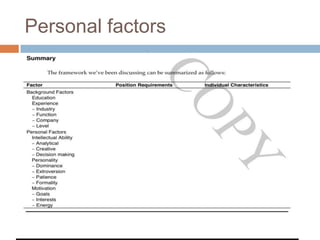
 Background factors, which include education and
experience; and ,
 Personal factors, which include intellectual
ability, personality and motivation, which often
translate into a management style.
Background Factors
 Background :
 Dimensions of the individual which can
determined from a resume, including
education and experience.
 Education
 Certain jobs have education as a prerequisite
 Every job has specific educational requirement
 i.e College Administrator need to have PhD in any field
so they can deal with faculty on equal level.
Case study: Hiring and selection
Process
 Experience
 We know experience is a great teacher, specific
experience is the most important factor in hiring
decision.
 Industry experience : working within the industry
 Functional experience: Knowledge and skills comes
for the functional experience
 Company experience: Work knowledge and skills of a
certain company
 Level of responsibility: Level of position or
responsibility.
Personal Factors
 Getting beyond the resume is important factor
in knowing a person to be hired, Following
traits are essential in this regard;
 Intellectual ability: Smart people perform well
in a managerial positions. Intellectual abilities
have three dimensions
 Analytical ability
 Creative ability
 Decision-making ability
Personal Factors
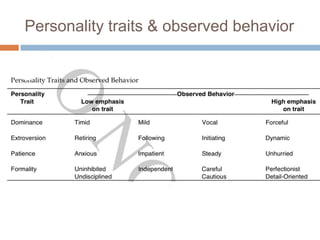
 Personality
 Very critical element as it is directly linked with the
behavior which is essential part of the job delivery
 Following are the personality traits
 Dominance: exert influence over people
 Extroversion: interact socially with others
 Patience: pace one’s activity slowly
 Formality: establish rules and structure
Personality traits & observed behavior
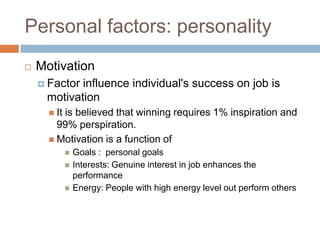
Personal factors: personality
 Motivation
 Factor influence individual's success on job is
motivation
 It is believed that winning requires 1% inspiration and
99% perspiration.
 Motivation is a function of
 Goals : personal goals
 Interests: Genuine interest in job enhances the
performance
 Energy: People with high energy level out perform others
Personal factors
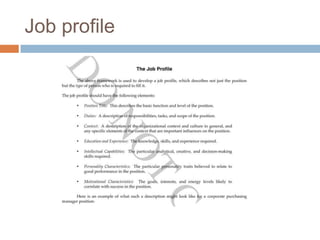
Job profile
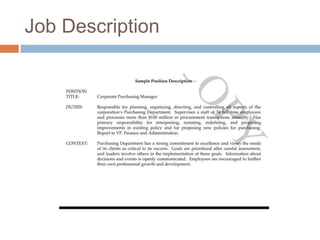
Job Description
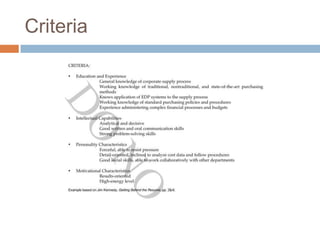
Criteria
The Interview
 The art is in figuring out is how to dig behind
the resume to get the facts so that one can
form his or her own opinion about the success
pattern of an individual.
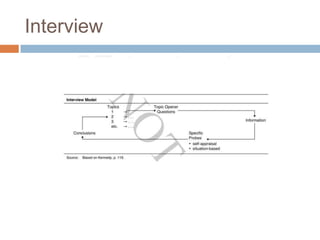
Interview
 Setting the tone
 Experience and Education: Probing the facts
which cannot be explained in the resume
 Like how many people managed/supervised at
certain position.
 Exceptional experiences ; new ventures, ideas
generated etc
Interview
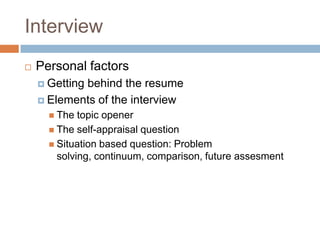
 Personal factors
 Getting behind the resume
 Elements of the interview
 The topic opener
 The self-appraisal question
 Situation based question: Problem
solving, continuum, comparison, future assesment
Interview
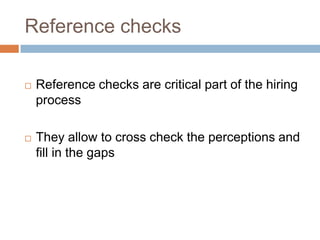
Reference checks
 Reference checks are critical part of the hiring
process
 They allow to cross check the perceptions and
fill in the gaps
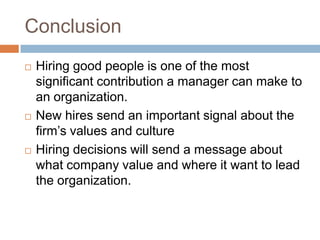
Conclusion
 Hiring good people is one of the most
significant contribution a manager can make to
an organization.
 New hires send an important signal about the
firm’s values and culture
 Hiring decisions will send a message about
what company value and where it want to lead
the organization.

Hiring and selection process: HBR case Study

  • 1.
    HIRING AND SELECTIONPROCESS A HARVARD BUSINESS SCHOOL : CASE STUDY Presented by Imran Ghaznavi MBA
  • 3.
    “Executives makeup theirminds about whether they like a candidate in the first 20 seconds and spend the next half-hour justifying their decision.”
  • 5.
    Case study: Hiringand Selection Process: An introduction Issue raised in the case study “Hiring people remains one of the least well practiced arts of the management.”
  • 6.
    Case study: Hiringand Selection Process: An introduction  Hiring people is one of the most critical task for the managers.  Selection challenges for rapidly growing firms are enormous;  Influx of employees  Structure of roles in evolution  Responsibilities change quickly
  • 7.
    Case study: Hiringand Selection Process; An introduction  Managers hire people who are their type i.e. matching chemistry  Head hunters vehemently differ from this approach  They believe that they spend endless time in reviewing the CV’s and shortlist the candidates but the managers hire people who matches their chemistry, even candidate do not fit in the criteria
  • 8.
    Case study: Hiringand selection Process  While hiring the candidates one must not ignore the personal characteristics and fully focus on the resume.  Many critical success factors that have nothing to do with a resume or work experience cannot be effectively conveyed in the resume  One must ensure that the personal characteristics must reflect the qualities needed to perform the job.
  • 9.
    Case study: Hiringand selection Process  Objective of the hiring process:  To find a person  Whose skills , abilities, and personal characteristics suit the job  Have a Fit between the individual and the requirement of the position.  This requires a “model of the dimensions” for creating a this fit
  • 10.
     There aretwo set of factors that can be used to analyze the requirements of a position and then determine the degree of fit between an individual and the position:  Background factors, which include education and experience; and ,  Personal factors, which include intellectual ability, personality and motivation, which often translate into a management style.
  • 11.
    Background Factors  Background:  Dimensions of the individual which can determined from a resume, including education and experience.  Education  Certain jobs have education as a prerequisite  Every job has specific educational requirement  i.e College Administrator need to have PhD in any field so they can deal with faculty on equal level.
  • 12.
    Case study: Hiringand selection Process  Experience  We know experience is a great teacher, specific experience is the most important factor in hiring decision.  Industry experience : working within the industry  Functional experience: Knowledge and skills comes for the functional experience  Company experience: Work knowledge and skills of a certain company  Level of responsibility: Level of position or responsibility.
  • 13.
    Personal Factors  Gettingbeyond the resume is important factor in knowing a person to be hired, Following traits are essential in this regard;  Intellectual ability: Smart people perform well in a managerial positions. Intellectual abilities have three dimensions  Analytical ability  Creative ability  Decision-making ability
  • 14.
    Personal Factors  Personality Very critical element as it is directly linked with the behavior which is essential part of the job delivery  Following are the personality traits  Dominance: exert influence over people  Extroversion: interact socially with others  Patience: pace one’s activity slowly  Formality: establish rules and structure
  • 15.
    Personality traits &observed behavior
  • 16.
    Personal factors: personality Motivation  Factor influence individual's success on job is motivation  It is believed that winning requires 1% inspiration and 99% perspiration.  Motivation is a function of  Goals : personal goals  Interests: Genuine interest in job enhances the performance  Energy: People with high energy level out perform others
  • 17.
  • 18.
  • 19.
  • 20.
  • 21.
    The Interview  Theart is in figuring out is how to dig behind the resume to get the facts so that one can form his or her own opinion about the success pattern of an individual.
  • 22.
    Interview  Setting thetone  Experience and Education: Probing the facts which cannot be explained in the resume  Like how many people managed/supervised at certain position.  Exceptional experiences ; new ventures, ideas generated etc
  • 23.
    Interview  Personal factors Getting behind the resume  Elements of the interview  The topic opener  The self-appraisal question  Situation based question: Problem solving, continuum, comparison, future assesment
  • 24.
  • 25.
    Reference checks  Referencechecks are critical part of the hiring process  They allow to cross check the perceptions and fill in the gaps
  • 26.
    Conclusion  Hiring goodpeople is one of the most significant contribution a manager can make to an organization.  New hires send an important signal about the firm’s values and culture  Hiring decisions will send a message about what company value and where it want to lead the organization.