RFID Update
Changes ahead for libraries?
Mick Fortune
LibraryRFID
Today I shall be mostly talking
about..
• The evolving RFID landscape
– New standards
– New applications
– New concerns – privacy, vulnerabilities
(and legislation?)
LibraryRFID
But first…
How do we think of RFID?
LibraryRFID
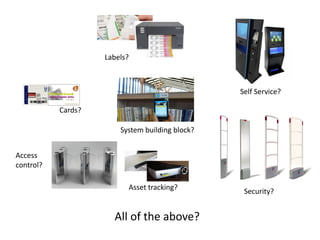
All of the above?
Labels?
Cards?
Asset tracking?
Self Service?
Security?
Access
control?
System building block?
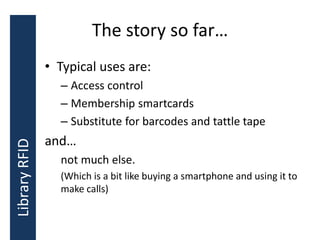
The story so far…
• Typical uses are:
– Access control
– Membership smartcards
– Substitute for barcodes and tattle tape
and…
not much else.
(Which is a bit like buying a smartphone and using it to
make calls)
LibraryRFID
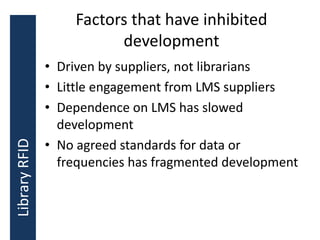
Factors that have inhibited
development
• Driven by suppliers, not librarians
• Little engagement from LMS suppliers
• Dependence on LMS has slowed
development
• No agreed standards for data or
frequencies has fragmented development
LibraryRFID
LibraryRFID
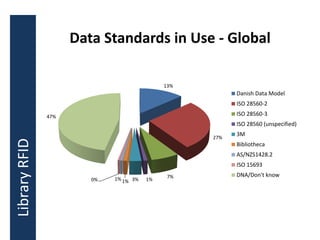
13%
27%
7%
1%3%1%1%0%
47%
Data Standards in Use - Global
Danish Data Model
ISO 28560-2
ISO 28560-3
ISO 28560 (unspecified)
3M
Bibliotheca
AS/NZS1428.2
ISO 15693
DNA/Don't know
0%
10%
20%
30%
40%
50%
60%
70%
80%
90%
100%
Australia Canada Germany Others UK US
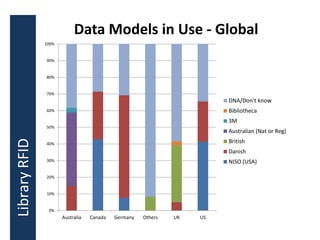
Data Models in Use - Global
DNA/Don't know
Bibliotheca
3M
Australian (Nat or Reg)
British
Danish
NISO (USA)
LibraryRFID
Growth of new Applications
• New applications being developed by
LMS/RFID suppliers
– UK – offline circulation, stock management
– Australia - supply chain monitoring, consortia
working
– US – ILL routing
• Mobile apps interacting with stock, not
catalogue
• Consortia/co-operative working encouraging
adoption of common standards
LibraryRFID
A UK Initiative!
The Library Communication Framework (LCF)
• Standardises data exchange between LMS and
RFID (and other 3rd party apps)
• Version 1 published at the end of September
• New collection management app (based on LCF)
already in development
• Supported by LMS supplier members of BIC
For more information on LCF visit
http://www.bic.org.uk/e4libraries/16/INTEROPERABILITY-
STANDARDS/
LibraryRFID
Other New Standards
• ISO 28560-4 – new data standard for
libraries using UHF
• NISO - SIP and NCIP
• EU Mandate M436
LibraryRFID
New Concerns - Privacy
• RFID privacy has been a recurring concern
since the technology first appeared
• In 2008 the EU published M436 to consider
– Signage
– Privacy Impact Assessments (PIA)
• Libraries will be required to complete PIAs
during 2014
• BIC working group details at:
http://www.bic.org.uk/105/Volunteers-Needed-%28BIC-Members-
Only%29/
LibraryRFID
New Concerns - Vulnerability
• Near Field Communication (NFC) is
another form of RFID operating at
13.56MHz – the same as library tags
• NFC is now appearing in many
smartphones and tablets
• It is possible to use a smartphone to
interrogate/alter library tags
• The industry is monitoring the problem
• We’ll keep you posted!
LibraryRFID
Checklist for 2014
• On data standards
– All the major UK suppliers endorse and
support ISO 28560-2. Consider migration.
• On interoperability
– Support the LCF for the best guarantee of
future interoperability.
• On privacy
– Watch for news about M436 and NFC.
LibraryRFID
Thank you!
e: mick@libraryrfid.co.uk
w: http://www.libraryrfid.co.uk
t: +44 7786 625544
: @libraryrfid
LibraryRFID

RFID Update for National Acquisitions Group Conference, York 2013

  • 1.
    RFID Update Changes aheadfor libraries? Mick Fortune LibraryRFID
  • 2.
    Today I shallbe mostly talking about.. • The evolving RFID landscape – New standards – New applications – New concerns – privacy, vulnerabilities (and legislation?) LibraryRFID
  • 3.
    But first… How dowe think of RFID? LibraryRFID
  • 4.
    All of theabove? Labels? Cards? Asset tracking? Self Service? Security? Access control? System building block?
  • 5.
    The story sofar… • Typical uses are: – Access control – Membership smartcards – Substitute for barcodes and tattle tape and… not much else. (Which is a bit like buying a smartphone and using it to make calls) LibraryRFID
  • 6.
    Factors that haveinhibited development • Driven by suppliers, not librarians • Little engagement from LMS suppliers • Dependence on LMS has slowed development • No agreed standards for data or frequencies has fragmented development LibraryRFID
  • 7.
    LibraryRFID 13% 27% 7% 1%3%1%1%0% 47% Data Standards inUse - Global Danish Data Model ISO 28560-2 ISO 28560-3 ISO 28560 (unspecified) 3M Bibliotheca AS/NZS1428.2 ISO 15693 DNA/Don't know
  • 8.
    0% 10% 20% 30% 40% 50% 60% 70% 80% 90% 100% Australia Canada GermanyOthers UK US Data Models in Use - Global DNA/Don't know Bibliotheca 3M Australian (Nat or Reg) British Danish NISO (USA) LibraryRFID
  • 9.
    Growth of newApplications • New applications being developed by LMS/RFID suppliers – UK – offline circulation, stock management – Australia - supply chain monitoring, consortia working – US – ILL routing • Mobile apps interacting with stock, not catalogue • Consortia/co-operative working encouraging adoption of common standards LibraryRFID
  • 10.
    A UK Initiative! TheLibrary Communication Framework (LCF) • Standardises data exchange between LMS and RFID (and other 3rd party apps) • Version 1 published at the end of September • New collection management app (based on LCF) already in development • Supported by LMS supplier members of BIC For more information on LCF visit http://www.bic.org.uk/e4libraries/16/INTEROPERABILITY- STANDARDS/ LibraryRFID
  • 11.
    Other New Standards •ISO 28560-4 – new data standard for libraries using UHF • NISO - SIP and NCIP • EU Mandate M436 LibraryRFID
  • 12.
    New Concerns -Privacy • RFID privacy has been a recurring concern since the technology first appeared • In 2008 the EU published M436 to consider – Signage – Privacy Impact Assessments (PIA) • Libraries will be required to complete PIAs during 2014 • BIC working group details at: http://www.bic.org.uk/105/Volunteers-Needed-%28BIC-Members- Only%29/ LibraryRFID
  • 13.
    New Concerns -Vulnerability • Near Field Communication (NFC) is another form of RFID operating at 13.56MHz – the same as library tags • NFC is now appearing in many smartphones and tablets • It is possible to use a smartphone to interrogate/alter library tags • The industry is monitoring the problem • We’ll keep you posted! LibraryRFID
  • 14.
    Checklist for 2014 •On data standards – All the major UK suppliers endorse and support ISO 28560-2. Consider migration. • On interoperability – Support the LCF for the best guarantee of future interoperability. • On privacy – Watch for news about M436 and NFC. LibraryRFID
  • 15.
    Thank you! e: mick@libraryrfid.co.uk w:http://www.libraryrfid.co.uk t: +44 7786 625544 : @libraryrfid LibraryRFID