Contactless Proximity Technology Type A Vs Type B Anshuman Sinha 1/1/2005 Anshuman Sinha <anshuman.sinha2@gmail.com>
Contactless Prox imity  Smartcard s Classification based on Operating distance Close Coupling  0 – 1  cm [ISO 10536] Proximity  0 – 10 cm [ISO 14443] Type A Type B Type C Vicinity  0 – 1 m [ISO 15693] Type X Type Y 08/22/11 Anshuman Sinha <anshuman.sinha2@gmail.com>
Proximity Smartcard Carrier frequency 13.56 MHz, in ISM band Spread – 13.56 MHz +/- 106 kHz Subcarrier frequency -> side bands at  +/- ~847 kHz  Electrical power transfer by inductive coupling Power gradient with distance drops fast, 60 dB at 10 cms of distance Data transfer rate of 106 kbps max as per ISO 14443 Some chips support higher data rate, which is ~ISO Transport layer protocol T = CL, per ISO 14443 – 4 Defined distance of 10 cms NFC, ICAO, PIV and EMV are some of the application standards which use proximity technology 08/22/11 Anshuman Sinha <anshuman.sinha2@gmail.com>
Type A - Interface Signal Type Carrier : ASK 100%, Modified Miller encoding Subcarrier : OOK,  Manchester encoding Power pause time 2.95 µs   Data self-clocked Anticollision based on  “ bit collision detection ” Physical layer same as Mifare but anti-collision is different Signal interface and anticollision specified ISO 14443 Part 3 Most widely deployed contactless type as of now … 08/22/11 Anshuman Sinha <anshuman.sinha2@gmail.com>
Type A - Anticollision An Example Say Address of first card (C1) = 1011 0010, and address of second card (C2) = 1010 0011 Reader -> Get Card Address – 1111 1111 All cards with address less than 1111 1111 respond C1 and C2 both respond with their addresses Bit collision occurs 101 X  001 X Reader -> Get Card Address 1010 1111 Cards with addresses between 101 0  0000 and 101 0  1111 respond Bit collision occurs 101 0  001X, but only one card responds, therefore C2 is selected for communication 08/22/11 Anshuman Sinha <anshuman.sinha2@gmail.com>
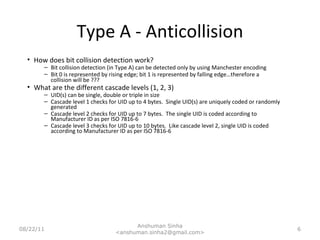
Type A - Anticollision How does bit collision detection work? Bit collision detection (in Type A) can be detected only by using Manchester encoding Bit 0 is represented by rising edge; bit 1 is represented by falling edge…therefore a collision will be ???   What are the different cascade levels (1, 2, 3) UID(s) can be single, double or triple in size Cascade level 1 checks for UID up to 4 bytes.  Single UID(s) are uniquely coded or randomly generated Cascade level 2 checks for UID up to 7 bytes.  The single UID is coded according to Manufacturer ID as per ISO 7816-6 Cascade level 3 checks for UID up to 10 bytes.  Like cascade level 2, single UID is coded according to Manufacturer ID as per ISO 7816-6 08/22/11 Anshuman Sinha <anshuman.sinha2@gmail.com>
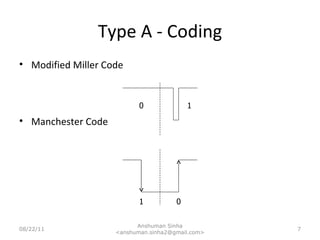
Type A - Coding Modified Miller Code Manchester Code 08/22/11 Anshuman Sinha <anshuman.sinha2@gmail.com> 0 1 1 0
Type B - Interface Signal Type Carrier : ASK 10%, NRZ – L Subcarrier : BPSK, NRZ – L Power pause time 0 µs Strength – Application can start processing even while handling the anti-collision exchange ATQB can send application level data to the IFD Chip level technology developed by Motorola and later made a standard Type B technology was designed for processor based systems Type B Anti-collision requires a (pseudo) random number generator 08/22/11 Anshuman Sinha <anshuman.sinha2@gmail.com>
Type B - Anti-collision Packet Transmission and collision detection  Method 1 - Slotted Aloha Method Method 2 – Probabilistic Slotted Aloha Method [Method 1] Time is divided into unit time for sending one packet.  Packets will collide when multiple cards are in field until slots are allocated Transmit the packet, backoff and wait for the acknowledge If collision occurs wait for next slot marker to send the packet Packets involved in collision are lost, packet collision detected by CRC error(s) or timeouts 08/22/11 Anshuman Sinha <anshuman.sinha2@gmail.com>
Slotted Aloha  [Method 1] Poisson distribution with number of channels in the field Throughput is underutilized when only one card is in the field Theoretical throughput maximum is 36.8% at 1 Requires queueing buffer for retransmission of packets 08/22/11 Anshuman Sinha <anshuman.sinha2@gmail.com> Offered Traffic Throughput 1
Slotted Aloha  [Method 1] REQB contains information on number of slots PCD selectively assigns a slot to the card Two levels of selection and rejection  First level -> based on AFI and/or random number Second level -> based on CID in a slot Card agrees to speak on an assigned slot  SLOT MARKER and ATTRIB command along with HLTB and ATQB assign the right slot to the card Once the card is in Active State the card responds only to the requests that are directed PUPI (Unique Card Identifier) is used as address of card while in Anti-collision process 08/22/11 Anshuman Sinha <anshuman.sinha2@gmail.com>
Probabilistic  [Method 2] First Level Selection by AFI Second Level Selection using R (Pseudo Random Number) IFD chooses AFI and N which are sent to card as part of REQB from the reader Only cards with matching AFI respond to the reader Tag or Card randomly generates R which is between  1 .. N (both inclusive) If R == 1, tag is selected to be in Active state (Probability of tag to generate R == 1 is 1/N) If R <> 1, tag doesn ’ t respond to the REQB During anti-collision process the card is identified by PUPI The reader will nominate a CID [0..16] to the tags that are Active.  Reader can talk to 16 cards simultaneously if cards support CID 08/22/11 Anshuman Sinha <anshuman.sinha2@gmail.com>
Type B Coding NRZ Code 08/22/11 Anshuman Sinha <anshuman.sinha2@gmail.com> 1 0 NRZ-L: [Non-Return-to-Zero-Level]: In NRZ-L encoding, the polarity of the signal changes only when the incoming signal changes from a one to a zero or from a zero to a one. NRZ-L method looks just like the NRZ method, except for the first input one data bit. This is because NRZ does not consider the first data bit to be a polarity change, where NRZ-L does.
References ISO 10536 ISO 14443 ISO 15693 Others … 08/22/11 Anshuman Sinha <anshuman.sinha2@gmail.com>

Contactless (Proximity) Smartcards

  • 1.
    Contactless Proximity TechnologyType A Vs Type B Anshuman Sinha 1/1/2005 Anshuman Sinha <anshuman.sinha2@gmail.com>
  • 2.
    Contactless Prox imity Smartcard s Classification based on Operating distance Close Coupling 0 – 1 cm [ISO 10536] Proximity 0 – 10 cm [ISO 14443] Type A Type B Type C Vicinity 0 – 1 m [ISO 15693] Type X Type Y 08/22/11 Anshuman Sinha <anshuman.sinha2@gmail.com>
  • 3.
    Proximity Smartcard Carrierfrequency 13.56 MHz, in ISM band Spread – 13.56 MHz +/- 106 kHz Subcarrier frequency -> side bands at +/- ~847 kHz Electrical power transfer by inductive coupling Power gradient with distance drops fast, 60 dB at 10 cms of distance Data transfer rate of 106 kbps max as per ISO 14443 Some chips support higher data rate, which is ~ISO Transport layer protocol T = CL, per ISO 14443 – 4 Defined distance of 10 cms NFC, ICAO, PIV and EMV are some of the application standards which use proximity technology 08/22/11 Anshuman Sinha <anshuman.sinha2@gmail.com>
  • 4.
    Type A -Interface Signal Type Carrier : ASK 100%, Modified Miller encoding Subcarrier : OOK, Manchester encoding Power pause time 2.95 µs Data self-clocked Anticollision based on “ bit collision detection ” Physical layer same as Mifare but anti-collision is different Signal interface and anticollision specified ISO 14443 Part 3 Most widely deployed contactless type as of now … 08/22/11 Anshuman Sinha <anshuman.sinha2@gmail.com>
  • 5.
    Type A -Anticollision An Example Say Address of first card (C1) = 1011 0010, and address of second card (C2) = 1010 0011 Reader -> Get Card Address – 1111 1111 All cards with address less than 1111 1111 respond C1 and C2 both respond with their addresses Bit collision occurs 101 X 001 X Reader -> Get Card Address 1010 1111 Cards with addresses between 101 0 0000 and 101 0 1111 respond Bit collision occurs 101 0 001X, but only one card responds, therefore C2 is selected for communication 08/22/11 Anshuman Sinha <anshuman.sinha2@gmail.com>
  • 6.
    Type A -Anticollision How does bit collision detection work? Bit collision detection (in Type A) can be detected only by using Manchester encoding Bit 0 is represented by rising edge; bit 1 is represented by falling edge…therefore a collision will be ??? What are the different cascade levels (1, 2, 3) UID(s) can be single, double or triple in size Cascade level 1 checks for UID up to 4 bytes. Single UID(s) are uniquely coded or randomly generated Cascade level 2 checks for UID up to 7 bytes. The single UID is coded according to Manufacturer ID as per ISO 7816-6 Cascade level 3 checks for UID up to 10 bytes. Like cascade level 2, single UID is coded according to Manufacturer ID as per ISO 7816-6 08/22/11 Anshuman Sinha <anshuman.sinha2@gmail.com>
  • 7.
    Type A -Coding Modified Miller Code Manchester Code 08/22/11 Anshuman Sinha <anshuman.sinha2@gmail.com> 0 1 1 0
  • 8.
    Type B -Interface Signal Type Carrier : ASK 10%, NRZ – L Subcarrier : BPSK, NRZ – L Power pause time 0 µs Strength – Application can start processing even while handling the anti-collision exchange ATQB can send application level data to the IFD Chip level technology developed by Motorola and later made a standard Type B technology was designed for processor based systems Type B Anti-collision requires a (pseudo) random number generator 08/22/11 Anshuman Sinha <anshuman.sinha2@gmail.com>
  • 9.
    Type B -Anti-collision Packet Transmission and collision detection Method 1 - Slotted Aloha Method Method 2 – Probabilistic Slotted Aloha Method [Method 1] Time is divided into unit time for sending one packet. Packets will collide when multiple cards are in field until slots are allocated Transmit the packet, backoff and wait for the acknowledge If collision occurs wait for next slot marker to send the packet Packets involved in collision are lost, packet collision detected by CRC error(s) or timeouts 08/22/11 Anshuman Sinha <anshuman.sinha2@gmail.com>
  • 10.
    Slotted Aloha [Method 1] Poisson distribution with number of channels in the field Throughput is underutilized when only one card is in the field Theoretical throughput maximum is 36.8% at 1 Requires queueing buffer for retransmission of packets 08/22/11 Anshuman Sinha <anshuman.sinha2@gmail.com> Offered Traffic Throughput 1
  • 11.
    Slotted Aloha [Method 1] REQB contains information on number of slots PCD selectively assigns a slot to the card Two levels of selection and rejection First level -> based on AFI and/or random number Second level -> based on CID in a slot Card agrees to speak on an assigned slot SLOT MARKER and ATTRIB command along with HLTB and ATQB assign the right slot to the card Once the card is in Active State the card responds only to the requests that are directed PUPI (Unique Card Identifier) is used as address of card while in Anti-collision process 08/22/11 Anshuman Sinha <anshuman.sinha2@gmail.com>
  • 12.
    Probabilistic [Method2] First Level Selection by AFI Second Level Selection using R (Pseudo Random Number) IFD chooses AFI and N which are sent to card as part of REQB from the reader Only cards with matching AFI respond to the reader Tag or Card randomly generates R which is between 1 .. N (both inclusive) If R == 1, tag is selected to be in Active state (Probability of tag to generate R == 1 is 1/N) If R <> 1, tag doesn ’ t respond to the REQB During anti-collision process the card is identified by PUPI The reader will nominate a CID [0..16] to the tags that are Active. Reader can talk to 16 cards simultaneously if cards support CID 08/22/11 Anshuman Sinha <anshuman.sinha2@gmail.com>
  • 13.
    Type B CodingNRZ Code 08/22/11 Anshuman Sinha <anshuman.sinha2@gmail.com> 1 0 NRZ-L: [Non-Return-to-Zero-Level]: In NRZ-L encoding, the polarity of the signal changes only when the incoming signal changes from a one to a zero or from a zero to a one. NRZ-L method looks just like the NRZ method, except for the first input one data bit. This is because NRZ does not consider the first data bit to be a polarity change, where NRZ-L does.
  • 14.
    References ISO 10536ISO 14443 ISO 15693 Others … 08/22/11 Anshuman Sinha <anshuman.sinha2@gmail.com>