COMPETITION BASED PRICING
S.HIRUTHICK
AYYA NADAR JANAKI AMMAL COLLEGE
COMPETITION BASED PRICING STRATEGIES
Price leadership
• Dominant firm can be set its own prices
• Few substitutes, in the eye of the customer
• Competitors follow the leader by establishing their prices based on the
price set by the price leader.
Predatory pricing
•It involves temporarily reducing price in an attempt to force rivals out of
the industry since they can not compete profitably
• The strategy often stems from an extension of a price war
• Some companies sell products at below cost price (Anti-competitive).
• A similar strategy is called “Limit pricing or pre-emptive pricing”. It
involves setting prices just low enough to discourage potential rivals.
• Predatory pricing and limit pricing are anticompetitive.
MARKET-LED PRICING STRATEGIES
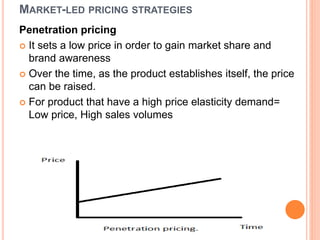
Penetration pricing
 It sets a low price in order to gain market share and
brand awareness
 Over the time, as the product establishes itself, the price
can be raised.
 For product that have a high price elasticity demand=
Low price, High sales volumes
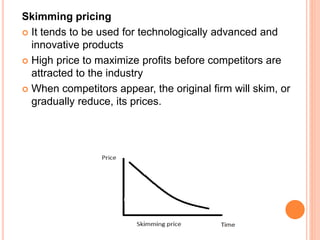
Skimming pricing
 It tends to be used for technologically advanced and
innovative products
 High price to maximize profits before competitors are
attracted to the industry
 When competitors appear, the original firm will skim, or
gradually reduce, its prices.
Prestige pricing
A firm permanently sets high price because of image,
reputation or status associated with the product.
High class jewelery
Price discrimination
When the same product, usually service, is sold in different
markets at different prices.
* Children and adults pay different prices for entering the
same cinema
 Airline companies increase their prices during Christmas
and summer holiday periods (Customers are more willing
to pay higher prices)
Promotional pricing
 When marketing new products by charging a low price to
entice customers and build brand awareness.
 It is also used to get rid of excess stocks or renew the
interest if sales have been falling.
 Rivals can copy the technique.
 It is similar to discount pricing. It can be used at the
beginning or later in the product’s life cycle (Extension
strategy)
ADVANTAGES
 Pricing is considered as one of the most important criteria for
online shoppers while making their final purchase
decision. More than %90 marked pricing as the first
indicator. Moreover, according to the e-commerce pricing
facts, an average online shopper will visit at least 3
websites before finalizing their purchase. By facing with
these facts, we can clearly say that online shoppers give
importance to the pricing and price comparison. As they are a
good deal hunter, believe me, they don’t hesitate even one
second to prefer one of your competitors if your prices don’t
satisfy their perception. So from the perspective of online
shoppers, adapting competitive pricing strategy will help you
to keep your customer base stable and let your business grow
by always offering competitive prices.

 Competitive pricing strategy can be combined with
some other pricing strategies to make it even more
efficient. For example, to hold the profitability
through competitive pricing strategy, online retailers
should always keep their costs in mind, and use a
mixed approach, where cost-based pricing may
decide on the target profit margins according to the
competitor pricing.
DISADVANTAGES
 The situation at above is valid if you are selling
premium products. For example, in the luxury
market, online shoppers tend to feel more special
and don’t care about the prices. So, trying to be
competitive in such industries may harm the
customer loyalty and brand value. It is better to mix
consumer-oriented and market-oriented pricing
strategies in these scenarios.
THANK YOU

Competition based pricing

  • 1.
  • 2.
    COMPETITION BASED PRICINGSTRATEGIES Price leadership • Dominant firm can be set its own prices • Few substitutes, in the eye of the customer • Competitors follow the leader by establishing their prices based on the price set by the price leader. Predatory pricing •It involves temporarily reducing price in an attempt to force rivals out of the industry since they can not compete profitably • The strategy often stems from an extension of a price war • Some companies sell products at below cost price (Anti-competitive). • A similar strategy is called “Limit pricing or pre-emptive pricing”. It involves setting prices just low enough to discourage potential rivals. • Predatory pricing and limit pricing are anticompetitive.
  • 3.
    MARKET-LED PRICING STRATEGIES Penetrationpricing  It sets a low price in order to gain market share and brand awareness  Over the time, as the product establishes itself, the price can be raised.  For product that have a high price elasticity demand= Low price, High sales volumes
  • 4.
    Skimming pricing  Ittends to be used for technologically advanced and innovative products  High price to maximize profits before competitors are attracted to the industry  When competitors appear, the original firm will skim, or gradually reduce, its prices.
  • 5.
    Prestige pricing A firmpermanently sets high price because of image, reputation or status associated with the product. High class jewelery
  • 6.
    Price discrimination When thesame product, usually service, is sold in different markets at different prices. * Children and adults pay different prices for entering the same cinema  Airline companies increase their prices during Christmas and summer holiday periods (Customers are more willing to pay higher prices)
  • 7.
    Promotional pricing  Whenmarketing new products by charging a low price to entice customers and build brand awareness.  It is also used to get rid of excess stocks or renew the interest if sales have been falling.  Rivals can copy the technique.  It is similar to discount pricing. It can be used at the beginning or later in the product’s life cycle (Extension strategy)
  • 8.
    ADVANTAGES  Pricing isconsidered as one of the most important criteria for online shoppers while making their final purchase decision. More than %90 marked pricing as the first indicator. Moreover, according to the e-commerce pricing facts, an average online shopper will visit at least 3 websites before finalizing their purchase. By facing with these facts, we can clearly say that online shoppers give importance to the pricing and price comparison. As they are a good deal hunter, believe me, they don’t hesitate even one second to prefer one of your competitors if your prices don’t satisfy their perception. So from the perspective of online shoppers, adapting competitive pricing strategy will help you to keep your customer base stable and let your business grow by always offering competitive prices. 
  • 9.
     Competitive pricingstrategy can be combined with some other pricing strategies to make it even more efficient. For example, to hold the profitability through competitive pricing strategy, online retailers should always keep their costs in mind, and use a mixed approach, where cost-based pricing may decide on the target profit margins according to the competitor pricing.
  • 10.
    DISADVANTAGES  The situationat above is valid if you are selling premium products. For example, in the luxury market, online shoppers tend to feel more special and don’t care about the prices. So, trying to be competitive in such industries may harm the customer loyalty and brand value. It is better to mix consumer-oriented and market-oriented pricing strategies in these scenarios.
  • 11.