



Value Pricing:
Getting the Price you Deserve


Presented by Global Partners Inc.
      Cambridge MA USA
        April 17th 2012
Welcome!
Global Partners Inc. is an international consulting, training and management
development firm.
We help Global 1000 companies to build their sales, marketing and customer
management capabilities in order to grow their businesses worldwide.


                 David Sanderson
                 Dave is a Principal at Global Partners, who focuses in areas at the intersection of
                 technology, consumer products, and healthcare. Dave has international
                 management experience with Global consumer product leaders, technology
                 leaders, and healthcare leaders.


                 Jay Gronlund
                 Jay is a Principal at Global Partners, who focuses on re-positioning
                 companies/brands, ideation sessions and business development in emerging
                 markets abroad. Jay has also been teaching a course on “Positioning and Brand
                 Development” at NYU since 1999.
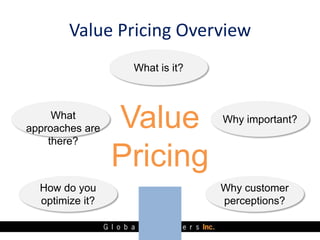
Value Pricing Overview
                  What is it?


     What
approaches are   Value          Why important?

    there?

                 Pricing
  How do you                    Why customer
  optimize it?                  perceptions?
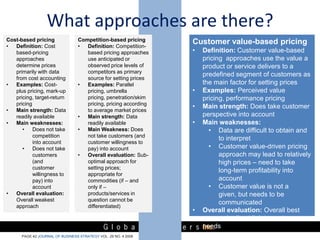
What approaches are there?
Cost-based pricing               Competition-based pricing       Customer value-based pricing
•  Definition: Cost              •  Definition: Competition-
   based-pricing                    based pricing approaches     •   Definition: Customer value-based
   approaches                       use anticipated or               pricing approaches use the value a
   determine prices                 observed price levels of         product or service delivers to a
   primarily with data              competitors as primary
                                                                     predefined segment of customers as
   from cost accounting             source for setting prices
•  Examples: Cost-               •  Examples: Parallel               the main factor for setting prices
   plus pricing, mark-up            pricing, umbrella            •   Examples: Perceived value
   pricing, target-return           pricing, penetration/skim        pricing, performance pricing
   pricing                          pricing, pricing according
                                                                 •   Main strength: Does take customer
•  Main strength: Data              to average market prices
   readily available             •  Main strength: Data              perspective into account
•  Main weaknesses:                 readily available            •   Main weaknesses:
      •    Does not take         •  Main Weakness: Does                • Data are difficult to obtain and
           competition              not take customers (and
                                                                           to interpret
           into account             customer willingness to
      •    Does not take            pay) into account                  • Customer value-driven pricing
           customers             •  Overall evaluation: Sub-               approach may lead to relatively
           (and                     optimal approach for                   high prices – need to take
           customer                 setting prices;
                                                                           long-term profitability into
           willingness to           appropriate for
           pay) into                commodities (if – and                  account
           account                  only if –                          • Customer value is not a
•  Overall evaluation:              products/services in                   given, but needs to be
   Overall weakest                  question cannot be
                                                                           communicated
   approach                         differentiated)
                                                                 •   Overall evaluation: Overall best
                                                                     approach, direct link to customer
                                                                     needs
      PAGE 42 JOURNAL OF BUSINESS STRATEGY VOL. 29 NO. 4 2008
Determine your company's
  optimal “Price Value”
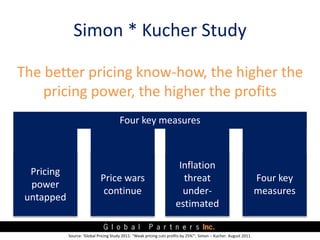
Simon * Kucher Study

The better pricing know-how, thenot theya
46% of companies still think what able
 65% of the only get half are higherin
 Companies companies of they're the
    pricing power,(theythey the profits
    toprice warthey higher deserve
        charge the didn't start)
  expect when whattry to raise prices
                            Pricing power untapped
                       Inflation threat under-estimated
                               Four key measures
                              Price wars continue


                                                                        Inflation
  Pricing
                             Price wars                                  threat                                     Four key
  power
                              continue                                   under-                                     measures
 untapped
                                                                       estimated

            Source: 'Global Pricing Study 2011: "Weak pricing cuts profits by 25%"'. Simon – Kucher. August 2011.
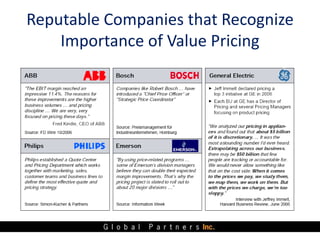
Reputable Companies that Recognize
        Importance of Value Pricing


Source: Team Top+ Customer Focus
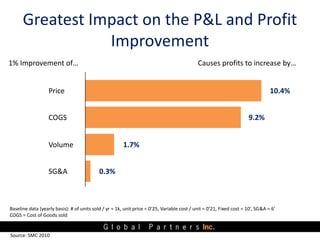
Greatest Impact on the P&L and Profit
                 Improvement
1% Improvement of…                                                                           Causes profits to increase by…


                   Price                                                                                                         10.4%


                   COGS                                                                                               9.2%


                   Volume                               1.7%


                   SG&A                     0.3%


Baseline data (yearly basis): # of units sold / yr = 1k, unit price = 0’25, Variable cost / unit = 0’21, Fixed cost = 10’, SG&A = 6’
COGS = Cost of Goods sold


Source: SMC 2010
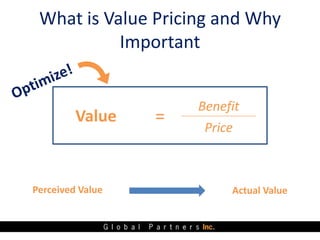
What is Value Pricing and Why
           Important


                      Benefit
         Value    =
                       Price


Perceived Value            Actual Value
Value Pricing
                   The true Test of Marketing…


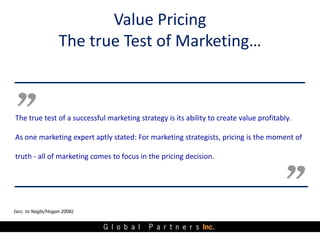
The true test of a successful marketing strategy is its ability to create value profitably.

As one marketing expert aptly stated: For marketing strategists, pricing is the moment of

truth - all of marketing comes to focus in the pricing decision.


(acc. to Nagle/Hogan 2006)
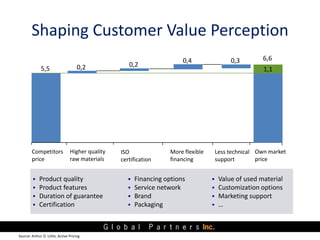
Shaping Customer Value Perception
                                                                         0,4                  0,3        6,6
                                      0,2            0,2
              5,5                                                                                         1,1


        Competitors              Higher quality   ISO                More flexible       Less technical Own market
        price                    raw materials    certification      financing           support        price


            Product quality                            Financing options               Value of used material
            Product features                           Service network                 Customization options
            Duration of guarantee                      Brand                           Marketing support
            Certification                              Packaging                       …


Source: Arthur D. Little, Active Pricing
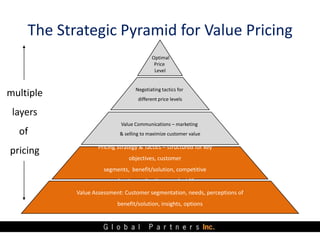
The Strategic Pyramid for Value Pricing
                                             Optimal
                                              Price
                                              Level


                                      Negotiating tactics for
multiple                               different price levels

 layers
                               Value Communications – marketing
  of                          & selling to maximize customer value

                    Pricing Strategy & Tactics – structured for key
pricing           Pricing Strategy & Tactics – structured for key objectives,
                                  objectives, customer
                     customer segments, benefit/solution, competitive
                      segments, benefit/solution, competitive
                              advantage, situation, product life
                           advantage, situation, product life
           Value Assessment: Customer segmentation, needs, perceptions of
            Value Assessment: Customer segmentation, needs, perceptions of benefit
                                  /solution, insights, options
                             benefit/solution, insights, options
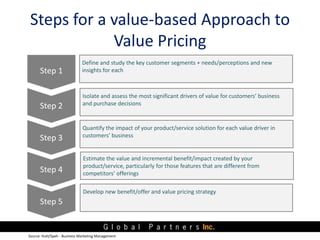
Steps for a value-based Approach to
            Value Pricing
                              Define and study the key customer segments + needs/perceptions and new
      Step 1                  insights for each


                              Isolate and assess the most significant drivers of value for customers’ business
      Step 2                  and purchase decisions


                              Quantify the impact of your product/service solution for each value driver in
                              customers’ business
      Step 3

                              Estimate the value and incremental benefit/impact created by your
                              product/service, particularly for those features that are different from
      Step 4                  competitors’ offerings

                              Develop new benefit/offer and value pricing strategy
      Step 5


Source: Hutt/Speh - Business Marketing Management
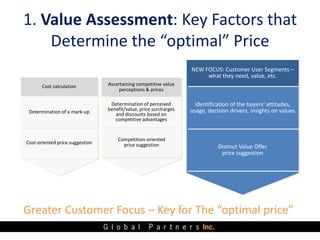
1. Value Assessment: Key Factors that
    Determine the “optimal” Price
                                                                  NEW FOCUS: Customer User Segments –
                                      Ascertaining competitive value   what they need, value, etc. – what
                                                                         Customer User Segments
       Cost calculation
       Cost calculation                     perceptions & prices
                                 Ascertaining competitive value                they need, value, etc.
                                     perceptions & prices

                                        Determination of perceived Identification of the buyers‘the buyers‘
                                  Determination of perceived                   Identification of attitudes,
 Determination ofmark-up              benefit/value, price surcharges
                                 benefit/value, price surcharges  usage, decision drivers, insights on values
 Determination of a a mark-up             and discounts based on
                                    and discounts based on
                                                                            attitudes, usage, decision drivers,
                                    competitive advantages
                                          competitive advantages                    insights on values


                                     Competition-oriented
Cost-oriented price suggestion
                                           Competition-oriented
                                       price suggestion                       Distinct Value Value Offer
                                                                                    Distinct Offer
Cost-oriented price suggestion               price suggestion                         price suggestion
                                                                               price suggestion


Greater Customer Focus – Key for The “optimal price”
Creating Satisfied Customers


The purpose of a business is not to make money;

it is to create a customer and satisfy that customer.


- Peter Drucker
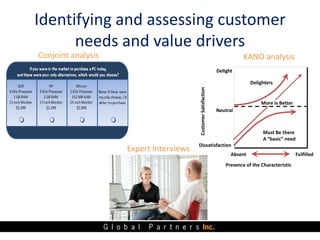
Identifying and assessing customer
      needs and value drivers
Conjoint analysis                                                           KANO analysis
                                                                Delight

                                                                               Delighters


                                        Customer Satisfaction
                                                                                    More Is Better
                                                                Neutral


                                                                                     Must Be there
                                                                                     A “basic” need
                                        Dissatisfaction
                    Expert Interviews
                                                                      Absent                          Fulfilled
                                                                    Presence of the Characteristic
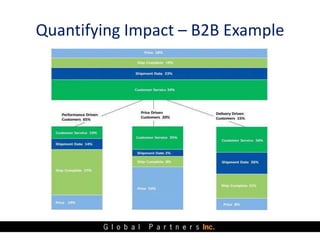
Quantifying Impact – B2B Example
Value Pricing Objectives - Examples
• Maximize Current Revenue
• Maximize Current Profit
• Build Market Share
• Combined – Revenue + Market Share
• Strengthen Customer Relationships
• Maximize Initial Trial (e.g. new
  product/service)
• Defend against New Competition
Factors to Consider for Value Pricing
              Strategy
  • Product Quality – Perceived and Real
  • Market/Customer Characteristics and Key Value
    Drivers
  • Competition
  • Demand Elasticity in Target Categories
  • Product Life Cycle
  • Cost – Manufacturing and Marketing/Selling
  • Positioning – To Be More Distinct and Relevant
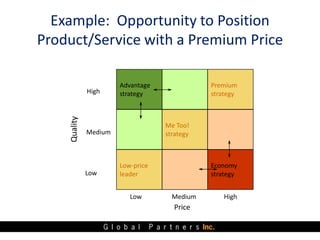
Example: Opportunity to Position
Product/Service with a Premium Price

                       Advantage              Premium
              High     strategy               strategy
    Quality


                                   Me Too!
              Medium               strategy


                       Low-price              Economy
              Low      leader                 strategy


                          Low        Medium      High
                                     Price
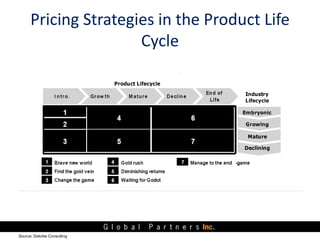
Pricing Strategies in the Product Life
                      Cycle


Source: Deloitte Consulting
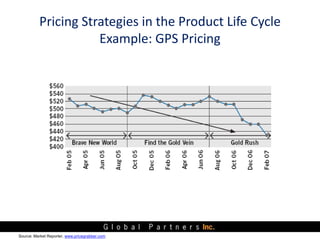
Pricing Strategies in the Product Life Cycle
                     Example: GPS Pricing


Source: Market Reporter, www.pricegrabber.com
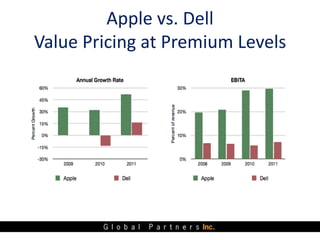
Apple vs. Dell
Value Pricing at Premium Levels
GPI Recommended Approaches
       To Improve Your Value Pricing*
• Advanced, Deeper Customer Research – to identify new insights, beyond
  traditional methods (e.g. using new digital applications)
• New creative, innovative ideas – use ideation to develop better, more
  distinct benefits/solutions that will enhance perceived value
• Strengthen Customer Relationships – improve brand image of company
  and product/service, plus new customized services to leverage insights
• Credibility , Prove Your Value with Metrics – Marketing to quantify
  positive impact (ROI) of solution and added value for customers

* Approaches consistent with “most important areas for improvement” from
recent IBM survey among CMOs , highlighted in new e-book from GPI
Are You Ready to Explore New Value
        Pricing Opportunities?
Summary Webinar
>Majority of companies do not charge the prices they deserve
>Value pricing Analysis effective way to improve profitability of products
> Value Assessment is key to determine customer segments and needs
> Establish Objectives and Strategies for defined markets
> Communicate values to sales team and customer to achieve optimal price

Start by Asking:
• Do we understand the Benefit/Value offered to our customers?
• Do our customers recognize and understand this value? Different by
   segment? In priority?
• Are we really getting the true value we deserve?
Thanks for attending
Global Partners Inc. is an international consulting, training and management
development firm.
We help Global 1000 companies to build their sales, marketing and customer
management capabilities in order to grow their businesses worldwide.
Our highly customized programs in Value Selling, Global Account
Management, Customer Focus and Strategic Marketing are designed to achieve
maximum impact on clients’ revenue and market share growth and to create lasting
change and tangible benefits.

                       One Broadway - Cambridge, MA 02142
                              Office: 1 (781) 352 2460
                               Fax: 1 (617) 401 3604
                           info@globalpartnersinc.com
                           www.globalpartnersinc.com

Value Pricing - Getting the Price you Deserve

  • 1.
    Value Pricing: Getting thePrice you Deserve Presented by Global Partners Inc. Cambridge MA USA April 17th 2012
  • 2.
    Welcome! Global Partners Inc.is an international consulting, training and management development firm. We help Global 1000 companies to build their sales, marketing and customer management capabilities in order to grow their businesses worldwide. David Sanderson Dave is a Principal at Global Partners, who focuses in areas at the intersection of technology, consumer products, and healthcare. Dave has international management experience with Global consumer product leaders, technology leaders, and healthcare leaders. Jay Gronlund Jay is a Principal at Global Partners, who focuses on re-positioning companies/brands, ideation sessions and business development in emerging markets abroad. Jay has also been teaching a course on “Positioning and Brand Development” at NYU since 1999.
  • 3.
    Value Pricing Overview What is it? What approaches are Value Why important? there? Pricing How do you Why customer optimize it? perceptions?
  • 4.
    What approaches arethere? Cost-based pricing Competition-based pricing Customer value-based pricing • Definition: Cost • Definition: Competition- based-pricing based pricing approaches • Definition: Customer value-based approaches use anticipated or pricing approaches use the value a determine prices observed price levels of product or service delivers to a primarily with data competitors as primary predefined segment of customers as from cost accounting source for setting prices • Examples: Cost- • Examples: Parallel the main factor for setting prices plus pricing, mark-up pricing, umbrella • Examples: Perceived value pricing, target-return pricing, penetration/skim pricing, performance pricing pricing pricing, pricing according • Main strength: Does take customer • Main strength: Data to average market prices readily available • Main strength: Data perspective into account • Main weaknesses: readily available • Main weaknesses: • Does not take • Main Weakness: Does • Data are difficult to obtain and competition not take customers (and to interpret into account customer willingness to • Does not take pay) into account • Customer value-driven pricing customers • Overall evaluation: Sub- approach may lead to relatively (and optimal approach for high prices – need to take customer setting prices; long-term profitability into willingness to appropriate for pay) into commodities (if – and account account only if – • Customer value is not a • Overall evaluation: products/services in given, but needs to be Overall weakest question cannot be communicated approach differentiated) • Overall evaluation: Overall best approach, direct link to customer needs PAGE 42 JOURNAL OF BUSINESS STRATEGY VOL. 29 NO. 4 2008
  • 5.
    Determine your company's optimal “Price Value”
  • 6.
    Simon * KucherStudy The better pricing know-how, thenot theya 46% of companies still think what able 65% of the only get half are higherin Companies companies of they're the pricing power,(theythey the profits toprice warthey higher deserve charge the didn't start) expect when whattry to raise prices Pricing power untapped Inflation threat under-estimated Four key measures Price wars continue Inflation Pricing Price wars threat Four key power continue under- measures untapped estimated Source: 'Global Pricing Study 2011: "Weak pricing cuts profits by 25%"'. Simon – Kucher. August 2011.
  • 7.
    Reputable Companies thatRecognize Importance of Value Pricing Source: Team Top+ Customer Focus
  • 8.
    Greatest Impact onthe P&L and Profit Improvement 1% Improvement of… Causes profits to increase by… Price 10.4% COGS 9.2% Volume 1.7% SG&A 0.3% Baseline data (yearly basis): # of units sold / yr = 1k, unit price = 0’25, Variable cost / unit = 0’21, Fixed cost = 10’, SG&A = 6’ COGS = Cost of Goods sold Source: SMC 2010
  • 9.
    What is ValuePricing and Why Important Benefit Value = Price Perceived Value Actual Value
  • 10.
    Value Pricing The true Test of Marketing… The true test of a successful marketing strategy is its ability to create value profitably. As one marketing expert aptly stated: For marketing strategists, pricing is the moment of truth - all of marketing comes to focus in the pricing decision. (acc. to Nagle/Hogan 2006)
  • 11.
    Shaping Customer ValuePerception 0,4 0,3 6,6 0,2 0,2 5,5 1,1 Competitors Higher quality ISO More flexible Less technical Own market price raw materials certification financing support price  Product quality  Financing options  Value of used material  Product features  Service network  Customization options  Duration of guarantee  Brand  Marketing support  Certification  Packaging  … Source: Arthur D. Little, Active Pricing
  • 12.
    The Strategic Pyramidfor Value Pricing Optimal Price Level Negotiating tactics for multiple different price levels layers Value Communications – marketing of & selling to maximize customer value Pricing Strategy & Tactics – structured for key pricing Pricing Strategy & Tactics – structured for key objectives, objectives, customer customer segments, benefit/solution, competitive segments, benefit/solution, competitive advantage, situation, product life advantage, situation, product life Value Assessment: Customer segmentation, needs, perceptions of Value Assessment: Customer segmentation, needs, perceptions of benefit /solution, insights, options benefit/solution, insights, options
  • 13.
    Steps for avalue-based Approach to Value Pricing Define and study the key customer segments + needs/perceptions and new Step 1 insights for each Isolate and assess the most significant drivers of value for customers’ business Step 2 and purchase decisions Quantify the impact of your product/service solution for each value driver in customers’ business Step 3 Estimate the value and incremental benefit/impact created by your product/service, particularly for those features that are different from Step 4 competitors’ offerings Develop new benefit/offer and value pricing strategy Step 5 Source: Hutt/Speh - Business Marketing Management
  • 14.
    1. Value Assessment:Key Factors that Determine the “optimal” Price NEW FOCUS: Customer User Segments – Ascertaining competitive value what they need, value, etc. – what Customer User Segments Cost calculation Cost calculation perceptions & prices Ascertaining competitive value they need, value, etc. perceptions & prices Determination of perceived Identification of the buyers‘the buyers‘ Determination of perceived Identification of attitudes, Determination ofmark-up benefit/value, price surcharges benefit/value, price surcharges usage, decision drivers, insights on values Determination of a a mark-up and discounts based on and discounts based on attitudes, usage, decision drivers, competitive advantages competitive advantages insights on values Competition-oriented Cost-oriented price suggestion Competition-oriented price suggestion Distinct Value Value Offer Distinct Offer Cost-oriented price suggestion price suggestion price suggestion price suggestion Greater Customer Focus – Key for The “optimal price”
  • 15.
    Creating Satisfied Customers Thepurpose of a business is not to make money; it is to create a customer and satisfy that customer. - Peter Drucker
  • 16.
    Identifying and assessingcustomer needs and value drivers Conjoint analysis KANO analysis Delight Delighters Customer Satisfaction More Is Better Neutral Must Be there A “basic” need Dissatisfaction Expert Interviews Absent Fulfilled Presence of the Characteristic
  • 17.
  • 18.
    Value Pricing Objectives- Examples • Maximize Current Revenue • Maximize Current Profit • Build Market Share • Combined – Revenue + Market Share • Strengthen Customer Relationships • Maximize Initial Trial (e.g. new product/service) • Defend against New Competition
  • 19.
    Factors to Considerfor Value Pricing Strategy • Product Quality – Perceived and Real • Market/Customer Characteristics and Key Value Drivers • Competition • Demand Elasticity in Target Categories • Product Life Cycle • Cost – Manufacturing and Marketing/Selling • Positioning – To Be More Distinct and Relevant
  • 20.
    Example: Opportunity toPosition Product/Service with a Premium Price Advantage Premium High strategy strategy Quality Me Too! Medium strategy Low-price Economy Low leader strategy Low Medium High Price
  • 21.
    Pricing Strategies inthe Product Life Cycle Source: Deloitte Consulting
  • 22.
    Pricing Strategies inthe Product Life Cycle Example: GPS Pricing Source: Market Reporter, www.pricegrabber.com
  • 23.
    Apple vs. Dell ValuePricing at Premium Levels
  • 24.
    GPI Recommended Approaches To Improve Your Value Pricing* • Advanced, Deeper Customer Research – to identify new insights, beyond traditional methods (e.g. using new digital applications) • New creative, innovative ideas – use ideation to develop better, more distinct benefits/solutions that will enhance perceived value • Strengthen Customer Relationships – improve brand image of company and product/service, plus new customized services to leverage insights • Credibility , Prove Your Value with Metrics – Marketing to quantify positive impact (ROI) of solution and added value for customers * Approaches consistent with “most important areas for improvement” from recent IBM survey among CMOs , highlighted in new e-book from GPI
  • 25.
    Are You Readyto Explore New Value Pricing Opportunities? Summary Webinar >Majority of companies do not charge the prices they deserve >Value pricing Analysis effective way to improve profitability of products > Value Assessment is key to determine customer segments and needs > Establish Objectives and Strategies for defined markets > Communicate values to sales team and customer to achieve optimal price Start by Asking: • Do we understand the Benefit/Value offered to our customers? • Do our customers recognize and understand this value? Different by segment? In priority? • Are we really getting the true value we deserve?
  • 26.
    Thanks for attending GlobalPartners Inc. is an international consulting, training and management development firm. We help Global 1000 companies to build their sales, marketing and customer management capabilities in order to grow their businesses worldwide. Our highly customized programs in Value Selling, Global Account Management, Customer Focus and Strategic Marketing are designed to achieve maximum impact on clients’ revenue and market share growth and to create lasting change and tangible benefits. One Broadway - Cambridge, MA 02142 Office: 1 (781) 352 2460 Fax: 1 (617) 401 3604 info@globalpartnersinc.com www.globalpartnersinc.com

Editor's Notes

  • #4 What is Value Pricing and Why So Important? Why Customer Perceptions are CriticalHow to Build Optimal Value Pricing Strategy Value based approaches to positioning & pricingDetermine your company's “Price Value”
  • #6 What is Value Pricing and Why So Important? Why Customer Perceptions are CriticalHow to Build Optimal Value Pricing Strategy Value based approaches to positioning & pricingDetermine your company's “Price Value”
  • #10 The Benefit offered by a company/product (e.g. the solution and/or quality) is vital for setting the valueThe Price must reflect the perception of this benefit or solution, and make the offer at least “worthwhile”The actual and/or perceived value is the most critical determinant for purchase decisions today. Shaping the optimal benefit/solution and price requires research, creativity and smart business approaches.
  • #18 The following methodologies for measuring value to customers are worthy of note:G1 Expert interviews. Company experts (such as senior representative from the marketing, and Focus group assessment of valueG2 Conjoint (or trade-off) analysisG3 Importance ratings (KANO)
  • #19 A Fortune 500 industrial manufacturing company was experiencing declines in market share and margins inone of its divisions. Pricing Solutions identified the customers’ key value drivers and how much they werewilling to pay for various services. This led to the identification of three key customer segments. PricingSolutions developed customized programs for each segment.
  • #20 Gathering Competitive Positioning Data for Your Key Product LinesTo assess and manage a product’s competitive positioning in the marketplace your value-based marketing strategy system should• Identify the key benefit attributes (buying factors) that customers value when selecting aproduct or choosing a brand• Measure your performance and the performance of competing products as perceived bycustomers• Estimate the relative importance or weight of each key buying factor• Measure how customers perceive your price versus competition and measure actualmonetary prices versus competition• Track market-share trends