275Built and Natural Environment Research Papers • Vol. 4 No. 2, 2011
Uptake of bim and ipd within the uk aec industry: the evolving role of the architectural technologist
Uptake of bim and ipd
within the uk aec Industry:
The Evolving Role of the
Architectural Technologist
Peter James Morton1
and Emine Mine Thompson2
ABSTRACT
Building Information Modelling is not only a tool, but also the process of creation,
maintenance, distribution and co-ordination of an integrated database that
collaboratively stores 2D and 3D information, with embedded physical and functional
data within a project-building model. The uptake of BIM within the UK Architecture,
Engineering and Construction (AEC) industry has been slow since the 1980’s, but over
recent years, adoptions have increased. The increased collaborative nature of BIM,
external data sharing techniques and progressively complex building design, promotes
requirements for design teams to coordinate and communicate more effectively to
achieve project goals. To manage this collaboration, new or evolved job roles may
emerge. This research examined the current use of BIM, Integrated Project Delivery
(IPD) and collaborative working in the UK AEC industry and job roles that have evolved
or been created to cater for them. Using semi-structured interviews the interviewees
indicated while several of the key enablers of IPD were being used, IPD itself had not
been fully adopted. BIM was being used with some success but improvements could
be made. New job roles such as the BIM Engineer and BIM Coordinator had been seen
in the industry and evidence that the Architectural Technologist (AT) role is evolving
into a more multidisciplinary role; this reflects similar findings of recent research.
Keywords: Building Information Modelling, Integrated Project Delivery, Enablers, Architectural
Technologist.
1
Awarded to “Space architecure award for Achievement in Architectural Technology, 2011”
2
School of the Built and Natural Environment, Northumbria University, Elison Building,
Newcastle upon Tyne NE1 8ST.
Built and Natural Environment Research Papers	 December 2011
276
INTRODUCTION
The uptake of Building Information Modelling (BIM) and a collaborative working environment has been
slow in the UK, but over recent years, adoptions have increased. This research seeks to identify the key
benefits of using BIM enabled Integrated Project Delivery (IPD) within the UK construction industry,
further identifying what effect this will have on the future roles of built environment professionals,
specifically the role of the Architectural Technologist (AT). This research reports on information obtained
from case studies produced in the USA as a direct comparison to the UK and a review of current literature.
The aims of this research were to:
• Investigate which, if any of the known characteristics of IPD are being used in the UK AEC industry.
• Investigate the benefits/issues experienced with BIM in the UK AEC industry.
• Identify the presence of any new or evolving job roles.
WHAT IS INTEGRATED PROJECT DELIVERY
IPD is a project delivery approach which integrates people, systems, business structures and practices into
a process that collaboratively harnesses the talents and insights of all participants, to reduce waste and
optimize efficiency through all phases of design, fabrication and construction (AIA, 2007).
The primary characteristics identified by the American Institute of Architects AIA (2007) as fundamental
to the success of IPD are:
• Mutual respect, trust, benefits and reward.
• Collaborative innovation and decision making.
• Early involvement of key participants.
• Early goal definition.
• Intensified planning.
• Open communication.
• Appropriate technology.
• Organisation and leadership.
With the backbone of IPD being ‘Teamwork’, the development of openness and trust between the
stakeholders is extremely important. The project team is seen as the lifeblood of IPD; within an IPD
arrangement, the project team comes together and works collaboratively as an Integrated Project Team
(IPT) (Hardin, 2009).
During a typical delivery process within the AEC industry, each consultant sticks to their own role and
responsibilities, maintaining a ‘silo’ effect, only ever looking outside their silo of responsibility when
problems occur, by which time it’s too late (Whaley, 2009).
IPD promotes the flattening of these ‘silos’, which in turn increases the ability to build respect and trust,
and harbours open communication, which the AIA identifies fundamental to the success of IPD.
The sequences in IPD are similar to projects using traditional delivery models; it begins with a concept
stage, which is worked up and followed by a construction stage, culminating with the project sign off
or closeout. The differences between IPD and traditional models are the convergence of stakeholders at
an earlier stage, and the early upfront effort that is required at the beginning of the project rather than
later in the construction documents stage. This early upfront effort is facilitated by the involvement of
the key participants who create the complete Integrated Project Team (IPT). The key participants then
collaboratively define the project goals from the outset, rather than individual goals (AIA, 2007).
277Built and Natural Environment Research Papers • Vol. 4 No. 2, 2011
Uptake of bim and ipd within the uk aec industry: the evolving role of the architectural technologist
IPD was created in the 1990’s; companies adopting IPD for the first time may adjust the arrangement
and approach making it more accessible. However, the essence of an IPD arrangement will remain
unchanged; consisting of a core team of stakeholders that includes the owner, the architect/engineers
and the contractor (other consultants may be included). They sign a single, multi-party contract with the
owner, who collaboratively outlines project goals with cost, time and quality attributes (CMAA, 2009).
WHAT IS BUILDING INFORMATION MODELLING
The National BIM Standard (NBIMS) defines BIM as:
“a digital representation of physical and functional characteristics of a facility...and a shared
knowledge resource for information about a facility forming a reliable basis for decisions during
its life-cycle; defined as existing from earliest conception to demolition.” (buildingSMART,
2010).
The uptake of BIM within the UK AEC industry has been slow since the 1980’s, but over recent years,
adoptions have increased. In a recent survey, 35% of construction professionals in the UK claim to use
BIM of that, 60% of architects, 39% of engineers and 23% of contractors (Bernstein, 2010). However, it
was revealed in a recent survey by standards and specification expert NBS that there was still an ‘alarming
lack of awareness’ of BIM across the UK construction industry (Winston, 2010).
Adopting BIM requires substantial operational changes within the construction industry, changing how
buildings are designed and constructed (Becerik and Pollalis, 2006). These changes include requirements
for additional training, particularly the information producers (the Architectural Technologists); timing
for information release (less information upfront as 3D modelling has to take place) and more time spent
collaborating.
ROLE OF THE ARCHITECTURAL TECHNOLOGIST
For many years the role of the AT was largely unrecognised and un-respected within an architectural
practice and within the AEC industry as a whole. The AT, although responsible for bridging the gap
between conceptual design and production, endured years devoid of recognised status, seemingly
overshadowed by the architect (Emmitt, 2002).
John T Emmitt (1880) criticised the ‘strange and paradoxical profession’ of architecture; highlighting
particularly the quandary of architectural assistants, claiming they were the most important member
of the architectural profession. Emmitt urged architects assistants to form an association; however his
views were not listened to for many years. In 1965, following a report from the Royal Institute for
British Architects (RIBA) which called for the establishment of ‘an institute for technicians’, the Society
of Architectural and Associated Technicians (SAAT) was formed. In 1986, SAAT changed its name to the
British Institute of Architectural Technologists (BIAT) and then changed to the Chartered Institute of
Architectural Technologists (CIAT) which remains its name today (CIAT, 2010a).
The CIAT defines the AT as a specialist in the application of technology to architecture, building design
and construction (CIAT, 2010b).
Northumbria University (in their course information) define the AT as the interface between design and
construction, optimising building performance and efficiency. They state an AT will have the ability
to “analyse, synthesise and evaluate building design factors in order to produce efficient and effective
technical design solutions which satisfy performance, production and procurement criteria” of a project
(Northumbria University, 2010).
Future Role of the Architectural Technologist
As previously described the AEC industry is facing a paradigm shift with evolving roles and responsibilities,
Built and Natural Environment Research Papers	 December 2011
278
primarily due to newly emerging collaborative technologies and processes such as BIM and IPD. New
roles will inevitably be formed catering for the more collaborative nature of the industry; roles such as
‘Building Modeller’, ‘Model Manager’ or ‘Collaboration Manager’ may be seen to emerge over time
(Eastman et al, 2008).
The role of the AT may also evolve to adapt to this new ‘paradigm’; a role which not only encapsulates
all of the previous characteristics of the AT, but also new collaborative qualities and the prerequisites to
be BIM savvy as a condition of employment or additional management skills for example.
BIM CASE STUDIES - RECENT CASE STUDIES
Several key case studies were taken from the AIA case studies document (AIA 2010), detailing projects
which used BIM enabled IPD to varying degrees, also identifying the success/failures and lessons learnt.
The table below shows the three case studies that were analysed in order to define the key IPD
characteristics and the relationship between IPD and BIM; identifying what extent they employed the
underlying core values of IPD within the project contract arrangement (Table 1).
IPD Characteristics	 Autodesk AEC	 Sutter Health	 Walter Cronkite
(Taken from case studies)	 Solutions Division 	 Fairfield Medical	 School of
	 Headquarters	 Office Building	 Journalism
Early Involvement of Key Participants	 Yes	 Yes	 Yes
Shared Risk and Reward	 Yes	 No	 No
Multi-Party Contract	 Yes	 Yes	 No
Collaborative Decision Making	 Yes	 Yes	 Yes
Liability Waivers	 Yes	 No	 No
Jointly Developed Goals	 Yes	 Yes	 Yes
Table 1: Case Study Projects (AIA, 2010)
Autodesk AEC Solutions Division Headquarters
The Autodesk AEC Solutions Division Headquarters in project Waltham, Massachusetts was Autodesk’s
third project used to highlight its new software and implementation of the new trends in the construction
industry. It showed how they could support BIM, design-to-fabrication, sustainability and building
performance analysis, with particular emphasis on incorporating IPD.
The project involved the fit out of a 55,000 square feet, three-storey new tenant improvement within a
speculative office building. The project included office space and associated conference rooms, training
facilities, cafe and a 5,000 square feet customer-briefing centre.
Autodesk handpicked an architect/builder team that were willing to try IPD. Early leaders in the selection
process wanted to change the proposed IPD arrangement; Autodesk declined. Klingstubbins and Tocci
Building were finally chosen; primarily due to their experience, local knowledge and suitability to the
client’s requirements. Both teams had extensive experience with BIM and LEED, both showing their
willingness to try IPD even though neither had tried it before (Autodesk, 2009).
Autodesk worked with both firms to create measurable and performance based goals for the project,
linked to the Incentive Compensation Layer (ICL). The primary goals were: to stay within budget, that
a very high sustainability goal (LEED Platinum for commercial interiors) was to be achieved and the
project would be completed within a very tight schedule of just eight and a half months.
279Built and Natural Environment Research Papers • Vol. 4 No. 2, 2011
Uptake of bim and ipd within the uk aec industry: the evolving role of the architectural technologist
The project did run into some problems, i.e. software interoperability. Although the project resulted in a
‘triple win’ for the stakeholders. Design/construction costs were below the target set, benefitting both the
design team and owner; the designer and contractor both exceeded their profit targets and the building
achieved the sustainability target of LEED CI Platinum (AIA 2010).
Lessons Learned
According to the feedback given in the study several of the design team principals noted it was crucial
they select the architect and builder as a team; if the architect and builder did not show the synergy
required, another team would be chosen.
AIA (2010) reports that Phil Bernstein, Autodesk’s Vice President for Industry Strategy and Relations
stated ‘the first step should be a scoping exercise taken to the level of conceptual, in which everyone
works at cost until a deep understanding of the project and budget is achieved by all parties’, echoing
the ‘Early Goal Definition’ characteristic of IPD. Bernstein also noted financial incentives, the ‘Joint
risk and reward’ Incentive Compensation Layer (ICL) were causing unwelcome changes in behaviour,
further stating it didn’t mean the incentives would be dropped, as they are essential for supporting the
right kind of behaviour (AIA, 2010). The study noted the architect learned by using IPD and by the
close collaboration with the builder. Redundant detailing was unnecessary, saving time and leaving the
architect to deal with more important problem.
Sutter Health Fairfield Medical Office Building
The Sutter Health Fairfield Medical Office Building in Castro Valley, California was a $320 million
project fully funded by Sutter Health, the first hospital in its county not financed by the taxpayer or
other public fund, and one of the largest non-profit care providers in Northern California (AIA, 2010
and Khemlani, 2009).
Sutter Health was looking for new ways to design, build and maintain its facilities following several
disputatious projects. They hosted the Sutter Lean Summit in 2004, with help from the Lean Construction
Institute (LCI), they set out their plans for transforming the way Sutter projects would be designed, built
and maintained.
The project involved the construction of a three-storey, 70,000 square metre medical office building,
housing primary care medical practices and laboratories; fully equipped with cardiology, oncology,
paediatrics and rheumatology departments. The owner, Sutter, wanted to use this opportunity to test
a new delivery process of collaboration and advanced technology. Their vision to create a landmark
medical centre that integrated advanced technologies without compromising patient comfort and care
(Khemlani, 2009). Sutter Health was looking for new ways to design, build and maintain its facilities
following several disputatious projects. They hosted the Sutter Lean Summit in 2004, with help from the
Lean Construction Institute (LCI), they set out their plans for transforming the way Sutter projects would
be designed, built and maintained.
Due to new safety laws introduced, requiring the organisation and execution of several large projects
within a specific timeframe, Sutter Health had to find a way to reduce the time delays and budget over-
runs generally associated with large complex projects. Specifically Sutter Health looked at how it could
transform the design and construction delivery model. IPD came to the attention of Sutter Health,
becoming a viable alternative. SH needed the project delivered in 25 months; this was a very tight
schedule as there was also a three month delay for programming at the start of the project and addition
of extra scope (AIA, 2010).
The project was completed under budget, it was estimated that Sutter Health saved approximately $9
million (Carbasho, 2008) it was within schedule; change orders being virtually eliminated (AIA, 2010).
Built and Natural Environment Research Papers	 December 2011
280
Lessons Learned
The feedback from the study noted the sub-contractors felt there was more intense effort required up
front compared to traditional delivery systems, but all agreed that the benefits of this up front effort
and collaboration comes later in the project, rework was almost completely eliminated. The contractor
also felt having supervisors on site full time with BIM software to continuously check the progress and
instantly find solutions to arising problems would be beneficial.
The study noted that the IPD philosophy wasn’t accepted by everyone. Several subcontractors did not
want their foremen attending group scheduling meetings; this has now become a mandatory requirement
from the contractor. The design team stated they felt the owner had to be kept engaged from the earliest
design stages and throughout construction. This enabled quick decision making on the owners’ side,
meaning less delays for the project.
Sutter Health was extremely pleased with the building and process. It has since been applied by Sutter
Health to larger, more complex projects.
Walter Cronkite School of Journalism
The Cronkite School of Journalism was a venture by the City of Phoenix for Arizona State University
(ASU), financed by a city bond measure. The project was to construct a six-storey, 230,000 square feet
building, which included: classrooms and offices for the School of Journalism and Mass Communication,
a university operated television station, general purpose classrooms and ground floor retail spaces which
were intended to activate the ground floor street (AIA, 2010).
Due to the size of the proposed ASU campus, it would fill a nine block area, so the concept was an
extremely important aspect of the Phoenix redevelopment vision. As the first significant building to be
built on the most prominent site, the Cronkite School was expected to set a high standard in not only
design quality but also construction quality.
The project required a number of rooms with advanced technology and specific performance requirements
such as recording studios, control rooms, production studios etc. all of which would need all of the
services accurately designed and coordinated. The City and University both had sustainability goals; the
City wanted the project to be LEED certified and the university wanted it to be LEED silver or higher
(AIA, 2010).
The project suffered from an extremely tight 24 month schedule, which was due to the ‘drop-dead’ date
for move in described by the bond measure. The only way that the project would be to be completed in
this tight schedule was by adopting IPD (Stahl, 2010).
One of the IPD tenets that the project team used was to co-locate the team members in a ‘Big Room’ from
day one. Having the architect, engineers and contractors in one room promoted the understanding of the
project vision; if any problems were encountered they were collaboratively solved by the whole team.
The project was delivered on schedule, which meant the school could be handed over to the client ready
for the start of term. The design costs were under budget but the construction costs ran over budget. The
project achieved LEED silver certification (AIA, 2010).
Lessons Learned
The design team quickly realised that in order for the project to be successful, they had to change the
behaviours that they were used to. They team felt that if they had slipped back into their traditional
mentality the project wouldn’t have been completed.
The design team also stated that co-location works, because when people work together closely, you
naturally build a relationship of trust and respect, one of the key characteristics of IPD. Although they
281Built and Natural Environment Research Papers • Vol. 4 No. 2, 2011
Uptake of bim and ipd within the uk aec industry: the evolving role of the architectural technologist
hit the tight programme schedule, the design team felt that an extra month would have been beneficial,
as the collaboration that was happening was extremely intense.
Interoperability issues became apparent in the project as the design architects were using Revit and the
executive architects were using Architectural Desktop. The translation of the models back and forth was
troublesome and problematic, which was extremely inefficient. The executive architect felt there wasn’t
enough time to train their staff in Revit for this project however, the firm has now since completely
transitioned to Revit.
Some of the sub-contractors felt uncomfortable with the nature of the IPD process and it was decided
that in the future extended training would be provided.
Overall, each of the stakeholders thought that the project went well, but did voice concern that some of
the lean construction techniques were inflexible.
Case Study Summary
The three case studies examined identified numerous benefits associated with IPD. They have shown
projects that have tight budgets and programmes that would normally be prone to value engineering to
achieve budgets, and also involve delays when using a traditional delivery system, can be achieved and
in some instances excelled if an IPD system is adopted. It is also clear there are some issues associated
with IPD; people’s reluctance to try something new or change their ways by using something they are
uncomfortable with is an issue that was seen on both the case studies. According to the feedback given
in the case studies interoperability also appears to be quite a common issue that has affected projects
using BIM and IPD. Early planning and getting the key participants together early enough can reduce
the problem of interoperability issues arising, as software can be agreed prior to commencement of the
project.
It is clear that IPD requires further development to be a ‘perfect’ delivery system, but it has shown it can
solve issues and inefficiencies currently affecting the construction industry. The key issues obtained from
the case studies enabled the production of the research methodology and aided the question design.
METHODOLOGY
The chosen method of research is a qualitative methodology and semi-structured interviews were
conducted. The interviews began with closed answer questions for classification purposes, followed
by standard open answer questions. Prompts were given to stimulate further discussion, also to help
interviewees to provide personal views, opinions and experiences regarding their exposure to BIM, IPD
and evolving job roles. The interview questions were delivered using a standard script. This maintained
similarity in question delivery so responses can be analysed accurately and fairly. The questions were
formulated in a way that they were equally accessible to each interviewee, meaning they could understand
the question in order to provide valuable and unique responses.
Interviewee Selection
Interviewees were selected due to:
• Their varying experience and position in the AEC industry in the North East of England,
• Their proximity/usage of BIM and
• Collaborative working on current projects.
The chosen interviewees represent the ‘Key Stakeholders’ as identified in an IPD multiparty contract
(Table 2).
Built and Natural Environment Research Papers	 December 2011
282
Interviewee	 Company	Position in AEC Industry (Key Stakeholder group)
I1	 C1	 Client Senior Project Manager (Owner)
I2	 C2	 Senior Design Manager (Constructor)
I3	 C3	 Structural Engineer (Designer)
I4	 C4	 Senior Architect (Designer)
I5	 C4	 Senior Architectural Technologist (Designer)
Table 2: Interviewee clasification
Interview protocol and coding
The Interviews were held at each interviewee’s place of work, to provide ease for the individual, reducing
disruption to their daily working duties. The interviews were audio-recorded and later transcribed for
analysis purposes, so analysis did not depend primarily on notes taken during the interview. During the
process of transcribing the interviewees, companies, people and buildings/projects were assigned a code
to maintain anonymity (Table 3).
Interview coding
Coding 	 Represents
I1, I2, I3 etc	 Interviewees
C1, C2, C3 etc 	 Companies
B1, B2, B3 etc	 Buildings/Projects
P1, P2, P3 etc	People
Table 3: Interviewee coding
Question Selection
Interview questions were determined through analysis of key issues raised from literature review and
the analysis of the case-studies. Designed to examine which enablers of BIM enabled IPD were currently
being used, as well as the personal experiences regarding collaboration and coordination, and their
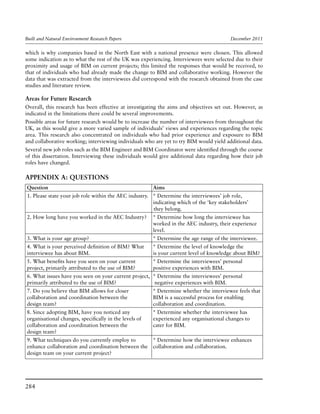
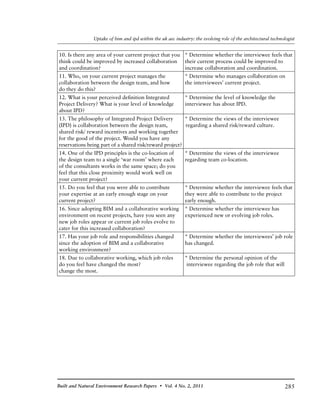
exposure to any new or evolving job roles (Appendix A).
RESULTS AND CONCLUSIONS
IPD enablers in the UK AEC industry
This research has shown that there are several IPD enablers currently in use in the UK AEC industry.
Clients are becoming more ‘intelligent’ and want more of an input into the project; this is pushing the
design team to provide the client with clear, accessible information. The client also voiced concerns
over poor design team performance, which was an issue previously identified. The use of BIM and
collaborative processes is enabling this process to improve. BIM is being used increasingly as a tool to
not only design, simulate and maintain buildings, but also as a way to communicate design intent to
invested parties.
Clients, designers and contractors are increasingly seeking to integrate at an earlier stage in the project
to identify key project and client objectives, strategies and timing of information release. The use of
dedicated client or model review meetings scheduled at strategic times is helping the design team and
283Built and Natural Environment Research Papers • Vol. 4 No. 2, 2011
Uptake of bim and ipd within the uk aec industry: the evolving role of the architectural technologist
client identify problematic areas, as well as reduce errors and design assumptions, which in turn reduces
time and money. The use of collaborative external document storage sites and new furniture solutions
are also aiding the design team in collaboration and coordination.
The majority of the interviewees identified that the co-location of the design team was potentially a good
idea, although they did state that it would only work if this happened at strategic times throughout the
project; this strategy was also identified in the case studies researched.
Several issues were also identified; including the current appointment process and procurement routes
taken by the contractors, which currently do not lend themselves to a collaborative working environment.
The lack of case history regarding the ‘multi-party’ contract tested in law was seen to be a prominent
barrier for trying IPD; this was also identified in the literature review.
BIM Benefits/issues
This research has shown that there has been a mixed response towards BIM and collaborative working.
Benefits include the ability to use 3D visualisations to communicate design intent to the client with more
clarity than traditional techniques; giving them a greater appreciation of the space. The combining of
individual design models to coordinate, run clash detections and enable the interrogation of complicated
design form was identified as a key benefit to the design team. Efficiencies over traditional processes,
increased quality of design output and reduction of redundant detailing, looks to benefit design teams
and contractor; these benefits were also identified in the research undertaken in the literature review.
The majority of the interviewees felt that using BIM enabled closer collaboration and coordination to
take place. The only barriers were the access to required software, early involvement of key participants,
and user understanding.
All interviewees noted that one issue regarding BIM was the learning curve that prevented users from
completing work efficiently, and that things took longer than traditional techniques.
New or evolving job roles
This research has revealed that the UK AEC industry is currently in a state of transition, with new
collaborativesoftware,toolsandprocessesbeingincreasinglyadopted.Thisincreasedlevelofcollaboration
has prompted an evolution in design professionals. Job roles such as the AT have started to evolve to
cater for the new tools and processes, some seeing this role evolving into a more multidisciplinary,
coordinating role. The identification of new roles such as the BIM Engineer and BIM Coordinator show
that these new processes require additional skill sets above what are already present. These roles have
also been identified to be present on both the design team and the contractors’ sides, generally sitting
outside the typical teams in a strategic role overseeing and managing the BIM and collaboration.
This research set out to investigate the past, present and future job role of the AT, through the research
carried out, it is evident that the AT will be one of many job roles that will evolve in the near future.
Design managers, architects and site personnel, will be part of this evolution, with the AEC industry
becoming more collaborative and team orientated.
FURTHER RESEARCH
Limitations of Research
The research carried out for this undergraduate dissertation gives an insight into BIM enabled IPD, and
the evolving job roles that are appearing in the North East AEC industry. Due to the selective sample
and the number and locality of the interviewees, the research is limited as it only portrays views and
experiences of professionals in the North East of the UK. The author was aware of this limitation,
Built and Natural Environment Research Papers	 December 2011
284
which is why companies based in the North East with a national presence were chosen. This allowed
some indication as to what the rest of the UK was experiencing. Interviewees were selected due to their
proximity and usage of BIM on current projects; this limited the responses that would be received, to
that of individuals who had already made the change to BIM and collaborative working. However the
data that was extracted from the interviewees did correspond with the research obtained from the case
studies and literature review.
Areas for Future Research
Overall, this research has been effective at investigating the aims and objectives set out. However, as
indicated in the limitations there could be several improvements.
Possible areas for future research would be to increase the number of interviewees from throughout the
UK, as this would give a more varied sample of individuals’ views and experiences regarding the topic
area. This research also concentrated on individuals who had prior experience and exposure to BIM
and collaborative working; interviewing individuals who are yet to try BIM would yield additional data.
Several new job roles such as the BIM Engineer and BIM Coordinator were identified through the course
of this dissertation. Interviewing these individuals would give additional data regarding how their job
roles have changed.
APPENDIX A: Questions
Question	Aims
1. Please state your job role within the AEC industry.	 * Determine the interviewees’ job role,
	 indicating which of the ‘key stakeholders’
		they belong.
2. How long have you worked in the AEC Industry?	 * Determine how long the interviewee has
	 worked in the AEC industry, their experience
	level.
3. What is your age group?	 * Determine the age range of the interviewee.
4. What is your perceived definition of BIM? What 	 * Determine the level of knowledge the
interviewee has about BIM.	 is your current level of knowledge about BIM?
5. What benefits have you seen on your current 	 * Determine the interviewees’ personal
project, primarily attributed to the use of BIM?	 positive experiences with BIM.
6. What issues have you seen on your current project, 	* Determine the interviewees’ personal
primarily attributed to the use of BIM?	 negative experiences with BIM.
7. Do you believe that BIM allows for closer 	 * Determine whether the interviewee feels that
collaboration and coordination between the 	 BIM is a successful process for enabling
design team?	 collaboration and coordination.
8. Since adopting BIM, have you noticed any 	 * Determine whether the interviewee has
organisational changes, specifically in the levels of 	 experienced any organisational changes to
collaboration and coordination between the 	 cater for BIM.
design team?	
9. What techniques do you currently employ to 	 * Determine how the interviewee enhances
enhance collaboration and coordination between the 	 collaboration and collaboration.
design team on your current project?
285Built and Natural Environment Research Papers • Vol. 4 No. 2, 2011
Uptake of bim and ipd within the uk aec industry: the evolving role of the architectural technologist
10. Is there any area of your current project that you 	 * Determine whether the interviewee feels that
think could be improved by increased collaboration 	 their current process could be improved to
and coordination?	 increase collaboration and coordination.
11. Who, on your current project manages the 	 * Determine who manages collaboration on
collaboration between the design team, and how 	 the interviewees’ current project.
do they do this?	
12. What is your perceived definition Integrated 	 * Determine the level of knowledge the
Project Delivery? What is your level of knowledge 	 interviewee has about IPD.
about IPD?	
13. The philosophy of Integrated Project Delivery 	 * Determine the views of the interviewee
(IPD) is collaboration between the design team, 		regarding a shared risk/reward culture.
shared risk/ reward incentives and working together
for the good of the project. Would you have any
reservations being part of a shared risk/reward project?
14. One of the IPD principles is the co-location of 	 * Determine the views of the interviewee
the design team to a single ‘war room’ where each 	 regarding team co-location.
of the consultants works in the same space; do you
feel that this close proximity would work well on
your current project?	
15. Do you feel that you were able to contribute 	 * Determine whether the interviewee feels that
your expertise at an early enough stage on your 	 they were able to contribute to the project
current project?	 early enough.
16. Since adopting BIM and a collaborative working 	 * Determine whether the interviewee has
environment on recent projects, have you seen any 	 experienced new or evolving job roles.
new job roles appear or current job roles evolve to
cater for this increased collaboration?	
17. Has your job role and responsibilities changed 	 * Determine whether the interviewees’ job role
since the adoption of BIM and a collaborative 	 has changed.
working environment?	
18. Due to collaborative working, which job roles 	 * Determine the personal opinion of the
do you feel have changed the most?	 interviewee regarding the job role that will
change the most.
Built and Natural Environment Research Papers	 December 2011
286
REFERENCES
AIA. The American Institute of Architects. (2007). Integrated Project Delivery: A Working Definition.
AIA. Available at: http://www.ipd-ca.net/images/Integrated%20Project%20Delivery%20Definition.pdf
(Accessed 19 November 2010)
AIA. The American Institute of Architects. (2010). Integrated Project Delivery: Case Studies. AIA.
Available at: http://www.aia.org/about/initiatives/AIAB082049 (Accessed 19 November 2010).
Autodesk. (2009). Take more risks - reap the rewards. Available at: www.images.autodesk.com/adsk/files/
trapelo_final_updated.pdf (Accessed 17 November 2010)
Becerik, B. and Pollalis, S. N. (2006). Computer aided collaboration for managing projects, Design and
Technology Report Series, Harvard Design School, Cambridge. [Online]. Available at: http://images.
autodesk.com/adsk/files/white_paper_computer_aided_collaboration_construction.pdf (Accessed: 06
January 2011).
Bernstein, P. (2010). Smartmarket Report: The Business Value of BIM in Europe. McGraw-Hill
Construction. Available at: http://bim.construction.com/research/FreeReport/BIM_Europe/ (Accessed 06
Oct 2010)
buildingSMART. (2010). Frequently Asked Questions, What is BIM. Available at: http://www.
buildingsmartalliance.org/index.php/nbims/faq/#faq1 (Accessed 03 January 2011)
Carbasho, T. (2008). Integrated Project Delivery Improves Efficiency, Streamlines Construction.
Available at: www.tradeline.com/reports/0A03D1C0%2D2B3B%2DB525%2D85702BCEDF900F61/
print (Accessed: 17 November 2010)
CIAT. (2010a). The history of CIAT. Available at: http://www.ciat.org.uk/en/the_institute/history.cfm
(Accessed 06 January 2011)
CIAT. (2010b). What does a professionally qualified Architectural Technician do? Available at: www.ciat.
org.uk/en/careers/What_does_a_professional_Architectural_Technician_do.cfm (Accessed 30 December
2010)
CMAA., Thomsen, C. (2009). Integrated Project Delivery: An Overview. Available at: www.
charlesthomsen.com/essays/IPD%20summary.pdf (Accessed 8 January 2011).
Eastman, C., Teicholz, P., Sacks, R. & Liston, K., (2008). BIM Handbook A guide to Building Information
Modelling for Owners, Managers, Designers, Engineers and Contractors. Hoboken, New Jersey: John
Wiley and Sons, Inc.
Emmitt, J. T. (1880). The profession of an Architect. British Quarterly Review. April, pp. 335-368.
Emmitt, S. (2002). Architectural Technology. Oxford: Blackwell Science Ltd.
Hardin, B., (2009). BIM and Construction Management Proven Tools, Methods, and Workflows.
Indianapolis, Indiana: Wiley Publishing, Inc.
Khemlani, L. (2009). Sutter Medical Center Castro Valley: Case Study of an IPD Project. Available at:
www.aecbytes.com/building the future/2009/sutter_IPDCaseStudy.html (Accessed 19 November 2010)
Northumbria University. (2010). Architectural Technology BSc (Hons) Course Information. Available at:
www.northumbria.ac.uk/?view=CourseDetail&code=DUPATC1 (Accessed 30 December 2010)
Stahl, N, Z. (2010) ASU Uses IPD to Speed Construction of Cronkite School. Available at: http://www.
tradelineinc.com/reports/96196521-A93A-2353-6DDD2E71846493FC (Accessed 05 January 2011).
Whaley, M. (2009). There is No “I” in IPD! Available at: www.aecbytes.com/viewpoint/2009/issue_45.
html (Accessed 19 November 2010)
Winston, A. (2010). Survey reveals industry split over BIM. Available at: www.bdonline.co.uk/news/
survey-reveals-industry-split-over-bim/5010009.article (Accessed: 20 December 2010)

Segment_001_of_PMoton-EMT-BIM-uptake

  • 1.
    275Built and NaturalEnvironment Research Papers • Vol. 4 No. 2, 2011 Uptake of bim and ipd within the uk aec industry: the evolving role of the architectural technologist Uptake of bim and ipd within the uk aec Industry: The Evolving Role of the Architectural Technologist Peter James Morton1 and Emine Mine Thompson2 ABSTRACT Building Information Modelling is not only a tool, but also the process of creation, maintenance, distribution and co-ordination of an integrated database that collaboratively stores 2D and 3D information, with embedded physical and functional data within a project-building model. The uptake of BIM within the UK Architecture, Engineering and Construction (AEC) industry has been slow since the 1980’s, but over recent years, adoptions have increased. The increased collaborative nature of BIM, external data sharing techniques and progressively complex building design, promotes requirements for design teams to coordinate and communicate more effectively to achieve project goals. To manage this collaboration, new or evolved job roles may emerge. This research examined the current use of BIM, Integrated Project Delivery (IPD) and collaborative working in the UK AEC industry and job roles that have evolved or been created to cater for them. Using semi-structured interviews the interviewees indicated while several of the key enablers of IPD were being used, IPD itself had not been fully adopted. BIM was being used with some success but improvements could be made. New job roles such as the BIM Engineer and BIM Coordinator had been seen in the industry and evidence that the Architectural Technologist (AT) role is evolving into a more multidisciplinary role; this reflects similar findings of recent research. Keywords: Building Information Modelling, Integrated Project Delivery, Enablers, Architectural Technologist. 1 Awarded to “Space architecure award for Achievement in Architectural Technology, 2011” 2 School of the Built and Natural Environment, Northumbria University, Elison Building, Newcastle upon Tyne NE1 8ST.
  • 2.
    Built and NaturalEnvironment Research Papers December 2011 276 INTRODUCTION The uptake of Building Information Modelling (BIM) and a collaborative working environment has been slow in the UK, but over recent years, adoptions have increased. This research seeks to identify the key benefits of using BIM enabled Integrated Project Delivery (IPD) within the UK construction industry, further identifying what effect this will have on the future roles of built environment professionals, specifically the role of the Architectural Technologist (AT). This research reports on information obtained from case studies produced in the USA as a direct comparison to the UK and a review of current literature. The aims of this research were to: • Investigate which, if any of the known characteristics of IPD are being used in the UK AEC industry. • Investigate the benefits/issues experienced with BIM in the UK AEC industry. • Identify the presence of any new or evolving job roles. WHAT IS INTEGRATED PROJECT DELIVERY IPD is a project delivery approach which integrates people, systems, business structures and practices into a process that collaboratively harnesses the talents and insights of all participants, to reduce waste and optimize efficiency through all phases of design, fabrication and construction (AIA, 2007). The primary characteristics identified by the American Institute of Architects AIA (2007) as fundamental to the success of IPD are: • Mutual respect, trust, benefits and reward. • Collaborative innovation and decision making. • Early involvement of key participants. • Early goal definition. • Intensified planning. • Open communication. • Appropriate technology. • Organisation and leadership. With the backbone of IPD being ‘Teamwork’, the development of openness and trust between the stakeholders is extremely important. The project team is seen as the lifeblood of IPD; within an IPD arrangement, the project team comes together and works collaboratively as an Integrated Project Team (IPT) (Hardin, 2009). During a typical delivery process within the AEC industry, each consultant sticks to their own role and responsibilities, maintaining a ‘silo’ effect, only ever looking outside their silo of responsibility when problems occur, by which time it’s too late (Whaley, 2009). IPD promotes the flattening of these ‘silos’, which in turn increases the ability to build respect and trust, and harbours open communication, which the AIA identifies fundamental to the success of IPD. The sequences in IPD are similar to projects using traditional delivery models; it begins with a concept stage, which is worked up and followed by a construction stage, culminating with the project sign off or closeout. The differences between IPD and traditional models are the convergence of stakeholders at an earlier stage, and the early upfront effort that is required at the beginning of the project rather than later in the construction documents stage. This early upfront effort is facilitated by the involvement of the key participants who create the complete Integrated Project Team (IPT). The key participants then collaboratively define the project goals from the outset, rather than individual goals (AIA, 2007).
  • 3.
    277Built and NaturalEnvironment Research Papers • Vol. 4 No. 2, 2011 Uptake of bim and ipd within the uk aec industry: the evolving role of the architectural technologist IPD was created in the 1990’s; companies adopting IPD for the first time may adjust the arrangement and approach making it more accessible. However, the essence of an IPD arrangement will remain unchanged; consisting of a core team of stakeholders that includes the owner, the architect/engineers and the contractor (other consultants may be included). They sign a single, multi-party contract with the owner, who collaboratively outlines project goals with cost, time and quality attributes (CMAA, 2009). WHAT IS BUILDING INFORMATION MODELLING The National BIM Standard (NBIMS) defines BIM as: “a digital representation of physical and functional characteristics of a facility...and a shared knowledge resource for information about a facility forming a reliable basis for decisions during its life-cycle; defined as existing from earliest conception to demolition.” (buildingSMART, 2010). The uptake of BIM within the UK AEC industry has been slow since the 1980’s, but over recent years, adoptions have increased. In a recent survey, 35% of construction professionals in the UK claim to use BIM of that, 60% of architects, 39% of engineers and 23% of contractors (Bernstein, 2010). However, it was revealed in a recent survey by standards and specification expert NBS that there was still an ‘alarming lack of awareness’ of BIM across the UK construction industry (Winston, 2010). Adopting BIM requires substantial operational changes within the construction industry, changing how buildings are designed and constructed (Becerik and Pollalis, 2006). These changes include requirements for additional training, particularly the information producers (the Architectural Technologists); timing for information release (less information upfront as 3D modelling has to take place) and more time spent collaborating. ROLE OF THE ARCHITECTURAL TECHNOLOGIST For many years the role of the AT was largely unrecognised and un-respected within an architectural practice and within the AEC industry as a whole. The AT, although responsible for bridging the gap between conceptual design and production, endured years devoid of recognised status, seemingly overshadowed by the architect (Emmitt, 2002). John T Emmitt (1880) criticised the ‘strange and paradoxical profession’ of architecture; highlighting particularly the quandary of architectural assistants, claiming they were the most important member of the architectural profession. Emmitt urged architects assistants to form an association; however his views were not listened to for many years. In 1965, following a report from the Royal Institute for British Architects (RIBA) which called for the establishment of ‘an institute for technicians’, the Society of Architectural and Associated Technicians (SAAT) was formed. In 1986, SAAT changed its name to the British Institute of Architectural Technologists (BIAT) and then changed to the Chartered Institute of Architectural Technologists (CIAT) which remains its name today (CIAT, 2010a). The CIAT defines the AT as a specialist in the application of technology to architecture, building design and construction (CIAT, 2010b). Northumbria University (in their course information) define the AT as the interface between design and construction, optimising building performance and efficiency. They state an AT will have the ability to “analyse, synthesise and evaluate building design factors in order to produce efficient and effective technical design solutions which satisfy performance, production and procurement criteria” of a project (Northumbria University, 2010). Future Role of the Architectural Technologist As previously described the AEC industry is facing a paradigm shift with evolving roles and responsibilities,
  • 4.
    Built and NaturalEnvironment Research Papers December 2011 278 primarily due to newly emerging collaborative technologies and processes such as BIM and IPD. New roles will inevitably be formed catering for the more collaborative nature of the industry; roles such as ‘Building Modeller’, ‘Model Manager’ or ‘Collaboration Manager’ may be seen to emerge over time (Eastman et al, 2008). The role of the AT may also evolve to adapt to this new ‘paradigm’; a role which not only encapsulates all of the previous characteristics of the AT, but also new collaborative qualities and the prerequisites to be BIM savvy as a condition of employment or additional management skills for example. BIM CASE STUDIES - RECENT CASE STUDIES Several key case studies were taken from the AIA case studies document (AIA 2010), detailing projects which used BIM enabled IPD to varying degrees, also identifying the success/failures and lessons learnt. The table below shows the three case studies that were analysed in order to define the key IPD characteristics and the relationship between IPD and BIM; identifying what extent they employed the underlying core values of IPD within the project contract arrangement (Table 1). IPD Characteristics Autodesk AEC Sutter Health Walter Cronkite (Taken from case studies) Solutions Division Fairfield Medical School of Headquarters Office Building Journalism Early Involvement of Key Participants Yes Yes Yes Shared Risk and Reward Yes No No Multi-Party Contract Yes Yes No Collaborative Decision Making Yes Yes Yes Liability Waivers Yes No No Jointly Developed Goals Yes Yes Yes Table 1: Case Study Projects (AIA, 2010) Autodesk AEC Solutions Division Headquarters The Autodesk AEC Solutions Division Headquarters in project Waltham, Massachusetts was Autodesk’s third project used to highlight its new software and implementation of the new trends in the construction industry. It showed how they could support BIM, design-to-fabrication, sustainability and building performance analysis, with particular emphasis on incorporating IPD. The project involved the fit out of a 55,000 square feet, three-storey new tenant improvement within a speculative office building. The project included office space and associated conference rooms, training facilities, cafe and a 5,000 square feet customer-briefing centre. Autodesk handpicked an architect/builder team that were willing to try IPD. Early leaders in the selection process wanted to change the proposed IPD arrangement; Autodesk declined. Klingstubbins and Tocci Building were finally chosen; primarily due to their experience, local knowledge and suitability to the client’s requirements. Both teams had extensive experience with BIM and LEED, both showing their willingness to try IPD even though neither had tried it before (Autodesk, 2009). Autodesk worked with both firms to create measurable and performance based goals for the project, linked to the Incentive Compensation Layer (ICL). The primary goals were: to stay within budget, that a very high sustainability goal (LEED Platinum for commercial interiors) was to be achieved and the project would be completed within a very tight schedule of just eight and a half months.
  • 5.
    279Built and NaturalEnvironment Research Papers • Vol. 4 No. 2, 2011 Uptake of bim and ipd within the uk aec industry: the evolving role of the architectural technologist The project did run into some problems, i.e. software interoperability. Although the project resulted in a ‘triple win’ for the stakeholders. Design/construction costs were below the target set, benefitting both the design team and owner; the designer and contractor both exceeded their profit targets and the building achieved the sustainability target of LEED CI Platinum (AIA 2010). Lessons Learned According to the feedback given in the study several of the design team principals noted it was crucial they select the architect and builder as a team; if the architect and builder did not show the synergy required, another team would be chosen. AIA (2010) reports that Phil Bernstein, Autodesk’s Vice President for Industry Strategy and Relations stated ‘the first step should be a scoping exercise taken to the level of conceptual, in which everyone works at cost until a deep understanding of the project and budget is achieved by all parties’, echoing the ‘Early Goal Definition’ characteristic of IPD. Bernstein also noted financial incentives, the ‘Joint risk and reward’ Incentive Compensation Layer (ICL) were causing unwelcome changes in behaviour, further stating it didn’t mean the incentives would be dropped, as they are essential for supporting the right kind of behaviour (AIA, 2010). The study noted the architect learned by using IPD and by the close collaboration with the builder. Redundant detailing was unnecessary, saving time and leaving the architect to deal with more important problem. Sutter Health Fairfield Medical Office Building The Sutter Health Fairfield Medical Office Building in Castro Valley, California was a $320 million project fully funded by Sutter Health, the first hospital in its county not financed by the taxpayer or other public fund, and one of the largest non-profit care providers in Northern California (AIA, 2010 and Khemlani, 2009). Sutter Health was looking for new ways to design, build and maintain its facilities following several disputatious projects. They hosted the Sutter Lean Summit in 2004, with help from the Lean Construction Institute (LCI), they set out their plans for transforming the way Sutter projects would be designed, built and maintained. The project involved the construction of a three-storey, 70,000 square metre medical office building, housing primary care medical practices and laboratories; fully equipped with cardiology, oncology, paediatrics and rheumatology departments. The owner, Sutter, wanted to use this opportunity to test a new delivery process of collaboration and advanced technology. Their vision to create a landmark medical centre that integrated advanced technologies without compromising patient comfort and care (Khemlani, 2009). Sutter Health was looking for new ways to design, build and maintain its facilities following several disputatious projects. They hosted the Sutter Lean Summit in 2004, with help from the Lean Construction Institute (LCI), they set out their plans for transforming the way Sutter projects would be designed, built and maintained. Due to new safety laws introduced, requiring the organisation and execution of several large projects within a specific timeframe, Sutter Health had to find a way to reduce the time delays and budget over- runs generally associated with large complex projects. Specifically Sutter Health looked at how it could transform the design and construction delivery model. IPD came to the attention of Sutter Health, becoming a viable alternative. SH needed the project delivered in 25 months; this was a very tight schedule as there was also a three month delay for programming at the start of the project and addition of extra scope (AIA, 2010). The project was completed under budget, it was estimated that Sutter Health saved approximately $9 million (Carbasho, 2008) it was within schedule; change orders being virtually eliminated (AIA, 2010).
  • 6.
    Built and NaturalEnvironment Research Papers December 2011 280 Lessons Learned The feedback from the study noted the sub-contractors felt there was more intense effort required up front compared to traditional delivery systems, but all agreed that the benefits of this up front effort and collaboration comes later in the project, rework was almost completely eliminated. The contractor also felt having supervisors on site full time with BIM software to continuously check the progress and instantly find solutions to arising problems would be beneficial. The study noted that the IPD philosophy wasn’t accepted by everyone. Several subcontractors did not want their foremen attending group scheduling meetings; this has now become a mandatory requirement from the contractor. The design team stated they felt the owner had to be kept engaged from the earliest design stages and throughout construction. This enabled quick decision making on the owners’ side, meaning less delays for the project. Sutter Health was extremely pleased with the building and process. It has since been applied by Sutter Health to larger, more complex projects. Walter Cronkite School of Journalism The Cronkite School of Journalism was a venture by the City of Phoenix for Arizona State University (ASU), financed by a city bond measure. The project was to construct a six-storey, 230,000 square feet building, which included: classrooms and offices for the School of Journalism and Mass Communication, a university operated television station, general purpose classrooms and ground floor retail spaces which were intended to activate the ground floor street (AIA, 2010). Due to the size of the proposed ASU campus, it would fill a nine block area, so the concept was an extremely important aspect of the Phoenix redevelopment vision. As the first significant building to be built on the most prominent site, the Cronkite School was expected to set a high standard in not only design quality but also construction quality. The project required a number of rooms with advanced technology and specific performance requirements such as recording studios, control rooms, production studios etc. all of which would need all of the services accurately designed and coordinated. The City and University both had sustainability goals; the City wanted the project to be LEED certified and the university wanted it to be LEED silver or higher (AIA, 2010). The project suffered from an extremely tight 24 month schedule, which was due to the ‘drop-dead’ date for move in described by the bond measure. The only way that the project would be to be completed in this tight schedule was by adopting IPD (Stahl, 2010). One of the IPD tenets that the project team used was to co-locate the team members in a ‘Big Room’ from day one. Having the architect, engineers and contractors in one room promoted the understanding of the project vision; if any problems were encountered they were collaboratively solved by the whole team. The project was delivered on schedule, which meant the school could be handed over to the client ready for the start of term. The design costs were under budget but the construction costs ran over budget. The project achieved LEED silver certification (AIA, 2010). Lessons Learned The design team quickly realised that in order for the project to be successful, they had to change the behaviours that they were used to. They team felt that if they had slipped back into their traditional mentality the project wouldn’t have been completed. The design team also stated that co-location works, because when people work together closely, you naturally build a relationship of trust and respect, one of the key characteristics of IPD. Although they
  • 7.
    281Built and NaturalEnvironment Research Papers • Vol. 4 No. 2, 2011 Uptake of bim and ipd within the uk aec industry: the evolving role of the architectural technologist hit the tight programme schedule, the design team felt that an extra month would have been beneficial, as the collaboration that was happening was extremely intense. Interoperability issues became apparent in the project as the design architects were using Revit and the executive architects were using Architectural Desktop. The translation of the models back and forth was troublesome and problematic, which was extremely inefficient. The executive architect felt there wasn’t enough time to train their staff in Revit for this project however, the firm has now since completely transitioned to Revit. Some of the sub-contractors felt uncomfortable with the nature of the IPD process and it was decided that in the future extended training would be provided. Overall, each of the stakeholders thought that the project went well, but did voice concern that some of the lean construction techniques were inflexible. Case Study Summary The three case studies examined identified numerous benefits associated with IPD. They have shown projects that have tight budgets and programmes that would normally be prone to value engineering to achieve budgets, and also involve delays when using a traditional delivery system, can be achieved and in some instances excelled if an IPD system is adopted. It is also clear there are some issues associated with IPD; people’s reluctance to try something new or change their ways by using something they are uncomfortable with is an issue that was seen on both the case studies. According to the feedback given in the case studies interoperability also appears to be quite a common issue that has affected projects using BIM and IPD. Early planning and getting the key participants together early enough can reduce the problem of interoperability issues arising, as software can be agreed prior to commencement of the project. It is clear that IPD requires further development to be a ‘perfect’ delivery system, but it has shown it can solve issues and inefficiencies currently affecting the construction industry. The key issues obtained from the case studies enabled the production of the research methodology and aided the question design. METHODOLOGY The chosen method of research is a qualitative methodology and semi-structured interviews were conducted. The interviews began with closed answer questions for classification purposes, followed by standard open answer questions. Prompts were given to stimulate further discussion, also to help interviewees to provide personal views, opinions and experiences regarding their exposure to BIM, IPD and evolving job roles. The interview questions were delivered using a standard script. This maintained similarity in question delivery so responses can be analysed accurately and fairly. The questions were formulated in a way that they were equally accessible to each interviewee, meaning they could understand the question in order to provide valuable and unique responses. Interviewee Selection Interviewees were selected due to: • Their varying experience and position in the AEC industry in the North East of England, • Their proximity/usage of BIM and • Collaborative working on current projects. The chosen interviewees represent the ‘Key Stakeholders’ as identified in an IPD multiparty contract (Table 2).
  • 8.
    Built and NaturalEnvironment Research Papers December 2011 282 Interviewee Company Position in AEC Industry (Key Stakeholder group) I1 C1 Client Senior Project Manager (Owner) I2 C2 Senior Design Manager (Constructor) I3 C3 Structural Engineer (Designer) I4 C4 Senior Architect (Designer) I5 C4 Senior Architectural Technologist (Designer) Table 2: Interviewee clasification Interview protocol and coding The Interviews were held at each interviewee’s place of work, to provide ease for the individual, reducing disruption to their daily working duties. The interviews were audio-recorded and later transcribed for analysis purposes, so analysis did not depend primarily on notes taken during the interview. During the process of transcribing the interviewees, companies, people and buildings/projects were assigned a code to maintain anonymity (Table 3). Interview coding Coding Represents I1, I2, I3 etc Interviewees C1, C2, C3 etc Companies B1, B2, B3 etc Buildings/Projects P1, P2, P3 etc People Table 3: Interviewee coding Question Selection Interview questions were determined through analysis of key issues raised from literature review and the analysis of the case-studies. Designed to examine which enablers of BIM enabled IPD were currently being used, as well as the personal experiences regarding collaboration and coordination, and their exposure to any new or evolving job roles (Appendix A). RESULTS AND CONCLUSIONS IPD enablers in the UK AEC industry This research has shown that there are several IPD enablers currently in use in the UK AEC industry. Clients are becoming more ‘intelligent’ and want more of an input into the project; this is pushing the design team to provide the client with clear, accessible information. The client also voiced concerns over poor design team performance, which was an issue previously identified. The use of BIM and collaborative processes is enabling this process to improve. BIM is being used increasingly as a tool to not only design, simulate and maintain buildings, but also as a way to communicate design intent to invested parties. Clients, designers and contractors are increasingly seeking to integrate at an earlier stage in the project to identify key project and client objectives, strategies and timing of information release. The use of dedicated client or model review meetings scheduled at strategic times is helping the design team and
  • 9.
    283Built and NaturalEnvironment Research Papers • Vol. 4 No. 2, 2011 Uptake of bim and ipd within the uk aec industry: the evolving role of the architectural technologist client identify problematic areas, as well as reduce errors and design assumptions, which in turn reduces time and money. The use of collaborative external document storage sites and new furniture solutions are also aiding the design team in collaboration and coordination. The majority of the interviewees identified that the co-location of the design team was potentially a good idea, although they did state that it would only work if this happened at strategic times throughout the project; this strategy was also identified in the case studies researched. Several issues were also identified; including the current appointment process and procurement routes taken by the contractors, which currently do not lend themselves to a collaborative working environment. The lack of case history regarding the ‘multi-party’ contract tested in law was seen to be a prominent barrier for trying IPD; this was also identified in the literature review. BIM Benefits/issues This research has shown that there has been a mixed response towards BIM and collaborative working. Benefits include the ability to use 3D visualisations to communicate design intent to the client with more clarity than traditional techniques; giving them a greater appreciation of the space. The combining of individual design models to coordinate, run clash detections and enable the interrogation of complicated design form was identified as a key benefit to the design team. Efficiencies over traditional processes, increased quality of design output and reduction of redundant detailing, looks to benefit design teams and contractor; these benefits were also identified in the research undertaken in the literature review. The majority of the interviewees felt that using BIM enabled closer collaboration and coordination to take place. The only barriers were the access to required software, early involvement of key participants, and user understanding. All interviewees noted that one issue regarding BIM was the learning curve that prevented users from completing work efficiently, and that things took longer than traditional techniques. New or evolving job roles This research has revealed that the UK AEC industry is currently in a state of transition, with new collaborativesoftware,toolsandprocessesbeingincreasinglyadopted.Thisincreasedlevelofcollaboration has prompted an evolution in design professionals. Job roles such as the AT have started to evolve to cater for the new tools and processes, some seeing this role evolving into a more multidisciplinary, coordinating role. The identification of new roles such as the BIM Engineer and BIM Coordinator show that these new processes require additional skill sets above what are already present. These roles have also been identified to be present on both the design team and the contractors’ sides, generally sitting outside the typical teams in a strategic role overseeing and managing the BIM and collaboration. This research set out to investigate the past, present and future job role of the AT, through the research carried out, it is evident that the AT will be one of many job roles that will evolve in the near future. Design managers, architects and site personnel, will be part of this evolution, with the AEC industry becoming more collaborative and team orientated. FURTHER RESEARCH Limitations of Research The research carried out for this undergraduate dissertation gives an insight into BIM enabled IPD, and the evolving job roles that are appearing in the North East AEC industry. Due to the selective sample and the number and locality of the interviewees, the research is limited as it only portrays views and experiences of professionals in the North East of the UK. The author was aware of this limitation,
  • 10.
    Built and NaturalEnvironment Research Papers December 2011 284 which is why companies based in the North East with a national presence were chosen. This allowed some indication as to what the rest of the UK was experiencing. Interviewees were selected due to their proximity and usage of BIM on current projects; this limited the responses that would be received, to that of individuals who had already made the change to BIM and collaborative working. However the data that was extracted from the interviewees did correspond with the research obtained from the case studies and literature review. Areas for Future Research Overall, this research has been effective at investigating the aims and objectives set out. However, as indicated in the limitations there could be several improvements. Possible areas for future research would be to increase the number of interviewees from throughout the UK, as this would give a more varied sample of individuals’ views and experiences regarding the topic area. This research also concentrated on individuals who had prior experience and exposure to BIM and collaborative working; interviewing individuals who are yet to try BIM would yield additional data. Several new job roles such as the BIM Engineer and BIM Coordinator were identified through the course of this dissertation. Interviewing these individuals would give additional data regarding how their job roles have changed. APPENDIX A: Questions Question Aims 1. Please state your job role within the AEC industry. * Determine the interviewees’ job role, indicating which of the ‘key stakeholders’ they belong. 2. How long have you worked in the AEC Industry? * Determine how long the interviewee has worked in the AEC industry, their experience level. 3. What is your age group? * Determine the age range of the interviewee. 4. What is your perceived definition of BIM? What * Determine the level of knowledge the interviewee has about BIM. is your current level of knowledge about BIM? 5. What benefits have you seen on your current * Determine the interviewees’ personal project, primarily attributed to the use of BIM? positive experiences with BIM. 6. What issues have you seen on your current project, * Determine the interviewees’ personal primarily attributed to the use of BIM? negative experiences with BIM. 7. Do you believe that BIM allows for closer * Determine whether the interviewee feels that collaboration and coordination between the BIM is a successful process for enabling design team? collaboration and coordination. 8. Since adopting BIM, have you noticed any * Determine whether the interviewee has organisational changes, specifically in the levels of experienced any organisational changes to collaboration and coordination between the cater for BIM. design team? 9. What techniques do you currently employ to * Determine how the interviewee enhances enhance collaboration and coordination between the collaboration and collaboration. design team on your current project?
  • 11.
    285Built and NaturalEnvironment Research Papers • Vol. 4 No. 2, 2011 Uptake of bim and ipd within the uk aec industry: the evolving role of the architectural technologist 10. Is there any area of your current project that you * Determine whether the interviewee feels that think could be improved by increased collaboration their current process could be improved to and coordination? increase collaboration and coordination. 11. Who, on your current project manages the * Determine who manages collaboration on collaboration between the design team, and how the interviewees’ current project. do they do this? 12. What is your perceived definition Integrated * Determine the level of knowledge the Project Delivery? What is your level of knowledge interviewee has about IPD. about IPD? 13. The philosophy of Integrated Project Delivery * Determine the views of the interviewee (IPD) is collaboration between the design team, regarding a shared risk/reward culture. shared risk/ reward incentives and working together for the good of the project. Would you have any reservations being part of a shared risk/reward project? 14. One of the IPD principles is the co-location of * Determine the views of the interviewee the design team to a single ‘war room’ where each regarding team co-location. of the consultants works in the same space; do you feel that this close proximity would work well on your current project? 15. Do you feel that you were able to contribute * Determine whether the interviewee feels that your expertise at an early enough stage on your they were able to contribute to the project current project? early enough. 16. Since adopting BIM and a collaborative working * Determine whether the interviewee has environment on recent projects, have you seen any experienced new or evolving job roles. new job roles appear or current job roles evolve to cater for this increased collaboration? 17. Has your job role and responsibilities changed * Determine whether the interviewees’ job role since the adoption of BIM and a collaborative has changed. working environment? 18. Due to collaborative working, which job roles * Determine the personal opinion of the do you feel have changed the most? interviewee regarding the job role that will change the most.
  • 12.
    Built and NaturalEnvironment Research Papers December 2011 286 REFERENCES AIA. The American Institute of Architects. (2007). Integrated Project Delivery: A Working Definition. AIA. Available at: http://www.ipd-ca.net/images/Integrated%20Project%20Delivery%20Definition.pdf (Accessed 19 November 2010) AIA. The American Institute of Architects. (2010). Integrated Project Delivery: Case Studies. AIA. Available at: http://www.aia.org/about/initiatives/AIAB082049 (Accessed 19 November 2010). Autodesk. (2009). Take more risks - reap the rewards. Available at: www.images.autodesk.com/adsk/files/ trapelo_final_updated.pdf (Accessed 17 November 2010) Becerik, B. and Pollalis, S. N. (2006). Computer aided collaboration for managing projects, Design and Technology Report Series, Harvard Design School, Cambridge. [Online]. Available at: http://images. autodesk.com/adsk/files/white_paper_computer_aided_collaboration_construction.pdf (Accessed: 06 January 2011). Bernstein, P. (2010). Smartmarket Report: The Business Value of BIM in Europe. McGraw-Hill Construction. Available at: http://bim.construction.com/research/FreeReport/BIM_Europe/ (Accessed 06 Oct 2010) buildingSMART. (2010). Frequently Asked Questions, What is BIM. Available at: http://www. buildingsmartalliance.org/index.php/nbims/faq/#faq1 (Accessed 03 January 2011) Carbasho, T. (2008). Integrated Project Delivery Improves Efficiency, Streamlines Construction. Available at: www.tradeline.com/reports/0A03D1C0%2D2B3B%2DB525%2D85702BCEDF900F61/ print (Accessed: 17 November 2010) CIAT. (2010a). The history of CIAT. Available at: http://www.ciat.org.uk/en/the_institute/history.cfm (Accessed 06 January 2011) CIAT. (2010b). What does a professionally qualified Architectural Technician do? Available at: www.ciat. org.uk/en/careers/What_does_a_professional_Architectural_Technician_do.cfm (Accessed 30 December 2010) CMAA., Thomsen, C. (2009). Integrated Project Delivery: An Overview. Available at: www. charlesthomsen.com/essays/IPD%20summary.pdf (Accessed 8 January 2011). Eastman, C., Teicholz, P., Sacks, R. & Liston, K., (2008). BIM Handbook A guide to Building Information Modelling for Owners, Managers, Designers, Engineers and Contractors. Hoboken, New Jersey: John Wiley and Sons, Inc. Emmitt, J. T. (1880). The profession of an Architect. British Quarterly Review. April, pp. 335-368. Emmitt, S. (2002). Architectural Technology. Oxford: Blackwell Science Ltd. Hardin, B., (2009). BIM and Construction Management Proven Tools, Methods, and Workflows. Indianapolis, Indiana: Wiley Publishing, Inc. Khemlani, L. (2009). Sutter Medical Center Castro Valley: Case Study of an IPD Project. Available at: www.aecbytes.com/building the future/2009/sutter_IPDCaseStudy.html (Accessed 19 November 2010) Northumbria University. (2010). Architectural Technology BSc (Hons) Course Information. Available at: www.northumbria.ac.uk/?view=CourseDetail&code=DUPATC1 (Accessed 30 December 2010) Stahl, N, Z. (2010) ASU Uses IPD to Speed Construction of Cronkite School. Available at: http://www. tradelineinc.com/reports/96196521-A93A-2353-6DDD2E71846493FC (Accessed 05 January 2011). Whaley, M. (2009). There is No “I” in IPD! Available at: www.aecbytes.com/viewpoint/2009/issue_45. html (Accessed 19 November 2010) Winston, A. (2010). Survey reveals industry split over BIM. Available at: www.bdonline.co.uk/news/ survey-reveals-industry-split-over-bim/5010009.article (Accessed: 20 December 2010)