4
AEC Market Trend
(IHSEconomics, 2013)
Global yearly construction spending
Residential From less than 3 trillion in 2010 to
4 trillion in 2020
Structures From 2.3 trillion in 2010 to more than
3 trillion in 2020
Infrastructure From less than 2 trillion in 2010 to
more than 3 trillion in 2020
Total more than 11 trillion in 2020 (per year!)
5.
5
Traditional Asset DeliveryProcess
Paper-based documentation & communication
Unanticipated field costs and delays due to
errors, omissions and changes during construction.
Significant time to carry out critical assessment
of design information.
Costly fabrication due to inconsistency,
inaccuracy and uncertainty in design.
Most fabrication and construction is onsite
where exact conditions are known.
Compared with factory environments, errors are
more common due to ill-defined and changing
onsite conditions.
6.
6
Traditional Asset DeliveryProcess
Lack of collaboration and much fragmentation
Incompatible systems in use by various teams
make it difficult to collaborate efficiently.
Bad interoperability prevents team members from
sharing information quickly and accurately,
resulting in added costs in construction, operation
and maintenance phases.
(Eastman, 2008)
Limited depth of building information in drawings
Leads to the need for re-entering data for post-
design simulation and analysis.
7.
7
Cost of Changes
Refinedfrom http://www.hok.com/thought-leadership/patrick-macleamy-on-the-future-
of-the-building-industry/ (Patrick MacLeamy, CEO HOK), see also
http://codebim.com/wp-content/uploads/2013/06/CurtCollaboration.pdf (CURT, 2004)
Ability to Impact cost and
performance
Cost of design changes
Drafting-centric workflow
Design
Effect/Cost/Effort
BIM workflow
Construction Operation
Detailing
9
Learning Outcomes
A betterunderstanding of
– features & benefits
– implementing BIM as a process and as a new
way of thinking
– integration throughout the building life cycle
– risks and challenges
Primary question:
– What are the keys to successful BIM
implementation?
10.
10
What is BIM?
Isit a design tool? A database? A management tool?
Digital representation of the physical and
functional characteristics of a facility.
Context: collaboration involving stakeholders of a
facility (insert, extract, update or modify
information).
(Smith, 2007)
11.
11
What is BIM?
BIMis a way of working.
BIM is information modeling and information
management in a team environment. All team
members work to the same standards. “BIM creates
value from the combined efforts of people, process
and technology.”
(UK National Building Specification, 2014)
The word “Building” in BIM is best taken as a verb.
(Kumar, 2015)
12.
12
What is NotBIM?
• Data models that contain 3D data only and no
object attributes
• Models with no support of behavior
• Multiple 2D CAD reference files that must be
combined to define the building
• Models that allow changes to dimensions in one
view that are not automatically reflected in other
views
13.
13
The ‘IM’ ofBIM
Information Modeling
An information model in software engineering is a
representation of concepts and the relationships,
constraints, rules, and operations to specify data
semantics for a chosen field.
Typically BIM specifies relations between kinds of
things, and may also include relations with
individual things. BIM can provide sharable,
stable, and organized structure of information
requirements and knowledge of the domain
context.
(B. Kumar
, Course Material, Building Information Modelling)
14.
14
Building Information Model
Foran example, see
http://www.bimproject.es/componentes/fotografia/megapic.jpg
Complex object-oriented data structures containing
architectual details as well as relevant information
from fields such as structural, foundations,
electrical, sanitary, HVAC and mechanical are
included in BIM models.
15.
15
Parametric BIM Objects
Animportant aspect of BIM is the concept of parametric
objects. These objects …
• consist of geometric definitions and associated data
and rules.
• have rules that determine when a particular change
violates object feasibility regarding size,
manufacturability, etc.
• are defined at different levels of aggregation.
• have the ability to link to or receive, broadcast or
export sets of attributes to other applications and
models. (Eastman, 2008)
16.
16
Parametric BIM Objects
Multipleinstances of a product are generated
from a parametric BIM model, based on user
needs for a particular project.
For an example, see
http://construction.com/CE/CE_images/2011/Apr_BIM_2.jpg
17.
17
Support for project-team
collaboration
Challenge
Buildingactivities involves diverse sets of
information and models. A lack of interoperability
may result in significant extra costs.
Two approaches
– Use software of the same vendor.
– Use software of various vendors which exchange
data using industry standards.
18.
18
Matrix of BIM
Fourpossibilities are:
• Closed BIM: Use of software tools of one single
vendor and proprietary formats for data
exchange.
• Open BIM: Use of software tools of different
vendors and open formats for data exchange.
• Little BIM: Isolated use of software tools to
solve specific tasks.
• Big BIM: Integrated use of a digital building
model among different disciplines throughout the
asset life cycle.
(Jernigan, 2008)
20
IFC – IndustryFoundation Classes
An attempt at standardization.
IFC is an ISO standard data schema for holding and
transmitting facility information throughout the
facility lifecycle.
(B. Kumar
, Course Material, Building Information Modelling)
Developed by International Alliance for
Interoperability (IAI), now called buildingSMART.
Website: http://www.buildingsmart.org/
21.
21
IFC
IFC is anopen, standardised and object-oriented
data model/format used to define digital building
information including geometric, physical and
functional properties.
Open, neutral schema for information exchange.
Most BIM-tools support export and import for IFC
files.
22.
22
IFC
Object oriented, providingthe following
– Inheritance Inherited properties of classes.
‐
– Polymorphism Provision of a single interface
‐
to different types of entities.
– Extensibility Future growth taken into
‐
consideration.
Building objects are instances of classes.
23.
IFC Model Architecture
23
SharedBuilding Elements
Product
Extension
Kernel
Refined from IFC 2x3 Architecture Diagram from
http://www.buildingsmart-tech.org/ifc/IFC2x3/TC1/html/
Other Elements
Date Time
Geometry
Material
Measure
Profile
Property
Quantity
Technology
Utility
Actor
Geometric Constraint
Geometric Model
External Reference
Representation
Resource Types:
Control Extension Process Extension
Architecture Domain Other Domains
24.
24
Geometric Representation VS
BuildingRepresentation
Rectangle
-Origin Point
-Length
-Width
Point
-X Coordinate
-Y Coordinate
R1 P1
Geometric representation:
25.
25
Geometric Representation VS
BuildingRepresentation
Building representation:
Wall
-Start Point
-Length
-Height
-Type
-Connected Walls
-Attached Spaces
-… Space
-Function
-Occupant
-Area
-…
Point
-X Coordinate
-Y Coordinate
W2
W1 W3
P3 S1
26.
26
IFC
IFC standards havethe potential to facilitate
information sharing across different practitioners in
a cost-effective way.
Challenges:
– International differences in laws, processes,
materials, etc.
– Inter-field differences in mining, petrochemical,
housing, bridges, etc.
– Complexity, large number of different ways to
describe geometry
31
nD Evolution
2D –Geometrical shapes in 2D
Traditional CAD software mimics hand drafting
with lines and arcs representing objects.
3D – Solid modeling
Intelligent objects to mimic the real-world
structures such as walls, windows and doors with
useful information embedded.
32.
32
nD Evolution
4D –3D + Scheduling
A type of simulation of a process transforming
space over time, which involves linking a 3D
model and a construction schedule.
34
nD Evolution
5D –3D + scheduling + costing
Real time conceptual modeling and cost planning
Quantity extraction to support detailed cost
estimation
Trade verification from fabrication models and
prefabrication solutions.
6D – Sustainability, facility management applications
Energy analysis
BIM maintenance plans and technical support
And a lot more…
35.
35
Database Management behindthe
Evolution
Enablement of the BIM process can drive the
creation of significant volumes of consistent data
used by dispersed teams. As a basis for a
multidisciplinary collaboration, all types of project
information need to be managed and used in a
more effective way.
(Keaney, 2011)
Management of non-geometric data:
– Schedule, manpower, coordination, cost,
material, etc. See also COBIE in later slides
36.
36
Database Management behindthe
Evolution
To keep the construction project on-track, all
changes of the project information from any team
need to be communicated to all other stakeholders
to avoid errors and delays.
BIM and the Cloud: Projects can be accessed by
anyone (having permission) in any location (even at
the building site) at anytime.
37.
37
CAD vs BIM
CAD:Drawings are core entities.
BIM: Based on object-based parametric modeling.
The core objects of BIM are building objects with
attached information and rules about behavior.
Building information includes: Geometry, spatial
relationships, geographic information, quantities
and properties of building components.
38.
38
Level of Maturity
Theprocess of moving the AEC industry to ‘full’
collaborative working is progressive.
Several distinct and recognizable milestones are
defined in terms of “level” within such process.
The broad concept is to define the level of BIM from
0 to 3.
(UK National Building Specification, 2014)
39.
39
Level of Maturity
Level0
No collaboration. Only 2D CAD drafting.
Level 1 (Little Closed BIM)
Many organizations are currently operating on
this level.
Typically comprises a mixture of 3D CAD and 2D
CAD drafting.
3D CAD for concept work and 2D for drafting of
statutory approval documentation and production
information.
No collaboration between disciplines.
40.
40
Level of Maturity
Level2 (Little Open BIM or Big Closed BIM)
Collaboration comes in the form of exchanging
information, design information is shared through
a common file format.
Software used by each discipline should be capable
to export to or import from one of the common file
formats, such as IFC.
Level 3 (Big Open BIM)
Full collaboration between all disciplines by means
of using a single shared project model stored in
central repository.
41.
41
Level of Maturity
UKgovernment requires that “all publicly-funded
construction work must be undertaken by using
Building Information Modeling to Level 2, by 2016”.
“… it is highly probable that collaborative working
practices will ultimately filter through to the private
sector ...”
(UK National Building Specification, 2014)
42.
42
BIM Maturity Diagram
Level0 Level 1 Level 2 Level 3
2D Separate BIM
models shared by
integration tools
Single
integrated
BIM model
3D
4D Scheduling
5D Cost Estimation
6D
Facility
management
43.
43
Review Quiz I
(Inspiredfrom Associated General Contractors of America)
1. The major problems of the traditional building delivery
process are the problems associated with the ineffective
exchange of building information, which will raise _____ , as
well as lower _______ during the building lifecycle.
A. Errors, omissions
B. Information consistency
C. Possibility of changes
D. Interoperability among the teams
2. What is Information Model and Building Information Model?
3. What are Parametric BIM Objects?
4. What is IFC?
44.
44
Answers: 1. AC;BD
2.Information model is a representation in software
engineering that consists of concepts and the relationships,
constraints, rules, and operations to specify data semantics.
Building information model, as indicated by its name, is the
information model being used in building construction process,
by simulating the objects , assemblies and components into
digital models.
3. Parametric BIM objects are different instances generated
from BIM model based on specific needs on particularly project,
containing the data and rules that reflect real-world attributes
and behavior.
4. BIM model and Parametric BIM objects can be in various
formats with different standards depending on vendors of the
software. IFC is an attempt at standardization. IFC is an ISO
standard data schema for holding and transmitting asset
information.
45.
45
5. In parametric3D BIM, if a door is modified in an
elevation view, it also will be updated in
A. all views, sections, elevations and schedules
throughout the model
B. the window schedule and elevation view only
C. the window schedule only
D. the elevation view only
6. What do 4D, 5D and 6D mean?
46.
46
Answers
5. A
6. Thebuilding industry uses the nD terms to refer
to groups of BIM Uses, which do not adequately
describe the variety of ways BIM can be used.
In general:
4D: Integration of the BIM with scheduling
5D: BIM with quantity extraction and cost
estimation
6D: Use of the BIM for facilities management
48
General
BIM protocols andstandard enhance collaboration.
For full benefits, BIM standards should be fixed
prior to software implementation.
49.
49
Benefits
More Efficient 3DVisualization
Eliminates creation and coordination of redundant
modeling.
A common 3D building model throughout the
design process, to visualize, communicate and
coordinate building design solutions from early
conception through construction administration.
“More time and cost can be saved to flesh out
design ideas.” (Rundell, 2007)
Higher quality presentation materials for approvals,
marketing and even design investigation.
50.
50
More Efficient 3DVisualization
Automatic low-level corrections when changes are
made into design.
May help convey design intent, identify the best
design alternatives and improve coordination
between multidisciplinary teams.(Schlosser, 2010)
51.
51
3D Model to2D Plan
2D building plans can be generated from BIM 3D
models.
– Floor plans
– Cross sections
– Elevations
– Perspective views
Possible benefits:
– Reduction of amount of time and number of
errors.
– Data consistency of among plans upon any
modification.
52.
52
Cost Estimation
Traditionally, theestimation process includes
quantification, pricing as well as various methods
using spreadsheet and cost software. Quantification
can take 50%-80% time of the whole process.
(Sabol, 2008)
BIM enables the generation of takeoffs, counts and
measurements directly from models.
Consistent information and accommodated
updates.
Faster and more accurate cost estimation process.
53.
53
Cost Estimation
Preliminary costestimation
Generally based on templates (past project
experience, standard square foot costs based on
region/project type/construction type).
Usually generic, at a high level and less detailed in
nature and avoids counting of individual pieces.
(Sabol, 2008)
54.
54
Cost Estimation
Detailed costestimation
Prepared from well-defined design and engineering
data, with standards (to what level of detail, at
which project phase) of representing building
elements (objects, families, assemblies) in a model.
Information and quantities will be identified and
exported to costing application.
To avoid creating cumbersome BIM models,
additional information can be affiliated with objects
in an external database.
(Sabol, 2008)
55.
55
Simulation and Analysis
Energyefficiency
Evaluation of the energy use during the early
design phases.
Opportunities to improve the building’s energy
performance.
MEP coordination and simulation (Mechanical,
electrical, and plumbing).
Structural analysis, emergency evacuation simulation,
simulation of other aspects such as lighting and
sound.
56.
56
Construction
BIM helps speedthe construction process, reducing
costs, minimizing the likelihood of legal disputes,
and providing a smoother process for the entire
project (Eastman, 2008).
57.
57
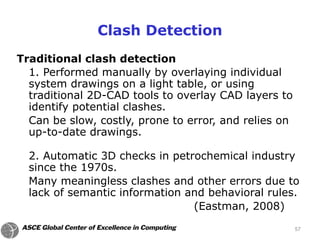
Clash Detection
Traditional clashdetection
1. Performed manually by overlaying individual
system drawings on a light table, or using
traditional 2D-CAD tools to overlay CAD layers to
identify potential clashes.
Can be slow, costly, prone to error, and relies on
up-to-date drawings.
2. Automatic 3D checks in petrochemical industry
since the 1970s.
Many meaningless clashes and other errors due to
lack of semantic information and behavioral rules.
(Eastman, 2008)
58.
58
3D BIM ClashDetection
Involves interpreting, combining, and displaying 3D
files from systems, such as MEP, HAVC,
architectural, structural, etc.
Conflicts are identified before they are detected in
the construction field. Coordination among
designers and contractors is enhanced, and costs
can be significantly reduced compared with
traditional manual clash detection.
59.
59
Before & After
Before,see
http://www.bexelconsulting.com/images/pages/
ClashDetection/before.png
After, see
http://www.bexelconsulting.com/images/
pages/ClashDetection/after.png
60.
60
High quality informationbased delivery of assets.
This leads to
• Lower repair and retrofit costs
• More informed decisions regarding replacement
COBIE - Construction Operations Building
Information Exchange (East, 2007)
This is an exchange standard for non-geometrical
data such as equipment lists and maintenance
data.
Asset management
61.
61
Other Benefits ofBIM
Reveals design and site problems.
Lowers the cost associated with changes.
Facilitates the offsite fabrication and construction
with the accurate representation of building
objects. Reduces time and cost of construction.
62.
62
Other Benefits ofBIM
Synchronized procurement with design and
construction, using accurate quantities,
specifications, properties of materials provided by
BIM models.
Better management and operation of facilities.
64
Building Lifecycle withBIM
The use of BIM goes beyond the plan and design
phase of the project and extends throughout the
building life-cycle. It supports processes including
project management, cost management, construction
management and facility operation.
(Advancedsolutions, 2015)
The information loss associated with transmitting
between teams can be bridged by BIM, by allowing
each group to manipulate project information that
they acquire during their contribution period of the
BIM process. (Hamilton, 2012)
66
Level of Development
“TheLevel of Development (LOD) specification is a
reference that enables practitioners in the AEC
Industry to specify and articulate the content and
reliability of BIMs at various stages in the design
and construction process.” (BIMForum,2013)
67.
67
Level of Development
“Thisclear articulation allows model authors to
define what their models can be relied on for, and
allows downstream users to clearly understand the
usability and the limitations of models they are
receiving.” (BIMForum,2013)
68.
68
Level Descriptions
LOD10
0
Conceptual design,
masterplanning
LOD20
0
Schematic design,
design development
LOD30
0
Construction
documents,
shop drawings
LOD40
0
Fabrication and
assembly
documentation
LOD50
0
As-built situation for
operation and
maintenance
Csocsics, M., LOD: Level of Detail or Level of Development? www.in-ex.hu/ eng
/blog/content/75-lod:-level-of-detail-or-level-of-development/level=4
69.
69
Level of Development
LODcan be built into “views” to clarify expectations
of stakeholders, in terms of information
“granularity”, which are often linked to time and
stage of work.
Concept – Construction – Management
(AECmag.com, 2013)
70.
70
BIM and IPD
IPD– Integrated Project Delivery
“A project delivery approach that integrates people,
systems, business structures, and practices into a
process that collaboratively harness the talents and
insights of all project participants to optimize
project results, increase value to the owner, reduce
waste, and maximize efficiency through all phases
of design, fabrication and construction.”
(AIA, 2007)
71.
BIM and IPD
“IPDhas materialized as a delivery method that
could most effectively facilitate the use of BIM for
construction projects.” (Becerik-Gerber, et al, 2009)
71
BIM
Trades
Architect
Engineer Contractor
Manufacturer
Owner
72.
72
BIM Project ExecutionPlan
PEP (Project Execution Plan)
“To successfully implement BIM, a project team must
perform detailed and comprehensive planning. A well
documented BIM Project Execution Plan will ensure
that all parties are aware of the opportunities and
responsibilities associated with the incorporation of
BIM into the project workflow.”
(The Computer Integrated Construction Research
Group, 2010)
“90% of the costs of a building occur after
construction.” Michael Schley, FM:Systems (UK
National Building Specification, 2014)
73.
73
BIM Project ExecutionPlan Procedure
Identify BIM Uses and Goals
• Define project and team value.
Design BIM Project Execution Process
• Develop a process which includes tasks supported by BIM along
with information exchanges.
Develop Information Exchanges
• Develop the information content, level of detail and responsible
party for each exchange.
Define supporting infrastructure for BIM Implementation
74.
74
IDM - InformationDelivery Manual
Similar idea to PEP procedure.
To use BIM effectively by improving the quality of
communication between different participants in the
construction process.
“IDM will grow progressively to provide a
comprehensive reference to the processes that
may be executed within building construction.”
(buildingSMART, 2015)
75.
75
The components ofIDM are:
• Process Map
“Provides a description of an activity (or set of
activities) related to a domain in the AEC/FM
industry.”
• Exchange Requirement
“A non technical description of the information
required as input to the process and the expected
source of that information together with a
description of the expected results of the process.”
• Model View Definitions
“Defines a subset of the IFC schema that is needed
to satisfy one or many Exchange Requirements of
the AEC industry.”
(buildingSMART, 2015)
76.
BIM Uses throughouta Building
Lifecycle
76
Plan Design Construction Operate
Existing Condition Modeling & Cost Estimation
Phase Planning
Programming & Site Analysis
Design Reviews
Engineering Analysis
Code Validation
3D Coordination
Site Utilization Planning
Digital Fabrication
3D Control and planning Maintenance &
Management
(Column Width – Scale Irrelevant)
77.
77
Case Study
Project overview:
Collegeof Liberal Arts (CoLA) Building on campus.
Owner: University of Texas at Austin.
Construction duration: 08/2010/-03/2013.
Total project cost: $100M
(Design cost $30M, Construction cost $70M)
Reasons for using BIM:
– Requirement by owner
– Complex MEP system
– Energy analysis
(F. Leite, Course material)
78.
78
BIM to FieldProcess
(Retrieved from BIM course slides, F. Leite)
80
BIM to FieldTechnical Components
• Robotic Total Stations
– Effective Field-to-Office Communication
• Tablet PCs/iPads
– Information Distributors
• Sync
– Updates Overnight
– Maintains useful As-Built
• Virtual Superintendent
– Virtual Inspection
– “Noodle-like mess” is easier to inspect
– Verifies what is drawn is what is built.
81.
81
Measurable Improvements
• Schedule:project delivery 6 months ahead
original schedule
• Cost: ~$200,000 estimated savings due to BIM-
based design coordination
83
Risks
• Ownership ofBIM data and its protection
– Owner pays for the design and team members
provide proprietary information.
– May reduce motivation to fully realize the
potential of BIM.
• Licensing issues
– Use of vendor’s design of a designer not licensed
in the project location.
• Responsibility for data entry and inaccuracy
– Controls on the entry of data.
– Cost of inputting and reviewing BIM data.
(Azhar, 2011)
84.
84
Risks
• Blurred levelof responsibility due to integrated
concept of BIM
– Which team fixes which errors?
• Responsibility for the proper technological
interface among various programs
– Incomplete submitted data.
– Data submitted from various scheduling and
costing programs which have been developed
in isolation.
– Increase in coordination costs and decreased
accuracy of data transmission.
(Azhar, 2011)
85.
85
Solutions
BIM protocol
“The Protocolidentifies the building information
models that need to be produced by members of
the project team and puts into place specific
obligations, liabilities and associated
limitations on the use of the models.”
The BIM protocol addresses the issues of
ownership, licensing and responsibility by defining
“Obligations”, ”Electronic Data Exchange”, “Use of
Models”, “Liability in respect of a model”, etc.
(Construction Industry Council, 2013)
86.
86
Solutions (cont.)
Scope ofServices for Information Management
Information Management is a mandated role in the
BIM Protocol.
“The initial responsibility for the appointment of the
information manager lies with the employer, who
must ensure that there is an Information Manager
appointed (whether by the employer or another
party) at all times until completion of the Project.”
(Construction Industry Council, 2013)
87.
87
Solutions (cont.)
EIR(Employer’s InformationRequirements)
“EIRs are an important element of Project BIM
Implementation as they are used to set out to the
bidder what models are required and what the
purposes of the models will be. These requirements
will be written into the BIM Protocol and
implemented through the BIM Execution Plan.”
The content of the EIR covers three sections:
• Technical: Software Platforms, etc.
• Management: Roles and Responsibilities, etc.
• Commercial: Defined BIM/Project Deliverables, etc.
(Bimtaskgroup,2013)
88.
88
Other Risks
• Useof inappropriate IFCs can make modifications
costly
• Information loss
• Small return on investment
• Increase in costs over traditional methods
• More errors and more delays than without BIM
89.
89
Challenges
• Lack ofExpertise
– BIM has been suspected to be a complex and
non-robust system
– Teams in the construction industry lack of
knowledge and competency to put the concept
into full practice.
• Resistance to change
– Effective implementation of BIM requires
changes to many aspects of business of an
organization, with a throughout understanding
and mature plan of BIM.
(BIMhub, 2013)
90.
90
Challenges
• Management ofInformation
The involvement and implementation of BIM by
practitioners will lead to challenging
management.
• New processes and skills
To achieve successful implementation of BIM,
new legal and negotiation processes need to be in
place. Experienced and skilled partners are
needed. This takes time.
91.
91
Challenges
• Technical challenges
–Requirement of tested practical strategies for
exchange and integration of meaningful
information among BIM models.
– Building object models can be difficult to
standardize universally due to technical,
cultural, regional, climatic, legal and political
differences.
92.
92
Challenges
• Managerial challenges
–Who should develop and operate the building
information models?
– Who pays for the development and operation?
– When should stakeholders be included?
(Azhar, 2011)
93.
93
The Future ofBIM
An increasing range of owners and manufacturers
are adopting BIM.
BIM is improving.
“The lack of appropriately trained professional staff,
rather than the technology itself, is the current
bottleneck to widespread implementation”(Eastman,
2008). This remains true today and it is expected to
be true for another couple of decades.
94.
94
The Future ofBIM
“The big picture is that BIM will facilitate early
integration of project design and construction
teams, making closer collaboration possible.
This will help make the overall construction
delivery process faster, less costly, more reliable,
and less prone to errors and risk.”
(Eastman, 2008)
95.
95
Review quiz II
1.What type of software might be needed for BIM? Keep in
mind that not all the software will be needed in every BIM
projects, but generally we need:
A. Object-oriented 3-D modeling software for creating and
manipulating models
B. Engineering simulation and analysis software
C. Rendering software
D. MATLAB
E. Construction coordination software for clash detection
F. Cost estimating software
G. Scheduling simulation software
2. What teams are involved in the BIM process?
3. Write down a few barriers to implementation of BIM.
96.
96
Answers:
1. A,B,C,E,F,G
2. BIMas a collaborative process, it would ideally
involve the entire project team: the owner,
architects, designers, engineers, contractors,
operation & maintenance.
3. Examples of barriers are
• Ownership and licensing of BIM models
• The lack of expertise
• Resistance to change
• Information management difficulties
• BIM model standardization
97.
97
4. BIM isusually called as a disruptive practice
because (choose one)
A. a large number of people are needed to
implement the process
B. it is difficult to execute
C. the benefits of the process are difficult to
quantify
D. it dramatically affects workflow
5. Write down examples to show the challenge of
IFC in terms of international differences and inter-
field differences respectively.
98.
98
Answers:
4. D
5. Examplesare
• International difference: countries have different
laws and code requirements.
• Inter-field difference: Petrochemical plant design
and construction standard models cannot be used
for residential building design and construction.
100
Summary
BIM is aprocess involving generation and
management of digital representations of
building objects, which are used during planning,
design, construction, operation and maintenance
of diverse physical infrastructures.
BIM helps to improve quality, reduce costs and
save time.
There are risks and challenges.
101.
101
Summary of Acronyms
IFC– Industry Foundation Classes
LOD – Level of Development
IPD – Integrated Project Delivery
IDM – Information Delivery Manual
PEP – Project Execution Plan
IAI – International Alliance for Interoperability
AIA – The American Institute of Architects
102.
102
Principal Source Documents
Coursematerial
• Building Information Modeling – Introduction
(BIM As Technology), B. Kumar, Glasgow
Caledonian University.
• CEE 4140 - Introduction to Building Information
Modeling (BIM) in Construction, J. Teizer, Georgia
Institute of Technology.
• BIM Course Slides, F. Leite, University of Texas at
Austin.
103.
103
References
• Advancedsolutions.com, (n.d.).Lifecycle BIM - Advanced Solutions. [online] Available at:
http://www.advancedsolutions.com/services/lifecyclebim.aspx [Accessed 21 Jul. 2015].
• AIA, (2007). Integrated project delivery: a guide, The American Institute of Architects California Council.
• Aecmag.com, (2013). Executive guide to BIM: part 2. [online] Available at:
http://aecmag.com/technology-mainmenu-35/564-executive-guide-to-bim-part-2 [Accessed 28 Jul. 2015].
• Azhar, S. (2011). Building Information Modeling (BIM): Trends, Benefits, Risks, and Challenges for the AEC
Industry. Leadership Manage. Eng., 11(3), pp.241-252.
• bimforum.org/LOD, (2013). Level of Development Specification For Building Information Models Version: 2013.
[online] Available at: http://bimforum.org/wp-content/uploads/2013/08/2013-LOD-Specification.pdf [Accessed
21 Jul. 2015].
• Becerik-Gerber, B. (2010). Implementation of Integrated Project Delivery and Building Information Modeling on
a Small Commercial Project. Ddes, Kent, D.
• Bimhub.com, (2013). Challenges in BIM Implementation. [online] Available at:
http://www.bimhub.com/blog/challenges-bim-implementation/ [Accessed 21 Jul. 2015].
• Bimtaskgroup.org, (2013). Employer’s Information Requirements Version 07 28.02.13 Available at:
http://www.bimtaskgroup.org/wp-content/uploads/2013/04/Employers-Information-Requirements-Core-Conten
t-and-Guidance.pdf
[Accessed 17 Aug. 2015].
• buildingSMART, (2015). IDM Makes IFC Work. [online] Available at:
http://web.stanford.edu/group/narratives/classes/08-09/CEE215/ReferenceLibrary/Industry%20Foundation%2
0Classes%20(IFC)/IDM/IDM%20Makes%20IFC%20Work!.pdf
[Accessed 3 Aug. 2015].
• Collier, E. and Fischer, M. (1995) Four Dimensional Modelling in Design and Construction, CIFE tech Report 101.
• Construction Industry Council, (2013). Building Information Model (BIM) Protocol CIC/BIM Pro first edition
2013. UK. Available at: http://cic.org.uk/download.php?f=the-bim-protocol.pdf
• CURT (2004) "Collaboration, Integrated Information, and the Project Lifecycle in Building Design and
Construction and Operation", Construction User Roundtable WP-1202
• Csocsics, M. (n.d.). LOD: Level of Detail or Level of Development?. [online] Studio IN-EX. Available at:
http://www.in-ex.hu/eng/blog/content/75-lod:-level-of-detail-or-level-of-development/level=4 [Accessed 29
Jul. 2015].
104.
104
References
• East, E.W.(2007) Construction Operations Building Information Exchange (COBIE) Requirements Definition
and Pilot Implementation Standard, Construction Engineering Research Laboratory (CERL) U.S. Army
Engineer Research and Development Center, Champaign, IL, USA
• Eastman, C. (2008). BIM handbook: A guide to building information modeling for owners, managers,
designers, engineers, and contractors. Hoboken, N.J.: Wiley.
• Hamilton, t. (2012). BIM deployment: A Process to Adopt and Implement a Disruptive Technology. Austin,
Tex.: University of Texas.
• IHS Economics, 2013, Global Construction Outlook: Executive Outlook, [online] www.ihs.com. Available at:
https://www.ihs.com/pdf/IHS_Global_Construction_ExecSummary_Feb2014_140852110913052132.pdf
• Jernigan, F.E. (2008): BIG BIM little bim: The practical approach to Building Information Modeling:
Integrated Practice done the right way! 2nd
ed., 4 Site Press, Salisbury, MD, USA.
• Keaney, P. (2011). BIM 360: Collaboration, Data Management, and BIM - Buildipedia. [online]
Buildipedia.com.
• Kumar, B. (2015) Personal Communication
• Rundell, R. (2007). BIM and Visualization, Part 2 (1-2-3 Revit Tutorial) | Cadalyst. [online] Cadalyst.com.
Available at: http://www.cadalyst.com/aec/bim-and-visualization-part-2-1-2-3-revit-tutorial-3635 [21.7.15]
• Sabol, L. (2008). Challenges in cost estimating with Building Information Modeling. IFMA World Workplace.
• Schlosser, M. (2010). Visualization and BIM: A Powerful Combination. [online] Geoexpressions.blogspot.ch.
Available at: http://geoexpressions.blogspot.ch/2010/07/visualization-and-bim-powerful.html [28.7.15].
• Smith, D. (2007) “An Introduction to BIM”. Journal of Building Information Modeling. Fall, 2007. p 12-14.
Available at: http://buildipedia.com/aec-pros/design-news/bim-360-collaboration-data-management-and-bim
[Accessed 21 Jul. 2015].
• The Computer Integrated Construction Research Group, (2010). Building Information Modeling Execution
Planning Guide Version 2.0. The Pennsylvania State University.
• UK National Building Specification (2014) Thenbs.com, (n.d.). What is BIM?. [online] Available at:
http://www.thenbs.com/bim/what-is-bim.asp BIM levels explained - Building Information Modelling (BIM)
article from NBS. [online] Available at: http://www.thenbs.com/topics/bim/articles/bim-levels-explained.asp
[Accessed 21 Jul. 2015].
105.
105
Bibliography
• AGC Certificateof Management—Building Information Modeling (2011) Candidate guide
• BIM Employer’s Information Requirements (EIR) http://www.bimtaskgroup.org/bim-eirs/
• BIM & Integration—Introduction
http://4sitesystems.com/iofthestorm/books/makers-of-the-environment/book-3/curriculum-built-world/categ
ories/introductionbim-integration/
• IAI, http://www.iai-tech.org/ifc/IFC2x3/TC1/html/index.htm
• Halttula, H., Aapaoja, A., and Haapasalo, H. (2015). "The Contemporaneous use of Building Information
Modeling and Relational Project Delivery Arrangements." Procedia Economics and Finance, 10.1016/S2212-
5671(15)00209-9, 532-539.
• Hamil, S. (2013). BIM, Construction and NBS: BIM and LOD. [online] Constructioncode.blogspot.ch.
Available at: http://constructioncode.blogspot.ch/2013/08/bim-and-lod.html [Accessed 28 Jul. 2015].
• Luth, G., Schorer, A., and Turkan, Y. (2014), Lessons from Using BIM to Increase Design-Construction
Integration, Practice Periodical on Structural Design and Construction, Vol. 19, No. 1, pp. 103-110.
• Patel, N. (2014). 3 Types Of 3D BIM Clash Detection Have Their Own Importance | News & Articles |
HiTechCADDServices. [online] Hitechcaddservices.com. Available at:
http://www.hitechcaddservices.com/news/3-types-of-3d-clash-detection-have-their-own-importance/
Accessed 21 Jul. 2015].
• Top 10 BIM Questions http://www.thenbs.com/topics/bim/articles/top10bimquestions.asp
• Wang, L. and Leite, F. (2014). Process-Oriented Approach of Teaching Building Information Modeling in
Construction Management. J. Prof. Issues Eng. Educ. Pract., 140(4), p.04014004.
Thanks to reviewers
F. Leite, C. Koch, E. Obonyo, B. Kumar
Editor's Notes
#4 Stanford University Center for Integrated Facilities Engineering (CIFE) figures based on 32 major projects using BIM indicates benefits such as (CIFE, 2007):
Up to 40% elimination of unbudgeted change.
Cost estimation accuracy within 3%.
Up to 80% reduction in time taken to generate a cost estimate.
A savings of up to 10% of the contract value through clash detections.
Up to 7% reduction in project time.
Dean (2007) carried out a research study to examine if BIM should be taught as a subject to the construction management students. He conducted two questionnaire surveys targeted at general contractors and ASC construction management programs in the Southeast. Based on the gathered data, he concluded in general that construction management programs should teach BIM to their students. The main reasons behind this conclusion were:
Approximately 70% of the industry participants indicated that they are either using or considering to use BIM in their companies. This trend indicates that the BIM utilization in the construction industry is going to increase.
Approximately 75% of survey participants consider employment candidates with BIM skills to have an advantage over candidates who lack BIM knowledge.
In another study, Woo (2006) pointed out that properly structured BIM courses would provide industry-required knowledge to prepare students for successful careers in the AEC industry. Instead of teaching a separate course, he suggested to reconfigure the existing construction courses to integrate BIM into the course contents.
#5 Discuss the traditional building delivery process’s drawbacks, raise the problems need to be solve
Raise the BIM solution with it benefits
#6 Discuss the traditional building delivery process’s drawbacks, raise the problems need to be solve
Raise the BIM solution with it benefits
#7 Source: http://projekter.aau.dk/projekter/files/55376698/BIM_Colla*boration_in_the_AEC_Industry_by_Mats_Thomassen.pdf
Figure 4 shows the increase of cost when design changes are made along with the time of the construction design, where the ability to impact cost and functional capabilities decreases by time. Traditionally the design process peaks while the construction documentation is made; a critical point where changes cannot be made without negatively affecting the costs of the project. The preferred design process peaks at the schematic design and design development; a curve which 2.1 Building Information Modelling 12 Design and construction Operations Value of facility documentation Feasibility Design Construction Facility startup Operations Facility retrot Collaborative BIM based delivery process Traditional Design-Bid-Build, paper based process Traditional facility management database process Loss of value due to handover, recreation of information Figure 3 - Data integrity (Eastman et al., 2008): Graphic presentation of the data losses during the lifetime of a building. Compared is the traditional paper-based process vs. a collaborative BIM based delivery process. BIM supports by its possibilities of creating precise models at earlier stages in the design process. (Eastman et al., 2008)
A mini guide in BIM implementation indicates that up to 70% of the design decisions must be made at an earlier stage than by traditional construction processes. (Levring, 2010)
#13 To introduce BIM, start with the concept of information modelling.
#66 How different teams see differently based on the same model and extract the information they need practically and effectively
#82 Sources:
Building Information Modeling (BIM): Benefits, Risks and Challenges Salman Azhar, Michael Hein and Blake Sketo
McWhorter School of Building Science
Auburn University
Auburn, Alabama
#83 Ownership :
For example, if the owner is paying for the design, then the owner may feel entitled to own it, but if team members are providing proprietary information for use on the project, their propriety information needs to be protected as well. Thus, there is no simple answer to the question of data ownership; it requires a unique response to every project depending on the participants' needs.
When project team members, other than the owner and A/E, contribute data that is integrated into the BIM, licensing issues can arise.
#89
Managerial
BIM modeling may allow facilities managers to enter the picture in the future at a much earlier stage, where they can influence the design and construction. The visual nature of the BIM allows all stakeholders to get important information before the building is completed. This includes tenants, service agents as well as maintenance personnel. Finding the right time to include these people will undoubtedly be a challenge for owners.












![103
References
• Advancedsolutions.com, (n.d.). Lifecycle BIM - Advanced Solutions. [online] Available at:
http://www.advancedsolutions.com/services/lifecyclebim.aspx [Accessed 21 Jul. 2015].
• AIA, (2007). Integrated project delivery: a guide, The American Institute of Architects California Council.
• Aecmag.com, (2013). Executive guide to BIM: part 2. [online] Available at:
http://aecmag.com/technology-mainmenu-35/564-executive-guide-to-bim-part-2 [Accessed 28 Jul. 2015].
• Azhar, S. (2011). Building Information Modeling (BIM): Trends, Benefits, Risks, and Challenges for the AEC
Industry. Leadership Manage. Eng., 11(3), pp.241-252.
• bimforum.org/LOD, (2013). Level of Development Specification For Building Information Models Version: 2013.
[online] Available at: http://bimforum.org/wp-content/uploads/2013/08/2013-LOD-Specification.pdf [Accessed
21 Jul. 2015].
• Becerik-Gerber, B. (2010). Implementation of Integrated Project Delivery and Building Information Modeling on
a Small Commercial Project. Ddes, Kent, D.
• Bimhub.com, (2013). Challenges in BIM Implementation. [online] Available at:
http://www.bimhub.com/blog/challenges-bim-implementation/ [Accessed 21 Jul. 2015].
• Bimtaskgroup.org, (2013). Employer’s Information Requirements Version 07 28.02.13 Available at:
http://www.bimtaskgroup.org/wp-content/uploads/2013/04/Employers-Information-Requirements-Core-Conten
t-and-Guidance.pdf
[Accessed 17 Aug. 2015].
• buildingSMART, (2015). IDM Makes IFC Work. [online] Available at:
http://web.stanford.edu/group/narratives/classes/08-09/CEE215/ReferenceLibrary/Industry%20Foundation%2
0Classes%20(IFC)/IDM/IDM%20Makes%20IFC%20Work!.pdf
[Accessed 3 Aug. 2015].
• Collier, E. and Fischer, M. (1995) Four Dimensional Modelling in Design and Construction, CIFE tech Report 101.
• Construction Industry Council, (2013). Building Information Model (BIM) Protocol CIC/BIM Pro first edition
2013. UK. Available at: http://cic.org.uk/download.php?f=the-bim-protocol.pdf
• CURT (2004) "Collaboration, Integrated Information, and the Project Lifecycle in Building Design and
Construction and Operation", Construction User Roundtable WP-1202
• Csocsics, M. (n.d.). LOD: Level of Detail or Level of Development?. [online] Studio IN-EX. Available at:
http://www.in-ex.hu/eng/blog/content/75-lod:-level-of-detail-or-level-of-development/level=4 [Accessed 29
Jul. 2015].](https://image.slidesharecdn.com/81bimmoduleepfl-250312154403-c6494325/85/Building-Information-Modeling-Introduction-103-320.jpg)
![104
References
• East, E.W. (2007) Construction Operations Building Information Exchange (COBIE) Requirements Definition
and Pilot Implementation Standard, Construction Engineering Research Laboratory (CERL) U.S. Army
Engineer Research and Development Center, Champaign, IL, USA
• Eastman, C. (2008). BIM handbook: A guide to building information modeling for owners, managers,
designers, engineers, and contractors. Hoboken, N.J.: Wiley.
• Hamilton, t. (2012). BIM deployment: A Process to Adopt and Implement a Disruptive Technology. Austin,
Tex.: University of Texas.
• IHS Economics, 2013, Global Construction Outlook: Executive Outlook, [online] www.ihs.com. Available at:
https://www.ihs.com/pdf/IHS_Global_Construction_ExecSummary_Feb2014_140852110913052132.pdf
• Jernigan, F.E. (2008): BIG BIM little bim: The practical approach to Building Information Modeling:
Integrated Practice done the right way! 2nd
ed., 4 Site Press, Salisbury, MD, USA.
• Keaney, P. (2011). BIM 360: Collaboration, Data Management, and BIM - Buildipedia. [online]
Buildipedia.com.
• Kumar, B. (2015) Personal Communication
• Rundell, R. (2007). BIM and Visualization, Part 2 (1-2-3 Revit Tutorial) | Cadalyst. [online] Cadalyst.com.
Available at: http://www.cadalyst.com/aec/bim-and-visualization-part-2-1-2-3-revit-tutorial-3635 [21.7.15]
• Sabol, L. (2008). Challenges in cost estimating with Building Information Modeling. IFMA World Workplace.
• Schlosser, M. (2010). Visualization and BIM: A Powerful Combination. [online] Geoexpressions.blogspot.ch.
Available at: http://geoexpressions.blogspot.ch/2010/07/visualization-and-bim-powerful.html [28.7.15].
• Smith, D. (2007) “An Introduction to BIM”. Journal of Building Information Modeling. Fall, 2007. p 12-14.
Available at: http://buildipedia.com/aec-pros/design-news/bim-360-collaboration-data-management-and-bim
[Accessed 21 Jul. 2015].
• The Computer Integrated Construction Research Group, (2010). Building Information Modeling Execution
Planning Guide Version 2.0. The Pennsylvania State University.
• UK National Building Specification (2014) Thenbs.com, (n.d.). What is BIM?. [online] Available at:
http://www.thenbs.com/bim/what-is-bim.asp BIM levels explained - Building Information Modelling (BIM)
article from NBS. [online] Available at: http://www.thenbs.com/topics/bim/articles/bim-levels-explained.asp
[Accessed 21 Jul. 2015].](https://image.slidesharecdn.com/81bimmoduleepfl-250312154403-c6494325/85/Building-Information-Modeling-Introduction-104-320.jpg)
![105
Bibliography
• AGC Certificate of Management—Building Information Modeling (2011) Candidate guide
• BIM Employer’s Information Requirements (EIR) http://www.bimtaskgroup.org/bim-eirs/
• BIM & Integration—Introduction
http://4sitesystems.com/iofthestorm/books/makers-of-the-environment/book-3/curriculum-built-world/categ
ories/introductionbim-integration/
• IAI, http://www.iai-tech.org/ifc/IFC2x3/TC1/html/index.htm
• Halttula, H., Aapaoja, A., and Haapasalo, H. (2015). "The Contemporaneous use of Building Information
Modeling and Relational Project Delivery Arrangements." Procedia Economics and Finance, 10.1016/S2212-
5671(15)00209-9, 532-539.
• Hamil, S. (2013). BIM, Construction and NBS: BIM and LOD. [online] Constructioncode.blogspot.ch.
Available at: http://constructioncode.blogspot.ch/2013/08/bim-and-lod.html [Accessed 28 Jul. 2015].
• Luth, G., Schorer, A., and Turkan, Y. (2014), Lessons from Using BIM to Increase Design-Construction
Integration, Practice Periodical on Structural Design and Construction, Vol. 19, No. 1, pp. 103-110.
• Patel, N. (2014). 3 Types Of 3D BIM Clash Detection Have Their Own Importance | News & Articles |
HiTechCADDServices. [online] Hitechcaddservices.com. Available at:
http://www.hitechcaddservices.com/news/3-types-of-3d-clash-detection-have-their-own-importance/
Accessed 21 Jul. 2015].
• Top 10 BIM Questions http://www.thenbs.com/topics/bim/articles/top10bimquestions.asp
• Wang, L. and Leite, F. (2014). Process-Oriented Approach of Teaching Building Information Modeling in
Construction Management. J. Prof. Issues Eng. Educ. Pract., 140(4), p.04014004.
Thanks to reviewers
F. Leite, C. Koch, E. Obonyo, B. Kumar](https://image.slidesharecdn.com/81bimmoduleepfl-250312154403-c6494325/85/Building-Information-Modeling-Introduction-105-320.jpg)


